
You are currently browsing the tag archive for the ‘food and wine’ tag.
Wine and movies have a lot in common. They are both worldwide markets for highly differentiated products with critics who are visible and economically important. But while there are as many film critics as there are films and opinions about films, there are just a handful of highly influential wine critics, Robert Parker’s Wine Advocate, The Wine Spectator, and a few others. This is somewhat counterintuitive because there are many, many more wines than films. Here are a few thoughts.
- People know their taste in movies better than they know their taste in wine. This makes it easier to find idiosyncratic movie critics that have similar tastes. Similar critics face an entry barrier in the wine world.
- All wines taste the same and the role of a critic is just to tell you which wines you are supposed to like and which wines you can brag about drinking. This creates a natural oligopoly among the wine critics who the market coordinates on.
- Wines are given as gifts and movies are not. This means that wine critics are rewarded for reflecting general rather than specialized tastes.
- A very small fraction of wines are good and wine criticism just means tasting thousands of wines until you find the good ones. This creates increasing returns to scale in wine criticism, another source of natural monopoly power.
- The movie businesss is less competitive so a blockbuster film earns more rents and as a result there is more rent seeking, especially in marketing. Thus the emergence of David Manning. There is no analogous force behind “The feel good wine of the year!”
- Wine critics provide a service for wine-makers, film critics are serving film-goers. What makes a good wine critic is the ability to articulate what wine buyers will buy. Whoever is best at this will dominate.
Cynics believe some version of 6 and 2 (Parkerization.) I don’t understand why 5 wouldn’t be the same for wine and film maybe this is just a matter of time. 4 may be true in the mid-range but whether this matters depends on whether you think wine critics are really influential here or rather at the high end where there are relatively few consistent performers. I lean toward 1, Gary Vaynerchuck notwithstanding, which is a less cynical version of 6.
I have always preferred Guinness at the warmer temperatures I have had it served to me in Britain. And I always assumed that 45-50F was the recommended serving temperature. That is why I was surprised to see this:
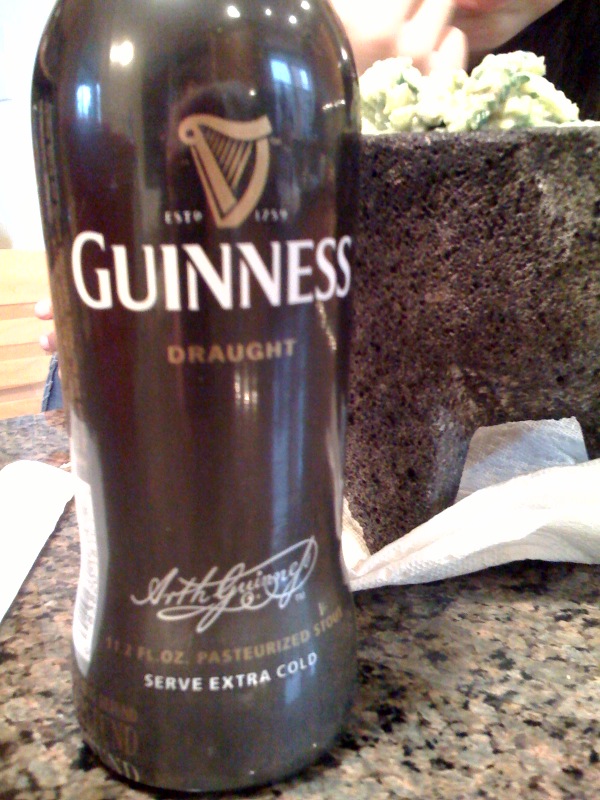
I assume that this is US-specific marketing. In the US, beer is always served ice cold and the marketing around this fact can be hysterical. I once remember an advertisement for Miller Genuine Draft which claimed that it was the “coldest.”
Anyway, does anybody know what temperature Guinness is served, say in Ireland? And on these new bottles with the “widget” and the nitrogen, does it also read “Serve Extra Cold” where you live?
(In the background is guacamole made in a molcajete. Grind 1/2 white onion, chopped, one jalapeno diced, and a small handful of cilantro in the bottom of the molcajete, with some kosher salt. 2 ripe avocados and the juice of one lime. Mash the avocado with the onion/cilantro/chile using a plastic fork. top with some more diced white onion and chopped cilantro. no tomatoes! Pair with… well duh.)
List the different varieties of animal meat that are sold at a typical grocery. Then ask for each item on that list what is the fraction of the US population that finds it acceptable to eat it. The distribution you will map out is not at all smooth. Most people will either find it acceptable to eat everything on the list or unacceptable to eat anything on the list.
I believe that both mass points are a result of the same phenomenon: the slippery slope. Moral rules are vulnerable to creeping margins and unraveling. If I want to argue that people should not eat meat it is easier to make that argument if I take an absolute stand. Absolute rules are easier to defend then nuanced rules that define some interior boundary (it is ok to eat animals if and only if they have no feelings) because nuanced rules admit cases that are very similar but fall on opposite sides of the boundary (you mean its ok to eat squid but not octopus?)
Likewise, people who insist that it is ok to eat all meat are usually painted into that corner for similar reasons. To accept that it is not ok to eat veal makes your filet mignon vulnerable.
So the slippery slope of moral negotiation pushes us to extremes where we are on firmer footing. All sides lose as a result. Especially those of us who would prefer that fewer animals are eaten. I was reminded of this point by an article from the Atlantic about “semitarianism:” proudly taking the middle ground. Here is an effective passage:
…, recall that even the most fervently ethics-based vegetarianism isn’t really about an ideological purity of all-or-nothing, us-versus-them purism activist groups foster. It’s about reducing animal suffering. Whether one person gives up meat or three people cut out a third, it’s all the same to the cow, and it should be the same to us.
(a little shout-out to Sandeep who is in Tuscany exercising his finnochiana option.)
The possibility is nearing that you can take a pill and remove some memories. (This evening I opened a nice bottle of Yangarra Old Vine Grenache 2005 and removed some memories but that doesn’t count because they will come back tomorrow.)
Media treatment of these advances always focuses on enabling us to erase bad memories. But its not so obvious that bad memories are the ones you want to lose. Bad memories often serve an important purpose. They record a lesson learned. It may be a lesson about what not to do (memories of car accidents after opening a nice bottle of…) It may be a lesson about people not to trust (memories of abuse.)
On the other hand, many good memories just get in the way. I remember vividly the film Leolo. But because of that memory I will never get to enjoy that film again. Likewise I remember the first time I heard Chick Corea’s Children’s Song #6, how to juggle, the end of The Naked and the Dead and the smell of my wife. These are all novelties that are no longer available to me, unless I could erase some good memories.
The good/bad distinction is less important than the following distinction. Is the memory affecting my decisions or not? Whether the memory is good or bad, I want to keep it if it encodes an important lesson helping me continue to make good decisions and avoid bad ones. And I want to erase it if its function is pure consumption. The bad memories I want to lose forever, the good memories I want to repeat.
In this case . . . while the challenged packaging contains the word “berries” it does so only in conjunction with the descriptive term “crunch.” This Court is not aware of, nor has Plaintiff alleged the existence of, any actual fruit referred to as a “crunchberry.” Furthermore, the “Crunchberries” depicted on the [box] are round, crunchy, brightly-colored cereal balls, and the [box] clearly states both that the Product contains “sweetened corn & oat cereal” and that the cereal is “enlarged to show texture.” Thus, a reasonable consumer would not be deceived into believing that the Product in the instant case contained a fruit that does not exist. . . . So far as this Court has been made aware, there is no such fruit growing in the wild or occurring naturally in any part of the world.
see here. (Shako shake: BoingBoing)
In an article about their famous restaurant surveys, Nina and Tim Zagat write
Over the years that we’ve spent surveying hundreds of thousands of diners, one fact becomes clear: Service is *the* weak link in the restaurant industry. How do we know? Roughly 70% of all complaints we receive relate to service. Collectively, complaints about food prices, noise, crowding, smoking, and even parking make up only 30%. Moreover, the average rating for food on our 30-point scale is usually two points higher than the average rating for service. Given the fact that identical people are voting, and that there are hundreds of thousands of them, this deficit is dramatic.
They go on to give some advice to the restaurant industry for improving service. But don’t these results say that in fact we don’t care about service? They show that we choose the restaurants with good food despite their bad service. Sure we complain about the service, other things equal who doesn’t want better service. But we can live with bad service if we get good food.
You can learn a lot about who loves you by walking around with food on your face.
Should you tell someone when they have food on their face? You will embarrass them but you will spare them embarrassment later. The embarrassment comes from common knowledge. He knows that you know, etc. that he had food on his face. You would escape this if you could alert him about the food without him knowing it was you.
You could wait and expect that the food will fall. But you run the risk that it won’t and he’ll discover the food and realize that you let him walk around with food on his face. And once you wait for a bit you are committed. You can’t very well tell him after the meal is over. “You mean you sat there talking to me the whole time with sauce on my chin?”
And what happens when you are in a group and one guy has food on his face? Whose going to tell? Whoever is the first to talk proves that everyone else was willing to ignore it.
Bottom line: if you are dining with me and I have food on my face, send me a text message.
I went to Boston a few weeks ago and had dinner with an old friend and his family. This friend is an economist but, apart from that, we could not be more different. But he and I share one thing in common: we love Top Chef! His family just discovered the show and watched all the seasons over the last few months. I’m clearly more TV-centered because I’ve watched it for years. Anyway, we’re all in withdrawal as the show is over this season.
So, I can’t help but notice references to it. One Top Chef contestant was cooking at the Obama family Easter egg roll. Others seems to be doing well with their own restaurants in NYC. The host Tom Colicchio lives in a cool apartment witha small kitchen. Our own Chicagoan Dale Levitski is cooking up a special dinner every Thursday at the Relax Lounge. And Stephanie Izzard is so famous that she was on the Interview Show before Jeff and me.
Like my friend, I think my wife and I are going to reproduce Top Chef at home with two parent-kid teams facing off. All we have to find are some judges.
2005 is a legendary Bordeaux vintage. I have a dozen or so bottles stored away and this is the first I have opened. Chateau Cap de Faugeres is in Cote de Castillon on the right bank. Cote de Castillon doesn’t have the reputation of the big-name regions in Bordeaux but that is why you can get good wines like this for relatively cheap. It has a special significance for us because Jennie and I had the 2003 the first time we were in Paris together. I recently finished the last of my 2003 stash, and that was an excellent investment at $22/bottle.
Based on this bottle I am sold on 2005. On the nose there is massive fruit. Blackberries and black cherries. Some smoke and a little oak. The nose is really explosive. And the color of this wine blew me away. Then the taste. Really rich fruit, big tannins, nicely integrated oak. Excellent structure. Everything you expect from the nose and then some roasted coffee tied in with the tannins on the finish. As expected, the tannins are still pretty rough so I will leave the rest of my 2005’s for at least a few more years, but now I know what I am in for. And I think I will buy a few more.
Update: 24 hours on, the wine is noticeably more refined. The bold black fruit now leans toward the red. The tannins are softer and the acidity comes to the fore. The wine is delicious.

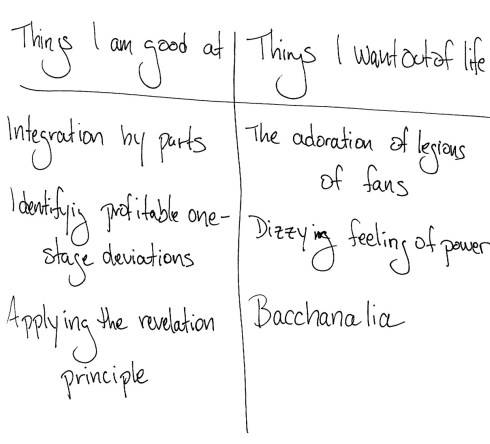
hmmm…. On the night Sandeep and I did our bit for Mark Bazer’s Interview Show at the Hideout in Chicago, Tito Beveridge, proprietor of Tito’s Handmade Vodka was one of the headline guests and he suggested a simple path to profound happiness. Take out a piece of paper and draw a line down the middle. On the left side, write down what you are good at. On the right side, write down what you want out of life.
I tried that, but I am having a hard time figuring out how to get the two ends to meet. Clearly it worked for Tito though, check it out:
Correlation is not causation but for anyone looking for an excuse, this study should be enough to get them guzzling wine if not beer. It says drinking wine in moderation adds five years to your life while beer adds 2.5. People who don’t drink die young.
Have not read the study but it reminds me of the fact that married men make more than men who never marry at all. Does marriage make men more productive? Does alcohol prolong life or is there another explanation?
The marriage counter-theory is easy: men who never marry on average do not have the social skills to do better at work. On the alcohol front, people who drink wine are on average wealthier than ones who drink beer. The rich have a healthier lifestyle, better medical care, cushier jobs etc. The study took place in Holland. The beer is great, much of it brought over from Belgium. Someone who does not drink this quality of beer and avoids alcohol all together has to be really, really antisocial and weird. Sad and lonely, they die young. Weak story at the end but best I can do while teaching.
We made the mistake of buying Goose Island’s attempt to make high-end, Belgian style beer. It was terrible. I gave up even trying to drink it after a few sips. Wine can be over-oaked. I don’t know what the beer equivalent is called. Whatever it is, Matilda has that quality. Too sweet, overwhelming flavor. Yuk. Don’t buy it.
This is a family favorite. There’s blackberry but enough tannin to make it dry and not sweet. Smoky barbecue. Acidic aftertaste. Great value for $22. It’s widely produced and distributed. Get any vintage you can find.
I think I need to sign up. The home page is here. They host conferences. Here is the program for the 2008 conference in Portland. Notice the scholarly outings in shaded green. The first issue of their society journal appeared in 2006 and features an article by Nobel Laureate Daniel McFadden. McFadden is a small-time wine maker whom I once heard say “How do you become a millionaire in the wine business? Start with 2 million.” Orley Ashenfelter is the editor of the journal and here is a working paper entitled “Predicting the Quality and Price of Bordeaux Wines.”
They have a blog here and there is a sister organization called The Association of Food Economists. (Gatsby Gesture: Marginal Revolution)
First of all, in case there is any misconception, trading in pork bellies really means trading in the bellies, and only the bellies, of pigs. Bacon (Sandeep’s vegetarian-exception) is cut from pork bellies. Pork bellies futures, like all futures contracts, are agreements on delivery, at some pre-specified date in the future, of freshly-butchered pork bellies. They have been traded for decades on the Chicago Mercantile Exchange. Futures contracts are generally used to manage risk from volatile prices by securing in advance a price for future delivery at some premium.
Now, the question. Why pork bellies futures? Are pork bellies prices so volatile? Surely they cannot be more volatile that than the rest of the pig’s parts since supply must move together. More volatile than other meat products? Since we can always just count the number of pigs alive today we can get a good forecast of the supply of butchered pigs in the future so any volatility must be explained by demand fluctuations. But what is so volatile about the demand for bacon? I can’t imagine it is any more volatile than the demand, say for sushi-grade tuna. But there are no tuna futures as far as I can tell. This is a genuine mystery. Please share your pork belly knowledge in the comments section.
(dinner conversation with Dilip, Tomek, Stephen and Sylvain acknowledged.)
For a long time in the US, processed foods have featured high-fructose corn syrup as a sweetener rather than cane or beet sugar. This is largely because of subsidies for domestically produced corn and tariffs on imported sugar. There now seems to be a backlash developing against HFCS and in favor of “natural” sugar (HFCS is processed by converting the glucose in corn syrup into fructose.) This Slate article takes a critical look at the case against HFCS and clarifies a few misconceptions. For one, while fructose is probably worse for you than glucose, HCFS has no more fructose than, for example, table sugar. Also, there is mixed evidence whether there is any difference in taste.
In a street survey conducted by the Toronto Star, most passers-by preferred regular Coke to the Passover version; several folks described the latter as tasting like aspartame. A similar confusion beset the Snapple testers at Fast Company: One described the HFCS version as tasting “more natural” while another dismissed the all-natural version for its “chemical taste.
Here is the ad for Pepsi Throwback with “natural sugar.” What model of consumer behavior rationalizes introducing a limited-time product that raises questions about the main product line?
The chef Bobby Flay is ubiquitous on the Food Network. I usually see him in two shows, Iron Chef America and Throwdown with Bobby Flay. Both are competitive shows. Flay usually loses on Throwdown and wins on Iron Chef.
On Throwdown, Bobby Flay makes one dish and competes with an expert . For example, recently there was a show where he made a deep dish pizza against Chicago native Lou Malnati. The two dishes are judged by two experts side by side with a partisan local audience watching. Flay lost.
On Iron Chef America, the format is different. There is a secret ingredient (though I bet both contestants have a fair idea of what it will be!). In this format, Flay and his fellow Iron Chefs are matched against a gourmet chef. Last week the secret ingredient was butter. The entrant was Koren Grieveson of avec in Chicago. Koren picked Cat Cora to compete against. And the competition was tied. As I said, this is a rare event in Iron Chef because the incumbent usually wins. Why?
I think it’s all in the judging. On Iron Chef, the chefs get to present their dishes to the judges so there is no anonymity. On Throwdown, they do not identify who cooked which dish.
I wish they would adopt the same format for Iron Chef. The judges are biased towards the incumbent. For example, while Cat Cora’s food looked good, she won more points in the category of “originality”. One of her dishes was bread and butter, another was gnocchi in a butter sage sauce. These are original only if one adopts an ironic definition of the word “original”. But then everything is original and the category makes no sense! Frankly, I went to avec last night and I just find it hard to believe Cat Cora’s food is better. Maybe I am expressing the bias manifested on Throwdown: the bias of the local audience towards the local contestant. This can also be fixed by making the judges judge in a different room. Similarly, on Iron Chef, a third party, say Alton Brown, could present the dishes. If the judges have questions, the show can set up speakers in a separate room where the chef is standing nervously. S/he can answer the questions into an earpiece worn by Alton Brown. He can relay the answers to the judges. This can be done in a theatrical way to add more drama and tension.
A basketball game where one team is vastly superior to the other is boring to watch. By leveling the playing field, Food Network can add more uncertainty to the competition and get more viewers.
After my Cafe Milano post yesterday, I got some great comments that took me north of the Berkeley campus. (First, I stopped at Peet’s on Telegraph so I had the requisite amount of caffeine to be able to walk from the south of campus to the north.)
One comment suggested Nefeli Caffe. Comment 7/33 on yelp offered up the blandishment of seeing sexy Europeans sipping coffee after a hard night of posing. I was not sure I would fit in but thought I would enjoy it anyway. In typical European fashion, Nefeli was closed. Europeans don’t like getting up too early on a Saturday, or speaking for myself as a pseudo-European, any other day. Brewed Awakenings, on the other hand, seems to be run by hard-working Middle Eastern immigrants and is open. It has free wifi. Quiet classical music in the background. Very few people. Good coffee and good almond croissant. And a great place to hang out and BS. Ideal for research I would say. This is my first stop on future visits to Berkeley. Ariel Rubinstein and Shachar Kariv have great taste.
I’m always hoping that Rogers Park yields some benefits so I don’t have to shlep downtown from Evanston for a good meal and a drink. Somehow managed to hear about Morseland. They can’t quite decide what they are – a bar, a restaurant or a club. It still seems to work. Couple of guys were playing pool, a few were watching a NBA playoff game at the bar. Eclectic mix of people eating. The types who spend hours making sure the goatee is just right but not much time at work. (What I aspire to be?)
Food was good and the beer list was great. Definitely going here again. Maybe, I’ll check out the music. Wish it was open for lunch.
Ever notice that food tastes better when your spouse cooked it (controlling for talent of course)? Why do leftovers often taste better than when the food was fresh? I believe the same phenomenon explains both of these.
A large part of tasting is actually smelling. You can verify this by, for example, eating an onion with your nose plugged. Our sense of smell tends to filter out persistent smells after being exposed to them for awhile so that we cannot smell them anymore. This means that when you are cooking in the kitchen, surrounded by the aromas of your food, you are quickly de-sensitised to them. Then when you sit down to eat, it is like tasting without smelling.
When your spouse has done the cooking you were likely in another room, isolated from the aromas. When you walk into the kitchen to eat, you get to smell and taste the food at the same time. That’s why it tastes better to you. The same idea applies to leftovers. It takes much less time to reheat leftovers than it took to prepare the food in the first place so you retain sensitivity to more of the aromas when it comes time to eat.
I believe that when recipes direct you to “allow the food to rest so that the flavors can combine” what is really happening is that you are induced to leave the kitchen and return with a renewed sensitivity. This also explains why dinners which you spent all day preparing are often disappointments. And it implies that when you have guests over for dinner you should entertain them outside of the kitchen so that they will enjoy the food more when it is ready.
It is back. Production was legalized in the US in 2007 after being banned for nearly a century based on bogus claims of psychedelic properties. The marquee ingredient in absinthe is wormwood but it typically includes other herbs such as anise and fennel. Out of the bottle it is clear, but the spirit is prepared by dropping in a cube of sugar which then drives the herb particulates out of solution producing the famous green haze. It is usually then diluted with 3 to 5 parts water but it is also a key ingredient in some cocktails. The most famous is the Sazerac, a classic from New Orleans.
The last time I was in New Orleans, absinthe was not yet widely marketed and the Sazerac was still being made with the substitute spirit Herbsaint. Did you ever notice that Herbsaint is nearly an anagram for Absinthe? I don’t think its a coincidence. But I think they missed a big chance with Thesbian. Like Herbsaint, its not a word (clearly it should be) but its an exact anagram.
Here is a recipe for a sazerac from wikipedia:
One old fashioned glass is packed with ice. In a second old fashioned glass, a sugar cube and 3 dashes of Peychaud’s Bitters are muddled. The Rye Whiskey is then added to the sugar/Bitters mixture. The ice is emptied from the first old fashioned glass and the Absinthe is poured into the glass and swirled to coat the sides of the glass. Any excess Absinthe is discarded. The Rye-Sugar-Bitters mixture is then poured into the Absinthe coated glass and the glass is garnished with a lemon peel.
Here is Gary Vaynerchuck tasting and reviewing three absinthe brands.
Mario Batali’s Simple Italian Cooking is not that simple. It’s usually way more time-consuming than he suggests. This turned out to be true of the Crespelles al Formaggio. They were delicious nonetheless and we will make them again. They went very well with this salad (we skipped the pomegranate!) and remnants of yesterday’s Pinot Noir.
Normally, my palette is not good enough to distinguish between the regular Pinot Noir and the Méthode à L’Ancienne (MA). But the 2006 MA vintage is so good that pretty much anyone can tell them apart! There’s lots of cherry, a slight acidity at the end and then the cherry comes back again. I couldn’t taste the bacon or strawberry the description mentions. Maybe I will after a few years in the bottle. It’s worth the extra ten bucks to get the MA over the regular. Navarro is one of my favorite vineyards for whites too. Check it out.
The vintage is supposed to be good but not great. It comes on the heels of the super-strong 2005 and the dramatic run-up of prices that was sustained through the solid 2006 and 2007 vintages. Now it appears that the market for 2008 futures will not clear at these prices and the adjustment is not happening. But there are no “menu costs” here. One possible explanation is given here.
David Sokolin, a fine wine dealer in Bridgehampton, New York, notes another potential pitfall. “If the producers cut prices sufficiently for the 2008 en primeur to move their product, they could undermine the prices of the 2007 vintage,” he said. That would hurt merchants and investors holding the back vintage, because their stocks of those wines would lose value. All of the first-growth, or highest ranked, producers — Château Lafite Rothschild, Château Margaux, Château Latour, Château Haut-Brion and Château Mouton-Rothschild — declined interview requests, citing the press of business before the start of the tastings.
Sounds like 2008 Premier Cru is a toxic asset.
The fundamental tension between technical skills and creativity in economic theory?
Actually, no. This is my half-remembered quote from a judge in the new “reality show” on the Food Network. Four chefs have to cook an appetizer, a main course and a dessert using ingredients that are presented to them. For example, these might be anchovies, jam and a lemon. They open up the hamper with the ingredients and then have half an hour to cook something with them and anything else they find in the pantry. In each round, one contestant is “chopped” by the three judges.
On last night’s show, there was a chef from a Gordon Ramsey restaurant at the London hotel in NYC. His food looked great, displayed great knife skills but was safe and unadventurous. Hence, the quote above from the judge. The other guy who was left standing by the end was tattooed from head to toe. He dropped meat on the floor in one round and then cooked it without washing it. And then he made a chestnut cream saboyon quesadilla for dessert. It was too mushy looking and there was too much quesadilla. The other guy made something generic that I can’t remember right now.
Of course, the technical guy won. But no-one slept with him, I guess, and the tattooed guy probably got laid. Who really won?

I found this place because it won an award on a Chicago food chat site. And the first time I went there I met a colleague from the Econ Dept who must have seen the same blog. Small world.
Anyway, when you go to most Indian restaurants, the stuff they serve – the radioactively orange chicken tikka etc – is North Indian. And for some reason it’s usually cooked by Nepalese chefs. ( There’s got to a story there about some Maoist chef exodus but I don’t know it.) It can be good but you miss the other regional cuisine your mother makes…at least, my mother.
Uru-Swati serves South Indian food (as well as some other generic things). So you get good dosas and idlis, things Indians normally have for breakfast but could easily be a nice light lunch. (Well, maybe it’s not light because the dosa will be cooked in ghee! Idlis, a kind of steamed dumpling, are good for you.)
But better than all of this – they serve Indian street snacks. Bhel Puri, Sev Puri, Chole Bhatura… If you’re tempted by these on an Indian street, you’ll soon regret it as your system gets cleaned out if you know what I mean! You can eat them safely at this restaurant and imagine Goa outside the window rather than the ten degree Chicago weather. The parathas are also excellent. Try the muli paratha which come stuffed with a kind of shredded radish, served with dal and pickle.
UPDATE: Check out this NYT story about just this kind of food
Bought it on sale. Totally regret it. It tastes unstructured, flavors are not integrated and there’s huge coconut aftertaste – OAK!
“At the violet hour, the evening hour that strives
Homeward, and brings the sailor home from the sea,
The typist home at teatime, clears her breakfast, lights
Her stove, and lays out food in tins.” T S Eliot, The Wasteland
The American T S Eliot poignantly captures an English sadness that can only be dealt with by a long visit to the pub. The typist was living at a time when nice women didn’t go to pubs and probably had a some sherry at home instead. Luckily for us, there are now many drinking establishments much more sophisticated than pubs. The Violet Hour in Bucktown in Chicago is one of them. It seems not be named after the Eliot poem which is a little too depressing for upbeat America, even the pre-depression America we appear to be living in. It is unmarked and you enter through a velvet curtain that hides the bustling bar where we can drink at the violet hour (or earlier!). I had a Juliet and Romeo – Gin, Mint and rose water – and was very happy with it. And the tempura green beans were great with it. Some of the drinks were very slow in coming so they gave them to us for free. The Violet Hour has a happy buzz. Despite the speakeasy motif, it has a comfortable lack of pretension that I associate with the Midwest. Good company with a good drink. I was very happy that night, quite unlike the main protagonists in the Wasteland.
It is a bit square to go to Union Square Cafe. It’s been around for years and I guess it’s now a “bridge and tunnel” crowd kind of place to go. I’m even more uncool than the visitors from Jersey, flying in all the way from Chicago. And even though I read the Dining section of the New York Times religiously, I go back to the old standbys when I have to make a reservation. Actually, I have only eaten there once before – and at the bar (!) – because it’s so popular. This time I got a reservation easily, got the time I wanted and got shown to the table after a few minutes. There’s definitely a recession. Everything in New York seemed more subdued.
The food was either simple and easy to make at home, like the Cara Cara ornage and fennel salad, or simple but time-consuming, like the ravioli of wild greens. Both were delicious and I am going to try to make the first dish tonight and hope that it really is simple. We had the Château Deyrem Valentin (1999). I rarely have the patience to wait ten years to drink a bottle of wine. I might have more self-control from now on because I saw the benefits of bottle aging. Smooth, subtle tannins; no oak; a lingering, long finish. Old World wine.
My first use of Ariel Rubinstein’s International Cafe Guide was a big success. Think Coffee on Mercer and 4th, just half a block south of the Economics and Politics Departments, is a great place to think which is what Rubinstein wants. There is free wifi (this may distract from thinking!), it’s not too loud and I always found a table easily even though it’s busy. But it’s also a great place to drink which is more of what I’m after. The coffee is delicious and they are great at latte art.
 Cheap Talk
