Counterfeiting money is the stuff of television, movies, and lore, but hardly seen by most of us – for only about one in ten thousand notes is found to be counterfeit annually.  But long ago, it was a big deal – for instance, playing a major role in the Revolutionary and Civil Wars. And nowadays, while it only directly costs Americans about $60-$80 million a year, the Treasury acts as if it is a multibillion dollar potential crime. And of course, counterfeit checks is a major crime, and source of the Nigerian schemes that pepper our email spam boxes.

My coauthor, Elena Quercioli (visiting Bocconi, soon teaching at Central Michigan), experienced the reality of counterfeiting beyond our borders in Mexico City. A merchant once informed her that a few hundred dollars worth of pesos that she had just been issued at an ATM was all counterfeit. In the USA, she would have lost the money, and been questioned by police. But there, she retained her pesos, and proceeded to find a “greater fool” upon whom to unload her losses – the crime of “uttering” (which we are told is extremely hard to prosecute even in the USA).

Elena saw that her misadventure pointed to an interesting paper on counterfeit money that might atone for her mild transgressions. The small literature on this topic never modeled the costly vigilance choice of individuals in dealing with counterfeiting. She proceeded to convince the Secret Service to give her a data trove on counterfeit dollars.  She pieced together a larger and hitherto partially unknown picture about the two flavors of counterfeit money – namely, seized money – that is confiscated from bad guys before it enters circulation – and passed money that is found at a later stage, and leads to losses by the public. Among her findings:

#1. The ratio of all counterfeit money to passed counterfeit money rises, but less than proportionately with the note.

#2. The per transaction passed rate (as a fraction of the circulation) is small for low notes, dramatically rises, and then levels off or drops. In Europe, for instance, the counterfeiting of the 500 Euro note is miniscule compared to the 200 Euro note.

(The Secret Service is under the mistaken impression that the $20 is the most counterfeit, as it fails to understand that the $50 and $100 notes circulate much less often. Go figure.)

#3. Since the 1970s, the  ratio of all counterfeit money to passed counterfeit money has drammatically fallen about 90%.

#4. The fraction of counterfeit notes found by Federal Reserve Banks falls in the note.
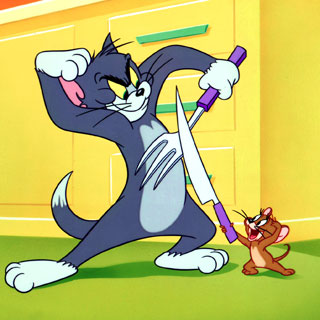
Cat and Mouse

I found these facts and intimations of a new theory very appealing. Our joint paper creates what may be the first multi-market “large game”, i.e. two interacting games each with a continuum of players. First, “bad guys” do battle with “good guys” in a massive game of cat and mouse. In it, good guys choose their vigilance effort  and bad guys choose their counterfeit quality – where greater quality better frustrates counterfeiting efforts. Second, since some fake money inexorably passes into circulation, a collateral game is induced, this one pitting good guys against one another. Such a hot potato game is one of “strategic complements”: Fixing the counterfeiting rate, the more carefully I expect the next guy to examine his notes, the more carefully I must. We show that this second market fixes the counterfeiting rate.

The whole exercise has proved an exploration of nanoeconomics – for instance, we can deduce that individuals expend at most ¼ a cent of vigilance attention looking at the $100 note, and much less for lesser notes. I must say that the paper has reinforced my faith in economics. For despite such miniscule attention costs, the theory does a decent job of simultaneously explaining all the above patterns in counterfeiting – for instance, even the nonmonotone one emerges, that the passed rate rises and then falls. We even do a darn good job absolving the Secret Service of any incompetence in the plummeting seizure rates.

You went early to the Tower of London hoping to avoid the long line to gawk at the Crown Jewels. Many tour buses were on the same schedule. You went to the Science Museum on a Tuesday to avoid the weekend hordes.  What you found were the weekday hordes of uniformed primary school children, pressing all the buttons on the interactive exhibits and leaving a trail of British germs for you to pick up.  Anal, misanthropic, germaphobe though you are, of course you forgot the hand sanitizer.

Under family pressure, you decide to go on a ride on the London Eye.  The lines are going to be horrible. You go to their website and are pleasantly surprised.  They must be private or have a non-London eye firmly trained on profit-maximization because they have come up with a price discrimination scheme exactly for last-minute-planning, people-hating, elitist b’stards like you. You have the option of Flexi Fast Track.  You can turn up anytime and swan to the front of the queue!

The Science Museum is free (wow!) and publicly owned so they can’t pull a stunt like this (but why not Science Museum, you really should, you need the money!).  The Queen is already so elitist that any further sign that there is a class system would cause a huge backlash.  So, there is no two-track procedure for seeing the Crown Jewels.  But the London Eye faces no such constraints.  You can decide where you lie on the forward-planning/value-of-time dimensions and pick from several options. Why not go the whole hog and get drunk on the London Eye with a Pimm’s experience (with optional extra fee for second glass) or a wine tasting?

You may have one other quibble.  Don’t expect to board like United Premier 1K travelers, before all the plebs come on with their crappy baggage.  They will let in around ten of you Fast Track princes and ten of us plebs.  But the Fast Track line is short because it is so bloody expensive (just like everything else in London!) and you will get on sooner. But you will be sharing a EyePod carriage with some plebs – get used to it.  On United, you can recline in your b-class bed secure in the knowledge that the plebs like me in Economy can’t even come into your section to pee. But on the London Eye, you will be breathing the same air as me.  Sorry.

A mother I know was looking into a week of golf camp for her son.  She was quoted a price and it sounded reasonable to her but the fact is she doesn’t really know what a reasonable price is for golf camp.  Think about your own experience in a situation like this.  Somehow, whether this is rational or not, the price itself tells you what a reasonable price is.  Once you hear the price you are anchored to it. For sure anything more than that would be unreasonable.

Now back to the mother who is the subject of this story.  Having been quoted a reasonable price she is inclined to go for it.  But first, she has some further inquiries. What happens if it rains?  Will there be a refund for that day?

There is some checking with higher ups and a return phone call with the answer in the negative.  Camp is rain or shine.  In the event of rain the children will play board games in the clubhouse.

Now the pro-rated daily fee is, by basic arithmetic, a reasonable price for a day of golf camp but not a reasonable price to pay for day care.  Thus, given the non-negligible probability of rain, the value of golf camp has just dropped by a non-negligible amount.  And indeed this price which was a reasonable price for 5 days of golf camp is not reasonable for an expected 4.25 days of golf camp.

No golf camp for junior.

Here is the lesson for optimal pricing policies. A fully informed, risk-neutral expected utility maximizer sees two equivalent ways of pricing golf camp.  Way #1:  Price is fixed and set at the value of the expected number of non-rain days.  Way #2:  A higher price but with refunds on rain days.

But given the inherent reference-dependence that comes from the natural tendency to interpret any price as just on the threshold of reasonable, Way #2 is clearly superior.  This has many implications.  Think shipping costs, all-inclusive holidays, etc.

With Oliver’s speech, we got some insights into the inception and inner workings of the Grossman-Hart team.  It was formed when both were put into the same session at the Stanford theory conference.  Sandy was working on informativeness of rational expectations equilibria and Oliver on general equilibrium with incomplete markets so their combination  in one session was not natural.  But they hit it off famously, despite political differences.  In his speech, Sandy said he was a moderate and Oliver was extremely left-wing and, when it was his turn, Oliver said he was a moderate and Sandy was extremely right-wing.

The Grossman-Hart team met intermittently in the various locations where the two members were located, with Grossman being the more peripatetic of the two.  They risked life and limb and went for long walks in the dodgy areas of Philadelphia and Chicago.  On one visit, Sandy suggested two topics they might work on, the “theory of the firm” and “supply function equilibria”. Not sure what the latter amounted to, but Oliver suggested that he might have become an auction theorist if he had chosen the latter topic. Fatefully, he decided on the former topic. They went back and forth several times for around ten days, coming up with models and then throwing them out till they finally honed in on the model that made its way into JPE.  They actually had a second model based on incomplete information but they decided to delete it from the final version (it was published in a book).

All this information comes from Oliver’s dinner speech.  He went on to say that Sandy has affected his thinking in many other ways.  He had tended to separate his economics from his political beliefs.  Once when Grossman was visiting London to work with Hart, there was a strike of some sort.  Oliver instinctively supported the strikers but, in debate with Sandy, Oliver eventually changed his mind.   He began integrating his politics and his economics. (Parenthetically, this suggests that both of them see theory not just as a mental-master-of-your-own-domain exercise.) Oliver ended though by defiantly returning to his own moderate or left-wing tendencies, depending on your point of view.  He said that while the National Heath Service is not first-best or even the fourth best, it is definitely better than the US version which is tenth best.  He added that Sandy had enjoyed the dental care given by the NHS on a Cambridge visit when he had a toothache.

Grossman offered some final remarks.  He had come up with the question “what is firm” in response to arguments made by ATT to avoid vertical disintegration.  They argued that if a non-ATTphone were plugged into the ATT network it might cause its complete collapse.  Hence, they argued that non-ATT phones should not be allowed for use on the ATT network.  Grossman thought this argument was crazy and started wondering about the proper definition of the firm.  He ended by discussing his toothache.  While a root canal was considerably cheaper in England, Grossman complained that the area administered to by English dentists was still sore. QED?


You receive a notice in the mail reminding you that your subscription to Food and Wine Magazine is about to expire.  Don’t miss out on everything you have come to love about Food and Wine Magazine, renew today!

I received one of these last week.  Thing is, I don’t subscribe to Food and Wine Magazine and I never have.  Still, for the briefest moments I think I did start to worry that I would miss out on everything I love about it.

In the end, I didn’t “renew” but I would bet that lots of people do.

(A Fuzzy iPhone Picture of Sandy Grossman)

One reason I came to the Grossman Hart + 25 conference was to catch a glimpse of Sandy Grossman and see what he had to say about his research.  Grossman resigned from Wharton and has been running his own hedge fund for the last 25 years. I have never met him and my generation and younger know him only from his fearsome reputation.  I did not get to speak to him so I cannot testify to his testiness.  But some sense of his breadth came across.

He offered his current view on ownership and control which was typically idiosyncratic.  He pointed out that human beings cannot will themselves to stop breathing.  A safety mechanism overrides the conscious, deliberate decision hence an individual who has “decision-rights” over his body does not have “control rights”.  And what holds at the level of the individual holds a fortiori at the level of the firm – the owner of an asset does not have necessarily have control rights. Apparently, in his spare time, Grossman reads about the working of the brain and also theoretical  physics.

There is an infamous story about Grossman remodeling his house. Having worked on incomplete contracts, Grossman was extra careful to write a contract so there was no wiggle room for the contractor to hold him up.  Inevitably, they fell into dispute.  The judge said that with the contract that is normally signed he would have sided with homeowner in this kind of dispute.  But since a non-standard and rather complex contract was written, the contingency under dispute must have been considered and dismissed.  Hence, the judge found in favor of the builder.  In other words, Grossman’s attempt to write a complete contract backfired and hurt him in the contract dispute.

When asked about his story, Grossman said “he had never heard it”.  Via a Clintonesque use of wording, Grossman gave an incomplete answer and avoided the main thrust of the question …

He is expecting regular raises.  Not every month, maybe not even every year but he expects a raise and he has his own timetable for when you should give it to him. No matter how hard you try to keep to a fair schedule of raises, uncertainty about his expectations together with other random factors mean that at some point you are going to fall behind.

As time passes and no raise he is going to start slacking off.  Maybe just a little bit at first but it’s going to be noticeable.  Now from your perspective it just looks like he is not working as hard as when you first hired him.  You tell yourself stories about how gardeners start out by working hard to get your business and then slack off over time.  You might even consider that maybe he is slacking off because you aren’t giving him a raise but what are you going to do now?  You can’t possibly give him a raise and reward him for slacking off.  If anything your raise is going to come even later now.

And so he slacks off even more.  In fact he has been through this before so the very first slack-off was a big drop because he knew it was the beginning of the end. He’s gonna be fired pretty soon.

  1. “I have given up. Letters have gone to both referees requesting the return of your manuscript to this office right away. I hope to God I can have better luck with the next people. I don’t know whether this is a matter of concern to you, but let me assure you that it is my intention not to publish the paper by Arrow and Debreu (which has also been submitted) before the publication of your paper (if both are found acceptable). I think this would only be fair to you.” Econometrica Editor Robert Strotz’ 1953 letter to Lionel McKenzie on his existence proof for general equilibrium
  2. I had a fun conversation over dinner with Alessandro Lizzeri (outgoing AER coeditor) at the 2011 Winter Meetings in Denver. He had a fine insight about the economics graduate education: Economics grad students start out learning the classics in first year, absorb the stock of highlights from the last ten years in second year, and then start coming to field seminars, seeing the quasi-shitty flow of marginal new ideas … and we wonder why they are jaded.
  3. “Wanna see who lives in Einstein’s House now? Visit Princeton on Hallowe’en night ….. the current genius, Dr. Eric Maskin dresses up like Einstein and gives treats out to Princeton kids.”
  1. SOPHOMORE = SOPHOS + MOROS = “wise” + “foolish” (Greek)
  2. I just learned that (1) Thomas Crapper did not invent the toilet, and (2) the word “crap” does not come from his name. Now I feel totally disillusioned about my knowledge base. Bummer!
  3. My car takes 91 octane. Gas is sold locally in octanes 87, 89 and 92 or 93 octane. So I must average octanes. One would think that gas stations would have figured this arbitrage out. But it is always strictly more profitable for me to mix 92 and 87 octane than 92 and 89 octane. So drivers: avoid 89 octane!
  4. I am such a sucker for Venn diagrams. This one categorizing all drugs is for the ages.
    Disclaimer: For me, caffeine is a stimulant and alcohol is a depressant (my nightly glass of red wine, angel face). I have had nitrous oxide (hallucinogen & depressant) two or three times. I have fended off the peer pressure to consume all others – does that make me a geek or a nerd? Curiously, cannabis – or marijuana (Mary Jane) – is  simultaneously a stimulant, hallucinogen, depressant, & anti-psychotic.

It is the twenty-fifth anniversary of the publication of Sanford Grossman and Oliver Hart’s “The costs and benefits of ownership, :a theory of vertical and lateral integration” in the Journal of Political Economy. John Moore did a spectacular job introducing the conference. He picked up the paper and said it was so bright that he had to put on sunglasses to look at it (he brought along sunglasses as a prop). He made many other jokes (“We are gathered here today to celebrate…” ) many of which unfortunately I now forget. The conference appears to be taped and perhaps some videos will be available online in the near future. One other point: John checked the Google Scholar scores of the original Grossman-Hart paper and the later Hart-Moore paper – the “property rights theory of the firm” is called the GHM theory.  Gross-Hart has approximately 5600 citations and Hart-Moore approximately 3500. Hence, in  aggregate, Oliver Hart has 9100 citations (in this area alone!).  To acknowledge the different level of contributions and renormalizing by a common factor, John suggested the theory be renamed the G8H15M5 property rights theory of the firm. While cumbersome, the name does convey some information.

  1. Jerry Seinfeld (September 1993) clearly beat Laibson (1994) to the punch on (the rebirth of) present-biased preferences, the conflict between future and current selves, and the value of commitment:
    The Glasses   I never get enough sleep. I stay up late at night, cause I’m Night Guy. Night Guy wants to stay up late. ‘What about getting up after five hours sleep?’, oh that’s Morning Guy’s problem. That’s not my problem, I’m Night Guy. I stay up as late as I want. So you get up in the morning, you’re … , you’re exhausted, groggy, oooh I hate that Night Guy! See, Night Guy always screws Morning Guy. There’s nothing Morning Guy can do. The only Morning Guy can do is try and oversleep often enough so that Day Guy loses his job and Night Guy has no money to go out anymore. 

    Hey we can’t let Jerry beat us, so let’s credit this agenda to its rightful originator, Strotz (1956), before his fourteen year presidency of Northwestern.

  2. Gary Becker (1973) only barely edged out Sylvester Stallone (1976) on the importance of strategic complements in the marriage model. Sly had has this wonderful metaphor in Rocky: “I dunno, she’s got gaps, I got gaps, together we fill gaps.”
  3. Patrick Billingsley – who taught me convergence of probability measures at Chicago — was also a part-time actor. I was unaware he was a bailiff in “The Untouchables” (with Kevin Costner, Sean Connery, and Robert De Niro). His Probability and Measure textbook was his chef d’oeuvre. I find it cool that a world-renowned star of probability pursued his passion as an obscure actor.
  4. Why won’t the Happy Days owners release season 5 and later on dvd? After all, I have been waiting over two years to get past season 4.  For the uninitiated, this is the season in which the TV series gave us the timeless metaphorical image to “jump the shark”. Perhaps they do not want to reveal this moment of futility?PS Which research agendas in the profession have also “jumped the shark”. ^_^ And could it be that their ratings (citations) decline long after their fundamentals do?

You remember that game where you ask your friends which of two unbearable acts they would rather endure? The more incomparably unspeakable the acts the more torturous it is to decide.  The game gets its irresistable charm from the way it tests our ability to decide beween alternatives we would never admit to being able to tolerate.

But that ability is the essence of compromise. You have your preferred policy but policy-making requires negotiation and your preferred policy just isn’t in the feasible set.  You’ve got to take stock of all the worst-best policies that your negotiating partners would agree to and decide which one is the least worst.

Admitting which one you would settle for is psychologically and strategically hard.  Because rhetorically it amounts to approval.  Your constituents will ask you how you possibly could have proposed that.  In the future your approval will tend to cement this compromise into place.  Bargaining frequently reaches impasse just because people have not had enough practice ranking alternatives that are far below their favorites.

That’s what I was thinking about when Courtney Conklin Knapp (guest-blogging this week for Megan Mcardle) wrote about the new death-images to be printed on cigarette packs.  The images are revolting. It seems wrong in some basic way to be forcing people to look at those.  But in practice we are faced with two choices.

Suppose you had a choice between only two policies: A) grotesque pictures or B) increased per-pack taxes calculated to generate exactly the same reduction in demand. Which do you prefer?

I think I favor the pictures.  But look at the 220 comments to Courtney’s post where she asked her readers to choose.  They are the roots of gridlock text-onified.  Almost nobody actually answers the question.  Its like when your friend forgets the rules of the game. You have to pick one.

Cheap Talk has reached 1,000,000 views.  Odds are the 1,000,000th guy was learning about how to open a bag of charcoal and is right now engulfed in flames. Thanks 1 millionth-CheapTalk-fireball-dude!

I lost combination to several old $5 Masterlocks. So I went to their web site. I found an amusing procedure.  The italics are Masterlock’s: I wonder how many prisoners are trying to use the web to unlock their prison cell doors…

Print out the Lost Combination Form from a printer friendly page, or download the PDF file.

Have your Lost Combination Form notarized by a Notary Public to prove that you are the owner of the lock (you can include up to 6 combinations on one notarized form).

Note: Inmates at a correctional facility – in addition to the lost combination form, you must submit your request on official prison letterhead. In lieu of notarization, the form must be signed by a prison official.

Photocopy the serial number on the back case of your combination lock. This copy MUST clearly show that the lock is not attached to anything. Be sure to hand write the serial number on the photocopy.

David Lake gave an interesting talk about the history of US policy on state-building.

State Building 1.0:  Installing puppets.  The underlying philosophy was Realpolitik.  This phase was exemplified by US support from Rafael Trujillo, “El Jefe”, dictator in the Dominican Republic.

State Building 2.0: Creating a legitimate government. The underlying philosophy is liberal.  It implies creating a functioning democracy with limited powers and a free-market economy.  This was attempted in Iraq and Afghanistan

Sate Building 3.0: Counterinsurgency.  This puts emphasis on providing security and public goods to the general population to get their support.  There is less emphasis on democracy and market reforms.

The audience found 3.0 controvertial – is there really a change in emphasis or is it really 2.0?  I personally found it persuasive and would add State Building 4.0: Intervention might decouple the provision of security from the creation of democracy altogether and instead install a puppet.  Some might say this is version 1.0 and perhaps this is right.  In any case, it certainly trends back towards version 1.0.  This is where the Afghan policy seems to be heading.  A puppet is important because there need to be American bases in Afghanistan to use for drone attacks against terrorists based in Pakistan.

As a theorist, I can muse about empirical issues generally safe from the fear that I might seriously explore them. Next summer is another Olympic year of competition and commentary. Consider the 100M dash. Victory spells fame and fortune, second place historical obscurity.  Effort expended is real, and competitors can roughly see how their nearest rivals are doing in real time, although admittedly in a bit of a blur. To what extent then can we understand behavior in these races using auction theory? If we regress winning times on times of predecessors, is the second fastest time the best predictor, and does it obviate the power in the other order statistics? And is this more true in the 10,000M run, where events are less of a blur, or less true, because at some point the race is often a foregone conclusion?

Another prediction of auction theory is that the best  times should be more clustered in head to head race, for instance, than if we just asked runners to race alone, not knowing their rivals’ times, and then picked the fastest time.

I spent the weekend in bed with the flu.  Sunday morning, on the tail end of it, I popped a few Advil to bring the fever down so I could semi-enjoy Father’s Day. Was I making a mistake?

As I understand it, my body elevates its temperature as a defense mechanism. Evolution has been operating long enough to have a pretty well-calibrated trade-off between the losses of reduced activity from the fever versus the speed and probability of a successful recovery.  Is my intervention distorting away from the optimum?

  1. Arguably I have private information about idiosyncratic conditions and Nature is calibrated only to the average state.  Note that while this hypothesis justifies my use of Advil on Father’s Day, it also implies that I should go short on Advil on other days.
  2. And anyway Nature has given me the infrastructure to condition physiology on my knowledge of immediate environmental conditions.  For example when I know that I am in danger, the body re-allocates resources to help me escape.  What makes this any different?
  3. My objective is probably different.  In Mother Nature’s eyes I am just a vessel from which offspring should spring forth.  She could care less whether I get to practice Pink Floyd’s San Tropez on the piano with my daughters.  So Nature’s revealed preference for activity is necessarily weaker than mine.
  4. But wait, my personal preference for non-reproductive activity is also something that Nature shaped.  So what would explain the wedge?
  5. If I am making the wrong decision by taking Advil it’s not because I have the wrong preferences but because Advil is something Nature never expected.  She has me well-trained when it comes to the fundamentals but she hasn’t had time to design my direct preference for the intermediate good Advil. She must leave it up to me to do the calculation of its implied tradeoffs in terms of the fundamentals. It’s only because of my miscalculation that I am making a mistake.

I am attending a workshop organized by Eli Berman at UCSD.  Eli and his co-authors have been studying the military surge in Afghanistan.  Colonel Joe Felter, a key member of the research team, presented an overview of the theory of counterinsurgency (COIN) – How can the Afghan government and the US forces “win hearts and minds”?

Think of Apple and Samsung competing for consumers.  In the end, a consumer hands over some cash and gets an iPad or a Galaxy.  Both sides of the exchange have sealed the deal, an exchange of a product for money.  The theory of COIN works the same way.  Two potential governments compete for allegiance from an undecided population.  They offer them security and public goods in exchange for allegiance.  They may also use coercion and violence to compel compliance.  There is a key difference – an Afghan citizen can take the goodies offered by the U.S., claim he will offer his allegiance and then withhold it.  The exchange takes place over time and there is no “contract” that guarantees payment of allegiance for US bounty.

The Afghans will offer their allegiance to the government that will be around in the long run.  And the Taliban tell them, “The Americans have watches but we have the time.”  And this strategic issue undercuts the theory of COIN.  How can the surge work if one of the firms that is trying to sell you a product won’t be around to honor the warranty?

In the early 1970s, Gary Becker was hitting stride, knocking out economic theories of crime, the allocation of time, discrimination, marriage, and children in rapid succession. His theory of marriage treated the marriage scene like any other economic market, cleared by a price. Men bid for women, and women bid for men. In a shallow view of his model, women sought handsome men, and men beautiful women, and beauty was not in the eye of the beholder. Becker’s main theorem — whose proof he credits to my esteemed colleague Buz Brock — found that the men and women efficiently sorted by their beauty when their beauties were complements.

I visited the Cowles Foundation at Yale for the winter of 2006, and taught a senior elective course. Seven fortunate students took my seminar in information economics. One impressive woman student — who organized the gay and lesbian social scene — asked whether the shallow view of Becker’s model was so unrealistic. Did babes match with hunks?

We brainstormed on data sources and settled on two new web sites: facebook.com and hotornot.com. Facebook allowed users to indicate with whom they were “in a relationship with”. Facebook was still new, and not yet open to all email addresses. So the student asked her friends at various campuses across  America for their logins. And so began our stealth project. Hundreds of photos of matched men and women were downloaded, and then uploaded to HotOrNot, all on the sly. HotOrNot afforded us the average evaluation of about 200 women for every man, and 2000 men for every woman.

The result: Regressing straight men’s or women’s hotness on their partner’s hotness gave a highly significant fit, with a slope of about 0.7 — so that a man rising in hotness from 7 to 8 expects his partner to rise by 0.7 points. But sorting was far closer for gays and lesbians, with a slope for each of about 0.9. As Becker implied, beauty is income in this meat market, and the “richest” men match with the “richest” women.

Last week Sandeep and I were at the Cowles Summer Microeconomic Theory Conference at Yale, a fantastic conference with many great papers and an All-Star roster of pure attendees.  Tomasz Strzalecki presented a provocative new paper on limited attention and asset price volatility (joint with Faruk Gul and Wolfgang Pesendorfer), Olivier Gossner showed us how Fudenberg and Levine’s famous reputation papers should have been written, and Lones Smith presented his paper with Elena Quercioli on The Economics of Counterfeit Money.  When pressed with a technical question from the audience he deployed a line that I will certainly be using myself in the future under similar circumstances:

It sounds like you are talking about some subtle math, but I’m just trying to pretend I’m in the 5th grade.

We liked his paper so much we thought about blogging it but then decided to do it one better and ask Lones himself to write about it in a guest post. And he agreed.

Of course, while he is at it we might as well hear what else he has on his mind so we’re going to have him sit in here at Cheap Talk for the week.  And if you know Lones, then you know that anything can happen, so it’s going to be fun.

It’s hard to model serendipity in a rational choice framework.  For example, people say that the web’s ability to focus your attention on subjects you like prevents you from being exposed to new stuff and that makes you worse off.  That may be true, but it could never be true in a rational framework because if you wanted exposure to new stuff you would choose that.  (I am leaving out market structure explanations, i.e. the market for serendipitous content may shrink.  That’s beside the point I am making and anyway I would guess exactly the opposite.  I can always take advantage of the increased diversity in content by supplying my own randomness.)

But here’s a version of serendipity that may be rationalized.  I have started reading blogs in my Google reader using the “All Items” tab where all the articles in all the blogs I subscribe to are listed in a flat format in chronological order, rather than blog-by-blog.  I have found a non-obvious effect of serendipity:  not knowing which blog I am reading and just reading the article prevents me from approaching it with expectation of the author’s prior biases, etc.  I recommend it.

For some kinds of information it may be beneficial to hide the source.  For example, pure rhetoric.  My ability to judge whether it is convincing or not is based purely on the logical connections between premise and conclusion and my prior beliefs about the plausibility of the premises.  Knowing the author of the rhetoric provides no additional information.  And if, for psychological reasons, knowing the source biases my interpretation then I am strictly better off having it hidden from me.  (At least temporarily)

You will complain that by appealing to psychological biases I have departed from the rational choice framework.  But I think there is a useful distinction between rational choice, and rational information processing (if the latter even has any meaning.)  If I can be expected to choose my sources rationally then there is no role for serendipitous exposure to new sources, even if I make errors in processing information.  But rational choice together with (self-aware) processing errors can justify keeping the source hidden.

(Drawing by Stephanie Yee.)

What was slated to be the world’s first brothel for women has been put on hold in New Zealand.  The reasons are murky but here’s one tangential item:

At the time of the launch, Corkery claimed that hundreds of men had applied to be $240-an-hour gigolos and satisfy the demands of Kiwi women wanting sex.

No surprises there!  NZ$240 = US$200 (approximately.)  Your first reaction is that the market clearing price must be much lower than that, possibly negative. But demand is certainly non-standard in this market due to adverse selection.  How much are Kiwi women willing to pay to have sex with a man who is paying to have sex with her? It could easily be that we need a price high enough to increase the supply of men who have valuable outside options.  You may just have to live with excess supply.

Whatever-hat-you-wear-to-a-brothel (I wouldn’t know)  insert-your-favorite-gesture: Arthur Robson.

  1. Among the males in my family tree, underwear preference alternates generations:  briefs then boxers then briefs…
  2. Smoking guns for this theory.  Italians who pronounce the hard b in the word “subtle”, and pronounce “differ” as in “diffAIR”  (they have no trouble with water, later, etc.)  Also, the hard p in “psychology.”
  3. Here’s the best way to get your wife to agree to a parenting strategy X:  “My mother tried not-X and that didn’t work.”
  4. I want to play a negative drum:  it makes a sound except when I hit it.
  5. What is the effect on equilibrium search models and assortative matching when once-matched, husbands can use headscarves to hide the quality of their mate from potential poachers?
  1. Telling a joke about the Dalai Lama to the Dalai Lama.
  2. Cricket and the Billie Jean mystery.
  3. This way you can write normal and still refuse to obey the lines.
  4. Search Sarah Palin’s inbox.  My searches:  pics, confidential, bastards, the indian with one testicle.  Post your favorite searches in the comments.
  5. This is my new favorite blog:  Helpful Hints for Everyday Living.

Some ants give up reproduction and take care of the queen ant’s young.  This altruism (“eusociality”) seems to contradict selfish natural selection.  Why would these ants be so selfless?

A solution seems to arise via the theory of kin selection: an ant maximizes the sum of its own payoff and the payoff of a co-player weighted by how closely related they are.  A rather precise formula was provided for this by the biologist W.D. Hamilton and it provides the underpinning of sociobiology.   It might also provide an explanation for eusociality: the baby ant you are looking after is closely related to you.   Also, via a quirk of fertilization, related ants share 3/4 of their genes increasing the “inclusive fitness” payoff behind the theory of kin selection..

But now along come some contrarians, Martin Nowak, Corina Tarnita and perhaps most surprisingly, the sociobiologist E.O. Wilson.  In a recent paper in Nature, they argue

Eusociality, in which some individuals reduce their own lifetime reproductive potential to raise the offspring of others,
underlies the most advanced forms of social organization and the ecologically dominant role of social insects and humans.
For the past four decades kin selection theory, based on the concept of inclusive fitness, has been the major theoretical
attempt to explain the evolution of eusociality. Here we show the limitations of this approach. We argue that standard
natural selection theory in the context of precise models of population structure represents a simpler and superior approach,
allows the evaluation of multiple competing hypotheses, and provides an exact framework for interpreting empirical
observations.

This has set off a firestorm – witness the huge number of letters arguing their paper is flawed.   The letters are gated so I have not read them but an economist can certainly read the ungated original paper and get some sense of the controversy.

First, Nowak et al. argue that the simple equation that Hamilton wrote down to capture inclusive fitness is too special.   It does not account for complementarities in payoffs and assumes pairwise interaction.  It often gives results which would come from maximizing fitness alone.  The Hamilton inequality is that cooperation occurs if R>c/b where R is relatedness, c is the cost to the cooperative action action and b is the benefit.  It already looks quite special as it seems to assume interaction payoffs are given by the Prisoner’s Dilemma.  This part of the Nowak et al critique does not look controversial to an outsider.

The second part is weird, at least to an economist.  Nowak et al offer their own theory of eusociality.  They compare two scenarios.  In one, the queen ant lives a solitary life in her nest as all her kids wander off and start their own nests (assume asexual reproduction for simplicity).  So the queen has to defend her own nest against predators and this affects the birth and death of her kids.  In the other scenario,  the kids stay and look after the newborns, eusociality.  This can increase the birth rate as the queen is less distracted by defense activities, and cut the death rate as the nest is well defended.  But why would the ants stay and defend and not wander off?  This seems to be the controversial part: Nowak at al assume the ants are robots pre-programmed to stay and hence they do not face a choice.  They do not get a good wage or have a terrible outside option, as we would say in economics.  Rather, they are like the Borg in Star Trek New Generation.  This smacks of group selection not individual selection.  And E. O. Wilson is a co-author on this theory.  No wonder it is controversial.

A reader, Kanishka Kacker, writes to me about Cricket:

Now, very often, there are certain decisions to be made regarding whether a given batter was out or not, where it is very hard for the umpire to decide. In situations like this, some players are known to walk off the field if they know they are “out” without waiting for the umpire’s decision. Other players don’t, waiting to see the umpire’s decision.

Here is a reason given by one former Australian batsman, Michael Slater, as to why “walking” is irrational:

(this is from Mukul Kesavan’s excellent book “Men in White”)

“The pragmatic argument against walking was concisely stated by former Australian batsman Michael Slater. If you walk every time you’re out and are also given out a few times when you’re not (as is likely to happen for any career of a respectable length), things don’t even out. So, in a competitive team game, walking is, at the very least, irrational behavior. Secondarily, there is a strong likelihood that your opponents don’t walk, so every time you do, you put yourself or your team at risk.”

What do you think?

Let me begin by saying that the only thing I know about Cricket is that “Ricky Ponting” was either the right or the wrong answer to the final question in Slumdog Millionaire.  Nevertheless, I will venture some answers because there are general principles at work here.

  1. First of all, it would be wrong to completely discount plain old honor. Kids have sportsmanship drilled into their heads from the first time they start playing, and anyone good enough to play professionally started at a time when he or she was young enough to believe that honor means something. That can be a hard doctrine to shake.  Plus, as players get older and compete in at more selective levels, some of that selection is on the basis of sportsmanship.   So there is some marginal selection for honorable players to make it to the highest levels.
  2. There is a strategic aspect to honor.  It induces reciprocity in your opponent through the threat of shame.  If you are honorable and walk, then when it comes time for your opponent to do the same, he has added pressure to follow suit or else appear less honorable than you.  Even if he has no intrinsic honor, he may want to avoid that shame in the eyes of his fans.
  3. But to get to the raw strategic aspects, reputation can play a role.  If a player is known to walk whenever he is out then by not walking he signals that he is not out.  In those moments of indecision by the umpire, this can tip the balance and get him to make a favorable call.  You might think that umpires would not be swayed by such a tactic but note that if the player has a solid reputation for walking then it is in the umpire’s interest to use this information.
  4. And anyway remember that the umpire doesn’t have the luxury to deliberate.  When he’s on the fence, any little nudge can tilt him to a decision.
  5. Most importantly, a player’s reputation will have an effect on the crowd and their reactions influence umpires.  If the fans know that he walks when he’s out and this time he didn’t walk they will let the umpire have it if he calls him out.
  6. There is a related tactic in baseball which is where the manager kicks dirt onto the umpire’s shoes to show his displeasure with the call.  It is known that this will never influence the current decision but it is believed to have the effect of “getting into the umpire’s head” potentially influencing later decisions.
  7. Finally, it is important to keep in mind that a player walks not because he knows he is out but because he is reasonably certain that the umpire is going to decide that he is out whether or not he walks.  The player may be certain that he is not out but only because he is in a privileged position on the field where he can determine that.  If the umpire didn’t have the same view, it would be pointless to try and persuade.  Instead he should walk and invest in his reputation for the next time when the umpire is truly on the fence.

Downside: It invites Cynicism. Upside:  It allows the CEO to make an example of a Cynic and keep other Cynics in line.

Classic mashup

Dan Ariely, Chris Anderson, Hal Varian and others are heading Startup-Onomics: a Behavioral Economics “Summit” for entrepreneurs.

What is behavioral economics?

As business owners, we want to design products that are useful, we want customers (lots of them), and we want to create a motivating work environment. But it’s not that easy. In fact, most of the time that stuff takes a lot of hard work and a lot of trial and error.

Good news. There is a science called Behavioral Economics.  This attempts to understand people’s day to day decisions (where do I get my morning coffee?) and people’s big decisions (How much should I save for retirement?).

Understanding HOW your users make decisions and WHY they make them is powerful. With this knowledge, companies can build more effective products, governments can create impactful policies and new ideas can gain faster traction.

Sessions include “How to get people to pay what they want,” and “The creation and role of habits in purchasing decisions,” etc.

Emperor penguins form a group huddle to share warmth as they wait for eggs to hatch.  How do they coordinate?

Emperor penguins are the only vertebrates that breed during the austral winter where they have to endure temperatures below −45°C and winds of up to 50 m/s while fasting. From their arrival at the colony until the eggs hatch and the return of their mates, the males, who solely incubate the eggs, fast for about 110–120 days [1][3]. To conserve energy and to maintain their body temperature[4], the penguins aggregate in huddles where ambient temperatures are above 0°C and can reach up to 37°C [1][3].

Huddling poses an interesting physical problem. If the huddle density is too low, the penguins lose too much energy. If the huddle density is too high, internal rearrangement becomes impossible, and peripheral penguins are prevented to reach the warmer huddle center. This problem is reminiscent of colloidal jamming during a fluid-to-solid transition [5]. In this paper we show that Emperor penguins prevent jamming by a recurring short-term coordination of their movements.

What are the individual incentives in the huddle?  It would seem that the dynamics would be governed by the need to prevent manipulation by a self-interested penguin.

Check out this video (unfortunately you have to click to download it, its about 30MB.  there is no streaming version.)