
You are currently browsing the category archive for the ‘Uncategorized’ category.
Consider a team selling tickets for its upcoming baseball season. Before the season begins it offers a bundle of tickets for every game. Some of these games however are certain to have very low attendance (games on a Tuesday, games against poor opponents, etc.) The tickets for these games will be placed on the secondary market at very low prices. Indeed one of the biggest problems for teams is the inability to prevent those secondary market prices from falling so low that they cannibalize single-game box office sales. The problem is so severe that many baseball teams are making arrangements with StubHub to enforce a price floor on that exchange.
The problem has a much simpler solution: stop selling season tickets. The team should instead offer the following type of bundle: you may purchase tickets for all of the predictably high-demand games at the usual season ticket discount.Then you may add to that bundle any subset of the low-demand games you desire but each at a price equal to the face value of the ticket.
This arrangement will make both season ticket holders and the team better off. Season ticket holders will opt not to add the low demand games (unless the opponent is a team they really like for example) and since they weren’t going to those games anyway they are saving money.
The team will increase revenue: supply of tickets to low demand games will be controlled. Secondary market tickets will be priced at or near face value because nobody will buy a ticket at face value for a lousy game unless they actually plan to use the tickets. This enables the team to hold prices at their desired (i.e. revenue maximizing) level without cannibalism.

For decades, [the Justice Department] argue, Anheuser-Busch has been employing what game theorists call a “trigger strategy,” something like the beer equivalent of the Mutually Assured Destruction Doctrine. Anheuser-Busch signals to its competitors that if they lower their prices, it will start a vicious retail war. In 1988, Miller and Coors lowered prices on their flagship beers, which led Anheuser-Busch to slash the price of Bud and its other brands in key markets. At the time, August Busch III told Fortune, “We don’t want to start a blood bath, but whatever the competition wants to do, we’ll do.” Miller and Coors promptly abandoned their price cutting.
But:
Budweiser’s trigger strategy has been thwarted, though, by what game theorists call a “rogue player.” When Bud and Coors raise their prices, Grupo Modelo’s Corona does not. (As an imported beer, Corona is also considered to have a higher value.) And so, according to the Justice Department, AB InBev wants to buy Grupo Modelo not because it thinks the company makes great beer, or because it covets Corona’s 7 percent U.S. market share, but because owning Corona would allow AB InBev to raise prices across all of its brands. And if the company could raise prices by, say, 3 percent, it would earn around $1 billion more in profit every year. Imagine the possibilities. The Justice Department already has.
Here is the Justice Department’s complaint. Davidson says they use game theory models to forecast the impact of the merger. But I do not see that in the complaint. Is there a publicly available document outlining their analysis?
Since you’ve only ever been you and you’ve had to listen to yourself talk about your own thoughts for all this time, by now you are bored of yourself. Your thoughts and acts seem so trite compared to everyone else so instead you try to be like them. But you fail to account for the fact that to everybody else you are pretty much brand new and indeed you would be a refreshing break from their boring selves if only you would just be you.
There are two actions, A and B, and there are two observable types of people L and R. Everybody is the same in the following sense: for any single individual either A or B is the optimal action but which one it is depends on an unknown state of the world.
But in another sense people are heterogeneous. It is common knowledge that in the state of the world where A is best for people of type L then B is best for people of type R. And in the other state its the other way around. Each person observes a private signal that contains information about the state of the world.
Acting in isolation everybody would do exactly the same thing: pick the action that is best according to their belief (based on the private signal) about the state of the world. But now embed this in a model of social learning. People make their choices in sequence and each observes the choices made by people who went before.
Standard herding logic tells us that L’s and R’s will polarize and choose the opposite action even if they get it completely wrong (with L’s choosing the action that is best for R’s and R’s choosing the action that is best for L’s)
(A reminder of how that works. Say that an L moves first. He chooses the action that looks the best to him say A. Now suppose the next guy is an R and by chance action B looks best to him. The third guy is going to look at the previous two and infer from their choices that there is strong information that the true state is such that A is good for L’s and B is good for R’s. This information can be so strong that it swamps his one little private signal and he follows the herd: choosing A if he is L or B if he is R. This perpetuates itself with all subsequent decision makers.)
In effect the L’s choose A just because the R’s are choosing B and vice versa.

This is an interesting article, albeit breathless and probably completely deluded, about acquired savantism: people suffering traumatic brain injury and as a result developing a talent that they did not have before. Here’s at least one bit that sounds legit:
Last spring, Snyder published what many consider to be his most substantive work. He and his colleagues gave 28 volunteers a geometric puzzle that has stumped laboratory subjects for more than 50 years. The challenge: Connect nine dots, arrayed in three rows of three, using four straight lines without retracing a line or lifting the pen. None of the subjects could solve the problem. Then Snyder and his colleagues used a technique called transcranial direct current stimulation (tDCS) to temporarily immobilize the same area of the brain destroyed by dementia in Miller’s acquired savants. The noninvasive technique, which is commonly used to evaluate brain damage in stroke patients, delivers a weak electrical current to the scalp through electrodes, depolarizing or hyperpolarizing neural circuits until they have slowed to a crawl. After tDCS, more than 40 percent of the participants in Snyder’s experiment solved the problem. (None of those in a control group given placebo tDCS identified the solution.)
(I know this problem because it was presented to us as a brain teaser when I was in 2nd grade. Nobody got it. The solution while quite simple is “difficult” to see because you instinctively self-impose the unstated rule that your pencil cannot leave the square.)
The suggestion is that with some drugs or surgery we could all unlock some hidden sensitivity or creativity that is latent within us. Forget about whether any of the anecdotes in the article are true examples of the phenomenon (the piano guy almost certainly is not. Watch the video, he’s doing what anyone with some concentrated practice can do. There is no evidence that he has acquired a natural, untrained facility at the piano. And anyway even if we accept the hypothesis about brain damage and perception/concentration why should we believe that a blow to the head can give you a physical ability that normally takes months or years of exercise to acquire?)
The examples aside, there is reason to believe that something like this could be possible. At least the natural counterargument is wrong: our brains should already be using whatever talents they have to their fullest. It would be an evolutionary waste to build the structure to do something useful and not actually use it. This argument is wrong but not because playing the piano and sculpting bronze bulls are not valuable survival skills. Neither is Soduku but we have that skill because its one way to apply a deeper, portable skill that can also be usefully applied. No, the argument is wrong because it ignores the second-best nature of the evolutionary optimum.
It could be that we have a system that takes in tons of sensory information all of which is potentially available to us at a conscious level but in practice is finely filtered for just the most relevant details. While the optimal level of detail might vary with the circumstances the fineness of the filter could have been selected for the average case. That’s the second best optimum if it is too complex a problem to vary the level of detail according to circumstances. If so, then artificial intervention could improve on the second-best by suppressing the filter at chosen times.
The case of The Oscars:
BEST PICTURE
“This is a preferential system. I’m putting Amour at No. 9 because I’m just pissed off at that film. Beasts of the Southern Wild is a movie that I just didn’t understand, so that’s my No. 8. Les Miserables goes in seventh place — it’s not just the most disappointing film of the year but the most disappointing film in many years. Above that I’m putting Silver Linings Playbook, which is just a “blah” film. Django Unchained will go into my fifth slot — it’s a fun movie, but it’s basically just Quentin Tarantino masturbating for almost three hours. Next up is Life of Pi because of how unique it is and for holding my attention up until its irritating ending. Argo is gonna go in third place, but I don’t want it to win because I don’t think it deserves to win and am annoyed that it is on track to win for the wrong reasons. Actually, come to think of it, do we have to put a film in every slot? Because what I want is for my best picture choice to have the best possible shot, so why even give any support to the others? [He has his assistant call the Oscar voting helpline, finds out that voters can leave slots blank and promptly removes all of the aforementioned selections.] I’m basically OK with one of two films winning. Lincoln is going in my second slot; it’s a bore, but it’s Spielberg, it’s well-meaning, and it’s important. Zero Dark Thirtyis my No 1.”
Vote: (1) Zero Dark Thirty, (2) Lincoln, (3) [blank], (4) [blank], (5) [blank], (6) [blank], (7) [blank], (8) [blank], (9) [blank]
Read the whole article for the inside view of Oscar balloting, including beating the shit out of Ann Hathaway, spinnng the iPhone, and filleting the neighbor’s dog.
Gatsby grip: Alex Frankel

Hat Tip: Arasan Aruliah

I just got back from a short trip. I flew United. I used my app to check our flight status. Surely enough, the incoming plane was delayed by thirty minutes. Decided to spend the extra time in Nature wallowing in the beauty she has created – a dolphin frolicking in the distance in the warm sea – rather than in the Southwest Florida International Airport in Fort Myers suffering in the sterile concrete lump Man has created. After all, I’d already printed off boarding passes and even checked in baggage before arrival.
Arrive at the counter and attempt to actually check in aforementioned bags. No such option was offered on the electronic check-in terminal. Find a wandering United clerk who repeats the procedure and encounters the same problem. She finds a higher-up United clerk who tries a third time. Then, the higher-up tells us that bags can only be checked in up to thirty minutes before the SCHEDULED departure not the ACTUAL departure. Luckily, sense is seen and baggage is checked in after some complaining.
So, United expects you to make decisions as if the flight is leaving on time even though it is common knowledge that it is not. Then, why tell you flight status? If they do not tell you, you are more likely to make the decisions they want you to make. If they give you up to date information, you are certainly going to make decisions based on the information. Yes, you can find out the information via other websites. But then if you are late, can’t check in bags etc., it’s your own problem. If United has told you flight status and you’re late, then it’s their problem too. Surely, there is some footnote somewhere on some website that says you should be on time even if the flight is late but who’s going to read that?
A fascinating article I found after digging through Conor Friedersdorf’s best of journalism.
What distinguishes a great mnemonist, I learned, is the ability to create lavish images on the fly, to paint in the mind a scene so unlike any other it cannot be forgotten. And to do it quickly. Many competitive mnemonists argue that their skills are less a feat of memory than of creativity. For example, one of the most popular techniques used to memorize playing cards involves associating every card with an image of a celebrity performing some sort of a ludicrous — and therefore memorable — action on a mundane object. When it comes time to remember the order of a series of cards, those memorized images are shuffled and recombined to form new and unforgettable scenes in the mind’s eye. Using this technique, Ed Cooke showed me how an entire deck can be quickly transformed into a comically surreal, and unforgettable, memory palace.
The author documents his training as a mental athlete and his US record breaking performance memorizing a deck of cards in 1 minute 40 seconds. I personally have a terrible memory, especially for names, but I don’t think this kind of active memorization is especially productive. The kind of memory enhancement we could all benefit from is the ability to call up more and more ideas/thoughts/experiences related to whatever is currently going on. We need more fluid relational memory, RAM not so much.
Look at married female academics and whether or not they use their maiden name. See how this depends on
1. Which of the two names comes earlier in the alphabet.
2. Whether their field uses the lexicographic convention of ordering authors names.
People don’t like to be idle. They are willing to spend energy on pointless activities just to avoid idleness. But they are especially willing to do that if they can make up fake reasons to justify the unproductive busyness. That’s the conclusion from a clever experiment Emir Kamenica told me about.
In this experiment subjects who had just completed a survey were told they had to deliver the survey to one of two locations before being presented with the next survey 15 minutes later. They could walk and deliver to a faraway location, about a 15 minute roundtrip, or deliver it nearby, in which case they would have to stand around for the remainder of the 15 minutes.
There was candy waiting for them at the delivery point. In a benchmark treatment it was the same candy at each location. In that treatment the majority of subjects opted for the short walk and idleness.
In a second treatment two different, but equally attractive (experimentally verified) types of candy were available at the two locations and the subjects were told this. In this treatment the majority of subjects walked the long distance.
The researchers conclude that the subjects wanted to avoid idleness and rationalized the effort spent by convincing themselves that they were getting the better reward. Indeed the subjects who traveled far reported greater happiness than their idle counterparts regardless of what candy was available.
In my first year as an Assistant Professor I was assigned the job of teaching Microeconomic Principles, aka Econ 1, aka the Freshman economics class which is for most students the first introduction to economics they will have and for a large fraction of them also the last. I sucked at it. But not because I didn’t care. I cared a lot and I put a lot of effort into preparing each class and making the whole sequence of classes fit together as a coherent whole. But that first year of teaching my evaluations were absolutely awful.
So I tried harder the next year, and put more and more effort into the class each year and yet each year my evaluations got worse and worse. The lowest point for me was when I decided I would write out every lecture word for word to make sure I was saying everything I needed to say and saying it right. That year my evaluations hit bottom and it was the last time I taught the course.
The next undergraduate course I taught was Intermediate Microeconomics and when I was planning how to teach it I decided to go to the completely opposite extreme and not prepare anything at all except for the topics of each lecture and how they would fit together. Apart from knowing what I needed to teach them I went into each class with no preparation at all, just chalk and a board. It couldn’t be any worse than before.
I discovered that when you are teaching something that you know very well, preparation only gets in the way. Improvisation
- Forces you to develop the ideas from scratch out loud which gives the students a glimpse at how to arrive at those ideas rather than just seeing them fully baked on an overhead.
- Creates an element of danger that you naturally respond to by digging deeper and finding your way through.
- Gets the students’ attention. They can tell you are doing it without a net and the drama of that hooks them in.
- Makes it less like a lecture and more like a conversation.
Google discontinued their appointment slots feature of Google Calendar. I was using that to schedule meetings with students. It was really nice because I could just block out some time for meetings and send a link to students and they would just sign up for 30 minute slots in the block. But no more. Does anybody know of a good alternative?
Comes from being able to infer that since by now you have not found any clear reason to favor one choice over the other it means that you are close to indifferent and you should pick now, even randomly.
- Plagiarize this: unquotations.
- Portrait of the artist falling from various heights.
- Highland Park, IL allows Billy Corgan to keep his 49 sq. ft. neon sign.
- You probably already saw this, but its a hilarious bad lip reading of NFL players on the field.
- How to make a cocktail, and many other simple howto videos.
In several computer science courses at Johns Hopkins University, the grading curve was set by giving the highest score on the final an A, and then adjusting all lower scores accordingly. The students determined that if they collectively boycotted, then the highest score would be a zero, and so everyone would get an A. Amazingly, the students pulled it off:
Her analysis of the problem would be the starting point for a nice introductory example in a game theory class (although it appears what she is saying is that taking the test is weakly dominant, but I doubt that is true if there is a positive opportunity cost of time.)
Kava tembel tumble: Arthur Robson
 Dani Rodrik has an interesting article about the pernicious effect of political economy research on policy making:
Frustrated by the reality that much of our advice went unheeded (so many free-market solutions still waiting to be taken up!), we turned our analytical toolkit on the behavior of politicians and bureaucrats themselves. We began to examine political behavior using the same conceptual framework that we use for consumer and producer decisions in a market economy. Politicians became income-maximizing suppliers of policy favors; citizens became rent-seeking lobbies and special interests; and political systems became marketplaces in which votes and political influence are traded for economic benefits.
In order to change the world, we need to understand it. And this mode of analysis seemed to transport us to a higher level of understanding of economic and political outcomes.
But there was a deep paradox in all of this. The more we claimed to be explaining, the less room was left for improving matters. If politicians’ behavior is determined by the vested interests to which they are beholden, economists’ advocacy of policy reforms is bound to fall on deaf ears. The more complete our social science, the more irrelevant our policy analysis.
But then he becomes more positive and extols the impact of “ideas” on politics:
Ideas determine the strategies that political actors believe they can pursue. For example, one way for elites to remain in power is to suppress all economic activity. But another is to encourage economic development while diversifying their own economic base, establishing coalitions, fostering state-directed industrialization, or pursuing a variety of other strategies limited only by the elites’ imagination. Expand the range of feasible strategies (which is what good policy design and leadership do), and you radically change behavior and outcomes.
Indeed, this is what explains some of the most astounding turnarounds in economic performance in recent decades, such as South Korea’s and China’s breakout growth (in the 1960’s and the late 1970’s, respectively). In both cases, the biggest winners were “vested interests” (Korea’s business establishment and the Chinese Communist Party). What enabled reform was not a reconfiguration of political power, but the emergence of new strategies. Economic change often happens not when vested interests are defeated, but when different strategies are used to pursue those interests.
I agree ideas matter but they too can be used to in political discourse to maximize the benefits to powerful vested interests. Deliberate misapplication of ideas is the age old strategy
First, take the “markets work” idea. Yes, free markets are great is some circumstances, when competition is perfect. But some kind of regulation is ideally warranted when they are imperfect. But the firms in imperfectly competitive markets would love to be deregulated. They can argue that their market is actually perfect. They can hire lobbyists to persuade politicians and perhaps succeed. In this case, ideas lead to deregulation when it is not warranted.
Second, take the “markets fail” idea. Yes, markets fail is some circumstances, when there are externalities. But there should be no regulation if they are perfect. But the firms in perfectly competitive markets would love price supports, tariffs against foreign competition, entry barriers etc. They can argue that their market is actually imperfect. They can hire lobbyists to persuade politicians and perhaps succeed. In this case, ideas lead to regulation when it is not warranted. We economists are enamoured on the “invisible hand” and have many examples of this scenario. We have fewer examples of the first partly because we do not look for them. But such examples are a favorite of liberals.
So, Rodrik has an interesting perspective of the pernicious effects of positive political economy and the nihilism is generates towards policy. But he is too optimistic about the power of ideas. Ideas can be misused deliberately by vested interests

You know how after you just saw a really cool movie with a friend and you and your friend run into a mutual friend and you two are so excited about the movie you describe it in great detail elaborating on one another’s account getting yourselves more and more excited about the movie just through your own process of recalling it and meanwhile your friend is bored to tears and really when you think about it the guy’s only real role here is to be a third party who hasn’t seen the movie so that you and your friend can talk to each other about the movie through him because it wouldn’t really make sense for the two of you to describe the movie to each other because, right, you both just saw it together but still there is something for the two of you to communicate to each other, to relive it and make the experience more common and indeed when you milk that to its fullest you are talking about subtleties that really only someone who has had the experience can relate to and appreciate so your third party gets progressively more estranged from the conversation at the same time that the two of you get more involved.
Well, that’s kinda what articles like this one about the Grateful Dead are like. Giving stories that anyone who doesn’t already know them isn’t going to be interested in but nevertheless there is a sense that this way of writing the article, pretending that the reader is someone else, is the most effective way to reminisce with the actual readers.
It was the way he treated last-second, buzzer-beating three-pointers. Not close shots at the end of a game or shot clock, but half-courters at the end of each of the first three quarters. He seemed to be purposely letting the ball go just a half-second after the buzzer went off, presumably in order to shield his shooting percentage from the one-in-100 shot he was attempting. If the shot missed, no harm all around. If it went in? Then the crowd would go nuts and he’d get a few slaps on the back, even if he wouldn’t earn three points for the scoreboard.
In Baseball, a sacrifice is not scored as an at-bat and this alleviates somewhat the player/team conflict of interest. The coaches should lobby for a separate shooting category “buzzer-beater prayers.” As an aside, check out Kevin Durant’s analysis:
“It depends on what I’m shooting from the field. First quarter if I’m 4-for-4, I let it go. Third quarter if I’m like 10-for-16, or 10-for-17, I might let it go. But if I’m like 8-for-19, I’m going to go ahead and dribble one more second and let that buzzer go off and then throw it up there. So it depends on how the game’s going.”
This seems backward. 100% (4-4) is much bigger than 80% (4/5) whereas the difference between 8 for 19 and 8 for 20 is just 2 percentage points.
When I was back home over Winter Break my Mom tried to get me to throw away all the old papers and junk that I left behind in a box but it didn’t work. Still I rummaged through and I found this gem. Its an essay assignment in a Freshman history class about racism in Joseph Conrad’s Heart of Darkness. This is very typical of my work in college. The grader’s comments in red are especially entertaining, again quite typical.
We, Jeff and Sandeep, are working with Northwestern Sports to launch what we think is going to be a revolutionary way to sell tickets to sporting events (and someday theatre, concerts, and restaurants…). Starting today it is in effect for two upcoming Mens’ Basketball games: The February 28 game against Ohio State and the March 7 game against Penn State.
We are using a system which could roughly be described as a uniform price multi-unit Dutch Auction. In simpler terms we are setting an initial price and allowing prices to gradually fall until either the game sells out or we hit our target price. Thus we are implementing a form of dynamic pricing but unlike most systems used by other venues our prices are determined by demand not by some mysterious algorithm.
But here is the key feature of our pricing system: as prices fall, you are guaranteed to pay the lowest price you could have got by delaying your purchase. That is, regardless of what price is listed at the time you reserve your seat, the price you will actually pay is the final price.
What that means is that fans have no reason to wait around and watch the price changes and try to time their purchases to get the best possible deal. We take care of that for you.
It also removes another common gripe with dynamic pricing, different people paying different prices for the same seats. Our system is fair: since everyone pays the lowest price, everyone will be paying the same price.
We explain all of the details in the video below. If you have any questions please ask them in the comments and we will try to answer them.
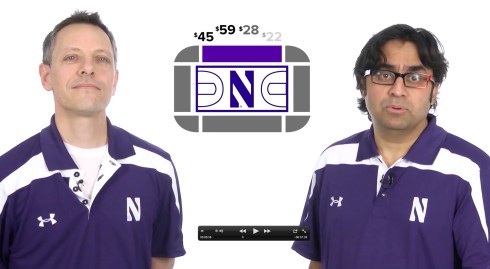
The system is live right now at NUSports.com. Support common-sense pricing by heading over there now and getting your tickets for either NU v Ohio State on Feb 28 or NU v Penn State on March 7.
And Go ‘Cats!
Update: Price alerts are now available. You may send email to wildcatmarketing@northwestern.edu to be notified when prices fall. (And if you just want to know when prices reach some target p, put that in your message.)

The paper doesn’t seem to exist yet but here are slides from talk by Raj Chetty, Emmanual Saez and Lazlo Sander. They randomly altered the incentives for referees at the Journal of Public Economics to see what it takes to get referees to give timely reports. Some referees were offered cash. Some were simply given shorter deadlines with no carrots. Still others were threatened with public shame if they did not submit reports on time. Not surprisingly the threat of humiliation caused many referees to refuse the contract altogether. Perhaps less surprisingly, cash didn’t do much better than simply shortening the deadline. The latter did help a bit.
Kofia krumple: Tobias Schmidt
Ever seen this? There’s a panel of experts and every couple weeks they are presented with a policy statement like “The debt ceiling creates too much uncertainty” and each one has to say individually whether they agree or disagree.
Randomize whether you put the statement in the affirmative or the negative: “The debt ceiling creates too much uncertainty” versus “The debt ceiling doesn’t create too much uncertainty”, and see how that affects how that affects which experts agree or disagree.
This is sublime writing. It will make your week, go and read it. Thanks to The Browser for the pointer.
Another good one from Scott Ogawa. It’s the Creampuff Dilemma. A college football coach has to set its pre-season non-conference schedule, thinking ahead to the end-of-season polling that decides Bowl Bids. A schedule stocked with creampuffs means lots of easy wins. But holding fixed the number of wins, a tough schedule will bolster your ranking.
Here’s Scott’s model. Each coach picks a number p between 0 and 1. He is successful (s=1) with probability p and unsuccessful (s=0) with probability 1-p. These probabilities are independent across players. (Think of these as the top teams in separate conferences. They will not be playing against each other.)
Highest s-p wins.
Lee Childs gets asked that question a lot.
But it’s a bad question. Its very form misleads writers and pushes them onto an unhelpful and overcomplicated track.
Because “How do you create suspense?” has the same interrogatory shape as “How do you bake a cake?” And we all know — in theory or practice — how to bake a cake. We need ingredients, and we infer that the better quality those ingredients are, the better quality the cake will be. We know that we have to mix and stir those ingredients, and we’re led to believe that the more thoroughly and conscientiously we combine them, the better the cake will taste. We know we have to cook the cake in an oven, and we figure that the more exact the temperature and timing, the better the cake will look.
So writers are taught to focus on ingredients and their combination. They’re told they should create attractive, sympathetic characters, so that readers will care about them deeply, and then to plunge those characters into situations of continuing peril, the descent into which is the mixing and stirring, and the duration and horrors of which are the timing and temperature.
But it’s really much simpler than that. “How do you bake a cake?” has the wrong structure. It’s too indirect. The right structure and the right question is: “How do you make your family hungry?”
And the answer is: You make them wait four hours for dinner.
As novelists, we should ask or imply a question at the beginning of the story, and then we should delay the answer. (Which is what I did here, and you’re still reading, right?)
It’s a great article but I agree with Emir Kamenica (deerstalker doff) who says that there’s one thing in there the author gets completely wrong.
The clocks in Grand Central are off by 1 minute:
But Grand Central, for years now, has relied on a system meant to mitigate, if not prevent, all the crazy. It is this: The times displayed on Grand Central’s departure boards are wrong — by a full minute. This is permanent. It is also purposeful.
The idea is that passengers rushing to catch trains they’re about to miss can actually be dangerous — to themselves, and to each other. So conductors will pull out of the station exactly one minute after their trains’ posted departure times. That minute of extra time won’t be enough to disconcert passengers too much when they compare it to their own watches or smartphones … but it is enough, the thinking goes, to buy late-running train-catchers just that liiiiiitle bit of extra time that will make them calm down a bit. Fast clocks make for slower passengers. “Instead of yelling for customers to hurry up,” the Epoch Times notes, “the conductors instead tell everyone to slow down.”
Not everyone is going to equilibrate, just the regulars. But that’s exactly what you want. If you set the clock right then everyone is rushing to the train just when its departing. If you set the clock 1 minute off and everyone equilibrates then still everyone rushes to the train when its departing.
The system works because some of the people adjust to the clock and others don’t. So the rush is spread over two minutes rather than one.
It’s the opposite of deduction. We didn’t sit down and try to figure something out.
It’s as if the computation happened so deep within our head, like all this time the basic facts were already there and in our subconscious minds they are stirring around until by chance one set of facts come together that happen to imply something new and the reaction creates an explosion big enough to get the attention of our conscious mind.
And at a conscious level we say “aha! I instinctively know something is true. But why?” And here’s where the 99% perspiration comes. We have to go back to find out why it’s true.
Ok sometimes we discover we were wrong. Other times we discover conclusively why we were right.
But almost always we can’t decide conclusively one way it another but we find reasons for what we believe.
And we believe what we believe. Rationally. We felt it instinctively. And that belief, that sensation is a thing. Its a signal. That we had that inspiration serves as information to us. We have faith in our beliefs.
To lack such faith would be to invite the padded cell.
So that’s another piece of evidence to go along with the facts. And it just might, again perfectly rationally, tip the balance.
 Cheap Talk