
You are currently browsing jeff’s articles.
- Its socially valuable for the University of Michigan measure consumer confidence and announce it even if that is an irrelevant statistic. Because otherwise somebody with less neutral motives would invent it, manipulate it, and publicize it.
- Kids are not purely selfish. They like it when they get better stuff than their siblings. To such an extent that they often feel mistreated when they see a sibling get some goodies.
- Someone should develop a behavioral theory of how people play Rock, Scissors, Paper when its common knowledge that humans can’t generate random sequences.
- The shoulder is the kludgiest joint because there are infinitely many ways to do any one movement. Almost surely you have settled into a sub-optimal way.
- I go to a million different places for lunch but at each one I always order one dish.
There is a stockpile of bottled water over here and a bunch of thirsty people over there. What should be done?
Before you can answer that question you first have to figure out what is possible. Don’t think yet about what institution or economic system you are going to use to bring about the outcome, first just ask what is feasible in principle.
There are two choices to make. First, which consumers will get water bottles (the allocation). And second, how much money will be transferred from the consumers to the suppliers (the transfers).
The welfare associated with any choice can be summarized by a pair of numbers: the total utility or surplus of consumers and the surplus of producers. You can plot the set of all such pairs that can be generated by some choice of allocation and transfers on a graph where consumer surplus is on one axis and producer surplus is on the other.
We are really interested in the Pareto efficient choices: the ones on the frontier of the feasible set. In our problem the frontier is a line with slope negative 1. Here’s how you achieve these points. First you allocate all of the water bottles to those consumers who value them the most. This achieves the maximum total surplus. Then you specify transfers in order to distribute this surplus in various ways between suppliers and consumers. As you vary the transfers you move along the frontier swapping producer for consumer surplus dollar for dollar.
Now that you have the feasible set you ask yourself what your social welfare function is. That is, how do you compare different points on the graph? You are essentially saying how you evaluate tradeoffs which reduce the utility of one individual and raise the utility of another. Once you have settled on a standard you choose the best point from the frontier according to that standard.
Then you start asking what economic system you can use to achieve it.
The price system is one. But the price system has a big problem. When water bottles are allocated by setting a price the two dimensions in your graph collapse into one. For example, if you want to achieve the surplus maximizing allocation with a price you are forced to accept one particular division of that surplus. There is a market clearing price p and every consumer who gets a bottle of water pays p to a supplier.
Another way of saying this is that market clearing prices correspond to one single point on your frontier. Is it the point you wanted before you started considering the price system as a mechanism? That would be quite an accident. And barring such a coincidence you are now left asking what else could be done within the confines of the price system?
You can choose a price different from the market clearing price. As you vary the price you do two things. First, you worsen the allocation and as a result total surplus goes down. So you move inside the old frontier. That’s bad. Second, you change the division of surplus. This traces out a new frontier giving you more than one choice. That’s good.
Now you can consult your social welfare function again and ask which point on the price-system-generated frontier do you like the best. Will it be the point corresponding to market-clearing prices? Of course it depends on your social welfare function but again it would be quite a coincidence.
For example it could be that market-clearing prices are very high and give almost all surplus to producers and leave consumers with close to zero surplus. If your social welfare function has diminishing marginal rate of substitution of one individual’s utility for another (whether they are consumers or producers, it doesn’t really matter) you will prefer a more interior point which would be achieved by setting prices below market-clearing levels. You are essentially willing to reduce total surplus by a bit (due to misallocation) in order to achieve a better distribution.
Thus, my response to Erik Brynjolffson, who writes in the comments to my post on price gouging:
Producers also are people, just like consumers, and we’d like to see their utility increased, ceteris paribus. Thus, even if production decisions don’t change, I don’t follow your argument that we should put zero weight on producer surplus.
is that nowhen did I say that we should do that and it’s not part of the argument. Instead the argument is that as long as you don’t think we should always be indifferent to arbitrarily reducing the surplus of one party in favor of another (again regardless of who is a consumer or a supplier) then your optimal price will not be the market-clearing price.
Let me emphasize that this is a very special problem because the quantity of water bottles was given, we don’t have to worry about incentives to produce. Another effect of the price system is to provide those incentives. And when supply is elastic, distorting prices reduces welfare for another reason: the quantity is distorted. The point I am making applies in the special cases when this distortion is small. For example when supply lines are cut in a natural disaster.
Other commenters, like Tyler Cowen, argue that supply cannot be considered perfectly inelastic even in rare, unexpected natural disasters. That’s true, but this is not a limiting argument. It doesn’t require perfectly inelastic supply. The tradeoff is still there with highly, but not perfectly, inelastic supply.
Eli Dourado wrote this on Twitter:
Despair. RT @GovChristie: The State Division of Consumer Affairs will look closely at any and all complaints about alleged price gouging.
When there’s a natural disaster some people, like Gov. Christie, start complaining in knee-jerk fashion about price gouging. And then some other people, with their knees jerking in exactly the same fashion, start complaining about people who complain about price gouging. The latter sets of knees usually belong to economists.
Suppose that an unexpected shock has occurred which has two effects. First, it increases demand for, say bottled water. Second, it cuts off supply lines so that in the short-run the quantity of bottled water in the relevant location is fixed at Q. A basic principle of economics is that if you wish to maximize total surplus then you should allow the price to adjust to its market-clearing level. This ensures that those Q consumers with the highest value for water get it. The total surplus will then be the sum of all their values.
The price plays two roles in this process, one crucial to the result, one just incidental and not necessarily intended. First, it separates out the high-value consumers from the low-value consumers. That’s the crucial role. Unavoidably it also plays a second role of taking some of that total surplus away from the consumers and giving it to producers. If you are maximizing total surplus you are completely indifferent to that second effect.
But what if you don’t want to maximize total surplus but just want to maximize consumers’ surplus? Your goal is that the Q bottles of water you’ve got should generate the greatest possible benefit for those who will consume them. I would bet that most people who understand the previous paragraph also assume that it applies equally well to the problem of maximizing consumer’s surplus. How else would you maximize it but to ensure that those with the highest value get the water?
But in fact it is quite typical for the consumer surplus maximizing solution to be a rationing system with a price below market clearing. I devoted a series of posts to this point last year. The basic idea is that the efficiency gains you get from separating the high-values from the low-values can be more than offset by the high prices necessary to achieve that and the corresponding loss of consumer surplus.
Why would we only care about consumers’ surplus and not also the surplus that goes to producers? We normally we care about producer’s surplus because that’s what gives producers an incentive to produce in the first place. But remember that a natural disaster has occurred. It wasn’t expected. Production already happened. Whatever we decide to do when that unexpected event occurs will have no effect on production decisions. We get a freebie chance to maximize consumer’s surplus without negative incentive effects on producers. And just at the time when we really care about the surplus of bottled water consumers!
Of course there are other good reasons to be skeptical of rationing in practice. It might not be enforceable, it might lead to inefficient rent-seeking, etc. But these objections mean that the debate should be about rationing in practice. The theoretical argument against it is weaker than many people think.
Tyler Cowen and Kevin Grier mention a curious fact:
Economists Andrew Healy, Neil Malhotra, and Cecilia Mo make this argument in afascinating article in the Proceedings of the National Academy of Science. They examined whether the outcomes of college football games on the eve of elections for presidents, senators, and governors affected the choices voters made. They found that a win by the local team, in the week before an election, raises the vote going to the incumbent by around 1.5 percentage points. When it comes to the 20 highest attendance teams—big athletic programs like the University of Michigan, Oklahoma, and Southern Cal—a victory on the eve of an election pushes the vote for the incumbent up by 3 percentage points. That’s a lot of votes, certainly more than the margin of victory in a tight race. And these results aren’t based on just a handful of games or political seasons; the data were taken from 62 big-time college teams from 1964 to 2008.
And Andrew Gelman signs off on it.
I took a look at the study (I felt obliged to, as it combined two of my interests) and it seemed reasonable to me. There certainly could be some big selection bias going on that the authors (and I) didn’t think of, but I saw no obvious problems. So for now I’ll take their result at face value and will assume a 2 percentage-point effect. I’ll assume that this would be +1% for the incumbent party and -1% for the other party, I assume.
Let’s try this:
- Incumbents have an advantage on average.
- Higher overall turnout therefore implies a bigger margin for the incumbent, again on average.
- In sports, the home team has an advantage on average.
- Conditions that increase overall scoring amplify the advantage of the home team.
- Good weather increases overall turnout in an election and overall scoring in a football game.
So what looks like football causes elections could really be just good weather causes both. Note well, I have not actually read the paper but I did search for the word weather and it appears nowhere.
Can opposite-sex friendships last? Only if the two are mutually deceived:
The results suggest large gender differences in how men and women experience opposite-sex friendships. Men were much more attracted to their female friends than vice versa. Men were also more likely than women to think that their opposite-sex friends were attracted to them—a clearly misguided belief. In fact, men’s estimates of how attractive they were to their female friends had virtually nothing to do with how these women actually felt, and almost everything to do with how the men themselves felt—basically, males assumed that any romantic attraction they experienced was mutual, and were blind to the actual level of romantic interest felt by their female friends. Women, too, were blind to the mindset of their opposite-sex friends; because females generally were not attracted to their male friends, they assumed that this lack of attraction was mutual. As a result, men consistentlyoverestimated the level of attraction felt by their female friends and women consistently underestimated the level of attraction felt by their male friends.
At some level this is automatically true. Assume simply this: all men are attracted to all women. Then which women will the men be friends with? The ones they expect to be able to hook up with. Of these friendships few will survive: if she figures out he is attracted to her she will either hookup with him (if its mutual) or run away (if its not). Either way the platonic friendship ends. The only surviving friendships will be those in which he thinks she’s attracted to him, she’s not attracted to him and she hasn’t yet figured out he’s attracted to her. QED.
Luigi Zingales writes that business schools are teaching MBA students to be criminals.
Oddly, most economists see their subject as divorced from morality. They liken themselves to physicists, who teach how atoms do behave, not how they should behave. But physicists do not teach to atoms, and atoms do not have free will. If they did, physicists would and should be concerned about how the atoms being instructed could change their behavior and affect the universe. Experimental evidence suggests that the teaching of economics does have an effect on students’ behavior: It makes them more selfish and less concerned about the common good. This is not intentional. Most teachers are not aware of what they are doing.
My colleague Gary Becker pioneered the economic study of crime. Employing a basic utilitarian approach, he compared the benefits of a crime with the expected cost of punishment (that is, the cost of punishment times the probability of receiving that punishment). While very insightful, Becker’s model, which had no intention of telling people how they should behave, had some unintended consequences. A former student of Becker’s told me that he found many of his classmates to be remarkably amoral, a fact he took as a sign that they interpreted Becker’s descriptive model of crime as prescriptive. They perceived any failure to commit a high-benefit crime with a low expected cost as a failure to act rationally, almost a proof of stupidity. The student’s experience is consistent with the experimental findings I mentioned above.
I remember a commercial for some kind of diet program where that was the tagline. A disembodied hand kept enticing this poor guy with delicious looking food and then taking it away because it was unhealthy and then the voiceover came in with that line and I thought that was so tragic that everything that tastes good had to be bad for you. Like what kind of cruel joke is that?
And it makes no sense from a biological point of view. I should want to eat what’s good for me so that I do eat what’s good for me and avoid what’s bad for me. That’s Mother Nature’s optimal incentive scheme. And once we have evolved to the point that we can think and understand that principle we should be able to infer that whatever tastes good must in fact be good for us. But it’s not!
At the margin it’s not. Indeed the right statement is “If it tastes good then you surely have already had too much of it to the point that any more of it is bad for you.” Because the basic elements in food that we love, namely sugar, salt, and fat, are all not just good for us but pretty much essential for survival. And so of course we are programmed to like those things enough that we are incentivized to consume enough of them to survive.
But the decision whether to eat something is based on costs as well as benefits. Nature programmed our tastes so that we internalize the benefits but it’s up to us to figure out the costs: how abundant is it, how hard is it to acquire, and when it’s sitting there before us how likely is it that we will have a chance to eat it again in the near future. Then we need to weigh the costs and benefits and eat up to the quantity where marginal costs equal marginal benefits.
It’s interesting that Nature put a little price theory to use when she worked all this out. A price is a linear incentive scheme. Every additional unit you buy costs you the same price as the last one. Your taste for food is like a linear subsidy, every unit tastes about as good as the last, at least up to a point. When you face linear incentives like that you consume up to the point where your personal, idiosyncratic marginal cost equals the given marginal benefit. If a planner (like your Mother Nature) wants to get you to equate marginal cost and marginal benefit, a (negative) price is a crude incentive scheme because the true marginal benefits might be varying with quantity but the subsidy makes you act as if its constant.
But that’s ok when the price is set right. The planner just sets the subsidy equal to the marginal benefit at the optimal quantity. Then when you choose that quantity you will in fact be equating marginal cost to the true marginal benefit. That’s a basic pillar of price theory.
So Nature assumed she knew pretty well what the optimal quantity of sugar, salt, and fat are and gave us a taste for those elements that was commensurate with the true marginal benefit at that optimal point. And its pretty much a linear incentive scheme at least in a large neighborhood of the target quantity. Sugar, salt and fat don’t seem to diminish in appeal until we have had quite a lot of it.
The problem is that the optimal quantity depends on both the value function and the cost function. Now the value function, i.e. the health benefits of various consumption levels is probably the same as it has always been. But the cost function has changed a lot. Nature was never expecting Mountain Dew, Potato Chips and Ice Cream. The reduction in marginal cost means that the optimal quantity is higher, but how much higher? That depends on how the shape of the value function at higher quantities. The old linear incentive scheme contains no information at all about that.
But one thing is for sure. If the true marginal benefit is declining, then at higher quantities the linear incentive scheme built into our taste buds overstates the marginal benefit. So when we equate the new marginal cost to the linear price we are doing what is privately optimal for us but what is certainly too high compared to Nature’s optimum. If it tastes good its bad for us we because we have already had too much.
From Nature news.
Calcagno, in contrast, found that 3–6 years after publication, papers published on their second try are more highly cited on average than first-time papers in the same journal — regardless of whether the resubmissions moved to journals with higher or lower impact.
Calcagno and colleagues think that this reflects the influence of peer review: the input from referees and editors makes papers better, even if they get rejected at first.
Based on my experience with economics journals as an editor and author I highly doubt that. Authors pay very close attention to referees’ demands when they are asked to resubmit to the same journal because of course those same referees are going to decide on the next round. On the other hand authors pretty much ignore the advice of referees who have proven their incompetence by rejecting their paper.
Instead my hypothesis is that authors with good papers start at the top journals and expect a rejection or two (on average) before the paper finally lands somewhere reasonably good. Authors of bad papers submit them to bad journals and have them accepted right away. Drew Fudenberg suggested something similar.
There is a pattern to how people arrange themselves in elevators depending on the number of other passengers. (via The Morning News.)
If someone else comes in, we may have to move. And here, it has been observed that lift-travellers unthinkingly go through a set pattern of movements, as predetermined as a square dance.
On your own, you can do whatever you want – it’s your own little box.
If there are two of you, you take different corners. Standing diagonally across from each other creates the greatest distance.
When a third person enters, you will unconsciously form a triangle (breaking the analogy that some have made with dots on a dice). And when there is a fourth person it’s a square, with someone in every corner. A fifth person is probably going to have to stand in the middle.
I liked the part where it is explained why we are socially awkward in elevators.
“You don’t have enough space,” says Professor Babette Renneberg, a clinical psychologist at the Free University of Berlin.
I had just eaten a little plastic carton of yogurt and I tossed it into the recycling bin. She said “That yogurt carton needs to be rinsed before you can recycle it.” And I thought to myself “That can’t be true. First of all, the recyclers are going to clean whatever they get before they start processing it so it would be a waste for me to do it here. Plus, the minuscule welfare gains from recycling this small piece of plastic would be swamped by water, labor, and time costs of rinsing it.” I concluded that, as a matter of policy, I will not rinse my recyclable yogurt containers.
So I replied “Oh yeah you’re right.”
You see, I didn’t want to dig through the recycling bin and rinse that yogurt cup. By telling her that I agree with her general policy, I stood a chance of escaping its mandate in this particular instance. Because knowing that I share her overall objective, she would infer that was that my high private costs of digging through the recycling that dictated against it under these special circumstances. And she would agree with me that letting this exceptional case go was the right decision.
If instead I told her I disagreed with her policy, then she would know that my unwillingness was some mix of private costs and too little weight on the social costs. Even if she internalizes my private costs she would have reason to doubt they were large enough to justify a pass on the digging and rinsing and she might just insist on it.
Yes, Boldrin and Levine keep saying the same thing over and over again, but they sure get better and better at saying it:
If a well-designed patent system would serve the intended purpose, why recommend abolishihg it? Why not, instead, reform it? To answer the question we need to investigate the political economy of patents: why has the political system resulted in the patent system we have? Our argument is that it cannot be otherwise: the “optimal” patent system that a benevolent dictator would design and implement is not of this world and it is pointless to advocate it as, by doing so, one only offers an intellectual fig-leaf to the patent system we actually have, which is horribly broken. It is fine to recommend reform but, if politics make it impossible to accomplish that reform, if they make it inevitable that if we have a patent system it will fail, then abolition – preferably by constitutional means as was the case in Switzerland and the Netherlands prior to the late 19th century – is the proper solution and proposals of reform are doomed to fail. This logic of political economy brings us to the view that we should work toward a progressive dismantlement of the patent system.
Read the article here.
A new joint paper with Alex Frankel and Emir Kamenica. The talk begins with tennis, the discussion of American Idol begins at 12:14, how to write a mystery novel is at 15:51, the M. Night Shamyalan dilemma is at 17:32, the ESPN Classic dilemma is at 18:50, and the optimal sporting contest is at 28:37.
- How many Connect Four game pieces can be missing without affecting the outcome? (ht: Adriana LLeras-Muney)
- I want reverse autocorrect: if I receive a nonsense message on my phone I want to be able to highlight any word and get a list of the most likely typos that would have been autocorrected into that word.
- I have never seen a Singaporean restaurant in the United States. I have never seen Laksa in the United States. I don’t understand this.
- When a plumber or other fixit guy comes, you will almost always want to call him back a few days later to make some minor adjustments, or fix something they forgot to, or to ask them some questions. But the second visit will cost you. So when they are there the first time, steal one of their tools. Then call them back a few days later and tell them they left something behind and they can come pick it up.
Some time ago I had half-written a post calling for a Nobel prize for Al Roth. It was after he gave his Nancy Schwartz lecture at Kellogg and I decided not to publish it because I thought maybe it was just a little too soon. Not too soon to get the prize but too soon to expect the Nobel folks to give it to him. I am glad I was wrong.
Don’t forget his very important co-authors Tayfun Sonmez, Attila Abdulkadiroglu, and Utku Unver. These guys, Tayfun especially, were still working on matching theory when nobody else was interested and before all the practical applications (mainly coming out of their collaboration with Al) started to attract attention.
This is a time for microeconomics to celebrate. When you are on a plane and you tell the person next to you that you’re an economist, they ask you about interest rates. Everyone instinctively equates economics with macroeconomics. And that’s probably because most people have the impression that macroeconomics is where economists have the biggest impact.
But actually microeconomic theory has already had a bigger impact on your life that macroeconomic theory ever will. And there’s no politics tangled up in microeconomics. When you meet a microeconomic theorist it never once occurs to you to check the saline content of their nearest body of water.
There are no fundamental disagreements about basic principles of microeconomics. And I would say that Al Roth epitomizes what’s great about microeconomics. He has no “field:” he does classical game theory/bargaining theory and he does behavioral economics. He does theory and experiments. He theorizes about market design and he actually designs markets.
Al is the second blogger to win a Nobel prize. Compare their fields and their blogs.
I never met Shapley and I only saw him give a couple talks when he was already way past his prime. But gappy3000 reminds me that he and John Nash invented a game called Fuck Your Buddy. So that’s something. And now he has a Nobel Prize. And of course without his work there would be no prize for Roth either. David Gale should have shared the prize but he died a few years ago.
Temporary parking sign spotted near the Stanford GSB/Economics department by Michael Ostrovsky (via Google+)

The abstract:
This is a line-by-line analysis of the second verse of 99 Problems by Jay-Z, from the perspective of a criminal procedure professor. It’s intended as a resource for law students and teachers, and for anyone who’s interested in what pop culture gets right about criminal justice, and what it gets wrong.
For example:
E. Line 7
So I pull over . . . At this point, Jay-Z has been seized, for purposes of Fourth Amendment analysis, because he has submitted to a show of police authority. He has thus preserved his Fourth Amendment claims. If you are stopped illegally and want to fight it later, you have to submit to the show of authority. In this case, if the police find the contraband, he’ll be able to challenge it in court. Smart decision here by Jay-Z.
The full paper is here, I thank the organic Troy Kravitz for the link.
You are planning a nice dinner and are shopping for the necessary groceries. After having already passed the green onions you are reminded that you actually need green onions upon discovering exactly that vegetable, in a bunch, bagged, and apparently abandoned by another shopper. Do you grab the bag before you or turn around and go out of your way to select your own bunch?
- This bag was selected already, and from a weakly larger supply. It is therefore likely to be better than the best you will find there now.
- On the other hand, it was abandoned. You have to ask yourself why.
- You would worry if the typical shopper’s strategy is to select a bag at random and then only carefully inspect it later. Because then it was abandoned because of some defect.
- But this a red herring. Whatever she could see wrong with the onions you can see too. The only asymmetry of information between you and your pre-shopper is about the unchosen onions. The selection effect works unambiguoulsy in favor of the scallions-in-hand.
- You can gain information based on where the onions were abandoned.
- First of all the fact that they were abandoned somewhere other than the main pile of onions reveals that she was not rejecting these in favor of other onions. If so, since she was going back to the onion pile she would have brought these with her. Instead she probably realized that she didn’t need the onions after all. So again, no negative signal.
- If these bunched green onions were abandoned in front of the loose green onions or the leeks or ramps, then this is an even better signal. She thought these were the best among the green onions but later discovered an even better ingredient. A sign she has discerning tastes.
- It is true though that compared to a randomly selected new bunch, these have been touched by on average one additional pair of human hands.
- And also she might be trying to poison you.
- But if she was trying to poison someone, is it her optimal strategy to put the poisoned onions into a bag and abandon them in a neighboring aisle?
- In equilibrium all bunches are equally likely to be poisoned and the bagging and abandoning ploy amounts to nothing more than cheap talk.
- But, she might not be trying to poison just any old person. She might really be targeting you, the guy who wants the best bunch of onions in the store.
- Therefore these onions are either logically the best onions in the store and therefore poisoned, or they are worse than some onions back in the big pile but then those are poisoned.
- Opt for take-out.
On the definitions of Pareto efficiency and surplus maximization and their connection. I have also updated my slides for this lecture, presenting things in a different order in a way that I think makes a bigger impact. You can find them here.
[vimeo 50833662 w=500&h=280]
When you grade exams in a large class you inevitably face the misunderstood question dilemma. A student has given a correct answer to a question but not the question you asked. As an answer to the question you asked it is flat out wrong. How much credit should you give?
It should not be zero. You can make this argument at two levels. First, ex post, the student’s answer reveals some understanding. To award zero points would be to equate this with writing nothing at all. That’s unfair.
You might respond by saying, tough luck, it is my policy not to reward misunderstanding the question. But even ex ante it is optimal to commit to a policy which gives at least partial credit to fortuitous misunderstanding. The only additional constraint at the ex ante stage is incentive compatibility. You don’t want to reward a student who interprets the question in a way that makes it easier and then supplies a correct answer to the easier question.
But you should reward a student who invents a harder question and answers that. And you should make it known in advance that you will do so. Indeed, taken to its limit, the optimal exam policy is to instruct the students to make up their own question and answer it, with harder questions (correctly answered) worth more than easier ones.
Incidentally I was once in a class where a certain professor asked exactly such a question.
I wrote about it here. I had a look at the video and it was the right call given the rule, but as I argued in the original post the rule is an unnecessary kludge. At best, it does nothing (in equilibrium.)
- Here’s another video of a cool and educational thing to do with your kids for you to bookmark for later but never actually do.
- I can name a few people who really are this obsessed with font spacing.
- I don’t even want to guess what you’re supposed to do in the one with the tandem bidet.
- The Shining with a laugh track and Seinfeld bumper music.
From an interview in Rolling Stone:
Oh, yeah, in folk and jazz, quotation is a rich and enriching tradition. That certainly is true. It’s true for everybody, but me. There are different rules for me. And as far as Henry Timrod is concerned, have you even heard of him? Who’s been reading him lately? And who’s pushed him to the forefront? Who’s been making you read him? And ask his descendants what they think of the hoopla. And if you think it’s so easy to quote him and it can help your work, do it yourself and see how far you can get. Wussies and pussies complain about that stuff. It’s an old thing – it’s part of the tradition. It goes way back. These are the same people that tried to pin the name Judas on me. Judas, the most hated name in human history! If you think you’ve been called a bad name, try to work your way out from under that. Yeah, and for what? For playing an electric guitar? As if that is in some kind of way equitable to betraying our Lord and delivering him up to be crucified. All those evil motherfuckers can rot in hell.
Read Gary Shteyngart’s painfully comic post-mortem following a surreal transatlantic flight on American Airlines:
At Heathrow, fire trucks met us because we landed “heavy,” i.e., still full of fuel we never got to spend over the Atlantic. At the terminal, a woman in a spiffy red American Airlines blazer was sent to greet us. But the language she spoke — Martian — was not easily understood, versed as we were in Spanish, English, Russian and Urdu.
Using her Martian language skills, the American Airlines woman proposed to take us “through the border” at Heathrow, for a night of rest before we resumed our journey the next morning. An apocalyptic scenario: an employee of the world’s worst airline assigned to the world’s worst border crossing at the world’s worst airport.
The Martian took us to one immigration lane, which promptly closed. Then another, with the same result. A third, ditto. Despite her blazer, the Martian was obviously not the ally we had made her out to be. So, ducking under security ropes, knocking some down entirely, we rushed the border with our passports held aloft, proclaiming ourselves the citizens of a fading superpower.
There seems to be something going on at American Airlines. As a part of bankruptcy proceedings they are trying to get concessions from the pilot’s union. The pilots appear to have found a clever way to fight back: obey the letter of the contract and in so doing violate its spirit with extreme prejudice:
Long story short, American is totally screwed. What management is discovering right now is that formal contracts can’t fully specify what it is that “doing your job properly” constitutes for an airline pilot. The smooth operation of an airline requires the active cooperation of skilled pilots who are capable of judging when it does and doesn’t make sense to request new parts and who conduct themselves in the spirit of wanting the airline to succeed. By having the judge throw out the pilots’ contract, the airline has totally lost faith with its pilots and has no ability to run the airline properly. It’s still perfectly safe, but if your goal is to get to your destination on time, you simply can’t fly American. The airline is writing checks it can’t cash when it tells you when your flights will be taking off and landing.
Taqiyah tap: Mallesh Pai
Its the same reason the lane going in the opposite direction is always flowing faster. This is a lovely article that works through the logic of conditional proportions. I really admire this kind of lucid writing about subtle ideas. (link fixed now, sorry.)
This phenomenon has been called the friendship paradox. Its explanation hinges on a numerical pattern — a particular kind of “weighted average” — that comes up in many other situations. Understanding that pattern will help you feel better about some of life’s little annoyances.
For example, imagine going to the gym. When you look around, does it seem that just about everybody there is in better shape than you are? Well, you’re probably right. But that’s inevitable and nothing to feel ashamed of. If you’re an average gym member, that’s exactly what you should expect to see, because the people sweating and grunting around you are not average. They’re the types who spend time at the gym, which is why you’re seeing them there in the first place. The couch potatoes are snoozing at home where you can’t count them. In other words, your sample of the gym’s membership is not representative. It’s biased toward gym rats.
- Is it that women like to socialize more than men do or is it that everyone, men and women alike, prefers to socialize with women?
- A great way to test for strategic effort in sports would be to measure the decibel level of Maria Sharapova’s grunts at various points in a match.
- If you are browsing the New York Times and you are over your article limit for the month, hit the stop button just after the page renders but before the browser has a chance to load the “Please subscribe” overlay. This is easy on slow browsers like your phone.
- Given the Archimedes Principle why do we think that the sea level will rise when the Polar Caps melt?
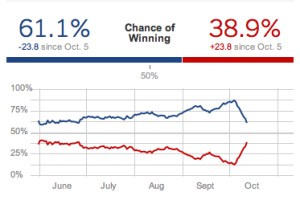
Nate Silver’s 538 Election Forecast has consistently given Obama a higher re-election probability than InTrade does. The 538 forecast is based on estimating vote probabilities from State polls and simulating the Electoral College. InTrade is just a betting market where Obama’s re-election probability is equated with the market price of a security that pays off $1 in the event that Obama wins. How can we decide which is the more accurate forecast? When you log on in the morning and see that InTrade has Obama at 70% and Nate Silver has him at 80%, on what basis can we say that one of them is right and the other is wrong?
At a philosophical level we can say they are both wrong. Either Obama is going to win or Romney is going to win so the only correct forecast would give one of them 100% chance of winning. Slightly less philosophically, is there any interpretation of the concept of “probability” relative to which we can judge these two forecasting methods?
One way is to define probability simply as the odds at which you would be indifferent between betting one way or the other. InTrade is meant to be the ideal forecast according to this interpretation because of course you can actually go and bet there. If you are not there betting right now then we can infer you agree with the odds. One reason among many to be unsatisfied with this conclusion is that there are many other betting sites where the odds are dramatically different.
Then there’s the Frequentist interpretation. Based on all the information we have (especially polls) if this situation were repeated in a series of similar elections, what fraction of those elections would eventually come out in Obama’s favor? Nate Silver is trying to do something like this. But there is never going to be anything close to enough data to be able to test whether his model is getting the right frequency.
Nevertheless, there is a way to assess any forecasting method that doesn’t require you to buy into any particular interpretation of probability. Because however you interpret it, mathematically a probability estimate has to satisfy some basic laws. For a process like an election where information arrives over time about an event to be resolved later, one of these laws is called the Martingale property.
The Martingale property says this. Suppose you checked the forecast in the morning and it said Obama 70%. And then you sit down to check the updated forecast in the evening. Before you check you don’t know exactly how its going to be revised. Sometimes it gets revised upward, sometimes downard. Soometimes by a lot, sometimes just a little. But if the forecast is truly a probability then on average it doesn’t change at all. Statistically we should see that the average forecast in the evening equals the actual forecast in the morning.
We can be pretty confident that Nate Silver’s 538 forecast would fail this test. That’s because of how it works. It looks at polls and estimates vote shares based on that information. It is an entirely backward-looking model. If there are any trends in the polls that are discernible from data these trends will systematically reflect themselves in the daily forecast and that would violate the Martingale property. (There is some trendline adjustment but this is used to adjust older polls to estimate current standing. And there is some forward looking adjustment but this focuses on undecided voters and is based on general trends. The full methodology is described here.)
In order to avoid this problem, Nate Silver would have to do the following. Each day prior to the election his model should forecast what the model is going to say tomorrow, based on all of the available information today (think about that for a moment.) He is surely not doing that.
So 70% is not a probability no matter how you prefer to interpret that word. What does it mean then? Mechanically speaking its the number that comes out of a formula that combines a large body of recent polling data in complicated ways. It is probably monotonic in the sense that when the average poll is more favorable for Obama then a higher number comes out. That makes it a useful summary statistic. It means that if today his number is 70% and yesterday it was 69% you can logically conclude that his polls have gotten better in some aggregate sense.
But to really make the point about the difference between a simple barometer like that and a true probability, imagine taking Nate Silver’s forecast, writing it as a decimal (70% = 0.7) and then squaring it. You still get a “percentage,” but its a completely different number. Still its a perfectly valid barometer: its monotonic. By contrast, for a probability the actual number has meaning beyond the fact that it goes up or down.
What about InTrade? Well, if the market it efficient then it must be a Martingale. If not, then it would be possible to predict the day-to-day drift in the share price and earn arbitrage profits. On the other hand the market is clearly not efficient because the profits from arbitraging the different prices at BetFair and InTrade have been sitting there on the table for weeks.
The excellent people ant NUIT have helped me put together a series of small videos that complement my Microeconomic Theory course. I start teaching today and I will be posting the videos here as the course progresses. You can find my slides here and eventually all the videos will be there too, organized by lecture. These videos are 5-10 minutes each and are meant to be high-level synopses of the main themes of each lecture. The slides as well as the videos are released to the public domain under Creative Commons (non-commercial, attribution, share-alike) licenses. The first video is on Welfare Economics and features figure skating.
While we are on the subject please read Josh Gans’ on-the-money thoughts about free online education.
The eternal Kevin Bryan writes to me:
Consider an NFL team down 15 who scores very late in the game, as happened twice this weekend. Everybody kicks the extra point in that situation instead of going for two, and is then down 8. But there is no conceivable “value of information” model that can account for this – you are just delaying the resolution of uncertainty (since you will go for two after the next touchdown). Strange indeed.
Let me restate his puzzle. If you are in a contest and success requires costly effort, you want to know the return on effort in order to make the most informed decision. In the situation he describes if you go for the 2-pointer after the first touchdown you will learn something about the return on future effort. If you make the 2 points you will know that another touchdown could win the game. If you fail you will know that you are better off saving your effort (avoiding the risk of injury, getting backups some playing time, etc.)
If instead you kick the extra point and wait until a second touchdown before going for two there is a chance that all that effort is wasted. Avoiding that wasted effort is the value of information.
The upshot is that a decision-maker always wants information to be revealed as soon as possible. But in football there is a separation between management and labor. The coach calls the plays but the players spend the effort. The coach internalizes some but not all of the players’ cost of effort. This can make the value of information negative.
Suppose that both the coach and the players want maximum effort whenever the probability of winning is above some threshold, and no effort when its below. Because the coach internalizes less of the cost of effort, his threshold is lower. That is, if the probability of winning falls into the intermediate range below the players’ threshold and above the coach’s threshold, the coach still wants effort from them but the players give up. Finally, suppose that after the first touchdown the probability of winning is above both thresholds.
Then the coach will optimally choose to delay the resolution of uncertainty. Because going for two is either going to move the probability up or down. Moving it up has no effect since the players are already giving maximum effort. Moving it down runs the risk of it landing in that intermediate area where the players and coach have conflicting incentives. Instead by taking the extra point the coach gets maximum effort for sure.
 Cheap Talk