
You are currently browsing jeff’s articles.

It’s hard to model serendipity in a rational choice framework. For example, people say that the web’s ability to focus your attention on subjects you like prevents you from being exposed to new stuff and that makes you worse off. That may be true, but it could never be true in a rational framework because if you wanted exposure to new stuff you would choose that. (I am leaving out market structure explanations, i.e. the market for serendipitous content may shrink. That’s beside the point I am making and anyway I would guess exactly the opposite. I can always take advantage of the increased diversity in content by supplying my own randomness.)
But here’s a version of serendipity that may be rationalized. I have started reading blogs in my Google reader using the “All Items” tab where all the articles in all the blogs I subscribe to are listed in a flat format in chronological order, rather than blog-by-blog. I have found a non-obvious effect of serendipity: not knowing which blog I am reading and just reading the article prevents me from approaching it with expectation of the author’s prior biases, etc. I recommend it.
For some kinds of information it may be beneficial to hide the source. For example, pure rhetoric. My ability to judge whether it is convincing or not is based purely on the logical connections between premise and conclusion and my prior beliefs about the plausibility of the premises. Knowing the author of the rhetoric provides no additional information. And if, for psychological reasons, knowing the source biases my interpretation then I am strictly better off having it hidden from me. (At least temporarily)
You will complain that by appealing to psychological biases I have departed from the rational choice framework. But I think there is a useful distinction between rational choice, and rational information processing (if the latter even has any meaning.) If I can be expected to choose my sources rationally then there is no role for serendipitous exposure to new sources, even if I make errors in processing information. But rational choice together with (self-aware) processing errors can justify keeping the source hidden.
(Drawing by Stephanie Yee.)
What was slated to be the world’s first brothel for women has been put on hold in New Zealand. The reasons are murky but here’s one tangential item:
At the time of the launch, Corkery claimed that hundreds of men had applied to be $240-an-hour gigolos and satisfy the demands of Kiwi women wanting sex.
No surprises there! NZ$240 = US$200 (approximately.) Your first reaction is that the market clearing price must be much lower than that, possibly negative. But demand is certainly non-standard in this market due to adverse selection. How much are Kiwi women willing to pay to have sex with a man who is paying to have sex with her? It could easily be that we need a price high enough to increase the supply of men who have valuable outside options. You may just have to live with excess supply.
Whatever-hat-you-wear-to-a-brothel (I wouldn’t know) insert-your-favorite-gesture: Arthur Robson.
- Among the males in my family tree, underwear preference alternates generations: briefs then boxers then briefs…
- Smoking guns for this theory. Italians who pronounce the hard b in the word “subtle”, and pronounce “differ” as in “diffAIR” (they have no trouble with water, later, etc.) Also, the hard p in “psychology.”
- Here’s the best way to get your wife to agree to a parenting strategy X: “My mother tried not-X and that didn’t work.”
- I want to play a negative drum: it makes a sound except when I hit it.
- What is the effect on equilibrium search models and assortative matching when once-matched, husbands can use headscarves to hide the quality of their mate from potential poachers?
- Telling a joke about the Dalai Lama to the Dalai Lama.
- Cricket and the Billie Jean mystery.
- This way you can write normal and still refuse to obey the lines.
- Search Sarah Palin’s inbox. My searches: pics, confidential, bastards, the indian with one testicle. Post your favorite searches in the comments.
- This is my new favorite blog: Helpful Hints for Everyday Living.

A reader, Kanishka Kacker, writes to me about Cricket:
Now, very often, there are certain decisions to be made regarding whether a given batter was out or not, where it is very hard for the umpire to decide. In situations like this, some players are known to walk off the field if they know they are “out” without waiting for the umpire’s decision. Other players don’t, waiting to see the umpire’s decision.
Here is a reason given by one former Australian batsman, Michael Slater, as to why “walking” is irrational:
(this is from Mukul Kesavan’s excellent book “Men in White”)
“The pragmatic argument against walking was concisely stated by former Australian batsman Michael Slater. If you walk every time you’re out and are also given out a few times when you’re not (as is likely to happen for any career of a respectable length), things don’t even out. So, in a competitive team game, walking is, at the very least, irrational behavior. Secondarily, there is a strong likelihood that your opponents don’t walk, so every time you do, you put yourself or your team at risk.”
What do you think?
Let me begin by saying that the only thing I know about Cricket is that “Ricky Ponting” was either the right or the wrong answer to the final question in Slumdog Millionaire. Nevertheless, I will venture some answers because there are general principles at work here.
- First of all, it would be wrong to completely discount plain old honor. Kids have sportsmanship drilled into their heads from the first time they start playing, and anyone good enough to play professionally started at a time when he or she was young enough to believe that honor means something. That can be a hard doctrine to shake. Plus, as players get older and compete in at more selective levels, some of that selection is on the basis of sportsmanship. So there is some marginal selection for honorable players to make it to the highest levels.
- There is a strategic aspect to honor. It induces reciprocity in your opponent through the threat of shame. If you are honorable and walk, then when it comes time for your opponent to do the same, he has added pressure to follow suit or else appear less honorable than you. Even if he has no intrinsic honor, he may want to avoid that shame in the eyes of his fans.
- But to get to the raw strategic aspects, reputation can play a role. If a player is known to walk whenever he is out then by not walking he signals that he is not out. In those moments of indecision by the umpire, this can tip the balance and get him to make a favorable call. You might think that umpires would not be swayed by such a tactic but note that if the player has a solid reputation for walking then it is in the umpire’s interest to use this information.
- And anyway remember that the umpire doesn’t have the luxury to deliberate. When he’s on the fence, any little nudge can tilt him to a decision.
- Most importantly, a player’s reputation will have an effect on the crowd and their reactions influence umpires. If the fans know that he walks when he’s out and this time he didn’t walk they will let the umpire have it if he calls him out.
- There is a related tactic in baseball which is wh
 ere the manager kicks dirt onto the umpire’s shoes to show his displeasure with the call. It is known that this will never influence the current decision but it is believed to have the effect of “getting into the umpire’s head” potentially influencing later decisions.
 - Finally, it is important to keep in mind that a player walks not because he knows he is out but because he is reasonably certain that the umpire is going to decide that he is out whether or not he walks. The player may be certain that he is not out but only because he is in a privileged position on the field where he can determine that. If the umpire didn’t have the same view, it would be pointless to try and persuade. Instead he should walk and invest in his reputation for the next time when the umpire is truly on the fence.
Dan Ariely, Chris Anderson, Hal Varian and others are heading Startup-Onomics: a Behavioral Economics “Summit” for entrepreneurs.
What is behavioral economics?
As business owners, we want to design products that are useful, we want customers (lots of them), and we want to create a motivating work environment. But it’s not that easy. In fact, most of the time that stuff takes a lot of hard work and a lot of trial and error.
Good news. There is a science called Behavioral Economics. This attempts to understand people’s day to day decisions (where do I get my morning coffee?) and people’s big decisions (How much should I save for retirement?).
Understanding HOW your users make decisions and WHY they make them is powerful. With this knowledge, companies can build more effective products, governments can create impactful policies and new ideas can gain faster traction.
Sessions include “How to get people to pay what they want,” and “The creation and role of habits in purchasing decisions,” etc.
Emperor penguins form a group huddle to share warmth as they wait for eggs to hatch. How do they coordinate?
Emperor penguins are the only vertebrates that breed during the austral winter where they have to endure temperatures below −45°C and winds of up to 50 m/s while fasting. From their arrival at the colony until the eggs hatch and the return of their mates, the males, who solely incubate the eggs, fast for about 110–120 days [1]–[3]. To conserve energy and to maintain their body temperature[4], the penguins aggregate in huddles where ambient temperatures are above 0°C and can reach up to 37°C [1]–[3].
Huddling poses an interesting physical problem. If the huddle density is too low, the penguins lose too much energy. If the huddle density is too high, internal rearrangement becomes impossible, and peripheral penguins are prevented to reach the warmer huddle center. This problem is reminiscent of colloidal jamming during a fluid-to-solid transition [5]. In this paper we show that Emperor penguins prevent jamming by a recurring short-term coordination of their movements.
What are the individual incentives in the huddle? It would seem that the dynamics would be governed by the need to prevent manipulation by a self-interested penguin.
Check out this video (unfortunately you have to click to download it, its about 30MB. there is no streaming version.)

The voice is the most expressive musical instrument and it also is the most directly connected to the creative engine. Shouldn’t it be the premier instrument for improvisation? That would be scat. Indeed scat is the most expressive form of improvisation but it is not very popular. A trumpet solo carries us along but scat just sounds weird. Why is that?
The words “scat” and “virtuoso” leave Google cold.
Could it be that a big part of what we appreciate about improvisation is the awesome physical skill that comes from training on an external instrument? Scatting is too easy.
Could it be akin to the uncanny valley? Audiences feel uncomfortable watching animated characters that look too similar to real people. Is scatting too much like singing?
Why are vocalists not using electronics to digitally transform their voice into something that sounds more less like a voice. Then they could utilize the expressiveness and fluidity of the voice and fool the audience into thinking it was an instrument. Autotune?
Would it be more attractive if the scat made sense? Why are there no vocalists who take written lyrics and then improvise them into a melody?
Listen to Clark Terry.
If someone could make a trumpet sound like that they would be heralded as a genius.
via The Browser, This article was thoroughly engaging from start to finish. It’s about a convict who faked insanity so that they would put him in the psycho ward instead of prison. And then he realizes what a huge mistake that was.
Tony said the day he arrived at the dangerous and severe personality disorder (DSPD) unit, he took one look at the place and realised he’d made a spectacularly bad decision. He asked to speak urgently to psychiatrists. “I’m not mentally ill,” he told them. It is an awful lot harder, Tony told me, to convince people you’re sane than it is to convince them you’re crazy.
So he tries to be co-operative in the hospital to prove that he wasn’t really criminally insane. According to his doctors that was a sure sign he belonged in the hospital.
I glanced suspiciously at Tony. I instinctively didn’t believe him about this. It seemed too catch-22, too darkly-absurd-by-numbers. But later Tony sent me his files and, sure enough, it was right there. “Tony is cheerful and friendly,” one report stated. “His detention in hospital is preventing deterioration of his condition.”
Then he tried the opposite.
After Tony read that, he said, he started a kind of war of non co-operation. This involved staying in his room a lot. On the outside, Tony said, not wanting to spend time with your criminally insane neighbours would be a perfectly understandable position. But on the inside it demonstrates you’re withdrawn and have a grandiose sense of your own importance. In Broadmoor, not wanting to hang out with insane killers is a sign of madness.
Eventually his doctors figured out that he had been faking it. But of course the willingness to fake criminal insanity in order to go to the psycho ward is all the more reason to stay there.
But then I read Maden’s next line: “Most psychiatrists who have assessed him, and there have been a lot, have considered he is not mentally ill, but suffers from psychopathy.”…
Faking mental illness to get out of a prison sentence, Maden explained, is exactly the kind of deceitful and manipulative act you’d expect of a psychopath.
A psychopath is basically someone who appears perfectly normal on the surface but lacks normal moral restraints that make people socially fit. And just as it is hard to prove that you are not a psychopath it becomes really easy to conclude that everybody else is one.
My mind drifted to what I could do with my new powers. If I’m being honest, it didn’t cross my mind to become some kind of great crime fighter, philanthropically dedicated to making society a safer place. Instead, I made a mental list of all the people who over the years had crossed me and wondered which of them I might be able to expose as having psychopathic character traits.
Bandwagon effects are hard to prove. If an artist is popular, does that popularity by itself draw others in? Are you more likely to enjoy a movie, restaurant, blog just because you know that lots of other people like it to? It’s usually impossible to distinguish that theory from the simpler hypothesis: the reason it was popular in the first place was that it was good and that’s why you are going to like it too.
Here’s an experiment that would isolate bandwagon effects. Look at the Facebook like button below this post. I could secretly randomly manipulate the number that appears on your screen and then correlate your propensity to “like” with the number that you have seen. The bandwagon hypothesis would be that the larger number of likes you see increases your likeitude.
- At what point do you suspect the impossible? Never-ending shampoo edition.
- Basketball and crack pie.
- DIY Crab Canon. (happy to have found this blog.)
- Bach on the glass harp.
- Miles Davis Septet in Oslo 1972. Check out Keith Jarrett.
- So Pitted!
- Homicide Studies, Theory and Practice.
It’s great, but what’s even greaterer is that they made a transcript of the whole thing and so what would take you an hour to listen to you can read in about 5 minutes. I read it from start to finish. Featuring appearances by Josh Gans, Valerie Ramey, Betsey Stevenson, Justin Wolfers and others.
The transcript is here.
Here’s the abstract of a recent paper in the Journal of Clinical Child and Adolescent Psychology.
We examined middle-class Israeli preschoolers’ cognitive self-transformation in the delay of gratification paradigm. In Study 1, 66 un-caped or Superman-caped preschoolers delayed gratification, half with instructions regarding Superman’s delay-relevant qualities. Caped children delayed longer, especially when instructed regarding Superman’s qualities. In Study 2 with 43 preschoolers, with the respective relevant superhero qualities emphasized (i.e., patient vs. impulsive), Superman-caped children tended to delay longer than Dash-caped children. In Study 3, 48 preschoolers delayed gratification after being instructed to pretend to be Superman or a child with the same patient qualities, or after watching a video of Superman, with or without pretend instructions. Invoking Superman led to longer delays and instructions regarding Superman’s qualities tended to lead to longer delays than watching the Superman video. In accounting for the data, we differentiated cognitive transformations of the reward’s consummatory value and cognitive transformations as basic intellectual processes.
Gat glide: Not Exactly Rocket Science.
 An article in the journal Neuron documents an experiment in which monkeys were trained to play Rock Scissors Paper. When a monkey played a winning strategy he was likely to repeat it on the next round. When he played a losing strategy he was likely to choose on the next round the strategy that would have won on this round. The researchers were interested in how monkeys learn and they interpret the results as consistent with “regret”-based learning.
Unfortunately in the experiment the monkeys were playing against a (minimax-randomizing) computer and not other monkeys. With this as a control it would now be interesting to see if they follow the same pattern when they play against another monkey. (With this pattern, the winning monkey would be negatively serially correlated.)
Vueltiao volley: Victor Shao.
Linkedin’s IPO followed the familiar pattern. Priced to initial investors at $45/share, the stock soared to a peak of $120/share on the first day of trading and closed at around $90. “Money was left on the table.” Felix Salmon has a good summary of different opinions about this and he briefly discusses auctions as an alternative to the traditional door-to-door IPO. You will recall that Google used an auction when it went public.
Like Mr. Salmon you might think that the winner’s curse would prevent an auction from discovering the right price and ensuring that money is not left on the table. The price-discovery properties of an auction rely on partially informed investors bidding according to their private information and this information thereby being reflected in the price. But a (potentially) winning bidder foresees that his win would mean that most other bidders bid less than he and that therefore “the market” is more pessmistic about the value of the firm than he is. Anticipating this, he underbids. Since all informed investors do this, the auction price will understate the value of the firm. Money will be left on the table again.
But an IPO is a multi-unit auction. Many shares are up for sale. A new strategic feature arises in these auctions, the loser’s curse. If you are outbid, then you know that many informed investors were more optimistic than you and this will make you regret having bid too low. This strategic force pushes you to raise your bid.
And in fact, as shown by Pesendorfer and Swinkels, for large auctions, under some quite general conditions, a uniform-price sealed bid auction produces a sales price which comes very close to the market’s best estimate of the value of the firm. No money is left on the table.

Via Mind Hacks, a story in the New York Times about twins conjoined at the head in such a way that they share brain matter and possibly consciousness.
Twins joined at the head — the medical term is craniopagus — are one in 2.5 million, of which only a fraction survive. The way the girls’ brains formed beneath the surface of their fused skulls, however, makes them beyond rare: their neural anatomy is unique, at least in the annals of recorded scientific literature. Their brain images reveal what looks like an attenuated line stretching between the two organs, a piece of anatomy their neurosurgeon, Douglas Cochrane of British Columbia Children’s Hospital, has called a thalamic bridge, because he believes it links the thalamus of one girl to the thalamus of her sister. The thalamus is a kind of switchboard, a two-lobed organ that filters most sensory input and has long been thought to be essential in the neural loops that create consciousness. Because the thalamus functions as a relay station, the girls’ doctors believe it is entirely possible that the sensory input that one girl receives could somehow cross that bridge into the brain of the other. One girl drinks, another girl feels it.
- The story is very interesting and moving. Worth a read.
- I would like to see them play Rock-Scissors-Paper.
- More generally, experimental game theory suffers from a mutliple-hypothesis problem. We assume rationality, and knowledge of the others’ strategy. Departures from theoretical predictions could come from violations of either of these two. The twins present a unique control.

Perfectionism seems like an irrational obsession. If you are already very close to perfect the marginal benefit from getting a little bit closer is smaller and smaller and, because we are talking about perfection, the marginal cost is getting higher and higher. An interior solution seems to be indicated.
But this is wrong. There is a discontinuity at perfection, a discrete jump up in status that can only be realized with literal perfection. Too see why, consider a competitive diver who performs his dive perfectly. Suppose that the skill of a diver ranges from 0 to 100, say uniformly distributed, and that only divers of skill greater than 80 can execute a perfect dive. Then conditional on a perfect dive, observers will estimate his skill to be 90. But if his dive falls short of perfection, no matter how close to perfection he gets, observers’ estimate of his skill will be bounded above by 80. That last step to perfection gives him a discontinuous jump upward in esteem.
Now of course in contests like diving, the competitors choose the difficulty of their dives. This unravels the drive to perfectionism because in fact the observers will figure out that he has chosen a dive that is easy enough for him to perfect. In equilibrium a diver of skill level q chooses a dive which can be perfected only by divers whose skill is q or larger. And then the choice of dive will perfectly reveal his skill. The discontinuity goes away.
But many activities have their level of difficulty given to us, and even among those where we can choose, most activities are not as transparent as diving. At a piano recital you hear only the pieces that the performers have prepared. You know nothing about the pieces they practiced but then shelved. The fame from pitching perfect game is not closely approximated by the notoriety of the near-perfect game.
You get to see only the blog post I wrote, not the ones that are still on the back burner.
(Drawing: Wait! from www.f1me.net)

Let’s start with the premise that self-confidence leads to greater success. (Now, you may object because most of the highly self-confident people you know are not as good as they think they are. But the premise is simply that they are more successful than they would otherwise be, not that their self-confidence is fully validated.)
Is it because confidence by itself makes you more successful? You can do some interesting behavioral economics with that assumption but here’s another channel that requires less of a leap. When you are confident in yourself you try harder, you take more chances, you let your intuitions run. But that by itself doesn’t make you any more successful than the next guy. Indeed it probably will make you less successful because your intuitions are probably wrong.
But it means that you will find that out sooner. And if you are confident enough, when your first foray fails you will believe in yourself enough to regroup and try again. Even if your confidence doesn’t make it any more likely that these successive attempts pay off, you will still be more successful in the long run because you will learn faster what doesn’t work, and those lessons won’t demoralize you.
And once we have this, then it follows that confidence per se can make you more successful. Because confidence signals this ability to roll with the punches and that will be rewarded by others.
There is typically a fine for parking your car on the street facing the wrong direction, i.e. against traffic. What is the harm in that?
Economic theory suggests that penalties should be attached to behaviors that are correlated with crime and not necessarily to criminal behavior itself. For example, price fixing may be impossible to detect, but conspiracy to fix prices may be much easier. It makes sense to make cheap talk a crime even though the talk itself causes no harm.
When you car is parked facing the wrong way its a sure sign that A) you previously committed the crime of driving the wrong way and B) you will soon do it again.
Do you get annoyed when someone boards the elevator with you only to ride up one floor? The stairs are right there, could they not just walk up a single flight? Well, consider this. Someone boards the elevator on the first floor with a 3rd floor destination, but instead of getting off at floor 2 and walking the last flight of stairs, they ride all the way to 3.
Doesn’t seem as annoying, right? So what explains the difference? It can’t be that you are just appalled at their laziness. Because riding to floor N rather than getting of at N-1 is just as lazy. It must be the externality.
Getting on the elevator only to ride up a single floor delays everybody else. The decision to ride to the second floor rather than the third isn’t the same because whichever he chooses the elevator is going to have to stop once.
Ah, but what if he gets on, floor 2 is already pushed but 3 is not. Then the tradeoff is the same. Because if he were to get off at floor 2 and walk he would spare everyone else the additional stop at 3. So you get annoyed at a single-floor rider you if and only if you get annoyed at this marginal-floor rider.
Well, not quite. Becuase there is one more difference. After he makes the sunk decision to get on the elevator, but before he makes the marginal decision, the problem changes. In particular, as he is riding he gains some new information: he can observe how many other people get on the elevator and are going to be affected by his decision.
This puts the marginal-floor rider in a different position than the single-floor rider in terms of social welfare. Because the single-floor rider’s decision whether to board at all is made without knowing how many other riders will be on the elevator. The marginal-floor rider can condition his decision on the number of riders.
Indeed, this means that you may even have cause to forgive Mr. Single-Floor and yet be annoyed at Ms. Marginal-Floor. He may have reasonably expected that few people, if any, were going to be inconvenienced. But if it turns out that the elevator is nearly full then the sum total of their delay due to Mr. SF’s decision to board is a sunk cost, but it’s an avoidable cost for Ms. MF. If she doesn’t get off at 2 and walk an extra flight, you all have plenty of reason to be annoyed.
This is all very important.
Also, this explains the otherwise inexplicable glass elevators, and raises the puzzle of why we don’t see them in office buildings.
Via Eli Dourado, an article in Slate by Ray Fisman on how counterfeit handbags are the gateway to the real thing.
Yet a preliminary studyfocused on counterfeit sales in China—the source of all those fake handbags in Chinatown and just about everywhere else—suggests that in many cases the sale of fakes may not be so bad for legitimate brands. The study, by Northwestern economist Yi Qian, examined the counterfeit market in the wake of well-publicized cases of food poisoning and exploding gas tanks in China, when enforcement efforts were diverted from policing fashion copycats and toward monitoring drugs, food, and gas. Counterfeit factories flourished, but surprisingly, this led to an increase in sales for high-end products in the years that followed.
Here’s one model. A fake raises your status among everyone who’s fooled. How much is that boost in status worth? Reducing enforcement makes it cheaper to buy a fake and find out. Some will learn that it’s worth more than they thought. But since not everyone is fooled by a fake they are nowwilling to pay more for the real thing to increase status on the extensive margin. These people would not have bought Prada without having first experimented with the cheap fake.

Clearly the reason that sex is so pleasurable is because that motivates us to have a lot of it. It is evolutionarily advantageous to desire the things that make us more fit. Sex feels good, we seek that feeling, we have a lot of sex, we reproduce more.
But that is not the only way to get motivated. It is also advantageous to derive pleasure directly from having children. We see children, we sense the joy we would derive from our own children and we are motivated to do what’s necessary to produce them, even if we had no particular desire for the intermediate act of sex.
And certainly both sources of motivation operate on us, but in different proportions. So it is interesting to ask what determines the optimal mix of these incentives. One alternative is to reward an intermediate act which has no direct effect on fitness but can, subject to idiosyncratic conditions together with randomness, produce a successful outcome which directly increases fitness. Sex is such an act. The other alternative is to confer rewards upon a successful outcome (or penalties for a failure.) That would mean programming us with a desire and love for children.
The tradeoff can be understood using standard intuitions from incentive theory. The rewards are designed to motivate us to take the right action at the right time. The drawback of rewarding only the final outcome is that it may be too noisy a signal of whether he acted. For example, not every encounter results in offspring. If so, then a more efficient use of rewards to motivate an act of sex is to make sex directly pleasurable. But the drawback of rewarding sex directly is that whether it is desirable to have sex right now depends on how likely it is to produce valuable offspring. If we are made to care only about the (value of) offspring we are more likely to make the right decision under the right circumstances.
Now these balance out differently for males than for females. Because when the female becomes pregnant and gives birth that is a very strong signal that she had sex at an opportune time but conveys noisier information about him.That is because, of course, this child could belong to any one of her (potentially numerous) mates. Instilling a love for children is therefore a relatively more effective incentive instrument for her than for him.
As for love of sex, note that the evolutionary value of offspring is different for males than for females because females have a significant opportunity cost given that they get pregnant with one mate at a time. This means that the circumstances are nearly always right for males to have sex, but much more rarely so for females. It is therefore efficient for males to derive greater pleasure from sex.
(It is a testament to my steadfastness as a theorist that I stand firmly by the logic of this argument despite the fact that, at least in my personal experience, females derive immense pleasure from sex.)
Drawing: Misread Trajectory from www.f1me.net
In time for Memorial Day I am here to share with you the results of painstaking research. You come to Cheap Talk for Economic Theology, existentially challenged theater reviews, and poetry, and today you are getting the instruction manual for summer. (Let’s hope it stops raining in time.)
I’m talking about those rugged paper bags of hardwood charcoal that are bound at the top with a zipper-like string seam that looks as if it was made to cleanly unravel. Sometimes it doesn’t and then you can yank and yank to no avail. And even when it does there seems to be some magic involved, like the gods of charcoal are smiling down on you. Well, I’m telling you its all science and you can make it happen every time with three simple steps.
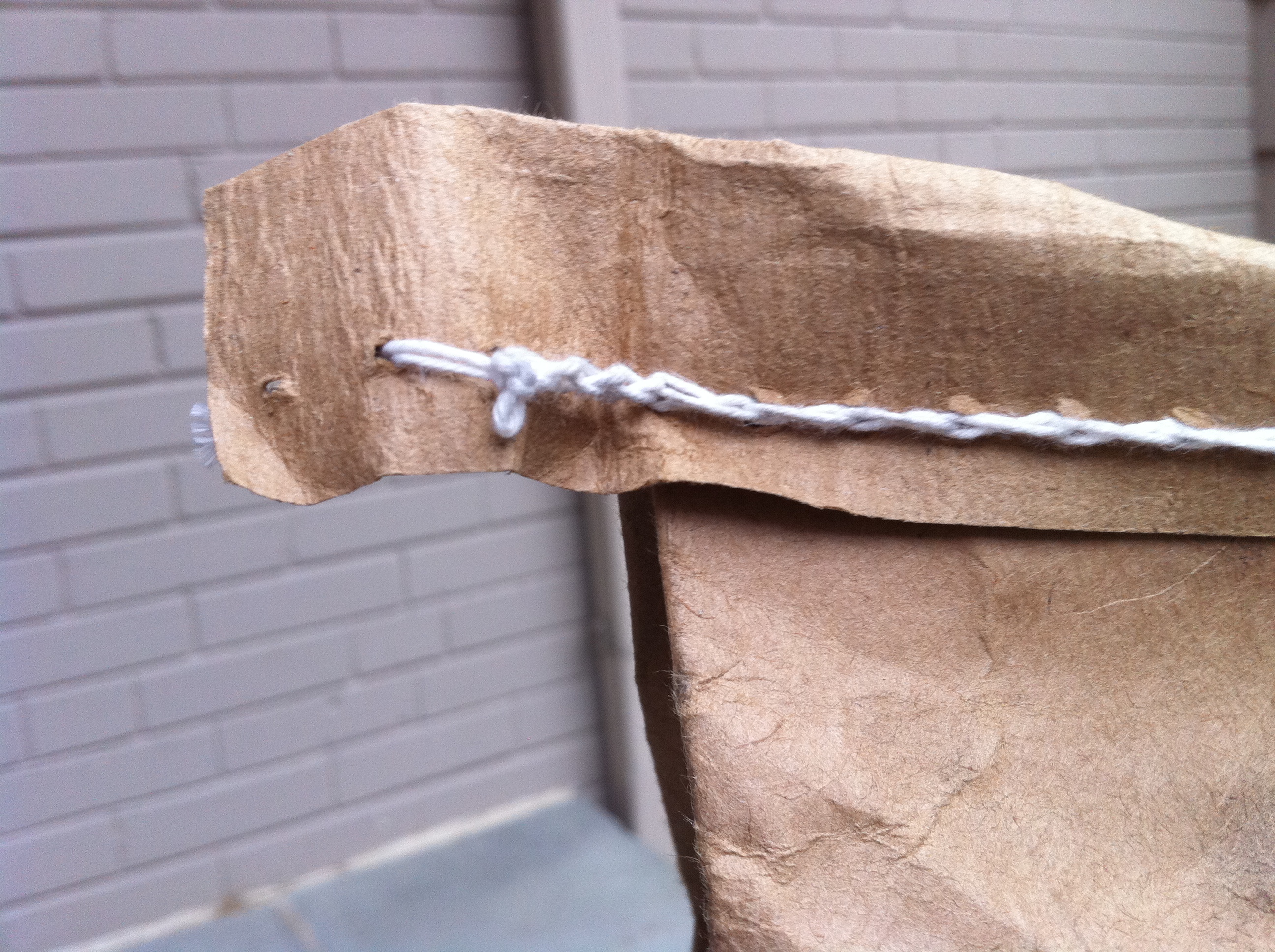
Step 1: Orient yourself. There is a front and a back. The front side has clean loops, the back side string is ragged and knotted at the end. Pictures:

Front Side
Back Side
You have to pull the string from the back side. It unravels from left to right.
Step 2: Understand what you are doing. There are really two strings here woven together. There is a string on the front side which is pushed through in loops through each of the little holes in the bag. Then a string on the back side is threaded through them also in a looping fashion. The end of the string on the left side is then knotted onto the leftmost loop. What you need to do is remove that knot and free up the end of the backside string so that you can pull it.
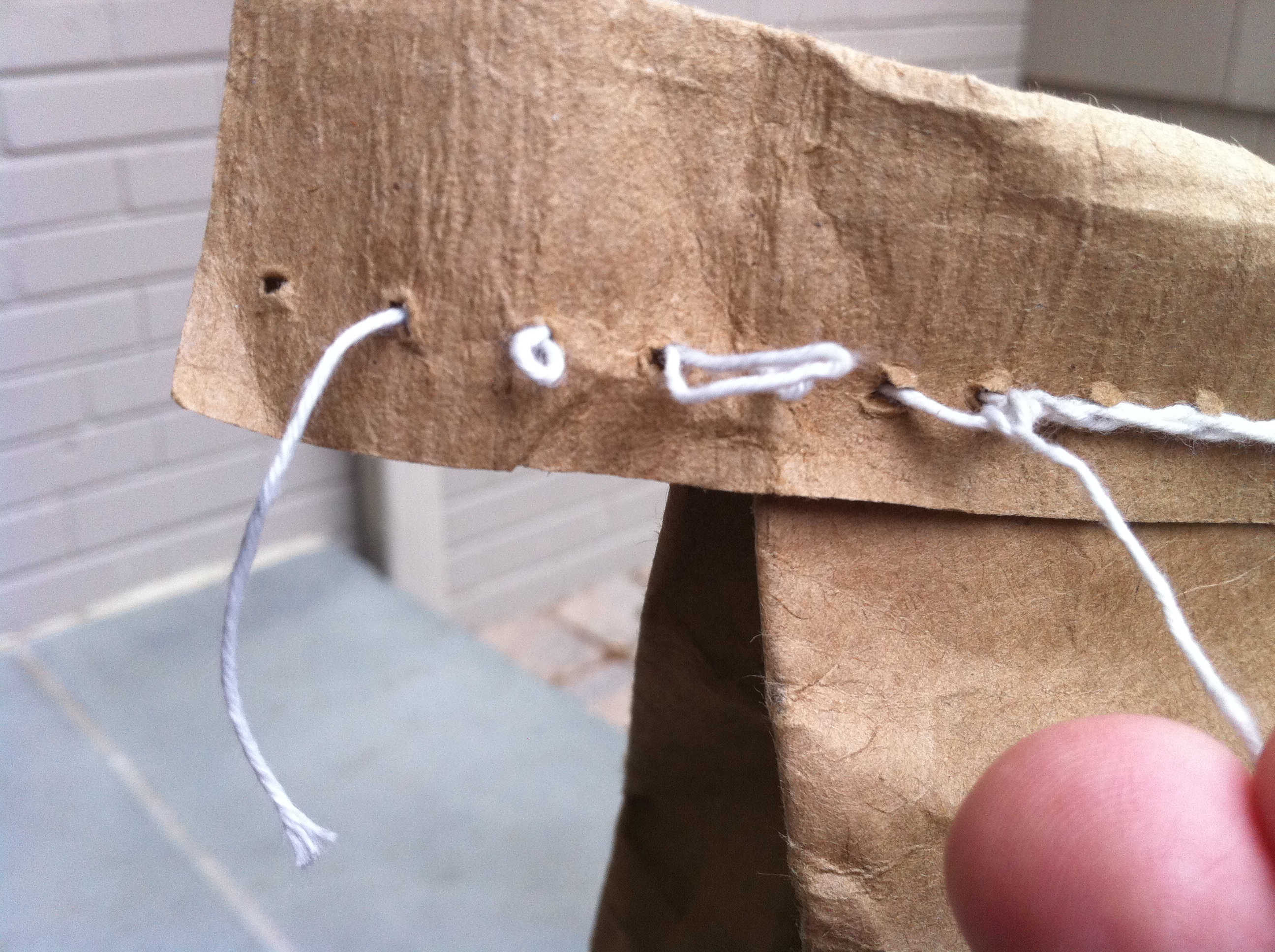
Unraveling
Step 3: The endgame. Once you have the end of the backside string all there is left to do is pull and the whole apparatus becomes unraveled. You can then extract the frontside string leaving you with two strings in your hand, a flap of paper to lift off the bag (and recycle) and finally a wide open bag of non-fossil fuel. No hassle, no pointless yanking, no scissors. Works every time.
[vimeo http://vimeo.com/12164830]How does the additional length of a 5 set match help the stronger player? Commenters to my previous post point out the direct way: it lowers the chance of a fluke in which the weaker player wins with a streak of luck. But there’s another way and it can in principle be identified in data.
To illustrate the idea, take an extreme example. Suppose that the stronger player, in addition to having a greater baseline probability of winning each set, also has the ability to raise his game to a higher level. Suppose that he can do this once in the match and (here’s the extreme part) it guarantees that he will win that set. Finally, suppose that the additional effort is costly so other things equal he would like to avoid it. When will he use his freebie?
Somewhat surprisingly, he will always wait until the last set to use it. For example, in a three set match, suppose he loses the first set. He can spend his freebie in the second set but then he has to win the third set. If he waits until the third set, his odds of winning the match are exactly the same. Either way he needs to win one set at the baseline odds.
The advantage of waiting until the third set is that this allows him to avoid spending the effort in a losing cause. If he uses his freebie in the second set, he will have wasted the effort if he loses the third set. Since the odds of winning are independent of when he spends his effort, it is unambiguously better to wait as long as possible.
This strategy has the following implications which would show up in data.
- In a five set match, the score after three sets will not be the same (statistically) as the score in a three set match.
- In particular, in a five-set match the stronger player has a lower chance of winning a third set when the match is tied 1-1 than he would in a three set match.
- The odds that a higher seeded player wins a fifth set is higher than the odds that he wins, say, the second set. (This may be hard to identify because, conditional on the match going to 5 sets, it may reveal that the stronger player is not having a good day.)
- If the baseline probability is close to 50-50, then a 5 set match can actually lower the probability that the stronger player wins, compared to a 3 set match.
This “freebie” example is extreme but the general theme would always be in effect if stronger players have a greater ability to raise their level of play. That ability is an option which can be more flexibly exercised in a longer match.
- One implication of a theory I have written about before is that a best of 5 set match confers a greater advantage on the stronger player than a best of 3 set match. (The basic idea is that the 5 sets gives the stronger player more flexibility in timing his bursts of effort.) Here are some data that would shed light: compare men’s versus women’s Grand Slam matches in terms of the probability that a higher-seeded player will win. Even better: divide the data into non-Grand Slam and Grand Slam matches. Ask how much more likely a higher-seeded player wins a Grand Slam match versus a non-Grand Slam match. Do this for both women and men. Then do the difference-in-differences. This gives you a nice control because women play 3 sets whether its a Grand Slam or not. Men play 5 sets in Grand Slams and 3 sets in almost all non-Grand-Slam events.
- Four Grand Slams, only three surfaces. It’s time the US Open switched to ice. (with skates.)
- In honor of de Balzac.
- Photolog of dinner at Next, with gripe about ticketing.
- Mashable Big Mac.
- Did the dopamine spike before or at the moment of reward? Science needs to know.
- Man milk.
- Beautiful card trick.
From Jonah Lehrer:
One week later, all the subjects were quizzed about their memory of the product. Here’s where things get disturbing: While students who saw the low-imagery ad were extremely unlikely to report having tried the popcorn, those who watched the slick commercial were just as likely to have said they tried the popcorn as those who actually did. Furthermore, their ratings of the product were as favorable as those who sampled the salty, buttery treat. Most troubling, perhaps, is that these subjects were extremely confident in these made-up memories. The delusion felt true. They didn’t like the popcorn because they’d seen a good ad. They liked the popcorn because it was delicious.
The article is interesting, you should check it out. These stories always sound impossible to believe. It just doesn’t seem so easy to manipulate memories. But it’s not all that surprising when you think about it.
- You have dreams where impossible things happen, where people you know have changed dramatically out of the blue, or where your life is completely changed. And when you have a dream like that you say “this is strange” and then you accept it as true and go on. It’s incredibly easy for you to believe in impossible things. And often you do it by convincing yourself that in fact its been like this all along.
- False memories sound impossible, but on the other hand we forget things all the time. Forgetting something is not all that different from a false memory. “Where did you put your keys?” “I didn’t put them anywhere. Somebody else must have put them somewhere.” And then you find the keys and remember that in fact you did put them there. You have not just forgotten something but you have believed in the false memory that the thing never happened.

There’s a good reason to fear regulation even if you can imagine beneficial regulation. You may be suspicious of government agencies’ motives or competence to implement it. Giving power to an agent when we can’t rely on her to use it in a beneficial way is often a bad idea.
But the same kind of fear, viewed through a mirror, often argues in favor of regulation. Take for example financial regulation. We may understand that if investors, managers, or insurers could be assumed to act reliably in ways that are consistent with their self-interest then markets would work well and there would be no rationale for regulation.
But should we predicate laissez faire on the assumption that they don’t make mistakes, that they perfectly fathom the complex path to their self-interest? If we can’t be sure, then giving them the power to do damage is often a bad idea.
(Drawing: Negative Space from www.f1me.net)
She wrote this convincing essay on happiness and parenting. Parents seem to be less happy but we shouldn’t read too much into that. She brings together all kinds of economic theory and data and along the way she cites a paper I like very much by Luis Rayo and Gary Becker:
Nobel Prize–winning economist Gary Becker, writing with Luis Rayo, has argued this contrary position. In their view, while “happiness and life satisfaction may be related to utility, they are no more measures of utility than are other dimensions of well-being, such as health or consumption of material goods.”[5] Or having kids. Children may make you less happy, but still raise your utility. Devout neoclassical reasoning leads Becker and Rayo to infer from the fact that we are having kids that they raise your utility (or at least they raise the utility of those who make this choice).
Rayo and Becker argued that happiness should be thought of as the carrot that gets us to make good decisions. But happiness is a scarce resource. There’s a limit to how happy you can be. So it has to be used in the most economical way. In their theory the most economical way to use happiness is to give an immediate, and completely transitory boost of happiness to reward good outcomes. You have sex, you get rewarded. It results in conception, that’s another reward. But then you are back to the baseline so as to maximize the range available for further rewards (and penalties) motivating behavior going forward. Bygones are bygones.
With that theory it makes no sense to look at a cross section of the population, compare how happy are people who did X relative to people who didn’t do X, and conclude on the basis of that whether its good to do X.
And by the way, if there is anything we can expect evolutionary incentives to have a good handle on, its whether or not to have kids. That’s the whole ballgame. If happiness is there to motivate us to succeed evolutionarily then you better have a good argument why Nature got it wrong. One place to look might be on the quantity/quality tradeoff. Perhaps the relative price of quality versus quantity has declined in modern times and Nature’s mechanism is tuned to an obsolete tradeoff. If so, then people feel a motivation to have more kids than they should. The prescription then would be to resist the temptation you feel to have another kid and instead invest more in the ones you have. Unless you want to be happy.
 Cheap Talk