You are currently browsing the tag archive for the ‘food and wine’ tag.
And the same for food critics/wine tasters. Also, wine tasters generally drink in moderation whereas chefs and food critics have been known to carry a little extra weight.
In both cases, the choice of profession has revealed a taste for the respective delicacy. Winemakers love the taste of wine, chefs love the taste of food. And, as demonstrated by wine tasters, you can taste without consuming, and you can partake without consuming to excess. The wine tasters manage to achieve this but the chefs do not.
Evolution has given us taste as an incentive to acquire necessary nutrients. Pleasant taste is our reward for consuming. Presumably, sometimes we might prefer to consume less (maybe more) than what Mother Nature would prefer, so she gives us the sense of taste so that we internalize her preference. But we try to find ways to manipulate her incentive scheme and get this taste without consuming a lot, or even at all, viz. the wine taster.
Mother Nature is perfectly content to allow us to taste but not consume wine if we see fit. But when it comes to food, she insists that she knows better than us and she will not let us get away with just a nibble. As with the taste of wine, the taste of food draws us in, and we expect to have just a taste. But once the food is in front of us, the trap is set and she deploys her most powerful weapon: temptation that cannot be overcome.
An evolutionary explanation of time-inconsistency and a preference for commitment, a’la Samuelson and Swinkels.
The Premier Cru Volnay came from a trip 4-5 years ago. Volnay is a village in Burgundy. I remember old men playing pétanque on a communal, gravel court. We were on the lookout for a nice cafe but we saw nothing. That is a big difference between Italy and France. Every small village in Italy has a cafe with some wizened old men who seem to spend all day there. Even the most prestigious vineyards/towns in Burgundy had nowhere to socialize or snack.
To the wines: I decanted them an hour or so before drinking. The Volnay was closed, bitter and disappointing. We shipped it from Burgundy and got slapped with huge customs duties. (We had been told that there was chance we might escape taxes as their application was random. It was not to be. ) So, with that memory of additional expense, I was doubly disappointed. The Goldeneye was smooth and delicious. Slutty and available. Lots of fruit but not overwhelming like a California Cab. We enjoyed a glass before dinner and it lasted into the first course. I returned to the Burgundy for my next glass. What a revelation! It opened up completely. Vegetal rather than fruity. Three dimensional. Celery and definitely barnyard on the palette. Great with food. We had a white bean, bacon and arugula salad from the Patrica Wells Paris cookbook. The Volnay stood up to it really well. The Goldeneye had faded a little bit. Apparently, it went well with the chicken. I am baconatarian (“vegetarian except for bacon”) so I skipped the chicken.
In the end, both were great and I would have them again, though they are on the expensive end. The US vs France wine clichés were reinforced.
Rated 88 – A zesty spice bomb of a Zinfandel, with boysenberry, ripe cherry, licorice and roasted herb notes and long, deep flavors that build toward firm, cedary tannins on the finish. Best from 2008 through 2012. – Wine Spectator
No tannins or licorice left by 2009. Definitely spicy, lots of cherry. Complexity added by blend of Petit Sirah and Carignane. Long finish, lingers with a bit of roughness at the back of the throat. Sweet at the start, bitterness at the end too and a little acidity. I love it and am going to try to track down some more. Around $30 (on sale for $25 if you’re lucky).
I remember once thinking what an amazing stroke of luck it was that on the Earth there happen to be so many wonderful gifts for people to enjoy. For example, it seemed close to definitive proof of a benevolent God that tangerines were just hanging there from trees for us to pick and eat. Somebody had to understand us very well and care about us a lot to give us this delicacy for free.
Of course this is a fallacy. It was not the fruit that was designed for our taste buds but the other way around.
We need to be incentivized to consume whatever we need to survive. And there is no need to bring any Designer into the story because this can be taken care of by natural selection.
These points are nicely recounted in this TED lecture by Dan Dennett. However, he stops short of considering the plot twist in which we develop conscious thought and learn how to manipulate nature’s incentive scheme. It starts with nutra-sweet, vasectomies and pornography. That’s when the real game begins.
If you Google “Top Chef”, the first news link is this. It seems I agree with the overwhelming majority of viewers that the wrong guy, Hosea, won the season. Hosea did do the best cooking in the final and so there was nothing unfair in him winning. The other two contestants had “fatal flaws”. Stefan is overconfident and Carla is too laid-back. Hosea is a solid and consistent performer. As the other contestants gave in to their flaws in the final show, Hosea ran past them onto the winner’s podium. Good luck to him.
The fault lay in the initial choice of contestants. Despite this show being in New York, there just wasn’t a great selection of good, young chefs. It’s the producers who lost.
Most of us are “irrationally” afraid of snakes…but few of us are afraid of mushrooms. Since both can be potentially fatal and both can be good eating, this is puzzling.


 Most of us are “irrationally” afraid of snakes…but few of us are afraid of mushrooms. Since both can be potentially fatal and both can be good eating, this is puzzling.
That’s from “Information, Evolution and Utility,” a paper by Jeroen Swinkels and Larry Samuelson about why natural selection shaped our preferences the way it did. In their story, Nature accepts that there are things that we can learn that she hasn’t had time to program into us (like which mushrooms are safe to eat.) So instead of giving us a complete set of instructions for how to behave in every situation, she gave us beliefs and the instinct to experiment and learn. Then she lets us choose.
But there are somethings she knows better than us . For example that snakes will likely kill us. So, forseeing that these beliefs she has given us can, and often do, go astray, she builds in backup measures to stop us from acting on them in contexts where she is confident that she knows best. Hence irrational fears.
I think there is wide open arbitrage opportunity in behavioral economics to import ideas from principal-agent theory to explain why Nature (the principal) has given us (the agent) certain preferences (incentives.)
Highland Park is very chi-chi and let’s face it, white. Then, you go a little further north and you enter an ethnic enclave which is less Cartier and Prada. It’s nice. There’s a fair there in the summer, lots of nice little restaurants with near-Highland Park prices. My favorite so far is Casa de Isaac. (I still have to try the Curry Hut.) It’s the only Jewish Mexican restaurant I have ever heard of. They open sundown on Saturday and are closed Friday night. Apart from that, there is so discernible Jewish influence. In fact, one of my Israeli friends thinks the whole thing is a big marketing ploy to differentiate it from other closeby establishments! We had chilaquiles – one red and spicy, the other green and tangy. Both were delicious. And we got to watch Aston Villa vs Tottenham Hotspur on the T.V. It was great.
This is a beautiful post from Alinea at Home. It is worth reading the whole thing, but this bit resonates with me.
And that’s why I think I was drawn to the Alinea cookbook above anything else. Because it’s so not me, but represents traits and skills I admire in others, but had not yet been willing to take the risk to figure out how to adapt or embed in myself. I don’t know if it’s possible for me to change in that way or explore the possibility of rewiring (or even just tinkering with) my brain in this manner, but I knew I needed to get better about breaking out of my comfort zone, and doing it with food seemed to me to be a path that would make me the most willing to learn.
There are people who inspire and there are people who are very good at getting inspired by others. We need both.
Sandeep and I and some friends have regular wine tastings focusing on different regions/varietals. Tonight we tasted five wines from the Rioja region in Spain. This was a high mean/medium variance sampling which pleasantly surprised me. A wine that received 92 points from Wine Advocate (Jay Miller does Spain for WA?) and 91+ from Stephen Tanzer was 4th out of 5 (this was the Artadi Vinas de Gain.) Even the lowest ranked wine was very interesting and worth another try (Marques de Caceres Reserva 2001.)
A confounding factor here is that we had some nice food with the wine (thanks John and Jacqueline) and we started eating midway through wine B, and the wines seemed especially agreeable with food, so this may bias our ratings upwards towards the end.
And of course, we swallowed and did not spit.
My impression was that this area has a nice merging of new and old-world styles. The best wine in my opinion, and also the majority favorite was exemplary in this regard. Big fruit, but old-world complexity and earthiness. Among the rest, there were fruit bombs (Vinas de Gain) and vegetal-centric wines (Marques de Caceres) and most had something to offer. Here are my notes (only lightly edited from the iPhone self-emails.)
A. New world fruit bomb. Gentle tannins long finish of coffee. Bitter linger.
B. Earthy/stinky nose. Joanne says plum. Very bright red fruit up front. Hollow midpalate pleasant tannins with a floral finish.
C. Color and nose like A. Inky black/purple. blackberries on the nose oak not pronounced. Very smooth and complex with a beautiful transition from blueberries to acidity on the finish which lasts. Sandeep says Bordeaux-like. Seems to be the choice so far.
D. Resembles B in color but has a distinctive nose. Entry has rich red fruit. Midpalate is somehat quiet like B but the transition is much smoother to a nice acidity and floral finish. Very nice.
E. Has a different color. Mauve. A vegetal nose with peppermint (Aviv). Bright red fruit at the start which rapidly runs away through the midpallate leaving a harsh bitterness in the finish. Interesting but not pleasant.
Reveal (tasting was blind):
A. Artadi. Vinas de gain 2006 (ok so maybe this wine is too young.) (My score 12.5/20)
B. Pujanza 2003 (14.5/20)
C. Muga riserva 2004 (favored by 3 of the 7.) (16/20)
D. Remelluri 2002 (favored by 4 of the 7 of us. I scored it 16.5/20)
E. Marques de caceres. Reserva 2001 (the big loser, I scored it 9.5/20.)
Shiny, red, and guaranteed to please the ladies. Yes, I turned 40 last year but no I didn’t buy a car. I planted heirloom tomatoes. And I am hooked. I just bought this book.
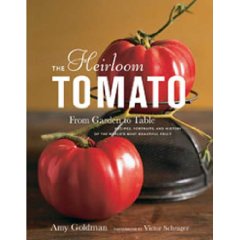
It has incredibly detailed flavor profiles, growing tips, seed sources, and recipes for hundreds of heirloom varieties. The photographs are beautiful and the mini-histories are very entertaining:
Early members of Seed Savers Exchange worked themselves into a frenzy trying to find a Pruden’s Purple–one “so purple it looked black, about the color of the Black Beauty eggplant,” fantasized Milan Rafayako of New Haven Kentucky in the 1981 yearbook. Alas, such a creature never materialized. Rare cultivated tomatoes, it turns out, don’t normally contain the purple pigment anthocyanin–although some of their wild relatives do.
If my calculations are correct, for the Chicago climate I need to germinate seeds in late April, transplant in late May, and pray that I have ripe tomatoes before I leave for San Diego in August. But if things go like last year, that last week I will be making heavy use of the recipe (page 221) for Fried Green Tomatoes.
I was really impressed by the trick pulled by the Top Chef producers this week.
Leah is a lame cook and made it much further than she deserved to given her talents. And on the way several better cooks got knocked out partly because they were in “team Leah” in some round.
I think the producers realized this and brought back two of the people recently eliminated, and Leah, back to give the dice another role. I was scared Leah would squeeze by on luck again but this time the Gods did not play games and she lost. Jeff won but then got knocked out again anyway as he had to “win” the elimination challenge to survive. But then Stefan squeezed by even though his food was worse than Jeff’s! I guess there has to be little unfairness to keep us watching. And I think they keep Stefan partly because he’s the guy everyone loves to hate (though I like him!).
I saw this at one of my regular lunch spots in downtown Evanston today:

They are offering $125 gift certificates at the price of $100. Should you take it? The answer is after the jump.
This person is actually cooking from the Alinea cookbook. And blogging it. Note that his (her?) most recent effort failed because he tried to do without the liquid nitrogen.
By the way, would someone please tell me exactly what it means to swim the Atlantic? I mean, she’s not sleeping in the water is she?
I think I am going to set a record for the least-trained pianist to play Beethoven’s Hamerklavier. I will play one note per day.
 Cheap Talk