
I never heard of her.
A city in Taiwan is trying to keep the streets clean by offering cash for collected dog poo.
City officials in Taichung, which has a population of one million, said on Wednesday the environmental protection bureau would give vouchers worth 100 Taiwan dollars ($3) for every kilo of dog poo collected. In areas of the city especially affected, the reward will be for every half-kilo.
In related news, Taichung is witnessing a sudden surge in demand for high-fiber dog food which is now being sold in convenient single-serving sizes priced at 99 Taiwan dollars.
Might as well throw my hat in the ring and reveal my predictions:
Lucid Angus De Rough Angus Deaton
Baron P Partha Hoody Partha Dasgupta
PM Big Cash Paul Milgrom
Jam Jean J Professor Wack Jean Tirole
Smug OO Murda Oliver Hart
Kid BH Wrath Bengt Holmstrom
Here, via Michael Nielsen. For example:
- Twitter’s user growth is no longer accelerating. The rate of new user acquisition has plateaued at around 8 million per month.
- Over 14% of users don’t have a single follower, and over 75% of users have 10 or fewer followers.
- 38% of users have never sent a single tweet, and over 75% of users have sent fewer than 10 tweets.
- 1 in 4 registered users tweets in any given month.
- Once a user has tweeted once, there is a 65% chance that they will tweet again. After that second tweet, however, the chance of a third tweet goes up to 81%.
- If someone is still tweeting in their second week as a user, it is extremely likely that they will remain on Twitter as a long-term user.
- Users who joined in more recent months are less likely to stop using the service and more likely to tweet more often than users from the past.
Here is a pie-chart:
 Have I mentioned that you should be following me on twitter? (I am talking to you Sandeep.)
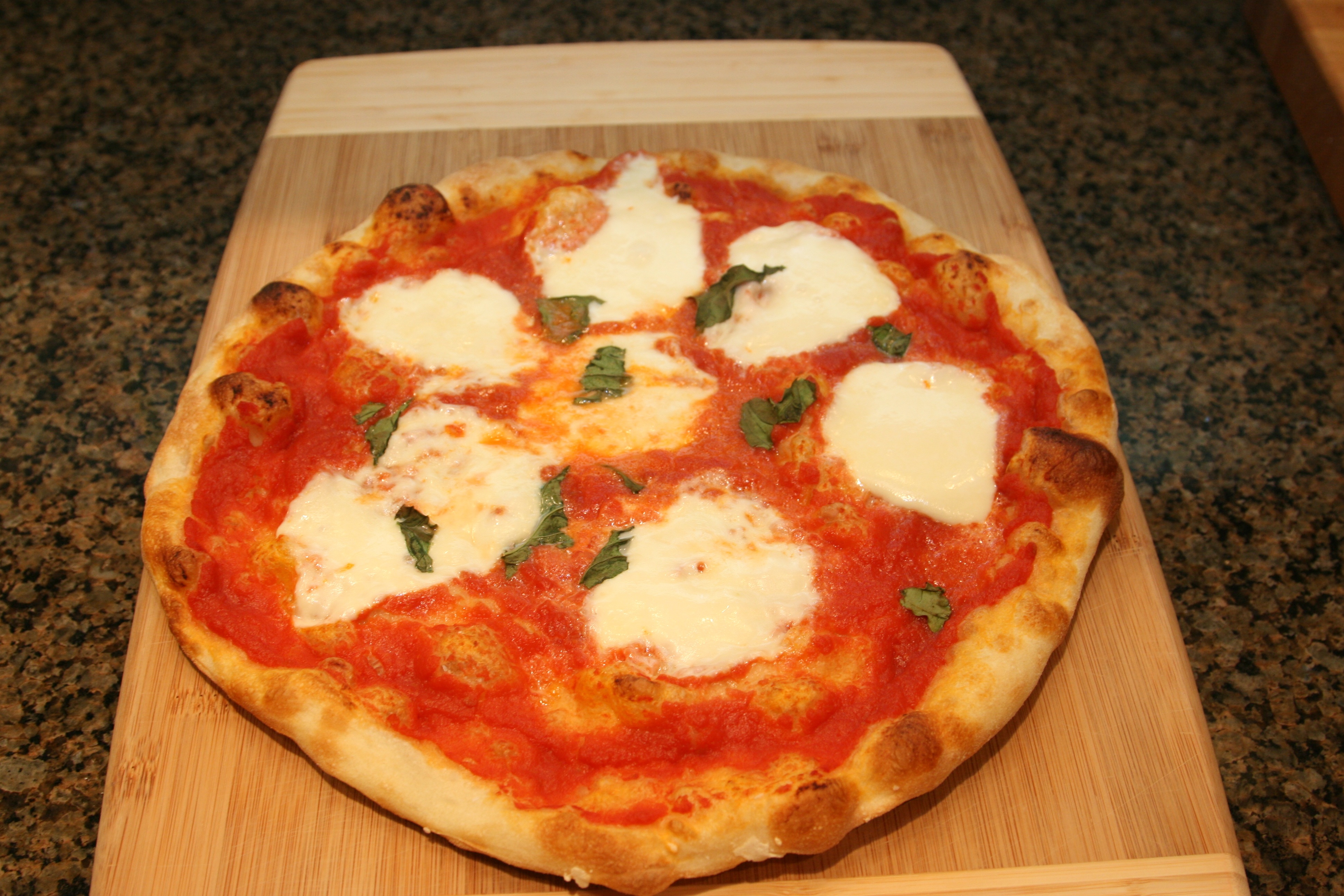
You can make pizza at home if you have an oven that will break 500F. And if you can, you should. Its easy to make good pizza and its fun. You need a pizza stone, peel, and a good stand mixer to do the kneading. Some things I have learned over time.
- Start with margherita (tomato sauce, mozzarella, basil). Once you make a good margherita you will realize there is not much point in making anything else.
- Use mozzarella di bufalo. It truly makes a big difference (naturally though there is variation in quality.)
- To make the sauce, use canned, peeled, san marzano tomatoes, remove the seeds and puree. Simmer in a skillet until there is no visible water pooling in the sauce and it sticks to a spoon. This takes longer than you would expect so be patient. (You do this while the dough is rising.) Add only salt. No garlic, no onion, etc.
- No-knead dough recipes are popular recently and they work for many things but not pizza dough. Yes it is convenient, but there is a simple reason it doesn’t work. To form gluten without kneading you add a lot more water than you normally would. Pizza cooks very fast. That short time is not enough to get enough moisture out of the dough to get the bite that you want on the edges. Water holds the temperature of the dough down because water cannot be raised above boiling temperature (think about it.)
I want to keep mine semi-secret so I can claim I was right whatever happens. So, I typed in my predictions into the website My Rap Name.com which then garbled them. So, here are my predictions:
Lucid Angus De Rough
Baron P Partha Hoody
PM Big Cash
Jam Jean J Professor Wack
Smug OO Murda
Kid BH Wrath
Maybe I’ll give he real names Monday if I can reconstruct them!
Shiller tops the poll. Igal Hendel garnered 5 votes.
- According to my mother, this doesn’t make it any less gross.
- Reason #17 I stick to the groomed parts. (via meanderings.)
- Babies, insurance, and dragons.
This terrifying story about E Coli is enough to make even the most ardent baconatarian consider veganism. Cargill produced hamburgers made by mixing up ground beef from different suppliers from all over the world. You could test for E Coli when the slaughterhouse’s meat arrives but:
Unwritten agreements between some companies appear to stand in the way of ingredient testing. Many big slaughterhouses will sell only to grinders who agree not to test their shipments for E. coli, according to officials at two large grinding companies. Slaughterhouses fear that one grinder’s discovery of E. coli will set off a recall of ingredients they sold to others.
If you violate this unwritten agreement then:
The food safety officer at American Foodservice, which grinds 365 million pounds of hamburger a year, said it stopped testing trimmings a decade ago because of resistance from slaughterhouses. “They would not sell to us,” said Timothy P. Biela, the officer. “If I test and it’s positive, I put them in a regulatory situation. One, I have to tell the government, and two, the government will trace it back to them. So we don’t do that.”
The downside is obvious:
The potential pitfall of this practice surfaced just weeks before Ms. Smith’s patty was made. A company spot check in May 2007 found E. coli in finished hamburger, which Cargill disclosed to investigators in the wake of the October outbreak. But Cargill told them it could not determine which supplier had shipped the tainted meat since the ingredients had already been mixed together.“Our finished ground products typically contain raw materials from numerous suppliers,” Dr. Angela Siemens, the technical services vice president for Cargill’s meat division, wrote to the U.S.D.A. “Consequently, it is not possible to implicate a specific supplier without first observing a pattern of potential contamination.”
Why not avoid this altogether, use a whole piece of meat and grind it yourself? Because:
In all, the ingredients for Ms. Smith’s burger cost Cargill about $1 a pound, company records show, or about 30 cents less than industry experts say it would cost for ground beef made from whole cuts of meat.
On the other hand, Costco does test the input:
The retail giant Costco is one of the few big producers that tests trimmings for E. coli before grinding, a practice it adopted after a New York woman was sickened in 1998 by its hamburger meat, prompting a recall.
Craig Wilson, Costco’s food safety director, said the company decided it could not rely on its suppliers alone. “It’s incumbent upon us,” he said. “If you say, ‘Craig, this is what we’ve done,’ I should be able to go, ‘Cool, I believe you.’ But I’m going to check.”
Costco said it had found E. coli in foreign and domestic beef trimmings and pressured suppliers to fix the problem. But even Costco, with its huge buying power, said it had met resistance from some big slaughterhouses. “Tyson will not supply us,” Mr. Wilson said. “They don’t want us to test.”
So, why the difference between Costco and Cargill? One company has a brand that is easily recognizable to consumers and the other doesn’t. The branded product/firm faces a bigger reputational risk in terms of lost sales if it doesn’t do a careful job. Hence, it has better incentives to monitor its product and ensure it is of high quality. The court of public opinion has lower standards for conviction than the court of legal opinion. Indeed, the deliberate lack of testing of inputs allows all parties to try to shift blame to another player to create reasonable doubt.
You would hope that the public opinion that can punish the retail end of the supply chain would filter back to through the whole supply chain. But that does not seem to happen. Consumer flight while it can be fatal to a retailer with a bad reputation is not well coordinated enough to exert pressure to the supplier. Back to my Cheerios.
Since I am willing to pay $X that means my opportunity cost of not buying is -$X, thus my willingness to pay is indeed $X. That appears to be what Google CEO Eric Schmidt is saying in the following deposition transcript talking about Google paying X=$1.65 billion for YouTube, a $1billion premium over what he estimated YouTube to be worth. From an article at cnet.
Baskin: So you orally communicated to your board during the course of the board meeting that you thought a more correct valuation for YouTube was $600 million to $700 million; is that what you said, sir?
Mancini objects to characterization of the testimony.
Schmidt: Again, to help you along, I believe that they were worth $600 million to $700 million.
Baskin: And am I correct that you were asking your board to approve an acquisition price of $1.65 billion; correct?
Schmidt: I did.
Mancini objects.
Baskin: I’m not very good at math, but I think that would be $1 billion or so more than you thought the company was, in fact, worth.
Mancini objects.
Schmidt: That is correct.
Later…
Baskin: Can you tell us what reasoning you explained?
Schmidt: Sure, this is a company with very little revenue, growing quickly with user adoption, growing much faster than Google Video, which was the product that Google had. And they had indicated to us that they would be sold, and we believed that there would be a competing offer–because of who Google was–paying much more than they were worth. In the deal dynamics, the price, remember, is not set by my judgment or by financial model or discounted cash flow. It’s set by what people are willing to pay. And we ultimately concluded that $1.65 billion included a premium for moving quickly and making sure that we could participate in the user success in YouTube.
We decided to check out another ‘hood of Boston. Haven’t been to the South End for over a decade. Area has this weird feel of gentrification meets recession, i.e. cool, expensive furniture stores that were largely empty. For dinner, we went to Ginger Park which was equally empty. It has a dramatic wavy, bent wood ceiling. Food was quite good. Some Indian snack food (lentil fritters), good Asian noodles and dumplings and more sophisticated dishes like tea-smoked duck. I get annoyed by people who talk about restaurant service as much as food but I’m getting old and crotchety so here goes: Our server was incompetent and yet confident and smug, qualities that often go together. But I would still go back. It didn’t have a good wine list. After we left, we took a stroll on Tremont and stopped in at Aquitaine for a glass of wine. That was fun. Atmosphere was great and the barman recommended a great wine, Château Peyremorin 05 Haut-Medoc (earthy, barnyard, and balanced). Will definitely go back and try the food.
It is one of the most basic premises of economics and decision theory. If you give a decision-maker better information about the consequences, he will make better choices.
This principle underlies one of the least controversial forms of paternalism: subsidizing information to improve welfare. It is uncontroversial because unlike policies which restrict or direct behavior, it doesn’t take a stand on what is good for the decision-maker. More information helps her achieve her desired outcomes, whatever they may be.
In New York City, fast food chains were required to conspicuously publish calorie counts for all of their offerings. This will enable customers to make better decisions, presumably in terms of health consequences. According to the theory, any change in behavior in response to the new information is evidence that the policy was a success. It reveals that people made use of the information.
…when the researchers checked receipts afterward, they found that people had, in fact, ordered slightly more calories than the typical customer had before the labeling law went into effect, in July 2008.
Here is the conclusion drawn by an author of the study:
“I think it does show us that labels are not enough,” Brian Elbel, an assistant professor at the New York University School of Medicine and the lead author of the study, said in an interview.
My mother tells me that where she lives there are cameras that will catch you if you don’t come to a complete stop at the octagonal sign. Your license plates will be photographed and you will be sent a bill in the mail. The fine is close to $500. That’s a lot more than I remember it.
Quiz: suppose the technology improves for detecting whether a violation has taken place. Should the fine increase, decrease or stay constant?
From Not Exactly Rocket Science:
In the Old English of Beowulf, seven different rules competed for governance of English verbs, and only about 75% followed the “-ed” rule. As the centuries ticked by, the irregular verbs became fewer and far between. With new additions to the lexicon taking on the standard regular form (‘googled’ and ’emailed’), the irregulars face massive pressure to regularise and conform.
Today, less than 3% of verbs are irregular but they wield a disproportionate power. The ten most commonly used English verbs – be, have, do, go say, can, will, see, take and get – are all irregular. Lieberman found that this is because irregular verbs are weeded out much more slowly if they are commonly used.
To get by, speakers have to use common verbs correctly. More obscure irregular verbs, however, are less readily learned and more easily forgotten, and their misuse is less frequently corrected. That creates a situation where ‘mutant’ versions that obey the regular “-ed” rule can creep in and start taking over.
There is a story in the Wall Street Journal about user ratings on web sites such as Amazon or eBay. It seems that raters are unduly generous with their stars.
One of the Web’s little secrets is that when consumers write online reviews, they tend to leave positive ratings: The average grade for things online is about 4.3 stars out of five.
And some users are fighting back:
That’s why Amazon reviewer Marc Schenker in Vancouver has become a Web-ratings vigilante. For the past several years, he has left nothing but one-star reviews for products. He has called men’s magazine Maxim a “bacchanalia of hedonism,” and described “The Diary of Anne Frank” as “very, very, very disappointing.”
I have noticed that Amazon reviewers are highly polarized with 5 stars being the most common with 1 star reiews coming in second. And in fact it makes a lot of sense. Say you think that a product is over-rated at 4.3 stars and you think that 4 stars is more appropriate. If there are more than just a few ratings, then to bring the average down to 4 you would have to give the lowest possible rating.
Once enough ratings have already been counted, subsequent raters will be effectively engaging in a tug of war. Those that want to raise the average will give 5 stars and those that want to reduce it will give 1.
Economists have often wondered why people tip. We have lots of sophisticated explanations for why rational (i.e. selfish) people pretend to be altruistic. A leading explanation, the reputation model, relies on some repeated game concern but how would that apply in a one shot waiter game? The puzzle is, of course, easily resolved if one allows homo economicus to have a heart. Warm, mushy feelings for waiters can easily explain tipping, even if you both know your relationship is the restaurant equivalent of the one night stand.
As our well-educated and well-read readers know, the heart is a complicated thing and often responds to incentives in odd ways. Larry David is the dark Jane Austen of our cynical time and his (second!) magnum opus, Curb Your Enthusiasm, is the warped Sense and Sensibility. I enjoyed the Seinfeld non-Reunion episode. There were so many treasures in one half hour but the business lunch between Larry and Jason Alexander was my favorite bit. Larry and Alexander go dutch and Larry suggests they coordinate the tip. He wishes to avoid the embarrassment of under-tipping. It is just obvious to Larry that other people’s opinion matters so he must tip. Note it is not morality but image and hence self-image that guide Larry. He certainly does not want to tip low when his Dutch partner tips high. But if your partner tips low, there is still an incentive to tip high, because it is quite natural that you want your image to be better than your partner’s. In other words, there is a dominant strategy to tip high…a Prisoner’s Dilemma of tipping. Once we open up the heart of homo economicus, not only is there an incentive to tip, but to overtip. No wonder Larry wants to collude and coordinate tips.
How does it all work out? I don’t want to give any more away than I already have. I’ll let you watch the episode and enjoy it for yourself.
I have read and heard anecdotal evidence that litigation in the United States is countercyclical. Usually this is cynically explained by saying that when times are tough everybody is looking to make an extra buck. But of course everybody is looking to make an extra buck when times are good too.
All of business activity relies on relationships that are partially supported by contracts and partially supported by trust. Trust fills in the gaps of incomplete contracts. When the contract is not followed to the letter, your interest in maintaining a healthy relationship smooths things over.
Bad times raise uncertainty about whether there are any gains left from this relationship in the future. This undermines trust and the result is that the courts are called in to fill the gaps.
There are a couple of natural ways to test this theory. First the countercyclical nature of litigation should vary across sectors. Thick markets with relatively anonymous actors should see less impact of economic downturns on the rate of litigation. Also, the effect outlined above is based on the assumption that contracts are written in good times and litigated in bad times. If the downturn is expected to last, then new contracts should tend to be more complete, taking into account the increased appetite for litigation. The result should be less litigation in longer downturns than in shorter ones.
I thank Rosemary for the conversation.
Started off too fruity and heavy. Took two hours to open up and then it was delicious. It smoothed out, the fruit receded. Tasted almost Bordeaux-like after it opened. Little bit of celery at the end. I thought it was overpriced initially but ended up accepting the $30 price by the time we finished the bottle.
I have a simple system for organizing recipes. I try out recipes I find in cookbooks, blogs, magazines, whatever. When one hits I do the following.
- Take a picture of it.
- Write down a list of the ingredients I wouldn’t typically have stocked.
- Email the above plus a link to the recipe (or what page in what cookbook) to myself.
Because the time you really need recipes is when you are shopping and you see, say some really good looking okra and you need to know what else to get. You pull out your iPhone, you search for okra in your mail folders, you get a picture and a list of ingredients. You go home and cook.
The picture is absolutely key. Think of your cookbooks at home. Which recipes do you most often cook? Its the ones with the beautiful photos in the middle of the book. The photo reminds you how yummy its going to be. Wouldn’t you love to cook this tonight?
The produce section announced the availability of fresh truffles. The freezer had a great selection of gelatos and sorbets. The bakery had some pretty nice looking cakes. But all of this was erased from my memory when I got to the cheese section at the back of the aptly named Formaggio Kitchen. Cheese is where the heart (and heart trouble!) is. It was a kind of Cheese Universe contest, only without the Donald. I blushed and didn’t know where to look with so much milky pulchritude around me. I finally plucked up my courage and asked for a few nibbles. Picked up a couple of bottles of good but overpriced wine as a go with. Luckily Formaggio Kitchen is not in Brookline. The transactions costs of getting there will protect my waistline.
According to the Times:
“A 2008 firefight in eastern Afghanistan has become a template for how not to win there, and helps to explain the strategy of Gen. Stanley A. McChrystal, the new commander.”
A new study is being released of the fire-fight. Among other things it says:
“Before the soldiers arrived, commanders negotiated for months with Afghan officials of dubious loyalty over where they could dig in, giving militants plenty of time to prepare for an assault.
Despite the suspicion that the militants were nearby, there were not enough surveillance aircraft over the lonely outpost — a chronic shortage in Afghanistan that frustrated Defense Secretary Robert M. Gates at the time. Commanders may have been distracted from the risky operation by the bureaucratic complexities of handing over responsibility at the brigade level to replacements — and by their urgent investigation of an episode that had enraged the local population, the killing a week earlier in an airstrike of a local medical clinic’s staff as it fled nearby fighting in two pickup trucks.
Above all, the unit and its commanders had an increasingly tense and untrusting relationship with the Afghan people.”
As far as I see from the story in the Times, the report on the firefight examines the mistakes that were made in implementation of a strategy. There are lots nuances but basically the army unit was meant to set up an outpost and they were not given the intelligence and manpower to do their job effectively. In other words this was a failure of “operations management” or what we might call tactics. We can learn from it in terms to how not to make the same mistake again.
What we cannot learn from it is what our strategy should be in Afghanistan. A strategy here is broader than what we usually mean in game theory. It is a description of an objective function as well as a plan of how to maximize it. (The objective function for Afghanistan is part of a grander objective function for U.S. domestic and foreign policy.) It will suggest questions such as: Should we ensure a stable democracy in Afghanistan? Or should we focus on Al Qaeda? Or have we overreacted to 9/11 overall and we should leave? None of this is answered by the study of the incident in 2008. Hence, we would be wrong to extrapolate from an issue of tactics to an issue of overall strategy. Maybe we decide we do not want outposts at all. Then a counterinsurgency strategy is moot.
Remember the browser wars? Resistance to open web standards, and “best viewed in Internet Explorer.” Remember “polluted java?” Here are paragraphs that caught my eye from ars technica’s overview of Google Wave.
In September, Google released Chrome Frame, a plugin for Internet Explorer that makes it possible for Microsoft’s browser to use Chrome’s rendering engine. Microsoft was not happy about this sudden but inevitable betrayal. Google later revealed that Wave was one of the catalysts that compelled them to launch the Chrome Frame project.
The developers behind the Wave project struggled to make Wave work properly in Microsoft’s browsers, but eventually determined that the effort was futile. Internet Explorer’s mediocre JavaScript engine and lack of support for emerging standards simply made the browser impossible to accommodate. In order to use Wave, Internet Explorer users will need to install Chrome Frame.

While we are on the subject I highly recommend the ars technica piece on Google Wave. In addition to lots of detail on the technology and implementation, it talks about Google’s commitment to open standards, open source, and decentralization. I came away less worried.
I have not been invited yet to try the beta.
Via kottke, here is a paper proposing A Unified Theory of Superman’s Powers. The abstract reads as follows.
Since Time immemorial, man has sought to explain the powers of Kal-El, a.k.a. Superman. Siegel et al. Supposed that His mighty strength stems from His origin on another planet whose density and as a result, gravity, was much higher than our own. Natural selection on the planet of krypton would therefore endow Kal El with more efficient muscles and higher bone density; explaining, to first order, Superman’s extraordinary powers. Though concise, this theory has proved inaccurate. It is now clear that Superman is actually flying rather than just jumping really high; and His freeze-breath, x-ray vision, and heat vision also have no account in Seigel’s theory.
In this paper we propose a new unfied theory for the source of Superman’s powers; that is to say, all of Superman’s extraordinary powers are manifestation of one supernatural ability, rather than a host. It is our opinion that all of Superman’s recognized powers can be unified if His power is the ability to manipulate, from atomic to kilometer length scales, the inertia of His own and any matter with which He is in contact.
The paper goes on to show how the theory can explain Superman’s super strength, ability to fly, super senses, and even his heat vision and freeze breath. It’s an elegant theory but the analysis has one significant gap. It is not enough to find a simple principle from which all of Superman’s powers follow. It is necessary to also show that the principle would not imply powers that Superman does not have.
If we do not insist on the latter, then there is an even simpler theory that does the trick: Superman can do everything. (Although that comes with its own difficulties.)
Austan Goolsbee does not sugarcoat the message.
Senator Baucus said he could not vote for the public option amendments as they would not get 60 votes in the Senate. That is, whatever his own narrowly defined preferences, he also has a preference for voting for the winning bill and, in fact, the latter component of his utility swaps the former.
This leads to the obvious issue: on what basis are the Senators Baucus canvassed saying they will not vote for the bill? If they vote like Baucus, they are also basing their votes on what will pass or not. The situation is ripe for coordination failure: even if sincere voting based on individual preference would lead to adoption of the public option amendments, the expectation that it will not pass causes people not to vote for it and guarantee that it will not pass.
If this is really as issue, supporters of the pubic option have to create momentum for it and convince Senators it will pass. They they will vote for the public option and it will pass. A self-fulfilling prophesy.
Steve Levitt links to his paper with Sudhir Venkatesh documenting some stylized facts about street prostitution in Chicago. It’s definitely worth a read, and one part is fodder for theory:
Prostitutes in their sample report using condoms 90 percent of the time, compared to only 25 percent in our sample for vaginal sex, and 21 percent for anal sex. Among their Mexican prostitutes, condom use is the default from which customers must bargain away, potentially inducing large increases in prices. In contrast, in our sample no condom appears to be the default choice, perhaps making it harder for the prostitute to credibly argue for a higher price if no condom is used. Moreover, in an equilibrium in which condom use is infrequent, infection rates among prostitutes are likely to be extremely high, so that the primary value of condoms to women may be protecting the women from becoming pregnant and hygiene, rather than the spread of disease. Indeed, one would expect that the johns would likely gain more in disease reduction from condoms than the prostitutes.
SOME DISCUSSION OF HOW CONDOM USE VARIES ACROSS PROSTITUTES IN OUR SAMPLE. SOME QUOTES ABOUT WHY THEY DON’T USE THEM. SOME FACTS ABOUT AIDS RATES AMONG JOHNS AND PROSTITUTES FROM MEDICAL LITERATURE.
(hmmm, it appears they are not quite done with the paper 🙂 ) They focus on the cost to the prostitute due to increased infection and the like, but there is already some unusual aspects to the demand side.
A John values unprotected sex over protected sex but even moreso if he is the only John, or among very few, who get that privelege. Holding fixed her frequency of unprotected sex, there is a downward sloping demand for unprotected sex as a function of the price premium over condom-clad. But that frequency is not verifiable, except insofar as it can be inferred from the price. Thus, as an equilibrium response the demand curve itself shifts with adjustments to the price.
This means that the prostitute cannot just choose any price. The price must be such that x% of Johns are willing to pay that price when they assume that x% of other Johns are having unprotected sex. Typically there will be just a few values of x that satisfy this fixed-point relationship.
So a cross-section of pricing patterns will exhibit a bang-bang (quiet down Beavis) or bi-modal (Beavis!) histogram with high prices and low prices and none in-between. The high prices correspond to the equlibria in which few Johns have unprotected sex so Johns are willing to pay a lot, and the low prices correspond to the equilibria in which many Johns have unprotected sex and Johns place lower value on it.
It could even happen that the price premium is for protected sex. In fact it could even be profit maximizing to distort downward the price of unprotected sex in order to signal how risky that would be, enabling the prostitute to raise the price of protected sex.
Read about it in the Wall Street Journal.
Many of his papers have been highly theoretical works focusing on imperfections in financial markets. “He’s probably the most abstract thinker ever to head a Federal Reserve bank,” said Robert Lucas, a Nobel Prize-winning economist who is serving as a consultant to the Minneapolis Fed.
Mr. Kocherlakota’s colleagues say he is a pragmatic person who is hard to identify fully with any one camp.
“He believes in the freshwater world, but he’s not that radical,” says Luigi Pistaferri, a frequent co-author with whom Mr. Kocherlakota worked for three years at Stanford University. “He agrees that there are market failures, and his attitude is, ‘How do we make the best of a world in which there are such failures?’ “
I once took Narayana to see The Bad Plus in Minneapolis on a visit there. Narayana is Canadian I believe and that night they busted out Tom Sawyer. I don’t think he was all that into it.
I assume this means we will need a new macro co-editor at Theoretical Economics. Volunteers?
Many Senators who support health care reform have made public commitments not to vote for any bill without a public option. Such pronouncements are not cheap talk. The pledge can be broken of course but constituents and fellow legislators will hold to account a Senator who breaks it.
And they can be relevant. A commitment not to vote for the Baucus bill raises the costs of proposing that bill because the pledged Senator would have to be compensated for breaking his pledge if he is going to be brought on board. In a simple bargaining game, the pledge will be made if and only if the cost of breaking the pledge is higher than the proposer is willing to pay. In this case the Baucus bill would not be proposed.
But legislative bargaining is not so simple. Each Senator has only one vote. A Senator who commits not to vote for the Baucus bill effectively moves the median voter (for that bill) one Senator to the right. This changes things in three ways by comparison to simple bargaining.
- The committed Senator will not be the median voter and so he will not be part of the bargaining.
- There is presumably a relatively small gap between the old median and the new so the costs imposed by the pre-commitment are much smaller.
- In the event that the gambit fails and the Baucus bill is proposed, it will be a worse bill from the perspective of the gambiteer (it will be farther to the right.)
This means that the commitment is a much less attractive strategy in the legislative setting and it loses much of its relevance. That is, those who are making this commitment would probably not have been willing to vote for the Baucus bill even without any pledge.
O.K., I don’t this is quite as good as the Paul Krugman song but anyone who can write the lyrics “Come on Nouriel, fix the Senate Finance Bill. You are a financial power drill” is talented:
 Cheap Talk