The Greeks gave us philosophy, mathematics, history and science but did they give us great food?  I always thought the answer was “No” but Taxim restaurant in the Bucktown neighborhood of Chicago persuaded me the answer might be “Yes”.

The first dilemma we faced was choosing the wine.  Taxim has an all-Greek wine list and the names of the grapes are unrecognizable.  I asked for a Rhone-like red and a generous glass of a Greek version of Syrah was promptly delivered.  (I think the name of the grape has an “X” in it but I can’t swear to it!).  The wine was delicious and I might actually enter the Greek section of a wine shop – if I can find a wine shop which has a Greek section!

We decided to mainly go the route of the small hot and cold plates with just one entree.  The food had some highs, lows and mediums.  Highs: The fried cauliflower with capers. Lentils with feta.  Duck fat fries (not so greek!).  Cauliflower is my new favorite vegetable.  I  polished off a delicious roasted cauliflower at the Girl and the Goat and incorporated a NYT roasted cauliflower recipe into a pasta dish.  The Taxim version is up there.  The lentils needed a touch more salt but once that was added, they were good.  Mediums: the roasted eggplant and the leek in phyllo.  The eggplant turned out to be babaganoush and the phyllo was too buttery for my taste.  Low: the duck breast – a bit dry according to my dining companion.

Bottom line:  I’m definitely going again.  Might mix up my order a bit and try a wine flight.

  1. First world problems.
  2. Already seen the video of the twin toddlers rapping in their diapers?  Have you seen this remake?
  3. What’s better than chocolate on Valentine’s Day?
  4. Charlie Crist apologizes to David Byrne.
  5. Vibrating strings and person.

We are reading it in my Behavioral Economics class and so far we have finished the first 5 chapters which make up Part I of the book “Anticipating Future Preferences.” In Ran Spiegler’s typical style, perfectly crafted simple models are used to illustrate deep ideas that lie at the heart of existing frontier research and, no doubt, future research this book is bound to inspire.

A nod also has to go to Kfir Eliaz who is Rani’s longtime collaborator on many of the papers that preceded this book.  Indeed, in a better world they would form a band.  It would be a early ’90s geek-rock band like They Might Be Giants or whichever band it was that did The Sweater Song.  I hereby name their band Hasty Belgium. (Names of other bands here.)

Many of the examples in the book are referred to as “close variations of” or “free variations of” papers in the literature.  And Rani has even written a paper that he calls “a cover version of” a paper by Heidhues and Koszegi.  So to continue the metaphor, I offer here some liner notes for the book.

In chapter 5 there is a fantastic distillation of a model due to Michael Grubb that explains Netflix pricing.  Conventional models of price discrimination cannot explain three-part tariffs:  a membership fee, a low initial per-unit price, and then a high per-unit price that kicks in above some threshold quantity.  (Netflix is the extreme case where the initial price per movie is zero, and above some number the price is infinite.) Rani constructs the simplest and clearest possible model to show how such a pricing system is the optimal way to take advantage of consumers who are over-confident in their beliefs about their future demand.

A conventional approach to pricing would be to set price equal to marginal cost, thereby incentivizing the consumer to demand the efficient quantity, and then adding on a membership fee that extracts all of his surplus.  You can think of this as the Blockbuster model.  The Netflix model by contrast reduces the per-unit price to zero (up to some monthly allotment) but raises the membership fee.

Here’s how that increases profits.  Many of us mistakenly think we will watch lots of movies.  Netflix re-arranges the pricing structure so that the total amount we expect to pay when we watch all of those movies is the same as in the Blockbuster model.  Just now we are paying it all in the form of a membership fee.  If it turns out that we watch as many movies as we anticipated, we are no better or worse off and neither is Netflix.

But in fact most of us discover that we are always too busy to watch movies. In the Blockbuster system when that happens we don’t watch movies and so we don’t pay per-unit prices and we Blockbuster doesn’t make much money. In the Netflix system it doesn’t matter how many movies we watch, because we already paid.

My only complaint about the book is the title.  (Not for those reasons, no.)  The term “Bounded Rationality” has fallen out of favor and for good reason.  It’s pejorative and it doesn’t really mean anything.  A more contemporary title would have been Behavioral Industrial Organization.  Now I agree that “Behavioral” is at least as meaningless as “Bounded Rationality.”  Indeed it has even less meaning. But that’s a virtue because we don’t have any good word for whatever “Bounded Rationality” and “Behavioral” are supposed to mean. So I prefer a word that has no meaning at all than “Bounded Rationality” which suggests a meaning that is misplaced.


What impact does trade between a developing and a developed country have on inequality in the developing country?

A plausible version of the canonical Hecksher-Olin model of trade would say that inequality decreases in the developing country. The Hecksher-Olin model studies the impact of different factor endowments on trade, taking technology as given across countries.  Suppose there is only one consumer good and suppose the ratio of skilled to unskilled labor is higher in the developed country.  Then the wage of skilled workers in the developing country is higher than that of skilled workers in the developed country and the wage of unskilled workers is higher in the developed country vs the developing country.  Allow trade in factors of production so factor prices are equalized across countries. Skilled workers will migrate from the developed to the developing country and unskilled workers the reverse.  The wages of skilled workers in the developing country will go down and the wage of unskilled workers will go up.  Inequality in the developing country – where developing is identified with a particular ratio of factor endowment – will go down with trade.

Apparently, the stylized facts on trade and inequality do not fit this story.  Kremer and Maskin offer a different theory based on complementarities in worker skill levels in production.  Suppose the only consumer good is produced by  a manager and a worker.  The skill level of the manager has a bigger impact on output than the skill level of the worker: output is the square of the skill of the manager times the skill of the worker.  Hence it is more efficient to assign a high quality worker to the manager’s task than the worker’s task.  Suppose there are skill levels A and B in the developed country and C and D in the developing country where we assume A>B>C>D.  Suppose there is an abundance of C workers in the developing country.  Before globalization, some C workers are matched with each other producing CCC and some are matched with D workers producing CCD.  The wage of the C-workers must be CCC/2 to maintain zero profits and this pattern of matching in equilibrium.

Now allow movement of labor across countries or equivalently production across borders.  Then the following is possible: C workers move to the developed country for a higher wage w’.  The D workers who are low skill and hence unattractive partners for production in the developed country, stay in the developing country.  They may still be matched with C workers but getting lower wages CCD-w’ as C workers now must earn more to stop them working for the developed country. Or if all C workers now work for the developed county, D workers end up matched with each other producing and splitting only DDD and hence with lower wages.  In either case, globalization increases inequality in the developing country.

This is the main idea.  Many extension and other parameter configurations are discussed. A useful literature review identifies Hecksher-Olin models where globalization can also increases inequality.

It was really fun to read this paper.  It is simple and clever.  It generates externalities in wages from matching patterns.  The implications are subtle and have provocative implications.

Analogous to “doctor shopping,” children practice parent shopping.  My son comes to me and asks if he can play his computer game.  When I say no, he goes and asks his mother.  That is, assuming he hasn’t already asked her.  After all how can I know that I’m not his second chance?

Indeed, if she is in another room and I have to make an immediate decision I should assume a certain positive probability that he has already approached her and she said no.  Assuming that my wife had good reason to say no that inference alone gives me a stronger reason to say no than I already had.  How much stronger?

If its an activity where he has learned from past experience that I am less willing to agree to, then for sure he asked his mother first and she said no.  It’s no wonder I am the tough guy when it comes to those activities.

If its an activity where I am more lenient he’s going to come to me first for sure. But his strategic behavior still influences my answer.  I know that if I say no, he’s going to her next and she’s going to reason exactly as in the previous paragraph. So she’s going to be tougher.  Now sometimes I say no because I am really close to being on the fence and it makes sense to defer the decision to his Mother. Saying no effectively defers that decision because I know he’s going to ask her next.  But now that his Mother is tougher than she would be in the first-best world, I must become a bit more lenient in these marginal cases.

Iterate.

(Addendum:  If you want to know how to combat these ploys, go ask Josh Gans.)

This time the subjects were in fMRI scanners while they delivered electric shocks for money.

But in FeldmanHall’s study, things actually happened. “There are real shocks and real money on the table,” she said. Subjects lying in an MRI scanner were given a choice: Either administer a painful electric shock to a person in another room and make one British pound (a little over a dollar and a half), or spare the other person the shock and forgo the money. Shocks were priced in a graded manner, so that the subject would earn less money for a light shock, and earn the whole pound for a severe shock. This same choice was given 20 times, and the person in the brain scanner could see a video of either the shockee’s hand jerk or both the hand jerk and the face grimace. (Although these shocks were real, they were pre-recorded.)

The brain scanners are supposed to shed light on the neuroscience of moral behavior.

Even though the findings are “a little bit chilling,” Wager says, “it’s important to know.” These kinds of studies can help scientists figure out how the brain dictates moral behavior. “There’s a real neuroscientific interest now in understanding the basis of compassion,” Wager says. “That’s something we are just starting to address scientifically, but it’s a critical frontier because it has such an impact on human life.”

Barretina bow:  Not Exactly Rocket Science.

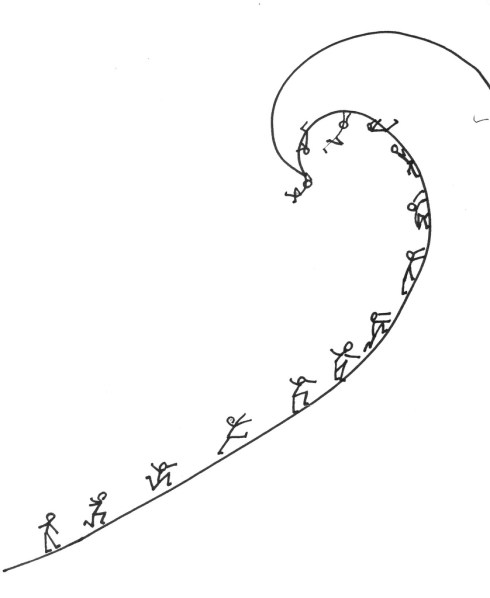
Two aspects of our taste for good weather are in force in the Spring.  First, we enjoy the warmer weather but we have diminishing marginal utility for higher and higher temperatures.  Second, we have reference-depenendence:  a 40F day feels balmy in March when its been below freezing for the past three months but the same 40F day gives you the chills in May on that day when Winter sends you its final parting gift from the grave.

Given those preferences, here’s how a benevolent Mother Nature would maximize the joy of Spring.  Each day raise the temperature by just a little bit.  Gobble up the steep part of our utility for warmth but stop before marginal utility declines too much.  Then, tomorrow when our reference point adjusts upward pushing the steep part back into play, gobble up those marginal utils again.  Repeat.  This steady but gradual transition from Winter to Summer would be the hallmark of a benevelont Mother Nature.

But woe is us, here in Chicago our Mother Nature is of a different sort than that. She seems well-acquainted with another aspect of our reference-dependent weather preferences:  loss aversion.  Drops in temperature hurt more than equal-sized jumps upward.  Our Mother has figured out how to exploit this to full effect and minimize the joy of Spring.  It all starts in late February when she lays on us a miraculous 60F day right out of nowhere.  Our reference points soar. But then we take the plunge back down on the steep side of the loss-aversion curve and the round trip is worse than if we just had another two days of plain old Winter.

And that pattern pretty much repeats until about June 1.  Instead of that gradual steady incline our Spring in Chicago is the classic sawtooth pattern, a series of tragicomic episodes in which our reference points are coaxed upward and then smashed back into place like some kind of meteorologic Moe-Curly routine. Thoughts of summer give us the hope to soldier on, but only if in the past year we were lucky enough to have forgotten whom she hands the baton to once the temperature finally settles down:  the mosquitos.

Predict which flights will be overbooked, buy a ticket, trade it in for a more valuable voucher.

Still, there are some travelers who see the flight crunch as a lucrative opportunity. Among them is Ben Schlappig. The 20-year-old senior at the University of Florida said he earned “well over $10,000” in flight vouchers in the last three years by strategically booking flights that were likely to be oversold in the hopes of being bumped.

“I don’t remember the last time I paid over $100 for a ticket,” he boasted. His latest coup: picking up $800 in United flight vouchers after giving up his seat on two overbooked flights in a row on a trip from Los Angeles to San Francisco. Or as he calls it, “a double bump.”

The full article has a rundown of all the tricks you need to know to get into the bumpee business.  I was surprised to read this.

Most of those people volunteered to give up their seats in return for some form of compensation, like a voucher for a free flight. But D.O.T. statistics also show that about 1.09 of every 10,000 passengers was bumped involuntarily.

On the other hand, it is not surprising because involuntary bumping only lowers the value of a ticket.  Monetary (or voucher) compensation can be recouped in the price of the ticket (in expectation.)

Garrison grab:  Daniel Garrett.

Linda Tesar, mild-mannered Chair of Michigan Economics Department by day, movie set owner by night:

As you walk down the long brick walkway toward the prominent front porch of Joe and Linda Tesar‘s home, built in 1910, it is easy to spot in the front garden the gallon jug container filled with a red substance and labeled “blood.” This is not the type of item you would normally see on this Burns Park block a full two months before Halloween. But then, the Tesars’ home is far from ordinary: For the past three-and-a-half weeks, it’s been a primary filming location for “Scream 4.”


A former academic economist and game theorist is now the Chief Economic Advisor in the Ministry of Finance in India.  His name is Kaushik Basu. Via MR, here is a policy paper he has just written advising that the giving of bribes should be de-criminalized.

The paper puts forward a small but novel idea of how we can cut down the incidence of bribery. There are different kinds of bribes and what this paper is concerned with are bribes that people often have to give to get what they are legally entitled to. I shall call these ―harassment bribes.‖ Suppose an income tax refund is held back from a taxpayer till he pays some cash to the officer. Suppose government allots subsidized land to a person but when the person goes to get her paperwork done and receive documents for this land, she is asked to pay a hefty bribe. These are all illustrations of harassment bribes. Harassment bribery is widespread in India and it plays a large role in breeding inefficiency and has a corrosive effect on civil society. The central message of this paper is that we should declare the act of giving a bribe in all such cases as legitimate activity. In other words the giver of a harassment bribe should have full immunity from any punitive action by the state.

This is not just crazy talk, there is some logic behind it fleshed out in the paper. If giving a bribe is forgiven but demanding a bribe remains a crime, then citizens forced to pay bribes for routine government services will have an incentive to report the bribe to the authorities.  This will discourage harrassment bribery.

The obvious question is whether the bribe-enforcement authority will itself demand bribes.  To whom does a citizen report having given a bribe to the bribe authority? At some point there is a highest bribe authority and it can demand bribes with impunity.  With that power they can extract all of the reporter’s gains by demanding it as a bribe.

Worse still they can demand an additional bribe from the original harasser in return for exonerating her. The effect is that the harasser sees only a fraction of the return on her bribe demands. This induces her to ask for even higher bribes.  Higher bribes means fewer citizens are able to pay them and fewer citizens receive their due government services.

The bottom line is that in an economy run on bribes you want to make the bribes as efficient as possible.  That may mean encouraging them rather than discouraging them.

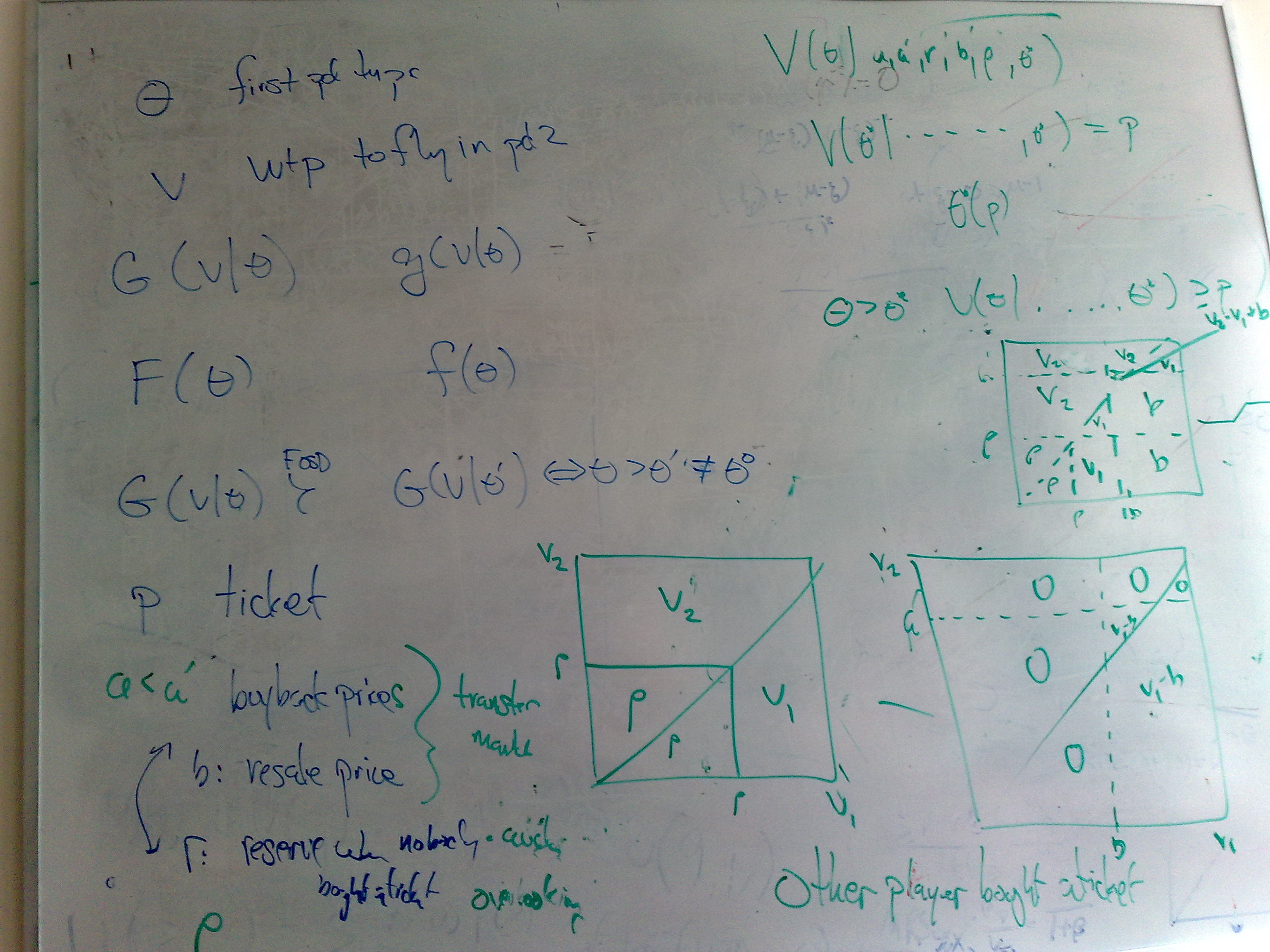
There are a few basic features that Grant Achatz and Nick Kokonas should build into their online ticket sales.  First, you want a good system to generate the initial allocation of tickets for a given date, second you want an efficient system for re-allocating tickets as the date approaches.  Finally, you want to balance revenue maximization against the good vibe that comes from getting a ticket at a non-exorbitatnt price.

  1. Just like with the usual reservation system, you would open up ticket sales for, say August 1, 3 months in advance on May 1.   It is important that the mechanism  be transparent, but at the same time understated so that the business of selling tickets doesn’t draw attention away from the main attractions: the restuarant and the bar.  The simple solution is to use a sealed bid N+1st price auction.  Anyone wishing to buy a ticket for August 1 submits a bid.  Only the restaurant sees the bid.  The top 100 bidders get tickets and they pay a price equal to the 101st highest bid.  Each bidder is informed whether he won or not and the final price. With this mechanism it is a dominant strategy to bid your true maximal willingness to pay so the auction is transparent, and all of the action takes place behind the scenes so the auction won’t be a spectacle distracting from the overall reputation of the restaurant.
  2. Next probably wants to allow patrons to buy at lower prices than what an auction would yield.  That makes people feel better about the restaurant than if it was always trying to extract every last drop of consumer’s surplus. Its easy to work that into the mechanism. Decide that 50 out of 100 seats will be sold to people at a fixed price and the remainder will be sold by auction. The 50 lucky people will be chosen randomly from all of those whose bid was at least the fixed price.  The division between fixed-price and auction quantities could easily be adjusted over time, for different days of the week, etc.
  3. The most interesting design issue is to manage re-allocation of tickets. This is potentially a big deal for a restaurant like Next because many people will be coming from out of town to eat there. Last-minute changes of plans could mean that rapid re-allocation of tickets will have a big impact on efficiency. More generally, a resale market raises the value of a ticket because it turns the ticket into an option.  This increases the amount people are willing to bid for it.  So Next should design an online resale market that maximizes the efficiency of the allocation mechanism because those efficiency gains not only benefit the patrons but they also pay off in terms of initial ticket sales.
  4. But again you want to minimize the spectacle.  You don’t want Craigslist. Here is a simple transparent system that is again discreet.  After the original allocation of tickets by auction, anyone who wishes to purchase a ticket for August 1 submits their bid to the system.  In addition, anyone currently holding a ticket for August 1 has the option of submitting a resale price to the system. These bids are all kept secret internally in the system. At any moment in which the second highest bid exceeds the second lowest resale price offered, a transaction occurs.  In that transaction the highest bidder buys the ticket and pays the second-highest bid.  The seller who offered the lowest price sells his ticket and receives the second lowest price.
  5. That pricing rule has two effects.  First, it makes it a dominant strategy for buyers to submit bids equal to their true willingness to pay and for sellers to set their true reserve prices. Second, it ensures that Next earns a positive profit from every sale equal to the difference between the second-highest bid and the second-lowest resale price.  In fact it can be shown that this is the system that maximizes the efficiency of the market subject to the constraint the market is transparent (i.e. dominant strategies) and that Next does not lose money from the resale market.
  6. The system can easily be fine-tuned to give Next an even larger cut of the transactions gains, but a basic lesson of this kind of market design is that Next should avoid any intervention of that sort.  Any profits earned through brokering resale only reduces the efficiency of the resale market.  If Next is taking a cut then a trade will only occur if the gains outweigh Next’s cut. Fewer trades means a less efficient resale market and that means that a ticket is a less flexible asset.  The final result is that whatever profits are being squeezed out of the resale market are offset by reduced revenues from the original ticket auction.
  7. The one exception to the latter point is the people who managed to buy at the fixed price. If the goal was to give those people the gift of being able to eat at Next for an affordable price and not to give them the gift of being able to resell to high rollers, then you would offer them only the option to sell back their ticket at the original price (with Next either selling it again at the fixed price or at the auction price, pocketing the spread.)  This removes the incentive for “scalpers” to flood the ticket queue, something that is likely to be a big problem for the system currently being used.
  8. A huge benefit of a system like this is that it makes maximal use of information about patrons’ willingness to pay and with minimal effort. Compare this to a system where Next tries to gauge buyer demand over time and set the market clearing price.  First of all, setting prices is guesswork.  An auction figures out the price for you. Second, when you set prices you learn very little about demand.  You learn only that so many people were willing to pay more than the price.  You never find out how much more than that price people would have been willing to pay.  A sealed bid auction immediately gives you data on everybody’s willingness to pay. And at every moment in time.  That’s very valuable information.

Grant Achatz is trying an innovative pricing system at his new restaurant Next. There is a set menu and instead of taking reservations and bringing a check at the end of the meal, Next is selling tickets. The ticket sales save on labor costs of employees taking reservations, distributing checks and running credit cards at the end of the meal.  The restaurant sells tickets through its own website so it does not share revenue with opentable.  The price of the ticket varies by day and time.  This is classic profit-maximizing price-discrimination.  At times where demand is high, charge a high price; when demand is low charge a low price and keep the restaurant busy when all the lights are on and chefs are in the kitchen.   So far, so good.

All the excitement is coming from the explosion in the resale market for Next tickets.  Resale is allowed by the restaurant.  They seem to think that it is impossible to stop so why not make it above board and monitor it carefully so there is no sale of fake tickets?  Also, if someone manages to get a ticket for a particular time or day and then finds they cannot make it, they have the opportunity to sell the tickets.  It seems tickets for two with a face value of $170 are selling for $1000. If Achatz and his partner Kokonas thought they were going to give impecunious Alinea fans a better deal, they were mistaken, at least at the opening of Next.  Plus all the revenue generated by resale is being handed over to people who were lucky enough to get into the start of the queue.  These might be true Achatz fans now but at the next round they will morph into the kind of ticket scalpers we see at Cubs games.  Achatz should redesign the ticket pricing to capture some of the revenue from the resale market.  At the very least he can take home more money; at best he can make the restaurant bigger and increase capacity till ticket prices fall to reasonable levels.

There a solution that gets Achatz and Kokonas more revenue: an auction.  The Cheap Talk team is clearly the obvious crew to consult on the auction.  Roger Myerson won a Nobel Prize for his work on auctions, Jeff has dabbled and so have I. I know I’d be willing to work for a table for two at either Next or Alinea and I bet Jeff would too.  Roger, I can’t speak for, but in my experience he is always willing to try new things and experiment.  So, how about it?  We are just up the road and can pop down anytime.

Jonah Lehrer writes about how bad NFL teams are at drafting talented players, particularly at the quarterback position.

Despite this advantage, however, sports teams are impressively amateurish when it comes to the science of human capital. Time and time again, they place huge bets on the wrong players. What makes these mistakes even more surprising is that teams have a big incentive to pick the right players, since a good QB (or pitcher or point guard) is often the difference between a middling team and a contender. (Not to mention, the player contracts are worth tens of millions of dollars.) In the ESPN article, I focus on quarterbacks, since the position is a perfect example of how teams make player selection errors when they focus on the wrong metrics of performance. And the reason teams do that is because they misunderstand the human mind.

He talks about a test that is given to college quarterbacks eligible for the NFL draft to test their ability to make good decisions on the field.  Evidently this test is considered important by NFL scouts and indeed scores on this test are good predictors of whether and when a QB will be selected in the draft.

However,

Consider a recent study by economists David Berri and Rob Simmons. While they found that Wonderlic scores play a large role in determining when QBs are selected in the draft — the only equally important variables are height and the 40-yard dash — the metric proved all but useless in predicting performance. The only correlation the researchers could find suggested that higher Wonderlic scores actually led to slightly worse QB performance, at least during rookie years. In other words, intelligence (or, rather, measured intelligence), which has long been viewed as a prerequisite for playing QB, would seem to be a disadvantage for some guys. Although it’s true that signal-callers must grapple with staggering amounts of complexity, they don’t make sense of questions on an intelligence test the same way they make sense of the football field. The Wonderlic measures a specific kind of thought process, but the best QBs can’t think like that in the pocket. There isn’t time.

I have not read the Berri-Simmons paper but inferences like this raise alarm bells.  For comparison, consider the following observation. Among NBA basketball players, height is a poor predictor of whether a player will be an All-Star.  Therefore, height does not matter for success in basketball.

The problem is that, both in the case of IQ tests for QBs and height for NBA players, we are measuring performance conditional on being good enough to compete with the very best. We don’t have the data to compare the QBs who are drafted to the QBs who are not and how their IQ factors into the difference in performance.

The observable characteristic (IQ scores, height) is just one of many important characteristics, some of which are not quantifiable in data. Given that the player is selected into the elite, if his observable score is low we can infer that his unobservable scores must be very high to compensate. But if we omit those intangibles in the analysis, it will look like people with low scores are about as good as people with high scores and we would mistakenly conclude that they don’t matter.

  1. Junior Ghadaffi’s US Tour, interrupted by war. (Sandeep blogged this yesterday, but you may have missed it.)
  2. Bacon cologne.
  3. Early Jim Henson.
  4. “I think I no how to make people or animals alive.”
  5. Scott Adams rant.
  6. Your rental car dashboard tells you what side the gas cap is on.
  7. My birthdate appears twice in the first 200000000 digits of pi.

Iran is trying to acquire nuclear weapons.  What impact does U.S. intervention in Libya have on Iran’s incentives to go nuclear?  Obama said that Gaddafi had lost the support of the citizens of Libya and hence should step down.  Deciding not to intervene after this statement might signal weakness and encourage nuclear proliferation by Iran.  This is an argument that has some support in the administration:

The mullahs in Tehran, noted Thomas E. Donilon, the national security adviser, were watching Mr. Obama’s every move in the Arab world. They would interpret a failure to back up his declaration that Col. Muammar el-Qaddafi had “lost the legitimacy to lead” as a sign of weakness — and perhaps as a signal that Mr. Obama was equally unwilling to back up his vow never to allow Iran to gain the ability to build a nuclear weapon.

But equally,

“You could argue it either way,” said one official who was involved in the Libya debate and spoke on the condition of anonymity. “Maybe it would encourage them to do what they have failed to do for years: come to the negotiating table. But you could also argue that it would play to the hard-liners, who say the only real protection against America and Israel is getting a bomb, and getting it fast.”

We have to incorporate several other examples to deduce Iran’s interpretation os U.S. strategy. Libya agreed to give up is nascent WMD program after the invasion of Iraq in return for a normalization of relations with the U.S.  Although Colonel Gaddafi was not able to pitch his tent at the U.N., his son was allowed to visit American firms, military schools, the creme de la creme of its educational institutions and enjoy the best aspects of its culture (the Broadway show “Mama Mia”).  At that point we were trying to signal “If you play ball with us, we play ball with you” (e.g. Libya) but “If you have or might have WMDs, we will get you” (e.g. Iraq).  In addition, our approach to North Korea signals “If you are actually nuclear, we pretty much leave you alone”.  In fact, the North Kora example undercuts any signaling impact of being tough on Libya: Why would the Iranians leadership believe the U.S. would attack them if they have WMDs when North Korea has survived because (not despite) of being nuclear?

So, will all this information at hand, the Iranians can draw a simple graph.  On the x-axis, the mullahs can plot the level of WMD development; on the y-axis the can plot the probability of U.S. intervention.  For high level of WMD development,  the probability of intervention is low (the North Korea example); for medium, the probability of intervention is high (the Iraq example) and for low level of WMDs it is high when circumstances dictate (the Libya example).  What is a mullah who values his independence going to deduce with this data?  Simple: Proliferate and acquire nuclear weapons.

To reduce incentives to proliferate, some part of the graph (if not all) must be upward sloping.  A threat to attack a country with nuclear weapons seems incredible.  That part of the graph is then downward sloping.  All the U.S. has left to play with to design incentives is the part of the graph at the low to medium level of WMD activity.  If this part is flat or downward sloping, it will maximize incentives to acquire WMDs.

The Boston Globe profiles Al Roth, who together with Atila AbdulkadirogluTayfun SonmezUtku Unver and many others are leading the most important development in Microeconomics right now:  market design.

Roth’s most recent project is helping to set up a nationwide kidney exchange, which would make it possible to find even more matches than the existing regional networks can find on their own. Running this national network has been a bureaucratic nightmare, and since it opened for business last fall, only two transplants have actually been carried out under its auspices. The problem is that depending on blood type, it can be hard or easy to find someone a compatible kidney. And when a hospital has an easy-to-match patient, its administrators are more likely to withhold that information from the other hospitals in the network because they’d rather do the transplant themselves, and get the business.

Alex Tabarrok wrote a thought-provoking piece on some ideas to increase kidney donation.

A distinguished colleague (whom I will spare the outing) teaches in the lecture room after me.  I received this email from him:

Subject: Any chance you could erase the Leverdome blackboard?

Or is this a Coase theorem thing?

Not the Coase Theorem, no.  The Coase Theorem is all about parties coming together to form agreeements that enhance welfare.  No, my dust-bound comrade this is much simpler seeing as how aggregate welfare is improved by the unilateral deviation of a single agent, namely me.

You see those days when we were following the conventional norm, according to which each Professor erases the chalkboard after his own lecture leaving a clean board for the next class, we were leaving a free lunch just sitting there on the table.  Because any one of us could have changed course, leaving the board to be erased by the next guy before his class, thus triggering a switch to the superior erase-before convention.

Now as I am sure I don’t have to explain to you,  once the convention is settled every Professor erases exactly once per day.  So nobody is any worse off.  But as you have by now noticed, that one particular Professor who initiated the switch avoids erasing that one time and is therefore strictly better off.  A Pareto improvement! but of course you are now well-trained at spotting those having just yesterday surveyed my lecture notes covering that very subject as you were erasing them from the Leverdome chalkboard.

From MR, I read this story about how the San Francisco smart parking meters will be designed to adjust meter rates in real time according to demand.  There wasn’t much detail there but this bit gave me pause.

Rates at curbside meters in the project area will be adjusted block by block in an attempt to have at least one parking space available at any time on a given block.


Sign up for tickets

(My approach to blogging is to send myself emails whenever I have an idea, then sort through those emails when i have the time and decide what to write about. Some ideas have gathered dust over the past year and its time to use them or lose them.)

When do you give up on a book?  It’s an optimal stopping problem with an experimentation aspect.  The more you read the more uncertainty gets resolved the more you learn whether the book will be rewarding enough to finish.  You stop reading when the expected continuation value, which includes the option value of quitting later, falls below the value of the next book in your queue.

So here’s an interesting question.  Is that more likely to happen at the beginning or near the end of a book? Ignore the irrational desire to complete a book just because you have already sunk a lot of time into reading it. (But do include the payoff from finding out what happens with all the threads you have followed along the way.)

It easily could be that the most likely time to quit reading a book is close to the end.  Indeed the following is a theorem.  For any belief about the flow value of the book going forward, if that belief leads you to dump the book near the beginning, then that same belief must lead you to dump the book nearer the end.  Because the closer to the end of the book the option value is lower and there is even less chance that it will get better.

It sounds wrong because probably even the most ruthless book trashers rarely quit near the end.  But there’s no contradictipon. Even if the option value rule implies that the threshold quality required to continue reading is increasing as you get deeper into the book, it can still be true that statistically you most often quit reading near the beginning of a book.  Because conditional on a book being dump-worthy, you are more likely to figure that out and cross that threshold for the first time early on rather than later.

Turing Test #N-1:  detect sarcasm:

“Sarcasm, also called verbal irony, is the name given to speech bearing a semantic interpretation exactly opposite to its literal meaning.” With that in mind, they then focussed on 131 occurrences of the phrase“yeah right” in the ‘Switchboard’ and ‘Fisher’ recorded telephone conversation databases. Human listeners who sifted the data found that roughly 23% of the “yeah right”s which occurred were used in a recognisably sarcastic way. The lab’s computer algorithms were then ‘trained’ with two five-state Hidden Markov Models (HMM) and set to analyse the data – and the programmes performed relatively well, successfully flagging some 80% of the sarky “yeah right”s.

That’s pretty good, but I’ll wait around for the computers to pass the Nth and ultimate Turing Test:  compose a joke that is actually funny.

Honestly if we had to rank tests of similarity to human interaction, I believe that composing original humor is probably the very last one computers will solve. (Restricting attention to the usual thought experiment where the subject you are interacting with is in another room and you have to judge whether it is a human or a computer just on the basis of text-based interaction.)

I am always writing about athletics from the strategic point of view:  focusing on the tradeoffs.  One tradeoff in sports that lends itself to strategic analysis is effort vs performance.  When do you spend the effort to raise your level of play and rise to the occasion?

My posts on those subjects attract a lot of skeptics.  They doubt that professional athletes do anything less than giving 100% effort.  And if they are always giving 100% effort, then the outcome of a contest is just determined by gourd-given talent and random factors. Game theory would have nothing to say.

We can settle this debate.  I can think of a number of smoking guns to be found in data that would prove that, even at the highest levels, athletes vary their level of performance to conserve effort; sometimes trying hard and sometimes trying less hard.

Here is a simple model that would generate empirical predictions.  Its a model of a race. The contestants continuously adjust how much effort to spend to run, swim, bike, etc. to the finish line. They want to maximize their chance of winning the race, but they also want to spend as little effort as necessary.  So far, straightforward.  But here is the key ingredient in the model: the contestants are looking forward when they race.

What that means is at any moment in the race, the strategic situation is different for the guy who is currently leading compared to the trailers.  The trailer can see how much ground he needs to make up but the leader can’t see the size of his lead.

If my skeptics are right and the racers are always exerting maximal effort, then there will be no systematic difference in a given racer’s time when he is in the lead versus when he is trailing.  Any differences would be due only to random factors like the racing conditions, what he had for breakfast that day, etc.

But if racers are trading off effort and performance, then we would have some simple implications that, if it were born out in data, would reject the skeptics’ hypothesis.  The most basic prediction follows from the fact that the trailer will adjust his effort according to the information he has that the leader does not have.  The trailer will speed up when he is close and he will slack off when he has no chance.

In terms of data the simplest implication is that the variance of times for a racer when he is trailing will be greater than when he is in the lead.  And more sophisticated predictions would follow.  For example the speed of a trailer would vary systematically with the size of the gap while the speed of a leader would not.

The results from time trials (isolated performance where the only thing that matters is time) would be different from results in head-to-head competitions. The results in sequenced competitions, like downhill skiing, would vary depending on whether the racer went first (in ignorance of the times to beat) or last.

And here’s my favorite:  swimming races are unique because there is a brief moment when the leader gets to see the competition:  at the turn.  This would mean that there would be a systematic difference in effort spent on the return lap compared to the first lap, and this would vary depending on whether the swimmer is leading or trailing and with the size of the lead.

And all of that would be different for freestyle races compared to backstroke (where the leader can see behind him.)

Finally, it might even be possible to formulate a structural model of an effort/performance race and estimate it with data.  (I am still on a quest to find an empirically oriented co-author who will take my ideas seriously enough to partner with me on a project like this.)

Drawing:  Because Its There from www.f1me.net

Roger Myerson playing “My Way” on his harmonica on his 60th birthday.

And here’s the story.

This is a plate of green curry chicken that I ate at a KFC in Chiang Mai. (Sorry about the shoddy phone-photos.) It cost 59 baht (about $1.90), it was delivered to my table by a waiter, and it wasn’t surprisingly good, or not bad considering, but legitimately excellent.

Think this is an unfair comparison? Even setting aside all the local adaptations, like the baby pearl eggplant (those aren’t peas), fresh chili pepper, and lashings of canonical green curry, the chicken alone was crisper and juicier than any I’ve ever had at a KFC in America. That chicken thigh was split open, dusted in whatever magical substance they use to give it that scaly crust, fried to a crackle, and sent right to my table without ever seeing a heat lamp.


Republicans and Democrats are negotiating a budget deal in an effort to avert a government shutdown. The last time the government was forced to furlough workers, Congressional Republicans and their leader Newt Gingrich took much of the blame in the eyes of the public.  It is generally believed that Republicans, the anti-goverment party, would again be blamed for a government shutdown should an agreement not be reached this time around.

The first-order analysis bears this out.  While a government shutdown would be a bad outcome for all parties, it is relatively less bad for the anti-big-government Republicans.  Other things equal you would infer that if a shutdown were not averted it would have been because the Republicans were willing to let that happen.

Of course other things are not equal.   The second-order analysis is that Democrats, understanding that Republicans would take the blame now become relatively more willing to allow a shutdown.  This affects the bargaining. Democrats are now emboldened to make more aggressive demands for two reasons.  First, the cost of having their demands rejected is lower because they score political points in the event of a shutdown. Second, for that same reason Republicans are now more likely to accept an aggressive offer.

Will the blame equilibrate?  Does the public internalize the second-order analysis and adjust its blame attribution accordingly?  And what does equilibrium blame look like?  Must it be applied equally to both parties?

In politics only the most transparent arguments hold sway with the public.  The second-order analysis is too subtle to be used as a talking point even though probably everybody understands it perfectly well.  A talking point is effective as long as it’s believed that many people believe it, even if in fact most people see right through it. So the first-order analysis will rule and the blame will not equilibrate.

In the current environment that could raise the chances of a government shutdown.  Ideally Democrats would maximize their advantage by increasing their demands and stopping just short of the point where Republicans would rather trigger a shutdown.  But the Tea Party complicates things. They might be so steadfast in their principles that they are not deterred by the blame. That could mean that the best deal Democrats can expect to reach agreement on is dominated by making a demand that the Tea Party rejects and forcing a shutdown.

  1. Iggy Pop’s Tour Rider
  2. Dangerously Diluted Cocktails. Perfect For a Frivolous Holiday.
  3. A Not-So-Softly Killing of Charlie Trotter.  Someone has an agenda.
  4. 8 bit video game deaths.
  5. Hosers.
  6. Brad Mehldau on Responsible Behavior.

In the last of our weekly readings, my daughter’s 4th grade class read Edgar Allen Poe’s “The Pit And The Pendulum” (a two minute read) and today I led the kids in a discussion of the story.  Here are my notes.

The story reads like a scholarly thesis on the art and strategy of torture.  My fourth graders had no trouble picking out the themes of commitment, credibility, resistance, and escalation as if they themselves were seasoned experts on the age-old institution.  We went around the table associating passages in the story to everyday scenes on the playground and in the lunch line. Many of the children especially identified with this account of the delicate balance between hope and despair in the victim:

And then there stole into my fancy, like a rich musical note, the thought of what sweet rest there must be in the grave. The thought came gently and stealthily, and it seemed long before it attained full appreciation; but just as my spirit came at length properly to feel and entertain it, the figures of the judges vanished, as if magically, from before me; the tall candles sank into nothingness; their flames went out utterly; the blackness of darkness supervened; all sensations appeared swallowed up in a mad rushing descent as of the soul into Hades.

We had a lengthy discussion of  how the victim was made to wish for death and one especially precocious youngster observed that the longing for death cultivates in the detainee what is known as the Stockholm Syndrome in which the victim begins to feel a sense of common purpose with his captors.

By long suffering my nerves had been unstrung, until I trembled at the sound of my own voice, and had become in every respect a fitting subject for the species of torture which awaited me.

Here Poe gives a nod to the eternal debate about the psychology of torture. Does psychological stress of torture bring the victim to a state in which he abandons all rationality?  There in the hush of the elementary school library, the children were insistent that Poe was right to suggest instead that torture, judiciously applied, only heightens the victim’s strategic awareness.

In light of that observation it came as no surprise to the sharpest among my students that the instrument to be used would leverage to the fullest the interrogators’ strategic advantage in this contest of wills.

It might have been half an hour, perhaps even an hour, (for in cast my I could take but imperfect note of time) before I again cast my eyes upward. What I then saw confounded and amazed me. The sweep of the pendulum had increased in extent by nearly a yard. As a natural consequence, its velocity was also much greater. But what mainly disturbed me was the idea that had perceptibly descended. I now observed — with what horror it is needless to say — that its nether extremity was formed of a crescent of glittering steel, about a foot in length from horn to horn; the horns upward, and the under edge evidently as keen as that of a razor. Like a razor also, it seemed massy and heavy, tapering from the edge into a solid and broad structure above. It was appended to a weighty rod of brass, and the whole hissed as it swung through the air.

Still we were, every one of us, in awe of Poe’s ingenious device.  The pendulum, serving both as a symbol of the deterministic and inexorable march of time, and a literal instrument of torture inheriting that same aura of inevitability.

I asked the youngest of my students, a gentle and charming, if somewhat reserved little girl to take her reader out of her Hello Kitty book bag and read aloud this entry, which I had highlighted as one whose vibrant color and imagery was sure to endear the students at such an early age to the rich joys of literature.

What boots it to tell of the long, long hours of horror more than mortal, during which I counted the rushing vibrations of the steel! Inch by inch — line by line — with a descent only appreciable at intervals that seemed ages — down and still down it came! Days passed — it might have been that many days passed — ere it swept so closely over me as to fan me with its acrid breath. The odor of the sharp steel forced itself into my nostrils. I prayed — I wearied heaven with my prayer for its more speedy descent.

This was the moment of my greatest pride in our weekly literary expeditions as I could tell that the child so was overcome with the joy and power of Poe’s insights into the art of interrogation, that she was nearly weeping at the end.

The story concludes with Poe’s most hopeful verdict on the limits of torture as a mechanism. Our victim persevered, resisted to the very end, and his steadfastness was rewarded with escape and rescue.  Likewise, the little boys and girls went back to their classroom and I detected that they were moving unusually slowly.  I surmised, I must say with a little pride, that they were still deep in thought about the valuable lesson we had explored together.  Indeed many of them confided in me that they were eager to tell their parents about me and the story I picked for them and everything they learned today.

An unusual coalition has developed at New York Times op-ed meetings – sworn enemies libertarian Tyler Cowen and socialist Paul Krugman have banded together to oppose the new NYT paywall.  Cowen and Krugman could not be further apart philosophically.

An ardent believer in the esoteric “Coase Theorem”, Cowen opposes all government intervention except to enforce property rights.  He believes everything else can be “left to the market” and “rational agents will negotiate their way to the efficient frontier”.  Krugman is now a behavioral economics fanatic.  To Krugman, rational agents are some hypothetical ideal that is never seen in the “real world”.  If people make mistakes, a government or a super-intelligent being – as Krugman believes himself to be – can make decisions on their behalf.  Hence, the Nobel Prize winner thinks consumers, firms, banks, investors, in fact pretty much anybody should be pushed not nudged into making good decisions.  Indeed, Krugman is writing a new book “Shove” to act as a counterpoint to the milder forms of intervention proposed by the Chicago School of Behavioral Economics.

Naturally, op-ed meetings were quite lively with these two extremists in the same virtual room via Skype.  But NYT Editor Bill Keller and owner Arthur Sulzberger are looking back at those meetings with misty eyed nostalgia now Cowen and Krugman have ganged up.  Both commentators are hopping mad about the paywall but for quite different reasons.

Libertarian Cowen thinks his column belongs to him and that the NYT has violated his property rights by making money from his columns without compensating him.  Also, he and Alex Tabarrok have a highly successful website, Marginal Revolution, which is free.  Cowen makes money from the advertising the site carries as well as from speaking gigs his fame generates.  His free-up-till-now column for the NYT was another part of this business model.

Krugman has quite different motives.  Most importantly, he simply wants his radical message to get out to as wide an audience as possible.  A paywall might stop that.  Second, Krugman is  obsessed with the size of his readership.  In the internal impact ratings followed at newspapers, the newspaper equivalent of Google Scholar, Krugman is number one. But the paywall might allow his archenemy George Will at the (free-after-you-register) Washington Post to leap ahead.

So, Cowen and Krugman are planning a Twitter-murder of the NYT paywall.  Each will link to NYT articles in Twitter messages and send them to vast legions of loyal followers. These links are free and subvert the entire logic of the paywall.  They may overwhelm traffic at the NYT.  If Twitter can get rid of a dictator in Egypt, surely it can tear down a paywall.

The TV channel AMC has a huge critical hit, the show “Mad Men”, on its hands.  It’s never been clear how much money they make of the show – a critical hit is not necessarily an audience hit. They are trying to make more money by cutting the budget and the length of the show and putting in ads.  The show’s creator Matt Weiner is having none of it.  Both sides have dug in their heels and there is a war of attrition. Inside reports suggest:

“Weiner may just walk away from the show and the AMC execs are threatening to go ahead with Mad Mean without Weiner”

Neither side has a fully credible threat.  Weiner loves his show too much to walk way from it and AMC needs the show as it put the channel on the map.

Both sides need to work on their outside options.  Weiner should talk to HBO which is kicking itself for turning down the show years ago.  AMC has an option on the show for one more year but then all bets are off.  Who knows how ambiguous AMC’s option on Mad Men is.  Maybe the show’s name can be changed and the whole thing can move with a new name to HBO.

Negotiating advice is harder to offer to AMC.  Do they have great shows right now or in the planning stage they can slot into the Mad Men time slot?  They can threaten to do the show without Weiner but if the actors and writer/director leave, is it really going to draw in an audience or the critics?

It is within the letter of the law of NHL hockey to employ a goalie who is obese enough to sit on the ice and obstruct the entire mouth of the goal.  But can you get away with it?

As strange as it may sound to anyone with a sense of decency, there is actually sound reasoning behind it. Because of the geometry of the game, the potential for one mammoth individual to change hockey is staggering. Simply put, there is a goal that’s 6 feet wide and 4 feet high, and a hockey puck that needs to go into it in order to score. Fill that net completely, and no goals can possibly be scored against your team. So why hasn’t it happened yet?

One answer is that professionalism and fair play prevent many sports teams from doing whatever it takes to win. This is also known as “having no imagination.” Additionally, in hockey the worry of on-ice reprisal from bloodthirsty goons would weigh heavily on the mind of any player whose very existence violated the game’s “unwritten rules.”

Hit the link for the full analysis, including a field experiment.  In a WSJ excerpt from a book entitled Andy Roddick Beat Me With A Frying Pan.  Helmet huck:  Arthur Robson.