
I am always writing about athletics from the strategic point of view: focusing on the tradeoffs. One tradeoff in sports that lends itself to strategic analysis is effort vs performance. When do you spend the effort to raise your level of play and rise to the occasion?
My posts on those subjects attract a lot of skeptics. They doubt that professional athletes do anything less than giving 100% effort. And if they are always giving 100% effort, then the outcome of a contest is just determined by gourd-given talent and random factors. Game theory would have nothing to say.
We can settle this debate. I can think of a number of smoking guns to be found in data that would prove that, even at the highest levels, athletes vary their level of performance to conserve effort; sometimes trying hard and sometimes trying less hard.
Here is a simple model that would generate empirical predictions. Its a model of a race. The contestants continuously adjust how much effort to spend to run, swim, bike, etc. to the finish line. They want to maximize their chance of winning the race, but they also want to spend as little effort as necessary. So far, straightforward. But here is the key ingredient in the model: the contestants are looking forward when they race.
What that means is at any moment in the race, the strategic situation is different for the guy who is currently leading compared to the trailers. The trailer can see how much ground he needs to make up but the leader can’t see the size of his lead.
If my skeptics are right and the racers are always exerting maximal effort, then there will be no systematic difference in a given racer’s time when he is in the lead versus when he is trailing. Any differences would be due only to random factors like the racing conditions, what he had for breakfast that day, etc.
But if racers are trading off effort and performance, then we would have some simple implications that, if it were born out in data, would reject the skeptics’ hypothesis. The most basic prediction follows from the fact that the trailer will adjust his effort according to the information he has that the leader does not have. The trailer will speed up when he is close and he will slack off when he has no chance.
In terms of data the simplest implication is that the variance of times for a racer when he is trailing will be greater than when he is in the lead. And more sophisticated predictions would follow. For example the speed of a trailer would vary systematically with the size of the gap while the speed of a leader would not.
The results from time trials (isolated performance where the only thing that matters is time) would be different from results in head-to-head competitions. The results in sequenced competitions, like downhill skiing, would vary depending on whether the racer went first (in ignorance of the times to beat) or last.
And here’s my favorite: swimming races are unique because there is a brief moment when the leader gets to see the competition: at the turn. This would mean that there would be a systematic difference in effort spent on the return lap compared to the first lap, and this would vary depending on whether the swimmer is leading or trailing and with the size of the lead.
And all of that would be different for freestyle races compared to backstroke (where the leader can see behind him.)
Finally, it might even be possible to formulate a structural model of an effort/performance race and estimate it with data. (I am still on a quest to find an empirically oriented co-author who will take my ideas seriously enough to partner with me on a project like this.)
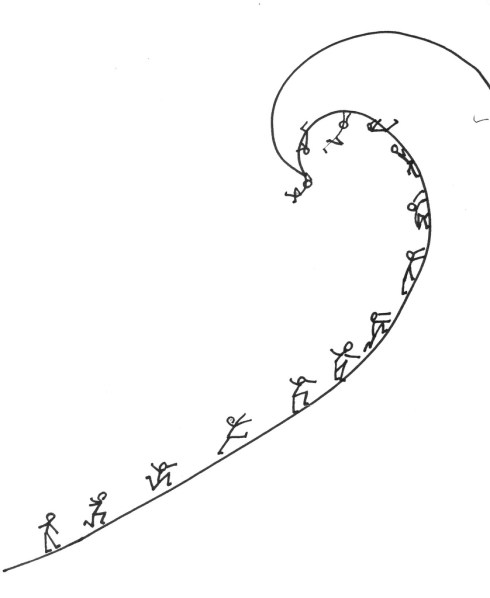
Drawing: Because Its There from www.f1me.net


7 comments
Comments feed for this article
April 4, 2011 at 11:30 pm
Hyena
Coaches think that morale, overall dynamics of the team and “being pumped” are important. I think it’s entirely plausible that a lot of this works by getting athletes to pre-commit to their effort and then allowing the team to regulate any tendency to shirk.
April 5, 2011 at 12:56 am
A-Z Blogging Challenge 2011 (A-E) Bloggers | I Love to Read | Write | Share Knowledge
[…] https://cheeptalk.wordpress.com/2011/04/04/effort-and-performance/ In Sports they give 100% Effort […]
April 5, 2011 at 9:06 am
Andrew
It seems the focus here is mainly on “individual” rather than “team” sports? In any case, it sounds as if your skeptics have not actually participated in sports themselves.
Speaking from experience in both cycling and running there is certainly a degree of “holding back” among the top racers. As you say, each racer wants to win but also wants to minimize effort. There is efficiency to be gained in staying within the draft of other racers, so despite the fact that a racer could go faster, he/she will hold back to stay with the others and not lead the race (where he/she would be putting out a larger effort relative to the rest of the group).
Some say that miler Alan Webb is a good example of a runner who was an excellent time-trialist but not a great head-to-head racer. He obviously could run fast, but he had trouble winning big races against others who were of similar speed (at least in theory)
April 5, 2011 at 1:13 pm
emir
There are 2 distinct models where athletes are strategic. One possibility is that athletes have preferences over winning and over effort (the model proposed by jeff). An alternative is that they only care about winning but have a fixed budget of effort to expand during the competition, and thus deploy their effort strategically. I think Andrew’s comment above is more relevant for the latter model.
I really like the swimming idea. The test is less clean in other races unless you both (i) have a valid instrument for whether a given runner is second or first (not so easy) and (ii) are certain there are no technological factors (e.g., drafting) that vary with whether you are first or second.
April 5, 2011 at 3:12 pm
jeff
emir thanks for clarifying. yes the preferences model is the one i am describing. the budget of effort model is entirely consistent with the skeptical view that athletes would never trade off winning versus effort.
i agree about the empirical challenges.
April 5, 2011 at 5:26 pm
Daniel Reeves
In many kinds of races, like cycling and skiing, there’s another factor: risk of crashing. The faster you go the greater the risk. So maximizing the probability of winning means holding back if you’re in the lead.
I predict your predictions will be correct!
April 6, 2011 at 10:46 am
LP
Nice idea but I think that a “good” empirical model would need to be quite complicated. The main point is that even the assumption that the leader “always gives everything” it’s not likely to hold in practice. Given the non-linearities involved, if everyone (including the leader) “shirks”, the effects on measurable quantities such as the performances’ variances are likely to be non trivial.
Why would the leader want to save energy?
– People in a race have info about who they’re competing against. They might know the other racers directly or have stats like personal best and season best. If someone knows he’s the clear leader of the field, he will have no incentive to race at 100%
– Some races are just less important than others and giving 100% is not always optimal… Daniel Reeves here above mentions the possibility of crashing but that point can be generalized. Pro runners (swimmers, whatever) follow very heavy schedules. The risk of “overdoing it” and get injured is real. Moreover, racing is a form of training in itself. As an example, suppose an elite runner runs a “easy” half marathon 6 weeks before the big race. Why would he want to give 100%, even assuming he’s the race leader?
– a related issue is seasonality. Racing in February when you’re still doing a lot of muscle work is not the same as racing in June at the peak of the season. This affects everybody but again if you think about the non linearities involved the effects on the estimates might be hard to forecast. Moreover, different athletes may be on slightly different schedules, have different histories of injuries, etc……..