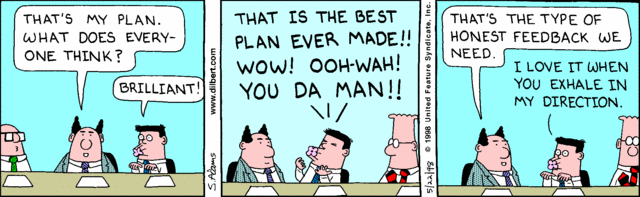
The members of a firm must work together on a big joint project.  There are many ways the project could be implemented.  One obvious procedure is dictatorial: the CEO simply choses her favorite option and demands that everyone follow her orders.  This is sometimes called directive or narcissistic leadership.  Another procedure is more participative: The CEO asks everyone their opinion and a decision is made.  Everyone might vote so the decision is made democratically or at the very least the CEO makes everyone’s opinions into account before making the decision herself.

In an emergency situation where decisions need to be made quickly, dictatorial leadership makes sense.  If you are in the middle of capturing Bin Laden, there is no time to mess around with participative leadership.  One person gives orders and everyone follows.

But in many other situations, it is wise to ask everyone’s opinions before embarking on a joint project.  The obvious rationale is that information is dispersed and communication might help to aggregate information.  The less obvious reason (to economists!): If people do not feel they “buy into” the decision, they are not going to work hard.  There may be no information to aggregate but the mere fact that everyone votes means that even the minority who voted against the decision feel committed to it.

The opening gambit of the book is surprisingly simple: If you were sentenced to five years in prison but had the option of receiving lashes instead, what would you choose? You would probably pick flogging. Wouldn’t we all?

I propose we give convicts the choice of the lash at the rate of two lashes per year of incarceration. One cannot reasonably argue that merely offering this choice is somehow cruel, especially when the status quo of incarceration remains an option. Prison means losing a part of your life and everything you care for. Compared with this, flogging is just a few very painful strokes on the backside. And it’s over in a few minutes. Often, and often very quickly, those who said flogging is too cruel to even consider suddenly say that flogging isn’t cruel enough. Personally, I believe that literally ripping skin from the human body is cruel. Even Singapore limits the lash to 24 strokes out of concern for the criminal’s survival. Now, flogging may be too harsh, or it may be too soft, but it really can’t be both.

The article is an excellent example of how considering an alternative (flogging replacing prison) which despite being non-serious still makes you think about the status quo in a new way.

If we could calibrate the number of lashes so as to create an equal disincentive but at a tiny fraction of the cost that should be a Pareto improvement right? Somehow that doesn’t seem right.  I think the thought experiment reveals that one important part of incarceration is just to prevent the criminal from committing more crimes.

If N lashes is just as unpleasant as 1 year in prison what exactly does that mean? It says that N lashes plus whatever I decide to do during the next year is just as unpleasant as being shut in for a year.  It will quite often be that the pivotal comparison is between prison and N lashes plus another year worth of crime.  In that case we certainly don’t have a Pareto improvement.

(hoodhi:  The Browser.)

You know the show Iron Chef?  Someone should organize Iron Blogger.  You are the chairman, you assemble your Iron Bloggers, and each week you invite a challenger blogger.  The “secret ingredient” is a topic for the challenger and his chosen Iron Blogger to write about.  You appoint judges to evaluate the writing according to content, style, and originality.

A firm is thinking about making a huge new investment.  After consultation and deliberation, the CEO and the employees unanimously decide the project should go ahead and initial investment begins.  As time passes more and more members of the organization realize that the investment is not a good idea after all.  It is better to cut and run.  Some costs are sunk and the NPV looking forward is negative.

The CEO is in charge of the continuation decision but his incentives are not aligned with the organization’s.  Privately, he was actually reluctant to pursue the project. Publicly, he boasted about the investment, how great it was all going to be, how great the firm would be when the investment paid off.  The CEO cannot go back on his word.  The market will judge him purely on whether the investment is made and whether it pays off.  He cannot cancel the project and instead he forces it through.  If it pays off, his career takes off; if it fails, his career is a shambles but is is also in a tailspin if he cancels the project.  The employees watch anxiously.  They will give him a year and if nothing works, they will look for opportunities elsewhere.

I knocked on my neighbor's door and asked for a liter of vacant platitudes

Seth Godin writes:

When two sides are negotiating over something that spoils forever if it doesn’t get shipped, there’s a straightforward way to increase the value of a settlement. Think of it as the net present value of a stream of football…

Any Sunday the NFL doesn’t play, the money is gone forever. You can’t make up for it later by selling more football–that money is gone. The owners don’t get it, the players don’t get it, the networks don’t get it, no one gets it.

The solution: While the lockout/strike/dispute is going on, keep playing. And put all the profit/pay in an escrow account. Week after week, the billions and billions of dollars pile up. The owners see it, the players see it, no one gets it until there’s a deal.

There are two questions you have to ask if you are going to evaluate this idea. First, what would happen if you change the rules in this way?  Second, would the parties actually agree to it?

Bargaining theory is one of the most unsettled areas of game theory, but there is one very general and very robust principle.  What drives the parties to agreement is the threat of burning surplus.  Any time a settlement proposal on the table it comes with the following interpretation: “if you don’t agree to this now you better expect to be able to negotiate for a significantly larger share on the next round because between now and then a big chunk of the pie is going to disappear.” Moreover it is only through the willingness to let the pie shrink that either party can prove that he is prepared to make big sacrifices in order to get that larger share.

So while the escrow idea ensures that there will be plenty of surplus once they reach agreement, it has the paradoxical effect of making agreement even more difficult to reach.  In the extreme it makes the timing of the agreement completely irrelevant.  What’s the point of even negotiating today when we can just wait until tomorrow?

But of course who cares when and even whether they eventually agree?  All we really want is to see football right?  And even if they never agree how to split the mounting surplus, this protocol keeps the players on the field.  True, but that’s why we have to ask whether the parties would actually accept this bargaining game. After all if we just wanted to force the players to play we wouldn’t have to get all cute with the rules of negotiation, we could just have an act of Congress.

And now we see why proposals like this can never really help because they just push the bargaining problem one step earlier, essentially just changing the terms of the negotiation without affecting the underlying incentives. As of today each party is looking ahead expecting some eventual payoff and some total surplus wasted.  Godin’s rules of negotiation would mean that no surplus is wasted so that each party could expect an even higher eventual payoff. But if it were possible to get the two parties to agree to that then for exactly the same reason under the old-fashioned bargaining process there would be a proposal for immediate agreement with the same division of the spoils on the table today and inked tomorrow.

Still it is interesting from a theoretical point of view.  It would make for a great game theory problem set to consider how different rules for dividing the accumulated profits would change the bargaining strategies.  The mantra would be “Ricardian Equivalence.”

  1. Blackouts
  2. “Filling in the census, I realised there wasn’t much to report beyond the fact that I didn’t have a wife and ten children and I didn’t believe in the resurrected Christ.”
  3. Recidivist paint inhaling.  (The mugshot is not to be missed.)
  4. Does he get fifth ammendment protection?
  5. Jihadville.
  6. Non-gay ringers on gay softball teams.
  7. Extreme ironing.

Now look, I am cool with “we” that means “one”, to celebrate the fact that the validity of mathematical statements is independent of the person who happens to claim them, as in “Dividing by \pi, we get that the game admits an equilibrium”. But sometimes the automatic replacement of `I’ with `we’ garbles the meaning of the sentence. When I write “I call such a sequence of variables a random play”, the singular pronoun implies that this is not a universally recognized definition, but one that I have invented for the current paper. Change this “I” to “we”, as the journal did, and the implication is lost. And sometimes `we’ for `one’ is just ridiculous, as in “We review Martin’s Theorem in the appendix”. It is one thing to say that every intelligent creature recognizes that the game admits an equilibrium, and another thing to say that every intelligent creature reviews Martin’s Theorem in the appendix.

We agree.

Consider the following syllogism:

  1. If a person is an American, he is probably not a member of Congress.
  2. This person is a member of Congress.
  3. Therefore he is probably not American.

As John D. Cook writes:

We can’t reject a null hypothesis just because we’ve seen data that are rare under this hypothesis. Maybe our data are even more rare under the alternative. It is rare for an American to be in Congress, but it is even more rare for someone who is not American to be in the US Congress!

We often remember things by relying on the overall gist of an event—for example, instead of storing every detail about our last birthday, we tend to remember abstract things like “I had a fun party” or “I was in a grumpy mood because I felt old.”  This strategy allows us to remember more things about an event, but there’s one major drawback: by storing memories based on gist, we actually change how we remember the event.  This happens because we are biased to remember things that are consistent with our overall summary of the event.  So if we remember the birthday party was “super fun” overall, we’ll exaggerate how we remember the details—the average chocolate cake is now “insanely good”, and the 10 friends who were there becomes a “huge crowd.”  One of the factors that could contribute to this distortion is time; as you forget the details of an event, there’s more room for gist to change how you remember things.  But you would remember the details of an event immediately afterward, right?

The article describes an experiment that suggests that this kind of classification-induced distortion occurs even for short-term memory.

Some of these things are coincidences, some not:

  1. The Bad Plus premeired their arrangement of Stravinsky’s Rite of Spring at Duke University on March 26, 2011.
  2. I happened to be at Duke University that day because the day before I presented “Torture” at the Economics Department.
  3. Atila Abdulkadiroglu and Bahar Leventoglu are my two favorite people in the whole world.
  4. After the show we met the band at a bar and had many drinks and fine conversation.
  5. Columbia B-School economist Maria Guadalupe was also there.
  6. Along with Philip Sadowski that brought the total number of economists enjoying free drinks on The Bad Plus to five.
  7. Maria’s sister is Cristina Guadalupe who collaborated on the visual arts aspect of the performance.
  8. Along with Philip’s wife that brought the total number of Spanish visual artists to two.
  9. Cristina is also married to the bass player Reid Anderson.
  10. And that is partly because Columbia B-school economist Bocachan Celen brought Maria to a Bad Plus performance and somehow this led to Reid meeting Cristina.
  11. Ethan Iverson does not want a MacArthur Fellowship.
  12. You can hear a recording of that night’s performance of The Rite of Spring here.

If I had to describe my feeling about the performance that night then I would probably procrastinate by doing something else because that’s how I tend to respond when I have to do something.  If I didn’t have to then I would say that it was a night I will never forget.

Drawing:  Spring from www.f1me.net

There was all this discussion about Steven Landsburg’s taxation example.

Nothing makes my job easier than a journalist who writes about something interesting and gets it 100% wrong.

Thanks, then, to Elizabeth Lesly Stevens for her column in yesterday’s Bay Citizen. Stevens wants to tax the “idle rich”, her Exhibit A being Robert Kendrick, heir to the $84 million Schlage Lock Company fortune. According to Ms. Stevens, Mr. Kendrick appears to do pretty much nothing but park and re-park his four cars all day long. Taxing people like Mr. Kendrick, she says, has to be part of any solution to America’s fiscal crisis.

Here’s what Ms. Stevens misses: Assuming the facts are as she states them, it is quite literally impossible to raise revenue by taxing the likes of Mr. Kendrick. We could argue about whether it’s desirable, but because it’s impossible, the discussion is moot.

The point being that once we look at the real economy, i.e. the allocation of goods and services and how that would be altered by taxing Mr. Kendrick, we see that since he is consuming nothing any increase in consumption by the goverment must be taking resources away from somebody else.

If that doesn’t persuade you then consider this.  Suppose Kendrick puts all of his assets into a pile of cash and burns it.  There is no affect on anybody’s consumption. (Assume he gets no consumption value from the bonfire.)  If at the same time the governement prints an equal number of dollars and spends it, consumption allocations have been altered but not Mr. Kendrick’s. Whatever goods and services the government consumes must come from somebody other than he.  Now observe that there is no difference at all between the scenario in which the money is burned by one party and printed by another and the scenario in which it is handed over directly through a tax.

Professor Landsburg makes a contribution by presenting these examples which force us to think carefully about concepts we normally take for granted. Indeed he is even willing to adopt the persona of a smug provocateur to get his point across, and we owe him our thanks for that sacrifice in service of the greater good.

On the other hand we should recognize that this exercise is really beside the point. The government certainly can raise revenue by taking Mr. Kendrick’s assets.  The fact is that the dollar value of his assets are a claim on goods and services that will eventually be exercised by whomever inherits the assets. Taxing his assets today means taking those claims away from them. Moreover, the real allocation of resources will be altered in a way that is right in line with the spirit of the original columnist’s motivation.  The government will consume more today, others will save more today.  Those savers will consume more in the future and Mr. Kendrick’s windfall heirs will consume less.


A player can engage in productive effort which adds value or in unproductive effort, buttering up the boss.  There are two workers and one is more productive than the other: The marginal product of effort for worker A is bigger than the marginal product of effort for worker B.  Productive effort is rewarded with monetary payment or career advancement and so is effort expended at buttering up the boss.

We get the following simple insight: The higher productivity worker faces a higher opportunity cost of buttering up the boss.  He will spend less time on unproductive activity and more time on productive activity.

(Acknowledgement:  Loosely based on a model presented by Stergios Skaperdas)

A series of photos he took in the summer of 1949 as a journalist.  Many of them are downright Kubrickian.  He has a way with furniture.

That’s the famed Pump Room

I organized and am attending a conference on conflict at NU.  Here is the website for the conference with schedule and papers.

Tyler raises the cash-grants versus Medicare question:

Nonetheless I propose a more modest version of the idea.  When people turn a certain age, allow them to trade in the current benefits package for a minimalistic package (set broken limbs and offer lots of potent painkillers), plus some of the rest in cash, doled out over the years if need be.  For some people, medical tourism will fill the gap.

Even if you believe that cash grants are a more efficient way to achieve whatever end Medicare does you should still be opposed to this idea.  Because Medicare will never go away forever.  You can “replace” it with cash grants but eventually people will notice again that old people want health care subsidies and then you will have both cash grants and Medicare.

Indeed, we already had cash grants in the form of Social Security when Medicare was introduced as a supplement to Social Security in 1965.

Your home is underwater but you can’t use that to keep your lawn green and the homeowner’s association is threatening to sue, what do you do?  Paint it.

The grass spraying business took off here as the housing crisis escalated and real estate brokers were looking to quickly increase the curb appeal of abandoned properties on the cheap. A lawn painting, using a vegetable-based dye, can cost about $200. Vigorous homeowners’ associations, which can fine owners thousands of dollars if a dispute drags on, have also been good for business, said Klaus Lehmann of Turf-Painters Enterprise.

How could it be that millions of users sign on to a service like Twitter and voluntarily impose upon themselves a constraint to talk in no more than 140 character dollops at a time?  Of course the answer is that they want access to the network, Twitter owns it and Twitter sets the rules.  But then the question is why is a restriction like that the blueprint for a successful network.

Here’s an analogy.  Imagine that you own a vacant lot where every weekend people meet to buy and sell stuff.  You don’t charge any entry fees and you don’t take a cut from any transaction, you simply want to be the most popular vacant lot in town.

Every seller who is there selling stuff contributes value to the market as a whole and you internalize that overall value.  But you and the sellers have a basic conflict of interest because they are maximizing their own profits and not the overall value of being in the market.  When they raise prices they extract surplus from the people willing to pay high prices and in the process reduce the surplus of people who don’t.

From your point of view the extracted surplus is just a transfer of value from one member of your club to another, and what you really care about is the lost value from the excluded sales.  So you will generally want lower prices than the sellers would set on their own.

Now think of each message in a social network as having two components:  information and self-promotion.  People follow you if you provide them with useful information.  And if your information is useful some would even be willing to wade through some self-promotion to get to your useful information.  But not all. The self-promotion is the price of the information and its a transfer of value because it costs the follower his attention and enhances the followee’s reputation.

From Twitter’s point of view the users are a bunch of tiny monopolists willing to exchange a little bit of overall surplus for a bit more of their own.  140 is like a price cap imposed by the owner of the vacant lot which boosts the information/self-promotion ratio of tweets.

The surprising thing is that some users aren’t just outright banned.

It’s almost as though the implosion was manufactured for the sole purpose of creating fodder for commentary.

Most of the inaccurate information about me on the Internet is harmless. And negative opinions about the quality of my work are always legitimate. The trouble starts when advocates for one cause or another use me as a whipping boy to promote their agendas. As I mentioned, the way that works is that they take out of context something I’ve written, paraphrase it incorrectly, and market me as a perfect example of the thought-criminal that they’ve been warning everyone about. I don’t think any of this is an organized conspiracy. I think it’s a combination of zealotry, bad reading comprehension, opportunism, and some herd behavior.

[If you’re new to this, the paragraph above is the part that will be taken out of context and paraphrased to show that I’m paranoid and delusional, claiming that organized groups are out to get me.]

The full article is likely to be your best read of the week.

1. Gary Vee records his final entry for Wine Library and starts the Daily Grape.

2. Great wine bar in Bordeaux which has amazing (though expensive) wines by the glass.

3. St John’s College Cambridge is 500 years old.  Eric Maskin helps them celebrate on July 4.

4. Tina Fey-McGaw Ymca Evanston connection

From Doktor Frank, quoting Hemingway, or Roald Dahl, or somebody.

The best way is always to stop when you are going good and when you know what will happen next. If you do that every day you will never be stuck. Always stop while you are going good and don’t think about it or worry about it until you start to write the next day. That way your subconscious will work on it all the time. But if you think about it consciously or worry about it you will kill it and your brain will be tired before you start.

Outstanding advice, but there is a tradeoff.  Being on a roll means being connected to what you are writing right now.  And that connection can lapse after time passes, even just overnight.  Material which was gold last night can turn in to lead the next morning.  A better bridge is to conclude the session with rapid, sketchy, outliny writing and start the next day by fleshing out the overhang to re-establish the flow.

Hat Tip: Frank’s comment in post below

To Be or Not To Be, That is the Question…

A hard question to answer in a business school professor’s teaching life.  Am I just teaching common sense? Is This Material Too Simple?  Existential questions.  And then comes evidence that actually rather basic knowledge is quite helpful.  Witness the startling article “Real-Life Lessons in the Delicate Art of Setting Prices” in the NYT.

Lesson 1: Inelastic Demand

‘About three years ago a computer error caused all of the prices on Headsets.com to be displayed at cost rather than retail. With the lower prices on display for a weekend, Mike Faith, the chief executive, expected sales to soar. Instead, the increase was marginal. “It was a big lesson for us,” Mr. Faith said’

Lesson 2: Vertical Differentiation and Market Power

(1) Math tutor Kronenberg:

‘I learned it’s a misconception that if you raise prices too much, you’ll have no business,” Mr. Kronenberg said. “There are many customers who shop based on quality, not lowest price.’

(2) Headsets.com:

‘[Mike Faith] realized that sales for his company, which is based in San Francisco, were far less dependent on price than on what he now says differentiates his business: customer service. “Every call we get is answered by a human being within four rings,” he said, “and our reps are well trained and know a lot about the headsets.”

Since the incident, Mr. Faith has raised prices once, by 8 percent and without much fanfare, although regular customers were told in advance. The result? Revenue rose about 8 percent as well.’

(3)  Artisan wheat flour producer:

`Naomi Poe, founder of Better Batter Gluten Free Flour near Altoona, Pa., learned that it is important to try to understand how your customers value your product.

In the food industry, Ms. Poe said, customers generally look for the cheapest price, but because her flour and baking mixes contain no gluten, they cost more to manufacture. She initially tried to compete with products that contain gluten on price but lost money on every sale. To raise prices, she had to convince customers her products offered added value. “In blind taste tests on regular people — not just those who are gluten-free — we heard consistently that our cakes were superior,” she said. “We also offer an unconditional guarantee as well as education and counseling.”

 Her first year in business, 2008, she raised prices 20 percent, increasing her gross profit margin — the profit on each item she sells — about 11 percent and increasing sales revenue 25 percent, she said.
“This helped us cover our expansion costs in 2008,” Ms. Poe said. After that, the business grew about 250 percent year to year.’

(3) Lesson 3: Price Discrimination

‘Last year [Footsyrolls, a company producing roll-up flat shoes] changed their offerings, going to two tiers of products and pricing. The Everyday Collection sells for $20 a pair and a higher-end category, Lux, for $30 a pair. “We actually have had the most interest in our higher-priced shoes,” Ms. Caplan said.

Because they brought one line down $5 and another up $5, the average price per unit remained about the same, but the impact was immediate. “We introduced the Lux line in summer 2010 and had a 100 percent increase in revenue,” she said. “We actually ran out of stock.”’

Lesson 4: These people need more lessons.

(1) Mike Faith: ‘The truth about pricing is it’s an art with a little bit of science, rather than a science with a little bit of art.’

No, Mike!  It’s the other way round.

(2) Naomi Poe: ‘In January she raised prices an additional 10 percent, this time to cover broker and distributor fees as well as the rising cost of fuel and ingredients. Far from losing customers, she saw her revenue double and her gross margins leap to about 36 percent from 20 percent.’

Revenue is not the same as sales.  Sales can go down when you raise price and revenue go up.  If this happens, your price is in “negative marginal revenue” territory so your pricing strategy is horribly wrong.  Perhaps a short exec ed course at the Kellogg School of Management taught by me for a large but well worth it fee will help you learn what marginal revenue means and make you hundreds of thousands in profits.

I remember going out to dinner with Jon Levin when he was on the job market (I think we went to Topolobambo?).  My food memory is way better than my seminar memory but I think Jon presented “Relational Incentive Contracts” as his job market paper.  Many employees are paid not only a base salary but a bonus based on hard to verify details of their performance.  Their employer realizes if she reneges on the promised performance-based bonus, there will be serious consequences.  As an example of the benefits of keeping employees happy, Jon mentions a dispute between United and its pilots.  During contract negotiations, the pilots “worked to rule”.  The resulting cancelled flights and delays convinced United to pay generously.

The relationship between the employer (principal) and the employee (agent) is a repeated game.  The agent might have unobservable information each period or exert unobservable effort each period.  The principal’s wage offer and bonus payment between the two parties are observed by both parties. Levin studies an environment with transferable utility.  If the principal deviates at any point in time, the equilibrium demands that they move to a static equilibrium where the principal offers a constant wage and the agent exerts zero effort. Hence, with observable principal behavior it is easy to keep the principal in line. The difficulty is keeping the agent working at the optimal level. In principle, the (incentive constrained) surplus maximizing contract can be quite complex.  But with transferable utility it is simple. The optimal contract can be taken to be stationary: the principal offers the same wage and bonus as a function of observed agent output.  Any non-stationary contract where continuation values vary over time can be replicated by a stationary contract: Any variation in continuation payoffs to the agent can be replicated by a transfer in the first period.  Hence, a stationary contract suffices to give incentives to the agent.  It might unravel incentives for the principal.  But since the principal’s and the agent’s payments to each other are observable, incentives w.r.t. transfers can be maintained in the stationary contract.

Levin then uses this benchmark to study many other things but my impression as an outsider to the relational contracting literature is that the result on stationary contracts is the fundamental contribution of the paper.  In many organizational economics seminars, I have seen presenters say “by Levin’s Theorem 2 I focus on stationary contracts” and then proceed to find the optimal contract in their setting under stationarity.  The paper has around 500 citations according to Google Scholar.

Now, I am going to wander into (even) shakier territory given my (lack of) expertise: I am going to describe one of his recent forays into empirical work. Adams, Einav and Levin study the behavior of borrowers in the subprime market for auto loans.  They have some amazing data from an auto sales company that also originates such subprime loans.  They also track the behavior of borrowers over time.  There are lots of interesting results.

First, demand is higher during tax rebate season.  Second, a $100 increase in required down payments reduces demand by 9% keeping prices fixed. Keeping the down payment fixed, the same decrease in demand is generated by a price increase of $3000!  The authors calculate that this implies borrowers are indifferent between paying $100 today or $1515 in one year!

The authors have the same data as the lender: they have data on applicants and on the performance of loans that were initiated.  Applicants have a median FICO score below 500 (the US median is 700-750), an average income of $1200/month and live with their parents or rent.  Around 2/3rds are turned away.  Those who are successful make a downpayment of $1000 and buy a car costing around $11,000  Interest rates are 20-30% and the default rate is 60%.

The lender uses risk-based pricing and faces regulated interest rate caps.  In theory, the latter should affect the down-payment.  Credit rationing can also occur in equilibrium with moral hazard and adverse selection.  The authors tease out various implications of the theory credit-rationing and see if they are backed up by the data.  For example, the more likely you are to default, the larger is the loan you demand – after all you are not paying it back anyway!  Also, the probability of default should rise with loan size for a given individual.  The authors can disentangle the first (adverse selection) from the second (moral hazard).  They argue that credit-scoring can go a long way towards mitigating the impact of adverse selection but moral hazard is more difficult to eradicate.

I still want to absorb the identification of moral hazard vs adverse selection in the data.  As a b school teacher, I will give this paper the highest compliment possible : I hope to incorporate this somehow into my competitive strategy course.  I hope the authors tracked not only the borrowers but the lender’s performance so we can determine whether they should have been lending in this market in the first place.

Jon has done lots of other work: see the AEA write-up.

Congratulation Jon!

This is the third and final post on ticket pricing motivated by the new restaurant Next in Chicago and proprietors Grant Achatz and Nick Kokonas new ticket policy.   In the previous two installments I tried to use standard mechanism design theory to see what comes out when you feed in some non-standard pricing motives having to do with enhancing “consumer value.”  The two attempts that most naturally come to mind yielded insights but not a useful pricing system. Today the third time is the charm.

Things start to come in to place when we pay close attention to this part of Nick’s comment to us:

we never want to invert the value proposition so that customers are paying a premium that is disproportionate to the amount of food / quality of service they receive.

I propose to formalize this as follows.  From the restaurant’s point of view, consumer surplus is valuable but some consumers are prepared to bid even more than the true value of the service they will get.  The restaurant doesn’t count these skyscraping bids as actually reflecting consumer surplus and they don’t want to tailor their mechanism to cater to them.  In particular, the restaurant distinguishes willingness to pay from “value.”

I can think of a number of sensible reasons they would take this view.  They might know that many patrons overestimate the value of a seating at Next. Indeed the restaurant might worry that high prices by themselves artificially inflate willingness to pay.  They don’t want a bubble.  And they worry about their reputation if someone pays $1700 for a ticket, gets only $1000 worth of value and publicly gripes.  Finally they might just honestly believe that willingness to pay is a poor measure of welfare especially when comparing high versus low.

Whatever the reason, let’s run with it.  Let’s define W(v)< v to be the value, as the restaurant perceives it, that would be realized by service to a patron whose willingness to pay is v.  One natural example would be

W(v) = \min \{v, \bar v\}

where \bar v is some prespecified “cap.”  It would be like saying that nobody, no matter how much they say they are willing to pay, really gets a value larger than, say \bar v = \$1000 from eating at Next.

Now let’s consider the optimal pricing mechanism for a restaurant that maximizes a weighted sum of profit and consumer’s surplus, where now consumer’s surplus is measured as the difference between W(v) and whatever price is paid. The weight on profit is \alpha and the weight on consumer surplus is 1- \alpha.  After you integrate by parts you now get the following formula for virtual surplus.

(1 - \alpha) W(v) + (2 \alpha - 1) [v - \frac{1-F(v)}{f(v)} ]

And now we have something!  Because  if \alpha is between 0 and 1/2 then the first term is increasing in v (up to the cap \bar v) and the second term is decreasing.  For \alpha close enough to 1/2, the overall virtual surplus is going to be first increasing and then decreasing.  And that means that the optimal mechanism is something new.  When bids are in the low to moderate range, you use an auction to decide who gets served.  But above some level, high bidders don’t get any further advantage and they are all lumped together.

The optimal mechanism is a hybrid between an auction and a lottery.  It has no reserve price (over and above the cost of service) so there are never empty seats. It earns profits but eschews exorbitant prices.

It has clear advantages over a fixed price.  A fixed price is a blunt instrument that has to serve two conflicting purposes.  It has to be high enough to earn sufficient revenue on dates when demand is high enough to support it, but it can’t be too high that it leads to empty seats on dates when demand is lower. An auction with rationing at the top is flexible enough to deal with both tasks independently.  When demand is high the fixed price (and rationing) is in effect. When demand is low the auction takes care of adjusting the price downward to keep the restaurant full.  The revenue-enhancing effects of low prices is an under-appreciated benefit of an auction.  Finally, it’s an efficient allocation system for the middle range of prices so scalping motivations are reduced compared to a fixed price.

Incentives for scalping are not eliminated altogether because of the rationing at the top. This can be dealt with by controlling the resale market.  Indeed here is one clear message that comes out of all of this.  Whatever motivation the restaurant has for rationing sales, it is never optimal to allow unfettered resale of tickets.  That only undermines what you were trying to achieve.  Now Grant Achatz and Nick Kokonas understand that but they are forced to condone the Craigslist market because by law non-refundable tickets must be freely transferrable.

But the cure is worse than the disease.  In fact refundable tickets are your friend. The reason someone wants to return their ticket for a refund is that their willingness to pay has dropped below the price. But there is somebody else with a willingness to pay that is above the price.  We know this for sure because tickets are being rationed at that price. Granting the refund allows the restaurant to immediately re-sell it to the next guy waiting in line. Indeed, a hosted resale market would enable the restaurant to ensure that such transactions take place instantaneously through an automated system according to the same terms under which tickets were originally sold.

Someone ought to try this.

A meditation on tipping in Australia versus the United States.

And Manhattan is really cool these days. Especially with the Aussie kicking seven kinds of Chinese tripe out of the greenback. But that rest room, it was a marvel. If it was a person I’d say it’d been scrubbed until its bellybutton shined. The mountain of crisp, white, freshly laundered hand towels never got any smaller despite the constant stream of punters using and discarding them. The wash basin, gleaming and shining, fairly groaned under the weight of the vast selection of cleansing gels, moisturizers, and other masculine hygiene products with which I must profess myself completely unfamiliar. Not one stray, errant drop marked the floor of this restroom. Nary a single pubic hair had escaped to run wild on the immaculate tiling. And it was all thanks to the dude from Senegal who was doing it for minimum wage and tips.

It seems that the toilets are not so clean in Oz.  And tipping, evidently an American import, hasn’t exactly captured the imagination down under.  The comments following the article are especially entertaining.

Restaurants, touring musicians, and sports franchises are not out to gouge every last penny out of their patrons.  They want patrons to enjoy their craft but also to come away feeling like they didn’t pay an arm and a leg.  Yesterday I tried to formalize this motivation as maximizing consumer surplus but that didn’t give a useful answer. Maximizing consumer surplus means either complete rationing (and zero profit) or going all the way to an auction (a more general argument why appears below.)  So today I will try something different.

Presumably the restaurant cares about profits too.  So it makes sense to study the mechanism that maximizes a weighted sum of profits and consumer’s surplus. We can do that.  Standard optimal mechanism design proceeds by a sequence of mathematical tricks to derive a measure of a consumer’s value called virtual surplus.  Virtual surplus allows you to treat any selling mechanism you can imagine as if it worked like this

  1. Consumers submit “bids”
  2. Based on the bids received the seller computes the virtual surplus of each consumer.
  3. The consumer with the highest virtual surplus is served.

If you write down the optimal mechanism design problem where the seller puts weight \alpha on profits and weight 1 - \alpha on consumer surplus, and you do all the integration by parts, you get this formula for virtual surplus.

\alpha v + (1 - 2\alpha) \frac{1 - F(v)}{f(v)}

where v is the consumer’s willingness to pay, F(v) is the proportion of consumers with willingness to pay less than v and f(v) is the corresponding probability density function.   That last ratio is called the (inverse) hazard rate.

As usual, just staring down this formula tells you just about everything you want to know about how to design the pricing system.  One very important thing to know is what to do when virtual surplus is a decreasing function of v. If we have a decreasing virtual surplus then we learn that it’s at least as important to serve the low valuation buyers as those with high valuations (see point 3 above.)

But here’s a key observation: its impossible to sell to low valuation buyers and not also to high valuation buyers because whatever price the former will agree to pay the latter will pay too.  So a decreasing virtual surplus means that you do the next best thing: you treat high and low value types the same. This is how rationing becomes part of an optimal mechanism.

For example, suppose the weight on profit \alpha is equal to 0. That brings us back to yesterday’s problem of just maximizing consumer surplus. And our formula now tells us why complete rationing is optimal because it tells us that virtual surplus is just equal to the hazard rate which is typically monotonically decreasing. Intuitively here’s what the virtual surplus is telling us when we are trying to maximize consumer surplus. If we are faced with two bidders and one has a higher valuation than the other, then to try to discriminate would require that we set a price in between the two. That’s too costly for us because it would cut into the consumer surplus of the eventual winner.

So that’s how we get the answer I discussed yesterday.  Before going on I would like to elaborate on yesterday’s post based on correspondence I had with a few commenters, especially David Miller and Kane Sweeney. Their comments highlight two assumptions that are used to get the rationing conclusion:  monotone hazard rate, and no payments to non-buyers.  It gets a little more technical than usual so I am going to put it here in an addendum to yesterday (scroll down for the addendum.)

Now back to the general case we are looking at today, we can consider other values of \alpha

An important benchmark case is \alpha = 1/2 when virtual surplus reduces to just v, now monotonically increasing.  That says that a seller who puts equal weight on profits and consumer surplus will always allocate to the highest bidder because his virtual surplus is higher.  An auction does the job, in fact a second price auction is optimal.  The seller is implementing the efficient outcome.

More interesting is when \alpha is between 0 and 1/2. In general then the shape of the virtual surplus will depend on the distribution F, but the general tendency will be toward either complete rationing or an efficient auction.  To illustrate, suppose that willingness to pay is distributed uniformly from 0 to 1. Then virtual suplus reduces to

(3 \alpha - 1) v + (1 - 2 \alpha)

which is either decreasing over the whole range of v (when \alpha \leq 1/3), implying complete rationing or increasing over the whole range (when \alpha > 1/3), prescribing an auction.

Finally when \alpha > 1/2 virtual surplus is the difference between an increasing function and a decreasing function and so it is increasing over the whole range and this means that an auction is optimal (now typically with a reserve price above cost so that in return for higher profits the restaurant lives with empty tables and inefficiency.  This is not something any restaurant would choose if it can at all avoid it.)

What do we conclude from this?  Maximizing a weighted sum of consumer surplus and profit yields again yields one of two possible mechanisms: complete rationing or an auction.  Neither of these mechanisms seem to fit what Nick Kokonas was looking for in his comment to us and so we have to go back to the drawing board again.

Tomorrow I will take a closer look and extract a more refined version of Nick’s objective that will in fact produce a new kind of mechanism that may just fit the bill.

Addendum: Check out these related papers by Bulow and Klemperer (dcd: glen weyl) and by Daniele Condorelli.

Complaining about TSA screening is considered by the TSA to be cause for additional scrutiny.

Agent Jose Melendez-Perez told the 9/11 commission that Mohammed al-Qahtani “became visibly upset” and arrogantly pointed his finger in the agent’s face when asked why he did not have an airline ticket for a return flight.

But some experts say terrorists are much more likely to avoid confrontations with authorities, saying an al Qaeda training manual instructs members to blend in.

“I think the idea that they would try to draw attention to themselves by being arrogant at airport security, it fails the common sense test,” said CNN National Security Analyst Peter Bergen. “And it also fails what we know about their behaviors in the past.”

A hypothetical example – A business school is offering a non-degree executive education course.  Forty people sign up and yet the course is cancelled.  An administrator says that when the overhead costs are taken into account, the course is unprofitable.

Without the class, the lecture rooms and dorm rooms would be empty and the same number of staff employed.  That is, the overhead cost is incurred whether the class is taught or not.  Hence it should not be included in determination of the cancellation decision.  The revenue from the class should be compared with the extra variable costs incurred from running it (e.g. the salary paid to the teacher!).

The reverse fallacy is also possible: The class is on the schedule, very few students have signed up and yet it is not cancelled. If it is cancelled, the logic goes, how would the school recover the overhead?

Jeff and I have a paper Mnemonomics… that offers a theory of the sunk cost fallacy based on limited memory.  We call the first fallacy above “the pro-rata fallacy” and the second “the Concorde fallacy” (after the supersonic jet).  In experiments, we find the pro-rata fallacy is extremely common.

Last week, in response to our proposal for how to run a ticket market, Nick Kokonas of Next Restaurant wrote something interesting.

Simply, we never want to invert the value proposition so that customers are paying a premium that is disproportionate to the amount of food / quality of service they receive. Right now we have it as a great bargain for those who can buy tickets. Ideally, we keep it a great value and stay full.

Economists are not used to that kind of thinking and certainly not accustomed to putting such objectives into our models, but we should.  Many sellers share Nick’s view and the economist’s job is to show the best way to achieve a principal’s objective, whatever it may be.  We certainly have the tools to do it.

Here’s an interesting observation to start with.  Suppose that we interpret Nick as wanting to maximize consumer surplus.  What pricing mechanism does that? A fixed price has the advantage of giving high consumer surplus when willingness to pay is high.  The key disadvantage is rationing:  a fixed price has no way of ensuring that the guy with a high value and therefore high consumer surplus gets served ahead of a guy with a low value.

By contrast an auction always serves the guy with the highest value and that translates to higher consumer surplus at any given price.  But the competition of an auction will lead to higher prices.  So which effect dominates?

Here’s a little example. Suppose you have two bidders and each has a willingness to pay that is distributed according the uniform distribution on the interval [0,1].  Let’s net out the cost of service and hence take that to be zero.

If you use a rationing system, each bidder has a 50-50 chance of winning and paying nothing (i.e. paying the cost of service.)  So a bidder whose value for service is v will have expected consumer surplus equal to v/2.

If instead you use an auction, what happens?  First, the highest bidder will win so that a bidder with value v wins with probability v.  (That’s just the probability that his opponent had a lower value.)  For bidders with high values that is going to be higher than the 50-50 probability from the rationing system. That’s the benefit of an auction.

However he is going to have to pay for it and his expected payment is v/2. (The simplest way to see this is to consider a second-price auction where he pays his opponent’s bid.  His opponent has a dominant strategy to bid his value, and with the uniform distribution that value will be v/2 on average conditional on being below v.)  So his consumer surplus is only

v (v - v/2) = v^{2}/2

because when he wins his surplus is his value minus his expected payment v- v/2, and he wins with probability v.

So in this example we see that, from the point of view of consumer surplus, the benefits of the efficiency of an auction are more than offset by the cost of higher prices.  But this is just one example and an auction is just one of many ways we could think of improving upon rationing.

However, it turns out that the best mechanism for maximizing consumer surplus is always complete rationing (I will prove this as a part of a more general demonstration tomorrow.)  Set price equal to marginal cost and use a lottery (or a queue) to allocate among those willing to pay the price.  (I assume that the restaurant is not going to just give away money.)

What this tells us is that maximizing consumer surplus can’t be what Nick Kokonas wants.  Because with the consumer surplus maximizing mechanism, the restaurant just breaks even.  And in this analysis we are leaving out all of the usual problems with rationing such as scalping, encouraging bidders with near-zero willingness to pay to submit bids, etc.

So tomorrow I will take a second stab at the question in search of a good theory of pricing that takes into account the “value proposition” motivation.

Addendum:  I received comments from David Miller and Kane Sweeney that will allow me to elaborate on some details.  It gets a little more technical than the rest of these posts so you might want to skip over this if you are not acquainted with the theory.

David Miller reminded me of a very interesting paper by Ran Shao and Lin Zhou.  (See also this related paper by the same authors.) They demonstrate a mechanism that achieves a higher consumer surplus than the complete rationing mechanism and indeed that achieves the highest consumer surplus among all dominant-strategy, individually rational mechanisms.

Before going into the details of their mechanism let me point out the difference between the question I am posing and the one they answer.   In formal terms I am imposing an additional constraint, namely that the restaurant will not give money to any consumer who does not obtain a ticket.  The restaurant can give tickets away but it won’t write a check to those not lucky enough to get freebies.  This is the right restriction for the restaurant application for two reasons.  First if the restaurant wants to maximize consumer surplus its because it wants to make people happy about the food they eat, not happy about walking away with no food but a payday.  Second, as a practical matter a mechanism that gives away money is just going to attract non-serious bidders who are looking for a handout.

In fact Shao and Zhou are starting from a related but conceptually different motivation: the classical problem of bilateral trade between two agents.  In the most natural interpretation of their model the two bidders are really two agents negotiating the sale of an object that one of them already owns.  Then it makes sense for one of the agents to walk away with no “ticket” but a paycheck.  It means that he sold the object to the other guy.

Ok with all that background here is their mechanism in its simplest form.  Agent 1 is provisionally allocated the ticket (so he becomes the seller in the bilateral negotiation.) Agent 2 is given the option to buy from agent 1 at a fixed price.  If his value is above that price he buys and pays to agent 1.  Otherwise agent 1 keeps the ticket and no money changes hands.  (David in his comment described a symmetric version of the mechanism which you can think of as representing a random choice of who will be provisionally allocated the ticket.  In our correspondence we figured out that the payment scheme for the symmetric version should be a little different, it’s an exercise to figure out how.  But I didn’t let him edit his comment. Ha Ha Ha!!!)

In the uniform case the price should be set at 50 cents and this gives a total surplus of 5/8, outperforming complete rationing. Its instructive to understand how this is accomplished.  As I pointed out, an auction takes away consumer surplus from high-valuation types.  But in the Shao-Zhou framework there is an upside to this.  Because the money extracted will be used to pay off the other agent, raising his consumer surplus.  So you want to at least use some auction elements in the mechanism.

One common theme in my analysis and theirs is in fact a deep and under-appreciated result.  You never want to “burn money.”  Using an auction is worse than complete rationing because the screening benefits of pricing is outweighed by the surplus lost due to the payments to the seller.  Using the Shao-Zhou mechanism is optimal precisely becuase it finds a clever way to redirect those payments so no money is burned.  By the way this is also an important theme in David Miller’s work on dynamic mechanisms. See here and here.

Finally, we can verify that the Shao-Zhou mechanism would no longer be optimal if we adapted it to satisfy the constraint that the loser doesnt receive any money.  It’s easy to do this based on the revenue equivalence theorem.  In the Shao-Zhou mechanism an agent with zero value gets expected utility equal to 1/8 due to the payments he receives. We can subtract utility of 1/8 from all types and obtain an incentive-compatible mechanism with the same allocation rule.  This would be just enough to satisfy my constraint.  And then the total surplus will be 5/8-2/8 = 3/8 which is less than the 1/2 of the complete rationing mechanism.  That’s another expression of the losses associated with using even the very crude screening in the Shao-Zhou mechanism.

Next let me tell you about my correspondence with Kane Sweeney.  He constructed a simple example where an auction outperforms rationing.  It works like this.  Suppose that each bidder either had a very low willingness to pay, say 50 cents, or a very high willingness to pay, say $1,000.  If you ration then expected surplus is about $500. Instead you could do the following.  Run a second-price auction with the following modification to the rules.  If both bid $1000 then toss a coin and give the ticket to the winner at a price of $1.  This mechanism gives an expected surplus of about $750.

Basically this type of example shows that the monotone hazard rate assumption is important for the superiority of rationing.  To see this, suppose that we smooth out the distribution of values so that types between 50 cents and $1000 have very small positive probability.  Then the hazard rate is first increasing around 50 cents and then decreasing from 50 cents all the way to $1000.  So you want to pool all the types above 50 cents but you want to screen out the 50-cent types.  That’s what Kane’s mechanism is doing.

I would interpret Kane’s mechanism as delivering a slightly nuanced version of the rationing message.  You want to screen out the non-serious bidders but ration among all of the serious bidders.