
You are currently browsing the category archive for the ‘Uncategorized’ category.
- If you have a blog and you write about potential research questions, write the question out clearly but give a wrong answer. This solves the problem I raised here.
- When I send an email to two people I feel bad for the person whose name I address second (“Dear Joe and Jane”) so I put it twice to make it up to them (“Dear Joe and Jane and Jane.”)
- If you have a rich country and a poor country and their economies are growing at the same rate you will nevertheless have rising inequality over time simply because, as is well documented, the poor have more kids.
- Are there arguments against covering contraception under health insurance that don’t also apply to covering vaccines?
- The most interesting news is either so juicy that the source wants it kept private or so important that the source wants to make it public. This is why Facebook is an inferior form of communication: as neither private nor fully public it is an interior minimum.

- How to make Siri curse like a sailor.
- Thick As A Brick 2?
- Dr. Seuss’ adult book.
- Time for TED. (If you click on only one Sordid Link this season, this should be the one.)
- Justin Wolfers tweeted a funny joke.
- Self-synchronizing metronomes.
He plays drums, he has a blog,
i am in a world title fight with a mid life crisis and im kicking its fu#$%$ing ass. i weigh 171lbs (4 lbs less than when i graduated from high school with a 1.9 grade point average) which means i’m trim and ripped and i drive a 1976 mercedes benz with a little more than a little rust on it because i drive it in minnesota winters and its only really worked for a little while but i look like a pbs, nova, paper chase watching mother fucker in it. I WILL ASK THIS ONLY ONE MORE TIME!!! DOES ANYONE WANT TO WRESTLE ME??? ive been watching college wrestling late at night on cable and wait………does anyone say “cable” anymore?? side note: i want to bring back the innocence of motel signs that say “free HBO” on them. I think it would be funny if i stood outside a courthouse with an old motel sign that said free HBO and just check out the reactions. you know…as in HBO should be let out of jail. IM SURE I CAN GET A GRANT FOR THIS. THIS IS POST MODERN.
and there is a new movie about him, called King For Two Days. I think the title means that it follows him for two days but not necessarily that the movie is two days long, although I haven’t checked to be 100% honest with you.
He posted this to his Market Design blog.
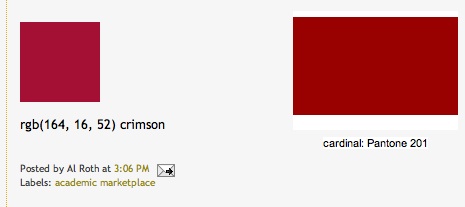
A different shade of red:
Chinese make up 0.43% of the population of Cincinnati and they have a Panda Express. That’s like putting a Wienerschnitzel in Singapore.
The population of Singapore is 85% Chinese and they have a Chinatown. That’s like putting a Honkytown in Cincinnati.
Teller as in Penn &. He’s out to teach neuroscientists a thing or two about deception.
I’m all for helping science. But after I share what I know, my neuroscientist friends thank me by showing me eye-tracking and MRI equipment, and promising that someday such machinery will help make me a better magician.
I have my doubts. Neuroscientists are novices at deception. Magicians have done controlled testing in human perception for thousands of years.
I remember an experiment I did at the age of 11. My test subjects were Cub Scouts. My hypothesis (that nobody would see me sneak a fishbowl under a shawl) proved false and the Scouts pelted me with hard candy. If I could have avoided those welts by visiting an MRI lab, I surely would have.
In the article he ticks off a list of mental shortcuts that the magician exploits for his tricks. You should read it. Visor visit: Jacob Grier.
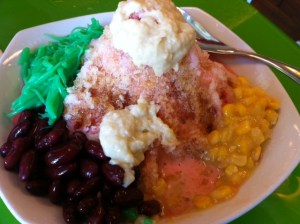
I was having coffee outside and I saw ants crawling on my feet so I moved to another table.
Then I rewound my stream of consciousness about 30 seconds and I was able to recall that in fact there was a little more going on than that. I was daydreaming while sipping my coffee and I felt ticklishness on my toes and ankles. That made me look down and that’s when I saw the ants.
Now the fact that I had to rewind to remember all of this says something interesting. Had I looked down and not seen ants, i.e. if it turned out it was just the precious Singapore wind blowing on my cozy bare feet, then this episode would never have penetrated my conscious mind. I would have gone on daydreaming without distraction.
The subconscious mind pays attention to a million things outside of our main line of being and only when it detects something worth paying attention to does it intervene in some way. There are two very common interventions. One is to react at a subconscious level. I.e. shooing a fly while I go on daydreaming. Another is to commandeer consciousness and force a reaction. I.e. pay attention to an attractive potential mate passing by.
Both of these involve the subconscious mind making a decisive call as to what is going on, what is its level of significance, and how to dispense with it. It’s all or nothing: let the conscious mind go on without interruption or completely usurp conscious attention.
But the ant episode exemplifies a third type. My subconscious mind effectively said something like this :”I am not sure what is going on here, but I have a feeling that its something that we need to pay attention to. But to figure that out I need the expertise and private information available only to conscious visual attention and deliberation. I am not telling you what to do because I don’t know, I am just saying you should check this out.”
And so a tiny slice of consciousness gets peeled off to attend to that and only on the basis of what it sees is it decided whether the rest has to be distracted too.
Email is the superior form of communication as I have argued a few times before, but it can sure aggravate your self-control problems. I am here to help you with that.
As you sit in your office working, reading, etc., the random email arrival process is ticking along inside your computer. As time passes it becomes more and more likely that there is email waiting for you and if you can’t resist the temptation you are going to waste a lot of time checking to see what’s in your inbox. And it’s not just the time spent checking because once you set down your book and start checking you won’t be able to stop yourself from browsing the web a little, checking twitter, auto-googling, maybe even sending out an email which will eventually be replied to thereby sealing your fate for the next round of checking.
One thing you can do is activate your audible email notification so that whenever an email arrives you will be immediately alerted. Now I hear you saying “the problem is my constantly checking email, how in the world am i going to solve that by setting up a system that tells me when email arrives? Without the notification system at least I have some chance of resisting the temptation because I never know for sure that an email is waiting.”
Yes, but it cuts two ways. When the notification system is activated you are immediately informed when an email arrives and you are correct that such information is going to overwhelm your resistance and you will wind up checking. But, what you get in return is knowing for certain when there is no email waiting for you.
It’s a very interesting tradeoff and one we can precisely characterize with a little mathematics. But before we go into it, I want you to ask yourself a question and note the answer before reading on. On a typical day if you are deciding whether to check your inbox, suppose that the probability is p that you have new mail. What p is going to get you to get up and check? We know that you’re going to check if p=1 (indeed that’s what your mailbeep does, it puts you at p=1.) And we know that you are not going to check when p=0. What I want to know is what is the threshold above which its sufficiently likely that you will check and below which is sufficiently unlikely so you’ll keep on reading? Important: I am not asking you what policy you would ideally stick to if you could control your temptation, I am asking you to be honest about your willpower.
Ok, now that you’ve got your answer let’s figure out whether you should use your mailbeep or not. The first thing to note is that the mail arrival process is a Poisson process: the probability that an email arrives in a given time interval is a function only of the length of time, and it is determined by the arrival rate parameter r. If you receive a lot of email you have a large r, if the average time spent between arrivals is longer you have a small r. In a Poisson process, the elapsed time before the next email arrives is a random variable and it is governed by the exponential distribution.
Let’s think about what will happen if you turn on your mail notifier. Then whenever there is silence you know for sure there is no email, p=0 and you can comfortably go on working temptation free. This state of affairs is going to continue until the first beep at which point you know for sure you have mail (p=1) and you will check it. This is a random amount of time, but one way to measure how much time you waste with the notifier on is to ask how much time on average will you be able to remain working before the next time you check. And the answer to that is the expected duration of the exponential waiting time of the Poisson process. It has a simple expression:
Expected time between checks with notifier on =

Now let’s analyze your behavior when the notifier is turned off. Things are very different now. You are never going to know for sure whether you have mail but as more and more time passes you are going to become increasingly confident that some mail is waiting, and therefore increasingly tempted to check. So, instead of p lingering at 0 for a spell before jumping up to 1 now it’s going to begin at 0 starting from the very last moment you previously checked but then steadily and continuously rise over time converging to, but never actually equaling 1. The exponential distribution gives the following formula for the probability at time T that a new email has arrived.
Probability that email arrives at or before a given time T =

Now I asked you what is the p* above which you cannot resist the temptation to check email. When you have your notifier turned off and you are sitting there reading, p will be gradually rising up to the point where it exceeds p* and right at that instant you will check. Unlike with the notification system this is a deterministic length of time, and we can use the above formula to solve for the deterministic time T at which you succumb to temptation. It’s given by
Time between checks when the notifier is off =

And when we compare the two waiting times we see that, perhaps surprisingly, the comparison does not depend on your arrival rate r (it appears in the numerator of both expressions so it will cancel out when we compare them.) That’s why I didn’t ask you that, it won’t affect my prescription (although if you receive as much email as I do, you have to factor in that the mail beep turns into a Geiger counter and that may or may not be desirable for other reasons.) All that matters is your p* and by equating the two waiting times we can solve for the crucial cutoff value that determines whether you should use the beeper or not.
The beep increases your productivity iff your p* is smaller than

This is about .63 so if your p* is less than .63 meaning that your temptation is so strong that you cannot resist checking any time you think that there is at least a 63% chance there is new mail waiting for you then you should turn on your new mail alert. If you are less prone to temptation then yes you should silence it. This is life-changing advice and you are welcome.
Now, for the vapor mill and feeling free to profit, we do not content ourselves with these two extreme mechanisms. We can theorize what the optimal notification system would be. It’s very counterintuitive to think that you could somehow “trick” yourself into waiting longer for email but in fact even though you are the perfectly-rational-despite-being-highly-prone-to-temptation person that you are, you can. I give one simple mechanism, and some open questions below the fold.
Giving the content away for free publicizes the event and adds to the cache of (and willingness to pay for) the actual event. Also,
Anderson did not stop there. He opened up not only the TED talks themselves but the TED name. TEDx are events that can be put on by pretty much anyone. You need a license and have to do a good job (there’s no automatic renewal of the license), but nearly anyone can pitch in. This is literally a freeing up of the concept “ideas worth spreading” to allow anyone to select what those ideas are. So long as you follow a few simple rules — a talk format, some video, and no ads or other commercial tags — you can host a TEDx event. And there are now hundreds of these each year. What is more, TED regularly features talks from these on the site, so they act as feeder for TED publishing.
That’s from Josh Gans, more here.

In 1964, [W D Hamilton] submitted a pair of papers to the Journal of Theoretical Biology. The papers hinged on one simple equation: rB > C. Genes for altruism could evolve if the benefit (B) of an action exceeded the cost (C) to the individual once relatedness (r) was taken into account. Hamilton referred to his model as “inclusive fitness theory.”…[A]n ambitious entomologist named E. O. Wilson read the paper. Wilson wanted to understand the altruism at work in ant colonies, and he became convinced that Hamilton had solved the problem. By the late nineteen-seventies, Hamilton’s work was featured prominently in textbooks; his original papers have become some of the most cited in evolutionary biology. …In an obituary published after Hamilton’s death, in 2000, the Oxford biologist Richard Dawkins referred to Hamilton as “the most distinguished Darwinian since Darwin.” But now, in an abrupt intellectual shift, Wilson says that his embrace of Hamilton’s equation was a serious scientific mistake. Wilson’s apostasy, which he lays out in a forthcoming book, “The Social Conquest of the Earth,” has set off a scientific furor.
I described the Wilson et al paper in an earlier post.
Here’s a pretty simple point but one that seems to be getting lost in the “discussion.”
Insurance is plagued by an incentive problem. In an ideal insurance contract the insuree receives, in the event of a loss or unanticipated expense, a payment that equals the full value of that loss. This smooths out risk and improves welfare. The problem is that by eliminating risk the contract also removes the incentive to take actions that would reduce that risk. This lowers welfare.
In order to combat this problem the contracts that are actually offered are second-best: they eliminate some risk but not all. The insured is left exposed to just enough risk so that he has a private incentive to take actions that reduce it. The incentive problem is solved but at the cost of less-than-full insurance.
But building on this idea, there are often other instruments available that can do even better. For example suppose that you can take prophylactic measures (swish!) that are verifiable to the insurance provider. Then at the margin welfare is improved by a contract which increases insurance coverage and subsidizes the prophylaxis.
That is, you give them condoms. For free. As much as they want.
This is worth your Friday (or your employer’s as the case may be.) Check out Jarrett playing/talking Bach (1:30ish), Manfred Eicher’s take (5:10ish), Keith Jarrett listening to Jack DeJohnette and Gary Peacock playing a piano duet! (7:00ish), KJ’s hippie brother (14:00 ish), small hands (3:45ish on part 2), obligatory squeaking questions (6:15 part 2), Miles Davis (part 3), Koln (halfway part 3), Chick Corea (end of part 3-part 4), playing soprano sax (middle part 4), American quartet (end part 4), European quartet (part 5), chronic fatigue (part 6).
Thanks to Tobias Schmidt for the link.

Iran may be going to headlong into a pursuit of nuclear weapons. Or maybe not:
Yet some intelligence officials and outside analysts believe there is another possible explanation for Iran’s enrichment activity…. They say that Iran could be seeking to enhance its influence in the region by creating what some analysts call “strategic ambiguity.” Rather than building a bomb now, Iran may want to increase its power by sowing doubt among other nations about its nuclear ambitions. Some point to the examples of Pakistan and India, both of which had clandestine nuclear weapons programs for decades before they actually decided to build bombs and test their weapons in 1998.
What are benefits and costs of ambiguity for the party pursuing ambiguity and potential opponents? Tomas Sjöström and I investigated this issue in a paper “Strategic Ambiguity and Arms Proliferation”. The basic idea is that a policy of ambiguity can strike the right balance between creating deterrence (the party pursuing ambiguity might be armed) and minimizing escalation (the party pursuing ambiguity might not be armed). With that balance struck, there is less incentive to acquire arms and this can even help your opponents who seek to minimize proliferation. In other words, an equilibrium with ambiguity can be better for all parties than an equilibrium with transparency.
Not even your thought experiments are safe.
Saul Kripke resigned yesterday from his position as Distinguished Professor of Philosophy at the CUNY Graduate Center. While similar allegations have been circulating in unpublished form for years, a team of philosophers from Oxford University has just released a damning report claiming that they were systematically unable to reproduce the results of thought experiments reported by Kripke in his groundbreaking Naming and Necessity.
(…) The report, forthcoming in Philosophical Studies, claims that 74% of the book’s thought-experimental results could not be reproduced using the standard philosophical criteria for inter-researcher agreement. A second version of the analysis, employing a generous application of the principle of charity, still left 52% of the results unverified.
That’s from fauxphilnews. Skullcap skip: Marciano Siniscalchi.
As the director of recruiting for your department you sometimes have to consider Affirmative Action motives. Indeed you are sympathetic to Affirmative Action yourself and even on your own your recruiting policy would internalize those motives. But in fact your institution has a policy. You perceive clear external incentives coming from that policy.
Now this creates a dilemma. For any activity like this there is some socially optimal level and it combines your own private motivations with any additional external interests. But the dilemma for you is how these should be combined. One possibility is that the public motive and your own private interest stem from completely independent reasons. Then you should just “add together” the weight of the external incentives you feel plus those of your own. But it could be that what motivates your Dean to institutionalize affirmative action is exactly what motivates you. In this case he has just codified the incentives you would be responding to anyway, and rather than adding to them, his external incentives should perfectly crowd out your own.
There is no way of knowing which of these cases, or where in between, the true moral calculation is. That is a real dilemma, but I want to think of it as a metaphor for the dilemma you face in trying to sort out the competing voices in your own private moral decisions.
Say you have a close friend and you have an opportunity to do something nice for them, say buy them a birthday gift. You think about how nice your friend has been to you and decide that you should be especially nice back. But compared to what? Absent that deliberative calculation you would have chosen the default level of generosity. So what your deliberation has led you to decide is that you should be more generous than the default.
But how do you know? What exactly determined the default? One possibility is that the default represents your cumulative wisdom about how nice you should be to other people in general. Then your reflection on this particular friend’s particular generosity should increment the default by a lot. But surely that’s not the relevant default. He’s your friend, he’s not just an arbitrary person (you would even be considering giving a gift to an arbitrary person.) No doubt your instinctive inclination to be generous to your friend already encodes a lot of the collected memory and past reflection that also went into your most recent conscious deliberation. And as long as there is any duplication, there should be crowding out. So you optimally moderate the enthusiasm that arises from your conscious calculation.
But how much? That is a dilemma.
(Based on a conversation with Nageeb Ali)
When you are selecting seats on a flight and you have an open row should you take the middle seat or the aisle? Even if you prefer the aisle seat you are tempted to take the middle seat as a strategic move. People who check in after you will try to find a seat with nobody next to them and if you take the middle seat they will choose a different row. The risk however is that if the flight is full you are still going to have someone sitting next to you and you will be stuck in the middle seat.
Let’s analyze a simple case to see the tradeoffs. Suppose that when you are checking in there are two empty rows and the rest of the plane is full. Let’s see what happens when you take the middle seat. The next guy who comes is going to pick a seat in the other row. Your worst fear is that he takes the middle seat just like you did. Then the next guy who comes along is going to sit next to one of you and the odds are 50-50 its going to be you. Had you chosen the aisle seat the next guy would take the window seat in your row.
If instead the guy right after you takes a window seat in the other row then your strategy just might pay off. Because the third guy will also go to the other row, in the aisle seat. If nobody else checks in you have won the jackpot. A whole row to yourself.
But this is pretty much the only case in which middle outperforms aisle. And even in this case the advantage is not so large. In the same scenario, had you taken the aisle seat, the third guy would be indifferent between the two rows and you’d still have a 50-50 chance of a row to yourself. Even when he takes your row he’s going to take the window seat and you would still have an empty seat next to you.
Worse, as long as one more person comes you are going to regret taking the middle seat. Because the other row has only a middle seat left. The fourth guy to come is going to prefer the window or aisle seat in your row. Had you been sitting in the aisle seat the first four passengers would go aisle, aisle, window, window and you would be safe.
Wealthy kids are usually wealthy because their wealthy parents left them a lot of money. You might think that’s because parents are altruistic towards their kids. Indeed every dollar bequeathed is a dollar less of consumption for the parent. But think about this: if parents are so generous towards their kids why do they wait until they die to give them all that money? For a truly altruistic parent, the sooner the gift, the better. By definition, a parent never lives to see the warm glow of an inheritance.
A better theory of bequests is that they incentivize the children to call, visit, and take care of the parents in their old age. An inheritance is a carrot that awaits a child who is good to the parent until the very end. That’s the theory of strategic bequests in Bernheim, Shleiffer and Summers.
But even with that motivation you have to ask why bequests are the best way to motivate kids. Why not just pay them a piece rate? Every time they come to visit they get a check. If the parent is even slightly altruistic this is a better system since the rewards come sooner.
To round out the theory of strategic bequests we need to bring in the compound value of lump-sum incentives. Suppose you are nearing the bitter end and its likely you are not going to live more than another year. You want your kids to visit you once a month in your last year and that’s going to cost you 12*c where c is your kid’s opportunity cost per weekly visit. You could either implement this by piece-rate, paying them c every time they come, or in a lump sum by leaving them 12c in your will if they keep it up the whole time.
But now what happens if, as luck would have it, you actually survive for another year? With the piece rate you are out 12c and still have to cough up another 12c if you want to see your kids again before you die. But a bequest can be re-used. You just restart the incentives, and you get another year’s worth of visits at zero additional cost.
Is it credible? All you need is to commit to a policy that depends only on their devotion in the last year of your life. Since you are old your kids know you can’t remember what happened earlier than that anyway so yes, it’s perfectly credible.
(Idea suggested by Mike Whinston.)
Not 100% sure this is real. Here’s his blurb for Miss Timmins School for Girls by Nayana Currimbhoy:
“Beautifully written, atmospheric…contains entire worlds. I couldn’t put it down.”
—Gary Shteyngart
And Flatscreen by Adam Wilson:
“OMFG, I nearly up and died from laughter when I read Flatscreen. This is the novel that every young turk will be reading on their way to a job they hate and are in fact too smart for.”
—Gary Shteyngart
He even blurbs his own blurb:
“Gary Shteyngart’s blurbs are touching, funny, and true. This is a blurber to watch”
Here’s some blurb-related research I’d like to see. There is a widespread suspicion that editors write the blurbs and the blurber just agrees to sign his name to it. It would be great to use text-pattern-recognition software to group blurbs according to apparent authorship and check whether this is really true.
Here is the abstract of a paper by Christian Roessler and Sandro Shelegia:
In Rome, if you start digging, chances are you’ll find things. We consider a famous complaint that justifies the underdeveloped Roman metro system: “if we tried to build a new metro line, it would probably be stopped by archeological finds that are too valuable to destroy, so we would have wasted the money.” Although this statement appears to be self-contradictory, we show that it can be rationalized in a voting model with diverse constituents. Even when there is a majority preference for a metro line, and discovery of an antiquity has the character of a positive option, a majority may oppose construction. We give sufficient conditions for this inefficiency to occur. One might think it arises from the inability to commit to finishing the metro (no matter what is discovered in the process). We show, however, that the inefficient choice is made in voting over immediate actions precisely when there is no Condorcet winner in voting over contingent plans with commitment. Hence, surprisingly, commitment cannot really solve the problem.
The problem is how to build a majority coalition in favor of digging. There’s no problem when the probability of an antiquity is low because then everyone who favors the Metro but not the antiquity will be on board. When the probability of an antiquity is high there is again no problem but now because you have the support of those who are hoping to find one. Rome’s problem is that the probability of an antiquity is neither low enough nor high enough.
I think this says something about flyouts in Junior Recruiting, and in turn it says something about how candidates should market themselves.
A question raised over dinner last week. A group of N diners are dining out and the bill is $100. In scenario A, they are splitting the check N ways, with each paying by credit card and separately entering a gratuity for their share of the check. In scenario B, one of them is paying the whole check.
In which case do you think the total gratuity will be larger? Some thoughts:
- Because of selection bias, it’s not enough to cite folk wisdom that tables who split the check tip less (as a percentage): At tables where one person pays the whole check that person is probably the one with the deepest pockets. So field data would be comparing the max versus the average. The right thought experiment is to randomly assign the check.
- Scenario B can actually be divided into two subcases. In Scenario B1, you have a single diner who pays the check (and decides the tip) but collects cash from everyone else. In Scenario B2 the server divides the bill into N separate checks and hands them to each diner separately. We can dispense with B1 because the guy paying the bill internalizes only 1/Nth of the cost of the tip so he will clearly tip more than he would in Scenario A. So we are really interested in B2.
- One force favoring larger tips in B2 is the shame of being the lowest tipper at the table. In both A and B2 a tipper is worried about shame in the eyes of the server but in B2 there are two additional sources. First, beyond being a low tipper relative to the overall population, having the server know that you are the lowest tipper among your peers is even more shameful. But even more important is shame in the eyes of your friends. You are going to have to face them tomorrow and the next day.
- On the other hand, B2 introduces a free-rider effect which has an ambiguous impact on the total tip. The misers are likely to be even more miserly (and feel even less guilty about it) when they know that others are tipping generously. On the other hand, as long as it is known that there are misers at the table, the generous tippers will react to this by being even more generous to compensate. The total effect is an increase in the empirical variance of tips, with ambiguous implications for the total.
- However I think the most important effect is a scale effect. People measure how generous they are by the percentage tip they typically leave. But the cost of being a generous tipper is the absolute level of the tip not the percentage. When the bill is large its more costly to leave a generous tip in terms of percentage. So the optimal way to maintain your self-image is to tip a large percentage when the bill is small and a smaller percentage when the bill is large. This means that tips will be larger in scenario B2.
- One thing I haven’t sorted out is what to infer from common restaurant policy of adding a gratuity for large parties. On the one hand you could say that it is evidence of the scale effect in 5. The restaurant knows that a large party means a large check and hence lower tip percentage. However it could also be that the restaurant knows that large parties are more likely to be splitting the check and then the policy would reveal that the restaurant believes that B2 has lower tips. Does anybody know if restaurants continue to add a default gratuity when the large party asks to have the check split?
- The right dataset you want to test this is the following. You want to track customers who sometimes eat alone and sometimes eat with larger groups. You want to compare the tip they leave when they eat alone to the tip they leave when part of a group. The hypothesis implied by 3 and 5 is that their tips will be increasing order in these three cases: they are paying for the whole group, they are eating alone, they are splitting the check.
(Thanks to those who commented on G+)
- (Mathematics) Not very good. He spends a good deal of time apparently in investigations in advanced mathematics to the neglect of his elementary work. A sound ground work is essential in any subject. His work is dirty.
- (Greek) He seems to find the subject a very hard one & most of his work has been very poor in quality. I think he tries.
- (Latin) His Latin work is for the most part careless & slovenly: he can do much better when he tries.
- (“House report”) No doubt he is a strange mixture: trying to build a roof before he has laid the foundations. Having secured one privileged exemption, he is mistaken in acting as if idleness and indifference will procure further release from uncongenial subjects.
The pointer came from Josh Gans on Google+
It can land you in jail.
Despite growing up nowhere near an ocean, Rex Flodstrom fell in love with surfing at an early age on trips to the West Coast. It’s a spiritual experience, pushing the Chicagoan to brave even the punishing snow and ice on Lake Michigan for the thrill of a winter wave.
But a chilly ride last month landed Flodstrom, 40, in trouble with police. He was arrested Jan. 17 near Oak Street Beach on misdemeanor ordinance violations of surfing more than 50 yards from shore, unlawful presence on a closed beach and jeopardizing the safety of others on the beach.
I lived in view of Lake Michigan for 4 years and I never once saw a surfable wave. And if the hilarious video at the link is any indication, neither has Rex, bless his frozen heart.
Here’s a card game: You lay out the A,2,3 of Spades, Diamonds, Clubs in random order on the table face up. So that’s 9 cards in total. There are two players and they take turns picking up cards from the table, one at a time. The winner is the first to collect a triplet where a triplet is any one of the following sets of three:
- Three cards of the same suit
- Three cards of the same value
- Ace of Spaces, 2 of Diamonds, 3 of Clubs
- Ace of Clubs, 2 of Diamonds, 3 of Spades
Got it? Ok, this game can be solved and the solution is that with best play the result is a draw, neither player can collect a triplet. See if you can figure out why. (Drew Fudenberg got it almost immediately [spoiler.]) Answer and more discussion are after the jump.
It’s the canonical example of reference-dependent happiness. Someone from the Midwest imagines how much happier he would be in California but when he finally has the chance to move there he finds that he is just as miserable as he was before.
But can it be explained by a simple selection effect? Suppose that everyone who lives in the Midwest gets a noisy but unbiased signal of how happy they would be in California. Some overestimate how happy they would be and some underestimate it. Then they get random opportunities to move. Who is going to take that opportunity? Those who overestimate how happy they will be. And so when they arrive they are disappointed.
It also explains why people who are forced to leave California, say for job-related reasons, are pleasantly surprised at how happy they can be in the Midwest. Since they hadn’t moved voluntarily already, its likely that they underestimated how happy they would be.
These must be special cases of this paper by Eric van den Steen, and its similar to the logic behind Lazear’s theory behind the Peter Principle. (For the latter link I thank Adriana Lleras-Muney.)
He was just promoted to Full Professor. It’s about time!
Here for your amusement is a collection of Facebook postings by people who don’t seem to understand that The Onion is fake news. Now, remember that The Onion is satire. And a piece of satire works best when it bears some resemblance to the object of satire. If a story in The Onion were not believed to be true by anybody then that would be a clear indication that it was poor satire. In other words, the credibility of a story in The Onion is optimally chosen so that inevitably a minimal fraction of people will believe it.
So it should not be amusing that some people fall for stories in The Onion, anymore than it is amusing that the Sun rises on Wednesdays. What would be amusing is finding out exactly who it is that lives in that tail of the gullibility distribution. However the web site is anonymized. So to me what is amusing about all of this is discovering how many exactly which people find this site amusing.
Note that the final plot device where one player does not know the rules of the game has not been encompassed by standard game theory.
 Cheap Talk