
You are currently browsing jeff’s articles.
It’s the opposite of deduction. We didn’t sit down and try to figure something out.
It’s as if the computation happened so deep within our head, like all this time the basic facts were already there and in our subconscious minds they are stirring around until by chance one set of facts come together that happen to imply something new and the reaction creates an explosion big enough to get the attention of our conscious mind.
And at a conscious level we say “aha! I instinctively know something is true. But why?” And here’s where the 99% perspiration comes. We have to go back to find out why it’s true.
Ok sometimes we discover we were wrong. Other times we discover conclusively why we were right.
But almost always we can’t decide conclusively one way it another but we find reasons for what we believe.
And we believe what we believe. Rationally. We felt it instinctively. And that belief, that sensation is a thing. Its a signal. That we had that inspiration serves as information to us. We have faith in our beliefs.
To lack such faith would be to invite the padded cell.
So that’s another piece of evidence to go along with the facts. And it just might, again perfectly rationally, tip the balance.
Cory Doctorow getting tangled up:
I know lots of people who disagree about when and whether it’s OK to reproduce creative works without permission. There are long, thoughtful debates about how long copyright should last; whether publicly funded works should be treated the same as privately created ones; whether scientific and scholarly works should be freely available; what sort of works qualify as “creative”, and, of course, what fair dealing/fair use should and should not allow.
But while I know plenty of proud pirates, I don’t think I’ve ever heard of someone standing up for the good, old fashioned plagiarism.
Interesting idea. But no:
When this happens, a consensus quickly emerges that the culprit is a bad person, that the attention has been misappropriated. The real artist has been wronged – she didn’t get the upvotes, attention and good feeling she deserved. But so has anyone who was conned into believing the misattribution, and so missed the chance to discover more works by the real artist.
For me, the most interesting thing about plagiarism is that even though it’s legal, companies and people who do it get into real trouble for it.
Even without a law, doing something that is so universally reviled has genuine, lasting consequences. There’s a lesson in there for people looking to find the right balance for internet copyright: a law without public support will be widely flouted, but things that the social consensus rejects out of hand be automatically, widely enforced.
- When you turn a bottle over to pour out its contents it is less messy if you do the tilt thing to make sure there is a space for air to flow back into the bottle. But which way of pouring is faster if you just want to dump it out in the shortest time possible? I think the tilt can never be as fast.
- I aspire to hit for the cycle: publish in all the top 5 economics journals. But it would be a lifetime cycle. Has anyone ever hit for the cycle in a single year?
- If you know you’ll get over it eventually shouldn’t you be over it now? And if not should you really get over it later?
- The efficient markets hypothesis means that there is no trading strategy that consistently loses money. (Because if there were then the negative of that strategy would consistently make a profit.) So trade with abandon!
- I predict that in the future the distinct meanings of the prepositions “in” and “on” will progressively blur because of mobile phone typos.
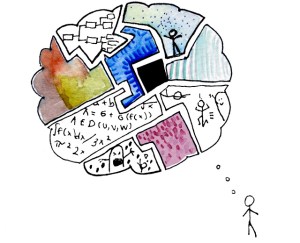
Drawing: Scatterbrained from www.f1me.net (yaaay she’s back.)
That commercial was rejected for the Super Bowl broadcast yesterday. And because of that it will be seen by many many people (even you!). Indeed the value of the publicity from being rejected rivals that of being accepted. You’ll get people actively watching your ad rather than just passively.
This is a problem for the broadcaster because first of all it is failing to capitalize on a valuable asset: the monopoly authority to reject ads. Second the plethora of rejected ads and their publicity dilutes the value of its other asset: the monopoly provider of broadcast airtime. So the Super Bowl broadcast network needs to find a way to capitalize on the publicity they can generate by rejecting ads and also to make rejected advertisers pay for the negative externality on accepted advertisers. How to do it?
Charge an enormous price to submit your ad for consideration. If you are accepted you get the submission fee refunded. If you are rejected, tough luck.
Added: You can also put a check box on the submission form allowing advertisers to secretly specify whether they want to be accepted or rejected.
Some might prefer the publicity/price of rejection over the actual broadcast. Without the checkbox they might not submit out of fear they will be accepted.
Imagine the publicity you can get when a marginal ad (like the one above) is rejected “unfairly.”

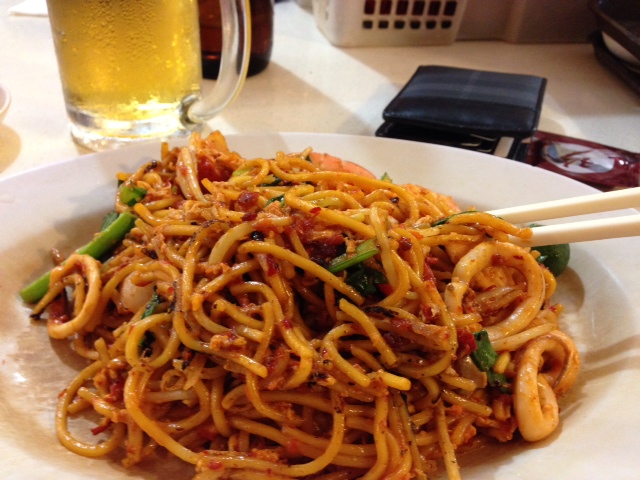
Here’s a thought I had over a lunch of Mee Goreng and Rojak. As the cost of transportation declines there is a non-monotonic effect on migration. Decreasing transportation costs make it cheaper to visit and discover new places. But for small cost reductions it is still too costly to visit frequently. So if you find a place you like you must migrate there.
For large declines in transportation costs, it becomes cheap to frequently visit the places that you like and you would otherwise want to migrate to. So migration declines.
The same non-monotonic effect can be seen as a function of distance. For any given decline in transportation costs migration to far away destinations increases but migration to nearer destinations declines.
For the vapor mill it means that over time between any two locations you should first see migration increase then decrease. And the switching point from increase to decrease should come later for locations farther apart.
By the way if you would like to see more pictures of delicious food in Singapore you can follow my photo stream. But beware it might make you want to migrate.
Cheap Talk has turned 4 years old. In honor of that, I could tell you about how many of you read us, how many of you subscribe to us, which were the greatest among all the great articles we wrote last year, etc. but instead I’ll take this opportunity to do something I have been wanting to do for a while.
A very interesting side benefit of having a blog is seeing the search terms that lead people to us. Its a fun game trying to figure out which post Google sent them to when they searched for terms like “students can lie to teachers very easily” but more than that, as the range of topics we have covered gets wider and wider just reading down the list of search terms each day starts to look like pure poetry.
So I decided to compose a poem entirely out of search phrases and as my fourth birthday present to myself I am going to make you read it. It is a testament to the power of the Internet that for each and every line below there was someone who, in a quest for knowledge, typed it into Google and Google dutifully led them to our blog.
For the best effect I recommend reading this poem in your best mental Christopher Walken voice.
Feral Dogs in Tampa
I like bareback sex with hookers
Explaining infinity to children,
The god in heaven
Serving GuinnessStatistically birthdays increase your age
What is there to do?
Remember abstract things
Courtney Conklin KnappLow hanging balls
Kink on demand,
Pile driver sex
I am tired of cohabitationYou are nothing
Empty plate with crumbs,
Playing with yourself in public
When will the Devil talk to you?Novel figure skates,
Who invented sarcasm,
Orthogonally-minded,
Try to arrange a meetingFuyuh.
Q: What draws Kareem Abdul-Jabbar back into the blogosphere?
A: Girls!
Watch him, he’s gonna swing left, shoot right.
Last season the show was criticized for being too white. Watching a full season could leave a viewer snow blind. This season that white ghetto was breached by a black character who is introduced as some jungle fever lover, with just enough screen time to have sex and mutter a couple of lines about wanting more of a relationship. A black dildo would have sufficed and cost less.
And why the 2 year lag since his last post? Research!
When it takes itself seriously is when it stumbles. I just wish it would express its seriousness by being funnier. Seinfeld made it a point to ridicule the characters’ shallowness and self-involvement, raising it to a level of social commentary. And it was funny. Two other girl-centric shows that reached these same heights to be voices of a generation were My So-Called Life and Wonderfalls. Both funny, yet also insightful and original. Perhaps that’s why they both only lasted one season before becoming cult hits. Girls, a safer more mousy voice, has already been renewed for a third season.
Honestly, Kareem is my hero. Lets list the things he has done:
1. All-time leading scorer in the NBA.
2. Using a shot, the sky hook, that nobody else has ever used to good effect.
3. Wore those zany frog goggles.
4. Starred in Bruce Lee’s Enter The Dragon as a Kung Fu bad guy.
5. Starred in Airplane as Kareem Abdul Jabbar pretending to be an airline co-pilot.
I say the deadweight loss here is not so large. Most art exhibitions are not self-financing from the side of the viewers, which suggests that the demand to see the pictures is not higher than the costs of mounting the exhibit. Arguably you can throw in philanthropic support as another part of “market demand,” but I consider that a separate valuation issue. Maybe our current artistic institutions are under-providing marketing opportunities for businesses and foundations, but that still won’t get you a major pent-up demand to view the pictures, again not relative to cost. The very popular pictures, such as the good works by the Impressionists and post-Impressionists, are shown quite frequently, including in traveling exhibitions.
Context matters a great deal in this setting. Currently most of the Louvre is not being viewed at any point in time, as the crowds tend to cluster in a few very well-known areas. Many people would want to go see anything they are told they ought to go see. What is underfunded is some kind of “demand for participation in a public event,” not the viewing of art per se. If only they could create more hullaballoo around the more obscure Flemish painters.
Almost all museums have large stretches of empty walls. I would put up many more pictures there, as indeed I do in my own home. That museums do not do this I find striking and indicative. Nor do I see viewers and visitors demanding this, if anything the unspoken feeling might be to wish for a bit less on the walls, so that one may have the feeling of having seen everything without exhaustion.
The costs of storing art are high. Perhaps the Louvre should sell some of its lower-tier works to private collectors. But the general public just doesn’t want so much more art to see, not if they have to pay for it and maybe even if they don’t.
Nice.
But I can’t help but ask what was the deadweight loss of all of Tyler’s ideas lost to the world pre-blogosphere? Is MR self-financing? How good a measure is the price (free) of the consumers’ surplus it generates now?
I just hope this doesn’t make me a Flemish painter.

Good grammar makes for bad passwords:
[…]there’s an Achilles’ heel in creating phrase-based passwords. It’s the fact that most English speakers will craft phrases that make sense.
Ashwini Rao and Gananand Kini at Carnegie Mellon and Birenda Jha at MIT have developed proof-of-concept password-cracking software that takes advantage of that weakness. It cracks long passwords, and beats existing cracking software, simply by following rules of English grammar.
“Using an analytical model based on parts-of-speech tagging, we show that the decrease in search space due to the presence of grammatical structures can be as high as 50 percent,” the researchers write in their paper.
Bad grammar makes for good passwords:
Instead, get creative. Try poor grammar and spelling, as in “de whippoorsnapper sashay sideway,” or get completely silly, as in “flipper flopper fliddle fladdle.”
It doesn’t matter how correct it is, as long as you can easily remember it.

You know what amazes me about Singapore? The coffee is consistently excellent pretty much everywhere I’ve been. And it’s not like there’s a blooming coffee culture in Singapore they apparently just know how to make everything taste good.
Right near the Economics Department is Humble Origins, a little outdoor cafe where the coffee is really special. Among the best on-campus coffee places I have been to anywhere in the world. It’s also located in a spot where students and faculty are headed in various directions between classes so its a great people-watching spot.
(Yesterday I noticed that nobody in Singapore wears sunglasses. If anybody can explain this to me I am very curious. )
They sell muffins (good) and sandwiches (didn’t try) but they no longer sell French toast (??).
Check out the prices on Stub Hub for tickets to the upcoming Big10 basketball game between the Iowa Hawkeyes and the Wisconsin Badgers. Quite a few of them are significantly below the $24 face value of the tickets. This can happen because fans who buy season tickets for Badgers basketball are buying for the games against the conference powerhouses. For the games against cellar dwellers like Iowa they dump their tickets on the secondary market at whatever price they will fetch.
Coping with scalpers who buy tickets through the box office and resell them at inflated prices is one thing. You could have raised prices yourself but you chose not to. But what do you do when scalpers are undercutting your box office price?
You should buy the tickets back from the scalpers is what you should do. The fans who are going to buy from the scalper at the low price might also be willing to buy at box office prices. If you buy the cheap tickets on StubHub first then the box office is the only option left for them. And if they do buy from the box office you have made a profit because you bought low and sold high.
But there’s a chance those fans aren’t willing to pay box office prices and in that case you’re just losing money. So there’s a tradeoff. It means that you don’t want to buy secondary market tickets at prices just below your box office price but you definitely do want to buy the tickets priced so low that they are worth the risk. Indeed there is some optimal offer price that you should be prepared to repurchase tickets at.
In fact every venue’s box office should be both a buyer and seller of tickets with an optimally calculated spread between bid and ask prices.
Now you might wonder whether this only further encourages season ticket holders to dump their unwanted tickets. Indeed it does but that’s exactly what you want them to do. The tickets will be reallocated more efficiently and you will capture the gains from trade. Moreover, fans are now willing to pay higher prices for season tickets if they know they can easily resell their unwanted tickets. You can then raise season ticket prices to capture those gains.

One reason people over-react to information is that they fail to recognize that the new information is redundant. If two friends tell you they’ve heard great things about a new restaurant in town it matters whether those are two independent sources of information or really just one. It may be that they both heard it from the same source, a recent restaurant review in the newspaper. When you neglect to account for redundancies in your information you become more confident in your beliefs than is justified.
This kind of problem gets worse and worse when the social network becomes more connected because its ever more likely that your two friends have mutual friends.
And it can explain an anomaly of psychology: polarization. Sandeep in his paper with Peter Klibanoff and Eran Hanany give a good example of polarization.
A number of voters are in a television studio before a U.S. Presidential debate. They are asked the likelihood that the Democratic candidate will cut the budget deficit, as he claims. Some think it is likely and others unlikely. The voters are asked the same question again after the debate. They become even more convinced that their initial inclination is correct.
It’s inconsistent with Bayesian information processing for groups who observe the same information to systematically move their beliefs in opposite directions. But polarization is not just the observation that the beliefs move in opposite directions. It’s that the information accentuates the original disagreement rather than reducing it. The groups move in the same opposite directions that caused their disagreement originally.
Here’s a simple explanation for it that as far as I know is a new one: the voters fail to recognize that the debate is not generating any new information relative to what they already knew.
Prior to the debate the voters had seen the candidate speaking and heard his view on the issue. Even if these voters had no bias ex ante, their differential reaction to this pre-debate information separates the voters into two groups according to whether they believe the candidate will cut the deficit or not.
Now when they see the debate they are seeing the same redundant information again. If they recognized that the information was redundant they would not move at all. But if don’t then they are all going to react to the debate in the same way they reacted to the original pre-debate information. Each will become more confident in his beliefs. As a result they will polarize even further.
Note that an implication of this theory is that whenever a common piece of information causes two people to revise their beliefs in opposite directions it must be to increase polarization, not reduce it.
Free as in liberated. Here’s the opening paragraph:
I wrote this paper with the recognition that it is unlikely to be accepted for publication. There is something liberating about writing a paper without trying to please referees and without having to take into consideration the various protocols and conventions imposed on researchers in experimental economics (see Rubinstein (2001)). It gives one a feeling of real academic freedom!
The paper reports on long-running experiments relating response times to mistakes in decision-making.
I read this interesting post which talks about spectator sports and the gap between the excitement of watching in person versus on TV. The author ranks hockey as the sport with the largest gap: seeing hockey in person is way more fun than watching on TV. I think I agree with that and generally with the ranking given. (I would add one thing about American Football. With the advent of widescreen TVs the experience has improved a lot. But its still very dumb how they frame the shot to put the line of scrimmage down the center of the screen. The quarterback should be near the left edge of the screen at all times so that we can see who he is looking at downfield.)
But there was one off-hand comment that I think the author got completely wrong.
I think NBA basketball players might be the best at what they do in all of sports.
The thought experiment is to compare players across sports. I.e., are basketball players better at basketball than, say, snooker players are at playing snooker?
Unless you count being tall as one of the things NBA basketball players “do” I would say on the contrary that NBA basketball players must be among the worst at what they do in all of professional sports. The reason is simple: because height is so important in basketball, the NBA is drawing the top talent among a highly selected sub-population: those that are exceptionally tall. The skill distribution of the overall population, focusing on those skills that make a great basketball player like coordination, quickness, agility, accuracy; certainly dominate the distribution of the subpopulation from which the NBA draws its players.
Imagine that the basket was lowered by 1 foot and a height cap enforced so that in order to be eligible to play you must be 1 foot shorter than the current tallest NBA player (or you could scale proportionally if you prefer.) The best players in that league would be better at what they do than current NBA players. (Of course you need to allow equilibrium to be reached where young players currently too short to be NBA stars now make/receive the investments and training that the current elite do.)
Now you might ask why we should discard height as one of the bundle of attributes that we should say a player is “best” at. Aren’t speed, accuracy, etc. all talents that some people are born with and others are not, just like height? Definitely so, but ask yourself this question. If a guy stops playing basketball for a few years and then takes it up again, which of these attributes is he going to fall the farthest behind the cohort who continued to train uninterrupted? He’ll probably be a step slower and have lost a few points in shooting percentage. He won’t be any shorter than he would have been.
When you look at a competition where one of the inputs of the production function is an exogenously distributed characteristic, players with a high endowment on that dimension have a head start. This has two effects on the distribution of the (partially) acquired characteristics that enter the production function. First, there is the pure statistical effect I alluded to above. If success requires some minimum height then the pool of competitors excludes a large component of the population.
There is a second effect on endogenous acquisition of skills. Competition is less intense and they have less incentive to acquire skills in order to be competitive. So even current NBA players are less talented than they would be if competition was less exclusive.
So what are the sports whose athletes are the best at what they do? My ranking
- Table Tennis
- Soccer
- Tennis
- Golf
- Chess
- Frontiers of performance enhancing drugs: poker.
- Tweeting birds.
- “You know what surprised me? No one drew a single vagina.”
- Lady Edith with googly eyes.
- Good story but the author’s credibility is significantly reduced when he imagines that Snoop would ever have seeds in his stash.
- Washing Watson’s mouth out with soap.

Its here. I like the purpose, as given on the masthead:
This blog is to help me remember stories and papers and provide ideas for students taking the Behavioral and Experimental class. It will focus on behavioral and experimental economics, with the occasional gender story.
Most of the posts are indeed links to papers with quotes from abstracts, but I enjoyed this one departure from normal programming
One of my colleagues talked about a (not very inspired) way to do research, which he adequately describes as keyword research (and which he denounces whole heartily). The idea is the following, which seems to work very well for theory papers: Take a bunch of keywords, select a few, check if a paper has been written if so, try again…
In that spirit, I came across the following blogpost: Sociology title Generator
Bearskin bow: Mobius.
With social networking you are now exposed to so many different voices in rapid succession. Each one is monotonous as an individual but individual voices arrive too infrequently for you notice that, all you see is the endless variety of people saying and thinking things that you can never think or say. It seems like the everyone in the world is more creative than one-dimensional you.

The other day I heard this chef talking on the radio about dropping lobsters into boiling water. The question was whether this or any other method of cooking live lobster was humane. Specifically he was focusing on the question of whether the lobster feels pain. The chef’s preferred method was to first put the lobster in the freezer until it stops moving and then drop it into boiling water.
Of course there is no way to know whether the lobster feels pain from being boiled alive but we can ask whether there is any theoretical reason it would feel pain. In creatures that feel it, pain is a selected response to a condition in the environment that is to be avoided. Notice an implication of this: being a (life-)threatening is a necessary but not sufficient condition for some environmental feature to induce the response of pain.
Apparently humans do not feel pain, or anything at all, when exposed to life-threatening carbon monoxide. Presumably that is because relative to the span of time it takes to evolve a protective painful response, carbon monoxide has not been a relevant threat for very long. No response has been selected for yet.
Does a lobster ever encounter hot water in its natural environment? Is there any channel through which natural selection would have given lobsters a painful response to being boiled? What about being frozen?
Its called Nostra Culpa and its a 16 minute 2 act opera dramatizing the exchange on Twitter between Paul Krugman and Estonian President Toomas Ilves about that country’s austerity program. Robert Siegel interviewed the librettist and composer on NPR yesterday:
SIEGEL: I would sort of have expected you to have written this for a tenor and a baritone. But unexpectedly, for me at least, the two characters – Paul Krugman and President Ilves of Estonia – are both sung by the same mezzo-soprano.
BIRMAN: Right. Well, the mezzo-soprano is somebody I’ve worked with before and she’s, I think, one of the greatest talents in Estonia as a dramatic singer. And my idea – my sort of inspiration to set these words was not so much to make some kind of argument, but to have the singer portray the people themselves who are stuck in this – between these two sides.
SIEGEL: Now, one writer observed that the entire exchange between Krugman and Ilves consisted of a 70-word blog post with chart, and then four tweets. Puccini had a lot more to work with when he sat down to write “Tosca,” let’s say.
BIRMAN: Well, one could write an opera, a full-length two-hour opera, using just this content, in my opinion. Because, in a way, why is the story interesting? To me it’s interesting because we have been discussing this ever since 2008, 2009 – what to do and how to get out of this, and we’re still not out. And the story is being written as we go.
The opera has its debut on April 7 in Estonia.
Consider a monopolist which sells two different goods to two independent markets. The firm sets the profit maximizing price in the two separate markets and suppose one of those prices is high and the other is low. Now suppose the firm bundles the two goods: they are no longer sold separately but instead if you want one you must buy both. The profit-maximizing price of the bundle will be higher than the low priced good but lower than the high priced good. Consumers of the previously low-priced good are worse off, consumers of the previously high-priced good are better off because of the bundling.
This is one simple point to have in mind when thinking about bundling of cable channels versus a la carte pricing. The bundling mixes the elasticities of the two separate demand curves and leads to pricing in between the individual profit-maximizing prices. If sports channels are in high demand and food channels are in low demand then people who like food but not sports are justified in complaining about bundling.
But as Alex Tabarrok points out, these complaints are often poorly targeted, instead focusing on the differential costs cable networks charge the cable companies for access. Bundling is often viewed as a way of cross-subsidizing high-cost cable channels by raising prices on subscribers who view low-cost channels. For example Kevin Drum, responding to an article in the LA Times breaking down the cable companies’ balance sheets, asks for a la carte pricing so that
“sports fans would be forced to pay the actual cost of their sports programming without being subsidized by the rest of us.”
Alex presents a simple example to demonstrate that this focus on costs is misguided. But just because they’ve got their reasoning wrong doesn’t mean they came to the wrong conclusion. And in debunking the analysis Alex himself overlooks the basic point about bundling above.
Have you seen Dragon Box? Once you do, you will be a believer in the power of technology for learning. I wasn’t before, I am now. My son is 6 and after about 4 hours of fun he can solve simple one-variable equations. Here’s how it works.
In the first level of Dragon Box you see a screen with two halves, “This side” and “That side.” There is a box on one side and some cards with random pictures on them. Your job is to isolate the box on one side, i.e. remove all the cards from the same side of the box.
This is very simple at the beginning because the only cards on that side are these funky vortex cards and all you have to do is touch them and they disappear. Vortex cards represent zero, but only you know that.
Later, other cards start appearing on the box’s side but then you learn something new: every card has a “night card” which graphically is represented by a card with the same picture but in negative exposure. Negative. If you slide a card onto its night card (or vice versa) the card turns into a vortex which you then dispatch with a subsequent tap.
Later again it happens that cards appear on the same side of the box but with no night card. But then you learn something new. You have cards in your deck and you can drag them onto either side of the screen. A card in your deck can be turned into its “night” version by tapping. Thus, you can eliminate a card on the box’s side by taking the same card from the deck, “nighting” it and then using it to vortex the offending card.
But any card you drag from the deck to one side of the screen you must drag to the other side also. This represents adding or subtracting a constant from both sides of an equation. After you have isolated the box on one side you have shown that the box equals the sum of all the cards remaining on the other side. But only you know these things.
Later still, cards appear with “partners,” i.e. another card right up next to it with an inexplicable dot connecting them. If the box has a partner you can eliminate the partner by dragging the corresponding card from your deck below a line which magically appears below the partners as you drag.
Dragon Box requires that whenever you drag a card from the deck below the line of any card, you must drag the same card below the lines of all card-groups on both sides of the screen. Once you have done that you can drag the card that is below the line onto its duplicate above the line and they together turn into a card with looks like a die with one pip showing. Such a card can then be dragged onto the box leaving only the box.
Here’s a demonstration (by me of an early level.)
The partners represent multiplication, the line represents division, the die with one pip represents the number 1 (i.e. the identity) and 1 times the box is just the box. After you have isolated the box you have shown that the box equals the sum and/or products of cards that appear on the other side. But only you know this.
Finally, the box mysteriously becomes the letter x. The cards lose their pretty pictures and become numbers and other constants. Night cards are now negative numbers. The vortex becomes zero and the die becomes the number 1. In the dividing zone between the two sides of the screen eventually appears an equals sign, and all the operations the child has learned now take their more familiar form and by pure sleight of hand he has been tricked into porting the very very simple logic of combining symbolic operations into the otherwise tedious world of “solve for x.”
I personally am astounded.
A few final thoughts.
- The reason a six-year-old can learn algebra with Dragon Box but could not before is that Dragon Box unbundles algebra from arithmetic. You don’t have to know what crazy-frog times lizard-fish equals to know that Box = CF times LF. Simplifying the right-hand-side is beside the point. Conventionally algebra comes after arithmetic because you need arithmetic to simplify the right-hand side.
- Actually what you learn from this is that algebra is far more elementary than arithmetic. My son can add numbers (up to one digit plus two digit) but just barely grasps the concept of multiplication. He has no idea what division is.
- Someone who already knows arithmetic can still learn algebra faster (and have more fun in the process) because Dragon Box shows how all the arithmetic can essentially be saved for the very end, modularizing the learning.
- Dragon box also rewards you if you solve the equation with the precise number of operations recommended. (This is usually the minimum number but not always.) This is a clever addition to the game because all of my kids refused out of pure pride to move on until they had solved each one in the right number of moves. Imagine asking a kid learning algebra to do that.
- The extraordinary doing the ordinary.
- Amazon reviews of binders for the purposes of being full of women.
- Intellectually what I took away from this is the interesting observation that the deaf have a different sign for masturbation depending on whether its a man or woman doing it.
- Psychedelic commercials for Hostess Twinkies.
- “In response to your request for a meeting, well, I think I can read between the lines on that one.”
My academic home page (http://faculty.wcas.northwestern.edu/~jel292/) is looking outdated. I need something new and a little more professional. Do you know anybody who designs websites for academics? Could you recommend anyone? An example of their work would be helpful.
Meanwhile here’s The Bad Plus playing with Bill Frisell at Newport. Amazing stuff.
What is Organic Raspberry Fruit Spread?
Organic can modify a single noun like raspberry. The resultant unit can then itself be used as a modifier of fruit spread. That would yield [[organic raspberry] [fruit [spread]]], denoting a fruit spread of the organic raspberry type. Perfectly grammatical; nothing amiss.
The difference is that the stuff referred to by this description needn’t fully satisfy the stringent conditions for being an organic product. Only the raspberries need to pass. And sure enough, the label on Nature’s Promise Organic Raspberry Fruit Spread says:
INGREDIENTS: ORGANIC SUGAR, ORGANIC RASPBERRIES, WATER, FRUIT PECTIN, CITRIC ACID, CALCIUM CHLORIDE.
SOME years ago, executives at a Houston airport faced a troubling customer-relations issue. Passengers were lodging an inordinate number of complaints about the long waits at baggage claim. In response, the executives increased the number of baggage handlers working that shift. The plan worked: the average wait fell to eight minutes, well within industry benchmarks. But the complaints persisted.
Puzzled, the airport executives undertook a more careful, on-site analysis. They found that it took passengers a minute to walk from their arrival gates to baggage claim and seven more minutes to get their bags. Roughly 88 percent of their time, in other words, was spent standing around waiting for their bags.
So the airport decided on a new approach: instead of reducing wait times, it moved the arrival gates away from the main terminal and routed bags to the outermost carousel. Passengers now had to walk six times longer to get their bags. Complaints dropped to near zero.
Sound the alarms: Another instance of “architectural plagiarism” is quickly developing in China. As Zaha Hadid begins work on her 11th building in China this year–the Wangjing Soho shopping center–a group of Chongqing developers is hurrying to complete a shopping complex that parrots the proportions and facade of the Soho almost exactly. The controversy has resulted in a bizarre competition that pits the original author against the copycat architects in a race to see who can complete the structures first.
Chilote chuck: Courtney Conklin Knapp
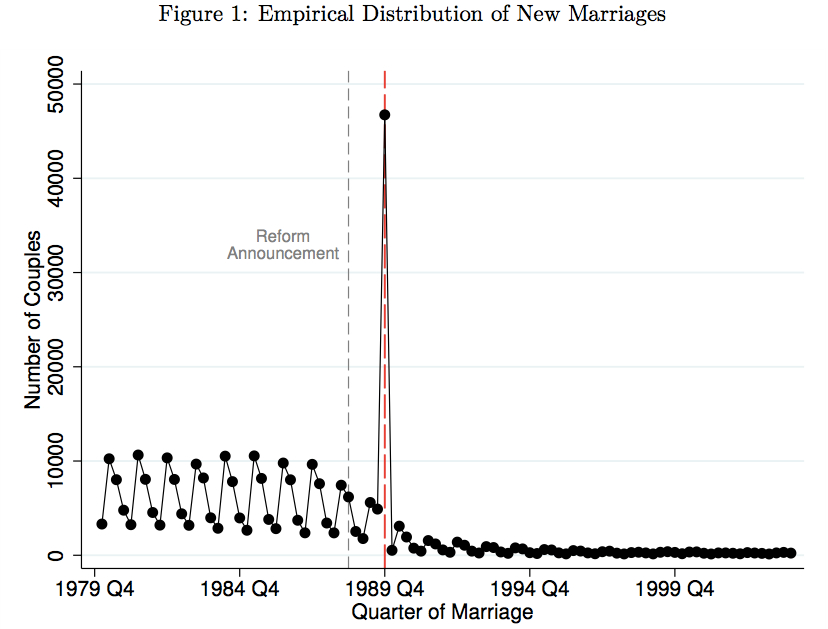
In June of 1988 in Sweden it was announced that survivorship benefits, a sort of government provided life insurance paid to a wife whose husband dies, would be discontinued. There was one interesting exception: an unmarried couple with a child together born before the change could take up survivorship insurance if they married before Jan 1 1990. The spike in new marriages in the graph shows the response to this incentive.
That’s the basis for Petra Persson‘s job market paper. Petra points out that the spike is somewhat mysterious because for all of these couples the promise of survivorship insurance wasn’t enough to induce them to marry previously and only when the option was going to disappear did they exercise it.
Of course some of these new marriages were couples that planned eventually to marry (and take up benefits) and who moved their marriage date earlier. But Petra credibly demonstrates that a large proportion of these marriages were marriages that never would have happened had the reform not been announced. What explains those “extra” marriages?
Petra’s theory is that these couples were still uncertain about whether they were a good match and were planning to live together longer before deciding later whether to marry. After the reform was announced this option to wait and see was no longer costless and therefore many of these couples rushed into a marriage that, given enough time, they might have eventually decided against.
There’s an alternative story that fits equally well. Consider a couple where there is no uncertainty at all about whether the match is good: its a bad match and that’s why they are not married. (Or it could be that they are perfectly happy together but just see no value in being legally wed.) This couple optimally plans to wait until the husband is close to death and then (if he hasn’t married somebody else) get married in order to take up survivorship insurance. Now once the reform is announced that option is removed and they re-optimize and marry December 31, 1989. Many of these are extra marriages because if they waited he might die unexpectedly or marry somebody else.
This theory (like Petra’s) also explains some other facts. For example, conditional on the husband not dying shortly after the reform the divorce rate for these marriages was unusually high. And even after controlling for everything a private insurance company would use to assess risk, takeup of the survivorship insurance via marriage is a good predictor of earlier-than-expected death.
I wonder what we could look for in the data to distinguish the two theories.
It’s a great paper and there’s lots more in there, you should definitely take a look. If I were making a list this year (I am not) Petra would definitely be on it. (Check out her paper on information overload.)

Take three siblings equally spaced in age. Here’s an advantage the second child has over the third.
When the oldest learns something new, the second will have a chance to learn a little of it alongside. For example, say the parents are teaching the oldest algebra in the car while on vacation (dreadful parents for sure.) All three siblings will be listening but the second, being older than the youngest is going to grasp more of it.
Now when the second reaches the same age that the oldest was at the time of the algebra lesson, the second will be more advanced than the oldest was as a result of the spillovers from the original lesson. The parents will know this and they will appropriately scale up the lesson. It will go faster and it will be more advanced. As a result the lesson will be less accessible to the youngest child than the original lesson to the oldest was to the second. The third child will benefit less from the spillovers than the second child did.
This process implies that the human capital of the second will closely track the oldest and diverge from the youngest so that parental investments tailored to the current human capital level of the oldest will have benefit the second more than the youngest by an ever increasing differential. And investments tailored to the level of the second will be too advanced to benefit the youngest.
Now the original assumption was that the siblings are equally spaced in age. Suppose instead that the two youngest are close in age and the oldest is much older. Then there will be little scope for spillovers from the oldest to the second. The second will have to be taught everything from scratch and now the youngest is going to receive the only spillovers. So the larger gap in age between the oldest and the second the smaller the advantage of the second over the third. And for a large enough gap the advantage reverses.

The final seconds are ticking off the clock and the opposing team is lining up to kick a game winning field goal. There is no time for another play so the game is on the kicker’s foot. You have a timeout to use.
Calling the timeout causes the kicker to stand around for another minute pondering his fateful task. They call it “icing” the kicker because the common perception is that the extra time in the spotlight and the extra time to think about it will increase the chance that he chokes. On the other hand you might think that the extra time only works in the kickers favor. After all, up to this point he wasn’t sure if or when he was going to take the field and what distance he would be trying for. The timeout gives him a chance to line up the kick and mentally prepare.
What do the data say? According to this article in the Wall Street Journal, icing the kicker has almost no effect and if anything only backfires. Among all field goal attempts taken since the 2000 season when there were less than 2 minutes remaining, kickers made 77.3% of them when there was no timeout called and 79.7% when the kicker was “iced.”
So much for icing? No! Icing the kicker is a successful strategy because it keeps the kicker guessing as to when he will actually have to prepare himself to perform. The optimal use of the strategy is to randomize the decision whether to call a timeout in order to maximize uncertainty. We’ve all seen kickers, golfers, players of any type of finesse sport mentally and physically prepare themselves for a one-off performance. The mental focus required is a scarce resource. Randomizing the decision to ice the kicker forces the kicker to choose how to ration this resource between two potential moments when he will have to step up.
If you ice with probability zero he knows to focus all his attention when he first takes the field. If you ice with probability 1 he knows to save it all for the timeout. The optimal icing probability leaves him indifferent between allocating the marginal capacity of attention between the two moments and minimizes his overall probability of a successful field goal. (The overall probability is the probability of icing times the success probability conditional on icing plus the probability of not icing times the success probability conditional on icing.)
Indeed the simplest model would imply that the optimal icing strategy equalizes the kicker’s success probability conditional on icing and conditional on no icing. So the statistics quoted in the WSJ article are perfectly consistent with icing as part of an optimal strategy, properly understood.
But whatever you do, call the timeout before he gets a freebie practice kick.
Here’s what I presented on Friday in Cambridge:
And here’s what I presented on Saturday in Chicago:
 Cheap Talk