
You are currently browsing jeff’s articles.
Twitter has finally acknowledged a long-suspected bug that makes users automatically unfollow accounts for no apparent reason, and now that it’s working on a fix, many would rather keep the bug to cover the awkwardness of manually unfollowing people. Time to admit you’re just sick of your friends’ updates, folks.
Of course, Twitter power users like Reuters’ Anthony De Rosa don’t really want to automatically lose followers, but it’s sort of funny for him to tweet “one benefit of the unfollow bug is it gives me an excuse if someone gets upset i unfollowed them.” De Rosa’s far from the only one. It seems likehundreds reacted with the same sentiment on hearing the news. That’s because it’s true that sometimes you keep following some idiot just because you don’t want the drama of dropping them. Look at how many people publiclycomplain about losing a follower. Well, tweeters, it’s time for us to take responsibility for our actions just a little bit more. Take a cue from The Awl’s Choire Sicha and embrace the hate.
The link came from Courtney Conklin Knapp, who I believe still follows me but I can’t be sure.

- Nobody ever loses for being too slow to do what Simon says.
- One argument against any “Privacy Bill of Rights:” If private entities have unfettered rights to use your (voluntarily relinquished) private data then that guarantees the government can’t monopolize it.
- Can you tell what language someone speaks if you only hear them laugh?
- I need dry erase markers in burgundy, grey, aquamarine, etc. It says something about academics’ total lack of style that they are always red, green, blue, black.
- I saw the 2011 The Three Musketeers on a plane. So that we would understand they were French the characters spoke with British accents. Except d’Artagnon who spoke like a Yankee. This is a general phenomenon where to an American movie audience British accent=any historical non American squares or evil geniuses.
- Look at what google Ngram gives for ‘2001.’ Peaks at the turn of three centuries. Think you know why? Well now look at 2002, 2003, 2004, etc. The effect fades out at about 2020. Best theory gets a prize.


In basketball the team benches are near the baskets on opposite sides of the half court line. The coaches roam their respective halves of the court shouting directions to their team.
As in other sports the teams switch sides at halftime but the benches stay where they were. That means that for half of the game the coaches are directing their defenses and for the other half they are directing their offenses.
If coaching helps then we should see more scoring in the half where the offenses are receiving direction.
This could easily be tested.


Instead of a mandate to buy insurance and a penalty of $X if you do not comply, what if everyone’s taxes are raised by $X and anyone who complies with the mandate receives a refund of $X? Does that make it constitutional?
The schedule of compensation for postal workers suffering the loss of various body parts:
Compensation Schedule: The following is a table which shows the number of weeks payable for each schedule member if the loss or loss of use of the function or part of the body is total:
Member Weeks ( x your pay) Member Weeks ( x your pay) Arm 312 Loss of hearing – monaural 52 Leg 288 Loss of hearing – binaural 200 Hand 244 Breast 52 Foot 205 Kidney 156 Eye 160 Larynx 160 Thumb 75 Lung 156 First finger 46 Penis 205 Great toe 38 Testicle 52 Second finger 30 Tongue 160 Third finger 25 Ovary (including Fallopian Tube) 52 Toe other than great toe 16 Uterus/cervix 205 Fourth finger 15 Vulva/vagina 205 Compensation for loss of binocular vision or for loss of 80 percent or more of the vision of an eye is the same as for loss of the eye. The degree of loss of vision or hearing for a schedule award is determined without regard to correction; that is, improvements obtainable with use of eyeglasses and hearing aids are not considered in establishing the percentage of impairment.
The source is here. Finally you know what it is that costs an arm and a leg. 12 testicles.
(Mortarboard mash: Adriana Lleras-Muney)

Here’s a simple model of the slippery slope. You have to adopt a position on an issue and defend your position to yourself and your critics. The spectrum of positions ranges from the left-most extreme to the right-most extreme and you have to decide whether to take one of these extreme positions or some moderate point in the interior.
Defending a moderate position is a delicate balancing act. It’s a very special set of utility functions which attain their maximum right at that point, and you need to convince your critics that the right utility function happens to be one of those. Any slight perturbation of a utility function in that set will push you to the left or right so your critics have an easy task. And once you’ve lost the first battle your credibility is damaged.
The easiest positions to defend are the extreme ones. At an extreme position you have a binding constraint. To defend your extremist position it is enough to say that you are such an extremist that you would like to move even farther to the right if that were possible. The set of utility functions that have an optimum somewhere to the right of the right boundary is a large set. You can perturb such a utility function and the extremist position will still be optimal.
The same logic explains why a few special interior positions can be robust to the slippery slope. Think of a kinked budget constraint. A large set of utility functions achieve their optimum at a kink.
In January, I posted and tweeted this:
7c6d61820d512c87789bf13a5fd16876da6d7004
which is the SHA1 hash of the following text, my prediction of the 2012 RES tour party:
Today is Thursday January 5 2012 and here are my predictions for the 2012 Review of Economics Studies Tour. Last year I made my predictions after having interviewed all of the top candidates. This year I am making my prediction only after reading job market papers and letters of recommendations and before actually meeting the candidates in an interview setting. The interviews begin tomorrow morning. We can compare my results and decide whether the interviews are informative or not.
Gabriel Carroll
Melissa Dell
Arun Chandresekher
Michal Fabinger
Paulo Somaini
Briana Chang
Treb AllenAs with last year I make these predictions not because I have tremendous confidence in them but simply as an experiment to see how easy it is to predict job market outcomes well in advance. This year I am fairly confident that I will get at least 3 right. 4 is my expected value.
You can verify this by visiting this web site, copying and pasting the prediction text and generating the SHA1 hash. If you are curious how it works, here is Wikipedia.
And here is the actual list of RES tourists selected this year:
Saki Bigio – NYU (going to Columbia GSB)
Gabriel Carroll – MIT (going to Stanford?)
Melissa Dell – MIT (Going to Harvard Society of Fellows)
Nathaniel Hendren – MIT (Going to Stanford ?)
Matteo Maggiori – Berkeley (Don’t know where he is going.)
Paulo Somaini – Stanford (Coming to Northwestern????)
Joe Vavra – Yale (Going to Chicago Booth School of Business)
As you can see I got three out of seven. Which I must say looks like a pretty poor score but hindsight is hard to shake and I made this prediction wild guess after only having read recommendation letters and job market papers. I take this as evidence that the face-to-face interviews (that happened in the days after I made this prediction) convey a lot of information. I am pretty sure I would have gotten two more if I made the prediction two days later.
More generally I would say that my miserable performance both last year and this pretty much dispells the cynical view that job market stars are minted before the market opens. If you don’t believe me, next year you try it.
The word “Intrepid” is on Hans Scheltema’s business card, and it’s more than just the name of his business. The professional line-stander prides himself on sticking it out, in all kinds of weather, on behalf of the lawyers, lobbyists and others willing to pay for a place in line at big events, such as arguments before the Supreme Court this week on thefederal health-care overhaul.
But even a guy with supreme stick-to-itiveness has his limits.
On Sunday afternoon, after holding down spot No. 3 outside the Supreme Court for the better part of the day, he hired a homeless man to fill in for a few hours. Scheltema, 44, who had taken over Sunday morning for a guy who had held the spot since Friday, wanted to go home to recharge — both himself and his BlackBerry.
In the study, male fruit flies that had mated repeatedly for several days showed no preference for alcohol-spiked food. On the other hand, spurned males and those denied access to females strongly preferred food mixed with 15 percent alcohol. The researchers believed the alcohol may have satisfied the flies’ desire for physical reward.
Over the course of your life you have to decide your position on a number of philosophical/social/political issues. You are open-minded so you collect as much data as you can before forming an opinion. But you are human and you can only remember so many facts.
There will come a time when the data you have collected make a very strong case for one particular position on issue A, say the right-wing position. When that happens you are pretty sure that there is never going to be enough evidence to overturn your position.
That’s not because you are closed-minded. That’s because you are very open-minded and based on the weight of all the evidence you collected and processed as objectively as a person can do, you have concluded that its very likely that this is the right position on A. And the fact that this is very likely the right position on A does not just imply but is indeed equivalent to saying that you attach very low probability to the future occurrence of strong evidence in the other direction.
Now that means that there’s not much point in collecting any more information about A. And indeed there’s not much point in remembering the detailed information that led you to this conclusion. The only reason for doing that would be to weigh it against future evidence but we’ve already established that this is unlikely to make any difference.
So what you optimally, rationally, perfectly objectively do is allow yourself to forget everything you know about A including all the reasons that justify your strongly-held views on A and to just make an indelible mental note that “The right-wing position on A is the correct one no matter what anyone else says and no matter what evidence to the contrary should come along in the future.”
The reason this is the rational thing to do is that you have scarce memory space. By allowing those memories to fade away you free up storage space for information about issues B, C, and D which you are still carefully collecting information on, forming an objective opinion about, in preparation for eventually also adopting a well-informed dogmatic opinion about.
Here is an excellent rundown of some soul searching in the neuroscience community regarding statistical significance. The standard method of analyzing brain scan data apparently involves something akin to data mining but the significance tests use standard single-hypothesis p-values.
One historical fudge was to keep to uncorrected thresholds, but instead of a threshold of p=0.05 (or 1 in 20) for each voxel, you use p=0.001 (or 1 in a 1000). This is still in relatively common use today, but it has been shown, many times, to be an invalid attempt at solving the problem of just how many tests are run on each brain-scan. Poldrack himself recently highlighted this issue by showing a beautiful relationship between a brain region and some variable using this threshold, even though the variable was entirely made up. In a hilarious earlier version of the same point, Craig Bennett and colleagues fMRI scanned a dead salmon, with a task involving the detection of the emotional state of a series of photos of people. Using the same standard uncorrected threshold, they found two clusters of activation in the deceased fish’s nervous system, though, like the Poldrack simulation, proper corrected thresholds showed no such activations.
Biretta blast: Marginal Revolution.
Hotels provide you with two different media with which to cleanse your corpus after a long day of giving talks and going for coffees: plain old soap and then a substance packaged under various labels whose modal variant is something like bath and body gel.
The soap is delivered in the form of a solid bar and the bath and body gel is poured out of a plastic vessel like the shampoo that it’s usually paired with. Now I generally prefer to shower with a liquid detergent, (Lever 2000 is my go-to solvent, it’s hard to resist the industrial counterpoint to the traditional fay branding and the pitch on the squeeze bottle is “for all your 2000 parts.” My lifelong project is to count my 2000 parts one shower at a time) but I never reach for the shower gel in a hotel.
The reason ultimately stems from the fact that there are two choices available to begin with, but lets work backward to that. The proximate reason is that shower gel makes me smell like a geisha at a tropical fruit stand. Not that I have any objection to that smell, indeed it’s exactly how I would like a geisha to smell, especially when I am in the mood for a refreshing snack. It’s just not a smell that I personally wear very well. On the other hand, you can usually count on hotel soap to smell like soap or at least something more manly than the bath gel.
Liquid/gelatinous soap doesn’t have to smell girly, viz. Lever 2000, but in hotels it always does. What gives? As usual when pondering the deepest puzzles of lavatory accoutrements, the answer can be found in the theory of labor market discrimination. The little bottle of shower gel is like a job market applicant. It is sitting there asking you to try it out on your body. And indeed you will only really discover its cleansing qualities when you are fully awash in its lather. Whether you want to take that risk depends on how you expect it to smell, not on how it actually smells. This is just the theory of statistical discrimination where the true quality of a worker matters less at the hiring stage than what the potential employer expects based on her demographic characteristics.
Once we arrive at an equilibrium in which everyone knows that the shower gel is for her and the soap is for him, everyone who opts for the gel is expecting a girly fragrance. Just as in the theory of statistical discrimination this feeds back to the initial investment decision of the applicant, in this case the decision of how to scent the product. There’s no choice now but to make it as attractive as possible for the sub-market appearances have restricted it to. Thus the girly scent, and thus the expectations are confirmed.
- The poetry of Ally Sheedy.
- I haven’t seen The Lorax, but I am pretty sure that this review summarizes what I would think about it.
- Interactive demo of the Lytro camera ex-post focus feature.
- You may think that underwater re-animated dissected frogs legs activated by a midi-connected drum pad will repulse you but you will never know for sure unless you click this link.
- The Smiths’ This Charming Man using only Super Mario noises.
- Christopher Walken reads Where The Wild Things Are.
This is a beautiful instrument, invented only 10 years ago. I want one. For more music from Manu Delago, including tour dates with Bjork (!), visit his web site.
On E-book collusion:
Once Apple made it known it would accept agency pricing (but not selling books at a higher price than other retail competitors), the publishing companies didn’t have to act in concert, although one of them had to be willing to bell the very large cat called Amazon by moving to the agency model.
I’ve long had a personal hypothesis — not based on any inside information, but simply my own read on the matter, I should be clear — that the reason it was Macmillan that challenged Amazon on agency pricing was that Macmillan is a privately held company, and thus immune from being punished short-term in the stock market for the action. Once it got Amazon to accept agency pricing, the other publishers logically switched over as well. This doesn’t need active collusion; it does need people paying attention to how the business dominoes could potentially fall.
Again, maybe they all did actively collude, in which case, whoops, guys. Stop being idiots. But if they did not, I suppose the question is: At what point does everyone knowing everyone else’s business, having a good idea how everyone else will act, and then acting on that knowledge, begin to look like collusion (or to the Justice Department’s point, activelybecome collusion)? My answer: Hell if I know, I’m not a lawyer. I do know most of these publishers have a lot of lawyers, however (as does Apple), and I would imagine they have some opinions on this.
John Scalzi is an author, blogger, and apparently a pretty good economist too. Read the whole thing.

Observers cite the possibility of a brokered convention as the only reason for Newt Gingrich to remain in the race for the Republican nomination. If Mitt Romney cannot accumulate a majority of committed delegates prior to the convention, then Newt’s delegates give him bargaining power, with the possibility of throwing them behind Rick Santorum or even forging a Santorum/Gingrich ticket.
But why wait for the convention? If Gingrich and Santorum can strike a deal why not do it right now? There are tradeoffs.
1. If all primaries awarded delegates in proportion to vote shares there would be no gain to joining forces early. Sending Newt’s share of the primary voters over to Rick gives him the same number of delegates as he would get if Newt collected those delegates himself and then bartered them at the convention. But winner-take-all primaries change the calculation. If Santorum and Gingrich split the conservative vote in a winner-take-all primary, all of those delegates go to Romney. Joining forces now gives the pair a chance of bagging those big delegate payoffs.
2. Teaming up now solves a commitment problem. If both stay in the race and succeed in bringing about a contested convention, the bargaining will be a three-sided affair with Romney potentially co-opting one of them and leaving the other in the cold.
Those are the incentives in favor of a merger now. Working against is
3. A candidate has less control over his voters than he would have over his delegates. Newt endorsing Santorum does not guarantee that all of Newt’s supporters will vote for Rick, many will prefer Romney and others would just stay at home on primary day.
Gingrich and Santorum are savvy enough, and there is enough at stake, for us to assume they have done the calculations. Given the widespread belief that any vote for Rick or Newt is a really an anti-Romney vote, they surely have discussed joining forces. But they haven’t done it yet and probably will not, and this tells us something.
The huge gain coming from points 1 and 2 can only be offset by losses coming from point 3. Their inability to strike a deal reveals that the Gingrich and Santorum staffs must have calculated that the anti-Romney theory is an illusion. They must have figured out that if Gingrich drops out of the race what will actually happen is that Romney will attract enough of Gingrich’s supporters (or enough of them will disengage altogether) to earn a majority and head into the convention the presumptive nominee.
Newt and Rick need each other. But what they particularly need is for each to stay in the race until the end, collecting not just the conservative votes but also the anti-other-conservative-candidate vote in hopes that their combined delegate total is large enough come convention-time to finally make a deal.
So there was this famous experiment and just recently a new team of researchers tried to replicate it and they could not. Quoting Alex Tabarrok:
You will probably not be surprised to learn that the new paper fails to replicate the priming effect. As we know from Why Most Published Research Findings are False (also here), failure to replicate is common, especially when sample sizes are small.
There’s a lot more at the MR link you should check it out. But here’s the thing. If most published research findings are false then which one is the false one, the original or the failed replication? Have you noticed that whenever a failed replication is reported, it is reported with all of the faith and fanfare that the original, now apparently disproven study was afforded? All we know is that one of them is wrong, can we really be sure which?
If I have to decide which to believe in, my money’s on the original. Think publication bias and ask yourself which is likely to be larger: the number of unpublished experiments that confirmed the original result or the number of unpublished results that didn’t.
Here’s a model. Experimenters are conducting a hidden search for results and they publish as soon as they have a good one. For the original experimenter a good result means a positive result. They try experiment A and it fails so they conclude that A is a dead end, shelve it and turn to something new, experiment B. They continue until they hit on a positive result, experiment X and publish it.
Given the infinity of possible original experiments they could try, it is very likely that when they come to experiment X they were the first team to ever try it. By contrast, Team-Non-Replicate searches among experiments that have already been published, especially the most famous ones. And for them a good result is a failure to replicate. That’s what’s going to get headlines.
Since X is a famous experiment it’s not going to take long before they try that. They will do a pilot experiment and see if they can fail to replicate it. If they fail to fail to replicate it, they are going to shelve it and go on to the next famous experiment. But then some other Team-Non-Replicate, who has no way of knowing this is a dead-end, is going to try experiment X, etc. This is going to continue until someone succeeds in failing to replicate.
When that’s all over let’s count the number of times X failed: 1. The number of times X was confirmed equals 1 plus the number of non-non-replications before the final successful failure.
That alcohol provides a benefit to creative processes has long been assumed by popular cul- ture, but to date has not been tested. The current experiment tested the effects of moderate alcohol intoxication on a common creative problem solving task, the Remote Associates Test (RAT). Individuals were brought to a blood alcohol content of approximately .075, and, after reaching peak intoxication, completed a battery of RAT items. Intoxicated individuals solved more RAT items, in less time, and were more likely to perceive their solutions as the result of a sudden insight. Results are interpreted from an attentional control perspective.
For reference, 0.75 .075 BAC is 3 drinks an hour for someone who weighs 150lbs. In related news, here are spiders on LSD.
How can a guy who never misses a field goal miss an easy one at a crucial moment?
Still, a semiconsensus is developing among the most advanced scientists. In the typical fight-or-flight scenario, scary high-pressure moment X assaults the senses and is routed to the amygdala, aka the unconscious fear center. For well-trained athletes, that’s not a problem: A field goal kick, golf swing or free throw is for them an ingrained action stored in the striatum, the brain’s autopilot. The prefrontal cortex, our analytical thinker, doesn’t even need to show up. But under the gun, that super-smart part of the brain thinks it’s so great and tries to butt in. University of Maryland scientist Bradley Hatfield got expert dart throwers and marksmen to practice while wearing a cumbersome cap full of electrodes. Without an audience, their brains show very little chatter among regions. But in another study, when dart throwers were faced with a roomful of people, the pros’ neural activity began to resemble that of a novice, with more communication from the prefrontal cortex.
When I was in the 6th grade I won our school’s spelling bee going away. The next level was the district-wide spelling bee, televised on community access cable. My amygdala tried to insert an extra `u’ into the word tongue and I was out in the first round.
- If you have a blog and you write about potential research questions, write the question out clearly but give a wrong answer. This solves the problem I raised here.
- When I send an email to two people I feel bad for the person whose name I address second (“Dear Joe and Jane”) so I put it twice to make it up to them (“Dear Joe and Jane and Jane.”)
- If you have a rich country and a poor country and their economies are growing at the same rate you will nevertheless have rising inequality over time simply because, as is well documented, the poor have more kids.
- Are there arguments against covering contraception under health insurance that don’t also apply to covering vaccines?
- The most interesting news is either so juicy that the source wants it kept private or so important that the source wants to make it public. This is why Facebook is an inferior form of communication: as neither private nor fully public it is an interior minimum.

- How to make Siri curse like a sailor.
- Thick As A Brick 2?
- Dr. Seuss’ adult book.
- Time for TED. (If you click on only one Sordid Link this season, this should be the one.)
- Justin Wolfers tweeted a funny joke.
- Self-synchronizing metronomes.
He plays drums, he has a blog,
i am in a world title fight with a mid life crisis and im kicking its fu#$%$ing ass. i weigh 171lbs (4 lbs less than when i graduated from high school with a 1.9 grade point average) which means i’m trim and ripped and i drive a 1976 mercedes benz with a little more than a little rust on it because i drive it in minnesota winters and its only really worked for a little while but i look like a pbs, nova, paper chase watching mother fucker in it. I WILL ASK THIS ONLY ONE MORE TIME!!! DOES ANYONE WANT TO WRESTLE ME??? ive been watching college wrestling late at night on cable and wait………does anyone say “cable” anymore?? side note: i want to bring back the innocence of motel signs that say “free HBO” on them. I think it would be funny if i stood outside a courthouse with an old motel sign that said free HBO and just check out the reactions. you know…as in HBO should be let out of jail. IM SURE I CAN GET A GRANT FOR THIS. THIS IS POST MODERN.
and there is a new movie about him, called King For Two Days. I think the title means that it follows him for two days but not necessarily that the movie is two days long, although I haven’t checked to be 100% honest with you.
He posted this to his Market Design blog.
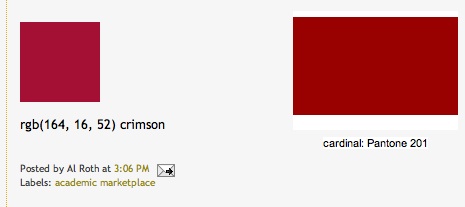
A different shade of red:
Chinese make up 0.43% of the population of Cincinnati and they have a Panda Express. That’s like putting a Wienerschnitzel in Singapore.
The population of Singapore is 85% Chinese and they have a Chinatown. That’s like putting a Honkytown in Cincinnati.
Teller as in Penn &. He’s out to teach neuroscientists a thing or two about deception.
I’m all for helping science. But after I share what I know, my neuroscientist friends thank me by showing me eye-tracking and MRI equipment, and promising that someday such machinery will help make me a better magician.
I have my doubts. Neuroscientists are novices at deception. Magicians have done controlled testing in human perception for thousands of years.
I remember an experiment I did at the age of 11. My test subjects were Cub Scouts. My hypothesis (that nobody would see me sneak a fishbowl under a shawl) proved false and the Scouts pelted me with hard candy. If I could have avoided those welts by visiting an MRI lab, I surely would have.
In the article he ticks off a list of mental shortcuts that the magician exploits for his tricks. You should read it. Visor visit: Jacob Grier.

I was having coffee outside and I saw ants crawling on my feet so I moved to another table.
Then I rewound my stream of consciousness about 30 seconds and I was able to recall that in fact there was a little more going on than that. I was daydreaming while sipping my coffee and I felt ticklishness on my toes and ankles. That made me look down and that’s when I saw the ants.
Now the fact that I had to rewind to remember all of this says something interesting. Had I looked down and not seen ants, i.e. if it turned out it was just the precious Singapore wind blowing on my cozy bare feet, then this episode would never have penetrated my conscious mind. I would have gone on daydreaming without distraction.
The subconscious mind pays attention to a million things outside of our main line of being and only when it detects something worth paying attention to does it intervene in some way. There are two very common interventions. One is to react at a subconscious level. I.e. shooing a fly while I go on daydreaming. Another is to commandeer consciousness and force a reaction. I.e. pay attention to an attractive potential mate passing by.
Both of these involve the subconscious mind making a decisive call as to what is going on, what is its level of significance, and how to dispense with it. It’s all or nothing: let the conscious mind go on without interruption or completely usurp conscious attention.
But the ant episode exemplifies a third type. My subconscious mind effectively said something like this :”I am not sure what is going on here, but I have a feeling that its something that we need to pay attention to. But to figure that out I need the expertise and private information available only to conscious visual attention and deliberation. I am not telling you what to do because I don’t know, I am just saying you should check this out.”
And so a tiny slice of consciousness gets peeled off to attend to that and only on the basis of what it sees is it decided whether the rest has to be distracted too.
Email is the superior form of communication as I have argued a few times before, but it can sure aggravate your self-control problems. I am here to help you with that.
As you sit in your office working, reading, etc., the random email arrival process is ticking along inside your computer. As time passes it becomes more and more likely that there is email waiting for you and if you can’t resist the temptation you are going to waste a lot of time checking to see what’s in your inbox. And it’s not just the time spent checking because once you set down your book and start checking you won’t be able to stop yourself from browsing the web a little, checking twitter, auto-googling, maybe even sending out an email which will eventually be replied to thereby sealing your fate for the next round of checking.
One thing you can do is activate your audible email notification so that whenever an email arrives you will be immediately alerted. Now I hear you saying “the problem is my constantly checking email, how in the world am i going to solve that by setting up a system that tells me when email arrives? Without the notification system at least I have some chance of resisting the temptation because I never know for sure that an email is waiting.”
Yes, but it cuts two ways. When the notification system is activated you are immediately informed when an email arrives and you are correct that such information is going to overwhelm your resistance and you will wind up checking. But, what you get in return is knowing for certain when there is no email waiting for you.
It’s a very interesting tradeoff and one we can precisely characterize with a little mathematics. But before we go into it, I want you to ask yourself a question and note the answer before reading on. On a typical day if you are deciding whether to check your inbox, suppose that the probability is p that you have new mail. What p is going to get you to get up and check? We know that you’re going to check if p=1 (indeed that’s what your mailbeep does, it puts you at p=1.) And we know that you are not going to check when p=0. What I want to know is what is the threshold above which its sufficiently likely that you will check and below which is sufficiently unlikely so you’ll keep on reading? Important: I am not asking you what policy you would ideally stick to if you could control your temptation, I am asking you to be honest about your willpower.
Ok, now that you’ve got your answer let’s figure out whether you should use your mailbeep or not. The first thing to note is that the mail arrival process is a Poisson process: the probability that an email arrives in a given time interval is a function only of the length of time, and it is determined by the arrival rate parameter r. If you receive a lot of email you have a large r, if the average time spent between arrivals is longer you have a small r. In a Poisson process, the elapsed time before the next email arrives is a random variable and it is governed by the exponential distribution.
Let’s think about what will happen if you turn on your mail notifier. Then whenever there is silence you know for sure there is no email, p=0 and you can comfortably go on working temptation free. This state of affairs is going to continue until the first beep at which point you know for sure you have mail (p=1) and you will check it. This is a random amount of time, but one way to measure how much time you waste with the notifier on is to ask how much time on average will you be able to remain working before the next time you check. And the answer to that is the expected duration of the exponential waiting time of the Poisson process. It has a simple expression:
Expected time between checks with notifier on =

Now let’s analyze your behavior when the notifier is turned off. Things are very different now. You are never going to know for sure whether you have mail but as more and more time passes you are going to become increasingly confident that some mail is waiting, and therefore increasingly tempted to check. So, instead of p lingering at 0 for a spell before jumping up to 1 now it’s going to begin at 0 starting from the very last moment you previously checked but then steadily and continuously rise over time converging to, but never actually equaling 1. The exponential distribution gives the following formula for the probability at time T that a new email has arrived.
Probability that email arrives at or before a given time T =

Now I asked you what is the p* above which you cannot resist the temptation to check email. When you have your notifier turned off and you are sitting there reading, p will be gradually rising up to the point where it exceeds p* and right at that instant you will check. Unlike with the notification system this is a deterministic length of time, and we can use the above formula to solve for the deterministic time T at which you succumb to temptation. It’s given by
Time between checks when the notifier is off =

And when we compare the two waiting times we see that, perhaps surprisingly, the comparison does not depend on your arrival rate r (it appears in the numerator of both expressions so it will cancel out when we compare them.) That’s why I didn’t ask you that, it won’t affect my prescription (although if you receive as much email as I do, you have to factor in that the mail beep turns into a Geiger counter and that may or may not be desirable for other reasons.) All that matters is your p* and by equating the two waiting times we can solve for the crucial cutoff value that determines whether you should use the beeper or not.
The beep increases your productivity iff your p* is smaller than

This is about .63 so if your p* is less than .63 meaning that your temptation is so strong that you cannot resist checking any time you think that there is at least a 63% chance there is new mail waiting for you then you should turn on your new mail alert. If you are less prone to temptation then yes you should silence it. This is life-changing advice and you are welcome.
Now, for the vapor mill and feeling free to profit, we do not content ourselves with these two extreme mechanisms. We can theorize what the optimal notification system would be. It’s very counterintuitive to think that you could somehow “trick” yourself into waiting longer for email but in fact even though you are the perfectly-rational-despite-being-highly-prone-to-temptation person that you are, you can. I give one simple mechanism, and some open questions below the fold.
Giving the content away for free publicizes the event and adds to the cache of (and willingness to pay for) the actual event. Also,
Anderson did not stop there. He opened up not only the TED talks themselves but the TED name. TEDx are events that can be put on by pretty much anyone. You need a license and have to do a good job (there’s no automatic renewal of the license), but nearly anyone can pitch in. This is literally a freeing up of the concept “ideas worth spreading” to allow anyone to select what those ideas are. So long as you follow a few simple rules — a talk format, some video, and no ads or other commercial tags — you can host a TEDx event. And there are now hundreds of these each year. What is more, TED regularly features talks from these on the site, so they act as feeder for TED publishing.
That’s from Josh Gans, more here.
 Cheap Talk