You are currently browsing the tag archive for the ‘publishing’ tag.
In case you have not been following the catfight, let me get you up to speed. Chris Anderson wrote a book called Free. I haven’t read it, but it apparently says “all your ideas are belong to us” because the price of ideas is crashing to zero. Malcom Gladwell says “please don’t let my employer read that”…I mean, “No its not.”
Let’s have a model. There are tiny ideas and big ideas. The tiny ideas are more like facts, or observations or experiences. They are costless to produce but costly to communicate. They are highly decentralized in that everybody produces their own heterogenous tiny ideas. The big ideas are assembled from a large quantity of tiny ideas. Different people have different production technologies for producing big ideas from small ones. These could differ just in cost, or also in terms of the quality of big ideas that are produced, it changes the story a little but doesn’t change the economics.
Start with a world where the marginal cost of communicating a tiny idea to another individual is large. Then the equilibrium market structure has big-idea producers who incur the high cost of acquiring tiny ideas, assemble them into big ideas and communicate the big ideas to the masses for a price. This market structure sustains high prices for big ideas and sustains entry by big-idea specialists.
Now suppose the marginal cost of communicating the tiny ideas shrinks to zero. Then an alternative for end users is to assemble their own big ideas for their own consumption out of the tiny ideas they acquire themselves for close to nothing. The cost disadvantage that the typical end user has is compensated by his ability to customize his palette of tiny ideas and resulting big ideas to complement his idiosyncratic endowment of other ideas, tastes, etc. The price of big ideas crashes. Former producers of big ideas exit the market. This is all efficient.
An important implication of this model is that the products that Anderson expects to be free are not the products Gladwell produces. So when Gladwell says that this is absurd because the economics do not support big ideas being sold at a price of zero, he is right. But that is because the big ideas are not being sold at all, and this is all efficient.
“Bob Dylan drew upon a rich lode of old folk tunes for most of his early songs,” Hyde writes. “That’s not theft; that’s the folk tradition at its best.” It seems that nearly two-thirds of Dylan’s work between 1961-63 — some 50 songs — were reinterpretations of American folk classics. In today’s corporate-creative environment, in which Disney was allowed to change the basic nature of copyright law back in the 90s so that their signature mouse wouldn’t fall into the public domain, Dylan’s early work would’ve landed him in court.
from a post at Mental Floss. The punchline:
Hyde argues that “there are good reasons to manage scarce resources through market forces, but cultural commons are never by nature scarce, so why enclose them far into the future with the fences of copyright and patent?
I am generally opposed to IP law, but I think this oversimplifies. There is room for argument about patents. (For example, I came across this story today about drugs for rare diseases. It is hard to see how drugs that will benefit a total of 3 people on the whole planet can be financed without monopoly rents.) However, copyright for music and other creative works is a solution to a non-existent incentive problem.
Here is a nice article (via The Browser) theorizing about why Wikipedia works. The apparent puzzles are why people contribute to this public good and why it withstands vandalism and subversion. The first puzzle is no longer a puzzle at all, even us economists now accept that people freely give away their information and effort all the time. But no doubt others have just as much motivation, or more, to vandalize and distort, hence the second puzzle.
The article focuses mostly on the incentives to police which is the main reason articles on say, Barack Obama, probably remain neutral and factual most of the time. But Wikipedia would not be important if it were just about focal topics that we already have dozens of other sources on. The real reason Wikipedia is as valuable a resource as it is stems from the 99.999% of articles that are on obscure topics that only Wikipedia covers.
For example, Barbicide.
These articles don’t get enough eyeballs for policing to work, so how does Wikipedia solve puzzle number two in these cases? The answer is simple: a vandal has to know that, say, John I of Trebizond exists to know that there is a page about him on Wikipedia that is waiting there to be vandalized. (I just vandalized it, can you see where?)
There are only two classes of people who know that there exists a John I of Trebizond (up until this moment that is.) Namely, people who know something useful about him and people who want to know something useful about him. So puzzle number 2 is elegantly sidestepped by epistemological constraints.
You write several novels and transfer copyright to a publisher in exchange for royalty payment. When you die your heirs have a legally granted option to negate the transfer of copyright. This option limits how much your publisher will pay you for the copyright. So you attempt to block your heirs by entering a second contract which pre-emptively regrants the copyright.
Eventually you die and your heirs ask the courts to declare your pre-emptive contract invalid.
You are (or were) John Steinbeck and your case is before the Supreme Court. If I am reading this right the appelate court decision went against the heirs. And remarkably the Songwriter’s Guild of America filed an amicus brief in favor of the heirs. (ascot angle: scotusblog.)
A standard introductory graduate textbook on game theory, A Course in Game Theory by Martin Osborne and Ariel Rubinstein is now freely available in PDF format. You can download it here. This is a great step toward the day when there will be top quality freely available textbooks in all subjects and the day when students and faculty will not be held-up. While we are on the subject, here is a list of other free economics books (right-hand column.)
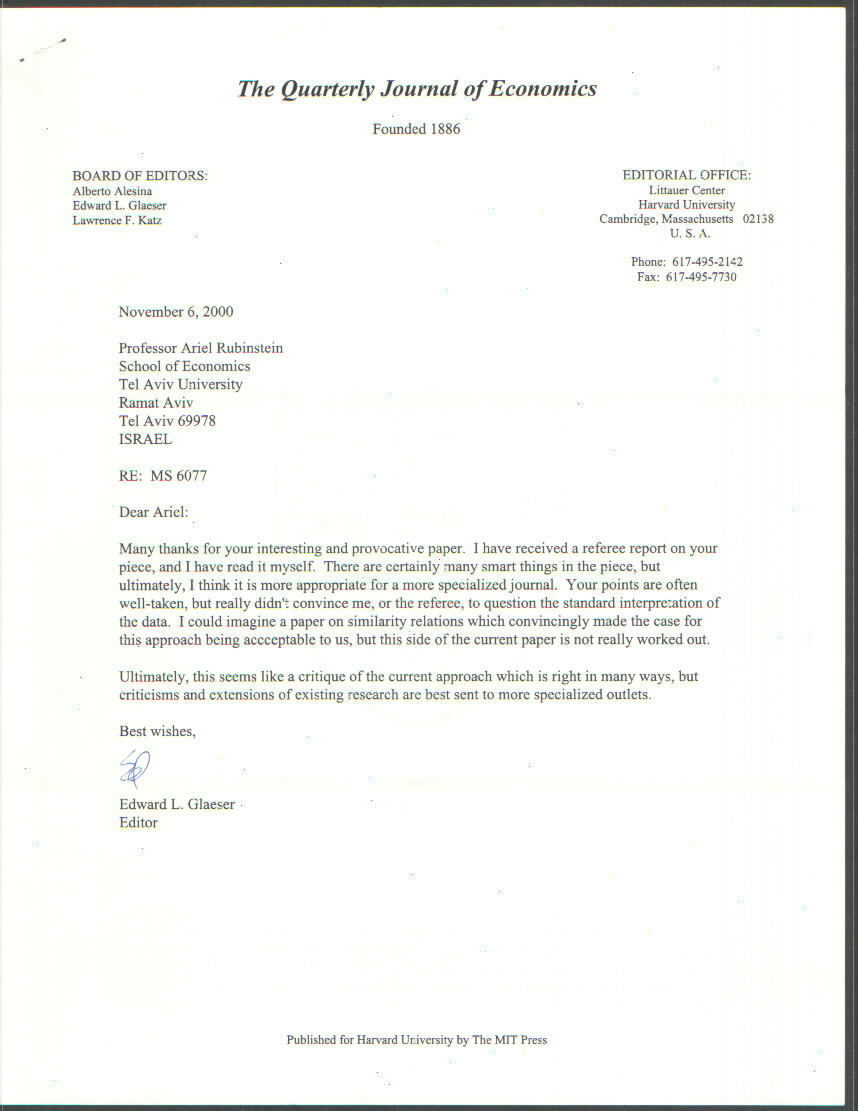
Start your QJE clocks! I just submitted my paper Kludged (rhymes with Qjed) to the Quarterly Journal of Economics. The QJE has a reputation for speedy rejections. For me this is a virtue. Obviously I prefer not to be rejected, (although for some a QJE rejection is a well-earned badge of honor) but conditional on being rejected (always the most likely outcome), the sooner the better.
Addendum: Alas, the paper was rejected 😦 It took about 3 1/2 months and I received 4 thoughtful referee reports. All in all I would say I was treated fairly.
Uber-twitterer and oenephile of the Proletariat Gary Vaynerchuck has just signed a million dollar deal with Harper Studio who will publish 10 (!) books by the hitherto unpublished, self-proclaimed non-reader. As reported here (bowlerbow: EatMeDaily), this represents an experiment in the terms of book contracts by the fledgling division of Harper Collins which was built on the premise that contracts delivering massive advances to the author and retaining sales revenue for the publisher are no longer part of a viable business model.
Publishing contracts must solve a thorny bilateral incentive problem which arises as a result of the timing of investment by author and publisher. The author commits effort up front writing the book and then the publisher is expected to commit resources editing and marketing the completed manuscript. The problem is to provide incentives for one party without dampening the incentives for the other. The traditional advance/residuals contract solves this problem because the residuals give the publisher incentive to market the book and maximize sales leaving the advance as the compensation for the author. The accompanying shift of risk from author to publisher is efficient because the publisher handles many books simultaneously, effectively creating a diversified portfolio.
The book market has famously weakened and it is becoming rarer and rarer for sales to justify the large advances that were hallmarks of existing contracts. This means that a larger fraction of the author’s compensation must come directly out of book royalties, undermining the incentive and risk-shifting benefits of the old structure. To adapt, publishers are seeking authors who already have an established “platform” such as a blog or other online community. Such authors are less averse to residuals because their ready-made audience makes the prospect less risky. Vaynerchuck would appear to fit the bill perfectly. His video blog, winelibrarytv attracts more than 80,000 viewers per day and as of today he has 177,000 followers on Twitter.
But when authors receive a large share of sales revenue, how can publishers be motivated to do the footwork of marketing the book to generate those sales? To some extent an author with a platform can do his own marketing but if word of mouth were all that was required to turn a book into a hit, there would be no reason for the publisher in the first place. Here is where the second novelty in the Vaynerchuck deal comes in: the long-term relationship. The contract marries Vaynerchuck and HarperStudio for 10 books. If HarperStudio can make his first book into a hit, it makes Gary into a star and it stands to reap the benefits on not just the first book but the 9 more to come.
“On the back end” as Gary would put it.
A debate is going on between Lawrence Lessig and Congressman John Conyers about a bill that Conyers is sponsoring. The bill would repeal an existing rule for NIH funding that requires funded research to be published in Open Acess journals. In addition it would generally prevent federal agencies from imposing these restrictions in the future. A good place to start is here and here are Lessig and Conyers. (hat tip: sandeep.)
There is some debate about the legal issues but to me those issues appear to be a red herring clouding the main dispute. There is probably one point of agreement: for-profit journals will be hurt. The disagreement is whether or not this is a good thing.
Requiring open-access publication obviously fulfills the aim of getting the maximum social benefit from dissemination of publicly-funded research. The marginal cost of distribution is zero, so the efficient price is zero. But the bill’s proponents argue that a dissemination is only one of the services provided by journals. Far more important is the evaluation and editing of submitted articles by the peer-review process. They worry that a zero price means that open-access journals have insufficient incentive to invest in this process. The result is that it becomes harder for outsiders to distinguish good, credible research from bad, sloppy research.
I have two points to add to this. First, as an editor of an Open Access journal and a member of editorial boards for many commercial journals I can testify that the publisher’s revenues are not being used effectively (or in most cases, at all) in providing incentives for editors and reviewers to do a good job. To the extent that the peer-review system works, it works because reviewers have external incentives like reputation, prestige, and plain old scientific integrity. And these incentives work at least as well in the Open Access world. (In fact, they seem to work even better since reviewers feel better about their work when it is serving the public interest and not the profits of publishers.)
Second, even if you disagree with the above it remains an empirical question which market structure would best provide material incentives for peer-review. Open Access publishing prevents the use of distortionary prices for raising the funds to pay reviewers. The alternative is a model in which authors pay for peer-review with submission fees. Of course this is also distortionary because the social benefit of having a manuscript carefully evaluated may outweigh the author’s willingness to pay.
But let’s remember: we are debating a policy about public funding of research. Basic research is publicly funded precisely because the social benefit of the research outweighs the researcher’s private incentive. Given this, the funding agency maximizes the value of its subsidy by funding not only the research itself but its dissemination. This is achieved by requiring Open Access publishing and earmarking some of the funds to pay for peer-review.
The relevant part seems to be:
Wiley-Blackwell will support our authors by posting the accepted version of articles by NIH grant-holders to PubMed Central upon acceptance by the journal. The accepted version is the version that incorporates all amendments made during peer review, but prior to the publisher’s copy-editing and typesetting. This accepted version will be made publicly available 12 months after publication. The NIH mandate applies to all articles based on research that has been wholly or partially funded by the NIH and that are accepted for publication on or after April 7, 2008.
So it seems that NIH-funded articles will appear in an Open-Access outlet, but 12 months after publication. I don’t know all of the details of the NIH rules, but this does seem a step in the right direction.
Joking. Its a huge development for economics and open access publishing: the Econometric Society and the Society for Economic Theory have agreed to bring the journal Theoretical Economics into the ES fold. A little background: about three years ago, these people had the bold plan to launch a new field journal for economic theory and to make it free in every sense of that word. We wanted to show that an open access journal could also be a top journal.
The Econometric Society has recognized our success and is seeing the light on open access. What better way to bring open access to the mainstream than to become the field journal of one of the oldest and most respected professional societies in economics.
I think one of the most entertaining ironies of this experience is that now economics (you know: laissez faire, maximize profits, invisible hand) is one of the very few disciplines which has a top journal that is fully open access.
Here is the announcement.
 Cheap Talk