
You are currently browsing the tag archive for the ‘game theory’ tag.
The phamily kind. Let’s say you are hiding something from your husband. For example, let’s say that you are trying to teach your husband a lesson about putting things “in their right place” and you hide his newly-arrived tomato seeds. Its time to germinate them indoors to be ready for a mid-May transplanting and he comes to you and says
H: I found the seeds.
Y: You did?
H: Yep. Were they there all the time? I am sure I looked there.
Y: I thought you would have. That’s where you always put stuff. You never put stuff in the right place.
H: I always put stuff there? Like what?
Y: Like remember you put X and Y and Z there and I couldn’t find them?
H: Ahh yes, X, Y and Z, I remember them well. Thanks for telling me where my tomato seeds are.

Rats in the lab learn to play best-responses in a repeated prisoner’s dilemma. The rats were given rewards according to which of two compartments each walks into, and these rewards were structured as in a Prisoner’s dilemma. First the rats were given a “training session” where they learned the payoff function. Then the strategy of one rat was manipulated as the experimenters manually placed the rat into compartments before the other rat made his choice.
When the control rat played a random strategy, the experimental rat mostly “defected” but when the control rat played a reciprocating strategy (Tit-for-tat), the experimental rat not only learned to cooperate but also how to invite escape from a punishment phase.
It may not be entirely surprising that rats cooperated in the Prisoner’s Dilemma. After all, animals often cooperate in nature to altruistically serve the group, whether that means hunting in packs to get more meat, or a surrogate mother animal adopting an abandoned baby to boost the pack’s numbers. Still, there’s no direct evidence that shows rats grasp the concept of direct reciprocity. Given that the rats in this study changed their strategy based on the game their opponent was playing, and cooperation rates were only high when the rats played against a tit-for-tat opponent, the authors showed, perhaps for the first time, that rats directly reciprocate.
With the help of DressRegistry.com:
Our goal is to lessen the chance that someone attending the same event as you will be wearing the EXACT same dress. We also hope we can be a resource for groups planning events through our message board and marketing partners. While it’s true we can not guarantee that someone else won’t appear in the same dress as you, the more that you (and others like you) use DressRegistry.com the lower that likelihood will be. So please use our site and have fun!
You find your event on their site and post a description and picture of the dress you will be wearing. When other guests check in to the site, they will know which dresses to avoid, in order to prevent dress disasters such as this one (Pink and Shakira, featured on the site):

The site promises “No personal information is displayed” but I wonder if anonymity is a desirable feature in this kind of mechanism. It seems to open the door to all kinds of manipulation:
- Chicken. Suppose you have your heart set on the Cache: green, ankle, strapless (picture here) but you discover that it has already been claimed for the North Carolina Museum of Art Opening Gala. You could put in a second claim for the same dress. You are playing Chicken and you hope your rival will back down. Anonymity means that if she doesn’t and the dress disaster happens, your safe because there’s only she-said she-said. Worried she might not back down? Register it 10 times.
- Hoarding. Not sure yet which dress is going to suit you on that day? Register everything that tickles your fancy, and decide later!
- Cornering the Market. You don’t just want to avoid dress disasters, you want to be the only one wearing your favorite color or your favorite designer or… Register away all the competition.
- Intimidation. Someone has already registered a knock-out dress that’s out of your price range. Register it again. She might think twice before wearing it.
I’ve been thinking about the Sleeping Beauty problem a lot and I have come up with a few variations that help with intuition. So far I don’t see any clear normative argument why your belief should be anything in particular (although some beliefs are obviously wrong.) My original argument was circular because I wanted to prove that your willingness to be reveals that you assign equal probability but I essentially assumed you assigned equal probability in calculating the payoffs to those bets.
Nevertheless the argument does show that the belief of 1/2 is a consistent belief in that it leads to betting behavior with a resulting expected payoff which is correct. On the other hand a belief of 1/3 is not consistent. If, upon waking, you assign probability 1/3 to Heads you will bet on Tails and you will expect your payoff to be (2/3)2 – (1/3)1 = $1. But your true expected payoff from betting tails is 50 cents. This means that you are vulnerable to the following scheme. At the end of their speech, the researchers add “In order to participate in this bet you must agree to pay us 75 cents. You will pay us at the end of the experiment, and only once. But you must decide now, and if you reject the deal in any of the times we wake you up, the bet is off and you pay and receive nothing.”
If your belief is 1/3 you will agree to pay 75 cents because you will expect that your net payoff will be $1 – 75 cents = 25 cents. But by agreeing the deal you are actually giving yourself an expected loss of 25 cents (50 cents – 75 cents.) If your belief is 1/2 you are not vulnerable to these Dutch books.
Here are the variations.
- (Clones in their jammies) The speech given by the researchers is changed to the following. “We tossed a fair coin to decide whether we would clone you, and then wake up both instances of you. The clone would share all of your memories, and indeed you may be that clone. Tails: clone, Heads: no clone (but still we would wake you and give you this speech and offer.) You (and your clone if Tails) can bet on the coin. In the event of tails, your payoff will be the sum of the payoffs from you and your clone’s bet (and the same for you if you are the clone.)”
- (Changing the odds) Suppose that the stakes in the event of Heads is $1.10. Now those with belief 1/2 strictly prefer to bet Heads (in the original example they were indifferent.) And this gives them an expected loss, whereas the strategy of betting Tails every time would still give an expected gain. This exaggerates the weirdness but it is not a proof that 1/2 is the wrong belief. The same argument could be applied to the clones where we would have something akin to a Prisoner’s dilemma. It is not an unfamiliar situation to have an individual incentive to do something that is bad for the pair.
- Suppose that the coin is not fair, and the probability of Tails is 1/n. But in the event of Tails you will be awakened n times. The simple counting exercise that leads to the 1/3 belief seemed to rely on the fair coin in order to treat each awakening equal. Now how do you do it?
- The experimenters give you the same speech as before but add this: “each time we wake you, you will place your bet BUT in the event of Tails, at your second awakening, we will ignore your choice and substitute a bet on Tails on your behalf.” Now your bet only matters in the first awakening. How would you bet now? (“Thirders” who are doing simple counting would probably say that, conditional on the first awakening, the probability of Heads is 1/2. Is it?)
- Same as 4 but the bet is substituted on the first awakening in the event of Tails. Now your bet only matters if the coin came up Heads or it came up Tails and this is the second awakening. Does it make any difference?
Via Robert Wiblin here is a fun probability puzzle:
The Sleeping Beauty problem: Some researchers are going to put you to sleep. During the two days that your sleep will last, they will briefly wake you up either once or twice, depending on the toss of a fair coin (Heads: once; Tails: twice). After each waking, they will put you to back to sleep with a drug that makes you forget that waking.
The puzzle: when you are awakened, what probability do you assign to the coin coming up heads? Robert discusses two possible answers:
First answer: 1/2, of course! Initially you were certain that the coin was fair, and so initially your credence in the coin’s landing Heads was 1/2. Upon being awakened, you receive no new information (you knew all along that you would be awakened). So your credence in the coin’s landing Heads ought to remain 1/2.
Second answer: 1/3, of course! Imagine the experiment repeated many times. Then in the long run, about 1/3 of the wakings would be Heads-wakings — wakings that happen on trials in which the coin lands Heads. So on any particular waking, you should have credence 1/3 that that waking is a Heads-waking, and hence have credence 1/3 in the coin’s landing Heads on that trial. This consideration remains in force in the present circumstance, in which the experiment is performed just once.
Let’s approach the problem from the decision-theoretic point of view: the probability is revealed by your willingness to bet. (Indeed, when talking about subjective probability as we are here, this is pretty much the only way to define it.) So let me describe the problem in slightly more detail. The researchers, upon waking you up give you the following speech.
The moment you fell asleep I tossed a fair coin to determine how many times I would wake you up. If it came up heads I would wake you up once and if it came up tails I would wake you up twice. In either case, every time I wake you up I will tell you exactly what I am telling you right now, including offering you the bet which I will describe next. Finally, I have given you a special sleeping potion that will erase your memory of this and any previous time I have awakened you. Here is the bet: I am offering even odds on the coin that I tossed. The stakes are $1 and you can take either side of the bet. Which would you like? Your choice as well as the outcome of the coin are being recorded by a trustworthy third party so you can trust that the bet will be faithfully executed.
Which bet do you prefer? In other words, conditional on having been awakened, which is more likely, heads or tails? You might want to think about this for a bit first, so I will put the rest below the fold.

Relationships that are sustained by reciprocity work like this. When she cooperates I stay cooperative in the future. When she egregiously cheats, the relationship breaks down. In between these polar cases it depends on how much she let me down and whether she had good reason. Forgiveness is rationed. Too much forgiveness and the temptation to cheat is too great.
This is also how it should work in your relationship with yourself. It takes discipline to keep working toward a long-term goal. Procrastination is the temptation to shirk today with the expectation that you’ll make it up in the future. Thus the only way to reduce the temptation is to change those expectations. Self-discipline is the (promise, threat, expectation) that if I procrastinate now, things will only get worse in the future. Too much self-forgiveness is self-defeating.
I came across a study by psychologists that, at first glance, casts doubt on this theory. Students who procrastinated on their midterm exams were asked whether they forgave (forgifted ?!) themselves. The level of forgiveness was then compared to the degree of procrastination on the final exam. The more self-forgiving students were found to procrastinate less on the final. The psychologists interpreted the finding in this way.
we have to forgive ourselves for this transgression thereby reducing the negative emotions we have in relation to the task so that we’ll try again. If we don’t forgive, we maintain an avoidance motivation, and we’re more likely to procrastinate.
But if we think a bit more, we can square the experiment quite nicely with the theory. The key is to focus on the intermediate zone where forgiveness is metered out depending on the extent of the violation. Forgiveness means that the relationship continues as usual with no punishment. The lack of forgiveness, i.e. punishment, means that the relationship breaks down. In the game with yourself that means that your resolve is broken and you lose the incentive to resist procrastination in the future. Forgiveness is negatively correlated with future procrastination.
(The apparent inversion comes from the fact that the experiment relates forgiveness to future procrastination. A naive reading of the theory is that because forgiveness reduces the incentive to work, forgiveness should predict more procrastination. As we see this is not true going forward. It would be true, however, looking backward. Those who are more likely to forgive themselves are more likely to procrastinate.)
The first comes from Eran Shmaya:
I heard this from Marco who heard it from Tzachi. Not sure what to make of it, but that will not deter me from ruminating publicly
There is a sack of chocolate and you have two options: either take one piece from the sack to yourself, or take three pieces which will be given to Dylan. Dylan also has two options: one pieces for himself or three to you. After you both made your choices independently each goes home with the amount of chocolate he collected.
The second from Presh Talwalker:
My friend Jamie is a professional poker player, and he came across a great example along the lines of the Prisoner’s Dilemma.
Here is what he reports:
I played a poker tournament at Caesar’s Palace last night with the
following setup: The buy-in is $65, which gets you 2500 chips. There
is also the option to buy an additional 500 chips for $5 more, giving
you a total of 3000 chips for $70. At 1 cent/chip, this add-on sounds
like a great bargain compared to the 2.6 cents/chip of the regular
buy-in.The kicker is that the house keeps the entire $5 add-on fee; none of
it goes into the prize pool.
Each of these is equivalent to a Prisoners’ Dilemma. That should be obvious in the first case. In the second case, notice that if you buy the additional chips you deflate the value of the others’ chips. (Poker seignorage!) If you were to present either of these examples to students, I would bet that most of them would play the corresponding Defect strategy. And this would make for a great teaching device if you show it to them before teaching the Prisoners’ dilemma. Because the usual framing of the prisoner’s dilemma suggests to students that they ought to be cooperative. This is the main reason students are often confused by the Prisoners’ dilemma.
My approach to blogging is pretty simple. When I have an idea I email it to myself. My mail server deposits these in a special folder which I then dig through when I am ready to write something. Some ideas don’t get written up and they start to attract dust. I am going to clean the closet and write whatever I can think of about the ideas that piled up. Here is one that Sandeep and I actually talked about some time ago, but I can’t now figure out where I wanted to go with it.
Shouldn’t gang wars end quickly? All you have to do is kill the leader of the rival gang. Instead, at least anectdotally, gang wars are more like wars of attrition. You have the low-level thugs picking each other off and the leaders are relatively safe. Why?
The leader embodies some valuable capital: control of his organization. Even if you could decapitate the rival gang by killing the leader it may be preferred to weaken him by taking out enough of his henchmen. Then you can offer him a deal. Maybe its a merger, maybe its a collusive agreement, but either way the point is that the coalition is more valuable with the opposing hierarchy intact than in disarray. Knowing all of this, each gang leader feels perfectly safe even in the midst of an all-out war.
Under this theory, gang wars break out because a rival has become too powerful and it is no longer clear which is the dominant gang. Its a necessary part of renegotiating the pre-existing power-sharing arrangement in light of a new balance of power.
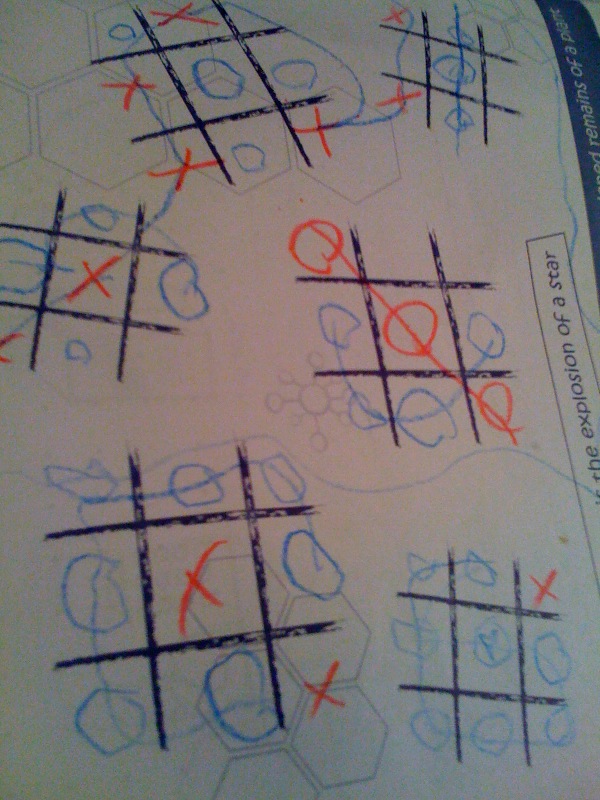
With best play tick-tack-toe is a draw. It comes as a surprise to people however that best play is hard to maintain when you are playing 50 games in succession, especially if you’ve had a few. Most people are willing to bet that they can go 50 games without losing one, many are even willing to give odds. You can make some money this way. (You are betting just that you can win at least one game, its safe to throw a few and that can knock a careful opponent out of his rhythm. And the sheer boredom that sets in around game #37 works to your advantage.)
One warning however. Only wager with with law-abiding adults. I tried this on my 3 year old and he cheats:
Karen Tumulty at the Time blog Swampland perceptively writes:
“the easiest choice for endangered Democrats in swing districts is to vote against the bill–but only if it passes. That’s because they need two things to happen to get re-elected this fall. They need to win independent voters (who in most recent polls, such as this one by Ipsos/McClatchy, are deeply divided on the bill). But they also need the Democratic base in their districts to be energized enough to turn out in force–something that is far less likely to happen if Barack Obama’s signature domestic initiative goes down in flames.”
Tumulty compares the scenario to an earlier vote in 1993 on the Clinton economic plan:
“It was the night of August 5, 1993, and Bill Clinton was one vote short of what he needed to get his economic plan through the House–a vote he got, when freshman Marjorie Margolies-Mezvinsky switched hers. The other side of the Chamber seemed to explode. Republicans pulled out their hankies and started waving them at her, chanting: “Bye-bye, Margie.”
Margolies-Mezvinsky learned the hard way that they were right. Her Main Line Philadelphia district was the most Republican-leaning of any represented by a Democrat in Congress. She had sealed her fate:
During her campaign, she had promised not to raise taxes, and the budget proposed a hike in federal taxes, including a gasoline tax. On the day of the vote, she appeared on television and told her constituents that she was against the budget. Minutes before the vote, however, on August 5, 1993, President Clinton called to ask Margolies-Mezvinsky to support the measure. She told him that only if it was the deciding vote—in this case, the 218th yea—would she support the measure. “I wasn’t going to do it at 217. I wasn’t going to do it at 219. Only at 218, or I was voting against it,” she recalled.11 She also extracted a promise from Clinton that if she did have to vote for the budget package, that he would attend a conference in her district dedicated to reducing the budget deficit. He agreed (and later fulfilled the pledge). Nevertheless, Margolies-Mezvinsky told Clinton “I think I’m falling on a political sword on this one.”
Tumulty suggests the underlying game is the Prisoner’s Dilemma. Some of her commenters suggest the game is similar to the free-rider problem in provision of public goods. The free-rider problem is very similar to a Prisoner’s Dilemma so really the commenters are echoing her interpretation though they may not realize it.
I claim the interesting version of the game for Democratic Representatives in conservative districts is Chicken. Two cars race towards each other on a road. Each driver can swerve out of the way or drive straight. If one swerves while the other does not, the former loses and the latter wins. If neither swerves, there is a terrible crash. If both swerve, both lose. A variant on this game is immortalized in the James Dean movie “Rebel without a Cause”.
According to Tumulty, Democratic Representatives in conservative districts want to have their cake and eat it: they need healthcare reform to pass to get Democratic turnout but they want to vote against it to keep independents happy. The strategic incentives are easy to figure out in two scenarios. First, suppose the bill is going down however the Rep votes as it does not have enough votes. Then, this Rep should vote against it – at least they get the independents in their district. Second, suppose the bill is going to pass however the Rep votes – they should vote against via the Tumulty logic.
The third scenario is ambiguous. Suppose a Rep’s vote is pivotal so the reform passes if and only if she votes for it. At the present count with retiring Reps, Pelosi needs 216 votes to pass the Senate bill in the House so a Rep is pivotal if there are 215 votes and her vote is the only way the bill will pass. Margie M-M was in this position in 1993. There are two possibilities in the third scenario. In the first, the Rep wants to vote against the bill even when she is pivotal as she is focused on the independent vote. This means she has a dominant strategy to vote against it the bill.
This case is strategically uninteresting and, as in the Margie case, it is implausible for all the undecideds to have a dominant strategy of this form. So let’s turn to the second possibility – many undecideds Rep wants to vote for the bill if they are pivotal. This generates Chicken. If none of the conservative Democratic Reps vote for it, the bill goes down and its a disaster as Democratic voters do not turn out. This is like cars crashing into each other in Chicken. Your ideal though is if someone else votes for it (i.e swerves) in the pivotal scenario and you can sit on the sidelines and vote against it (drive straight). There is a “free-rider” problem in this game as in the Prisoner’s Dilemma. But there is a coördination element too – if you are the pivotal voter you do want to vote for the bill.
Chicken has asymmetric equilibria where one player always swerves and the other drives straight. This corresponds to the case where the conservative Democrats know which of them will fall on their swords and vote for the bill and the rest of them can then vote against it. This is the best equilibrium for Obama as the Senate Bill definitely passes the House. But there is a symmetric equilibrium where each conservative Rep’s strategy is uncertain. They might vote for it, they might not. There is no implicit or explicit coördination among the voters in this equilibrium. This equilibrium is bad for Obama. Sometimes lots of people vote for the bill and it passes with excess votes. But sometimes it fails.
There is lots of strategy involved in trying to influence which equilibrium is played. And there’s lots of strategy among the Reps themselves to generate coordination. If you can commit not to vote for the bill, Obama and Pelosi are not going to twist your arm and they’ll focus on the lower-hanging fruit. Commitment is hard. You can make speeches in your district saying you’ll never vote for the bill. Margie M-M did this but a call from the President persuaded her to flip anyway. Republicans are going to emphasize the size of the independent vote to convince the undecideds that they have a dominant strategy to vote against the bill. And the President is going to hint he’s not going to help you in your re-election campaign if you vote against the bill. Etc., etc.
So, if the Senate bill is finally voted on, as we creep up to 200 votes or so, we’ll see Chicken played in the House. We’ll see who lays an egg.

On my way to yoga this afternoon I heard a bit on NPR about the song “You’re So Vain” by Carly Simon. You remember the song, it’s addressed to some mysterious man who wears a fruity scarf and apparently has a big ego.
At the end of the segment there was a query from a listener that packed a punch. (Paraphrasing the NPR listener) She sings “I bet you think this song is about you, don’t you?” Why would she sing that? After all, the song is about him.
At first I thought that the listener just didn’t understand the point of the barb: She is saying that he is so vain because when he hears a song about someone he assumes it is about him. But after thinking for awhile, I see that the listener was onto something.
Is it vain to think that a song is about you when indeed it really is about you? Can you be accused of being vain just for being right? What if the guy has never before thought a song was about him. Maybe this was the very first time in his life that he ever thought a song was about him, and he had good reason to because in fact it was about him and indeed all the clues were laid out in previous verses?
She could have sung “I bet you think those other songs, like you know the song about turning brown eyes blue, by Crystal Gayle, or the one by the Carpenters about birds suddenly appearing, you know those songs, I bet you think those songs are about you. Well I got news for you, they are not. In fact those singers have never met you, duh.” But she didn’t.
Even worse, the song clearly accuses its subject of being vain. If he thinks the song is about him, then he is acknowledging his own vanity. Certainly the guy gets humility points for recognizing his own vanity, right?
But wait. The subject knows that Carly knows that the subject’s recognition of himself in Carly’s song is an admission of vanity, and hence an act of humility. And therefore “I bet you think this song is about you” translates to “I bet you think you are humble.” And given that, since the subject indeed recognizes himself in the song he is in fact claiming to be humble, an act of sheer vanity.
So Carly’s lyrics cut deep indeed.
(Postscript: before today I actually thought the song was about me.)
Chat Roulette (NSFA) is a textbook random search and matching process. Except that it is missing a key ingredient: an instrument for screening and signaling. That, coupled with free entry, means that everyone’s payoff is driven to zero.
In practice the big problems with Chat Roulette are
- Too many lemons
- Too much searching
- The incentive do something attention grabbing in the first few seconds is too strong
On the other, hand I expect the next generation of this kind of service to be a tremendous money maker. Here are some ideas to improve on it. The general idea is to create a mechanism where better partners are able to more easily find other good partners.
- Users maintain a score equal to the average length of their past chats. The idea is to give incentives to invest more in each chat, and to reward people who can keep their partners’ attention for longer. A user with a score of x is given the ability to restrict his matches to other users with a score greater than any z≤x he specifies. This is probably prone to manipulation by users who just keep their chats open inviting their partners to do the same and pad their numbers.
- Within the first few seconds of a match, each partner bids an amount of time they would like to commit to the current match. The system keeps the chat open for the smaller of the two numbers. Users maintain a score equal to the average amount of time other users have bid for them. Scores are used to restrict future matching partners just as above.
- Match users in groups of 10 instead of 2. Each member of the group clicks on one of the others and any mutually-clicking pair joins a chat. This could be coupled with a system like #1 above to mitigate the manipulation problem. Or your score could be the frequency with which others click on you.
- A simple “like/don’t like” rating system at the end of each chat. In order to make this incentive-compatible, you have an increased chance of meeting the same person again in future matches if both of you like each other. On top of that, your score is equal to the number of times people like you.
- Same as 4, but your score is computed using ranking algorithms like Google’s PageRank where it’s worth more to be liked by a well-liked partner.
- Multiple channels with their own independent scores. You could imagine that systems like the above would have multiple equilibria where the tastes of users with the highest scores dominate, thus reinforcing their high scores. Multiple channels would allow diversity by supporting different equilibria.
- Allow users to indicate gender preference of their matches. To avoid manipulation, your partners report your gender to the system.
These are all screening mechanisms: you earn control over whom you match with. But the system also needs a signaling mechanism: a way for a brand new user to signal to established users that she is worth matching with. The problem is that a good signal requires a commitment to lose reputation if you don’t measure up. But without a way to stop users from just creating new identities, these penalties have no force.
This is a super-interesting design problem and someone who comes up with a good one is going to get rich. (NB: Sandeep’s and my consulting fees remain quite modest.)
In a nice paper, Chiappori, Groseclose and Levitt look at the zero-sum game of a penalty kick in professional soccer. They lay out a number of robust predictions that are testable in data, but they leave out the formal analysis of the theory (at least in the published version.) These make for great advanced game theory exercises. Here’s one:
The probability that the shooter aims for the middle of the goal (as opposed to aiming for the left side or the right side) is higher than the probability that the goalie stays in the middle (as opposed to jumping to the left or to the right.)
Hint: the answer is related to my post from yesterday, and you can get the answer without doing any calculation.
Does game theory have predictive power? The place to start if you want to examine this question is the theory of zero sum games where the predictions are robust: you play the minimax strategy: the one that maximizes your worst-case payoff. (This is also the unique Nash equilibrium prediction.)
The theory has some striking and counterintuitive implications. Here’s one. Take the game rock-scissors-paper. The loser pays $1 to the winner. As you would expect, the theory says each should play each strategy with 1/3 probability. This ensures that each player is indifferent among all three strategies.
Now, for the counterintuitive part, suppose that an outsider will give you an extra 50 cents if you play rock (not a zero-sum game anymore but bear with me for a minute), regardless of the other guy’s choice. What happens now? You are no longer indifferent among your three strategies, so your opponent’s behavior must change. He must now play paper with higher probability in order to reduce your incentive to play rock and restore your indifference. Your behavior is unchanged.
Things are even weirder if we change both players’ payoffs at the same time. Take the game matching pennies. You and your opponent hold a penny and secretly place it with either heads or tails facing up. If the pennies match you get $1 from your opponent. If they don’t match you pay $1.
Suppose we change the payoffs so that now you receive $2 from your opponent if you match heads-heads. All other outcomes are the same as before. (The game is still zero-sum) What happens? Like with RSP, your opponent must play heads less often in order to reduce your incentive to play heads. But since your opponent’s payoffs have also changed, your behavior must change too. In fact you must play heads with lower probability, because the payoffs have now made him prefer tails to heads.
How can we examine this prediction in the field? There is a big problem because usually we only observe outcomes and not the players’ payoffs which might vary day-to-day depending on conditions only known to them. To see what I mean, consider the game-within-a-game between a pitcher and a runner on first base in baseball. The runner wants to steal second, the pitcher wants to stop him. The pitcher decides whether to try a pick-off or pitch to the batter. The runner decides whether to try and steal.
When he runs and the pitcher throws to the plate, the chance that he beats the throw from the catcher depends on how fast he is and how good the catcher is, and other details. Thus, the payoff to the strategy choices (steal, pitch) is something we cannot observe. We just see whether he steals succesfully.
But there is still a testable prediction, even without knowing anything about these payoffs. By direct analogy to matching pennies, a faster runner will try to steal less often than a slower runner. And the pitcher will more often try to pick off the faster runner at first base. Therefore, in the data there will be correlation between the pitcher’s behavior and the runner’s. If the pitcher is throwing to first more frequently, that is correlated with a faster runner which in turn predicts that the runner tries to steal less often.
This correlation across players (in aggregate data) is a prediction that I believe has never been tested. (It’s strange to think of non-cooperative play of a zero-sum game as generating correlation across players.) And while many studies have failed to reject some basic implications of zero-sum game theory, I would be very surprised if this prediction were not soundly rejected in the data.
(The pitcher-runner game may not be the ideal place to do this test, can anyone think of another good, binary zero-sum game where there is good data?)
Do you use opt-in or opt-out? That is, do you agree to meet unless one or more of the group calls and says they can’t make it, or do you agree only if enough of you call and say they can make it?
With opt-out each person has insufficient incentive to make the call. If she has already decided not to go, courtesy is the only motive for informing the others. Moreover even if she is courteous, since the call could kill the meeting, if she is not 100% sure she can’t make it, she has a private incentive to wait until the last minute to make the call, just in case.
With opt-in each person has stronger incentives to try to coordinate. Because if I want to go to the meeting and I don’t make the call it might not happen.
So, returning to the question in the title, it all depends on what you want. Opt-out minimizes the chance that the meeting will be cancelled, but probably also at the expense of minimizing attendance.
I spent last week at UCSD where the weather was spectacular and academic life seems to consist of going for walks with everybody you know, in sequence.
I am recovering from hamstring tendonitis (the walks helped a lot, as did the weather and especially the company!) so I walk a little slower than usual. I noticed something about how a small group deals with a slowpoke on a walk. It starts out with everybody going at their usual pace and then noticing that I am falling behind. Eventually everybody slows down to my pace, however I am always one or two steps behind.
Its not an equilibrium for the faster walkers to stay even with the slow poke, but it also not an equilibrium for them to walk at a faster speed and increase the gap beyond more than a few steps. Its as if some minimum distance is necessary to remind them that they can’t walk at their natural speed.
I even found myself slightly out front of Joel Sobel when we went for our walk. He has a broken leg.
India has proposed a new round of talks with Pakistan. The last meaningful talks in 2007 led to a thawing of relations and real progress till everything was brought to a grinding halt by the terrorist attacks in Mumbai.
What are the payoffs and incentives for the two countries? David Ignatius ar the Washington Post offers this analysis:
“The India-Pakistan standoff is like one of those game-theory puzzles where both nations would be better off if they could overcome suspicions and cooperate — in this case, by helping the United States to stabilize the tinderbox of Afghanistan. If Indian leaders meet this challenge, they could open a new era in South Asia; if not, they may watch Pakistan and Afghanistan sink deeper into chaos, and pay the price later.”
The quote offers a theory for how India might gain from peace but what about Pakistan? Pakistan cannot be treated as a unitary actor. Some part of the elite and perhaps even the general population may gain from an easing of tension and a permanent peace with India. But the Pakistani military has quite different interests. The military dominate Pakistan politically and economically. Their rationale for resources, power and prestige relies on perpetual war not perpetual peace. Sabotage is a better strategy for them than cooperation with India. The underlying game is not the Prisoner’s Dilemma.
Military payoffs have to be aligned with economic payoffs to encourage cooperation. Economic growth can also generate the surplus to bankroll a bigger army. A poor country needs the threat of war to divert valuable resources into defense. But a rich country does not.
I saw it on the plane yesterday. Very funny, very insightful, somewhat disjointed at the end.
Forgive me for doing the game theorist’s equivalent of spoiling a time-travel movie by pointing out the paradoxes, but the main premise of the story rests on some shaky epistemology.
Nobody ever lies, but what really drives the plot is that everybody is perfectly credulous. Does it follow? Partially: if everybody has always been honest and you cannot conceive of the possiblity that anyone would lie, then yes you should assume that everything you hear is truthful.
But that’s not the same as the truth. Take for example the scene in which Gervais’ character lies to the bank teller. He tells her that he has $800 in his account. She looks up his account on the computer which says that he has only $300. What should she conclude?
She has to consider the possible scenarios that could have led to this contradiction and decide which is most likely. She must believe that he is being truthful and the movie assumes that this leads her to the conclusion that the computer is wrong and he is right. But surely people have often been mistaken even if they have always been truthful. And so another scenario is that the computer is right and he is making an honest mistake.
Indeed it is probably more common that people make honest mistakes than computer records are wrong. So that is the most likely explanation and its what the teller should have concluded. And this kind of inferential dilemma underlies most of the movie.
In a world where everybody is honest but nobody is omniscient, someone who starts lying will sooner be viewed as delusional than a prophet.
You are a student living in a small room with no closet. All of your clothes sit on the floor. You can never remember if they are clean or dirty, and each day you have to decide whether to do the laundry or just throw something on.
If your strategy in these circumstance is to always do the laundry, you will be doing laundry every day, often washing clothes that are already clean. On the other hand if your strategy is to dress and go your clothes will never get clean.
Instead you have to randomize. If you wash with probability p then p is the probability you will be wearing clean clothes on any given day. Of course you would like p=1, but then you are doing laundry with probability 1 every day. Your optimal p is strictly between 0 and 1 and trades off the probability of clean clothes p versus the probability of washing clothes that are already clean. (The latter is equal to the probability these clothes are clean, p, multiplied by the probability you wash them, again p so it’s p².)
The same logic applies to:
- I’ve been standing here in the shower for what must be a good 30 minutes; singing, sleeping, or absorbed in a proof that doesn’t work and I have forgotten whether I washed my hair. (shower cap nod: David K. Levine)
- Its dark and I lost count of how many intersections I’ve crossed and I know I have to turn left somewhere to get home. (The classic example, due to Piccione and Rubinstein.)
- When was the last time I called my mother?
- etc…
eBay combines a proxy bidding system with minimum bid increments. These interact in a peculiar way. If you have placed the first bid of $5 and the seller’s reserve is $1, then the initial bid is recorded at $1. Your true bid of $5 is kept secret and the system will bid for you (by “proxy”) until someone raises the price above $5.
Now I come along and bid, say $2. That’s not enough to outbid your $5, so you remain the high-bidder but the price is raised. In this case it is raised to $2 plus the minimum increment, say $0.50, provided that sum is less than your bid. In this case it is. But suppose the next bidder comes along and bids $4.75. Again you have not been outbid and so you remain the high bidder but in this case $4.75 + $0.50 is larger than $5, and when this happens the price is raised only to equal your bid, $5.
So, if you are bidding and your bid was not high enough to displace the high bidder but the price didn’t rise by the minimum increment above your bid, then the new price is exactly the (previously secret) bid of the high bidder. If you happen to also be the person selling the object up for sale and you are shill bidding, now is the time to stop because you have just raised the price to extract all of the surplus of the high bidder.
Notice how, as a shill bidder, you can incrementally bid the price up and, in most cases, hit but never overshoot the high bid. (“In most cases” because you must outbid the current price by the minimum increment and you get unlucky if the high bid falls in that gap. A good guess is that the high bidder is bidding in dollar denominations. If that is the case you can guarantee a perfect shill.)
This is discussed in a paper by Joseph Engelberg and Jared Williams (Kellogg PhDs.) The authors have a simple way to detect sellers who using shills in this way and they estimate that at least 1.3% of all bids are shill bids.
Homburg hail: barker.
Job market interviewing entails a massive duplication of effort. You interview with each of your potential employers individually imposing costs on them and on you. Even in the economics PhD job market, a famously efficient matching process, we go through a ridiculous merry-go-round of interviews over an entire weekend. Each candidate gives essentially the same 30 minute spiel to 20 different recruiting committees.
What if we assigned a single committee to interview every candidate and webcast it to any potentially interested employer? Most recruiting chairs would applaud this but candidates would hate it. Both are forgetting some basic information economics.
Candidates hate this idea because with only one interview, a bad performance would ruin their job market. With many interviews there are certain to be at least a few that go smoothly. But of course there is a flip-side to both of these. If the one interview goes very well, they will have a great outcome. With many interviews there are certain to be a few that go badly. How do these add up?
Auction theory gives a clear answer. Let’s rate the quality of an interview in terms of the wage it leads your employer to be willing to pay. Suppose there are two employers and you give them separate interviews. Competitive bidding will drive the wage up until one of them drops out. That will be the lower of the two employer’s willingness to pay.
On the other hand, if both employers saw the outcome of the same interview, then both would have the same willingness to pay equal to the quality of that one interview. On average the quality of one draw from a distribution is strictly larger than the minimum of two draws from the same distribution. You get a higher wage on average with a single interview.
What’s going on here is that the private information generated by separate interviews gives each employer some market power, so-called information rents. By pooling the information you put the employers on equal footing and they compete away all of the gains from employment, to your benefit.
In fact, pooling interviews is even better than this argument suggests due to another basic principle of information economics: the winner’s curse. When interviews are separate, each employe rs’ willingness to pay is based on the quality of the interview and whatever he believes was the quality of the other interview. Both interviews are informative signals of your talent. Without knowing the quality of the other interview, when bidding for your labor each employer worries that he might win the bidding only because you tanked the other interview. Since this would be bad news for the winner (hence the curse), each bidder bids conservatively in order to avoid overpaying in such a situation. Your wage suffers.
By pooling interviews you pool the information and take away any doubts of this form. Without the winner’s curse, employers can safely bid aggressively for you.
Going back to the original intuition, its true there are upsides and downsides of having separate interviews but the mechanics of competition magnify the downsides through both of these channels, so in the end separate interiews leads to a lower wage on average than if they were pooled.
Perhaps this explains why, despite their grumblings, economics department recruiters are still willing to spend 18 hours locked in a windowless hotel room conducting interviews.
Addendum: A commenter asked about competition by more than two employers. If six are bidding for you, then eventually the wage has been bid up until four have dropped out of the competition. The price at which they drop out reveals their information to the two remaining competitors. At that point the two-bidder argument applies.
This is a really affordable, reliable and widely available red from Allegrini. It’s a blend of Corvina and Rondinella grapes – don’t ask me for any French analogs, I have no idea. And there’s a bit of Sangiovese chucked in. This makes for a complex, multidimensional wine. Blackberry and cherry notes but it’s still dry and not too sweet. They blend the wine with dried grapes just like an Amarone. This gives it a heft and a deep red color. Luckily, it does not have the road tar consistency of an Amarone. At under $20 it’s a great value for this level of quality.
Here are some tips.
Computer Scoring – … Tax returns are “scored” using two systems – Discriminant Function System (DIF) and Unreported Income DIF (UIDIF). The Discriminant Information Function System (DIF) score gives the IRS an indication of the potential for change in tax due, based on past IRS experience. The Unreported Income DIF (UIDIF), as you can imagine, scores the return on the potential for unreported income. The higher the score, for either, the more likely the return will be reviewed.
Apparently these tips come from the IRS itself! When would it make sense for the IRS to teach us how to avoid an audit? It would make sense if the ways of cheating on your taxes were known and easy to describe. Then the IRS just announces it will audit anyone who does something that looks like that. But if there are always innovative ways to cheat on your taxes then an announcement like this, if truthful, probably only helps cheaters avoid audits.
On the other hand the IRS’s objective might be to maximize prosecutions. Then they want to lie about their audit policy and hope you believe them.
Its obvious right? Ok but before you read on, say the answer to yourself.

Is it because he is the most able to make up any lost time by the earlier teammates? Because in the anchor leg you know exactly what needs to be done? Now what about this argument: The total time is just the sum of the individual times. So it doesn’t matter what order they swim in.
That would be true if everyone was swimming (running, potato-sacking, etc.) as fast as they could. But it is universally accepted strategy to put the fastest last. If you advocate this strategy you are assuming that not everyone is swimming as fast as they can.
For example, take the argument that in the anchor leg you know exactly what needs to be done. Inherent in this argument is the view that swimmers swim just fast enough to get the job done.
(That tends to sound wrong because we don’t think of competitive athletes as shirkers. But don’t get drawn in by the framing. If you like, say it this way: when the competition demands it, they “rise to the occasion.” Whichever way you say it, they put in more or less effort depending on the competition. And one does not have to interpret this as a cold calculation trading off performance versus effort. Call it race psychology, competitive spirit, whatever. It amounts to the same thing: you swim faster when you need to and therefore slower when you don’t.)
But even so its not obvious why this by itself is an argument for putting the fastest last. So let’s think it through. Suppose the relay has two legs. The guy who goes first knows how much of an advantage the opposing team has in the anchor leg and therefore doesn’t he know the amount by which he has to beat the opponent in the opening leg?
No, for two reasons. First, at best he can know the average gap he needs to finish with. But the anchor leg opponent might have an unusually good swim (or the anchor teammate might have a bad one.) Without knowing how that will turn out, the opening leg swimmer trades off additional effort in return for winning against better and better (correspondingly less and less likely) possible performance by the anchor opponent. He correctly discounts the unlikely event that the anchor opponent has a very good race, but if he knew that was going to happen he would swim faster.
The anchor swimmer gets to see when that happens. So the anchor swimmer knows when to swim faster. (Again this would be irrelevant if they were always swimming at top speed.)
The other reason is similar. You can’t see behind you (or at least your rear-ward view is severely limited.) The opening leg swimmer can only know that he is ahead of his opponent, but not by how much. If his goal is to beat the opening leg opponent by a certain distance, he can only hope to do this on average. He would like to swim faster when the opening leg opponent is behind but doing better than average. The anchor swimmer sees the gap when he takes over. Again he has more information.
There is still one step missing in the argument. Why is it the fastest swimmer who makes best use of the information? Because he can swim faster right? It’s not that simple and indeed we need an assumption about what is implied by being “the fastest.” Consider a couple more examples.
Suppose the team consists of one swimmer who has only one speed and it is very fast and another swimmer who has two speeds, both slower than his teammate. In this case you want the slower swimmer to swim with more information. Because in this case the faster swimmer can make no use of it.
For another example, suppose that the two teammates have the same two speeds but the first teammate finds it takes less effort to jump into the higher gear. Then here again you want the second swimmer to anchor. But this time it is because he gets the greater incentive boost. You just tell the first swimmer to swim at top speed and you rely on the “spirit of competition” to kick the second swimmer into high gear when he’s behind.
More generally, in order for it to be optimal to put the fastest swimmer in the anchor leg it must be that faster also means a greater range of speeds and correspondingly more effort to reach the upper end of that range. The anchor swimmer should be the team’s top under-achiever.
Exercises:
- What happens in a running-backwards relay race? Or a backstroke relay (which I don’t think exists.)
- In a swimming relay with 4 teammates why is it conventional strategy to put the slowest swimmer third?
You are late with a report and its not ready. Do you wrap it up and submit it or keep working until its ready? The longer it takes you the higher standard it will be judged by. Because if you needed the extra time it must be because its going to be extra good.
For some people the speed at which they come up with good ideas outpaces these rising expectations. Others are too slow. But its the fast ones who tend to be late. Because although expectations will be raised they will exceed those. The slow ones have to be early otherwise the wedge between expectations and their performance will explode and they will never find a good time to stop.
Compare Apple and Sony. Sony comes out with a new product every day. And they are never expected to be a big deal. Every single Apple release is a big deal. And highly anticipated. We knew Apple was working on a phone more than a year before the iPhone. It was known that tablet designs had been considered for years before the iPad. With every leak and every rumor that Steve Jobs was not yet happy, expectations were raised for whatever would eventually make it through that filter.
Dear TE referees. Nobody is paying attention to how late you are.
The hypothetical “ticking time-bomb” scenario represents a unique argument in favor of torture. There will be a terrorist attack on Christmas day and a captive may know where and by whom. Torture seems more reasonable in this scenario for a few reasons.
- It’s a clearly defined one-off thing. We can use torture to defuse the ticking time-bomb and still claim to have a general policy against torture except in these special cases.
- The information especially valuable and verifiably so.
- There is limited time.
If we look at torture simply as a mechanism for extracting information, in fact reasons #1 and #2 by themselves deliver at best ambiguous implications for the effectiveness of torture. A one-off case means there is no reputation at stake and this weakens the resolve of the torturer. The fact that the information is valuable means that the victim also has a stronger incentive to resist. The net effect can go either way.
(Keep in mind these are comparative statements. You may think that torture is a good idea or a bad idea in general, that is a separate question. The question here is whether aspects #1 and #2 of the ticking time-bomb scenario make it better.)
We would argue that a version of #3 is the strongest case for torture, and it only applies to the ticking time-bomb. Indeed the ticking time-bomb is unique because it alters the strategic considerations. A big problem with torture in general is that its effectiveness is inherently limited by commitment problems. If torture leads to quick concessions then it will cease quickly in the absence of a concession (but of course continue once a concession has revealed that the victim is informed ). But then there would be no concession. And as we wrote last week, raising the intensity of the torture only worsens this problem.
But the ticking time-bomb changes that. If the bomb is set to detonate at midnight then torture is going end whether he confesses or not. Now the victim faces a simple decision: resist torture until midnight or give up some information. The amount of information you can get from him is limited only by how much pain you are threatening. More pain, more gain.
I once tried setting my watch ahead a few minutes to help me make it to appointments on time. At first it worked, but not because I was fooled. I would glance at the watch, get worried that I was late, then remember that the watch is fast. But that brief flash acted as a sort of preview of how it feels to be late. And the feeling is a better motivator than the thought in the abstract.
But that didn’t last very long. The surprise wore off. I wonder if there are ways to maintain the surprise. For example, instead of setting the watch a fixed time ahead, I could set it to run too fast so that it gained an extra minute every week or month. Then if I have adaptive expectations I could consistently fool myself.
I think I might adjust to that eventually though. How about a randomizing watch? I don’t think you want a watch that just shows you a completely random time, but maybe one that randomly perturbs the time a little bit. Would a mean-preserving spread make sense? That way you have the right time on average but if you are risk-averse you will move a little faster.
You could try to exploit “rational inattention.” You could set the watch to show the true time 95% of the time and the remaining 5% of the time add 5 minutes. Your mind thinks that it’s so likely that the watch is correct that it doesn’t waste resources on trying to research the small probability event that it’s not. Then you get the full effect 5% of the time.
Maybe its simpler to just set all of your friends’ watches to run too slow.
In the top tennis tournaments there is a limited instant-replay system. When a player disagrees with a call (or non-call) made by a linesman, he can request an instant-replay review. The system is limited because the players begin with a fixed number of challenges and every incorrect challenge deducts one from that number. As a result there is a lot of strategy involved in deciding when to make a challenge.
Alongside the challenge system is a vestige of the old review system where the chair umpire can unilaterally over-rule a call made by the linesman. These over-rules must come immediately and so they always precede the players’ decision whether to challenge, and this adds to the strategic element.
Suppose that A’s shot lands close to B’s baseline, the ball is called in by the linesman but this call is over-ruled by the chair umpire. In these scenarios, in practice, it is almost automatic that A will challenge the over-ruled call. That is, A asks for an instant-replay hoping it will show that the ball was indeed in.
This seems logical. It looked in to the linesman and that is good information that it was actually in. For example, compare this scenario to the one in which the ball was called out by the linesman and that call was not over-ruled. In that alternative scenario, one party sees the the ball out and no party is claiming to see the ball in. In the scenario with the over-rule, there are two opposing views. This would seem to make it more likely that the ball was indeed in.
But this is a mistake. The chair umpire knows when he makes the over-rule that the linesman saw it in. He factors that information in when deciding whether to over-rule. His willingness to over-rule shows that his information is especially strong: strong enough to over-ride an opposing view. And this is further reinforced by the challenge system because the umpire looks very bad if he over-rules and a challenge shows he is wrong.
I am willing to bet that the data would show challenges of over-ruled calls are far less likely to be successful than the average challenge.
A separate observation. The challenge system is only in place on the show courts. Most matches are played on courts that are not equipped for it. I would bet that we could see statistically how the challenge system distorts calls by the linesmen and over-rules by the chair umpire by comparing calls on and off the show courts.
Sandeep and I are writing a paper on torture. We are trying to understand the mechanics and effectiveness of torture viewed purely as a mechanism for extracting information from the unwilling. A major theme we are finding is that torture is complicated by numerous commitment problems. We have blogged about these before. Here is Sandeep’s first post on torture which got this whole project started.
A big problem is that torture takes time and when the victim has resisted repeated torture it becomes more and more likely that he actually has no information to give. At this point the torturer has a hard time credibly commiting to continue the torture because in all likelihood he is torturing an innocent victim. This feeds back into the early stages of the torture because it increases the temptation for the truly informed victim to resist torture and pretend to be uninformed.
In light of this it is possible to say something about the benefits of adopting more and more severe forms of torture, waterboarding say. A naive presumption is that a technology which delivers suffering at a faster pace would circumvent the problem because it makes it harder to resist temptation for long enough.
But this logic is backwards. Indeed, if it were true that more severe torture induced the informed to reveal their information early, then this would only hasten the time at which the torture ceases because the torturer becomes convinced that his heretofore silent victim is in fact innocent. So credible torture requires that those who resist the now more severe torture must find compensation in the form of less information revealed in the future. In the end the informed victim is no worse off and this means that the torturer is no better off.
Once you account for that what you are left with is that there is more suffering inflicted on the uninformed who has no alternative but to resist. And this only makes it more difficult to continue torturing once the victim has demonstrated he is innocent. That is, the original commitment problem is only made worse.
It’s been blog fodder the past week.
In other words, to pull off a successful boast, you need it to be appropriate to the conversation. If your friend, colleague, or date raises the topic, you can go ahead and pull a relevant boast in safety. Alternatively, if you’re forced to turn the conversation onto the required topic then you must succeed in provoking a question from your conversation partner. If there’s no question and you raised the topic then any boast you make will leave you looking like a big-head.
It makes perfect sense. First of all, purely in terms of how much I impress you, an unprovoked boast is almost completely ineffective. Because everybody in the world has something to boast about. If I get to pick the topic then I will pick that one. If you pick the topic or ask the question then the odds you serve me a boasting opportunity are long unless I am truly impressive on many dimensions.
And it follows from that why you think I am a jerk for blowing my own horn. I reveal either that I don’t understand the logic and I am just trying to impress you or I think that you don’t understand it and I can fool you into being impressed by me.
 Cheap Talk
