220px-Portrait_of_Niccolò_Machiavelli_by_Santi_di_Tito the_thinker,_rodinDani Rodrik has an interesting article about the pernicious effect of political economy research on policy making:

Frustrated by the reality that much of our advice went unheeded (so many free-market solutions still waiting to be taken up!), we turned our analytical toolkit on the behavior of politicians and bureaucrats themselves. We began to examine political behavior using the same conceptual framework that we use for consumer and producer decisions in a market economy. Politicians became income-maximizing suppliers of policy favors; citizens became rent-seeking lobbies and special interests; and political systems became marketplaces in which votes and political influence are traded for economic benefits.

In order to change the world, we need to understand it. And this mode of analysis seemed to transport us to a higher level of understanding of economic and political outcomes.

But there was a deep paradox in all of this. The more we claimed to be explaining, the less room was left for improving matters. If politicians’ behavior is determined by the vested interests to which they are beholden, economists’ advocacy of policy reforms is bound to fall on deaf ears. The more complete our social science, the more irrelevant our policy analysis.

But then he becomes more positive and extols the impact of  “ideas” on politics:

Ideas determine the strategies that political actors believe they can pursue. For example, one way for elites to remain in power is to suppress all economic activity. But another is to encourage economic development while diversifying their own economic base, establishing coalitions, fostering state-directed industrialization, or pursuing a variety of other strategies limited only by the elites’ imagination. Expand the range of feasible strategies (which is what good policy design and leadership do), and you radically change behavior and outcomes.

Indeed, this is what explains some of the most astounding turnarounds in economic performance in recent decades, such as South Korea’s and China’s breakout growth (in the 1960’s and the late 1970’s, respectively). In both cases, the biggest winners were “vested interests” (Korea’s business establishment and the Chinese Communist Party). What enabled reform was not a reconfiguration of political power, but the emergence of new strategies. Economic change often happens not when vested interests are defeated, but when different strategies are used to pursue those interests.

I agree ideas matter but they too can be used to in political discourse to maximize the benefits to powerful vested interests. Deliberate misapplication of ideas is the age old strategy

First, take the “markets work” idea. Yes, free markets are great is some circumstances, when competition is perfect. But some kind of regulation is ideally warranted when they are imperfect. But the firms in imperfectly competitive markets would love to be deregulated. They can argue that their market is actually perfect. They can hire lobbyists to persuade politicians and perhaps succeed. In this case, ideas lead to deregulation when it is not warranted.

Second, take the “markets fail” idea. Yes, markets fail is some circumstances, when there are externalities. But  there should be no regulation if they are perfect. But the firms in perfectly competitive markets would love price supports, tariffs against foreign competition, entry barriers etc. They can argue that their market is actually imperfect. They can hire lobbyists to persuade politicians and perhaps succeed. In this case, ideas lead to regulation when it is not warranted. We economists are enamoured on the “invisible hand” and have many examples of this scenario. We have fewer examples of the first partly because we do not look for them. But such examples are a favorite of liberals.

So, Rodrik has an interesting perspective of the pernicious effects of positive political economy and the nihilism is generates towards policy. But he is too optimistic about the power of ideas. Ideas can be misused deliberately by vested interests

You know how after you just saw a really cool movie with a friend and you and your friend run into a mutual friend and you two are so excited about the movie you describe it in great detail elaborating on one another’s account getting yourselves more and more excited about the movie just through your own process of recalling it and meanwhile your friend is bored to tears and really when you think about it the guy’s only real role here is to be a third party who hasn’t seen the movie so that you and your friend can talk to each other about the movie through him because it wouldn’t really make sense for the two of you to describe the movie to each other because, right, you both just saw it together but still there is something for the two of you to communicate to each other, to relive it and make the experience more common and indeed when you milk that to its fullest you are talking about subtleties that really only someone who has had the experience can relate to and appreciate so your third party gets progressively more estranged from the conversation at the same time that the two of you get more involved.

Well, that’s kinda what articles like this one about the Grateful Dead  are like. Giving stories that anyone who doesn’t already know them isn’t going to be interested in but nevertheless there is a sense that this way of writing the article, pretending that the reader is someone else, is the most effective way to reminisce with the actual readers.

It was the way he treated last-second, buzzer-beating three-pointers. Not close shots at the end of a game or shot clock, but half-courters at the end of each of the first three quarters. He seemed to be purposely letting the ball go just a half-second after the buzzer went off, presumably in order to shield his shooting percentage from the one-in-100 shot he was attempting. If the shot missed, no harm all around. If it went in? Then the crowd would go nuts and he’d get a few slaps on the back, even if he wouldn’t earn three points for the scoreboard.

In Baseball, a sacrifice is not scored as an at-bat and this alleviates somewhat the player/team conflict of interest.  The coaches should lobby for a separate shooting category “buzzer-beater prayers.” As an aside, check out Kevin Durant’s analysis:

“It depends on what I’m shooting from the field. First quarter if I’m 4-for-4, I let it go. Third quarter if I’m like 10-for-16, or 10-for-17, I might let it go. But if I’m like 8-for-19, I’m going to go ahead and dribble one more second and let that buzzer go off and then throw it up there. So it depends on how the game’s going.”

This seems backward.  100% (4-4) is much bigger than 80% (4/5) whereas the difference between 8 for 19 and 8 for 20 is just 2 percentage points.

When I was back home over Winter Break my Mom tried to get me to throw away all the old papers and junk that I left behind in a box but it didn’t work.  Still I rummaged through and I found this gem.  Its an essay assignment in a Freshman history class about racism in Joseph Conrad’s Heart of Darkness.  This is very typical of my work in college.  The grader’s comments in red are especially entertaining, again quite typical.

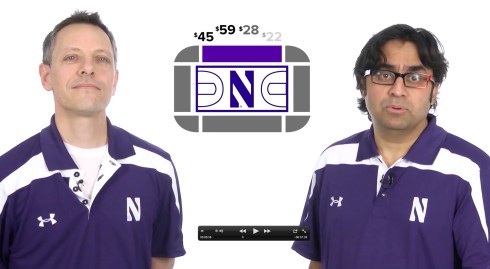
We, Jeff and Sandeep, are working with Northwestern Sports to launch what we think is going to be a revolutionary way to sell tickets to sporting events (and someday theatre, concerts, and restaurants…). Starting today it is in effect for two upcoming Mens’ Basketball games: The February 28 game against Ohio State and the March 7 game against Penn State.

We are using a system which could roughly be described as a uniform price multi-unit Dutch Auction. In simpler terms we are setting an initial price and allowing prices to gradually fall until either the game sells out or we hit our target price. Thus we are implementing a form of dynamic pricing but unlike most systems used by other venues our prices are determined by demand not by some mysterious algorithm.

But here is the key feature of our pricing system:  as prices fall, you are guaranteed to pay the lowest price you could have got by delaying your purchase. That is, regardless of what price is listed at the time you reserve your seat, the price you will actually pay is the final price.

What that means is that fans have no reason to wait around and watch the price changes and try to time their purchases to get the best possible deal. We take care of that for you.

It also removes another common gripe with dynamic pricing, different people paying different prices for the same seats. Our system is fair: since everyone pays the lowest price, everyone will be paying the same price.

We explain all of the details in the video below. If you have any questions please ask them in the comments and we will try to answer them.

purple pricing

The system is live right now at NUSports.com.  Support common-sense pricing by heading over there now and getting your tickets for either NU v Ohio State on Feb 28 or NU v Penn State on March 7.

And Go ‘Cats!

Update:  Price alerts are now available. You may send email to wildcatmarketing@northwestern.edu to be notified when prices fall. (And if you just want to know when prices reach some target p, put that in your message.)


The paper doesn’t seem to exist yet but here are slides from talk by Raj Chetty, Emmanual Saez and Lazlo Sander.  They randomly altered the incentives for referees at the Journal of Public Economics to see what it takes to get referees to give timely reports.  Some referees were offered cash.  Some were simply given shorter deadlines with no carrots.  Still others were threatened with public shame if they did not submit reports on time.  Not surprisingly the threat of humiliation caused many referees to refuse the contract altogether.  Perhaps less surprisingly, cash didn’t do much better than simply shortening the deadline.  The latter did help a bit.

Kofia krumple:  Tobias Schmidt

Ever seen this?  There’s a panel of experts and every couple weeks they are presented with a policy statement like “The debt ceiling creates too much uncertainty” and each one has to say individually whether they agree or disagree.

Randomize whether you put the statement in the affirmative or the negative:  “The debt ceiling creates too much uncertainty” versus “The debt ceiling doesn’t create too much uncertainty”, and see how that affects how that affects which experts agree or disagree.

This is sublime writing.  It will make your week, go and read it.  Thanks to The Browser for the pointer.

Another good one from Scott Ogawa.  It’s the Creampuff Dilemma.  A college football coach has to set its pre-season non-conference schedule, thinking ahead to the end-of-season polling that decides Bowl Bids.  A schedule stocked with creampuffs means lots of easy wins.  But holding fixed the number of wins, a tough schedule will bolster your ranking.

Here’s Scott’s model.  Each coach picks a number p between 0 and 1.  He is successful (s=1) with probability p and unsuccessful (s=0) with probability 1-p.  These probabilities are independent across players.  (Think of these as the top teams in separate conferences.  They will not be playing against each other.)

Highest s-p wins.

Interesting article about the Cameron government’s use of Thaler tricks to improve government servies and save money:

Take the job centre in Loughton, where he describes – step by step – the minutiae of how his team has encouraged advisers to be forward-looking, specific and to give their clients a sense of progress; all of which, studies have shown, have a big impact on people reaching their goals, he says.

“So instead of jobseekers having to show they’ve looked for at least three jobs in the last two weeks, advisers will now say, ‘OK, let’s talk about what you are going to do in the next two weeks’. They will ask what their client needs to work on. ‘So, you said you needed to work on your CV. So when will you do that. OK, Wednesday morning after breakfast.’ The client is then encouraged to write it down in a little booklet they get. And all the things you need to do before you get your job have been compressed on to one side of paper and designed in such a way that when you go through it with the adviser, you’ve done a third of it straight away. That in itself gives you a strong, immediate sense of progress.”

The results speak for themselves. On the top floor of the job centre where it was trialled for three months, about a fifth more jobseekers were off their books in 13 weeks compared with the floor below where processes remained unchanged.

I still need a nudge to buy the book though.


Lee Childs gets asked that question a lot.

But it’s a bad question. Its very form misleads writers and pushes them onto an unhelpful and overcomplicated track.

Because “How do you create suspense?” has the same interrogatory shape as “How do you bake a cake?” And we all know — in theory or practice — how to bake a cake. We need ingredients, and we infer that the better quality those ingredients are, the better quality the cake will be. We know that we have to mix and stir those ingredients, and we’re led to believe that the more thoroughly and conscientiously we combine them, the better the cake will taste. We know we have to cook the cake in an oven, and we figure that the more exact the temperature and timing, the better the cake will look.

So writers are taught to focus on ingredients and their combination. They’re told they should create attractive, sympathetic characters, so that readers will care about them deeply, and then to plunge those characters into situations of continuing peril, the descent into which is the mixing and stirring, and the duration and horrors of which are the timing and temperature.

But it’s really much simpler than that. “How do you bake a cake?” has the wrong structure. It’s too indirect. The right structure and the right question is: “How do you make your family hungry?”

And the answer is: You make them wait four hours for dinner.

As novelists, we should ask or imply a question at the beginning of the story, and then we should delay the answer. (Which is what I did here, and you’re still reading, right?)

It’s a great article but I agree with Emir Kamenica (deerstalker doff) who says that there’s one thing in there the author gets completely wrong.

The clocks in Grand Central are off by 1 minute:

But Grand Central, for years now, has relied on a system meant to mitigate, if not prevent, all the crazy. It is this: The times displayed on Grand Central’s departure boards are wrong — by a full minute. This is permanent. It is also purposeful.

The idea is that passengers rushing to catch trains they’re about to miss can actually be dangerous — to themselves, and to each other. So conductors will pull out of the station exactly one minute after their trains’ posted departure times. That minute of extra time won’t be enough to disconcert passengers too much when they compare it to their own watches or smartphones … but it is enough, the thinking goes, to buy late-running train-catchers just that liiiiiitle bit of extra time that will make them calm down a bit. Fast clocks make for slower passengers. “Instead of yelling for customers to hurry up,” the Epoch Times notes, “the conductors instead tell everyone to slow down.”

Not everyone is going to equilibrate, just the regulars.  But that’s exactly what you want.  If you set the clock right then everyone is rushing to the train just when its departing.  If you set the clock 1 minute off and everyone equilibrates then still everyone rushes to the train when its departing.

The system works because some of the people adjust to the clock and others don’t.  So the rush is spread over two minutes rather than one.

It’s the opposite of deduction. We didn’t sit down and try to figure something out.

It’s as if the computation happened so deep within our head, like all this time the basic facts were already there and in our subconscious minds they are stirring around until by chance one set of facts come together that happen to imply something new and the reaction creates an explosion big enough to get the attention of our conscious mind.

And at a conscious level we say “aha! I instinctively know something is true. But why?” And here’s where the 99% perspiration comes. We have to go back to find out why it’s true.

Ok sometimes we discover we were wrong. Other times we discover conclusively why we were right.

But almost always we can’t decide conclusively one way it another but we find reasons for what we believe.

And we believe what we believe. Rationally. We felt it instinctively. And that belief, that sensation is a thing. Its a signal. That we had that inspiration serves as information to us. We have faith in our beliefs.

To lack such faith would be to invite the padded cell.

So that’s another piece of evidence to go along with the facts. And it just might, again perfectly rationally, tip the balance.

Cory Doctorow getting tangled up:

I know lots of people who disagree about when and whether it’s OK to reproduce creative works without permission. There are long, thoughtful debates about how long copyright should last; whether publicly funded works should be treated the same as privately created ones; whether scientific and scholarly works should be freely available; what sort of works qualify as “creative”, and, of course, what fair dealing/fair use should and should not allow.

But while I know plenty of proud pirates, I don’t think I’ve ever heard of someone standing up for the good, old fashioned plagiarism.

Interesting idea.  But no:

When this happens, a consensus quickly emerges that the culprit is a bad person, that the attention has been misappropriated. The real artist has been wronged – she didn’t get the upvotes, attention and good feeling she deserved. But so has anyone who was conned into believing the misattribution, and so missed the chance to discover more works by the real artist.

For me, the most interesting thing about plagiarism is that even though it’s legal, companies and people who do it get into real trouble for it.

Even without a law, doing something that is so universally reviled has genuine, lasting consequences. There’s a lesson in there for people looking to find the right balance for internet copyright: a law without public support will be widely flouted, but things that the social consensus rejects out of hand be automatically, widely enforced.

According to this video by Tim Hartford, this includes: Designing wargames for Kissinger et al., helping Kubrick with Dr Strangelove, suggesting the red telephone be installed between USA and Soviet Union and trying but failing to dissuade a bombing campaign in Vietnam. On the intellectual plane (as well as game theory), decades ahead of his time in thinking about behavioral economics (because he was trying to give up smoking), doing the first agent-based model (of discrimination) and thinking about climate change. Near-fatal flaw for Nobel Committee: Not enough math.

Great for teaching. Part on mutually assured destruction vs common interest games could easily be folded into discussion of Nash vs subgame perfect equilibrium and hence credibility.


  1. When you turn a bottle over to pour out its contents it is less messy if you do the tilt thing to make sure there is a space for air to flow back into the bottle. But which way of pouring is faster if you just want to dump it out in the shortest time possible? I think the tilt can never be as fast.
  2. I aspire to hit for the cycle:  publish in all the top 5 economics journals. But it would be a lifetime cycle. Has anyone ever hit for the cycle in a single year?
  3. If you know you’ll get over it eventually shouldn’t you be over it now? And if not should you really get over it later?
  4. The efficient markets hypothesis means that there is no trading strategy that consistently loses money. (Because if there were then the negative of that strategy would consistently make a profit.)  So trade with abandon!
  5. I predict that in the future the distinct meanings of the prepositions “in” and “on” will progressively blur because of mobile phone typos.

Drawing:  Scatterbrained from www.f1me.net (yaaay she’s back.)

That commercial was rejected for the Super Bowl broadcast yesterday. And because of that it will be seen by many many people (even you!). Indeed the value of the publicity from being rejected rivals that of being accepted. You’ll get people actively watching your ad rather than just passively.

This is a problem for the broadcaster because first of all it is failing to capitalize on a valuable asset: the monopoly authority to reject ads. Second the plethora of rejected ads and their publicity dilutes the value of its other asset: the monopoly provider of broadcast airtime. So the Super Bowl broadcast network needs to find a way to capitalize on the publicity they can generate by rejecting ads and also to make rejected advertisers pay for the negative externality on accepted advertisers. How to do it?

Charge an enormous price to submit your ad for consideration. If you are accepted you get the submission fee refunded. If you are rejected, tough luck.

Added: You can also put a check box on the submission form allowing advertisers to secretly specify whether they want to be accepted or rejected.

Some might prefer the publicity/price of rejection over the actual broadcast. Without the checkbox they might not submit out of fear they will be accepted.

Imagine the publicity you can get when a marginal ad (like the one above) is rejected “unfairly.”

Rojak

Here’s a thought I had over a lunch of Mee Goreng and Rojak.  As the cost of transportation declines there is a non-monotonic effect on migration.  Decreasing transportation costs make it cheaper to visit and discover new places.  But for small cost reductions it is still too costly to visit frequently.  So if you find a place you like you must migrate there.

For large declines in transportation costs, it becomes cheap to frequently visit the places that you like and you would otherwise want to migrate to.  So migration declines.

The same non-monotonic effect can be seen as a function of distance.  For any given decline in transportation costs migration to far away destinations increases but migration to nearer destinations declines.

For the vapor mill it means that over time between any two locations you should first see migration increase then decrease.  And the switching point from increase to decrease should come later for locations farther apart.

By the way if you would like to see more pictures of delicious food in Singapore you can follow my photo stream.  But beware it might make you want to migrate.

Mee Goreng

Cheap Talk has turned 4 years old.  In honor of that, I could tell you about how many of you read us, how many of you subscribe to us, which were the greatest among all the great articles we wrote last year, etc. but instead I’ll take this opportunity to do something I have been wanting to do for a while.

A very interesting side benefit of having a blog is seeing the search terms that lead people to us.  Its a fun game trying to figure out which post Google sent them to when they searched for terms like  “students can lie to teachers very easily” but more than that, as the range of topics we have covered gets wider and wider just reading down the list of search terms each day starts to look like pure poetry.

So I decided to compose a poem entirely out of search phrases and as my fourth birthday present to myself I am going to make you read it. It is a testament to the power of the Internet that for each and every line below there was someone who, in a quest for knowledge, typed it into Google and Google dutifully led them to our blog.

For the best effect I recommend reading this poem in your best mental Christopher Walken voice.

Feral Dogs in Tampa

I like bareback sex with hookers
Explaining infinity to children,
The god in heaven
Serving Guinness

Statistically birthdays increase your age
What is there to do?
Remember abstract things
Courtney Conklin Knapp

Low hanging balls
Kink on demand,
Pile driver sex
I am tired of cohabitation

You are nothing
Empty plate with crumbs,
Playing with yourself in public
When will the Devil talk to you?

Novel figure skates,
Who invented sarcasm,
Orthogonally-minded,
Try to arrange a meeting

Fuyuh.

Q: What draws Kareem Abdul-Jabbar back into the blogosphere?

A: Girls!

Watch him, he’s gonna swing left, shoot right.

Last season the show was criticized for being too white. Watching a full season could leave a viewer snow blind. This season that white ghetto was breached by a black character who is introduced as some jungle fever lover, with just enough screen time to have sex and mutter a couple of lines about wanting more of a relationship. A black dildo would have sufficed and cost less.

And why the 2 year lag since his last post? Research!

When it takes itself seriously is when it stumbles. I just wish it would express its seriousness by being funnier. Seinfeld made it a point to ridicule the characters’ shallowness and self-involvement, raising it to a level of social commentary. And it was funny. Two other girl-centric shows that reached these same heights to be voices of a generation were My So-Called Life and Wonderfalls. Both funny, yet also insightful and original. Perhaps that’s why they both only lasted one season before becoming cult hits. Girls, a safer more mousy voice, has already been renewed for a third season.

Honestly, Kareem is my hero. Lets list the things he has done:

1. All-time leading scorer in the NBA.

2. Using a shot, the sky hook, that nobody else has ever used to good effect.

3. Wore those zany frog goggles.

4. Starred in Bruce Lee’s Enter The Dragon as a Kung Fu bad guy.

5. Starred in Airplane as Kareem Abdul Jabbar pretending to be an airline co-pilot.

Classic Tyler:

I say the deadweight loss here is not so large.  Most art exhibitions are not self-financing from the side of the viewers, which suggests that the demand to see the pictures is not higher than the costs of mounting the exhibit.  Arguably you can throw in philanthropic support as another part of “market demand,” but I consider that a separate valuation issue.  Maybe our current artistic institutions are under-providing marketing opportunities for businesses and foundations, but that still won’t get you a major pent-up demand to view the pictures, again not relative to cost.  The very popular pictures, such as the good works by the Impressionists and post-Impressionists, are shown quite frequently, including in traveling exhibitions.

Context matters a great deal in this setting.  Currently most of the Louvre is not being viewed at any point in time, as the crowds tend to cluster in a few very well-known areas.  Many people would want to go see anything they are told they ought to go see.  What is underfunded is some kind of “demand for participation in a public event,” not the viewing of art per se.  If only they could create more hullaballoo around the more obscure Flemish painters.

Almost all museums have large stretches of empty walls.  I would put up many more pictures there, as indeed I do in my own home.  That museums do not do this I find striking and indicative.  Nor do I see viewers and visitors demanding this, if anything the unspoken feeling might be to wish for a bit less on the walls, so that one may have the feeling of having seen everything without exhaustion.

The costs of storing art are high.  Perhaps the Louvre should sell some of its lower-tier works to private collectors.  But the general public just doesn’t want so much more art to see, not if they have to pay for it and maybe even if they don’t.

Nice.

But I can’t help but ask what was the deadweight loss of all of Tyler’s ideas lost to the world pre-blogosphere? Is MR self-financing? How good a measure is the price (free) of the consumers’ surplus it generates now?

I just hope this doesn’t make me a Flemish painter.

Good grammar makes for bad passwords:

[…]there’s an Achilles’ heel in creating phrase-based passwords. It’s the fact that most English speakers will craft phrases that make sense.

Ashwini Rao and Gananand Kini at Carnegie Mellon and Birenda Jha at MIT have developed proof-of-concept password-cracking software that takes advantage of that weakness. It cracks long passwords, and beats existing cracking software, simply by following rules of English grammar.

“Using an analytical model based on parts-of-speech tagging, we show that the decrease in search space due to the presence of grammatical structures can be as high as 50 percent,” the researchers write in their paper.

Bad grammar makes for good passwords:

Instead, get creative. Try poor grammar and spelling, as in “de whippoorsnapper sashay sideway,” or get completely silly, as in “flipper flopper fliddle fladdle.”

It doesn’t matter how correct it is, as long as you can easily remember it.

20130130-150737.jpg

You know what amazes me about Singapore? The coffee is consistently excellent pretty much everywhere I’ve been. And it’s not like there’s a blooming coffee culture in Singapore they apparently just know how to make everything taste good.

Right near the Economics Department is Humble Origins, a little outdoor cafe where the coffee is really special. Among the best on-campus coffee places I have been to anywhere in the world. It’s also located in a spot where students and faculty are headed in various directions between classes so its a great people-watching spot.

(Yesterday I noticed that nobody in Singapore wears sunglasses. If anybody can explain this to me I am very curious. )

They sell muffins (good) and sandwiches (didn’t try) but they no longer sell French toast (??).

Check out the prices on Stub Hub for tickets to the upcoming Big10 basketball game between the Iowa Hawkeyes and the Wisconsin Badgers.  Quite a few of them are significantly below the $24 face value of the tickets.  This can happen because fans who buy season tickets for Badgers basketball are buying for the games against the conference powerhouses.  For the games against cellar dwellers like Iowa they dump their tickets on the secondary market at whatever price they will fetch.

Coping with scalpers who buy tickets through the box office and resell them at inflated prices is one thing.  You could have raised prices yourself but you chose not to.   But what do you do when scalpers are undercutting your box office price?

You should buy the tickets back from the scalpers is what you should do.  The fans who are going to buy from the scalper at the low price might also be willing to buy at box office prices.  If you buy the cheap tickets on StubHub first then the box office is the only option left for them.  And if they do buy from the box office you have made a profit because you bought low and sold high.

But there’s a chance those fans aren’t willing to pay box office prices and in that case you’re just losing money.  So there’s a tradeoff.  It means that you don’t want to buy secondary market tickets at prices just below your box office price but you definitely do want to buy the tickets priced so low that they are worth the risk.  Indeed there is some optimal offer price that you should be prepared to repurchase tickets at.

In fact every venue’s box office should be both a buyer and seller of tickets with an optimally calculated spread between bid and ask prices.

Now you might wonder whether this only further encourages season ticket holders to dump their unwanted tickets. Indeed it does but that’s exactly what you want them to do.  The tickets will be reallocated more efficiently and you will capture the gains from trade.  Moreover, fans are now willing to pay higher prices for season tickets if they know they can easily resell their unwanted tickets.  You can then raise season ticket prices to capture those gains.

concorde

James Surowiecki has a great article about why the Jets are sticking with struggling quarterback Mark Sanchez:

[T]he Jets have invested an enormous amount of energy and money in Sanchez, and, assuming that no one will trade for him, they are contracted to pay him $8.25 million next year, whether he plays or not….

In a purely rational world, Sanchez’s guaranteed salary would be irrelevant to the decision of whether or not to start him (since the Jets have to pay it either way). But in the real world sunk costs are hard to ignore. Hal Arkes, a psychologist at Ohio State University who has spent much of his career studying the subject, explains, “Abandoning a project that you’ve invested a lot in feels like you’ve wasted everything, and waste is something we’re told to avoid.” This means that we often end up sticking with something when we’d be better off cutting our losses—sitting through a bad movie, say, just because we’ve paid for the ticket. In business and government, the effect pushes people to throw good money after bad.

Jeff and I have a paper, Mnemonomics: The Sunk Cost Fallacy As A Memory Kludge, that offers a primitive theory of this “Concorde effect” as a response to limited memory. Mark Sanchez was hired years ago. At that time there was a rationale for why he would be a great QB for the Jets and hence he was paid a high salary. This rationale for his hiring has been lost in the mists of time but his salary is recalled perfectly. His salary encodes the rationale for his hiring – the higher the salary the better must have been the rationale for his hiring.  Even if we have forgotten the details, the rationale must have been good if Sanchez was paid a high salary. Therefore the higher the salary, the greater the chances of retention even when future events creates costs of retention.  This is the Concorde effect. As far as Mark Sanchez goes, mnemonomics does not do too bad a job.

But an obvious alternate theory rests on reputation:

“Taking the original decision-maker out of the picture and letting a fresh pair of eyes look at the pros and cons can help,” Arkes says. He points to a…study of a bank that found that loan officers were reluctant to acknowledge that loans they’d made had gone bad, whereas new executives were far more likely to take the loss and move on. Whoever becomes the Jets’ new general manager will have no personal or reputational investment in Sanchez, which should make it easier for him to be more objective, though he’ll still have to persuade the head coach and the owner.

There’s surely a lot of truth to this theory. But there is a countervailing effect too. Managerial turnover generates limited memory – who knows why the previous CEO made the decisions he did? If he was smart, it would be good to accord his decisions some respect and see them through before trying out new ideas. Perhaps the best CEOs understand this. From our paper:

For example, when John Akers stepped down and Lou Gerstner became C.E.O. of IBM in 1993, he was determined to “carry out a set of policies put in place by none other than the much-maligned Akers.” He was not “rushing to make significant changes in vision” but was “still following through on Akers’ two-year-old restructuring.” He believed that “IBM has yet to test fully many if the changes Akers put in place” and said, “I want to make sure the current system is implemented before we try any alternatives.” We interpret Gerstner’s decision-making as follows: Akers’ old plans were initiated using information known to him at the time. By the time Gerstner arrived, the direct information was lost but was manifested indirectly in the strategic plan he inherited. Hence, this generated a bias to implement the old plan.

photo-2

One reason people over-react to information is that they fail to recognize that the new information is redundant.  If two friends tell you they’ve heard great things about a new restaurant in town it matters whether those are two independent sources of information or really just one. It may be that they both heard it from the same source, a recent restaurant review in the newspaper. When you neglect to account for redundancies in your information you become more confident in your beliefs than is justified.

This kind of problem gets worse and worse when the social network becomes more connected because its ever more likely that your two friends have mutual friends.

And it can explain an anomaly of psychology:  polarization.  Sandeep in his paper with Peter Klibanoff and Eran Hanany give a good example of polarization.

A number of voters are in a television studio before a U.S. Presidential debate. They are asked the likelihood that the Democratic candidate will cut the budget deficit, as he claims. Some think it is likely and others unlikely. The voters are asked the same question again after the debate. They become even more convinced that their initial inclination is correct.

It’s inconsistent with Bayesian information processing for groups who observe the same information to systematically move their beliefs in opposite directions.  But polarization is not just the observation that the beliefs move in opposite directions.  It’s that the information accentuates the original disagreement rather than reducing it.  The  groups move in the same opposite directions that caused their disagreement originally.

Here’s a simple explanation for it that as far as I know is a new one: the voters fail to recognize that the debate is not generating any new information relative to what they already knew.

Prior to the debate the voters had seen the candidate speaking and heard his view on the issue.  Even if these voters had no bias ex ante, their differential reaction to this pre-debate information separates the voters into two groups according to whether they believe the candidate will cut the deficit or not.

Now when they see the debate they are seeing the same redundant information again.  If they recognized that the information was redundant they would not move at all.  But if don’t then they are all going to react to the debate in the same way they reacted to the original pre-debate information. Each will become more confident in his beliefs.  As a result they will polarize even further.

Note that an implication of this theory is that whenever a common piece of information causes two people to revise their beliefs in opposite directions it must be to increase polarization, not reduce it.

Free as in liberated.  Here’s the opening paragraph:

I wrote this paper with the recognition that it is unlikely to be accepted for publication. There is something liberating about writing a paper without trying to please referees and without having to take into consideration the various protocols and conventions imposed on researchers in experimental economics (see Rubinstein (2001)). It gives one a feeling of real academic freedom!

The paper reports on long-running experiments relating response times to mistakes in decision-making.

I read this interesting post which talks about spectator sports and the gap between the excitement of watching in person versus on TV. The author ranks hockey as the sport with the largest gap: seeing hockey in person is way more fun than watching on TV. I think I agree with that and generally with the ranking given. (I would add one thing about American Football. With the advent of widescreen TVs the experience has improved a lot. But its still very dumb how they frame the shot to put the line of scrimmage down the center of the screen. The quarterback should be near the left edge of the screen at all times so that we can see who he is looking at downfield.)

But there was one off-hand comment that I think the author got completely wrong.

I think NBA basketball players might be the best at what they do in all of sports.

The thought experiment is to compare players across sports. I.e., are basketball players better at basketball than, say, snooker players are at playing snooker?

Unless you count being tall as one of the things NBA basketball players “do” I would say on the contrary that NBA basketball players must be among the worst at what they do in all of professional sports. The reason is simple: because height is so important in basketball, the NBA is drawing the top talent among a highly selected sub-population: those that are exceptionally tall. The skill distribution of the overall population, focusing on those skills that make a great basketball player like coordination, quickness, agility, accuracy; certainly dominate the distribution of the subpopulation from which the NBA draws its players.

Imagine that the basket was lowered by 1 foot and a height cap enforced so that in order to be eligible to play you must be 1 foot shorter than the current tallest NBA player (or you could scale proportionally if you prefer.) The best players in that league would be better at what they do than current NBA players. (Of course you need to allow equilibrium to be reached where young players currently too short to be NBA stars now make/receive the investments and training that the current elite do.)

Now you might ask why we should discard height as one of the bundle of attributes that we should say a player is “best” at. Aren’t speed, accuracy, etc. all talents that some people are born with and others are not, just like height? Definitely so, but ask yourself this question. If a guy stops playing basketball for a few years and then takes it up again, which of these attributes is he going to fall the farthest behind the cohort who continued to train uninterrupted? He’ll probably be a step slower and have lost a few points in shooting percentage. He won’t be any shorter than he would have been.

When you look at a competition where one of the inputs of the production function is an exogenously distributed characteristic, players with a high endowment on that dimension have a head start. This has two effects on the distribution of the (partially) acquired characteristics that enter the production function. First, there is the pure statistical effect I alluded to above. If success requires some minimum height then the pool of competitors excludes a large component of the population.

There is a second effect on endogenous acquisition of skills. Competition is less intense and they have less incentive to acquire skills in order to be competitive. So even current NBA players are less talented than they would be if competition was less exclusive.

So what are the sports whose athletes are the best at what they do? My ranking

  1. Table Tennis
  2. Soccer
  3. Tennis
  4. Golf
  5. Chess
  1. Frontiers of performance enhancing drugs:  poker.
  2. Tweeting birds.
  3. “You know what surprised me?  No one drew a single vagina.”
  4. Lady Edith with googly eyes.
  5. Good story but the author’s credibility is significantly reduced when he imagines that Snoop would ever have seeds in his stash.
  6. Washing Watson’s mouth out with soap.

Its here.  I like the purpose, as given on the masthead:

This blog is to help me remember stories and papers and provide ideas for students taking the Behavioral and Experimental class. It will focus on behavioral and experimental economics, with the occasional gender story.

Most of the posts are indeed links to papers with quotes from abstracts, but I enjoyed this one departure from normal programming

One of my colleagues talked about a (not very inspired) way to do research, which he adequately describes as keyword research (and which he denounces whole heartily). The idea is the following, which seems to work very well for theory papers: Take a bunch of keywords, select a few, check if a paper has been written  if so, try again…

In that spirit, I came across the following blogpost: Sociology title Generator

Bearskin bow:  Mobius.