What is there to do outside Chicago with bored young boys?  I imagine easy day-trips to Cape Cod or Cape Ann for parents in Boston.  And I can’t even speculate about the options available in San Francisco or Palo Alto….I turn green with envy just thinking about it.

Unsuccessful hikes in rural Wisconsin, a horrible weekend in a seven golf-course resort outside Galena have soured us on the idea that any escape is possible.  Over the last year, on the advice of seasoned veterans of the Midwest, we’ve decided to give the day-trip one more whirl.  Saugatuk, Michigan, was a big success.  Good food, good beer, cheap house rentals, private sandy beaches and pretty countryside.  Just what the doctor ordered.

Closer to us and in some ways more historically interesting – Lake Geneva in Wisconsin.  I thought its description as the Newport of the Midwest was a stretch till I saw mansion upon mansion lining the shore of Lake Geneva.  The empire than Wrigley’s chewing gum built is as impressive as any feudal monarch’s.  And it has a chewier, softer and more benevolent foundation than the war and pillage that lead to a typical King’s wealth.   The boat ride that allows the great unwashed a fleeting glance into the capitalist palaces does not hold a child’s attention for long.

For that, we had the East Troy Railroad Museum.  The first carriage we saw had “Evanston Express” displayed on it.   An old El car that ran between Evanston and Wilmette.  The museum has a good cappuccino and smoothie stand and there is an ice cream parlor next door.  The trip we took in an open carriage was exhilarating.  We spotted old train stops that had been left to crumble.  People waved from the houses and cars we passed.   Our joy was infectious.  At the start of the ride, on one side of the line are McMansions and on the other trailer parks.  This is left behind soon for countryside and then finally a farmer’s market.  But it’s the open carriage itself that’s most fun.  With old lights and seats that flip around for the trip back.

The train was driven by an enthusiastic old volunteer and there was a young volunteer guide.  Public good provision that left us all charmed.  Good to know that the torch will be passed from the Senior Members to the Junior Members and the East Troy line will live on.

Here is an article (via MindHacks) profiling the types of people who are attracted to conspiracy theories.

It is the domain of psychology to study the specific conspiracy theories that appear and the people who advocate them, but to a game theorist the prevalence of conspiracy theories is not surprising.  They fill a credibility gap.  Like nature, the truth abhors a vacuum.  It cannot be an equilibrium that only the truth is told and retold.  Because then we would learn to believe everything we hear.  That would be exploited by people trying to take advantage.

Conspiracy theories are just one example of noise that must be present in equilibrium to ensure that we don’t believe everything we hear.  And arguably conspiracy theories about events that have already happened or are beyond our control are the cost-minimizing way of moderating credibility.  Nobody really gets harmed.

I’m sipping my morning coffee and glancing at the Sunday New York Times when my 8-year old son asks “What is stillborn?”.  I choke on my coffee a bit and open my eyes wider to see a photo of several women in Tanzania burying a tiny stillborn baby on the front page of the paper. After a quick answer that doesn’t invite much discussion I flip the paper over so that the distressing photo is no longer in view.  Only to see another photo — this one of a college student feeding a lamb with a bottle in upstate New York  — that makes the first photo even more depressing.  Apparently in the U.S. we have a surfeit of college educated young people to care for newborn lambs, while in Tanzania (and in distressingly many other places throughout the developing world) mothers and their babies die because there are too few people with the requisite skills to care for them.

Psyblog has a rundown of 18 failures of the brain’s system of attention.  My favorite:

9. Ironic processes of control

In fact sometimes attention is a real bear. What about when you really want to get something right, like putt the ball, hit a beautiful serve right in the corner or reverse the car into a narrow space? Naturally you concentrate even harder than normal, really focus. Unfortunately that just seems to make things worse: you miss the putt by a mile, frame the ball 50ft in the air and ding the car. What gives? These are what Wegner et al. (1998) call ‘ironic processes of control’. Sometimes too much attention is just as detrimental as too little.

I normaly strive to pay as little attention as possible.

Not a weird animal from a dream but a vegetarian restaurant in Chicago.  It’s actually a green tomato, a favorite of farmers’ markets.  As the name suggests, the food is meant to be seasonal just like the tomato.  Thankfully, the weather has finally improved over the last few weeks and some semi-decent produce is actually available in the Midwest.  When we’ve been before, there’s been the odd miss but not yesterday – all the eleven plates we shared were excellent.  I’m going to attempt to make the feta marinated in chili sauce – why didn’t I think of that before?  The American popover is somehow related to the Yorkshire pudding – hadn’t realized that either.  And I’m going to grill sliced fennel!  I won’t be able to reproduce the presentations but hopefully the taste will come through.

If you’re ever coming through Chicago, you should try this restaurant, even if you’re not a vegetarian.  They serve really original, tasty food.

I don’t think this is the right way to make it.

Linguine and clams is one of those dishes where insistence on simplicity is rewarded.  The basic mechanics of the dish are extremely straightforward.  There are just a few little secrets that elevate a good dish to an excellent one.

Obviously you want fresh clams.  You don’t want fresh pasta.  Dried pasta works much better here, more on that later.  You want garlic, parsley is a nice touch, olive oil, butter and white wine.  That’s it. (Bacon?? Sorry Sandeep, no.) Maybe red chile flakes.

Start boiling the pasta.  Set the timer for 1 minute short of al dente.  Heat a flat pan which can be covered.  When hot add a touch of olive oil and chopped garlic (If you like the red chile flakes here is where you add it.)  When the garlic is soft but nowhere near brown place the clams in the pan and cover.  After about a minute throw splash in some white wine and cover again.  After another minute you should have open clams and a lot of clam juice in the pan.  Remove the clams to a bowl and reduce the heat on the pan.

Look in the pan.  This is your sauce.  You will soon be placing pasta in this sauce and you want the pasta to be covered but not swimming, so you are adjusting the heat so that it reduces to that target when your timer goes off.  Just before it does, swirl in butter to enrich the sauce.

When the timer goes off you have pasta which is not quite cooked.  That is what you want.  Use tongs and directly lift the pasta out of the boiling water and into the sauce.  There is a reason for this.  The pasta water has starch in it from the pasta and some of this water will come along with the pasta into the sauce.  The starch tastes good and it will help give body to the sauce.  Also, the water will increase the volume of the sauce and you want this because you are going to cook the pasta for its remaining minute in the sauce.  Pasta is a sponge at this point of the cooking process (think of what your pasta looks like when you have leftovers:  swollen and soft.  It has soaked up everything around it.)  The pasta will soak up the juices in its last minute of cooking.  Fresh pasta will not do this.

When this is done, throw in your parsley, toss and plate the pasta.  Arrange the clams on top and serve.  Provide bread and fork.  Beer is best.

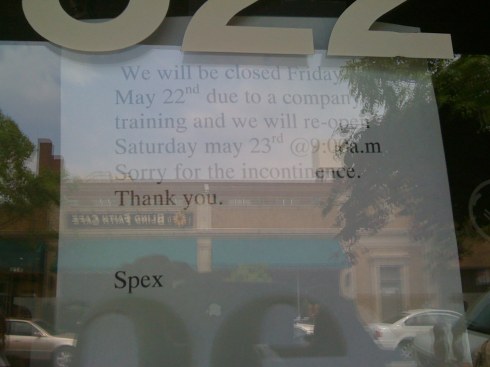
IMG_0059 Seen in Evanston on Dempter St.  Intentional?  Hopefully the training is about writing.

The credit card companies are claiming they will have to charge annual fees and cut reward programs for customers who always pay on time because they are being forced to stop ripping off confused customers who incur late fees and sudden doubling of their interest rates.  Ed Yingling, President of the American bankers’ association warns:

“It will be a different business,” said Edward L. Yingling, the chief executive of the American Bankers Association, which has been lobbying Congress for more lenient legislation on behalf of the nation’s biggest banks. “Those that manage their credit well will in some degree subsidize those that have credit problems.”

The idea seems to be that since the price is being cut for the people with credit problem, it will have to be increased for those with good credit.

I claim this is does not make any sense and is not going to happen.  There are two reasons for this.

To understand the first reason, we must consider why credit card companies charge different prices to different consumers in the first place.  This is a form of price discrimination.  To people with lots of outside options, you have to give a good deal – this is the rationale for reward programs for good risks.  For people with few options, you can afford to raise the price – this is the rationale for high interest rates  for the high risk consumers.  To implement price discrimination you have to be able to identify people in the two groups.  The credit card companies have access to both internal and shared data to do this.  You make profits in both markets,  with higher profits presumably in the high risk market if you manage the risk correctly.  If you cannot price-discriminate because you do not have the information or are not allowed to do so by law, you set a uniform price, hiking up the price to the low risk and lowering it for the high risk.  This is the idea Yingling is suggesting.  For a monopolist, uniform pricing makes less profit that price discrimination as it is less targeted to cnsumers’ willingness to pay.

The new legislation is limiting the firms’ ability to impose terms on the high risk consumers.  So, they will make less money in that segment.  But the key point is – legislation is not outlawing their ability to price  discriminate. There is no incentive for them to do uniform pricing as they still have the information, ability and incentive to price discriminate.  As long as the different segments have different patterns of willingness to pay for credit card services, the rationale for price discrimination is present.

Moreover, there is second reason why fees will not go up – competition.  The low risk consumers are profitable as they generate merchant fees because they use their cards frequently.  Suppose all the credit card companies cut rewards and/or impose annual fees.  Then, one company or another has an incentive to cut the fee or increase rewards to steal customers from another.  In fact, this is the most fundamental force keeping fees down and rewards high – the low risk, high volume consumers of credit card services generate revenue.  To entice them to get your card, you have to give them rewards up front.  The legislation does not change this competitive logic.

So, look forward to more points that help keep up the constant upgrading of your iPod.

(Hat tips: Kellogg MBA students – Aneesha Banerjee, Ondrej  Dusek, and Steven Jackson)

Here is a nice article (via The Browser) theorizing about why Wikipedia works.  The apparent puzzles are why people contribute to this public good and why it withstands vandalism and subversion.  The first puzzle is no longer a puzzle at all, even us economists now accept that people freely give away their information and effort all the time.  But no doubt others have just as much motivation, or more, to vandalize and distort, hence the second puzzle.

The article focuses mostly on the incentives to police which is the main reason articles on say, Barack Obama, probably remain neutral and factual most of the time.  But Wikipedia would not be important if it were just about focal topics that we already have dozens of other sources on.  The real reason Wikipedia is as valuable a resource as it is stems from the 99.999% of articles that are on obscure topics that only Wikipedia covers.

For example, Barbicide.

These articles don’t get enough eyeballs for policing to work, so how does Wikipedia solve puzzle number two in these cases?  The answer is simple:  a vandal has to know that, say, John I of Trebizond exists to know that there is a page about him on Wikipedia that is waiting there to be vandalized.  (I just vandalized it, can you see where?)

There are only two classes of people who know that there exists a John I of Trebizond (up until this moment that is.)  Namely, people who know something useful about him and people who want to know something useful about him.  So puzzle number 2 is elegantly sidestepped by epistemological constraints.

Modern classical music, especially, is really hard.  What the hell are you listening too, this endlessly winding dissonant stuff without much melody?

The only way to get this kind of music in your ear is to listen to it over and over, which is what I have been doing with the first movement, “Prelude,” of the Maw Violin Concerto the last couple of days.  It doesn’t matter whether I want to hear it again or not:  I just play it again when it’s done.

When I cycle a piece of thorny orchestral music this way the fog slowly lifts, the picture clears, figure and ground separate.  Past pieces I’ve placed on endless loop have included Ligeti’s Melodien, Birtwistle’s The Triumph of Time, Lieberson’s Piano Concerto, and Schuller’s Of Reminiscences and Reflections. Initially they were all daunting listens but now they are old friends.  In every case I have learned to understand the composer’s acerbic language much better, so that new experiences with their other pieces aren’t as hard.

That’s Ethan Iverson who, in addition to being the piano player for the frontier jazz trio The Bad Plus, writes an outstanding blog, Do The MathThis post clarified a lot for me.  Iverson is a broad, open-minded, and gifted musician and even he approaches contemporary classical music the same way my PhD students approach the Revenue Equivalence Thereom.  I have tried exactly what he describes here for Ligeti, etc.  and I have yet to turn that corner.

OK so I am apparently obsessed with this theme, but I guess that is what makes me a blogger.

Research, like a lot of collaborative activities, encourages specialization.  Successful co-authorships often combine people with differentiated skills.  So successful co-authors are complementary which means that your co-author’s other co-authors are substitutes for you.   This should imply that you are less likely, other things equal, to have a successful co-authorship with your co-author’s co-authors than with, say a randomly selected collaborator.

If we tried to look for evidence of this in data the difficulty would be in holding other things equal.  You are more likely to talk to and have other things in common with your co-author’s co-author than with a random researcher so this would have to be controlled for.

These issues make me think there is some really interesting research waiting to be done taking data from social networks, like patterns of co-authorship or frienship relations on Facebook and trying to simultaneously identify (in the formal sense of that word) “types”  (e.g. technician vs idea-man)  and preferences (e.g. whether these types are complements or substitutes.)  The really interesting part of this must be the econometric theory saying what are the limits of what can and cannot be identified.

In chess, one way a game can be declared a draw is if black, say, has no legal move.  This is called stalemate.  Typically stalemate occurs because white has a material advantage but fails to checkmate and instead leaves the black king with no space to move that does not walk into check.  It is illegal to place your own king in check.

The reason stalemate is an artificial rule is that check is an artificial rule.  Clearly the object in chess is to conquer the opponent’s king. One can imagine that check evolved as a way to prevent dishonorable defeat when you overlook a threat against your king and allow it to be captured even though it could have escaped.  To prevent this, if your king is in check the rules of chess require that you escape from check on the next move and it is illegal to move into check.  This rule means that the only way to win is to checkmate:  place your opponent in a position where his king is threatened and cannot escape the threat.  The game ends there because on the very next move the king will certainly be captured.

This gives rise to stalemate:  it is only because of check that a player can have no legal move.  If we dispensed with checkmate, replacing it with the more transparent and natural objective of capturing the king, and eliminating the requirement that you cannot end your turn in check, then a player would always have a legal move.  (it is easy to prove this.)  Thus, no stalemate.

You can learn a lot about who loves you by walking around with food on your face.

Should you tell someone when they have food on their face?  You will embarrass them but you will spare them embarrassment later.  The embarrassment comes from common knowledge. He knows that you know, etc. that he had food on his face.  You would escape this if you could alert him about the food without him knowing it was you.

You could wait and expect that the food will fall.  But you run the risk that it won’t and he’ll discover the food and realize that you let him walk around with food on his face.  And once you wait for a bit you are committed.  You can’t very well tell him after the meal is over.  “You mean you sat there talking to me the whole time with sauce on my chin?”

And what happens when you are in a group and one guy has food on his face?  Whose going to tell?  Whoever is the first to talk proves that everyone else was willing to ignore it.

Bottom line:  if you are dining with me and I have food on my face, send me a text message.

Sandeep has previously blogged about the problems with torture as a mechanism for extracting information from the unwilling. As with any incentive mechanism, torture works by promising a reward in exchange for information.  In the case of torture, the “reward” is no more torture.

Sandeep focused on one problem with this.  This works only if the torturer will actually carry out his promise to stop torturing once the information is given.  But once the information is given the torturer now knows he has a real terrorist and in fact a terrorist with valuable information.  This will lead to more torture (for more information) not less.  Unless the torturers have some way to tie their hands and stop torturing after a few tidbits of information, the captive soon figures out that there is no incentive to talk and stops talking. A well-trained terrorist knows this from the beginning and never talks.

Let me point out yet another problem with torture.  This one cannot be solved even by enabling the torturers to commit to an incentive scheme.

The very nature of an incentive scheme is that it treats different people differently.    To be effective, torture has to treat the innocent different than the guilty.  But not in the way you might guess.

Before we commence torturing we don’t know in advance what information the captive has, and indeed we don’t know for sure that he is a terrorist at all, even though we might be pretty confident.    A captive who really has no information at all is not going to talk.   Or if he does he is not going to give any valuable information, no matter how much he would like to squeal and stop the torture.

And of course the true terrorist knows that we don’t know for sure that he is a terrorist. He would like to pretend that he has no information in hopes that we will conclude he is innocnent and stop torturing him.  Therefore the torture must ensure that the captive, if he is indeed an informed terrorist, won’t get away with this.  With torture as the incentive mechanism, the only way to do this is to commit to torture for an unbearably long time if the captive doesn’t talk.

And this leads us to the problem.  In the face of this, the truly informed terrorist begins talking right away in order to avoid the torture.  The truly innocent captive cannot do that no matter how much he would like to.  And so torture, if it is effective at all, necessarily inflicts unbearable suffering on the innocent and very little suffering on the actual terrorists.

My old post about A-Rod  colluding with the opposition to massage his stats was drawn from a New York Times article.  It suggested that in blow-out games when a few extra runs here or there would not affect the outcome, A Rod  would collude with friends on the other side to raise improve their stats and his.

Now a follow-on article in the NYT says a data analysis suggests this did not occur.  I personally think A Rod is getting a bad rap and did not cheat.  But the statistical analysis does not make a convincing proof of this hunch.

The data say that in low stakes situations A Rod had many fewer runs than in high stakes situations.  This leads the NYT to conclude that either there was “no tipping going on or it was pathetically ineffective.”

This when a little game theory is useful.  When the game is close, you have the most incentive to exert effort to win.  When it is not close, even the likely winner slacks off as there is no reason to work hard.  This is the game theory analysis of R and D races for example (though the details are quite intricate and can sometimes be surprising).

This logic meant A Rod would naturally, given the dynamics of the game, have played hard when the game is close.  The collusion has a countervailing effect when the game is not close.  But this effect may not be large enogh to counteract the natural incentives of competition.  So the data do not prove anything.  But I still think A Rod did not cheat.

(Another Hat Tip: Pablo Montagnes)

Ridge is one of my favorite wine producers.  They are extremely well-known and have wide distribution so it should be easy to find a bottle of something wherever you live in U.S. (well not Utah obviously).  Single vineyard Zins are their specialty but they are pricey enough that you don’t drink them every day.  The York Creek is around $30, for example.  I had never had it before this last weekend.  It lived up to expectations.  It’s definitely an American wine.  It’s jammy.  I tasted lots of blackberries and cherry.  It’s very thick, chewy and velvety.  It’s aged in oak but I could not taste obvious vanilla.  The oak had mellowed the tannins so it was very smooth.  You got the feeling that by 2012 it will have more complexity.  Now, once you open a bottle, you can’t stop drinking as it’s delicious.  The unfortunate thing is that it has roughly 15% alcohol so you might regret the easy drinking.  I’m going to buy more bottlles, invite some frieds over and commit to drinking less that way.

  1. Next there will be scam-baiter-baiters, etc.
  2. Psychological time travel.  Must have something to do with this.
  3. Jazz and brain chemistry.

Let’s try a little (thought) experiment in verbal short-term memory. First, find a friend. Then, find a reasonably complex sentence about 45 words long …Now call your friend up on the phone, and have a discussion about the topic of the article. In the course of this conversation, slip in a verbatim performance of the selected sentence. Then ask your friend to write an essay on the topic of the discussion. … How likely is it that the selected sentence will find its way, word for word, into your friend’s essay?

In case you haven’t guessed, the question is rhetorical and the article (from LanguageLog, a great blog) is referring to Maureen Dowd’s plagiarism.  It is a fallacy though to focus only on the probability of the scenario you are trying to reject.  What matters is the relative probability of that scenario with the alternative scenario, namely that Maureen Dowd would bother (intentionally) lifting word for word a paragraph which is not particularly insightful or cleverly written from a popular blog at the risk of being called a plagiarizer.

When something happens that has two very unlikely explanations, picking one of those explanations is mostly driven by your priors.

De Waal’s own experiments suggest that capuchin monkeys are sensitive to fairness. If another monkey gets a tasty grape, they will not cooperate with an experimenter who offers a piece of cucumber (Nature, vol 425, p 297). A similar aversion has been spotted in dogs (New Scientist, 13 December 2008, p 12), and even rabbits seem affected by inequality, leading de Waal to believe that an ability to detect and react to injustice is common to all social animals. “Getting taken advantage of by others is a major concern in any cooperative system,” he says.

This article mostly just regurtitates some tired and fragile “evolutionary” explanations for fairness and revenge, but there are a few interesting tidbits, like some experiments with monkeys and this joke:

A genie appears to a man and says: “You can have anything you want. The only catch is that I’ll give your neighbour double.” The man says: “Take out one of my eyes.”

Greg Clark offers an analysis of the impact of the economic crisis on the market for academic economists.  His basic thesis is: (a)  Economics has not made any progress for the last eighty years.   (b) This will reduce demand for economists.  Or perhaps the crisis cuts demand for academic economists directly as endowments decline in value. (c)  Even though supply is constrained by the technical complexity of becoming a professional economist, wages will fall.

Greg uses the intellectual apparatus of demand and supply to make his argument.  This framework has been around for over a hundred years (or more?) but I associate it most with Alfred Marshall and his work in the early part of twentieth century.  I guess this still makes Clark’s argument for him: the canonical framework of economics is part of Econ 1 and over eight years old!

I agree with many of Clark’s comments but have a different analysis – you can never get two economists to agree on anything, another old idea.

(1) Demand:  Demand for academic economists comes from business schools as well as economics departments.  Demand for assistant professors in B schools is driven by teaching demand.  In a medium slump, this demand goes up as more people decide to get an M.B.A. as the job market is tight.  So, this is not so bad.

(2) Supply: The trouble is on the supply side.

(2.1) One of the main drivers of wages is the finance market.  B school finance salaries reflect what incoming grads could get on Wall Street.  As these decline, so do salaries for finance professors as the supply of candidates has gone up.  Finance salaries run at a premium compared to econ salaries.  This is because you can do more “academic” work in economics and you pay for that with a lower salary.  But there is an obvious positive correlation between finance and econ salaries because, if the finance salary premium is high, economists would switch to finance.  To keep them, economics salaries have to go up.  I’m going to stop belaboring this as I’m sure you can all work it out as it is Econ 1!  Suffice it to say supply has gone up.

(2.2) As Clark says, economics is interesting again.  Let’s face it was getting bit boring so more and more people were doing “freakonomics” rather than “economics.”  Or perhaps this reflected the fact that the questions we have not answered are really hard so we were tackling the ones we can answer.  I don’t know.  The financial crisis makes it clear that we have to answer them.  Whatever went wrong reflected too large a faith in the supposed optimal incentives given by the free market rather than an understanding of the perverse incentives facing lenders, borrowers and A.I.G.  To unravel these complications, we will use the tools we have developed in microeconomics since the 1970s: moral hazard, adverse selection and mechanism design.  It should attract lots of bring young things to replace jaded old-timers like me. The net implication: supply will go up.

So, I am led to the same conclusion as Greg Clark – salaries are going to be stagnant in academic economics.  Because supply will go up not because demand will go down.  But I’m more optimistic about scientific contributions – I think incentive theory will be useful.  I am more optimistic for the science as a whole as more talented people are going to come in, driven by the desire to explain all the things we do not understand.

Following up on my previous post about the infield fly rule, lets get to the bottom of the zero-sum game that ensues when there is a fly ball in the infield.  Let’s suppose the bases are loaded and there are no outs.

The infield fly rule is an artificial rule under which the batter is immediately called out and the runners are free to remain standing on base.  Wikipedia recounts the usual rationale:

This rule was introduced in 1895 in response to infielders’ intentionally dropping pop-ups to get multiple outs by forcing out the runners on base, who were pinned near their bases while the ball was in the air.[2] For example, with runners on first and second and fewer than two outs, a pop fly is hit to the third baseman. He intentionally allows the fly ball to drop, picks it up, touches third and then throws to second for a double play. Without the Infield Fly Rule it would be an easy double play because both runners will tag up on their bases expecting the ball to be caught.

I would argue (as do commenters to my previous post) that there is no reason to prevent a double play from this situation, especially because it involves some strategic behavior by the defense and this is to be admired, not forbidden.  But aren’t we jumping to conclusions here?  Will the runners really just stand there and allow themselves to be doubled-up?

First of all, if there is going to be a double play, the offense can at least ensure that the runners remaining on base will be in scoring position.  For example, suppose the runner on second runs to third base and stands there.  And the batter runs to first base and stands there.  The other runners stay put.  Never mind that there will now be two runners standing on first and third base, this is not illegal per se.  And in any case, the runner can stop just short of the base poised to step on it safely when the need arises.  What can the defense do now?

If the ball is allowed to drop, there will be a force out of the runners on third and first.  A double play.  But the end result is runners on first and third.  Better than runners on first and second which would result if the three runners stayed on their bases.  And careful play is required by the defense.  If the force is taken first at second base, then this nullifies the force on the remaining runners and the runner on third would be put out only by a run-down, a complicated play that demands execution by the defense.  The runner could easily score in this situation.

If on the other hand the ball is caught, then the runer on second will be put out as he is off base.  Another double play but again leaving runners on first and third.

So the offense can certainly do better than a simplistic analysis suggests.  They could allow the double play but ensure that no matter what the defense does, they will be left with runners on first and third.

But, in fact they can do even better than that.  The optimal strategy turns out to be even simpler and avoids the double play altogether.  It is based on rule 7.08H:  (I am referring to the official rules of Major League Baseball here, especially section 7)

A runner is out when … He passes a preceding runner before such runner is out

According to this rule, the batter can run to first base and stand there.  All other base runners stay where they are.  Now, a naive analysis suggestst that the fielder can get a triple play by allowing the ball to fall to the ground and using the force play at home, third, and second.  But the offense needn’t allow this.  The moment the ball touches the ground, the batter can advance toward second base, passing the runner who is standing on first and causing himself, the batter, to be called out.  One out, and the only out because according to rule 7.08C, this nullifies the force so that all the baserunners can stay where they are, leaving the bases loaded:

if a following runner is put out on a force play, the force is removed and the runner must be tagged to be put out.

Given this option, the fielder can do no better than catch the ball, leaving the bases loaded.  No double play.  The same outcome as if the infield fly were called. So the designers of the infield fly rule were game theorists.  They figured out what would happen with best play and they just cut to the chase.

But just because best play leads to this outcome doesnt mean that we shouldn’t require the players to play it out.  When one team is heavily favored, we don’t call the game for the favorite just because we know that with best play they will win.  To quote a famous baseball adage “that’s why they play the game.” The same should be true for infield flies.  There’s a lot that both sides could get wrong.

As a final note, let me call your attention to the following, perhaps overlooked but clearly very important rule, rule 7.08I.  I don’t think that the strategy I propose runs afoul of this rule, but before using the strategy a team should make certain of this.  We cannot make a travesty of our national pastime:

7.08(i)  A runner is out  when … After he has acquired legal possession of a base, he runs the bases in reverse order  for the purpose of confusing the defense or making a travesty of the game. The  umpire shall immediately call “Time” and declare the runner out;

Q: What’s the difference between a Fiat and a Jehovah’s Witness?

A: You can’t close the door on a Fiat.

Hat tip: Car Talk

The first time I ever flew to Canada, I was flying to Toronto and I forgot to bring my passport.  This was pre 9/11 and so the immigration authorities still had a sense of humor.  Upon landing they brought me to the basement to interrogate me.  Only one question was required and it was ingenious.  “What is the infield fly rule?”  Only an American would know the answer to this question.  (The immigration authorities knew the right trade-off between Type I and Type II errors.  A quick survey of my dinner companions tonight revealed that indeed only Americans knew the answer, but not all Americans.)

Suppose there is a runner on first base and the ball is hit in the air where it is catchable by an infielder.  As the ball hangs in the air, it sets off a tiny zero sum game-within-the-game to be played by the players on the ground watching it fall to Earth.  For if the ball is caught by the infielder, then the runner must be standing on first base, else he will be out after a quick throw to the first baseman, a double play.  But, if he does stay standing on first base then the infielder can allow the ball to fall to the ground forcing the runner to advance.  Then a quick throw to second base will get the runner out.  And again a double play unless the batter has already made it to first.

Apparently this goes against some moral code deeply ingrained in American culture.  Is it that the optimal strategy is random?  Is it that we don’t want our heroes stranded between bases waiting to see which way they will meet their end?  Is it that we don’t want to see the defense gaining advantage by purposefully dropping the ball?  Whatever it is, we have ruled it out.

The infield fly rule states that in the above situation, the batter is immediately called out and the runner must stay on first base.  No uncertainty, no inscrutability, no randomization. No intrigue.  No fun.

But we are game theorists and we can still contemplate what would happen without the infield fly rule.  Its actually not so bad for the runner.  The runner should stand on first base.  Usually by the time the ball descends, the batter will have made it to first base and a double play will be avoided as the infielder can either catch the ball and get the batter out or drop the ball and get the runner out.  But not both.

In fact, if the ball is hit very high in the infield (usually the case since an infield fly almost always occurs because of a pop-up) the batter should advance to second base and even to third if he can.  That is, run past the base runner, a strategy that otherwise would never be advisable. This forces the infielder to catch the ball as otherwise the best he can do is force out the runner on first, leaving a runner in scoring position.

So in these cases an infield fly does not really introduce any subtle strategy to the game.  When the team at-bat plays an optimal strategy, the outcome entails no randomness.  The final result is that there will be one out and a runner will remain on first base.  And the fielder can always catch the ball to get the out.

However, this is not the only situation where the infield fly rule is in effect.  It also applies when there are runners on first and second and also bases loaded.  In those situations, if we did away with the infield fly rule the strategy would be a bit more subtle.  And interesting!  Lets try to figure out what would happen.  Post your analysis in the comments.

(conversation with Roberto, Massimo, Itai, Alesandro, Wojciech, Alp, Stefan and Takashi acknowledged)

Next time:  eliminating stalemate (another mysterious artificial rule) in Chess.

Update: Ah, a reader points out that the infield fly rule is waived when there is only a runner on first.  Good thing my friendly immigration officer didnt know that!  (even if he did, he would know that only an American would get the question wrong in that particular way).

I went to Boston a few weeks ago and had dinner with an old friend and his family.  This friend is an economist but, apart from that, we could not be more different.   But he and I share one thing in common: we love Top Chef!  His family just discovered the show and watched all the seasons over the last few months.  I’m clearly more TV-centered because I’ve watched it for years.  Anyway, we’re all in withdrawal as the show is over this season.

So, I can’t help but notice references to it.  One Top Chef contestant was cooking at the Obama family Easter egg roll.  Others seems to be doing well with their own restaurants in NYC.  The host Tom Colicchio lives in a cool apartment witha small kitchen.  Our own Chicagoan Dale Levitski is cooking up a special dinner every Thursday at the Relax Lounge.  And Stephanie Izzard is so famous that she was on the Interview Show before Jeff and me.

Like my friend, I think my wife and I are going to reproduce Top Chef at home with two parent-kid teams facing off.  All we have to find are some judges.

In the film A Beautiful Mind about John Nash, there is a scene which purports to dramatize the moment in which Nash developed his idea for Nash equilibrium.  He and three mathematician buddies are in a bar (here I might have already jumped to the conclusion that the story is bogus, but I just got back from Princeton and I can confirm that there is a bar there.)  There are four brunettes and a blonde and the four mathematicians are scheming about who will go home with the blonde.  Nash proposes that the solution to their problem is that none of them go for the blonde.

Let’s go to the video.

Of course this is not a Nash equilibrium (also it is inefficient so it cannot be a dramatization of Nash’s bargaining paper either.)  However, this makes it the ideal teaching tool.

  1. This game has multiple equilibria with different distributional consequences.
  2. The characters talk before playing so its a good springboard for discussion of how pre-play communication should or should not lead to equilibrium.
  3. One of the other mathematicians actually reveals that he understands the game better than Nash does when he accuses Nash of trying to send them off course so that Nash can swoop in on the blonde.
  4. Showing what isn’t a Nash equilibrium is the best way to illustrate what it takes to be a Nash equilibrium.
  5. It has the requisite sex to make it fun for undergraduates.

When police stopped a 49-year-old businessman, they discovered his blood alcohol level to be well over Norway’s legal limit. Citing the man’s personal wealth of more than $30 million, a court ordered him to pay $109,000 as a drunken-driving penalty — almost his entire annual income. In Norway, fines are based on income and personal wealth.

Listen to the brief NPR item here.  A similar system is in place in Finland where according to this older story, there was a fine in 2004 of 170,000 euros, the largest I could find.

From a pure revenue point of view this makes sense although it seems like the fines are rising too quickly with wealth.  You would raise more revenue by setting the fine a little lower than my entire annual income and induce me to get caught more often and pay more fines.

From an incentive point of view there might be two rationales.  The effect of a fixed penalty gets smaller as my income increases so to generate the same deterrent you want the fine to rise with income.  Alternatively, you might wish to make the fine so high so as to deter anyone from ever consider breaking the law but you can only expect to extract such a fine from the very rich.  The latter story is suspicious because, based purely on efficient incentives, you do want people to sometimes drive drunk if it is sufficiently important, for example if they need to rush someone to the hospital.  And perhaps a better way to deal with the former issue is to just take away driving priveleges for some length of time.  That would be a simple way to make the effect of the penalty constant despite varying income.

But shouldnt the fine also vary with the income of all the other drivers in the vicinity?  Their income is a measure of the value they contribute to society and so its a good measure of the externality caused by the unsafe driving.  If you are putting people with high income at risk then you should be fined appropriately.

Today I heard about the following experiment.  Subjects were given a number to memorize.  Half of the subjects were given 7 digit numbers and half were given 2 digit numbers.  The subjects were asked to walk across a hallway to another room and report the number to the person waiting there.  If they reported the correct number they were going to earn some money.  On the way, there was a cart with coupons available that could be redeemed for a snack.  There were coupons for chocolate cake and coupons for fruit salad.  Subjects could take only one or the other before proceeding to the end of the corridor and completing their participation in the experiment.

63% of the subjects memorizing 7 digit numbers picked the chocolate cake.

Only 49% of the subjects memorizing 2 digit numbers picked the chocolate cake.

I can see two possible explanations of this.  One is very interesting one is more prosaic.  What’s your explanation?  I will post mine, and more information tomorrow.

Update: The experiment is in the paper “Heart and Mind in Conflict:  The Interplay of Affect and Cognition in Consumer Decision Making” by Shiv and Fedorikhin.  Unfortunately I cannot find an ungated version.  It is published in the Journal of Consumer Research 1999.  I heard about the experiment from a seminar given by David LevineHere is the paper he presented which is partially motivated by this and other experiments.

Our interpretations are similar.  The interesting interpretation is that we have an impulse to pick the chocolate cake and we moderate that impulse with a part of the brain which is also typically engaged in conscious high-level thinking.  When it is occuppied by memorizing 7 digit numbers the impulse runs wild.

The less interesting interpretation is that when we dont have the capacity to think about what to choose we just choose whatever catches our attention first or most prominently, independent of how “tempting” it is.  One aspect of the study which raises suspicion is the following.  In the main treatment, the coupons were on a table where threre was displayed an actual piece of chocolate cake and and a bowl of fruit salad.  This treatment gave the results I quoted above.  In a separate treatment, there was just a photograph of the two.  In that treatment the number of digits being memorized made no difference in the coupon taken.

The authors explain this by saying that the actual cake is more tempting than a picture.  That’s plausible, but it would be nice to have something more convincing.  Would we get the same result as in the main treatment if instead of chocolate cake and fruit salad we had yogurt and fruit salad?

Everyone agrees that Mother Theresa was an irreproachable, wonderful human being.  Right?  Wrong, according to Christopher Hitchens. InThe Missionary Position: Mother Teresa in Theory and Practice, he argues she took money from disgraced banker Charles Keating, even writing a letter of support for him to the judge at his trial.  He claims she did not adequately take care of the sick at her hospital in Calcutta and baptized them while they were too weak to protest.

Everyone agrees that Mahatma Gandhi was a visionary who drove the British out of India by peaceful means.  Right? Wrong, according to Christopher Hitchens.  As far as I can make out, he thinks that Gandhi’s embrace of Hinduism drove out the Muslims and led to partition.

There are two common themes here.  First, a burning desire to contradict the conventional wisdom.  Second, a dislike of religion and a denial that it might might ever lead to decent behavior.  The first impulse and presumably the 9/11 attacks led him to side with Cheney et al. in the waterboarding debate.  But Hitchens, unlike Sean Hannity thus far, put his views on the line by allowing himself to be subjected to waterboarding.  This experience (a disturbing video is available) led him to reject waterboarding and to change his mind.   Obama recently quoted Churchill in a speech about torture and Hitchens expands on Obama’s comments in a recent Slate article.  He quotes a certain Captain Robin Stephens who dealt with Nazi spies::

“Violence is taboo, for not only does it produce answers to please, but it lowers the standard of information…There is no room for a percentage assessment of reliability. If information is correct, it is accepted and recorded; if it is doubtful, it should be rejected in toto.”

Glad the Captain is on board with my earlier post.  And Hitchens, while a difficult man to agree with on all topics, has some new information to throw into the debate (he recommends a book from which he got this quote for instance) and is always interesting to read.  And he can change his mind as he receives new data, a refreshing phenomenon.

Watch this BBC video.  (via BoingBoing)

I continue to believe that de-facto de-criminalization, and not overt legalization, will be the likely path at least in the short run.  De-criminalization as it appears to be working in Canada will create an above-board market that will prevent government-sponsored cartelization which could be no better than the existing drug war.

This primer has a lot of advice about how to give a good presentation (via The Browser).  Much of it I agree with.  Especially these

  1. No bullet points
  2. Don’t use the slides to remind yourself what to say
  3. Don’t read your slides
  4. Very few words on each slide

On point 4, I remember Bill Zame once telling me that each slide should have no more than a single thought on it.  I have used that advice ever since.  The most impressive single slide I have ever seen was in a job market talk given by Luis Rayo where his slide had exactly one symbol on it, right in the middle.  (One quibble, the font was too small.)

I disagree strongly however with the suggestion of replacing words with pictures. Getting rid of extraneous words is good, replacing them with extraneous pictures is bad.  Unless the picture is a diagram that conveys the ideas better than spoken words can, leave it out. Coincidentally using comical pictures is a common practice in computer science talks, at least those that I have seen.  The writer of this manifesto is apparently a computer scientist.

Here is an example of a diagram that conveys ideas better than spoken words can, from my talk on Kludged.

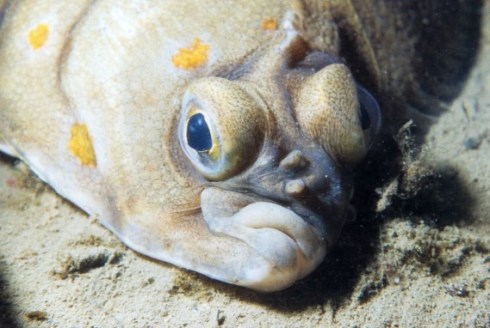
flatfish