List the different varieties of animal meat that are sold at a typical grocery.  Then ask for each item on that list what is the fraction of the US population that finds it acceptable to eat it.  The distribution you will map out is not at all smooth.  Most people will either find it acceptable to eat everything on the list or unacceptable to eat anything on the list.

I believe that both mass points are a result of the same phenomenon:  the slippery slope.  Moral rules are vulnerable to creeping margins and unraveling.  If I want to argue that people should not eat meat it is easier to make that argument if I take an absolute stand.  Absolute rules are easier to defend then nuanced rules that define some interior boundary (it is ok to eat animals if and only if they have no feelings) because nuanced rules admit cases that are very similar but fall on opposite sides of the boundary (you mean its ok to eat squid but not octopus?)

Likewise, people who insist that it is ok to eat all meat are usually painted into that corner for similar reasons. To accept that it is not ok to eat veal makes your filet mignon vulnerable.

So the slippery slope of moral negotiation pushes us to extremes where we are on firmer footing.  All sides lose as a result.  Especially those of us who would prefer that fewer animals are eaten.  I was reminded of this point by an article from the Atlantic about “semitarianism:”  proudly taking the middle ground.  Here is an effective passage:

…, recall that even the most fervently ethics-based vegetarianism isn’t really about an ideological purity of all-or-nothing, us-versus-them purism activist groups foster. It’s about reducing animal suffering. Whether one person gives up meat or three people cut out a third, it’s all the same to the cow, and it should be the same to us.

(a little shout-out to Sandeep who is in Tuscany exercising his finnochiana option.)
In an old post, I half-jokingly suggested that the rules of scrabble should be changed to allow the values of tiles to be determined endogenously by competitive bidding.  PhD students, thankfully, are not known for their sense of humor and two of Northwestern’s best, Mallesh Pai and Ben Handel, took me seriously and drafted a set of rules.  Today we played the game for the first time.  (Mallesh couldn’t play because he is traveling and Kane Sweeney joined Ben and me.)

Scrabble normally bores me to tears but I must say this was really fun.  The game works roughly as follows.  At the beginning of the game tiles are turned over in sequence and the players bid on them in a fixed order.  The high bidder gets the tile and subtracts his bid from his total score.  (We started with a score of 100 and ruled out going negative, but this was never binding.  An alternative is to start at zero and allow negative scores.)  After all players have 7 tiles the game begins.  In each round, each player takes a turn but does not draw any tiles at the end of his turn.  At the end of the round, tiles are again turned over in sequence and bidding works just as at the beginning until all players have 7 tiles again, and the next round begins.  Apart from this, the rules are essentially the standard scrabble rules.

Since each players’ tiles are public information, we decided to take memory out of the game and have the players keep their tiles face up.  It also makes for fun kibbitzing.  The complete rules are here.  Share and enjoy!  Here are some notes from our first experiment:

  1. The relative (nominal) values of tiles are way out of line of their true value.  The way to measure this is to compare the “market” price to the nominal value.  If the market price is higher that means that players are willing to give up more points to get the tile than that tile will give them back when played (ignoring tile-multipliers on the board.)  That means that the nominal score is too high.  For example, blanks have a nominal score of zero.  But the market price of a blank in our play was about 20 points.  This is because blanks are “team players:” very valuable in terms of helping you build words.  So, playing by standard scrabble rules with no bidding, if the value of a blank was to be on equal terms with the value of other tiles, blanks should score negative:  you should have to pay to use them.  Other tiles whose value is out of line:  s (too high, should be negative), u(too low), v(too low.)  On the other hand, the rare letters, like X, J, Z, seem to be reasonably scored.
  2. Defense is much more a part of the game.  This is partly because there is more scope for defense by buying tiles to keep them from the opponent, but also in terms of the play because you see the tiles of the opponents.
  3. It is much easier to build 7/8 letter words and use all your tiles.  This should be factored into the bidding.
  4. There are a few elements of bidding strategy that you learn pretty quickly.  They all have to do with comparing the nominal value of the tile up for auction with the option value of losing the current auction and bidding on the next, randomly determined, tile.  This strategy becomes especially interesting when your opponent will win his 7th tile, forcing you the next tile(s) but at a price of zero.
  5. Because the game has much less luck than standard scrabble, differences in ability are amplified.  This explains why Ben kicked our asses.  But with three players, there is an effect which keeps it close:  the bidding tends to favor the player who is behind because the leaders are more willing to allow the trailer to win a key tile than the other leader.

Finally, we have some theoretical questions.  First, suppose there is no lower bound to your score, so that you are never constrained from bidding as much as you value for a tile, the initial score is zero, and there are two players playing optimal strategies.  Is the expected value of the final score equal to zero?  In other words, will all scoring be bid away on average?  Second, to what extent do the nominal values of the tiles matter for the play of the game.  For example, if all values are multiplied by a constant does this leave the optimal strategy unchanged?

100_0861I’m visiting my sister in Tuscany on my way to a conference.  She runs a cooking school, Organic Tuscany.  The students are all housed in an 18th century villa near Certaldo.  We’re staying here too because the villa is huge and has a swimming pool.  The students seem to be having a great time.  They cook from 10.30-1.30. and then eat what they made for lunch. The incentives are place to pay attention in class!  In the afternoon, they go somewhere for an organized trip – today Siena, yesterday San Gimignano.  My sister has set this up. I’m very impressed as I could never pull off something like this.
We didn’t want to disturb her this morning during class so we did our own disorganized trip to Volpaia.  We went there ten (!) years ago before we had kids.  We had a nice, semi-challenging hike to the hill-top where Volpaia sits prettily.  I remember it well as my pre-made boring pecorino sandwich looked much less interesting that by wife’s finnochiana.  That’s where the salami-exception to my “vegetarianism” began.  The beginning of a key hypocrisy is always memorable, however many mild hypocrisies you commit daily.

I indulged the big one again at La Bottega di Volpaia where we shared a salami plate.  I followed this with spectacular potato tortelli in a fresh porchini sauce.  My wife enjoyed her classic ricotta ravioli  in a butter and sage sauce and the kids even ate their spaghetti with pesto.

The drive up there is great too as long as your stomach can withstand the hair-raising near-crashes with Italians speeding in the other direction while hogging the middle of small, windy roads.  The lunch was so good and the drive so picturesque that we might risk it again.

Behavioral economists Devin Pope and Maurice Schweitzer have a new paper showing that professional golfers perform differently on putts that are identical in all respects except that one is for par and one is for birdie.  What does “identical in all respects mean?”  From a summary in the New York Times:

The professors, Devin Pope and Maurice Schweitzer, seemingly anticipated every “But what about?” reflex from golf experts. The tendency to miss birdie putts more often existed regardless of the player’s general putting or overall skill; round or hole number; putt length; position with respect to the lead or cut; and more.

They find that par putts are made more often than birdie putts.  One natural response might be the following.  If the putt is for par, then the golfer is, on average, farther behind than if the putt is for birdie.  And when you are farther behind you have an incentive to take greater risk.  In putting, you can increase the chance of making a putt at the expense of a more difficult next putt if you miss (by say using a firmer stroke.)  You would have more incentive to do this when you are farther behind.  (Then you care less about the consequences in the event of missing since in that event you are even further behind.)

But they apparently control for this by matching par putts with birdie putts that are identical in terms of the total score that would result from sinking them.  They find the bias is still there. (See Column 8 of Table 3 in their paper.)

However, you might say that this means that the bias is not due to loss aversion.  Because in these two matched settings the golfer is at the same point relative to any reference point.  And if you appeal to “narrow framing” by saying that the players are using a hole-by-hole reference point of par, then the same narrow framing makes it rational to take risks when the putt is for par and play it safe when the putt is for birdie.

A real smoking gun would be the following.  Take the birdie and par putts matched in terms of score conditional on sinking the putt.  Now ask what is the expected final score, or tournament rank, or prize money, or other measure of success, conditional on whether the putt was for birdie or bogey.  The null hypothesis is that these would be the same.  Loss aversion would imply that they are not the same, although it is not obvious which direction it would go.  (The authors do a back of the envelope calculation to address a related question in their concluding section.  They find that the apparent loss aversion matters for final scores but they don’t seem to include any of the controls from the earlier parts of the paper in this calculation.)

(Gatsby greeting: kottke.org)

Iran’s political system is complex and confusing.  But the basic point is that it is a form of dictatorship with Supreme Leader Khamenei in charge.  The protests on the street suggest it is weaker than ever before.  My research with David Lucca and Tomas Sjöström suggests regimes which are neither democracies nor dictatorships but something in between can be the most aggressive of all.

I used this idea for an opinion piece in the New York Times. Here it is:

A stolen election, and what it reveals about the security of Iran’s ruling elite, means that it is more important than ever to engage with Iran.

So far the signs from the Obama administration are encouraging: “The administration will deal with the situation we have, not what we wish it to be,” one senior official said. Let’s hope the administration understands what that situation is.

President Obama is in a difficult position. He under pressure to speak out more and take a tougher line with Iran, as Senator McCain has. But the main issue is not whether the election was stolen or not, but what it reveals about Ayatollah Khamenei’s hold on power.

If we respond with our own saber-rattling, this is more likely to inflame the situation than ever before.

Under Khamenei’s leadership, the Revolutionary Guard has become more powerful and taken over parts of the economy. The disputed election suggests that Khamanei’s position has become weaker as the public distaste for Ahmadinejad’s policies has grown. If we respond with our own saber-rattling, this is more likely to inflame the situation than ever before. A strong dictator can be passive in the face of aggression and still survive in power. But a weak dictator must respond forcibly to every threat to his rule.

The key question is whether Khamenei will ratchet up aggression to survive in power. One way to consolidate power is to win a war. If the regime’s survival is in question, it may destabilize the region and pursue nuclear weapons in a bid to consolidate internal support. A democratic leader may also try to use aggression to drum up support for re-election.

A careful study of history finds that weak dictatorships like Iran, that lie in between full democracy or strong dictatorships, can be the most warlike of all.

I might add one more point:  I would love for the Obama administration to “help the demonstrators” somehow.  But making a statement in their support will backfire as it will give an excuse to display demonstrations as American sponsored.  Iranian TV can just run footage of Obama making the statement, translate it and interpret it in a biased way and literally beat protesters over the head with it.

Now we have set the stage.  We are considering social choice problems with transferrable utility.  We want to achieve Pareto efficient outcomes which in this context is equivalent to utilitarianism.

Now we face the next problem.  How do we know what the efficient policy is? It of course depends on the preferences of individuals and any institution must implicitly involve providing a medium through which preferences are communicated and mediated.  In this lecture I introduce this idea in the context of a simple example.

Two roomates are condering purchasing an espresso machine.  The machine costs $50.  Each has a maximum willingness to pay, but each knows only his own willingness to pay and not the others.  It is efficient to buy the machine if and only if the sum exceeds $50.  They have to decide two things:  whether or not to buy the machine and how to share the cost.  I ask the class what they would do in this situation.

A natural proposal is to share the cost equally.  I show that this is inefficient because it may be that one roomate has a high willingness to pay, say $40, and the other has a low willingness to pay, say $20.  The sum exceeds $50 but one roomate will reject splitting the cost.  This leads to discussion of how to improve the mechanism.  Students propose clever mechanisms and we work out how each of them can be manipulated and we discover the conflict between efficiency and incentive-compatibility.  There is scope for some very engaging class discussions here that create a good mindset for the coming more careful treatment.

At this stage I tell the students that these mechanisms create something like a game played by the roomates and if we are going to get a good handle on how institutions perform we need to start by developing a theory of how people play games like this.  So we will take a quick detour into game theory.

For most of this class, very little game theory is necessary.  So I begin by giving the basic notation and defining dominated and dominant strategies.  I introduce all of these concepts through a hilarious video:  The Golden Balls Split or Steal Game (which I have blogged here before.)  I play the beginning video to setup the situation, then pause it and show how the game described in the video can be formally captured in our notation.  Next I play the middle of the video where the two players engage in “pre-play communication.”  I pause the video and have a discussion about what the players should do and whether they think that communication should matter.  I poll the class on what they would do and what they predict the two players will do.  Then I show them the dominant strategies.

Finally I play the conclusion of the video.  Its a pretty fun moment.   I conclude with a game to play in class.  This year I had just started using Twitter and I came up with a fun game to play on Twitter.  I blogged about this game previously.

(By the way this game is extremely interesting theoretically.  I am pretty confident that this game would always succeed in implementing the desired outcome: getting the target number of players to sign up, but it is not easy to analyze because of the continuous time nature.  The basic logic is this:  if you think that the target will not be met, then you should sign up immediately.  But then the target will be met.)

Here are the lecture slides.

Apparently the price you are quoted when you search for fares on Spain’s high-speed railway depends on whether you search in English or Spanish:

When I searched the site earlier that day from my office, I searched in Spanish. A one-way ticket from Barcelona to Madrid could be had for around 44 euros on a “tarifa Web,” their Internet special fare with 30 day advance purchase.

When I was at home, ready to finalize my purchase, I opted to search with the site language set to English. The price was nearly 110 euros.

The economic logic is standard:  language is a way to segment the market and this segmentation is profitable if the two markets have a large difference in price-sensitivity.  Presumably if you are searching in English then you are a tourist and you have fewer alternative modes of transportation.  This makes you less price-sensitive.

I thank the well-travelled and multi-lingual Mallesh Pai for the pointer.

Much as I’d like to rationalize  alcohol consumption, it seems the studies showing moderate drinking leads to better health have the usual problem according to the New York Times:

No study….. has ever proved a causal relationship between moderate drinking and lower risk of death — only that the two often go together. It may be that moderate drinking is just something healthy people tend to do, not something that makes people healthy.

Health economics might provide a treasure trove for economists well-versed in the techniques of  “instrumental variables” typically used to determine causation.

There is a summary of the research in the New York Times:

In those families, if the first child was a girl, it was more likely that a second child would be a boy, according to recent studies of census data. If the first two children were girls, it was even more likely that a third child would be male.

Demographers say the statistical deviation among Asian-American families is significant, and they believe it reflects not only a preference for male children, but a growing tendency for these families to embrace sex-selection techniques, like in vitro fertilization and sperm sorting, or abortion.

Here is the source article.  There is one small problem with the conclusion:

To reduce the probability that there was an eldest child not in the household, we also restricted our sample to families where the oldest child was 12 years or younger.

Here is the problem.  Let’s suppose that Asian-American parents have a preference for boys but do not engage in any manipulation, except that they keep trying until they get one boy.  Consider two families.  Both families have kids spaced 3 years apart.  The first family has a girl and then a boy and stops.  The second family has 4 girls before the first boy is born.  The first family is included in the sample, the second is not.  More generally, families whose first two children are girls are less likely to be included in the sample than the boy-girl families.  This statistical selection makes it look as if the parents are actively engaged in selection.

The 12 year cap may exclude very few families and so this selection effect may be too small to generate the statistics they are reporting, but it’s hard to know for sure.  The sample sizes are not large.   Here is a graph showing large and overlapping confidence intervals.

It is worth acknowledging that even my alternative story relies on Asian-American parents having a stronger preference for boys than the American population as a whole.  However, it doesn’t require the assumption that they engage in pre-natal sex selection.

Update: The ever-vigilant Marit Hinnosaar (are you noticing a pattern here?) has pointed out to me that I mis-interpreted their sample selection criterion.  As she puts it:

The situation you discribed would create a problem if their sampling method was: include in the sample each household iff the age difference of the children is no more than 12 years. But that is not what they did. With the sampling method they used, they included households, where the oldest child in the household was born not earlier than in 1988 (they used 2000 census data and excluded households that had a child older than 12). This does not lead to the biased sample that you described, since for the researchers these two households that you described are equivalent in terms of whether to include in the sample.

This is not one of those arrangements where donors can sponsor a needy child or a sorghum farmer in the developing world. The person asking for help is a 21-year-old neurobiology major at Harvard, and she is requesting a loan from Harvard alumni.

The service, Unithrive, resembles micro-lending in a number of ways (except perhaps the sticker.)

Unithrive, which made its debut last month, matches alumni lenders and cash-strapped students, who post photographs and biographical information and can request up to $2,000. The loans are interest-free and payable within five years of graduation.

See the article in the New York Times.

When groups wanting to establish different political structures compete, who will win? Here is a simple model.    Let’s say one group wants (full) democracy and one group wants a theo-autocracy.  The winner will be determined in large part by the costs these groups are willing to incur.  That is limited by the long run benefit of keeping the winning system in place.

When both groups are strong, the value of democracy is handicapped by the fact that the authoritarians will be granted participation in the process and this will be a constant threat to the system.  By constrast the authoritarians internalize more of the benefits from winning the struggle because it is a defining feature of that system that the supporters of democracy will be excluded.

This means that the incentives of even a small minority of authoritarians may outweigh a majority who seek democracy.

Guardian Newspaper

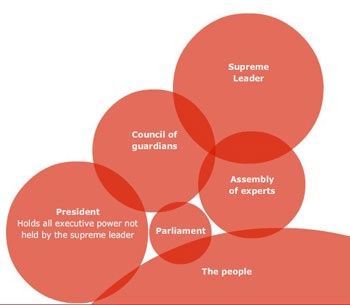
Iran is clearly not a full democracy like the United States – there is a Supreme Leader, currently Ayatollah Khamenei, who controls foreign and nuclear policy and is not subject to general election.  There is a President who is (or was?) elected and controls domestic policy.  There is a council, the Assembly of Experts, that ostensibly determines who is Supreme Leader.  However, they have never acted to remove anyone!  Moreover, the Supreme Leader via the Guardian Council can veto candidates who stand for election for President or the Assembly of Experts!   Confused?  I am.  But here are three excellent depictions of the political systems.

The BBC version

– Jeff found this one

– The prettiest but most confusing is from the UK Guardian news paper, above.

Once you work it all out it boils down to one thing – Khamenei is the man in charge and always has been (Ahmadinejad is more colorful and has a bigger press presence but he is just the face of the regime).

What is still not clear is whether the election was stolen removing even the veneer of democracy or whether there is a vocal minority in Tehran that does not support Ahmadinejad but Ahmadinejad actually won.

In the past, Khamenei has managed to live with a reformist President, Ayatollah Khatami, by sabotaging his policies behind the scenes.  If he can no longer do that and is behind the stolen election, it means Khamenei is weaker than before.  Weak dictators or even democratic leaders with a weak hold on power do crazier things that a strong dictator because they need some support, e.g. from the army, to survive in power.  Starting a war is one way to try to generate enough support to survive.  (E.g. Galtieri in Argentina). Drumming up popular hatred of an enemy the country must oppose is another related strategy.  So if Khamenei is weaker than before, Iran just got more dangerous.  This means Obama must not give Khamenei/Ahmadinejad an excuse to increase their hold on power by taking bellicose actions that allow them to weaken internal opposition.  For example, making pro-democracy statements can be made to seem like outside interference.  This will lead to people “rallying around the flag” and hence lead to less chance of democracy flowering.

Obama does seem to be keeping a low profile so far.  Let’s wait and see what happens.

From an excellent article in the Washington Post:

The election results in Iran may reflect the will of the Iranian people. Many experts are claiming that the margin of victory of incumbent President Mahmoud Ahmadinejad was the result of fraud or manipulation, but our nationwide public opinion survey of Iranians three weeks before the vote showed Ahmadinejad leading by a more than 2 to 1 margin — greater than his actual apparent margin of victory in Friday’s election.

The fact that, in the run-up to the election, expectations were low for any change in Iran is also pretty good evidence that what we are seeing is, sadly, less a reflection of majority opinion than a vocal, and highly motivated minority.  The implications are a little scary just weeks after the anniversary of Tiananmen…

The article concludes with some political dangers:

Allegations of fraud and electoral manipulation will serve to further isolate Iran and are likely to increase its belligerence and intransigence against the outside world. Before other countries, including the United States, jump to the conclusion that the Iranian presidential elections were fraudulent, with the grave consequences such charges could bring, they should consider all independent information. The fact may simply be that the reelection of President Ahmadinejad is what the Iranian people wanted.

Update:  There may be reason to remain suspicious even in light of this poll.  See Marciano’s comment below.

Suspicious graph of Ahmadinejad’s vote share? No, says Nate Silver

An excellent analysis from a former National Security Council member.

Where did I find all these? Huffington Post.

The possibility is nearing that you can take a pill and remove some memories.  (This evening I opened a nice bottle of Yangarra Old Vine Grenache 2005 and removed some memories but that doesn’t count because they will come back tomorrow.)

Media treatment of these advances always focuses on enabling us to erase bad memories.  But its not so obvious that bad memories are the ones you want to lose.  Bad memories often serve an important purpose.  They record a lesson learned.  It may be a lesson about what not to do (memories of car accidents after opening a nice bottle of…) It may be a lesson about people not to trust (memories of abuse.)

On the other hand, many good memories just get in the way.  I remember vividly the film Leolo.  But because of that memory I will never get to enjoy that film again.  Likewise I remember the first time I heard Chick Corea’s Children’s Song #6, how to juggle, the end of The Naked and the Dead and the smell of my wife. These are all novelties that are no longer available to me, unless I could erase some good memories.

The good/bad distinction is less important than the following distinction.  Is the memory affecting my decisions or not?  Whether the memory is good or bad, I want to keep it if it encodes an important lesson helping me continue to make good decisions and avoid bad ones.  And I want to erase it if its function is pure consumption.  The bad memories I want to lose forever, the good memories I want to repeat.

Thursday night we had another overtime game in the NBA finals.  For the sake of context, here is a plot of the time series of point differential.  Orlando minus LA.

LALORLsmall

A few of the commenters on the previous post nailed the late-game strategy behind the eye-popping animation. First, at the end of the game, the team that is currently behind will intentionally foul in order to prevent the opponent running out the clock.  The effect of this in terms of the histogram is that it throws mass out away from zero.  But the ensuing free-throws might be missed and this gives the trailing team a chance to close the gap.  So the total effect of this strategy is to throw mass in both directions.

If the trailing team is really lucky both free throws will be missed and they will score on the subsequent possession and take the lead.  Now the other team is trailing and they will do the same.  So we see that at the end of the game, no matter where we are on that histogram, mass will be thrown in both directions, until either the lead is insurmountable, or we land right at zero, a tie game.

Once the game is tied there is no more incentive to foul.  But there is also no incentive to shoot (assuming less than 24 seconds to go.)  The leading team will run the clock as far as possible before taking one last shot.

So there are two reasons for the spike:  risk-taking strategy by the trailing team increases the chance of landing at a tie game, and then conservative strategy keeps us there. The following graphic (again due to the excellent Toomas Hinnosaar) illustrates this pretty clearly.

bihistogramInbanaivedistnIn blue you have the distribution of point differences that we would get if we pretented that the teams’ scoring was uncorrelated.  This is what I referred to as the crude hypothesis in the previous post.  In red you see the extra mass from the actual distribution and in white you see the smaller mass from the actual distribution.  We see that the actual distribution is more concentrated in the tails (because there is less incentive to keep scoring when you are already very far ahead), less concentrated around zero (because of risk-taking by the trailing team) and much more concentrated at the point zero (because of conservative play when the game is tied.)

Now, this is all qualitatively consistent with the end-of-regulation histogram and with the animation.  The big question is whether it can explain the size of that spike quantitatively.  Obviously, not all games that go into overtime follow this pattern.  For example, Thursday’s game did not feature intentional fouling at the end.  How can we assess whether sound strategy alone is enough to explain the frequency of overtime?

David Pogue does not call it demand elasticity but that is what he’s talking about when he explains why Apple is selling it’s new OS upgrade for $29 rather than the usual $130:

The App Store Effect says this: if you cut a software program’s price in half, you sell far more than twice as many copies.

If he had only said something like this ten weeks ago, I would have had a great example for class!

We used to be in denial that there were any bubbles, now everything is a bubble.   This article in the Chronicle of Higher Education sounds the alarm on higher education (tassle twirl:  lone gunman.)

Is it possible that higher education might be the next bubble to burst? Some early warnings suggest that it could be.

With tuitions, fees, and room and board at dozens of colleges now reaching $50,000 a year, the ability to sustain private higher education for all but the very well-heeled is questionable. According to the National Center for Public Policy and Higher Education, over the past 25 years, average college tuition and fees have risen by 440 percent — more than four times the rate of inflation and almost twice the rate of medical care. Patrick M. Callan, the center’s president, has warned that low-income students will find college unaffordable.

Meanwhile, the middle class, which has paid for higher education in the past mainly by taking out loans, may now be precluded from doing so as the private student-loan market has all but dried up.

The analogy to the housing bubble is certainly tempting.  Pell grants and Stafford Loans are to Colleges what Fannie and Freddie are to housing.  It is undeniable that easy access to credit fueled rises in tuition.  It is not a stretch to think of these loan programs as essentially subsidies to Universities as they raise tuition dollar for every dollar of loans that are essentially forgiven.

But the analogy doesn’t go any farther than that.  There is no speculation fueling demand for higher education.  There is a permanent and measurable difference in earnings for college graduates.  There will continue to be a robust market for credit to students because, to borrow a phrase, consumption wants to be smoothed.  And unlike subsidized loans for housing, there is a real externality that justifies continued federal presence in the student loan market.

Although men and women follow a similar number of Twitter users, men have 15% more followers than women. Men also have more reciprocated relationships, in which two users follow each other. This “follower split” suggests that women are driven less by followers than men, or have more stringent thresholds for reciprocating relationships. This is intriguing, especially given that females hold a slight majority on Twitter: we found that men comprise 45% of Twitter users, while women represent 55%. To get this figure, we cross-referenced users’ “real names” against a database of 40,000 strongly gendered names.

Even more interesting is who follows whom. We found that an average man is almost twice more likely to follow another man than a woman. Similarly, an average woman is 25% more likely to follow a man than a woman. Finally, an average man is 40% more likely to be followed by another man than by a woman. These results cannot be explained by different tweeting activity – both men and women tweet at the same rate.

And this makes Twitter different than other social networks:

These results are stunning given what previous research has found in the context of online social networks. On a typical online social network, most of the activity is focused around women – men follow content produced by women they do and do not know, and women follow content produced by women they knowi

(See the article here.  via MR.)  Actually this may not be stunning at all because there is probably a very simple explanation for both observations.  Twitter is a one-way social network.  If I want to follow you I do not need your permission.  Unless you block everybody and require followers to ask permission.

Regardless of the social network, women are less willing than men to allow unsolicited followers and so they are more inclined to require permission.  So for example if I just randomly selected 100 Twitter users to follow, there will be many of those 100 whom I will be unable to follow because they require permission.  Most of those will be women.  Thus, on Twitter the ratio between the number of followers of a random woman to the number of followers of a random man will be smaller than the same ratio on, say, Facebook.  And everybody will follow more men on Twitter than on Facebook.

There have been quite a few overtime games in the NBA playoffs this year.  We have had one in the finals already and in an earlier series between the Bulls and Celtics, 4 out of 7 games went into overtime, with one game in double overtime and one game in triple overtime!

How often should we expect a basketball game to end tied after 48 minutes of play?  At first glance it would seem pretty rare.  If you look at the distribution of points scored by the home teams and by the visiting teams separately, they look pretty close to a normal distribution with a large variance.  If we made the crude hypothesis that the two distributions were statistically independent, then ties would indeed be very rare:  2.29% of all games would reach overtime.

But the scoring is not independent of course.  Similar to a marathon, the amount of effort expended is different for the team currently in front versus the team trailing and this amount of effort also depends on the current point differential.  But such strategy should have only a small effect on the probability of ties.  The team ahead optimally slows down to conserve effort, balancing this against the increased chance that the score will tighten.  Also, conservation of effort by itself should generally compress point differentials, raising not just the frequency of ties, but also the frequency of games decided by one or two points.

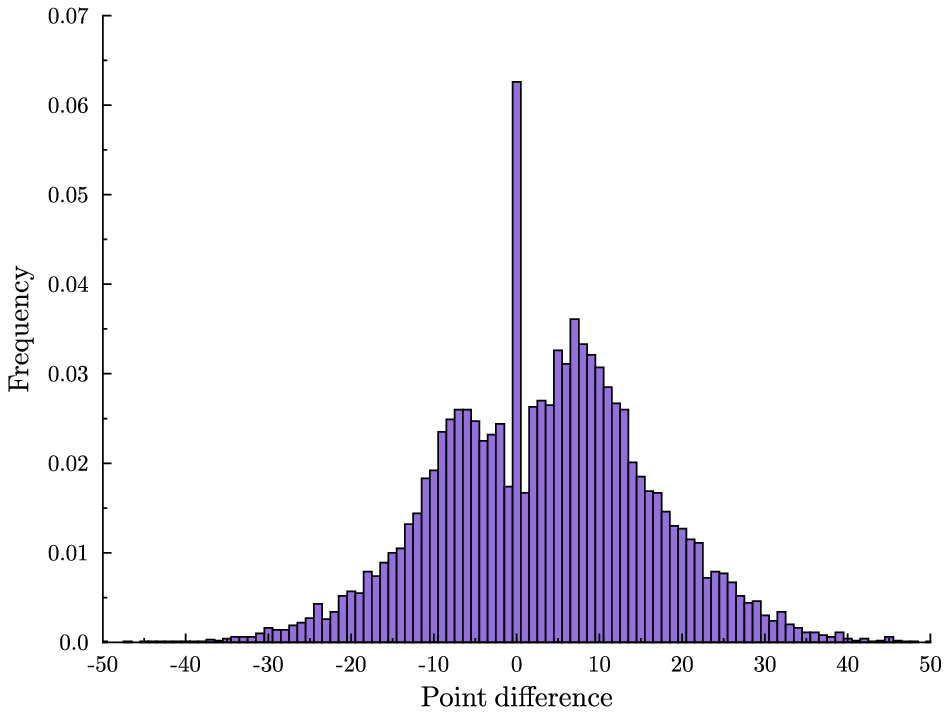
But overtime is almost 3 times more frequent than this:  6.26% of all NBA games are tied at the end of regulation play.  And games decided by just a few points are surprisingly rare:  It is more likely to have a tie than for the game to be decided by two points, and a tie is more than twice as likely as a one-point difference.  These statistics are quite dramatic when you see them visually.

Here is a frequency histogram of the difference in points between the home team and visiting team at the end of regulation play.  These are data from all NBA games 1997-2009.  A positive number means that the home team won, a zero means that the game was tied and therefore went into overtime.  Notice the massive spike at zero.

histogramInbantime

(There is also more mass on the positive end.  This is the well-known home team bias.)

What explains this? A star PhD student at Northwestern, Toomas Hinnosaar, and I have been thinking about this. Our focus in on the dynamics and strategy at the end of the game.  To give you some ideas, Toomas created the following striking video. It shows the evolution of the point differential in the last 40 seconds of the fourth quarter.  At the beginning, the distribution looks close to normal.  This is what the crude hypothesis above would predict.  Watch how the spike emerges in such a short period of time.

By contrast, here is the same animation at the end of halftime.  Nothing unusual.

Apple always claimed its computers were better than PCs.  Yet, PCs became ubiquitous and Apple’s share of the computer market is small.

Q: Why did the supposedly inferior product win out?

A:  Network effects. PCs became cheap, Microsoft let developers loose on its operating system and so there are more useful applications available for the PC than Apple.  Steve Jobs did not want to let developers have control over his product and his product withered away as a result.

Apple has learned its lesson this time around with the iPhone.  Apps take the phone to a different level.  I can’t survive without my G-Park app that tells me where I parked my car in the vast array of Northwestern  carparks.  I let my kids play JellyCar to distract them when we’re on a long trip.  As Slate puts it, the irony is that the network effects that killed the Apple computer make the iPhone impregnable:

For years, Apple fans claimed that the company made the best PCs in the world, hands down. Nevertheless, it was hard to argue with the fact that Windows PCs simply ran more programs. Now Apple is in the position once occupied by Microsoft. Over the next few years, Palm, Research in Motion, Nokia, Sony, and others are sure to create some transcendent mobile devices. But the hardware hardly matters anymore. How is anyone going to compete with all these amazing apps?

For coffee, Peet’s for me.  Better coffee, fewer people (at least in Evanston), and for us in the Midwest, a wistful San Fran ambiance at the height of winter.

Apparently, Zagat‘s readers disagree rating even Dunkin Donuts over Peet’s.  Nate Silver at fivethirtyeight solves the mystery: Zagat’s counts an “abstain” vote for Peet’s as a “zero” rating from a 0-3 rating scale.  What happens in a binary election where abstainers are eliminated?

I wish Peet’s had the Greek yogurt I get from Starbucks.  Then, I would face no dilemma in the morning.

R. Crumb is illustrating The Book of Genesis.  An excerpt appears in this week’s New Yorker.  Here is a copyright-violating scan.  (via BoingBoing)

By the time he came to the story of Noah, though, he was annoyed. He had begun to realize, he says, that “the whole thing is a piece of patriarchal propoganda, engineered to consciously and deliberately suppress matriarchy.”

One of the best movies I have ever seen is Crumb, a documentary about R. Crumb and his two brothers.  If you have seen that film you have some context for the quote above.  I am pre-ordering my Book of Genesis now.

According to the New York Times:

Mr. Obama answered a question about “dealing with the hawks in the current Israeli government,” by suggesting that Israel’s new, conservative prime minister, Benjamin Netanyahu, might have an opportunity to play a more constructive role than a more liberal leader:

I believe that Prime Minister Netanyahu will recognize the strategic need to deal with this issue. And that in some ways he may have an opportunity that a labor or more left leader might not have. There’s the famous example of Richard Nixon going to China. A Democrat couldn’t have gone to China. A liberal couldn’t have gone to China. But a big, anti-communist like Richard Nixon could open that door. Now, it’s conceivable that Prime Minister Netanyahu can play that same role.

This is the essence of  Cukierman and Tomassi’s “Why does it take a Nixon to go to China?” American Economic Review, Mar. 1998, pp. 180-197.  Suppose a political knows the “state of the world” and the policy that most voters would support.  But voters do not have this information.  They cannot tell whether a policy is suggested by a politician because it is the ideal policy for the state of the world or because he has a bias for it.  Then, a right-wing politician is more likely to implement a extreme left-wing policy. Voters are likely to believe it is the “right” policy as he is voting against his natural bias.  He is then rewarded by being re-elected.  Hopefully, there is no Watergate on the horizon for Netanyahu.

Until 2010 that is, whereupon its time to shuffle it:

If Congress doesn’t act, the estate tax will disappear in 2010 but will return in 2011 at the pre-2001 level of $1 million with a tax rate of 55%.

That could generate some interesting data.

After the showstopper that is Arrow’s Theorem, we could just throw in the towel.  The motivation for studying social welfare functions was to find a coherent standard by which to judge institutions and to propose policies.  Now we see that there is no coherent standard.  Well students you are not getting away so easily, after all this is only the second week of the course.  We will accept that we must violate one of the axioms.  Which one do we choose?

A lot of normative economic theory is implicitly built upon one of two welfare criteria, either Pareto efficiency or utilitarianism.  While it is standard to formally define Pareto efficiency in an undergraduate micro class, utilitarianism is often invoked without explicit mention.  For example, we are implicitly using some form of utilitarianism when we talk about consumer and producer surplus.  And to argue that a monopoly is inefficient in a partial equilibrium framework is a utilitarian judgment (absent compensating transfers.)

So I make it explicit.  And I take the time to formally define utilitarianism, explain where it applies and what justifies it and I point out its limitations.  In terms of Arrow’s theorem I tell the students that we are dropping the axiom of universal domain (UD.)  That is, we are not requiring our social welfare function to apply in all situations, only in those situations in which there is a valid measure of welfare that can be transferred and/or compared inter-personally.  In this class, that measure of welfare is willingness to pay, and it applies when there are monetary transfers available and all agents value money in equal terms, i.e. quasi-linear utility.

These lectures contain one important formal result.  In the quasi-linear world with monetary transfers utilitarianism coincides with Pareto efficiency.  So these two common welfare standards are the same.  (Any utilitarian improvement can be made into a Pareto improvement with judiciously chosen transfers and any Pareto improvement is a utilitarian improvement.)

Here are the notes.

My yoga teacher begins class instructing us to moderate our breathing.  Her precise instruction is this:  breathe loud enough so that your neighbor can hear you breathe but not so loud that you cannot hear your neighbor’s breath.

How loud should I breathe?

From Language Log:

The opening sentence of George F. Will’s latest column (“Have We Got a Deal for You“, 6/7/2009):

“I,” said the president, who is inordinately fond of the first-person singular pronoun, “want to disabuse people of this notion that somehow we enjoy meddling in the private sector.”

This echoes J.B.S. Haldane’s quip that the creator, if he exists, must be inordinately fond of beetles; and Will, like Haldane, is presumably proposing an inference about someone’s preferences from his actions, not reporting a direct emotional revelation.

So, since I’m one of those narrow-minded fundamentalists who believe that statements can be true or false, and that we should care about the difference, I decided to check. (On Will, not Haldane.)

Based on a few press conferences, it turns out that Obama uses “I” less often than both G.W. Bush and Bill Clinton.  By the way it looks like I have found a good resource for searching Presidential cheap talk:  The American Presidency Project.

One theory: Broadway is vulnerable to boors because it is under pressure. More new shows opened this past season than at any point in the past 25 years, which means more seats to fill in a recession. In response, shows have been offering steep discounts on tickets, which can normally cost upwards of $100 apiece. BroadwayWorld.com, an entertainment site, is promoting a “Lucky Sevens” discount that offers a “Guys and Dolls” ticket for $7.77 with the purchase of a full-price seat.

That’s the theory.  Here are the data:

The litany of misdemeanors is long. During a Saturday matinee of the Holocaust drama “Irena’s Vow,” a man walked in late and called up to actress Tovah Feldshuh to halt her monologue until he got settled. “He shouted, ‘Can you please wait a second?’ and then continued on toward his seat,” recalls Nick Ahlers, a science teacher from Newark, N.J., who was in the audience. He says the actress complied.

During a recent matinee of “God of Carnage,” which explores the lives of two couples, a woman in the mezzanine screamed, “How ’bout those Yankees!” — filling one of the play’s intense silences. At “The Norman Conquests,” an elderly man familiar with the British comedy script recited his favorite lines as the actors read them, prompting audience members to confront him at intermission. Steve Loucks, a theater blogger from Minneapolis who was sitting near the man, was stunned. “What is with people who think they’re in their own living rooms?”