The more students use technology to do homework, the more they cheat:

In surveys, he asked students if they viewed bringing a cheat sheet to an exam as cheating. Most did. Then he asked the same students whether they would consider it cheating to bring a graphing calculator with equations secretly stored on it. Many said no, that wasn’t cheating.

“I call it ‘technological detachment phenomenon,'” he told me recently. “As long as there’s some technology between me and the action, then I’m not culpable for the action.” By that logic, if someone else posted homework solutions online, what’s wrong with downloading them?

One proposal:

Make it easier for professors to handle such cases, and reform academic judicial systems to make clearer distinctions between smaller violations, like homework copying, and larger ones, like cheating on exams. And assign appropriate punishments for each.

What stops students from cheating?  Social norms must play some role.  Formalizing a price for allowing a decision maker to violate a norm might invalidate the norm and cause its collapse.  This is the idea in an experimental paper by Gneezy and Rustichini “A Fine is a Price”.  If the norm collapses, cheating may actually rise if the fine is too small.  So the appropriate punishment for  small infringement is large – then, even if the norm collapses, the fine alone will deter cheating on homework.  Maybe a large fine for small infringements is not credible.  How could a professor or a university justify a large fine for a small crime morally or even worse to an angry parent? If that is a problem, the present system, turning a blind eye to small violations, might be the best system after all.

Female digger wasps prey on katydids.  But they don’t kill them.  They paralyze them and then store them in little holes they dig in the ground.  They are preparing nests where they will lay eggs and when the eggs hatch, the larvae will feast on the katydids.

Richard Dawkins and John Brockman observed that it sometimes happens that two digger wasps are unknowingly tending the same nest.  Naturally, once they figure this out, there’s going to be a fight.  Dawkins and Brockman noticed two things about these fights.  First, the wasp that wins is usually the one that has contributed more katydids to the common nest.  Second, the duration of the fight is predicted by the number of katydids contributed by the eventual loser.

For Dawkins and Brockman the wasps are revealing a sunk-cost fallacy.  Evidently, their willingness to fight is not determined by the total reward, but instead by the individual wasp’s past investment.  The more they invested, the more they are willing to fight.

A more nuanced interpretation is that the wasps’ behavior is not a fallacy at all, but a clever hack.  The wasps really do care about the total value of the nest, but their best estimate of that value is (proportional to) their own contribution to it.  For example, a wasps may be able to “remember” the number of katydids she paralyzed (and she must if she is able to condition her fighting intensity on that number) but not be able to count the number of katydids in the nest.  The former is going to be correlated with the latter.

Sunk cost bias:  a handy trick.

1. Even the graffiti in the UofChicago men’s room is nerdy.

2. Markets propagate fairness as does religion.

3. Polite British potential Chancellors of the Exchequer debate on TV for the first time.

4. Tomorrow night’s dinner?

What would happen if the individual mandate were removed from the health care bill? Republicans are proposing to do that but leave intact the rules on pre-existing conditions. This sounds like disaster because then the equilibrium is for only the already-sick to have “insurance,” meaning premiums are very high, meaning that the healthy prefer not to buy insurance until they are already sick.

This is not a problem of “skyrocketing costs” as some characterize it. If the same number of people get sick, then costs are the same. Its the premiums that skyrocket. The problem with that is that health care insurance is no longer insurance.

But the individual mandate is not the only way to bring the insurance back into health insurance. (And it appears that the penalties are so low that we are headed for this equilbirium anyway. See this article on MR. ) Many employer-based health insurance providers use a system of “open enrollment.” You can sign on to the plan when you join, but if you don’t and then decide later you want to , you must wait until a specific narrow window of time.

I don’t know what the intended purpose of open enrollment is but one effect it has is to give incentives to buy insurance before you get sick. A system like this would work just fine in place of the individual mandate.

Even better: when you turn 21 you are able to buy insurance from any provider regardless of your pre-existing conditions. This right continues as long as you have had insurance continuously. If you chose not to buy insurance in the past (and you could have afforded it) and you wish to buy it now then you cannot be denied coverage due to pre-existing condition. However, insurance companies are not required to offer you the same policy as the main pool.

Update: Austin Frakt argues that the penalties are already high enough to avoid the bad equilibrium.

Last week, I was in line at the front desk of a condo hotel in Naples, Florida at around 9 pm.  My electronic key had discharged and I needed a replacement, i.e. I already had a room.

Unlike me, the guy ahead of me was looking to rent a two bedroom but the clerk said they were all full but she could offer him a couple of one bedrooms.  She has three left.  The guy asked her the rate and she quoted him $269/room.  He said that was too much and she asked him how much he was comfortable with paying.  My guess is that as it was pretty late, it was unlikely that the rooms would be used that night so the clerk was willing to  negotiate.  The guy said he was willing to pay at most $200/room.  The clerk said she had to ask her manager and disappeared into the back room.  She came back with an offer of $239 and the guy said that was too much.  The clerk was unwilling to haggle further and the guy left.

All I wanted was a new key.  I was itching for the guy to leave so I could go to bed and ended up focusing on the discussion as I was hoping it would end quickly.  For an economist, it was pretty fun.

First, who knew you could haggle for hotel room prices this way?  A sign of the recession perhaps.  Second, the “let me take your offer to my manager”, just hearkens to haggling for cars so there is a  nice symmetry with that subculture of bargaining.

Finally, we see how delegation can help in certain situations.  Normally, when an agent works for a principal, the principal tries to align incentives so the agent works hard on her behalf.  This results in the optimality of bonuses, commissions and the like where the agent shares the profits of hard work.  But sometimes it is good to commit to turn down business.

A firm with monopoly power wants to maintain a high price.  Once it has made a take or leave it offer to a buyer, if the buyer rejects the offer, the firm has the incentive to cut the price to get business.  Knowing this will happen, high value buyers will reject the initial offer and wait for the lower price. The firm’s market power diminishes as a result of its inability to commit not to lower prices.  This is a hugely simplified version of the Coase conjecture.

But, if instead of a firm/hotel, a manager/clerk makes the offer, there is potentially a different conclusion.  If the clerk does not see a share of the profits generated by the extra sale, the clerk has no incentive to cut the price.  This results in some business being turned away but allows the hotel to maintain some market power.   I guess something like this happened in the hotel bargaining I observed. (Perhaps the clerk is on commission to make a sale and the manager in the back room makes sure the rooms are not then just given way to get the commission?).  If the clerk had the same incentives as the hotel owner, it would be bad for profits as commitment power would evaporate.  Mis-aligning incentives makes more sense.

Or there is a small chance that a person observing the conversation reports it on his blog.  The hotel’s reputation for maintaining high prices goes up in smoke and future sales are made at low prices.  Knowing this, the hotel refuses to accept low offers and keeps its reputation intact.

I’ve been thinking about the Sleeping Beauty problem a lot and I have come up with a few variations that help with intuition.  So far I don’t see any clear normative argument why your belief should be anything in particular (although some beliefs are obviously wrong.)  My original argument was circular because I wanted to prove that your willingness to be reveals that you assign equal probability but I essentially assumed you assigned equal probability in calculating the payoffs to those bets.

Nevertheless the argument does show that the belief of 1/2 is a consistent belief in that it leads to betting behavior with a resulting expected payoff which is correct.  On the other hand a belief of 1/3 is not consistent.  If, upon waking, you assign probability 1/3 to Heads you will bet on Tails and you will expect your payoff to be (2/3)2 – (1/3)1 = $1.  But your true expected payoff from betting tails is 50 cents.  This means that you are vulnerable to the following scheme.   At the end of their speech, the researchers add “In order to participate in this bet you must agree to pay us 75 cents.  You will pay us at the end of the experiment, and only once.   But you must decide now, and if you reject the deal in any of the times we wake you up, the bet is off and you pay and receive nothing.”

If your belief is 1/3 you will agree to pay 75 cents because you will expect that your net payoff will be $1 – 75 cents = 25 cents.  But by agreeing the deal you are actually giving yourself an expected loss of 25 cents (50 cents – 75 cents.)  If your belief is 1/2 you are not vulnerable to these Dutch books.

Here are the variations.

  1. (Clones in their jammies) The speech given by the researchers is changed to the following.  “We tossed a fair coin to decide whether we would clone you, and then wake up both instances of you.  The clone would share all of your memories, and indeed you may be that clone.  Tails: clone, Heads: no clone (but still we would wake you and give you this speech and offer.)  You (and your clone if Tails) can bet on the coin.  In the event of tails, your payoff will be the sum of the payoffs from you and your clone’s bet (and the same for you if you are the clone.)”
  2. (Changing the odds)  Suppose that the stakes in the event of Heads is $1.10.  Now those with belief 1/2 strictly prefer to bet Heads (in the original example they were indifferent.)  And this gives them an expected loss, whereas the strategy of betting Tails every time would still give an expected gain.  This exaggerates the weirdness but it is not a proof that 1/2 is the wrong belief.  The same argument could be applied to the clones where we would have something akin to a Prisoner’s dilemma.  It is not an unfamiliar situation to have an individual incentive to do something that is bad for the pair.
  3. Suppose that the coin is not fair, and the probability of Tails is 1/n.  But in the event of Tails you will be awakened n times.  The simple counting exercise that leads to the 1/3 belief seemed to rely on the fair coin in order to treat each awakening equal.  Now how do you do it?
  4. The experimenters give you the same speech as before but add this:  “each time we wake you, you will place your bet BUT in the event of Tails, at your second awakening, we will ignore your choice and substitute a bet on Tails on your behalf.”  Now your bet only matters in the first awakening.  How would you bet now?  (“Thirders” who are doing simple counting would probably say that, conditional on the first awakening, the probability of Heads is 1/2.  Is it?)
  5. Same as 4 but the bet is substituted on the first awakening in the event of Tails.  Now your bet only matters if the coin came up Heads or it came up Tails and this is the second awakening.  Does it make any difference?
  1. Aldous Huxley’s Death
  2. Absinthe: fact and fiction
  3. Underwear jokes
  4. Free as in water
  5. Sperm wars

Via Robert Wiblin here is a fun probability puzzle:

The Sleeping Beauty problem: Some researchers are going to put you to sleep. During the two days that your sleep will last, they will briefly wake you up either once or twice, depending on the toss of a fair coin (Heads: once; Tails: twice). After each waking, they will put you to back to sleep with a drug that makes you forget that waking.

The puzzle:  when you are awakened, what probability do you assign to the coin coming up heads?  Robert discusses two possible answers:

First answer: 1/2, of course! Initially you were certain that the coin was fair, and so initially your credence in the coin’s landing Heads was 1/2. Upon being awakened, you receive no new information (you knew all along that you would be awakened). So your credence in the coin’s landing Heads ought to remain 1/2.

Second answer: 1/3, of course! Imagine the experiment repeated many times. Then in the long run, about 1/3 of the wakings would be Heads-wakings — wakings that happen on trials in which the coin lands Heads. So on any particular waking, you should have credence 1/3 that that waking is a Heads-waking, and hence have credence 1/3 in the coin’s landing Heads on that trial. This consideration remains in force in the present circumstance, in which the experiment is performed just once.

Let’s approach the problem from the decision-theoretic point of view:  the probability is revealed by your willingness to bet.  (Indeed, when talking about subjective probability as we are here, this is pretty much the only way to define it.) So let me describe the problem in slightly more detail.  The researchers, upon waking you up give you the following speech.

The moment you fell asleep I tossed a fair coin to determine how many times I would wake you up.  If it came up heads I would wake you up once and if it came up tails I would wake you up twice.  In either case, every time I wake you up I will tell you exactly what I am telling you right now, including offering you the bet which I will describe next.  Finally, I have given you a special sleeping potion that will erase your memory of this and any previous time I have awakened you.  Here is the bet: I am offering even odds on the coin that I tossed.  The stakes are $1 and you can take either side of the bet.  Which would you like?  Your choice as well as the outcome of the coin are being recorded by a trustworthy third party so you can trust that the bet will be faithfully executed.

Which bet do you prefer?  In other words, conditional on having been awakened, which is more likely, heads or tails?  You might want to think about this for a bit first, so I will put the rest below the fold.

Read the rest of this entry »

You are having dinner with your child in a restaurant.  He has ordered chicken tenders with fries and you force him to have a small salad before the main course arrives.  In a “When Harry met Sally” moment, you ask for the fries to be brought “on the side”, i.e. on another plate.

He has a small amount of the chicken and you give him a few fries as a reward.  He then claims that he is full.  Is he really?

There are two states of the world, full F and hungry H.  The state is known to the agent/child but the principal/parent does not know the state.  The agent has private information.  How does the principal work out the true state?  Offer the agent another french fry. If it is accepted, the true state is H – he is truly hungry and only pretending to be full.  If he refuses, it is F and the chips he had earlier filled him up. Of course you have to know your kids to determine which food product separates or screens the two states.

The first few times you try this trick, you can go a  bit further.  Once he has accepted the fry, you point out he must really be in state H and make him have some more chicken.  In the long run, he will work out that accepting the fry leads to more chicken.  He will refuse the fry and you’ll never work out if the true state is F or H. Your solution depends on bounded rationality and if learning helps to eliminate it, you are powerless in the long run.  Also, if you choose the wrong food group you won’t be able to screen the two states in the first place.  In our case, ice cream is always acceptable in all states while more french fries are acceptable if and only if the true state is H.

If you are one of the millions of Facebook users who play games like Playfish or Pet Society, you are a datum in Kristian Segerstale’s behavioral economics experiments.

Instead of dealing only with historical data, in virtual worlds “you have the power to experiment in real time,” Segerstrale says. What happens to demand if you add a 5 percent tax to a product? What if you apply a 5 percent tax to one half of a group and a 7 percent tax to the other half? “You can conduct any experiment you want,” he says. “You might discover that women over 35 have a higher tolerance to a tax than males aged 15 to 20—stuff that’s just not possible to discover in the real world.”

Note that these are virtual goods that are sold through the game for (literal) money.  And here is the website of the Virtual Economy Research Network which promotes academic research on virtual economies.

Tom Friedman is concerned that it might:

“One-party autocracy certainly has its drawbacks. But when it is led by a reasonably enlightened group of people, as China is today, it can also have great advantages. That one party can just impose the politically difficult but critically important policies needed to move a society forward in the 21st century. It is not an accident that China is committed to overtaking us in electric cars, solar power, energy efficiency, batteries, nuclear power and wind power. China’s leaders understand that in a world of exploding populations and rising emerging-market middle classes, demand for clean power and energy efficiency is going to soar. Beijing wants to make sure that it owns that industry and is ordering the policies to do that, including boosting gasoline prices, from the top down.

Our one-party democracy is worse. The fact is, on both the energy/climate legislation and health care legislation, only the Democrats are really playing. With a few notable exceptions, the Republican Party is standing, arms folded and saying “no.” “

A dictator can simply impose policies but in messy American democracy a filibuster-proof consensus has to emerge to get anything done.  This is an advantage for central planning, at least if the dictator is benevolent.  This is Friedman’s main  idea.

But he misses a key point, the cornerstone of laissez-faire market economics: even a benevolent dictator is not omniscient and does not know what to invest in.  Demand and cost information is dispersed through the economy and the dictator may invest in the wrong industry.  Overproduction of tractors and shoes and underproduction of soap, the cliches of communist central planning.  Market prices aggregate information and the invisible hand directs investment into the right activities.  Chinese central planning might be as bad as Soviet or for that matter Indian central planning of yesteryear.  So messy democracy mixed up with free markets might dominate Chinese communism.  This is the flaw in Friedman’s logic.

Still, I think there is an element of truth in his conclusion if not his reasoning.  As we shop in any American store, we realize how many goods are made in China.  New Communism is  not closed economy central planning but open economy central planning.  Chinese central planners can learn what sells and what doesn’t sell by observing prices.  If green products are in, the reds can easily find out the same way we can.  And then can order, subsidize and simply force entry into green products.  Messy American politics will have a harder time doing the same thing.  American capitalists will not fight on a level playing field with Chinese “capunnists”.  American innovators may come up with new products first but if they can be made cheaply in China, they won’t stay American.

So there is a chance that Chinese communism can outperform American capitalism.

(HT: Thanks to dinner companions in Princeton for listening to my random warbling and also for identifying the Friedman thesis that I use to begin this post.)

Relationships that are sustained by reciprocity work like this.  When she cooperates I stay cooperative in the future.  When she egregiously cheats, the relationship breaks down.  In between these polar cases it depends on how much she let me down and whether she had good reason.  Forgiveness is rationed.  Too much forgiveness and the temptation to cheat is too great.

This is also how it should work in your relationship with yourself.  It takes discipline to keep working toward a long-term goal.  Procrastination is the temptation to shirk today with the expectation that you’ll make it up in the future.  Thus the only way to reduce the temptation is to change those expectations.  Self-discipline is the (promise, threat, expectation) that if I procrastinate now, things will only get worse in the future.  Too much self-forgiveness is self-defeating.

I came across a study by psychologists that, at first glance, casts doubt on this theory.  Students who procrastinated on their midterm exams were asked whether they forgave (forgifted ?!) themselves.  The level of forgiveness was then compared to the degree of procrastination on the final exam.  The more self-forgiving students were found to procrastinate less on the final.  The psychologists interpreted the finding in this way.

we have to forgive ourselves for this transgression thereby reducing the negative emotions we have in relation to the task so that we’ll try again. If we don’t forgive, we maintain an avoidance motivation, and we’re more likely to procrastinate.

But if we think a bit more, we can square the experiment quite nicely with the theory.  The key is to focus on the intermediate zone where forgiveness is metered out depending on the extent of the violation.  Forgiveness means that the relationship continues as usual with no punishment.  The lack of forgiveness, i.e. punishment, means that the relationship breaks down.  In the game with yourself that means that your resolve is broken and you lose the incentive to resist procrastination in the future.  Forgiveness is negatively correlated with future procrastination.

(The apparent inversion comes from the fact that the experiment relates forgiveness to future procrastination.  A naive reading of the theory is that because forgiveness reduces the incentive to work, forgiveness should predict more procrastination.  As we see this is not true going forward.  It would be true, however, looking backward.  Those who are more likely to forgive themselves are more likely to procrastinate.)

This happened in a dream I had.  We were at a large round table having dinner.  I was talking about pizza and saying something typically smart-ass about how to make good crust.  Krugman was at the other end of the table and overheard.  He jumped in just long enough to reduce my pizza thesis to mere crumbs.  The rest of the guests looked on in pity.

When the party was over, I bumped into him again on the way out.  We had this little conversation:

Krugman:  When.

Jeff:  When what?

K:  No.  When, dude.

J:  I don’t understand you.

K:  I am saying goodbye.

J:  That’s how you say goodbye?

K:  It’s like instead of saying “see you later,” people say just “later.” you’ve heard that right?

J:  Yeah but you said when.

K:  Same thing. I could have said “when we meet again,” but I just said “when.”

J:  But nobody says that.

K:  They do now.

(I blog by sending myself emails when I have an idea.  These emails are stored in a separate folder to think about later.  Some ideas have gathered dust and I am cleaning them out.)

Bilingual kids have better pronunciation than those who acquire a second language as adults.  I have read that this is because of specialization both in the brain and physically in terms of the kinds of sounds we are able to make.  But I bet there is another reason:  adults know how to read.

Take the hard ‘r’ sound in Spanish.  It can be farily well approximated by an English ‘d’ sound which any English speaker has the wiring and hardware to make.  But native Enlish speakers do not mispronounce ‘corazon’ by saying ‘codazon.’  Instead, they say ‘core a zone.’  And the reason is presumably that they have seen that word written out and the association between the written ‘r’ and the familiar sound has been highly reinforced.  This is also a problem with most vowel sounds.

I would bet that adults would more easily learn fluency in another language if they were taught exclusively orally.  Now it would seem that the obvious test case would be Chinese to English and vice versa.  I don’t know but I would guess that it would not be possible to write English words phonetically using written Chinese.  Despite this “advantage,” native Chinese speakers have a hard time with English fluency.  Bad for the theory. But I think that Chinese to English is already too difficult for other reasons to consider this a good test.  First of all the sound palettes are very different.  Second, the rhythms of the languages are very different, even with good pronunciation.

Instead, to hold other factors constant, I would look to the blind.    My guess is that the blind have a weaker association between pronunciation and the written language.  (How much of a role does Braille play when a blind person learns a new language? ) The key prediction then would be that among native English speakers who learn Spanish as adults, the blind are more fluent.

Because he is 17 year old Russian high-school student Andrey Ternovskiy.  He’s the guy who created Chatroulette by himself, on a whim, in 3 months, and is now in the US fielding offers, meeting with investors, and considering never again returning to Moscow.

Should he sell?  Would he sell?  To frame these questions it is good to start by taking stock of the assets.  He has his skills as a programmer, the codebase he has developed so far, and the domain name Chatroulette.com which is presently a meeting place for 30 million users with an additional 1 million new users per day. His skills, however formidable, are perfectly substitutable; and the codebase is trivially reproduceable.  We can therefore consider the firm to be essentially equal to its unique exclusive asset:  the domain name.

Who should own this asset?  Who can make the most out of it?  In a perfect world these would be distinct questions.  Certainly there is some agent, call him G, which could do more with Chatroulete.com than Andrey, but in a perfect world, Andrey keeps ownership of the firm and just hires that person and his competitive wage.

But among the world’s many imperfections, the one that gets in the way here is the imperfection of contracting.  How does Andrey specify G’s compensation?  Since only G knows the best way to build on the asset, Andrey can’t simply write down a job description and pay G a wage.  He’d have to ask G what that job description should be.  And that means that a fixed wage won’t do. The only way to get G to do that special thing that will make Chatroulette the best it can be is to give G a share of the profits.

If Andrey is going to share ownership with G, who should have the largest stake?  Whoever has a controlling stake in the firm will be the other’s employer.  So, should G employ Andrey (as the chief programmer) or the other way around?  Andrey’s job description is simple to write down in a contract.  Whatever G says Chatroullete should do, Andrey programs that.  Unlike when Andrey employs G, G doesn’t have to know how to program, he just has to know what the final product should do.  And if Andrey can’t do it, G can just fire him and find someone who can.

So Andrey doesn’t need any stake in the profits to be incentivized to do his job, but G does.  So G should own the firm completely and Andrey should be its employee.  The asset is worth more with this ownership structure in place, so Andrey will be able to sell for a higher price than he could expect to earn if he were to keep it.

Here is my previous post on ChatRoulette.

Ten Tables JP may be my number one restaurant choice for Boston.  I love Sportello and Oleana.  The food is equally good at all three places.  But the ambience at Ten Tables is the best.  It actually only has ten tables so you have to book well ahead.  (They cheat a bit by having a bar but it looks a lot less cosy than the restaurant.)  There’s an open kitchen so you can see the chefs at work.

My wife’s garlic soup was spectacular.   My citrus panna cotta was too heavy and creamy but the radicchio salad that came with it was lovely.  My ricotta pasta with maitake mushrooms was delicious and my two companions really enjoyed their chicken and steak dishes.   We split a chocolate mousse and pistachio semifreddo for dessert.  The wines are decently priced and I had a great barbera in my Italian wine flight.

Looking forward to going back.  By the way, there is a second Ten Tables in Cambridge.  The food is equally good but the service is rude and the dinner crowd is less cool.  Make sure you go to the right branch.

On average, dentists are conservative Democrats.  This and many other interesting facts from Adam Bonica‘s great pictorial representation of campaign contributions and occupations:

Updated to reflect ryan’s comment below!

HT: Matt Yglesias

Amazon is trying to beat down the prices of eBooks sold on the Kindle:

Amazon appears to be responding to the Apple threat by waging a publisher-by-publisher battle, trying to keep as many books as possible out of Apple’s hands, while preserving as much flexibility as it can to set its own prices.

Apple meanwhile has signed up five of the six major publishers and is allowing them to set their own prices.  Apple is taking 30% of the price for acting as the go-between.  If the variable cost of producing an eBook is zero (a pretty good approximation!) then a publisher will set the same price for  a book as it would if the Apple “tax” is zero – if costs are zero, the publisher maximizes revenue and the “tax” charged by Apple just cancels out of its calculation.  So, Apple iPad book prices will be high and reflect monopoly power.

Amazon is taking a different approach: Sell the books for cheap, maximize volume and hence adoption of the Kindle.  Two different approaches so which one is playing the eReader game better?

I’m inclined to go with Apple right now.  Publishers want control over pricing and Apple is getting them on board by giving them flexibility.  Amazon has been playing hardball with the same publishers:

Amazon shocked the publishing world by removing the “buy” buttons from its site for thousands of printed books from Macmillan, one of the country’s six largest publishers, in a dispute over e-book pricing.

Eventually, Amazon climbed down and let Macmillan set prices.

A consumer not only cares about the price of a book but what the range of books being sold.  If Amazon isn’t getting a full selection because publishers are unhappy with its pricing policy, then you might hesitate to get a Kindle.  I’m thinking particularly of students in high schools and colleges who have to get books for their classes.  Electronic books are going to be cheaper than hard copies anyway, as the variable costs are lower.  And it’s way more convenient to carry an eReader than heave around a bunch of textbooks.  But if Macmillan textbooks are not on Kindle, you’re going to get the iPad.

So you’re not going to be able to trigger sales of the Kindle by having cheap books if your range of offerings is small.  This is the danger posed by Amazon’s strategy.

As a SoCal transplant to the Midwest I have had two very different experiences with weather.  Growing up, I learned a few immutable climate axioms.

  1. If there is sunshine its going to be warm, if it is cloudy it is going to be cold.
  2. If there are clouds plus precipitation its going to be even colder.

The beauty of these principles is that you can look out your window and know how to dress.  The tragedy of these principles is that they are totally false.

In Chicago, sunshine means on average that it is going to be colder.  Especially in the winter.  Cloudy days are on average warmer than sunny days.  And precipitation, especially snow, means its going to be even warmer than if it was just cloudy.

Eventually I think I figured out why.  The true axioms of weather are instead

  1. How warm or cold it will be depends almost entirely on where the air is coming from.
  2. Whether there are clouds and how much precipitation there will be depends a lot on where the air is coming from.

#1 is obvious but would be completely lost on a SoCalian because the air pretty much comes from the same place all the time.  It blows in from over the Pacific.  This being constant, the only thing left to determine the tiny fluctuations in temperature is whether or not the Sun has yet to burn off the marine layer (essentially fog that comes along with water blowing over the ocean.)  Naturally therefore sunshine=warmer.

(A variation on this which still confounds the SoCalian is the occasional Santa Ana condition where the air is blowing offshore from the deserts.  This keeps the marine layer at bay (sunshine) and the desert air is of course warm.)

In Chicago, the air can be coming from just about anywhere Westish.  Air coming from Canada: cold.  Air coming from Missouri:  warmer.  Now, sunshine means that the excess moisture that would have been in the air to form clouds fell to the ground before the air arrived.  That is more likely to have happened if the air is coming from Canada because in Canada it is colder and that means the the air can hold less moisture.  Hence the correlation sunshine=cold.

Indeed, clouds indicate that the air has moved from some place warmer, where the air could hold moisture.  Finally, precipitation means that it was so warm wherever the air is coming from that there is so much moisture in the air that by the time it reaches cold Chicago, it has to fall out of the sky onto me.

File this one under Blogging Something I Know Nothing About, yes. But after the first few times I ran outside in shorts in January because the sky was crystal blue, I have come to depend heavily on this theory.  And its working pretty well, at least until I move to Hawaii.

In a classic article “The Problem of Dirty Hands”, the philosopher Michael Walzer offers the following scenario:

[C]onsider a politician who has seized upon a national crisis-a prolonged colonial war-to reach for power. He and his friends win office pledged to decolonization and peace; they are honestly committed to both, though not without some sense of the advantages of the commitment. In any case, they have no responsibility for the war; they have steadfastly opposed it. Immediately, the politician goes off to the colonial capital to open negotiations with the rebels. But the capital is in the grip of a terrorist campaign, and the first decision the new leader faces is this: he is asked to authorize the torture of a captured rebel leader who knows or probably knows the location of a number of bombs hidden in apartment buildings around the city, set to go off within the next twenty- four hours. He orders the man tortured, convinced that he must do so for the sake of the people who might otherwise die in the explosions- even though he believes that torture is wrong, indeed abominable, not just sometimes, but always.

Walzer concludes the politician is “right” to torture the rebel leader.  I want to point out how this leads to a commitment problem for the moral politician.  First, it is impossible to keep a promise to stop torturing if the rebel leader releases part of his information.  Once he has supplied the information, the Walzer argument can be reapplied.  The utility of saving innocent lives outweighs the costs of continuing torture so a utilitarian should continue not cease torture as he promised.  Second, the rebel leader says he was not involved in the planning of the attack and does not know the details.  You become convinced he is telling the truth.  Then, the Walzer argument means the moral politician should stop. The leader knows nothing that will save lives in the next 24 hours and the politician abhors torture so there is  no point carrying out the threat of torture.

So, the moral politician faces the two commitment problems Jeff and I have discussed in earlier posts.  Walzer concludes that the moral politician should get “dirty hands” and torture the rebel leader.  But what happens to this conclusion when the moral politician faces commitment problems?  To be continued….

A more appropriate name for DST is daylight consumption time.  Shifting the clock re-alloates daylight from an hour when most are sleeping to an hour when almost everyone is awake.  And unless our preference for daylight has a discrete jump in the Spring and the Fall, we should be smoothing out this consumption.

Apart from watches (and what is the point of wearing one of those anyway?) nearly all of our timepieces orient themselves relative to a central server.  This would enable us to coordinate a smooth addition of time to our clocks, say 1 minute per day over a 60 day period.

Getting out of bed 1 minute earlier each of 60 consecutive days will dramatically reduce the total level of morning grumpiness compared to the current system where it comes in one big, grumpy, lump.

In the old days when our clocks were not synchronized this would not only have been too much of a chore, it would have caused all kinds of mis-coordination due to lack of common knowledge of the current time.  (Does she worry that I worry that she forgot to add a minute?)  But that problem is gone.

True, there would be a new kind of asynchrony vis-a-vis other countries where consumption of daylight isn’t valued as highly.  Under the current system at least they know our local time modulo the little hand.  But again, their time servers are smart enough to tell them the right time at whatever locale they are interested in.

Then of course in the fall, we smoothly adjust our clocks back.

The first comes from Eran Shmaya:

I heard this from Marco who heard it from Tzachi. Not sure what to make of it, but that will not deter me from ruminating publicly

There is a sack of chocolate and you have two options: either take one piece from the sack to yourself, or take three pieces which will be given to Dylan. Dylan also has two options: one pieces for himself or three to you. After you both made your choices independently each goes home with the amount of chocolate he collected.

The second from Presh Talwalker:

My friend Jamie is a professional poker player, and he came across a great example along the lines of the Prisoner’s Dilemma.

Here is what he reports:

I played a poker tournament at Caesar’s Palace last night with the
following setup: The buy-in is $65, which gets you 2500 chips. There
is also the option to buy an additional 500 chips for $5 more, giving
you a total of 3000 chips for $70. At 1 cent/chip, this add-on sounds
like a great bargain compared to the 2.6 cents/chip of the regular
buy-in.

The kicker is that the house keeps the entire $5 add-on fee; none of
it goes into the prize pool.

Each of these is equivalent to a Prisoners’ Dilemma.  That should be obvious in the first case.  In the second case, notice that if you buy the additional chips you deflate the value of the others’ chips.  (Poker seignorage!)  If you were to present either of these examples to students, I would bet that most of them would play the corresponding Defect strategy.  And this would make for a great teaching device if you show it to them before teaching the Prisoners’ dilemma.  Because the usual framing of the prisoner’s dilemma suggests to students that they ought to be cooperative.  This is the main reason students are often confused by the Prisoners’ dilemma.

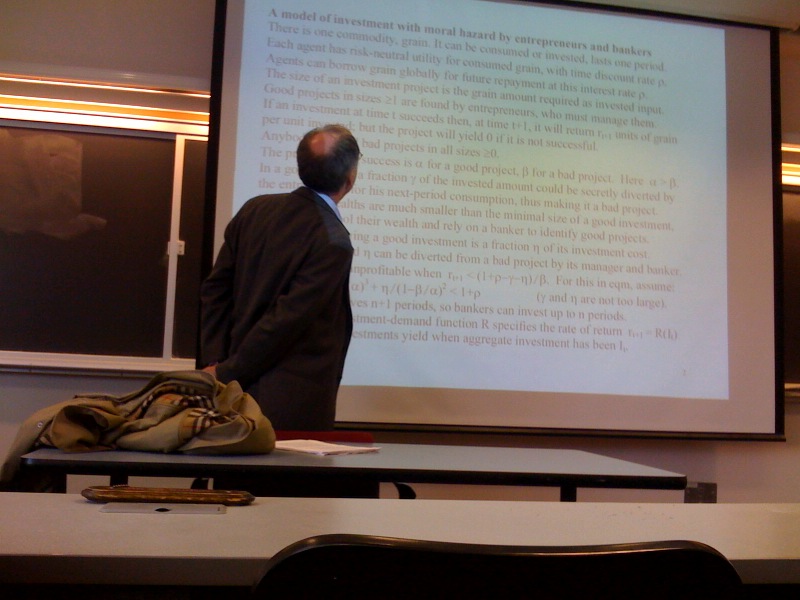
Now that Roger Myerson is one.  Today at Northwestern he presented his new work on A Moral Hazard Model of Credit Cycles.  It attracted a huge crowd, not surprisingly, and introduced a whole new class of economists to the joy and sweat of a Roger Myerson lecture.

(Roger apparently hasn’t read my advice for giving talks.)  Listening to Roger speak is not only thoroughly enlightening and entertaining, its calisthenics for the mind.  I once brought a pen and pad to one of his talks and outlined his nested digressions.  It is absolutely a thing of beauty when every step down the indentation ladder is paired with a matching step on the way back up. When he finally returns to the original stepping off point, no threads are left hanging.

Keeping track of all this in your head and still following the thread of the talk is a bit like Lucy and Ethel wrapping candy.

Still, I think I got the basic point.  Roger has a model of credit cycles that falls out naturally from a well-known feature of dynamic moral hazard.  In his model, banks are intermediaries between investors and entreprenuers and they are incentivized via huge bonuses to invest efficiently.  These bonuses are paid only when the bankers retire with a record of success.

These backloaded incentives mean that bankers are trusted with bigger funds the closer they are to retirement.  That’s when the coming payout looms largest, deterring bankers from diverting the larger sums for their own benefit.  Credit cycles are an immediate result.  Because bankers handle larger sums near their retirement than those just starting out, their retirement means that total investment must go down.  So the business cycle tracks the age demographics of the banking sector.

(It’s the Cocoon theory of business cycles, because if you could extend the lives of bankers you would enhance the power of incentives, lowering the moral hazard rents and increasing investment.)

Presh Talwalker reports:

After a late night out, I found myself at the only eatery still open in the suburbs, the late night haven that is Denny’s.  When paying for the meal, I noticed a curious offer on the receipt that read something like:

If your receipt does not list a food or drink you ordered, let us know and you will get the item free plus a $5 gift certificate.

Which, as Presh deduced, is a counter-bribe from Denny’s management so you will rat out your server if he or she bribes you with free food in return for a tip.

My approach to blogging is pretty simple.  When I have an idea I email it to myself.  My mail server deposits these in a special folder which I then dig through when I am ready to write something.  Some ideas don’t get written up and they start to attract dust.  I am going to clean the closet and write whatever I can think of about the ideas that piled up.  Here is one that Sandeep and I actually talked about some time ago, but I can’t now figure out where I wanted to go with it.

Shouldn’t gang wars end quickly?  All you have to do is kill the leader of the rival gang.  Instead, at least anectdotally, gang wars are more like wars of attrition.  You have the low-level thugs picking each other off and the leaders are relatively safe.  Why?

The leader embodies some valuable capital:  control of his organization.  Even if you could decapitate the rival gang by killing the leader it may be preferred to weaken him by taking out enough of his henchmen.  Then you can offer him a deal.  Maybe its a merger, maybe its a collusive agreement, but either way the point is that the coalition is more valuable with the opposing hierarchy intact than in disarray.  Knowing all of this, each gang leader feels perfectly safe even in the midst of an all-out war.

Under this theory, gang wars break out because a rival has become too powerful and it is no longer clear which is the dominant gang.  Its a necessary part of renegotiating the pre-existing power-sharing arrangement in light of a new balance of power.

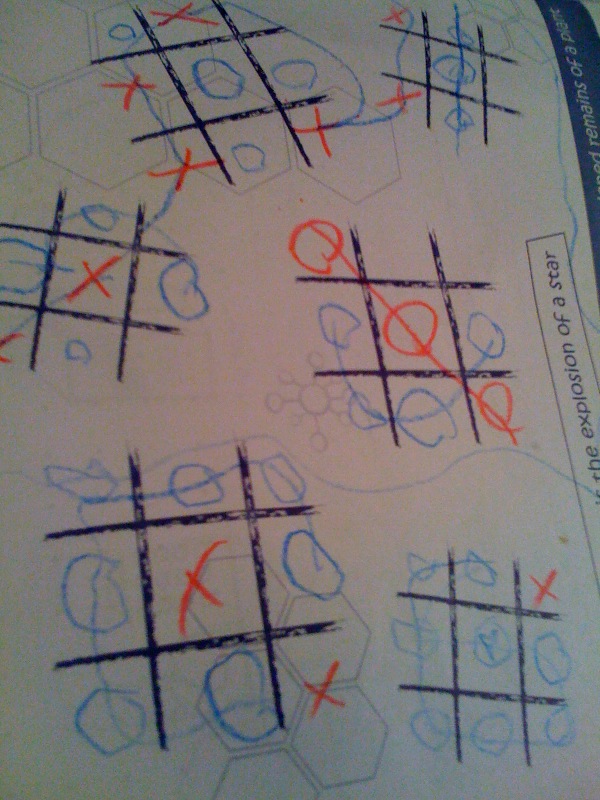
With best play tick-tack-toe is a draw.  It comes as a surprise to people however that best play is hard to maintain when you are playing 50 games in succession, especially if you’ve had a few. Most people are willing to bet that they can go 50 games without losing one, many are even willing to give odds.  You can make some money this way.  (You are betting just that you can win at least one game, its safe to throw a few and that can knock a careful opponent out of his rhythm.  And the sheer boredom that sets in around game #37 works to your advantage.)

One warning however.  Only wager with with law-abiding adults.  I tried this on my 3 year old and he cheats:

I got it for $30 on sale in a New Hampshire state liquor store.   Great year for Bordeaux so I went for it.

It’s drinkable but it’s not worth it.  There’s lots of oak, heavy coconut and a one dimensional, fruity taste.  Not worth the money.   Plenty of good stuff under $20 that’s better. Maybe it’ll get better with age?

Recommendation: Don’t buy unless you see it for less that $20.

Jason Kottke tweeted:

Kids, don’t ever aspire to be the world’s oldest person. Have you not noticed that they’re always dying?

which is a good point but I would bet big money that the world’s youngest person dies more often than the oldest.

  1. Neuromarketing.
  2. Kit Kat flavors in Japan (miso, yuzu, soy sauce, etc.)
  3. The economics of testicles as food.
  4. Bedbug-sniffing dogs.

Obama has gone “all in” with his healthcare strategy, now delaying a foreign trip to have more time to pressure House Democrats:

The president’s international trip had grown into a source of frustration among many House Democrats, who complained privately to the White House that they were being forced to take a quick vote on health care so Mr. Obama and his family could leave on a trip to Indonesia next week.

The president agreed to delay his departure from March 18 to March 21, an administration official said, in an effort to show flexibility in the final push on health care legislation. The three-day delay effectively sets a new timetable for the House vote on the measure.

He has outlined a healthcare reform plan after a year of saying it was up to Congress to come up with one.  Obama has revealed his hand after months of ambiguity. It’s obvious why.  The original hope was to have a bipartisan plan.  By not laying down an explicit plan, he could have hoped that Republicans and Democrats came up with one together.  He was playing to two audiences.  One audience has rejected his message.  This leaves only the Democrats.  Now, he has to nail his colors to the mast to get them to pass healthcare alone using the Byrd Rule that Jeff discusses below.