Republican leader, Senator Mitch McConnell, opposes the current version of the financial reform bill.  He claims that the bill generates “moral hazard” by creating a fund that bails out banks if they fail:

Mr. McConnell has framed the Republican opposition as an attempt to prevent future bailouts, and has specifically criticized a $50 billion fund, to be created with a tax on banks, that would help cover the costs of dealing with failing firms in the future. Mr. McConnell said the mere existence of the fund is an invitation to banks to take on risk that could lead them to fail. The White House does not support the fund, which is being pushed by Congressional Democrats.

Democrats have countered that the fund is intended pay for dismantling such firms and putting them out of business – and that setting up in advance would help ensure that the financial industry, rather than taxpayers, would cover the expense of future failures.

Note that the White House does not support the fund either and recently advised the Congressional Democrats to ditch the provision from the bill.  As far as I can tell, the White House view is that the fund is too small and its existence would complicate efforts to raise extra money should it be needed.   If McConnell is right, a bigger fund would exasperate the moral hazard problem so the White House’s preferences would make things even worse.

Also, the Democrats’ faith that firms would be dismantled if they fail may turn out to be mistaken.  The same executives who get their firm in trouble by taking risky bets are in the best position to disentangle them if they go bad.  That’s what happened with A.I.G.

All that leaves just one feature of the current bill to discuss: the fund is to be created by taxing financial firms in good times to help them out in bad times.  Depending on how the tax is designed, it can mitigate risk-taking.  The tax would have to affect the marginal incentive to make a risky bet and cannot be a lump-sum tax.  A successful tax would basically work by decreasing the upside to a trade to compensate for the fact that the firm is insured on the downside by the fund.  This brings up the whole question of what the optimal incentive scheme might be.  I was puzzling about this but then I realized I was trying to reinvent the wheel.  Much attention has already been paid to these issues in the finance literature and our very own Jeff Ely linked to a blog where Eric Maskin gave his five recommendations for great papers to read for guidance about the financial crisis.

To summarize some of the main points:  Banks must take equity in the bets they take to reduce moral hazard and this may have to be regulated (Holmstron and Tirole).  Depositors and small shareholders do not have good incentives to monitor so the government may have to set capital requirements to substitute for them (Dewatripont and Tirole).  Tight monetary policy can be used reduce the profitability of lending, much like a tax.  There are lots of other points but they are less relevant for the topic of this post.  I have not read a couple of these papers myself (eg Kiyptaki-Moore) but I intend to!

There are lots of other ideas floating out there (Volker rule, breaking up banks, reinstating Glass-Steagal).  Which is truly the best is hard to say.  But the basic principle is clear: If banks are going to be bailed out as a bank failure would cause systemic risk, they do have the incentive to take on riskier bets (let’s call this the “McConnell effect”).  Then, there has to be a countervailing effort to reduce the upside of risky bets (let’s call this the Olympia Snowe/Susan Collins/Scott Brown effect as we know who’s in the driving seat).

This brings me to my final point: While such a policy is designed for the long run, it will create pain in the short run.  Banks are pretty reluctant to lend right now (I assume?).  They do not need a tax to dis-incentivize them.  They may need the reverse.  How does financial reform deal with this?  Do we delay the implementation of the restrictive legislations?  This would create the incentive to invest and lend now rather than delay if profits from future lending are going to be taxed.  Probably there is some old finance paper that already discussed this too!  But I do not know it.
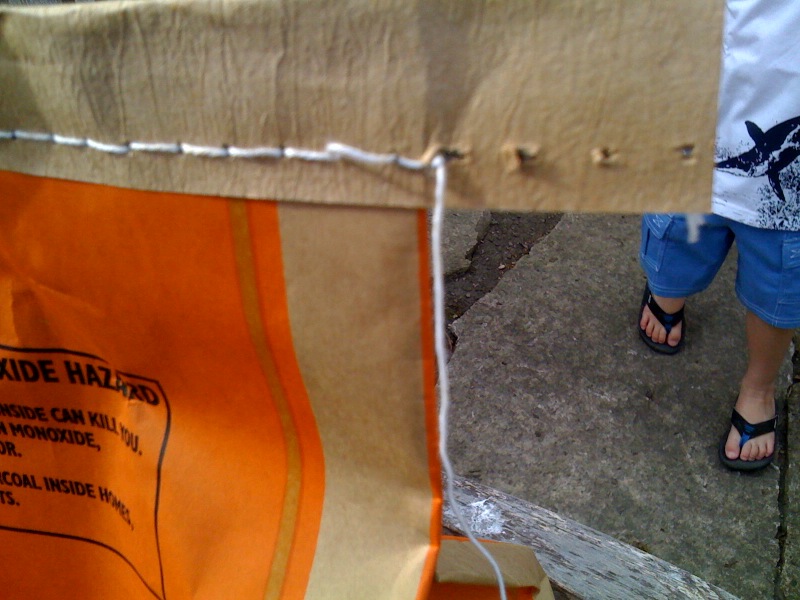
I buy these bags of hardwood charcoal from Whole Foods.  They are sewn closed at the top and a little thread hangs out at one end.  Every so often I grab the thread, offer a prayer to the grilling gods and pull; and the most beautiful thing happens:  the thread unravels end to end and the bag is open.  And if this has ever happened to you, the sound of it, the feel of it, and the pure joy of being admitted entrance, at a subconscious level all remind you of your other favorite thing to unzip.

But like that other thing it almost never works out that way and it seems to be determined by nothing more than pure randomness.  When it fails you can try yanking in either direction or unraveling it by hand for a bit to get it started but to no avail.  Eventually you have to get the scissors.

So I am asking you, dear readers.  Does anybody know what is the trick to get these threaded seams to unravel?  (I already tried plying it with tequila.)

What explains Jamiroquai?  How can an artist be talented enough to have a big hit but not be talented enough to stay on the map?  You can tell stories about market structure, contracts, fads, etc, but there is a statistical property that comes into play before all of that.

Suppose that only the top .0001% of all output gets our attention. These are the hits.  And suppose that artists are ordered by their talent, call it τ.  Talent measures the average quality of an artist’s output, but the quality of an individual piece is a draw from some distribution with mean τ.

Suppose that talent itself has a normal distribution within the population of artists.  Let’s consider the talent level τ which is at the top .001 percentile.  That is, only .001% of the population are more talented than τ.  A striking property of the normal distribution is the following.  Among all people who are more talented than τ, a huge percentage of them are just barely more talented than τ.  Only a very small percentage, say 1% of the top .001% are significantly more talented than τ, they are the superstars. (See the footnote below for a precise statement of this fact.)

These superstars will consistently produce output in the top .0001%.  They will have many hits.  But they make up only 1% of the top .001% and so they make up only .00001% of the population.  They can therefore contribute at most 10% of the hits.

The remaining 90% of the hits will be produced by artists who are not much more talented than τ.  The most talented of these consist of the remaining 99% of the top .001%, i.e. close to .001% of the population.  With all of these artists who are almost equal in terms of talent competing to perform in the top .0001%, each of these has at most a 1 in 10 chance of doing it once.  A 1 in 100 chance of doing it twice, etc.

_____________________

(*A more precise version of this statement is something like the following.  For any e>0 as small as you wish and y<100% as large as you wish, if you pick x big enough and you ask what is the conditional probability that someone more talented than x is not more talented than x+e, you can make that probability larger than y.  This feature of the normal distribution is referred to as a thin tail property.)

Is it a superstition that babies born in a Year of the Dragon will have good luck?  The Taiwanese government wanted to dispell the superstition.

The demographic spike in 1976 was sufficiently large that governments decided to issue warnings in 1987 against having babies in Dragon years because of the problems they caused for the educational system, particularly with respect to finding teachers and classroom space. Editorials were issued that claimed no special luck or intelligence for Dragon babies and a government program in Taiwan was designed to alert parents to the special problems faced by children born in an unusually large cohort (Goodkind, 1991, p. 677 cites multiple newspaper accounts of this).

But the effort failed and another spike was seen in 1988.  Why?  Because the dragon superstition is true. In this paper by Johnson and Nye, among Asian immigrants to the US, those born in Dragon years are compared to those born in non-Dragon years.  Dragon babies are more successful as measured in terms of educational attainment.  And the difference is larger than the corresponding difference for other US residents.

And of course it turns out that this is due to the self-fulfilling nature of the superstition.  Asian Dragon babies have parents who are more successful and they are more likely to have altered their fertility timing in order to have a baby in a Dragon year.  Is this because the smarter parents were more likely to be dumb enough to believe the superstition?

Or is it because of statistical discrimination?  Since the Dragon superstition is true, being a Dragon is a signal of talent and luck.  Unless these traits are observable without error, even unlucky and untalented Dragons will be treated preferentially relative to unlucky and untalented non-Dragons.  Smart parents know this and wait until Dragon years.

Thanks to Toomas Hinnosaar for the pointer.

This weekend we attended a charity auction for my kids’ pre-school.  What does a game theorist think about at a charity auction?

  1. There is a “silent auction” (sealed bid), followed by a live auction (open outcry).  How do you decide which items to put in the live auction?
  2. The silent auction is anonymous, so items with high signaling value should be moved to the live auction.  A 1 week vacation in Colorado sold for less than $1000 (who would want to signal that they don’t already have their own summer home?) wheras a day of working as an assistant at Charlie Trotter’s sold for $2500.
  3. There is a raffle.  You sell those tickets at the door when people are distracted and haven’t started counting how much they have spent yet.  But what price do you set?
  4. The economics of the charity auction are such that vendors with high P-MC markups can donate a high value item (high P) for a low cost (low MC).  This explains why the items usually have a boutique quality to them.
  5. In the silent auction, you write down your bids with a supplied pen on the bid sheet.  Sniping is pervasive.  Note for next year:  bring a cigarette lighter.  You make your last minute bids and then melt the end of the pen just enough to stop the ink from flowing.
  6. When you are in suburban Winnetka on Chicago’s North Shore, for which kind of item is the winner’s curse the strongest: art or sports tickets/memorabilia?
  7. One of the live auction side-events is a pure signaling game where you are asked to give an amount of money to a special fund.  They start with a very high request and after everyone who is willing to give that much has raised their hand, they continually lower the request.  I think this is the right timing.  With the ascending version the really big donors will give too early.
  8. How do you respond when asked to pay to enter a game with the rules to be announced later?  Answer:  treat it like a raffle.  Surprise answer:  A chicken will be placed in a cage.  The winner of the game is the player whose number the chicken poops on.

That didn’t turn out to be such a good idea.  Someone forgot to put a lid on the cage and the chicken, well-versed in the hold-up problem, found a way to use his monopoly power:

The game of chicken

That is an actual-use, signed and engraved hockey stick from Patrick Kane of the Chicago Blackhawks.  It subsequently sold for over $1000.  The chicken was unharmed and eventually spent the evening perched on a rafter high above the proceedings threatening to select a winner directly.

1. We have no clear strategy to deal with Iran’s nuclear ambitions.

2. The Taliban want peace.

3. Graham Allison gives Obama an “incomplete” on one aspect of his policy on nuclear arms.

4. Osama loves volleyball, de Gaulle and Field Marshall Montgomery.

  1. Twitter’s plan to make money.
  2. The herb that even Julia Child would pick off her plate and throw on the floor.
  3. Some valuable thoughts on Fair Trade coffee.

About a year ago I posted a link to a YouTube video of the Golden Balls “Split or Steal” game, hailing it as a godsend for teachers of game theory and the Prisoners’ Dilemma.  That video has made its way around the web in the year since and I sat down to prepare my introductory game theory lecture yesterday looking for something new.

Well, it turns out that now there are many, many new videos of Split or Steal on YouTube and you can spend hours watching these.  Here is my favorite and the one I used in class today.

I also heard from Seamus Coffey who has analyzed the data from Split or Steal games and finds:

  • Women are more cooperative than men, non-whites more than whites, the old more cooperative than the young.
  • There is more cooperation between opposite-sex players than when the players are of the same sex.
  • The young don’t cooperate with the old, and the old discriminate even more against the young.
  • Blonde women cooperate a lot.  Men cooperate less with blondes than with brunettes.

Here is a link to a paper by John List who looks at similar patterns in the game Friend or Foe.

It’s always nice when you get a comment from someone you recognize but do not know personally.  So it was a nice surprise to see that Andrew Gelman left  a comment on my earlier post and then wrote his own blog post.  Andrew says:

[I]f this “cheap talk” is useless, why it’s done at all! Or, conversely, why it wasn’t done earlier. Baliga’s analysis seems to me to rely on there being some “suckers” somewhere who don’t realize what’s going on.

Perhaps, for example, the leaders of Iran, Russia, etc., aren’t fooled by the cheap talk.–after all, they run countries and have incentives to understand the relevant signaling–but maybe it could sway American voters, who don’t have the time and inclination to gain a deep understanding of power politics. But . . . if it could fool the voters, it could change U.S. policy, and in that sense the stated policy does mean something. Beyond this, there are default effects and status quo effects and costs to violating or altering a stated policy. So I don’t think such public statements are necessarily meaningless, especially considering the many players involved in policymaking in any country.

On the other hand, I know next to nothing about international relations, so I could well be missing something important. I don’t see Baliga’s conclusions as following from basic game theory but maybe there’s something about this particular setting that changes things.

I was a bit terse in my original post and the concept of “cheap talk” is confusing so let me have another stab at an explanation.

Cheap talk is a costless message sent before a game is played.  Since it is costless, you might think it never has an impact.   That turns out not to be true. But whether and how cheap talk has an impact depends on the game that’s played after the talk.

The simplest and most famous scenario is where the game just involves a decision made by one player, the receiver (this is the famous Crawford-Sobel model).  In the background, there is some uncertainty and the receiver would love to fine-tune his decision to the underlying state.  If he does not know the state, the receiver makes a decision which works out on average and this is the equilibrium of the game without cheap talk.  Now add  a player, the sender, who knows the state and whose preferences coincide exactly with the sender’s.  Let the sender send a message before the receiver makes his decision.  The sender has perfect incentives to tell the truth, so the receiver learns the true state in equilibrium and cheap talk works.  That is, the equilibrium set of the game without cheap talk is different than the game with cheap talk.  Hence, cheap talk can be effective even if it is costless.  It does not require the existence of suckers.  And cheap talk is useful as it helps the two players to some to the best decision in each state.  (Actually, Jeff has already written about this game.)

But in the nuclear proliferation scenario I claim cheap talk is not useful.   I copy my initial response to Andrew:

But there is one key case where cheap talk is useless even in games of incomplete information: when a player i’s preferences over player j’s actions do not depend on player i’s preferences. In the nuclear story, this arises if the player i prefers that player j not acquire nuclear weapons, whether player i is itself rapacious, conciliatory or something in between. Then, player i will always send the message that minimizes the probability that player j arms and cheap talk cannot be informative.

As  player i sends the same message whatever his preferences, his message contains no information.  Hence, the equilibrium set does not change compared to a nuclear proliferation game with no talk preceding it.  Whatever player j’s optimal plan was in the game without cheap talk, it remains optimal with cheap talk.  Some message is sent in any case – even saying nothing is a message.  There will always be some message, like it or not, once you allow cheap talk before a game.  The question is whether it is effective and I claim it is not in my visualization of the nuclear proliferation game.

My analysis is a rational choice analysis, as is analysis in basic game theory.  It assumes in particular that Iran is rational.  This means they can do backward induction and think through Obama’s strategic incentives to send messages.  Then, they can deduce that he always has the incentive to minimize their probability of acquiring weapons whether he intends to be belligerent, conciliatory or not.  So, there is no information content in the message as the same message in sent in all cases.

Gelman makes the point that if voters can be fooled, cheap talk may be effective.  Also, if Iran is fooled, cheap talk is also effective.  This latter possibility is the hypothesis that makes sense of the new nuclear policy in the simplest way – if Iran accepts Obama’s message at face value, it might stop pursuing nuclear weapons.  If Obama believes that Iran is naive, he does want to send the message.  But, as Andrew suggests, the idea that Iran would be caught out is implausible.  If even if Obama believes there is small chance Iran/North Korea is fooled, he may send it anyway – after all I claim the policy has no impact anyway if Iran is rational but if it makes things better with a small probability, why not?

Andrew’s idea that voters might be fooled is plausible and his post built around this idea.  (Somewhat confusingly, he suggests I am assuming there are suckers in the model but I think his idea requires them while mine is a rational choice analysis.) But anyway, till we have a good theory of how to fool voters, it is hard to judge how the change in nuclear policy affects nuclear proliferation.  If voters think Obama’s policy is a softening of the previous policy and will embolden Iran, as the Cheneys will say, voters may think Obama is weak.  Then, Obama may have to signal he is tough by acting tough, not just talking tough.  So fooling voters is bad for Obama in the end and he is a sucker too in this scenario.  Or we can go the other way and say voters will increase support for Obama as he is a smart foreign policy guy and will reduce nuclear proliferation.  Then, the Obama strategy makes sense.  We can send the analysis anyway we want by adding players who can be fooled into the story.

But there is an insight to the basic game theory analysis – why might communication not work?  It would be good to understand that before moving on to add naive voters, status quo effects and the like.

There was a Memorial Service for Paul Samuelson last weekend.  A video of the service and texts of speeches are available and they are quite interesting.  Ricardo Caballero’s speech has a lovely passage where he describes a faculty lunch on a snowy day.  To a small group of colleagues, Samuelson held forth on a thesis of Alberto Calderon,  John Nash’s contemporary at M.I.T.   Caballero says:

“This episode left such an impression on me that I decided to take the afternoon off to savor the moment. (And afternoons off are not my thing, as many of you
know…)   I drove home in complete awe. The silence that only snow can produce, served to exacerbate the surreal feeling I was experiencing. Much like what one feels when visiting the Basilica di Santa Croce in Florence, where names such as Michelangelo, Galileo, and Machiavelli are buried: Sheer and pure admiration for a great mind.”

We noticed that professional golfers today have ads on their hats, sleeves, collars, belt-buckles, shoes, etc. while in the past few had more than one or two ads.  At an individual level this makes sense but collectively it shows that the PGA would do better to centralize their negotiations with advertisers.

When Phil Mickleson considers selling another ad he has to lower his price.  He trades off the additional sale versus the reduction in the price to decide whether it is worth it.  He doesn’t take into account how his increased supply lowers the price of ads for all PGA golfers.  When this negative externality is not internalized, the PGA as a whole sells too many ads.  PGA-wide ad revenue would increase if they could negotiate ads as a group rather than individually.

Why don’t they?  In the short-term it would be simple.  Each golfer reports the ad revenue he is currently earning.  Then an agent for the PGA negotiates with advertisers to sell a block of ads and distributes them optimally across golfers.  This optimization would not only involve keeping quantity low but it would also take into account complementarity between golfer and ad, screen time, diversification, etc.  Then, the total ad revenue would be shared among the players in some way that gives each player at least as much as he was earning individually.  Since total revenue would be higher, there would be money left over to divide up in some way.

The problem is how to manage this over time.  In order to keep a majority of players willing to go along with it, they will have to be promised at least as much as their autarky value.  But the most recent public information about that value was recorded just before they entered the cooperative agreement.  Over time that information depreciates as players rise and fall and new players arrive.

But privately, each individual player would be able to estimate their ad revenues should he go it alone.  When the players bargain over shares, each individual player will exaggerate his earnings potential and insist on compensation for his outside option.  When public information is weak enough, these demands can add up to more than the group can earn, at which point bargaining breaks down and autarky prevails.

When you are competing to be the dominant platform, compatibility is an important strategic variable.  Generally if you are the upstart you want your platform to be compatible with the established one.  This lowers users’ costs of trying yours out.  Then of course when you become established, you want to keep your platform incompatible with any upstart.

Apple made a bold move last week in its bid to solidify the iPhone/iPad as the platform for mobile applications.  Apple sneaked into its iPhone OS Developer’s agreement a new rule which will keep any apps out of its App Store that were developed using cross-platform tools. That is, if you write an application in Adobe’s Flash (the dominant web-based application platform) and produce an iPhone version of that app using Adobe’s portability tools, the iPhone platform is closed to you.  Instead you must develop your app natively using Apple’s software development tools.  This self-imposed-incompatibility shows that Apple believes that the iPhone will be the dominant platform and developers will prefer to invest in specializing in the iPhone rather than be left out in the cold.

Many commentators, while observing its double-edged nature, nevertheless conclude that on net this will be good for end users.  Jon Gruber writes

Cross-platform software toolkits have never — ever — produced top-notch native apps for Apple platforms…

[P]erhaps iPhone users will be missing out on good apps that would have been released if not for this rule, but won’t now. I don’t think iPhone OS users are going to miss the sort of apps these cross-platform toolkits produce, though.  My opinion is that iPhone users will be well-served by this rule. The App Store is not lacking for quantity of titles.

And Steve Jobs concurs.

We’ve been there before, and intermediate layers between the platform and the developer ultimately produces sub-standard apps and hinders the progress of the platform.

Think about it this way.  Suppose you are writing an app for your own use and, all things considered, you find it most convenient to write in a portable framework and export a version for your iPhone.  That option has just been taken away from you.  (By the way, this thought experiment is not so hypothetical.  Did you know that you must ask Apple for permission to distribute to yourself software that you wrote?) You will respond in one of two ways.  Either you will incur the additional cost and write it using native Apple tools, or you will just give up.

There is no doubt that you will be happier ex post with the final product if you choose the former.  But you could have done that voluntarily before and so you are certainly worse off on net.  Now the “market” as a whole is just you divided into your two separate parts, developer and user.  Ex post all parties will be happy with the apps they get, but this gain is necessarily outweighed by the loss from the apps they don’t get.

Is there any good argument why this should not be considered anti-competitive?

Obama’s Nuclear Posture Review has been revealed.  The main changes:

(1) We promise not to use nuclear weapons on nations that are in conflict with the U.S. even if they use biological and chemical weapons against us;

(2) Nuclear response is on the table against countries that are nuclear, in violation of the N.P.T., or are trying to acquire nuclear weapons.

This is an attempt to use a carrot and stick strategy to incentivize countries not to pursue nuclear weapons.  But is it any different from the old strategy of “ambiguity” where all options are left on the table and nothing is clarified?  Elementary game theory suggests the answer is “No”.

First, the Nuclear Posture Review is “Cheap Talk”, the game theoretic interpretation of the name of our blog.  We can always ignore the stated policy, go nuclear on nuclear states or non-nuclear on nuclear states – whatever is optimal at the time of decision.  Plenty of people within the government and outside it are going to push the optimal policy so it’s going to be hard to resist it. Then, the words of the review are just that – words.  Contracts we write for private exchange are enforced by the legal system.  For example a carrot and stick contract between an employer and employee, rewarding the employee for high output and punishing him for low output, cannot be violated without legal consequences.  But there is no world government to enforce the Nuclear Posture Review so it is Cheap Talk.

If our targets know our preferences, they can forecast our actions whatever we say or do not say, so-called backward induction.  So, there is no difference between the ambiguous regime and the clear regime.

What if our targets do not know our preferences?  Do they learn anything about our preferences by the posture we have adopted? Perhaps they learn we are “nice guys”?  But even bad guys have an incentive to pretend they are nice guys before they get you.  Hitler hid his ambitions behind the facade of friendliness while he advanced his agenda.  So, whether you are a good guy or bad guy, you are going to send the same message, the message that minimizes the probability that your opponent is aggressive.  This is a more sophisticated version of backward induction. So, your target is not going to believe your silver-tongued oratory.

We are left with the conclusion that a game theoretic analysis of the Nuclear Posture Review says it seems little different from the old policy of ambiguity.

My memory is not so good but it seems to me that professional golfers didn’t used to look so much like race cars.

Perhaps they have been consulting with auction theorists.  Selling ad space on your shirt is like a multi-unit auction but with an interesting twist.  Like any auction you want to insist on a reserve price to keep revenues high.  The reserve acts as a threat not to sell unless bids are high enough and this induces more agressive bidding.  Normally this leads to under-supply, just as a textbook monopolist restricts output to keep prices high.

But here’s the twist.  After you have sold the ad on your hat, your auction for an ad on your lapel is a threat against the advertiser on your hat.  If you sell an ad on your lapel it’s going to take some focus off the hat.

That means it is in both yours and the hat-advertiser’s interest to have him bid for the lapel ad.  Yours because more competition is better, and his because he wants to keep the competitors off your lapel.  Now think about how your reserve price for the lapel-auction works.  Just as before, for the new bidders it is an inducement to bid higher.  But for the hat-guy it’s an inducement to lower his bid for your lapel.  If you set a high reserve then he can safely lose the auction for your lapel and expect that nobody else will win, which for him is just as good as winning.

This leads you to set a lower reserve on your lapel than you otherwise would.  In effect this is a threat to the hat-hawker that if he doesn’t bid high enough to keep your lapel clean, you are going to put someone else’s logo there.  That is, you are over-supplying ads (relative to the situation in which the ads had no spillovers.)

When these principles are put to use, two kinds of outcomes can occur.  If there is a high enough bidder you will sell exclusive advertising to that bidder.  If not, you will sell lots of little ads to little bidders.

While we are on the subject, here are recent prices for apparel real-estate.

  1. Princess Leia meets Jerry Garcia
  2. The gift card multiplier
  3. Fox News firing on all cylinders

A new paper by Bollinger, Leslie, and Sorenson studies Starbuck’s sales data to assess the effects of New York City’s mandatory calorie posting law.  Here is the abstract:

We study the impact of mandatory calorie posting on consumers’ purchase decisions, using detailed
data from Starbucks. We find that average calories per transaction falls by 6%. The effect is almost
entirely related to changes in consumers’ food choices—there is almost no change in purchases of beverage calories. There is no impact on Starbucks profit on average, and for the subset of stores located close to their competitor Dunkin Donuts, the effect of calorie posting is actually to increase Starbucks revenue. Survey evidence and analysis of commuters suggest the mechanism for the effect is a combination of learning and salience.

And this bit caught my eye:

The competitive effect of calorie posting highlights the distinction between mandatory vs. voluntary posting. It is important to note that our analysis concerns a policy in which all chain restaurants, not just Starbucks, are required to post calorie information on their menus. Voluntary posting by a single chain would result in substantively different outcomes, especially with respect to competitive effects.

A natural response to these laws is that if it were in the interests of consumers, vendors would voluntarily post calorie counts.  But if consumers are truly underestimating calories, then unilateral posting by a single competitor would backfire.  Consumers would be shocked at the high calorie counts at Starbucks and go somewhere else where they assume the counts are lower.

It’s as if someone at the New York Times scanned this blog, profiled me, and assembled an article that hits every one of my little fleemies:

(Follow closely now; this is about the science of English.) Phoebe and Rachel plot to play a joke on Monica and Chandler after they learn the two are secretly dating. The couple discover the prank and try to turn the tables, but Phoebe realizes this turnabout and once again tries to outwit them.

As Phoebe tells Rachel, “They don’t know that we know they know we know.”

Literature leverages our theory of mind.

Humans can comfortably keep track of three different mental states at a time, Ms. Zunshine said. For example, the proposition “Peter said that Paul believed that Mary liked chocolate” is not too hard to follow. Add a fourth level, though, and it’s suddenly more difficult. And experiments have shown that at the fifth level understanding drops off by 60 percent, Ms. Zunshine said. Modernist authors like Virginia Woolf are especially challenging because she asks readers to keep up with six different mental states, or what the scholars call levels of intentionality.

And they even drag evolution into it.

To Mr. Flesch fictional accounts help explain how altruism evolved despite our selfish genes. Fictional heroes are what he calls “altruistic punishers,” people who right wrongs even if they personally have nothing to gain. “To give us an incentive to monitor and ensure cooperation, nature endows us with a pleasing sense of outrage” at cheaters, and delight when they are punished, Mr. Flesch argues. We enjoy fiction because it is teeming with altruistic punishers: Odysseus, Don Quixote, Hamlet, Hercule Poirot.

Cordobés address:  Marcin Peski.

My former colleague Oprah Winfrey reportedly resigned once the grading of  term papers got too much for her.

Luckily, for busy Oprahs and slightly less busy Baligas and Elys everywhere, capitalism has come up with a solution – outsourcing of grading to India:

Virtual-TA, a service of a company called EduMetry Inc., took over. The goal of the service is to relieve professors and teaching assistants of a traditional and sometimes tiresome task — and even, the company says, to do it better than TA’s can.

The graders working for EduMetry, based in a Virginia suburb of Washington, are concentrated in India, Singapore, and Malaysia, along with some in the United States and elsewhere. They do their work online and communicate with professors via e-mail. The company advertises that its graders hold advanced degrees and can quickly turn around assignments with sophisticated commentary, because they are not juggling their own course work, too.

The company argues that professors freed from grading papers can spend more time teaching and doing research.

Who does the grading and how do they know how to grade?  Answer:

Assessors are trained in the use of rubrics, or systematic guidelines for evaluating student work, and before they are hired are given sample student assignments to see “how they perform on those,” says Ravindra Singh Bangari, EduMetry’s vice president of assessment services.

Mr. Bangari, who is based in Bangalore, India, oversees a group of assessors who work from their homes. He says his job is to see that the graders, many of them women with children who are eager to do part-time work, provide results that meet each client’s standards and help students improve.

“Training goes on all the time,” says Mr. Bangari, whose employees work mostly on assignments from business schools. “We are in constant communication with U.S. faculty.”

Such communication, part of a multi-step process, begins early on. Before the work comes rolling in, the assessors receive the rubrics that professors provide, along with syllabi and textbooks. In some instances, the graders will assess a few initial assignments and return them for the professor’s approval.

When will I be replaced by a robot?

Frances Xu wrote to me:

Someone asked me why evolution lets a bee die after it stings.  I don’t seem to have a good theory. I have a bad one: it shows that bees are of a crazy type, so people are more afraid of them. Just wonder if you have any thoughts on this.

There are two ways to phrase the question.  First, why would a bee sacrifice its life to sting me.  Second, why would Nature design the bee so that it dies after it stings?   The answer to the second question is that after stinging the bee’s life is not worth living.  The answer to the first is that it wasn’t worth much before either.

The queen honeybee uses sperm stored from her maiden flight to fertilize and lay eggs.  Time seems to be the only binding constraint on how many bees she can bring to life.  There is no opportunity cost because her capacity is essentially unlimited.   This means that the marginal bee has close to zero net marginal value for the colony.

The marginal bee’s value at birth incorporates the value of stinging together with the value of all of the other services it contributes to the colony.  When the bee loses its stinger it loses its ability to sting and its value to the colony drops a discrete amount.  Now its value to the colony is negative.  The cost in terms of demand on colony resources for survival outweighs the benefits.

At this point it is optimal for the colony that the bee should die.

Now if the bee were genetically identical to the colony then its interests would align perfectly and it would therefore also be in the bee’s interest to die.  In fact the bee is genetically identical only to a component of the colony:  those other bees produced from the sperm of the same drone.  (Roughly 15 drones mate with the queen.)  Since the bee’s contribution to the colony is presumably shared by all bees, this means in fact that the bee has even less incentive to go on living.

The final variable is whether the bee could expect someday to mate with a new queen and get his genes into a new colony.  That prospect would give the bee reason to live.  But worker bees are sterile.

Drones are not.  And drones don’t die when they sting.  (update: drones don’t have stingers.)

The phamily kind.  Let’s say you are hiding something from your husband.  For example, let’s say that you are trying to teach your husband a lesson about putting things “in their right place” and you hide his newly-arrived tomato seeds.  Its time to germinate them indoors to be ready for a mid-May transplanting and he comes to you and says

H:  I found the seeds.

Y:  You did?

H:  Yep.  Were they there all the time? I am sure I looked there.

Y:  I thought you would have.  That’s where you always put stuff.  You never put stuff in the right place.

H:  I always put stuff there?  Like what?

Y:  Like remember you put X and Y and Z there and I couldn’t find them?

H:  Ahh yes, X, Y and Z, I remember them well.  Thanks for telling me where my tomato seeds are.

If I have a jug of milk that is close to its expiration date and another, newer and unopened, jug of milk I will use up the old milk before opening the new one.

But if I have a batch of coffee that was roasted 2 weeks ago and a new, fresher batch comes in, I will open the new batch and save the old batch to be used up after the newer one is done.

The difference derives from shape of their expiration curves. Milk stays relatively fresh for a while and then rapidly deteriorates. It’s freshness curve is concave. Coffee quality deteriorates quickly after roasting and then stays relatively constant after that. 2 month old coffee is just as agreeable as 5 days old but both are much worse than 1 day old. Coffee’s freshness curve is convex.

The shape of the expiration curve determines whether you like or dislike mean-preserving spreads in the age profile of your stash. Convexity means you would choose 1/2-new 1/2-old over all-medium. Concavity means you have the opposite preference.

What are the expiration curves of other things?

Convex: eggs, bananas, significant others (except mine of course, she gets fresher with age.)

Concave: vegetables, bread, co-authors, this blog post

1. Possible future Prime Minister  and Chancellor of Exchequer of Britain in earlier days.  A Who’s Who for the David Cameron photo.

2. Of course, it’s hard to join the Bullingdon Club.  But you can approximate their social and dress codes (y-updated).

  1. WTF1: The gene that makes you gullible.
  2. Distressed Assets?

Rats in the lab learn to play best-responses in a repeated prisoner’s dilemma.  The rats were given rewards according to which of two compartments each walks into, and these rewards were structured as in a Prisoner’s dilemma.  First the rats were given a “training session” where they learned the payoff function.  Then the strategy of one rat was manipulated as the experimenters manually placed the rat into compartments before the other rat made his choice.

When the control rat played a random strategy, the experimental rat mostly “defected” but when the control rat played a reciprocating strategy (Tit-for-tat), the experimental rat not only learned to cooperate but also how to invite escape from a punishment phase.

It may not be entirely surprising that rats cooperated in the Prisoner’s Dilemma.  After all, animals often cooperate in nature to altruistically serve the group, whether that means hunting in packs to get more meat, or a surrogate mother animal adopting an abandoned baby to boost the pack’s numbers.  Still, there’s no direct evidence that shows rats grasp the concept of direct reciprocity.  Given that the rats in this study changed their strategy based on the game their opponent was playing, and cooperation rates were only high when the rats played against a tit-for-tat opponent, the authors showed, perhaps for the first time, that rats directly reciprocate.

There are many differences between men and women that create delicate asymmetries in a relationship.   But few are as polarizing and mysterious as a man’s appreciation of his own farts.

Beneath the Dutch ovens, pulled fingers, and silent but deadlies, there must be a scientific explanation and I believe that, as usual, it all boils down to evolution and sex.

Monogamy is relatively rare among animals and for good reason.  Monogamous males forego the opportunity to have offspring by other mates.  This sacrifice in quanitity is evolutionarily beneficial for the male only if monogamy has some offsetting benefits.  The obvious benefit would be the male’s investment the survival probability of the offspring in the monogamous relationship.  But the return on this investment is always threatened by the female’s incentive for cuckoldry:  secretly being impregnated by a superior male and passing on the burden of rearing to the cuckold.

The only way this incentive can be mitigated is the presence of a signature that identifies the child as the true descendant of the monogamous father.  There are in principle many ways this signature could have evolved, but natural selection favors solutions that piggyback on existing physiology and minimize incidental costs.  The passing of gas makes an ideal signature because of two facts.  First, the rapid development of intestinal flora means that infants are already especially gassy.  Second, as documented by Professor Hugh Kuddachize of the University of Wafting, the susceptibility to various lactose-feeding bacteria is determined by genes on the Y-chromosome.

That is, a male infant’s farts will smell similar to those of his biological father.  This enables the father to determine parenthood at an early stage.  And because the mother can’t know in advance whether the child will be male or female, this 50% detection probability is enough to dissuade her from sneaking around.  And the father’s pleasure at the smell of his son’s farts is Nature’s incentive mechanism to keep him at home while still shielding him from cuckoldry.

The humorous byproduct of this development of course is that men love the smell of their own farts.  And we can now understand the asymmetry.  There is no uncertainty about maternal parentage, so no need for any signature.  On the other hand, bacterial infection of the intestine is a signal of the child’s health and Nature accordingly programs the mother to respond to the olfactory expression with alarm.  The father’s farts carry the same signature and induce the same response.

Understanding our evolutionary origins helps us understand ourselves and in this case it teaches us to appreciate and indeed cherish the gas that keeps the family together.

Growing up in California I didn’t get much experience driving in the snow and I had a steep learning curve when I moved to Chicago.  So it’s pretty important to me to make sure that my kids get an early start.  My 3 year old made a lot of progress with his driving lessons last fall and so I wanted to strike while the iron was hot and get him out on the road in some snow this winter.

There are certainly some new challenges involved.  For safety reasons I wanted him to learn in a car with all-wheel-drive.  Only my car has that, but my car is a manual transmission.  He’s a big boy but still its a big reach down to that clutch.  We figured out that he could see a lot better with a simple convex mirror held at just the right angle.

It takes a lot of practice to do that and shift gears quick enough to get his hands back on the steering wheel, so we had to start early before the big snows hit to make this transition as smooth as possible.

Another big issue with driving in the snow of course is that the car can easily get stuck, especially when you are just learning.  Before I’m going to let him take the wheel in a major snow storm I want to make sure he knows how to get the car out of rut when necessary.  We are firm believers in teaching our children to be self-sufficient. So we practiced this a lot.

As with every big milestone in a child’s life, there were many ups and downs.  Not to mention some real nail-biting moments as you would expect.  So you could imagine our pride and emotion when he was finally ready for his first solo ride. (Click here to see video if you are using google reader)

See this interesting new approach to MBA teaching.  Here is an interesting novel approach by a new school in Moscow and the associated Times story:

New York Times, April 1, B1

MBA students pay high fees, leave the job market for two years and lose income and face the stress of getting a job when they’re done.  Why?

The value added from an MBA must be high.  Where does it come from?  The teaching, the professors, the exams and grades.  All that value has to be substantial.  But undoubtedly, another huge part of the value comes from meeting other like-minded, smart, beautiful, go-getting people.

But the value of networking can be generated without a bricks-and-mortals B School. At least this is the bet taken by a budding education entrepreneur, Anton Napolitanokich, based in Moscow.

“Leading B Schools in the US and Europe are not going to risk their reputation by going digital,” said Napolitanokich. “And nor are great students in those regions going to give up the brand reputation that a HBS degree gives you to do something risky.  But here in Moscow, there is little competition and a more amenable market.  The Virtual MBA is the future of business education”

Napolitanokich’s business model is based on social networking websites like Facebook and as well pure, old-fashioned “networking” in nightclubs!  “MBA students are in constant wireless contact already.  All they need is someone to screen the group they interact with.  That’s the key to what the traditional bricks and mortar B Schools do and we will replicate that.  Of course we are total unknowns right now.  So, we will do an excellent job letting in great students in our first round.  We will let them in for free to prime the pump.  If it works out, everyone will want to interact with our star students.  In the next rounds, we will auction off entry into this select group  It is kind of like a nightclub: you let in the good-looking people for free and then wait for everyone else to line up to get in.  Of course, we can’t let in everyone – we have to maintain a high quality pool.  So, we’ll restrict the number of spots and let the bidding takeoff!  If it works, the price will be even higher than a traditional MBA!  Go to www.virtualmba.com and apply for admission right away!  It’s the future – even Sergey Brin is interested in the idea.  He’s from Moscow you know.  Brin ses we are the new Amazon and they are the old Barnes and Noble”

But what will the students actually be doing?  Napolitanokich envisages that students will play interactive business games.  The point of the games is more to get the students to get to know each other, establish networks and friendships.  In a business coup, Napolitanokich has partnered with Disney to produce interactive business games.  Disney’s Club Penguin website has been a huge hit with the elementary school set.  Kids get to choose an avatar in penguin form to play interactive video games and hang out with other avatar penguins in chat rooms.  Napolitanokich envisages a similar scenario for the b school games.  Preppy J Crew wearing MBA avatars will engage in strategic competition, negotiation and marketing and have time to relax in virtual bars and restaurants. Disney finds the model every promising and hopes to create connecting sites all the way from Club Penguin up the age ladder to Virtual MBA, training budding entrepreneurs in high school.

Of course, only so much can be achieved by networking remotely.  Actual face-to-face communication is vital too.   Napolitanokich envisages intense live-in weeks where flocks of virtual MBAs fly in to isolated resort locations for intense interactive teaching sessions.  So, some professors are inescapable he admits.  But they will be a new breed of hyper-profs, flying in and out for short trips, living everywhere and nowhere.  Ciphers who facilitate and coordinate student-student interaction but otherwise get out of the way.  The still young century welcomes a new model for education.

Hope it does not work out for Anton, otherwise I’m out of a job!

President Obama has used the Congressional recess to appoint Paul Krugman as Vice Chairman of the Federal Reserve system.

Obama spent the first year in office wooing centrists like Olympia Snowe.  That strategy slowed down his reform agenda and did not pay off.  The President had to rely on old hardball Chicago politics to pass healthcare reform.  He has realized his hope of appealing to the center of the political spectrum is futile.  And in any case, it’s the diehard party faithful that decide midterm elections.  What better way to energize the base than by appointing their hero, the self-styled conscience of liberalism and economics Nobel Prize winner, Paul Krugman, to the Federal Reserve?

Krugman stands no chance of getting the 60 votes required to survive the usual Senate confirmation process.  As his appointment has no direct impact on the budget, the arcane procedure known as “reconciliation”, that requires only a simple majority, cannot be used to give him an up and down confirmation vote. Ironically, Krugman will have a huge impact on the budget as he favors expansionary monetary and fiscal policy in recessions.  A perpetually gloomy forecaster, Krugman almost always believes a recession is round the corner and for all practical purposes favors large budget deficits all the time.  Even if reconciliation could be used, with moderate Democrats against him, it is not clear that Krugman could draw 50 votes.  So,  a recess appointment was the only possible strategy for Obama.

This is obviously a dangerous move for the President.   He is used to hiding his liberal agenda behind the fig-leaf of bipartisanship.  With the leaf removed, he feels naked and vulnerable.  Obama has gambled that the extreme left must be brought out to retain the Democrats’ hold on Congress.  With the Krugman appointment as a flashpoint, Obama risks losing moderates and perversely provoking the extreme right to turn out and vote.

The benefits and risks for Obama are clear but what’s in it for Krugman?  He has long wanted to get his hands on the levers of economic policy.  But at what cost?  He will have to step down from his sinecure as a Times’ columnist.  He will have to mothball his textbook, as Ben Bernanke did before him.  Most of all, he may regret the demise of the speaking engagements that have helped to bankroll his many houses and apartments in America and beyond.  A favorite of the Hollywood glitterati – Ben Affleck is a close friend – Krugman will now have to give up the organic-chicken-and-chardonnay circuit and attend regular Fed meetings in Washington D.C. A dream for a regular economist but perhaps a letdown for a media star like Krugman.  Of course as a recess appointee, Krugman can only serve until the next Congress is seated – maybe that is just the right amount of time for him to substitute Ben Bernanke for Ben Affleck in his speed dial.

All in all, an intriguing appointment for all parties concerned.

With the help of DressRegistry.com:

Our goal is to lessen the chance that someone attending the same event as you will be wearing the EXACT same dress. We also hope we can be a resource for groups planning events through our message board and marketing partners. While it’s true we can not guarantee that someone else won’t appear in the same dress as you, the more that you (and others like you) use DressRegistry.com the lower that likelihood will be. So please use our site and have fun!

You find your event on their site and post a description and picture of the dress you will be wearing.  When other guests check in to the site, they will know which dresses to avoid, in order to prevent dress disasters such as this one (Pink and Shakira, featured on the site):

The site promises “No personal information is displayed” but I wonder if anonymity is a desirable feature in this kind of mechanism.  It seems to open the door to all kinds of manipulation:

  1. Chicken.  Suppose you have your heart set on the Cache: green, ankle, strapless (picture here) but you discover that it has already been claimed for the North Carolina Museum of Art Opening Gala.  You could put in a second claim for the same dress.  You are playing Chicken and you hope your rival will back down.  Anonymity means that if she doesn’t and the dress disaster happens, your safe because there’s only she-said she-said.  Worried she might not back down?  Register it 10 times.
  2. Hoarding.  Not sure yet which dress is going to suit you on that day?  Register everything that tickles your fancy, and decide later!
  3. Cornering the Market.  You don’t just want to avoid dress disasters, you want to be the only one wearing your favorite color or your favorite designer or…  Register away all the competition.
  4. Intimidation.  Someone has already registered a knock-out dress that’s out of your price range.  Register it again.  She might think twice before wearing it.