You are a poor pleb working in a large organization.  Your career has reached a stage where you are asked to join one of two divisions, division A or division B.  You can’t avoid the choice even if you prefer the status quo – it would be bad for your career.  Each division is controlled by a boss.  Boss A is sneaky and self-serving. perhaps he is “rational” in the parlance of economics.  Even better, perhaps his strategy is quite transparent to you after a brief chat with him so you can predict his every move.  He is the Devil you know. Boss B might be rational or might be somewhat altruistic and have your best interests at heart.  He is the Devil you don’t know.  Neither boss is going anywhere soon and you have no realistic chance of further advancement.  You will be interacting frequently with the boss of the division you choose.

Which division should you join?

You face a trade-off it seems.  If you join division A, it is easier for you to play a best-response to boss A’s strategy – you can pretty much work out what it is.  If you join division B, it is harder but the fact that you don’t know can help your strategic interaction.

For example, suppose you are playing a game where “cooperation” is not an equilibrium if it is common knowledge that both players are rational – the classical story is the Prisoner’s Dilemma.  Then, the incomplete information might help you to cooperate.  If you do not cooperate, you reveal you are rational and the game collapses into joint defection.  If you cooperate, you might be able to sustain cooperation well into the future (this is the famous work of Kreps, Milgrom, Roberts and Wilson).

On the other hand, if you are playing a pure coordination game, this logic is less useful.  All you care about is the action the other player is going to take and you want to play a best response to it.  So, the division you should join depends on the structure of the later boss-pleb game.

Perhaps it is possible to frame this question in such a way that the existing reputation and game theory literature tells us if and when incomplete information should be welcomed by the pleb so you should play with the Devil you don’t know and when it is bad, so you should play with the Devil you know?

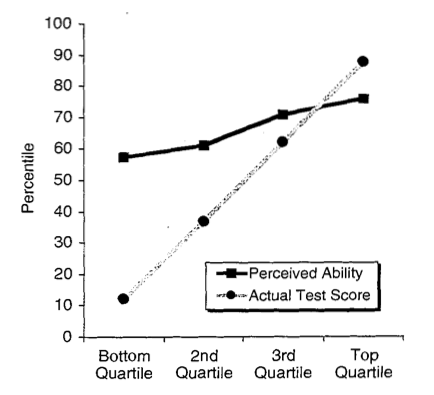
You have probably heard about the science that shows how incompetent people are overconfident.  Here is a nice article which cuts through some of the hype and then presents a variety of ways to debunk the finding as a statistical illusion.  (Which comes as a relief to me, but perhaps a little late.) Let me give you an even easier way, one that is related to the “regression toward the mean” idea given in the article. First, here is the finding summarized in a graph.

Suppose you have competent and incompetent people in equal proportions.  They will take a test which will give them a score ranging from 0 to 4.  The competent people score a 3 on average and they know this.  The incompetent people score 1 on average and they know this.  Due to idiosyncratic features of the test, the weather, etc. each subject’s actual score is random and it will range from one less to one more than their average.

You ask everyone to predict their outcome.  The incompetent people predict a score of 1 and the competent people predict a score of 3.  These are the best predictions.  Then they take the test.  The actual scores range from 0 to 4.  Everyone who scored 0 predicted a score of 1, everyone who scored 4 predicted a score of 3, and the average prediction of those who scored 2 is about 2.

Trilby tribute:  Marginal Revolution.

Some organizations have clearly defined goals and many of the tactics to meet their goals come readily to mind.  An economics department wants to produce the best research possible and the best grad students possible.  They try to hire great professors, train students well and place them in good universities.  If the organization is resource constrained, there will be conflict.  A good leader for this kind of organization needs strong arbitration and mediation skills but not vision.  A neutral player is the ideal leader.  A leader with strong preferences one way or the other will alienate some members and escalate conflict. Only if the organization needs to radically alter course will vision be required.  For example, if an economics department wants to leap up in the rankings or is in danger of decline, a visionary needs to take control.

But in most organizations and at most points in time, things are not so easy.  A firm wants to maximize profits but how should it do so?  For example, Microsoft has done very well for itself but how many it avoid being left behind as Apple and Google capture the imagination of new consumers?  And Microsoft needed a vision when it started and when it grew.   In some organizations, there is a fundamental uncertainty about what an organization should be doing and where it should be going.  Almost everyone may accept that the status quo is not sustainable and that a leader with a vision for the organization should take control.  In this scenario, there are common values among the members of the organization and for better or worse it will move in some direction established by the vision of the leader.  If everyone does not agree, then the organization will stay at the status quo.  It may slowly or even rapidly depreciate.  Only a random shock can salvage it.

If you play tennis then you know the coordination problem.  Fumbling in your pocket to grab a ball and your rallying partner doing the same and then the kabuki dance of who’s gonna pocket the ball and who’s going to hit first?  Sometimes you coordinate, but seemingly just as often the balls are simultaneously repocketed or they cross each other at the net after you both hit.

Rallying with an odd number of balls gives you a simple coordination device.  You will always start with an unequal number of balls, and it will always be common knowledge how many each has even if the balls are in your pockets.

I used to think that the person holding 2 or more should hit first.  That’s a bad convention because after the first rally you are back to a position of symmetry.  (And a convention based on who started with two will fail the common knowledge test due to imperfect memory, especially when the rally was a long one.)

Instead, the person holding 1 ball should hit first.  Then the subgame following that first rally is trivially solved because there is only one feasible convention.

By the way, this observation is a key lemma in any solution to Tyler Cowen’s tennis ball problem.

Of course this works with any odd number of balls.  But five is worse.  It becomes too hard to keep track of so many balls and eventually you will lose common knowledge of the total number of balls in rotation.

With many neighbors willing to help with childcare, my wife and I managed to escape for a quick meal on our own.  We went to Anteprima, within easy striking distance of Evanston.  At a dinner at Rialto in Boston, I’d guessed that we’d eat better and cheaper at Anteprima and our experience proved me right.  The chef has the market-driven sensibility that is all the rage.  I was in luck because someone must have brought squash blossoms to the market that week.  So, I had lovely fried zucchini flowers stuffed with ricotta-herb mix.  My wife had the Tuscan crostini and enjoyed it as well.  We both settled for the spaghetti with tomato, chilis and crispy breadcrumbs – easily made at home unlike the stuffed squash blossoms!  We didn’t regret it as it was executed perfectly.

In New York City, people might expect this kind of meal from their local Italian joint.  After Boston, it seemed extraordinary to us.

For dessert, we ended up getting overpriced gelato at Pasticceria Natalina. The owner makes quite exceptional pastries but the pricing is crazy.  No-one else was there and I wonder if this unique place is going to last too much longer.  Someone should tell them about the trade-off between margin and volume and perhaps also how to calculate margin correctly in the first place – don’t incorporate fixed and sunk costs into your pricing decision!  It makes you think that elementary economics is actually useful for business owners.

How often do you and your friends agree?

According to recent work by Winter Mason, Duncan Watts, and myself [Sharad Goel], you probably don’t know them as well as you think. In particular, we found that when friends disagree on a political issue, they are unaware of that disagreement about 60% of the time. Even close friends who discuss politics are typically unaware of their differences in opinions.

You probably can guess my reaction.  (Or at least you think you can.)  Since I am always right, and my friends are right more often than they are wrong, I am right to assume that they agree with me more often than not.

It turns out that my distant friends are right just about as often as my close friends:

people consistently overestimate the likelihood that their friends agree with them on political issues. Notably, even though close friends (so-called strong ties[1]) are in reality more likely to agree with one another than distant friends, people do not appropriately adjust their perceptions. In other words, though we think close and distant friends are about equally likely to agree with us on political issues, in reality we are much more likely to agree with close friends.

I am very interested in this kind of survey work because I think that people do overestimate how similar they are to the rest of the world and I think it has important consequences.  But perhaps for different reasons than these authors are emphasizing.

At the margin people are too reluctant to express themselves because they assume that what they have to say is obvious.  But in fact the obvious thing is exactly what you want to say.  Because the more obvious the thought the more likely it is uniquely yours and the more valuable it is to others.

Apple’s latest response to the iPhone 4 antenna issue:

Upon investigation, we were stunned to find that the formula we use to calculate how many bars of signal strength to display is totally wrong. Our formula, in many instances, mistakenly displays 2 more bars than it should for a given signal strength. For example, we sometimes display 4 bars when we should be displaying as few as 2 bars. Users observing a drop of several bars when they grip their iPhone in a certain way are most likely in an area with very weak signal strength, but they don’t know it because we are erroneously displaying 4 or 5 bars. Their big drop in bars is because their high bars were never real in the first place.

Apple will soon be releasing a software update that will fix the problem by lowering the number of bars displayed on your phone.  In related news, in response to my students’ grade groveling I have re-examined the midterm and noticed that everyone’s score was 5 points higher than it should have been.  The curve has been re-calculated.

It gets harder and harder to avoid learning the outcome of a sporting event before you are able to get home and watch it on your DVR.  You have to stop surfing news web sites, stay away from Twitter, and be careful which blogs you read.  Even then there is no guarantee.  Last year I stopped to get a sandwich on the way home to watch a classic Roddick-Federer Wimbledon final (16-14 in the fifth set!) and some soccer-moms mercilessly tossed off a spoiler as an intermezzo between complaints about their nannys.

No matter how hard you try to avoid them, the really spectacular outcomes are going to find you.  The thing is, once you notice that you realize that even the lack of a spoiler is a spoiler. If the news doesn’t get to you, then at the margin that makes it more likely that the outcome was not a surprise.

Right now I am watching Serena Williams vs Yet-Another-Anonymous-Eastern-European and YAAEE is up a break in the first set.  But I am still almost certain that Serena Williams will win because if she didn’t I probably would have found out about it already.

This is not necessarily a bad thing.  Unless the home team is playing, a big part of the interest in sports is the resolution of uncertainty.  We value surprise. Moving my prior further in the direction of certainty has at least one benefit: In the event of an upset I am even more surprised.  This has to be taken into account when I decide the optimal amount of effort to spend trying to avoid spoilers.  It means that I should spend a little less effort than I would if I was ignoring this compensating effect.

It also tells me something about how to spend that effort.  I once had a match spoiled by the Huffington Post.  I never expected to see sports news there, but ex post I should have known that if HP is going to report anything about tennis it is going to be when there was an upset.  You won’t see “Federer wins again” there.

Finally, if you really want to keep your prior and you recognize the effects above, then there is one way to generate a countervailing effect.  Have your wife watch first and commit to a random disclosure policy.  Whenever the favorite won, then with probability p she informs you and with probability 1-p she reveals nothing.

Tyler Cowen forwards an email sent by a loyal reader disputing the argument that governments should borrow and spend more when interest rates are low.

But assume that the U.S. borrows an extra trillion of dollars now, due in 10 years (the average debt duration of the U.S. debt is something like 4 years?). Sure, the interest rate is low, but the borrowing is cheap only as long as we assume that during the 10 years the U.S. repays this whole extra debt, compared to what would have happened in the baseline world.

This does not affect the argument in any way.  The economic argument for borrowing when interest rates are low says this.  Suppose you have a plan for the future about when you will do your spending, borrowing, and repayment.  This plan is predicated on your expectations of the path of interest rates. Now suppose that, as a surprise, interest rates are lower today than you expected.  Then, other things equal, your original plan is no longer optimal.  You should re-adjust and borrow more today.

The operative word here is “more.”  I did not write “borrow a lot today.”  And in fact the conclusion could be that you don’t borrow at all because if the original plan was to make re-payments, then “borrowing more” means (on net) just repaying less.

There is nothing at all deep about the economics here.  And in fact, its rare that there is much deep economics involved when the economics really matters. Economics is really, really easy.  What is hard is to use economics faithfully in your rhetoric.  Advocates of increased borrowing and spending don’t ever refer to the default plan from which we should be adjusting.  And without that (and the default plan probably doesn’t really exist) there isn’t much economics behind the rhetoric.

All sides are guilty.  Tyler’s reader should be saying “the price of funds is determined by the path of interest rates, not just their value now and therefore this mutes to some degree the effect on borrowing of a drop in interest rates.”  This is another very simple economic point.  But it’s hard to resist the temptation to distort it from a simple comparative statement to one that is absolute.

It’s a variation on the old coordinated attack problem or Rubinstein’s electronic mail game.  But this one is much simpler and even more surprising.  It is due to my colleague Jakub Steiner and his co-author Colin Stewart.

Two generals, you and me, have to coordinate an attack on the enemy.  An attack will succeed only if we both attack at the same time and if the enemy is vulnerable.

From my position I can directly observe whether the enemy is vulnerable.  You on the other hand must send a scout and he will return at some random time. We agree that once you learn that the enemy is vulnerable, you will send a pigeon to me confirming that an attack should commence.  It will take your pigeon either one day or two to complete the trip.

Suppose that indeed the enemy is vulnerable, I observe that is the case, and on day n your pigeon arrives informing me that you know it too.  I am supposed to attack.  But will I?

Since you sent a pigeon I know that you know that the enemy is vulnerable.  But what day did you send your pigeon?  It could be either n-1 or n-2.  Suppose it was n-1, i.e. the pigeon arrived in one day.  Then you don’t know for sure that the pigeon has arrived yet.  So you don’t know that I know that you know that the enemy is vulnerable.  And that means you can’t be certain that I will attack so you will not attack.  And now since I cannot rule out that you sent the pigeon on day n-1, and if that was indeed the date you sent it you will not attack, then I will not attack either.

Thus, an attack will not occur the day I receive the pigeon.  In a certain sense this is obvious because only I know what day I receive the pigeon.  But the surprising thing is that there is no system we can use to decide the date of an attack and have it be successful.

Suppose that we have decided on some system and according to that system I am supposed to attack on date k.  What must be true for me to actually be willing to follow through?  First, I must expect you to be attacking too.  And since you will only attack if you know that the enemy is vulnerable, I will only attack if I have received your pigeon confirming that you know.

But that is not enough.  You will only attack if you know that I will attack and we just argued that this requires that I know that you know that the enemy is vulnerable.  So you will attack only if you know that I have received your pigeon.  You can only be sure of this 2 days after you sent it.  And since I need to be sure you will attack, I will only attack if I received the pigeon yesterday or earlier so that I am sure that you sent it at least 2 days ago and are therefore sure that I have already received it.

But that is still not enough.  Since we have just argued that I will only attack if I received your pigeon at least 1 day ago, you can only be certain that I will attack if you sent your pigeon at least 3 days ago.  And that is therefore necessary for you to be prepared to attack.  But now since I will attack only if I am certain that you will attack, I need to be certain that you sent your pigeon at least 3 days ago and that requires that I received your pigeon at least 2 days ago (and not only yesterday.)

This goes on.  In order for me to attack I must know that you know that I know, etc. etc. that the enemy is vulnerable.  And each additional iteration of this requires that the pigeon be sent one day earlier than the previous iteration. Eventually we run out of earlier days because today is day k.  This means that I will not attack because I cannot be sure that you are sure that (iterate k times) that the enemy is vulnerable.

I am driving to Chicago from Boston with two kids in the back of my car.  Random observations:

1. Julia Child’s My Life in France audiobook is family-friendly.  It sent the five year old to sleep and the nine year enjoyed it quietly, as did I.  Julia got a couple of rejections before getting her magnum opus accepted by Knopf.

2. Ithaca, Rome, Troy, Seneca Falls, Utica, Syracuse…..Why do so many towns have ancient, classical names?

3. We are staying in Geneva, faux-Switzerland, not Greece or Italy.  I recommend the Ramada Inn, right on the lake.

An eternal puzzle is how a husband/father handles visits by his mother without agonizing conflict between the wife and her mother-in-law.  Here is my Machiavellian solution.  The husband should engineer a conflict with his mother that puts him in the wrong.  Then the wife and her mother-in-law will naturally bond in the face of a mutual enemy.  Don’t forget the key condition that the crime has to be egregious enough so the wife does not come to your defense.  This is why the conflict should not be with the wife:  your mother, being your mother,  is naturally more inclined to side with you.  Added bonus:  husband is conveniently ostracized!

FIFA experimented with a “sudden-death” overtime format during the 1998 and 2002 World Cup tournaments, but the so-called golden goal was abandoned as of 2006.  The old format is again in use in the current World Cup, in which a tie after the first 90 minutes is followed by an entire 30 minutes of extra time.

One of the cited reasons for reverting to the old system was that the golden goal made teams conservative. They were presumed to fear that attacking play would leave them exposed to a fatal counterattack.  But this analysis is questionable.  Without the golden goal attacking play also leaves a team exposed to the possibility of a nearly-insurmountable 1 goal deficit.  So the cost of attacking is nearly the same, and without the golden goal the benefit of attacking is obviously reduced.

Here is where some simple modeling can shed some light.  Suppose that we divide extra time into two periods.  Our team can either play cautiously or attack.  In the last period, if the game is tied, our team will win with probability p and lose with probability q, and with the remaining probability, the match will remain tied and go to penalties.  Let’s suppose that a penalty shootout is equivalent to a fair coin toss.

Then, assigning a value of 1 for a win and -1 for a loss, p-q is our team’s expected payoff if the game is tied going into the second period of extra time.

Now we are in the first period of extra time.  Here’s how we will model the tradeoff between attacking and playing cautiously.  If we attack, we increase by G the probability that we score a goal.  But we have to take risks to attack and so we also we increase by L the probability that they score a goal.  (To keep things simple we will assume that at most one goal will be scored in the first period of extra time.)

If we don’t attack there is some probability of a goal scored, and some probability of a scoreless first period.  So what we are really doing by attacking is taking an G-sized chunk of the probability of a scoreless first period and turning it into a one-goal advantage, and also a L-sized chunk and turning that into a one-goal deficit.  We can analyze the relative benefits of doing so in the golden goal system versus the current system.

In the golden goal system, the event of a scoreless first period leads to value p-q as we analyzed at the beginning.  Since a goal in the first period ends the game immediately, the gain from attacking is

G - L + (1-G-L)(p-q).

(A chunk of sized G-L of the probability of a scoreless first period is now decisive, and the remaining chunk will still be scoreless and decided in the second period.)  So, we will attack if

p - q \leq G - L + (1 - G - L) (p-q)

This inequality is comparing the value of the event of a scoreless first period p-q versus the value of taking a chunk of that probability and re-allocating it by attacking.  (Playing cautiously doesn’t guarantee a scoreless first period, but we have already netted out the payoff from the decisive first-period outcomes because we are focusing on the net changes G and L to the scoring probability due to attacking.)

Rearranging, we attack if

p - q \leq \frac{G-L}{G+L}.

Now, if we switch to the current system, a goal in the first period is not decisive.  Let’s write y for the probability that a team with a one-goal advantage holds onto that lead in the second period and wins.  With the remaining probability, the other team scores the tying goal and sends the match to penalties.

Now the comparison is changed because attacking only alters probability-chunks of sized yG and yL.  We attack if

p - q \leq Gy - Ly + (1 - G - L) (p-q),

which re-arranges to

p - q \leq y\frac{G-L}{G+L}

and since y < 1, the right-hand side is now smaller.  The upshot is that the set of parameter values (p,q,y,G,L) under which we prefer to attack under the current system is a strictly smaller subset of those that would lead us to attack under the golden goal system.

The golden goal encourages attacking play.  The intuition coming from the formulas is the following.  If p > q, then our team has the advantage in a second period of extra time.  In order for us to be willing to jeopardize some of that advantage by taking risks in the first period, we must win a sufficiently large mass of the newly-created first-period scoring outcomes.  The current system allows some of those outcomes (a fraction 1-y of them) to be undone by a second-period equalizer, and so the current system mutes the benefits of attacking.

And if p<q, then we are the weaker team in extra time and so we want to attack in either case.  (This is assuming G > L.  If G< L then the result is the same but the intuition is a little different.)

I haven’t checked it but I would guess that the conclusion is the same for any number of “periods” of extra time (so that we can think of a period as just representing a short interval of time.)

In Asia the well-to-do avoid the sun (you’ve seen them with their parasols) because fair skin signals that you don’t spend your days outside, working.  In Europe they embrace the sun because a good tan signals that you don’t spend all your time inside, working.

Obama has two focal options in Afghanistan, “Stay the Course” or “Cut and Run”.  Stay the Course means continuing the current counterinsurgency (COIN) strategy of “winning hearts and minds” of Afghan civilians.  Cut and Run means getting out as soon as possible and leaving the Afghans to deal with their own mess.  In either scenario it is optimal to sack McCrystal.

McCrystal is a strong believer in COIN so if you want to Cut and Run, it s better to replace him with someone else, a true believer in Cut and Run.  If Obama wants to Stay the Course, McCrystal is a possible candidate.  But there is a reputational cost, looking weak, to Obama of retaining McCrystal.  Replacing him carries the risk that the COIN strategy fails.  But Petraeus is the author of COIN so this risk is minimized if Petraeus replaces McCrystal.  So, even if you want to Stay the Course, it is optimal to sack McCrystal.

Pretty simple?

  1. Tomato and Watermelon Soup (Cold)
  2. Marinated Anchovy “Lasagna”
  3. Tomatoes Stuffed With Squid Over Rice With its Ink and Carranza Cheese
  4. Grilled Hake With Potatoes and Iodized Mussel Juice
  5. Pan Roasted Cod With Olive Oil and Olive Oil Cream
  6. Carmelized French Toast With Ice Cream of Fresh Cheese
  7. Slightly Spicy Peach Gnocchi With Coconut Ice Cream and Vanilla Juice

Tomato and watermelon, it turns out, were made for each other. The fish was amazingly prepared. Course number 3 on its own would have been the best dinner I had in years. We drank with it a white, slightly sparkling Basque-country wine called Txomin Extaniz (2009), which itself was a revelation: the apple accent was so distinctive I almost mistook it at first for cider. The total price for two: about $2500.

But when you net out the sunk costs of the round trip airfare to Madrid, train from Madrid to Barcelona, flight and bus from Barcelona to Donostia (San Sebastian) and hotels along the way, what’s left is the paltry 100 euros we paid for the Menu al Degustacion at Bodegón Alejandro in the old city. San Sebastian is a pescatarian’s paradise and this was the third of three outstanding experiences we had here.

We were steered away from a Basque pinxto bar in Barcelona because we were told that we would be getting the real thing in San Sebastian. My advice: have your pinxtos in Barcelona or elsewhere and put SS to it’s best use. It may have an absolute advantage but it’s comparative advantage is the restaurant scene. I hereby rank this the best foodie playground in all of Europe for the astonishing density of incredibly high-quality, moderately priced menus.

It is truly unbelievable how easy it is to walk into any generic restaurant here, without reservations, sit down and have a phenomenal meal. And if you get bored of that it has more than its fair share of Michelin 3-stars too.

In a must-read article in the New Yorker (subscription required), Anthony Lane breaks down strategies for singers in the Eurovision Song Contest.  All the countries taking part get to vote for contestants from other countries.  The main problem – anyone who does not sing in English is at a big disadvantage because voters can’t understand them. Ironically, this means that contestants have to adopt English for the lyrics.   This can lead to beautiful poetry:

“Your breasts are like swallows-a-nesting” Sweden 1973

Unfortunately, strategizing only has an impact on a small batch of swing voters because most countries vote along geo-political fault lines.  Cyprus votes reliably for Greece and vice-versa.  Georgia cannot vote for Russia however mellifluous is the Russian entry.  The Scandinavians vote for each other etc etc.  The decisive votes for going to come from countries that are largely outside a current zone of conflict .  And votes are going to go to “common value” candidates that have not irritated anyone.  Ireland is a clear favorite, singing in English and being somewhat removed from the center of any Euro-controversies.

American has imported many entertainment phenomena from Europe (e.g. Simon Cowell).  Why not an Amerivision Song Contest which each state submitting a contestant?  A Presidential election with red states and blue states only gives us a shallow appreciation of what divides and unites Americans.  An Amerivision Song Contest would give a deeper insight into the soul of America.  Step aside American Idol.

Claire Bowern is undertaking a large scale survey of regional dialects within North America in attempt to identify patterns of variation along the lines of this:

But with a larger database and more variables.


Please help out and go here to take a short survey and record your voice.

  1. How will NFL marketing geniuses handle Super Bowl L?
  2. It is easier to hold your breath underwater because there is no instinct to breathe.
  3. By revealed preference, everyone is better off when goods are priced $99.99
  4. The new iPhone 4 gyroscope will make this possible.
  5. If you find something you have written sitting around at someone else’s house, pick it up and read it.  Your state of mind will be such that you see your writing through their eyes.
  6. Which words are uncapitalized in blog titles?

A hot day in Boston.  What could be better than a trip to the leafy sculpture garden at the DeCordova Museum?   Try to help the red man climb out of the Earth.  Build dams in the stream in the Rain Gates.  Tap on the Two Black Hearts to see if they hollow.  Try to take out the stovetop espresso maker embedded in one of the hearts.There is a lot more to see and do in the garden.  The Museum itself is in a lovely building. You can see the faux château roofs as you walk around the garden.  It has interesting exhibits and a little café that serves pre-made sandwiches and salads.  But the Museum is not the reason to go to the DeCordova.  It is the sculpture garden that makes it worth the trip.

1. The porn, wine, Chateau Petrus nexus.

2. Pretty girlfriend of Spanish goalie distracted him and caused horrible loss?  Perhaps not.

3. Pretty ex-girlfriend of English goalie distracted him and caused horrible mistake?  Who knows but sources are similar to 2.

  1. Jamiroquai, where is he (sic) now.
  2. Mickey Mouse’s adventures with amphetamines.
  3. X-ray pinup calendar.
  4. Presidential profanity.
  5. How to subtly flirt with your best friend.

Just as I get ready to head back to Evanston, I find a great coffee shop for work near MIT!

I like Crema Coffee in Harvard Square for its coffee and even its food.  Unfortunately, it’s too crowded and noisy for work.  1369 Coffee House is a little better for work but the products are worse.  And both branches, Central and Inman Square, are a bit cramped.  But a few blocks south of Central Square I found Andala Coffee House.  There’s table service, so the prices are a bit higher than you might expect.  The mint tea and hummus were well worth the extra few bucks.  There’s an outside patio, a porch that sticks out over the street and, as you come in, a large room with lots of windows.  It was a little chilly to sit outside and the porch was full so I had to settle for the large room.  It was fine.  The music is mellow and there is some quiet, pleasant chatter in the background.  I worked for two hours at high concentration and left regretting I had not found Andala earlier.  I’ll be back often over the next couple of weeks.

Here’s what my students said about me, presented in the form of a word cloud:

What are the primary teaching strengths of the instructor?

What are the primary weaknesses of the instructor?

Please summarize your reaction to this course focusing on the aspects that were most important to you.


Vast mineral resources in Afghanistan have recently been discovered by American geologists.

Nigeria has oil, Angola has diamonds but neither has a stable political system or a booming economy spreading wealth to all its citizens.  GDP fell by 1.3% per capita on average in OPEC countries from the late sixties to the late nineties.  On the other hand, Norwegians are quite happily enjoying their oil revenue.

There are economic reasons for a resource curse.  The price of the resource can fluctuate on world markets and so can the income of the producer.  The income generated by the resource can push up the price of non-tradables and distort domestic allocation of inputs.  But I would guess all of these pale into insignificance with the political implications of a resource curse.

If the force of law is weak, there is an overwhelming temptation to steal resources.  Rents are dissipated by fighting or defensive expenditures. Leaders are short-termists and over-extract resources fearing they will be out of power soon.

The rule of law must precede development.  A windfall can provoke contests not prevent them.

You (the sender) would like someone (the responder) to do you a favor, support some decision you propose or give you some resource you value.  You email the responder, asking him for help.  There is no reply.  Maybe he has an overactive Junk Mail filter or missed the email.  You email the responder again. No reply.  The first time round, you can tell yourself that maybe the responder just missed your request.  The second time, you realize the responder will not help you.  Saying Nothing is the same as saying “No”.

Why not just say No to begin with?  Initially, the responder hopes you do not send the second email.  Then, when the responder reverses roles and asks you for help, you will not hold an explicit No against him.  By the time the second email is sent and received, it is too late – at this point whether you respond or not, there is a “No” on the table and your relationship has taken a hit.  The sender will eventually learn that often no response means “No”.  Sending a second email, while clearing up the possibility the first non-response was an error, may lead to a worsening of the relationship between the two players.  So, the sender will weigh the consequences of the second email carefully and perhaps self-censor and never send it.

Then, Saying Nothing will certainly be better than Saying No for the responder and a communication norm is born.

Here is the advice from Annie Duke, professional poker player and the 2006 Champion of the World Series of Rock, Scissors, Paper:

The other little small piece of advice that I would give you is that people tend to throw rock on their first throw. Throwing paper is usually not a good strategy because they might throw scissors. You should throw rock as well.

The key is, and this is the best piece of advice that I can give you, if you do think that you recognize the pattern from your opponent, it’s good to try to throw a tie as opposed to a win. A tie will very often get you a tie or a win, whereas a win will get you a win or a loss. For example, if you think that someone might throw a rock, it’s good to throw rock back at them. You should be going for ties.

If at first it sounds dumb, think again.  The idea is some combination of pattern learning and level-k thinking:  If she thinks that I think that I have figured out her pattern and it dictates that she will play Rock next, then she expects me to play Paper and so in fact she will play Scissors. That means I should play Rock because either I have correctly guessed her pattern and she will indeed play Rock and I will tie, or she has guessed that I have guessed her pattern and she will play Scissors and I will win.

She is essentially saying that players are good at recognizing patterns and that most players are at most level 2

Research note:  why are we wasting time analyzing penalty kicks?  Can we get data on competitive RoShamBo? While we wait for that here is an exercise for the reader:  find the minimax strategy in this game:

My male colleagues at Kellogg are a clean-shaven, short-haired bunch. The first hypothesis is that the “business casual” atmosphere at a B-School makes the a clean-cut JCrew look focal and any deviation from it socially uncomfortable (though I have no qualms about ignoring it!). But colleagues on the Econ Dept, which is outside the B-School, also largely subscribe to this norm. Even short-sporting, flip-flop wearing, oldish-wannabe-surfer-economists from Southern California seem to shave daily. I can remember this pattern from grad school: the Europeans were pretty casual about shaving and the Americans were much more likely to have the clean-cut look.  There was no business casual social norm to conform to in grad school, so I don’t think that explanation carries all the water.

Another rationale for the buzz cut can be safely dismissed: if you think that having sticking with short hair saves on visits to the barber, you’re wrong. For this rationale to work, you have to be willing to have long hair too, otherwise you’re going quite often to the barber to keep it short all the time.  So if you are unwilling to go long, going short keeps your barber nicely employed.

I am led then to the Jeff Van Gundy explanation:

My dad said, ‘You can’t have normal-length hair until high school.’ It was a form of discipline.

Not only is it is a form of discipline, it is a signal of discipline.  You are disciplined enough to have regular haircuts and, by extension, shave regularly.  On the other hand, Europeans are busy counter-signaling: you are undisciplined and do incredibly well on exams, so you must be really smart!   No wonder Europeans and Americans can have such a hard time communicating with each other.

Hmmn.  After all this analysis, I guess I still have to work out what look to adopt.  After all, some scruffy people are hirsute because they truly are undisciplined.  Gotta make sure I’m not in that group.

David Byrne, singer of the Talking Heads, solo artist, and blogger, is suing Charlie Crist for the use of the song “Road to Nowhere” in an advertisement for his Florida Senate campaign.  One of the reasons given is interesting.  Because the law requires that permission be granted:

… use of the song and my voice in a campaign ad implies that I, as writer and singer of the song, might have granted Crist permission to use it, and that I therefore endorse him and/or the Republican Party, of which he was a member until very, very recently. The general public might also think I simply license the use of my songs to anyone who will pay the going rate, but that’s not true either, as I have never licensed a song for use in an ad. I do license songs to commercial films and TV shows (if they pay the going rate), and to dance companies and student filmmakers mostly for free. But not to ads.

Note that if there were no requirement to ask for permission then there would be no such inference.  (Not that it would change things in this case because David Byrne is opposed for other reasons as well.)