For 15 years, the British bookmaker William Hill allowed bettors to wager on their own weight loss, often taking out full-page newspaper ads to publicize the bet.  This was a clear opportunity for those looking to lose weight to make a commitment, with real teeth.  Here is a paper by Nicholas Burger and John Lynham which analyzes the data.

Descriptive statistics are presented in Table 2, which shows that 80% of bettors lose their bets. Odds for the bets range from 5:1 to 50:1 and potential payoffs average $2332.9 The average daily weight loss that a bettor must achieve to win their bet is 0.39 lbs. In terms of reducing caloric intake to lose weight, this is equivalent to reducing daily consumption by two Starbucks hot chocolates. The first insight we draw from this market is that although bettors are aware of their need for commitment mechanisms, those in our sample are not particularly skilled at selecting the right mechanisms.10 Bettors go to great lengths to construct elaborate constraints on their behaviour, which are usually unsuccessful.

Women do much worse than men.  Bets in which the winnings were committed to charity outperformed the average.  Bets with a longer duration (Lose 2x pounds in 2T days rather than x pounds in T days) have longer odds, suggesting that the market understands time inconsistency.

Beanie barrage:  barker.

Recruit homeless people to run as candidates in an opposing party.  Steve May, Republican party operative in Arizona is recruiting three way-way-outside-the-beltway candidates to run for the Green party in a local election, expecting that Green candidates will siphon votes from Democratic candidates.

“Did I recruit candidates? Yes,” said Mr. May, who is himself a candidate for the State Legislature, on the Republican ticket. “Are they fake candidates? No way.”

To make his point, Mr. May went by Starbucks, the gathering spot of the Mill Rats, as the frequenters of Mill Avenue are known.

“Are you fake, Benjamin?” he yelled out to Mr. Pearcy, who cried out “No,” with an expletive attached.

“Are you fake, Thomas?” Mr. May shouted in the direction of Thomas Meadows, 27, a tarot card reader with less than a dollar to his name who is running for state treasurer. He similarly disagreed.

“Are you fake, Grandpa?” he said to Anthony Goshorn, 53, a candidate for the State Senate whose bushy white beard and paternal manner have earned him that nickname on the streets. “I’m real,” he replied.

Whether it is desirable to have your kid fall asleep in the car goes through cycles as they age. It’s lovely to have your infant fall asleep in the snap-out car carriers. Just move inside and the nap continues undisturbed. By the time they are toddlers and you are trying to keep a schedule, the car nap only messes things up. Eventually though, getting them to fall asleep in the car is a free lunch:  sleep they wouldn’t otherwise get, a moment of peace you wouldn’t otherwise get. Best of all at the end of a long day if you can carry them into bed you skip out on the usual nighttime madness.

Our kids are all at that age and so its a regular family joke in the car ride home that the first to fall asleep gets a prize. It sometimes even works. But I learned something on our vacation last month we went on a couple of longer then usual car trips. Someone will fall asleep first, and once that happens the contest is over. The other two have no incentives. Also, in the first-to-fall game, each child has an incentive to keep the others awake. Not good for the parents. (And this second problem persists even if you try to remedy the first by adding runner-up prizes.)

So the new game in town is last-to-sleep gets a prize. You would think that this keeps them up too long but it actually has some nice properties. Optimal play in this game has each child pretending to sleep, thereby tricking the others into thinking they can fall asleep and be the last. So there’s lots of quiet even before they fall asleep. And there’s no better way to get a tired kid to fall asleep than to have him sit still, as if sleeping, in a quiet car.

Let’s take a bike ride next to the Lake Michigan and see what our impressions are of the neighborhoods we ride through.

We start in south Evanston.  We can ride on a path of some sort next to the lake all the way to Lincoln St in north Evanston, about 2-3 miles.   We see lovely sandy beaches on our right (i.e to the east) and on our left we see families barbecuing or picnicking.   We pass playgrounds, tennis courts and enter the grounds of Northwestern University.  We bike around a lovely lagoon.  We pause and look back south to take in a fantastic view of downtown Chicago.

Our impressions of Evanston are pretty good so far: nice bike path, nice views, generous provision of public goods.  This impression fades a little after Lincoln.  We continue north, perhaps heading east on Central and then north again on Ridge St. Or we take a big risk and ride on Sheridan.  Potholes whichever way we go.  And fast cars if we go on Sheridan.  We amend our impression of Evanston: perhaps the local government isn’t as flush with cash as we thought.

Then, we enter Wilmette. We have to bike on the road but there is a lovely bike lane. All smooth and fast. We start thinking we’re pretty fit as we pick up speed. We realize we’re heading downhill so maybe not. We pass a lovely Bahai Temple. We try getting closer to the lake to recreate our wonderful Evanston experience.  Big mistake: many parts of the road are cobbled to slow down traffic.  Our arms get tired and we feel the beginning of a backache.  So, we head back to Sheridan and ride along the road looking at the large houses and wondering how much they cost.  By the time we leave Wilmette, we have a mixed impression.  Nice bike path but are the cobbles really necessary?  Sure they slow down cars but Wilmette ain’t no urban metropolis – there’s no traffic  to slow down in the first place.  We remember why we decided not to move to Wilmette but are happy they have a nice bike path.

Next, we ride into Kenilworth.  The houses are even larger.  There’s the odd McMansion but it’s hard to see behind the trees, at the end of a long drive.  The bike lane suddenly disappears and we’re left high and dry.  At least the road is wide and Kenilworth is small and we enter  Winnetka.  The road narrows. More potholes than Evanston.  Have we crossed a boundary back into a poor neighborhood? We look around.  A line of mutant double-cheeseburger-meets-big-macs homes as far as the eye can see.  Surely richer than Evanston.  We conclude that they are deliberately not maintaining the road to keep interlopers out of their chi-chi town.  We’re a little disgusted and anyway we’re risking our life riding on this road.

We cut across to the Green Bay Trail.  We realize that riding along the lakefront, seeing all those big houses, has triggered avarice and envy.  We’re a little disgusted at having fallen prey to such base emotions.  We hunker down and pedal hard, ignoring Glencoe and Highland Park.

Is the United States the world’s dominant exporter of culture?  If this were true of any area you would think that area would be pop music.  But it appears not to be the case.

In this paper we provide stylized facts about the global music consumption and trade since 1960, using a unique data on popular music charts from 22 countries, corresponding to over 98% of the global music market. We find that trade volumes are higher between countries that are geographically closer and between those that share a language. Contrary to growing fears about large- country dominance, trade shares are roughly proportional to country GDP shares; and relative to GDP, the US music share is substantially below the shares of other smaller countries. We find a substantial bias toward domestic music which has, perhaps surprisingly, increased sharply in the past decade. We find no evidence that new communications channels – such as the growth of country-specific MTV channels and Internet penetration – reduce the consumption of domestic music. National policies aimed at preventing the death of local culture, such as radio airplay quotas, may explain part of the increasing consumption of local music.

Here is the paper by Ferreira and Waldfogel.  And before you click on this link, guess which country is the largest exporter as a fraction of GDP.

If you receive email from ‘me’ and every instance of the word “me” is single-quoted, as in ‘me,’ don’t bother looking for any hidden message.

Rather it is a strange bug in my iPhone text-substitution mechanism which replaces every instance of me with ‘me.’ I could probably figure out how to fix this, but I might not. Sometimes feel like I am encased in single quotes so it seems appropriate.

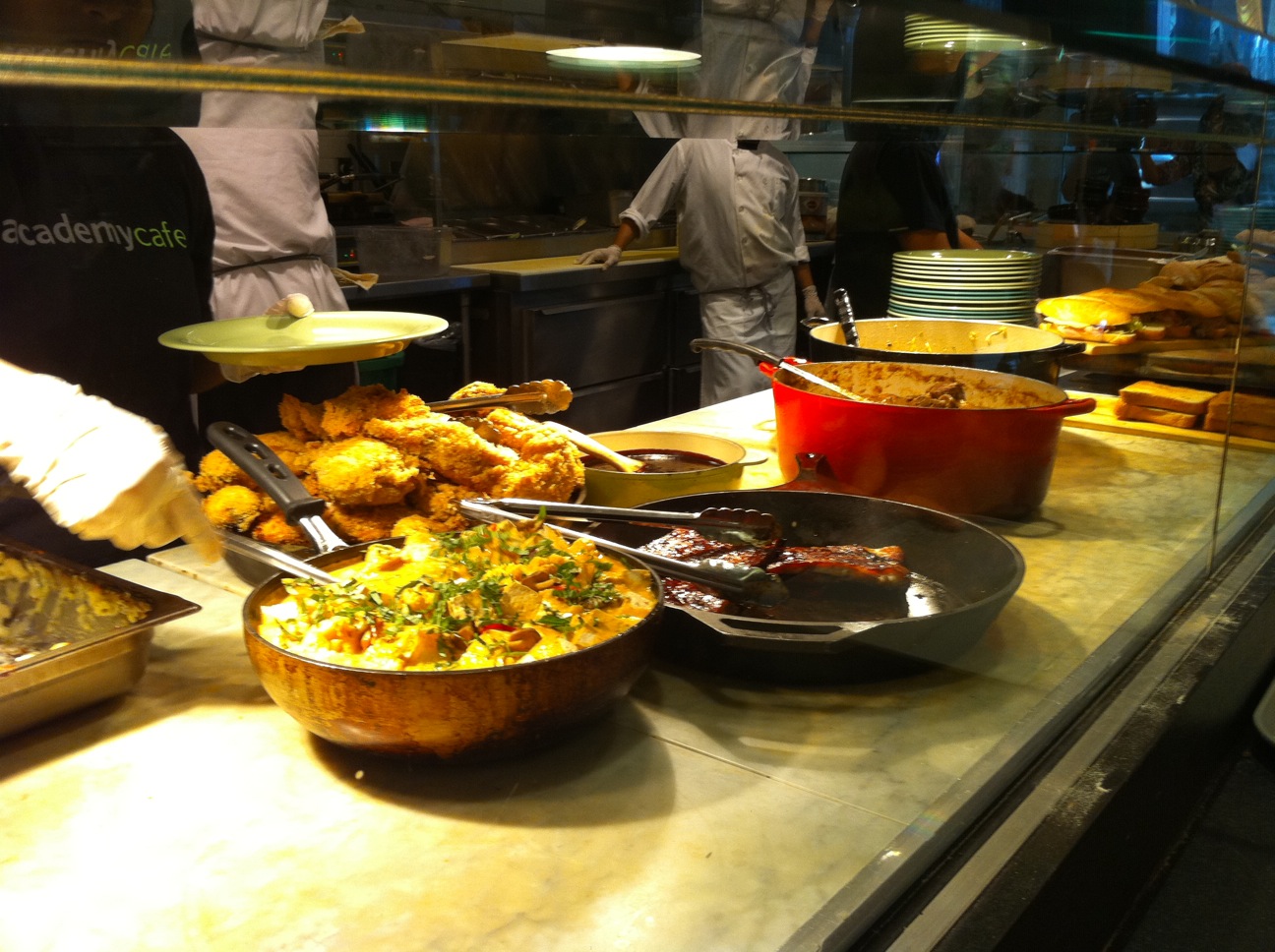
We planned to have a quick bite at the cafe before spending the afternoon at the California Academy of Sciences, an aquarium/science museum in Golden Gate Park.  But when we walked in we knew right away that we would be spending at least as much time in the cafe as in the museum.

Freshly prepared fast food from many cuisines.  It’s San Francisco on a plastic tray.  We had tofu and cauliflower curry with brown rice, an hierloom tomato salad, barbecued ribs, carnitas tacos, Pho, steamed pork buns, and blackberry agua fresca.  This fed 7 of us and cost about 70 bucks.  With more time we could have doubled that.

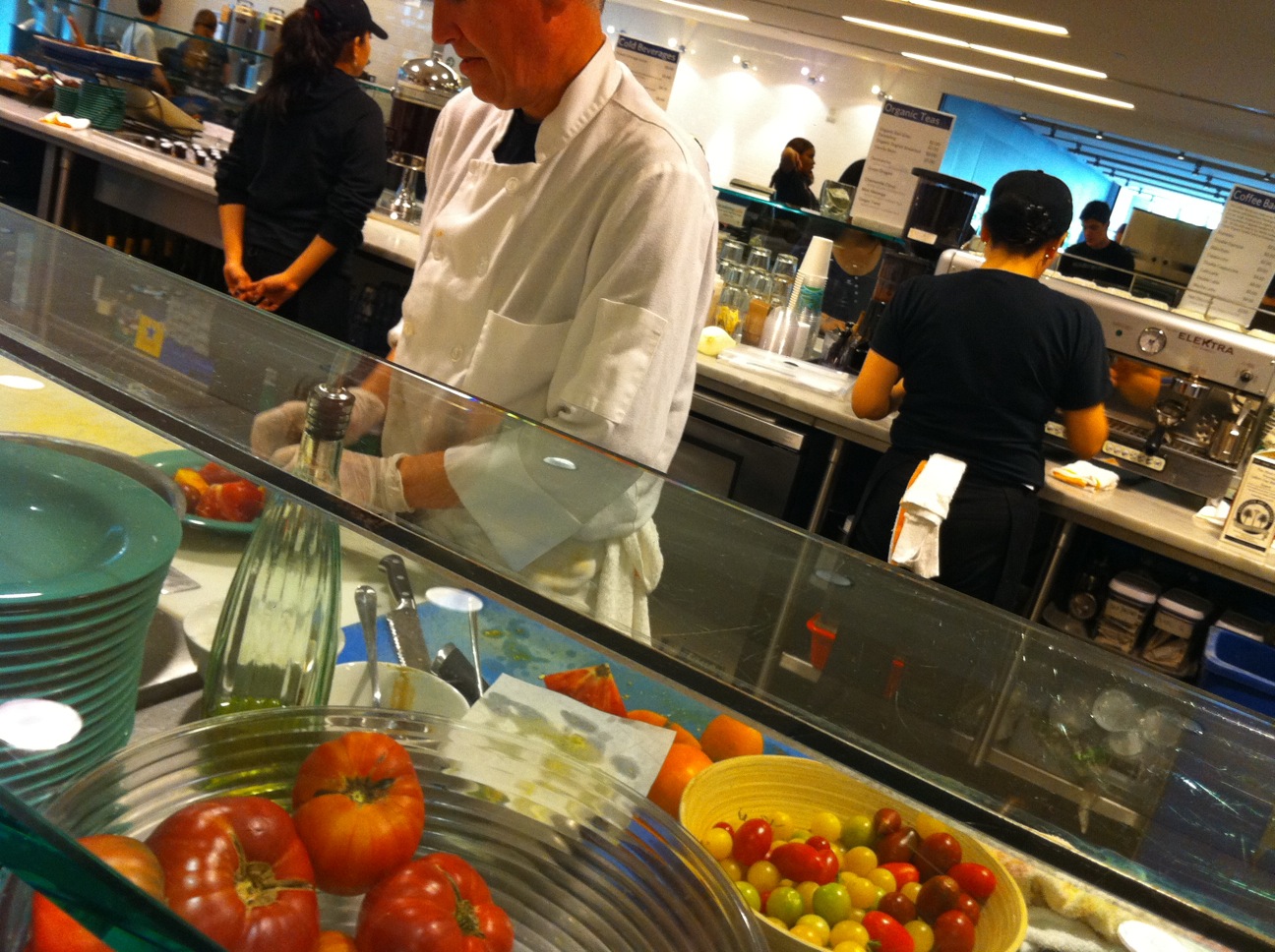
The stalls are organized by cooking style rather than cuisine.  “Steamed,” “Slow-Cooked,” etc.  Many of the stalls have cooks stationed behind who will prepare the food on the spot.  Here’s the guy making the tomato salad:

Be careful to skip the first cafe you see from the entrance to the building.  It’s inviting because it has terrace seating but your resistance is rewarded.  There is a sit-down restaurant downstairs which will be our dinner destination the next time we come (without kids.)


The museum?  Brilliant.  It has a rain forest.  The aquarium dominates Chicago’s Shedd despite being only 1/8 of the size.  We spent 3 hours there and didn’t even make it to the planetarium.  Next time.


Unlike the first bottle, the second must be profound. In selecting, you are obliged to demonstrate sophistication without descending into foolishness. Nobody wants to hear your reflections on the beads of dew you observed on the leaves of Pinot Noir vines when bicycling through the Côte d’Or in ’92. Save your ruminations on imaginary nymphs frolicking in the fields. And for goodness’ sake, do not talk like some early-twentieth-century English fop, describing the bottles you decide against as guttersnipes. Never mention Bacchus. Ever.

That’s from Alan Richman’s tips for ordering wine at dinner.

  1. Roger Federer is William Tell
  2. New album from The Bad Plus.  And here are the places I need to be this fall.
  3. Basque wine.
  4. Charles Keating’s pornography research
  5. Punk math.

Syllabus for his course on Leadership:

  • 7th September 2010: “The Importance of Leading Differently – The Changing Operating Environment”
  • 14th September 2010: “Case Study: The Changing Military 1972-2010”
  • 21st September 2010: “Role of a Leader”
  • 27th September 2010 (6-8pm): “Coping With Failure”
  • 28th September 2010 (Assignment 1 Due): “Building Teams – What Makes Some Great”
  • 5th October 2010: “Driving Change and Operating Differently”
  • 12th October 2010: “Navigating Politics”
  • 19th October 2010: “Making Difficult Decisions Pt. 1 – How We Decide”
  • 26th October 2010 (Assignment 2 Due): “Making Difficult Decisions Pt. 2 – Dealing With Risk”
  • 2nd November 2010: “Loyalty, Trust and Relationships”
  • 9th November 2010: “Dealing With Cultural Differences”
  • 16th November 2010: “Communicating the Story – the Media Environment”
  • 30th November 2010 (Assignment 3 Due): “The Leader – the Personal Impact of Responsibility, Notoriety and Other Realities”
  • 7th December 2010: “The Future Leader”

Details about the first class:

7th September 2010 – Seminar 1: The Importance of Leading Differently: The Changing Operating Environment

Description: A description of how changes in our operating environment over the 34 years of my service have demanded changes in how organizations operate – and how leaders lead them. For the military, focus often falls too narrowly – on technological advances in weaponry and armor. But like most organizations, truly significant changes in technology, politics, media, and society overall have driven change to almost every aspect of leading. Increasingly, the product of a failure to change – is failure.

Historical Examples:

  • Case Study 1: The career of Stanley McChrystal
  • Case Study 3: The 2002-2003 decision to invade Iraq
  • Case Study 3: The United States Civil War
  • Case Study 4: German Grand Strategy of World War 2

Primary Reading

  • Filkins, Dexter. Stanley McChrystal’s Long War. The New York Times Magazine.
  • 18th October 2009. P. 36.

Supplemental Reading

  1. FM 6-22 Army Leadership, Chapter 10: Influences on Leadership (Operating Environment, Stress in Combat, Stress in Training, Dealing with the Stress of Change, Tools for Adaptability).
  2. Coutu, Diane L., “How Resilience Works,” Harvard Business Review on Leading in Turbulent Times. Harvard Business School Press. 2003.
  3. Gehler, Christopher P. Agile Leaders, Agile Institutions: Educating Adaptive and Innovative Leaders for Today and Tomorrow. Strategy Research Project.
  4. Carlisle Barracks, PA: U.S. Army War College, 2005. 26pp. http://handle.dtic.mil/100.2/ADA434868
  5. Wong, Leonard. Developing Adaptive Leaders: The Crucible Experience of Operation Iraqi Free-dom. Carlisle Barracks, PA: U.S. Army War College, Strategic Studies Institute, 2004. 23pp. http://handle.dtic.mil/100.2/ADA424850
  6. Doyle, Michele Erina and Mark K. Smith, “Classical Leadership: theories of leadership” article (ILE materials)
  7. Reed, George E., ”Warrior Ethos” (ILE materials)
  8. Gardener, John. On Leadership. New York: Free Press. 1990., Chapters 1-3.

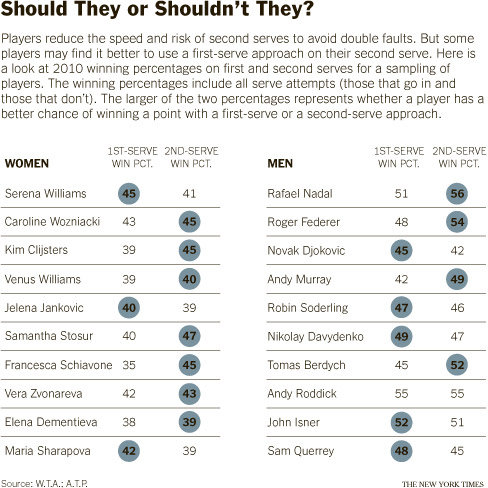
The data on first vs. second serve win frequency cannot be taken at face value because of selection problems that bias against second serves.  The general idea is that first serves always happen but second serves happen only when first serves miss.  The fact that the first serve missed is information that at this moment serving is harder than usual.  In practice this can be true for a number of reasons:  windy conditions, it is late in the match, or the server is just having a bad streak.  In light of this, we can’t conclude from the raw data that professional tennis players are using sub-optimal strategy on second serves.

To get a better comparison we need an identification strategy:  some random condition that determines whether the next serve will be a first or second serve.  We would restrict our data set to those random selections.  Sounds hopeless?

When a first serve hits the net and goes in it is a “let” and the next serve is again a first serve.  But if it goes out then it is a fault.  The impact with the net introduces the desired randomness, especially when the ball hits the tape and bounces up.  Conditional on hitting the tape, whether it lands in or out can be considered statistically independent of the server’s current mental state, the wind conditions, and the stage of the game.  These are the ingredients for a “natural experiment.”

Here is Sandeep’s post on the data discussed in the New York Times about winning percentages on first and second serves in tennis.There are a few players who win with higher frequency on either the first or second serve and this is a puzzle. Daniel Khaneman even gets drawn into it.  (To be precise, we are calculating the probability she wins on the first serve and comparing that to the probability she wins conditional on getting to her second serve.  At least that is the relevant comparison, this is not made clear in the article.  Also I agree with Sandeep that the opponent must be taken into consideration but there is a lot we can say about the individual decision problem. See also Eilon Solan.)

And the question persists: would players have a better chance of winning the point, even after factoring in the sure rise in double faults, by going for it again on the second serve — in essence, hitting two first serves?

But this is the wrong way of phrasing the question and in fact by theory alone, without any data (and definitely no psychology), we can prove that most players do not want to hit two first serves.

One thing is crystal clear, your second serve should be your very best.  To formalize this, let’s model the variety of serves in a given player’s arsenal.  For our purposes it is enough to describe a serve by two numbers.  Let x be the probability that it goes in and the point is lost and let y be the probability that it goes in and the point is won.  Then x + y \leq 1 and 1 - (x +y) is the probability of a fault (the serve goes out.) The arsenal of serves is just the set of pairs (x,y) that a server can muster.

Your second serve should be the one that has the highest y among all of those in your arsenal.  There should be no consideration of “playing it safe” or “staying in the point” or “not giving away free points” beyond the extent to which those factor into maximizing y the probability of the serve going in and winning.

But it’s a jumped-to conclusion that this means your second serve should be as good as your first serve.  Because your first serve should typically be worse!

On your first serve it’s not just y that matters.  Because not all ways of not-winning are equivalent.  You have that second serve y to fall back on so if you are going to not-win on your first serve , better that it come from a faulted first serve than a serve that goes in but loses the point.  You want to leverage your second chance.

So, you want in your arsenal a serve which has a lower y than your second serve (it can’t be higher because your second serve maximizes y) in return for a lower x.  That is, you want decisive serves and you are willing to fault more often to get them.  Of course the rate of substitution matters. The best of all first serves would be one that simply lowers x to zero with no sacrifice in winning percentage y.  At the other extreme you wouldn’t want to reduce y to zero.

But at the margin, if you can reduce x at the cost of a comparatively small reduction in y you will do that. Most players can make this trade-off and this is exactly how first serves differ from second serves in practice.  First serves are bombs that often go out, second serves are rarely aces.

So when Vanderbilt tennis coach Bill Tym says

“It’s an insidious disease of backing off the second serve after they miss the first serve,” said Tym, who thinks that players should simply make a tiny adjustment in their serves after missing rather than perform an alternate service motion meant mostly to get the ball in play. “They are at the mercy of their own making.”

he might be just thinking about it backwards.  The second serve is their best serve, but nevertheless it is a “backing-off” from their first serve because their first serve is (intentionally) excessively risky.

Statistically, the implications of this strategy are

  1. The winning percentage on first serves should be lower than on second serves.
  2. First serves go in less often than second serves.
  3. Conditional on a serve going in, the winning percentage on the first serve should be higher than on second serves.

The second and third are certainly true in practice.  And these refute the idea that the second serve should use the same technique as the first serve as suggested by the Vanderbilt coach. The first is true for most servers sampled in the NY Times piece.

Twenty years ago, David Kaplan of the Case Western Reserve University had a manuscript rejected, and with it came what he calls a “ridiculous” comment. “The comment was essentially that I should do an x-ray crystallography of the molecule before my study could be published,” he recalls, but the study was not about structure. The x-ray crystallography results, therefore, “had nothing to do with that,” he says. To him, the reviewer was making a completely unreasonable request to find an excuse to reject the paper.

The article surveys the usual problems with peer review and is worth a read. I recognize all of the problems and they are real but I am less bothered than most.  We don’t really need journals for dissemination anymore so the only function they serve is peer-review.  The slowness of the process is not so big a deal anymore.  (Unless you are up for tenure this year of course.)

Also, it’s true that reviewers are often just looking for excuses to reject a paper. But that is mainly because they feel obliged to give some reason to justify their decision.  In many cases bad papers are like pornography.  You know them when you see them. Few referees are willing to write “I reject this paper because it’s not a good paper,”  so they have to write something else.  To the extent that this is a failure it’s because the effort in reading through the paper looking for an excuse could be more productively spent elsewhere.

Hard Hat Heave:  Lance Fortnow.

Abdelbasset al-Megrahi.  He was the Lockerbie bomber who was released from a Scottish prison because he had just a few weeks to live.  As it turns out, he lived for a year and may live for many more.

The public outrage has an uncomfortable edge to it.

Clinton yesterday implied strongly that Megrahi’s release, and his continued survival long beyond the three months predicted by Scottish ministers, meant justice for the families of the dead had been denied.

Let’s get this straight.  We agree on the following ranking of outcomes, from best to worst.

  1. Alive and in prison
  2. Alive 1 year after being released from prison.
  3. Dead 1 week after being released from prison.

But its easy to get confused because, conditional on learning that he was going to be alive 1 year later, we see that releasing him was a mistake.  Because we assumed that he was going to die in a week so that 1 and 2 were not feasible.  Now that we see that 1 was actually feasible we are outraged that he is alive.  When we feel outraged that he is alive we start to think that means that we wish he was dead.  But alive/dead is just the signal that we made a mistake. What we really wish is that we hadn’t made the mistake of setting him free.

The data suggest that players should serve big on the second serve as well as their first. And distinguished psychologist and Nobel Prize winner Daniel Kahnemann offers an explanation:

“People prefer losing late to losing early,” Daniel Kahneman, a Noble Prize-winning psychologist and professor emeritus at Princeton, wrote in an e-mail.

Some of Kahneman’s best-known research, with Amos Tversky, focused on decision-making and people’s aversion to risk, even when given identical potential outcomes.

“Imagine a game in which you have a 20 percent chance to get to the second stage and an 80 percent chance to win the prize at that stage,” Kahneman wrote. “This is less attractive than a game in which the percentages are reversed.”

But this is not an individual decision-making scenario, it is a game so we have to account for how the receiver will respond to the change in strategy by the server.   One model: the receiver has a budget of effort to expend on the two serves.  In the slow second serve and fast first serve scenario, he saves some effort for the second serve.  Hence, the first-serve win percentage for the server is large.  If the server serves hard on both serves, there is less incentive to save effort for the second serve as it is fast anyway.  So, transfer effort to the first.   For the server, the win percentage will go down on the first serve and up on the second.  I guess the server might be worse off as result.  No-one is imagining any of this is explicitly calculated by either player but perhaps learning by trial and error, a process that should work well in zero sum games, should find the optimum.

Who knows is this is realistic or formalizable.  But the qualitative point is the most important:  in a game when one player evaluates a change in strategy based on data, she should carefully think through the response of other players to her change.

Parallel paths meet and end on one astounding episode of The Price is Right. Beautiful writing.

Ted says that when he went back for the afternoon taping, the producers moved him to a part of the studio where the contestants couldn’t see him. He says that he has heard “through unofficial channels” that he has been banned from the Bob Barker Studio, the way casinos have started asking Terry not to play blackjack inside their walls again. That Kathy Greco gave him a “Sicilian death stare” after the show, and that nobody ever needs a three-digit PIN. That according to his database, the Big Green Egg had appeared on the show only twice — before Terry and Linda began recording it — and that it was $900 before it was $1,175. That so many contestants — not just Terry — had won that day because they had listened to him. That his only mistake came when Terry played Switch?, because Ted didn’t realize there were two bikes, and he thought that a terabyte sounded like a lot of memory. That he was edited out of the show when it aired, that he can be seen only once, shaking his head when the prize is a Burberry coat, a prize that had never before appeared on the show. Otherwise, he would have known how much it was worth, the way he knew that a Berkline Contemporary Rock-a-Lounger was worth $599, and Brandon’s Ducane gas grill was worth $1,554, and Sharon’s car was worth $18,546. And for all that knowledge, for all his devotion, Bob Barker had called him a Loyal Friend and True, and Drew Carey called him that guy in the audience.

Deerstalker display:  The Browser.

In golf:

How big a deal is luck on the golf course? On average, tournament winners are the beneficiaries of 9.6 strokes of good luck. Tiger Woods’ superior putting, you’ll recall, gives him a three-stroke advantage per tournament. Good luck is potentially three times more important. When Connolly and Rendleman looked at the tournament results, they found that (with extremely few exceptions) the top 20 finishers benefitted from some degree of luck. They played better than predicted. So, in order for a golfer to win, he has to both play well and get lucky.

I don’t understand the statistics enough to evaluate this paper. Apparently they call “luck” the residual in some estimate of “skill.” What I don’t understand is how such luck can be distinguished from unexpectedly good performance.  If a schlub wins a big tournament and then returns to being a schlub, is that automatically luck?

Imagine the game:  you and your partner are holding opposite ends of a rope which has a ribbon hanging from the middle of it.  Your goal is to keep the ribbon dangling above a certain point marked on the ground.

This game is the Tug of Peace.  Unlike a tug of war, you do not want to pull harder than your partner.  In fact you want to pull exactly as hard as she pulls.

That shouldn’t be too difficult.  But what if you feel that she is starting to tug a little harder than at first and the ribbon starts to move away from you.  You will tug back to get it back in line.

But now she feels you tugging.  If she responds, it could easily escalate into an equilibrium in which each of you tugs hard in order to counteract the other’s hard tugging.

This is metaphor for many relationship dysfunctions.  For no reason other than strategic uncertainty you get locked into a tug of peace in which each party is working hard to keep the relationship in balance.

There is an even starker game-theoretic metaphor.  Suppose that you choose simultaneously how hard you will tug and your choice is irreversible once the tugging begins.  You never know how cooperative your partner is, and so suppose there is a tiny chance that she wants the ribbon just a little bit on her side of the mark.

Ideally you would both like to tug with minimal effort just to keep the ribbon elevated.  But since there is a small probability she will tug harder than that you will tug just a little harder than that too to get the ribbon centered “on average.” Now, she knows this.  And whether or not she is cooperative she will anticipate your adjustment and tug a little harder herself.  But then you will tug all the harder.  And so on.

This little bit of incomplete information causes you both to tug as hard as you can.

Doctors are skeptical.  But they should be.  When I approach a doctor with symptoms he has no way of knowing how many other doctors have already examined me.  On average that number is larger than zero.  So the doctor should factor in the wisdom of at least that fractional number of doctors who have already given me a clean bill of health.  My symptoms have to be especially bad to compensate for that automatic positive signal.

I don’t mind rejection but a lot of people do.

When I want to ask someone to join me for a coffee or lunch I always send email. And its all about rejection even though I don’t mind rejection so much. The reason is that nobody can know for sure how I deal with rejection.  And almost everybody hates to reject someone who might have their feelings hurt.

If I ask face-to-face I put my friend in an awkward position.  Because every second she pauses to think about it is an incremental rejection.  Because while the delay could be just because she is thinking about scheduling, it also could be that she is searching for excuses to get out of it.

These considerations combined with her good graces mean that she feels pressure to say yes and to say yes quickly.  Even if she really does want to go.  I would rather she have the opportunity to consider it fully and I would rather not make her feel uncomfortable.

Email adds some welcome noise to the transaction.  It is never common knowledge exactly when she is able to read my email invitation.  If she gets it right away she can comfortably consider the offer and her schedule and get back to me on her own time.  And she knows that I know that… that I have no way of knowing how much time it took her to decide.

Game theorists can’t stop trashing email as a coordination device but that’s because we always think that common knowledge is desirable.  But when psychology is involved it is more often that we want to destroy common knowledge.

I was wandering by the Bottle Shop last week when I popped in on a whim to see if they had the Trimbach Fredric Emile.  No luck in that search but I starting talking to Joe, one of the owners.  I asked him if he carries wines distributed by Kermit Lynch. Not only did he carry them but Greg, the local Kermit-rep, was in the shop opening some of his wines for Joe and Amy, the other owner of the Bottle Shop.  One thing led to another and I found that the Bottle Shop had both the Chateau Aney and Ch. de Bellevue recommended by the NYT wine writer Eric Asimov.  I left clutching those two bottles and an invitation to a Saturday tasting at the shop hosted by Greg.

When I went by on Saturday, Greg was pouring a Domaine Henri Perrusset Macon-Villages.  It was multi-faceted – classic Chardonnay but with a mineral almost salty finish.  We bought several bottles and left converts to the Bottle Shop.  They carry lots of wines hard to find elsewhere and the owners are friendly and informed.

The atmosphere of melancholia on the show Mad Men has to broken by brief bursts of bright comedy or an undercurrent of sexual intrigue.  In this instance, the show indulged in the use of (at least) three strategic ploys to distract us from the plight of sad, newly divorced Don Draper regretting he boinked his secretary.

Draper’s ad agency SCDP is facing competition from a small entrant, say agency X (I forgot the name).  SCDP has lost some accounts and is bidding for a new contract from Honda.  Honda has put strict limits on the bid, stipulating that only a storyboard should be presented, not a filmed ad.  SCDP cannot afford to produce a filmed ad and nor can agency X.  Also, Don believes the Japanese might not appreciate the rules of their auction being broken.  He comes up with a bluff: pretend to  make a filmed ad and thereby trick agency X into making one.  The Japanese will reject them and agency X will be driven close to bankruptcy. The ploy works not because of the clichéd Japanese cultural stereotype embraced by Don but because Honda is using its own strategic ploy: it gets a better deal from its existing agency by threatening to switch to the winner from the auction.

Two players bluffing and lying.

And then another player, Dr. Faye, reveals her bluff.  She is not really married and is wearing a wedding ring to ward off unwanted male attention.  She tells Don and he wonders why she told him.  Faye smiles slightly.  We know why she revealed her hand and we wonder why Don doesn’t get read it.  Married-Winner-Don of Seasons 1 to 2 and perhaps even Season 3 would have worked it out immediately. But Single-Loser-Don of Season 4 is missing even blindingly obvious signals.  I guess codes will be broken in a later show.

Locavores advocate paying attention to the distance your food traveled before it reached your table.  They want you to be aware of the social cost of the the tomatoes you buy.  Steven Landsburg ridicules this kind of micro-mindedness as follows:

You should. You should care about all those costs. And here are some other things you should care about: How many grapes were sacrificed by growing that California tomato in a place where there might have been a vineyard? How many morning commutes are increased, and by how much, because that New York greenhouse displaces a conveniently located housing development? What useful tasks could those California workers perform if they weren’t busy growing tomatoes? What about the New York workers? What alternative uses were there for the fertilizers and the farming equipment — or better yet, the resources that went into producing those fertilizers and farming equipment — in each location?

And he helpfully points out that accounting for all of this is unnecessary because these costs are already all summarized by the price of the tomato.

But even if markets are perfectly competitive, the marginal social cost of a tomato equals the price plus the under-priced cost of the environmental damage from the fuels used in transportation.  Any given locavore has his own private belief about the size of that gap.  So a locavore wants to know how much energy was used in order to calculate the total gap.  And locavore advocates are doing precisely the right thing by presenting that information.

On the other hand, this guy, the guy who Landsburg was actually ridiculing, is spot on when he points out they often present distorted information.

I think all sides should compromise.  We should build a very tiny mosque.  And it should have wings.  The Ground Zero Mosquito.  But instead of sucking your blood it would enrich your blood with the dual nectars of Retribution and Tolerance.  We will all make pilgrimages to the site and our children will line up to be kissed by it.  And one by one they will announce their mosquito-induced blessings like “I want to vanquish all of those who do Evil to our homeland but still I Love them all the same.”  Thank you Ground Zero Mosquito!

Mark Kleiman proposes making it legal to grow, share, and consume cannabis, but not to sell it.

To the consumer, developing a bad habit is bad news. To the marketing executive, it’s the whole point of the exercise. For any potentially addictive commodity or activity, the minority that gets stuck with a bad habit consumes the majority of the product. So the entire marketing effort is devoted to cultivating and maintaining the people whose use is a problem to them and a gold mine to the industry.

Take alcohol, for example. Divide the population into deciles by annual drinking volume. The top decile starts at four drinks a day, averaged year-round. That group consumes half of all the alcohol sold. The next decile does from two to four drinks a day. Those folks sop up the next thirty percent. Casual drinkers – people who have two drinks a day or less – take up only 20% of the total volume. The booze companies cannot afford to have their customers “drink in moderation.”

Some questions come to mind:

  1. Would it be legal to sell the seeds?  If not, how could anybody get them?  If so, has the problem (assuming there is one) really been solved?
  2. The economics of the problem boil down to which market structure minimizes the private incentive to boost demand, say via marketing.  If we outlawed the sale of tobacco but allowed the sale of grow-your-own-tobacco kits would we see more or less marketing?  The less competitive the market the more each individual seller gains from a boost in generic demand.  Should we expect the market for growing kits to be more competitive than the market for the final product?
  3. If we are going to ban something, why not advertising?  Seems more direct and arguably a Pareto improvement if advertising acts as rent-seeking between producers and creates “artificial” demand as the premise of the policy seems to be.

Subjects in an experiment were shown pictures of people of the opposite sex and were asked to rate their attractiveness.  Some subjects were first subliminally flashed pictures of their opposite-sex parent.  For other subjects the pictures they were rating were actually a composite image made from pictures of the subject himself.  Both of these induced higher attractiveness ratings.

Finally, in a third treatment the subjects were falsely (!) told that the images they were seeing were partly morphed from pictures of themselves.  This reduced the attractiveness ratings.

Here is a link to the paper.

I’m on a brief family trip to the Willamette Valley in Oregon.  A couple of days ago, the temperatures were in the mid-90s F in the valley and in the 60s on the coast.   To escape the heat, we made the obvious decision to visit the coast for the day.  After the obligatory trip to the beach, I persuaded the troop to visit the Rogue Brewery and Pub in Newport.  Rogue is a well-known producer of supposedly good beers.   Somehow I had only sampled the Dead Guy Ale so I was eager to expand my horizons.  The visit started well enough.  You enter through a tall metal tower which looks like it’s been built from old beer storage vats.  You can make howling noises and listen for the echo.  A persuasive opening for two complaining children.  Then, you walk through the brewery itself before you get to the pub – see the photo.All the goodwill started disappearing when we got to the pub.  The waitress couldn’t do justice to the 15 or so beers on tap and assumed we were already familiar with them.  She wanted us to make decisions quickly and we had to slow her down.  We settled for the samplers ($6 for four tastes) to get some idea of the beers on offer.  Some of them were better than others.  We enjoyed the Dry Hop Red and Yellow Snow IPA (ha ha).  The Wheatbeer was weak, the Brutal IPA was not particularly brutal etc etc.  You win some, you lose some so it was all forgivable.  But what was unforgivable was the food.  The clam chowder was O.K. but the rest was almost inedible.  There’s lots of great seafood in Oregon and lots of great produce.  With such great raw materials readily available, it’s criminal to put out food that could easily be English school lunch material.  I’m definitely not coming here again and it’s put me off the beer.

On the way out, we sang a chorus: “The beer is O.K., the food – No!”  People coming in looked amused.  Hopefully they were visiting for the brewery tour and not for an early dinner.

First watch the video below.  The dark haired guy, Booth, has just made a big bet. He is claiming to have three-of-a-kind (fours).  If he does he would win the hand, but he might be bluffing.  The other guy, Lingren, has to decide whether to call the bet and he does something unexpected:  he asks Booth to show him one of his cards:

The strategic subtext is this:  if Booth has the third four then he wants Lingren to call.  If not, he wants him to fold.  Implicitly, Lingren is offering the following mechanism:  if you do have the third four then you won’t want me to know it because I would then fold.  So show me a card, and if it’s not a four I will call you.

What is left unsaid is what Lingren would do if Booth declined to show a card.  The spirit of the mechanism is that showing a card is the price Booth has to pay to have his bet called.  So the suggestion is that Lingren would fold if Booth is not forthcoming because that would signal that he is hiding his strong hand.

But in fact this can’t be part of the deal because it would imply exactly the opposite of Lingren’s expectations.  Booth, knowing that it would get Lingren to fold, would in fact hide his cards when he is bluffing and show a card when he actually has the three-or-a-kind (because then he gets a 50% chance of having his bet called rather than a 100% chance of Lingren folding.)

So what exactly should happen in this situation?  And did Booth really play like a genius? Leave your analysis in the comments.

Visor visit: the ever-durable Presh Talwalker.

Here is the abstract from a paper by Matthew Pearson and Burkhard Schipper:

In an experiment using two-bidder first-price sealed bid auctions with symmetric independent private values, we collected information on the female participants’ menstrual cycles. We find that women bid significantly higher than men in their menstrual and premenstrual phase but do not bid significantly different in other phases of the menstrual cycle. We suggest an evolutionary hypothesis according to which women are genetically predisposed by hormones to generally behave more riskily during their fertile phase of their menstrual cycle in order to increase the probability of conception, quality of offspring, and genetic variety.

Believe it or not, this contributes to a growing literature.

Tyler links to this paper which asks the question “Do Minimum Parking Requirements Force Developers to Provide More Parking than Privately Optimal?” and answers in the affirmative.

I would think that is exactly the purpose of minimum parking requirements, especially in suburbs.  Take as given that residents will resist the installation of parking meters on their streets or other parking restrictions.  Then parking spaces in strip malls have positive externalities for homeowners because they reduce spillover parking in the neighborhoods.  The privately optimal number of parking spaces is therefore too low and mandatory minimums are aimed at correcting that.  The question we are interested in is whether mandatory minimums increase parking space beyond what is socially optimal.