When your doctor points to the chart and asks you to rate your pain from 0 to 5, does your answer mean anything?  In a way, yes: the more pain you are in the higher number you will report.  So if last week you were 2 and this week you are 3 then she knows you are in more pain this week than last.

But she also wants to know your absolute level of pain and for that purpose the usefulness of the numerical scale is far less clear.  Its unlikely that your 3 is equal in terms of painfulness to the next guy’s 3.  And words wouldn’t seem to do much better.  Language is just too high-level and abstract to communicate the intensity of experience.

But communication is possible.  If you have driven a nail through your finger and you want to convey to someone how much pain you are in that is quite simple. All you need is a hammer and a second nail.  The “speaker” can recreate the precise sensation within the listener.

Actual mutilation can be avoided if the listener has a memory of such an experience and somehow the speaker can tap into that memory.  But not like this: “You remember how painful that was?”  “Oh yes, that was a 4.” Instead, like this: “You remember what that felt like?” “OUCH!”

Memories of pain are more than descriptions of events.  Recalling them relives the experience.  And when someone who cares about you needs to know how much help you need, actually feeling how you feel is more informative than hearing a description of how you feel.

So words are at best unnecessary for that kind of communication, at worst they get in the way.  All we need is some signal and some understanding of how that signal should map to a physical reaction in the “listener.” If sending that signal is a hard-wired response it’s less manipulable than speech.

Which is not to say that manipulation of empathy is altogether undesirable. Most of what entertains us exists precisely because our empathy-receptors are so easily manipulated.
Malcolm Gladwell is cynical about the ability of social media to facilitate activism:

The platforms of social media are built around weak ties. Twitter is a way of following (or being followed by) people you may never have met. Facebook is a tool for efficiently managing your acquaintances, for keeping up with the people you would not otherwise be able to stay in touch with. That’s why you can have a thousand “friends” on Facebook, as you never could in real life

If Twitter is only identifying people with weak preferences for activism, the “revolution will not be tweeted”.  But there is a second countervailing effect created by network externalities, studied in Gladwell’s book The Tipping Point.  An individual’s cost in participating in a revolution is s function of how many other people are involved.  For example, the probability that an individual gets arrested is smaller the larger the number of people surrounding him in a demonstration.  Even if Twitter in the first instance does not increase the number of people participating in a demonstration, it does create common knowledge about where they are meeting and when.  The marginal participant in the absence of common knowledge strictly prefers to participate with Twitter-common-knowledge.  Now more individuals will join as the demonstration has gotten a bit bigger etc.  The twitting point is reached and we have a bigger chance of revolution.  Now, let me go to Jeff’s twitter feed and see what he is plotting in his takeover of the NU Econ Dept.

After winning her Australian Open semi-final match against Caroline Wozniacki, Li Na was interviewed on the court. She got some laughs when she complained that she was not feeling her best because her husband’s snoring had been keeping her up the night before. Then she was asked about her motivation.

Interviewer: What got you through that third set despite not sleeping well last night?

Li Na: Prize money.

The government in Egypt is cutting off communications networks, including mobile phones and the Internet.

The decision to get out and protest is a strategic one.  It’s privately costly and it pays off only if there is a critical mass of others who make the same commitment.  It can be very costly if that critical mass doesn’t materialize.

Communications networks affect coordination.  Before committing yourself you can talk to others, check Facebook and Twitter, and try to gauge the momentum of the protest.  These media aggregate private information about the rewards to a protest but its important to remember that this cuts two ways.

If it looks underwhelming you stay home, go to work, etc.  And therefore so does everybody who gets similar information as you.  All of you benefit from avoiding protesting when the protest is likely to be unsuccessful.  What’s more, in these cases even the regime benefits from enabling private communication, because the protest loses steam.

Now consider the strategic situation when you lines of communication are cut and you are acting in ignorance of the will of others.  The first observation is that in these cases when the protest would have fizzled, without advance knowledge of this many people will go out and protest.  Many are worse off, including the regime.

The second observation is that even in those cases when protest coordination would have been amplified by private communication, shutting down communication may nevertheless have the same effect, perhaps even a stronger one.  There are two reasons for this. First, the regime’s decision to shut down communications networks is an informed one.  They wouldn’t bother taking such a costly and face-losing move if they didn’t think that a protest was a real threat.  The inference therefore, when you are in your home and you can’t call your friends and the internet is shut down is that the protest has a real chance of being effective.  The signal you get from this act by the regime substitutes for the positive signal you would have gotten had they not acted.

The other reason is that this signal is public.  Everyone knows that everyone knows … that the internet has shut down.  Instead of relying on the noisy private signal that you get from talking to your friends, now you know that everybody is seeing exactly the same thing and are emboldened in exactly the same way.

It’s as if the regime has done the information aggregation for you and packaged it into a nice fat public signal.  This removes a lot of the coordination uncertainty and strengthens your resolve to protest.

Addendum: Tyler has some related observations.

There is pressure for filibuster reform in the Senate.  Passing the threshold of sixty to even hold a vote was hard in the last couple of years when the Democrats had a large majority.  It’s going to be near impossible now their ranks are smaller.  Changing the rules has a short run benefit – easier to get stuff passed – but a long run cost – the Republicans will use the same rules to pass their legislation when Sarah Palin is President.  Taking the long view, the Democrats decided not to go this route.

By the same token, the kind delaying tactics that did not work in the lame duck session are an efficiency loss  – they had little real effect on legislation but delayed the Senators taking the kind of long holidays they are used to.   Some movement on delaying tactics is mutually beneficial.  And so according to the NYT:

“Mr. Reid pledged that he would exercise restraint in using his power to block Republicans from trying to offer amendments on the floor, in exchange for a Republican promise to not try to erect procedural hurdles to bringing bills to the floor.

And in exchange for the Democratic leaders agreeing not to curtail filibusters by means of a simple majority vote, as some Democratic Senators had wanted to do, Senator Mitch McConnell of Kentucky, the Republican leader, said he would refrain from trying that same tactic in two years, should the Republicans gain control of the Senate in the next election.”

One of Steve Levitt’s claims to fame: The LoJack and positive externalities.  The Lojack is a radio transmitter hidden in a car.  If it is stolen, the LoJack signal can be used to find/track the car.  Since LoJack is hidden, a thief can’t tell if a car he is thinking about stealing has the LoJack installed or not.  Hence, not only does the LoJack deter car theft in cars where it is employed, but it also deters theft of cars where it is not employed. It has a general deterrence effect on all car theft.  LoJack owners exert a positive externality on all cars and Ayres Levitt find some way to estimate this effect and find it is large.

My Five-year old came home yesterday with the following “fact”: The Monarch Butterfly is poisonous and predators have come to avoid it.  The Viceroy butterfly resembles the Monarch butterfly but is not poisonous.  Predators have come to avoid it, mistakenly failing to identify it as a Viceroy not a Monarch.  This resembles the LoJack argument and the Monarch exerts a positive externality on the Monarch.  There is “undersupply” of Monarchs from a welfare perspective etc etc.

Alas, like all stylized facts, this one may not be true either.  An experiment in Nature purports to show that Viceroys are poisonous to their predators.  The authors offered Viceroy abdomens to wild-caught red-wing blackbirds and compared their responses to offers of control species.  The Viceroy abdomens were rejected more frequently and the birds displayed discomfort if they did eat them.  So, there goes another great stylized fact!   I’ll wait a couple of years before I break it to the five year old.

What is good economic theory?  What is “applied theory” vs. “theory”?  Different people and departments have different answers to these questions.  Attempts to define these terms and then categorize papers using the definitions is fraught with problems.  Good economic theory is like pornography: You recognize it when you see it.  I am led to this conclusion by reading a paper “Model Building vs Theorizing: The Paucity of Theory in the Journal of Economic Theory” in Econ Journal Watch. The authors define good theory using three questions: Theory of what?, Why should we care?, What merit in your explanation?.  They then categorize papers in JET in 2004 using the three questions.  They ask the questions in order: a paper must pass the previous question for the next even to be applied.  By “what”, the authors mean “some fact in the real world”, by “care” they mean to ask “is it important to explain the fact” and by “merit” they mean “have you given the best explanation or an original one”.

I claim that a good economic theory does not have to satisfy the first question.  Indeed the main paper the authors hold out as an example of good economic theory, Akerlof’s Market for Lemons, I would argue fails the first question.  Akerlof was not trying to explain some fact in the real world.  In fact the used car market does not break down completely and may work quite well (see a paper by Hendel and Lizzeri in AER 1999) but this does not undercut Akerlof’s theory as it was never meant to describe the used car market. Akerlof utilized the used car market to illustrate the idea of adverse selection.  I claim he definitely passes the “why should we care” question, not because to he explains some fact but because he identifies a fundamental issue that impacts all trade under common values and asymmetric information.  Whether it is a big effect or a small effect is an empirical question; adverse selection may face some countervailing effects that minimize its impact.  But Akerlof certainly explained the logic of adverse selection incredibly clearly.  To identify countervailing effects, you first have to understand adverse selection.  Akerlof’s model is totally original and hence he also passes the third test.

Nash equilibrium also fails the first question – it explains no fact.  It passes the other two (broadly defined) as without this notion of equilibrium or its variants it is impossible to study strategic interaction formally.  Much of the research published in JET might fall into this category – fact-free but with the potential to be important in social science research.  But identifying this papers with some defined criteria is impossible.

Finally, unlike the physical sciences, economics has a normative theoretical component which is prescriptive not predictive.  This also fails the first question but is important nevertheless.

So, certainly both non-theorists and some theorists have little patience for research that displays mathematical ingenuity but has no value as social science.  But defining this work exactly is impossible.  This sort of work is like pornography quite simple to recognize when one sees it.  Unlike pornography, it draws no large audience and is quite easy to ignore.

If you read this piece you might come to believe, as I have, that by spending your days and nights observing the patterns of life in a White Castle you could become enlightened, an artist, a social critic.  And fat too.

7:12 p.m. 8/13/10. How White Castle Explains Aesthetics.

The interior of White Castle #100034 feels a little cramped. It is not a welcoming dining space. The kitchen and staff areas are encased in bulletproof glass. You sit on benches made of lacquered plywood and consume your onion rings ($1.72) on melamine tables the color of muggy summer skies. It is meat-locker cold. The bathrooms are also cordoned off by bulletproof glass and you have to gesture (through more glass) at someone in the kitchen to buzz you in.  Out of the 11 occasions I ate at WC, only once was I asked “to stay or to go?” and given a meal tray; every other time my food came in a paper or plastic sack.

The word crave is everywhere—customers are called Cravers, the menu subdivisions are Sandwich Cravings, Drink Cravings, etc.—and cravings are immediate, short-lived. You satisfy them and then they’re gone.

I personally have never been to a White Castle.  And now I think I must go.

(Toque tweak:  The Browser.)

At this stage of the Chicago Mayoral election we have the following candidates: Rahm Emmanuel and a bunch of people who for entered a race they had almost no chance of winning and so presumably were motivated by something other than being the Mayor of Chicago.  It is past the stage when new candidates can enter the race.  Perhaps you dread having Rahm Emmanuel as Mayor, but at this point wouldn’t removing him be even worse?  Just sayin’.

Tennis commentators will typically say about a tall player like John Isner or Marin Cilic that their height is a disadvantage because it makes them slow around the court.  Tall players don’t move as well and they are not as speedy.

On the other hand, every year in my daughter’s soccer league the fastest and most skilled player is also among the tallest.  And most NBA players of Isner’s height have no trouble keeping up with the rest of the league. Indeed many are faster and more agile than Isner.  LeBron James is 6’8″.

It is not true that being tall makes you slow. Agility scales just fine with height and it’s a reasonable assumption that agility and height are independently distributed in the population. Nevertheless it is true in practice that all of the tallest tennis players on the tour are slower around the court.

But all of these facts are easily reconcilable.  In the tennis production function, speed and height are substitutes.  If you are tall you have an advantage in serving and this can compensate for lower than average speed if you are unlucky enough to have gotten a bad draw on that dimension.  So if we rank players in terms of some overall measure of effectiveness and plot the (height, speed) combinations that produce a fixed level of effectiveness, those indifference curves slope downward.

When you are selecting the best players from a large population, the top players will be clustered around the indifference curve corresponding to “ridiculously good.” And so when you plot the (height, speed) bundles they represent, you will have something resembling a downward sloping curve.  The taller ones will be slower than the average ridiculously good tennis player.

On the other hand, when you are drawing from the pool of Greater Winnetka Second Graders with the only screening being “do their parent cherish the hour per week of peace and quiet at home while some other parent chases them around?” you will plot an amorphous cloud.  The best player will be the one farthest to the northeast, i.e. tallest and fastest.

Finally, when the sport in question is one in which you are utterly ineffective unless you are within 6 inches of the statistical upper bound in height, then  a) within that range height differences matter much less in terms of effectiveness so that height is less a substitute for speed at the margin and b) the height distribution is so compressed that tradeoffs (which surely are there) are less stark.  Mugsy Bogues notwithstanding.

I am teaching a new PhD course this year called “Conflict and Cooperation”. The title is broad enough to include almost anything I want to teach.  This is an advantage – total freedom! – but also a problem – what should I teach?  The course is meant to be about environments with weak property rights where one player can achieve surplus by stealing it and not creating it.  To give some structure, I have adopted Hobbes’s theories of conflict to give structure to the lectures.  Hobbes says the three sources of conflict are greed, fear and honour. The solution is to have a government or Leviathan which enforces property rights.

Perhaps reputation models à la Kreps-Milgrom-Roberts-Wilson come closest to offering a game theoretic analysis of honour (e.g. altruism in the finitely repeated prisoner’s dilemma). But I will only do these if I get the time as this material is taught in many courses.  So, I decided to begin with greed.

I started with the classic guns vs butter dilemma: why produce butter when you can produce guns and steal someone else’s butter?  This incentive leads to two kinds of inefficiency: (1) guns are not directly productive and (2) surplus is destroyed in war waged with guns.  The second inefficiency might be eliminated via transfers (the Coase Theorem in this setting). This still leaves the first inefficiency which is similar to the underinvestment result in hold-up models in the style of Grossman-Hart-Moore.  With incomplete information, there can be inefficient war as well.  A weak country has the incentive to pretend to be tough to extract surplus from another.  If its bluff is called, there is a costly war. (Next time, I will move this material to a later lecture on asymmetric information and conflict as it does not really fit here.)

These models have bilateral conflict. If there are many players, there is room for coalitions to form, pool guns, and beat up weaker players and steal their wealth. What are stable distributions of wealth? Do they involve a dictator and/or a few superpowers? Are more equitable distributions feasible in this environment? It turns out the answer is “yes” if players are “far-sighted”. If I help a coalition beat up some other players, maybe  my former coalition-mates will turn on me next. Knowing this, I should just refuse to join them in their initial foray. This can make equitable distributions of wealth stable.

I am writing up notes and slides as I am writing a book on this topic with Tomas Sjöström.  Here are some slides.

From an article in the Boston Globe:

He’s a sought-after source for journalists, a guest on talk shows, and has even acquired a nickname, Dr. Doom. With the effects of the Great Recession still being keenly felt, Roubini is everywhere.

But here’s another thing about him: For a prophet, he’s wrong an awful lot of the time. In October 2008, he predicted that hundreds of hedge funds were on the verge of failure and that the government would have to close the markets for a week or two in the coming days to cope with the shock. That didn’t happen. In January 2009, he predicted that oil prices would stay below $40 for all of 2009, arguing that car companies should rev up production of gas-guzzling SUVs. By the end of the year, oil was a hair under $80, Hummer was on its way out, and automakers were tripping over themselves to develop electric cars. In March 2009, he predicted the S&P 500 would fall below 600 that year. It closed at over 1,115, up 23.5 percent year over year, the biggest single year gain since 2003.

He’s not such an outlier:

To find the answer, Denrell and Fang took predictions from July 2002 to July 2005, and calculated which economists had the best record of correctly predicting “extreme” outcomes, defined for the study as either 20 percent higher or 20 percent lower than the average prediction. They compared those to figures on the economists’ overall accuracy. What they found was striking. Economists who had a better record at calling extreme events had a worse record in general. “The analyst with the largest number as well as the highest proportion of accurate and extreme forecasts,” they wrote, “had, by far, the worst forecasting record.”

But it’s not a bad gig:

The Steelers have a five point lead, the ball and there are two minutes to go.  The Jets started slow but are breathing down their necks.  Should they run the ball or throw it?

Running the ball is the safe option.  Pretty much the only way the Jets can win is if they intercept the ball, get possession and score a touchdown. There is less chance of that happening if the Steelers run the ball.   The downside is that the Jets are expecting this strategy and are prepared for it.  Throwing the ball has the advantage of surprise and so:

With two minutes remaining and Pittsburgh clinging to a five-point lead facing third-and-6 from the New York Jets’ 40-yard line, Tomlin walked over to his offensive coaches and said in so many words, “We’re playing to win, throw the ball.”

And they got the advantage of surprise:

Heck Ryan, himself a guy who is never afraid to announce his presence, was shocked at what he saw as the Steelers came to the line in a five-receiver, shotgun formation.

“I was actually shocked they didn’t run the football,” Ryan said…. “They spread us out and … I actually expected them to run a quarterback draw there.”


(Pictures are worth some number of words you know.)

If markets are efficient then price movements happen because of news that changes the value of assets.  Often however stock prices seem to fluctuate even in the absence of any new information.  On Black Monday in 1987, US stocks dropped by more than 20% without any obvious reason in terms of information about fundamentals. Are asset price movements simply random, or worse, a result of manipulation?

The question is impossible to answer using data from today’s markets.  How can you independently identify what is news?  And even when there is verifiably no news how can you rule out the possibility that prices moved precisely because of the absence of some expected good or bad news?

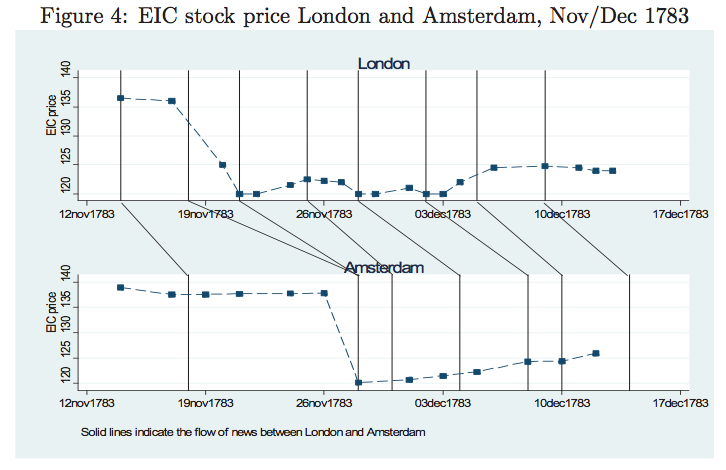
Peter Koudijs has found a wonderful historical episode in which it is possible to identify precisely the days in which news arrives and to measure the effect of news on stock prices.  During the 18th century there were a few English companies whose stock was traded both in London and in exchanges in Amsterdam. When the prices of these stocks changed in London, information about the price movements reached Amsterdam via mail boats that crossed the North Sea. When weather prevented these boats from crossing, news was delayed.  These weather events enable him to show that a large component of price volatility is directly attributable to the arrival of news. This dramatic picture pretty much summarizes it:

On the 19th of November, shares of the British East India Company (EIC) began to drop in response to a speech given by British Prime Minister Fox who spoke of  “the deplorable state” of its fiances.  Bad weather delayed the arrival of boats from England to Amsterdam until around the 27th of November.  In the intervening period, there was little change in the price of EIC shares on the Amsterdam exchange.  But as soon as the boats arrive, the stock price dropped to the level seen on the London exchange a week earlier.

1. Mafia activity in New York, New Jersey and Rhode Island with Google Maps.

2. What do they think of the Larry King replacement in his home country?

3. Life follows art in U.K. politics.

  1. Lyndon Johnson procuring pants.
  2. People cheese.
  3. A collection of Soviet workplace-safety posters.
  4. One letter titles.
  5. Remedial potty training.
  6. The infamous Terry Gross interview with Gene Simmons from 2002.

Tony Blair is testifying again in a British inquiry into the decision-making leading up to the Iraq War.  I read Blair’s book My Journey over Xmas.  Blair on the logic of terrorism in the Ireland Chapter:

The response [to a terrorist attack] is often to clamp down in a way that alienates the peacemakers as well as the terrorists…The problem is the moment such a course is taken, the keys to the process are put in the hand of the terrorists.  Their purpose is to lock up the process. That’s the sick rationale behind the terror.

This kind of idea is related to a paper I have with Tomas Sjöström.  Blair on the right response to 9/11:

There was no other course; no other option; no alternative path.  It was war.  It had to be fought and won.

Applying his earlier analysis, we might conclude that this is what the terrorists actually want and if we go to war we give them the keys to the peace process.  Blair goes on to say the war on terror would have to be a different kind of war, “a battle for and about the ideas and values that would shape the 21st century.”  But actually, we have more conventional wars going on still.  There may be some way to make Blair’s two points consistent: When should we respond to terrorist attacks with aggressiveness and when should we resist the impulse to overreact?  I did not find a clear answer in the book.  Nevertheless, in the end, I was glad I read the book.  The chapter on Ireland is very interesting.  And the book is written in an engaging and informal style:

We also has an unfortunate run-in with Britain’s pensioners.  One of the greatest myths of human existence is that as people get older, they get more benign…Your average Rottweiler on speed can be a lot more amiable that a pensioner wronged… Visiting a housing development..I caught sight of an old-age pensioner, a woman so less, with a placard that read: “Blair, you are a c**t.”…. I was really shocked.  She looked like your typical sweet granny.  I almost stopped to remonstrate and then wisely thought better of it.

Here is a paper by Hugo Mialon which examines titles of economics papers and how they correlate with publication success and citations.

This paper examines the impact of titles and other characteristics of published economics articles on the ultimate success of these articles, as measured by their cumulative citations over the six year period following their publication. Interestingly, poetic titles are pivotal to the productivity of published empirical papers, but detri- mental to that of theoretical papers. Another finding of general interest is that the reputation of authors and their institutions counts much more toward the success of empirical papers than toward that of theoretical papers.

Also, here is Hugo’s paper on Torture, whose title wisely eschews poetry.

It appears to be intended for using illustrative experiments in an undergraduate-level course in game theory.

This site is based on the perception of game theory as the study of a set ofconsiderations used by individuals in strategic situations. Models are not seen as depictions of how individuals actually play game-like situations and are not meant to be used as the basis for a recommendation on how to play real “games”.  My goal as a teacher is to deliver a loud and clear message that game theoretic models are not meant to supply predictions of strategic behavior in real life.


Traffic jam bailouts:

Chinese motorists stuck in traffic can now hire someone to sit in jams for them, with entrepreneurs finding a business opportunity in the growing gridlock across the car-crazy country.

As wider car ownership leaves roads more congested in the country of 1.3 billion, motorists can now escape by calling a substitute driver to take their cars to their destinations, China Daily reported Saturday.

As drivers are whisked away on the back of motorcycles, a car service employee sits in traffic for them, the state-run newspaper said.

The service is for “those with urgent dates or business meetings to go to, and those who have flights to catch and can’t afford to wait in a traffic jam for too long,” Huang Xizhong, whose company offers the service in the central city of Wuhan, was quoted as saying.


My old college friend Arasan Aruliah has been radicalized by the financial crisis.  If he were an American, perhaps he would be a member of the Tea Party?  But radicalism in the U.K. is different than in the U.S.  Arasah has decided to vent his frustrations in cartoon form in a series Ripped-Off Britons in the Guardian and in a theraputic blog.  Here is a  recent cartoon:

You and your family are booked on an American Airlines flight from Florida to Chicago.  The weather is bad in Chicago – freezing rain is forecast.  You sign up for email alerts from AA, warning you if the flight is cancelled.  If you are warned of a delay or cancellation, you can hang out longer at the beach, stay an extra day etc.  You get an email  2.5 hours before departure telling you everything is on schedule.  What should you infer from this?

AA knows the probability that the flight is cancelled, you do not.  If the probability it is cancelled is close to zero, they have the incentive to tell the truth: this way the trade is executed in timely manner, just the way you and they want it.  There is no hassle with rebooking, paying for an extra day of hotel for them or you.  If the flight is very likely to be cancelled, they have good incentives to tell you.  Then, they can rebook you without you coming to the airport and getting upset.  You will end up paying for the extra night of hotel if you decide to rebook for the next day etc.

The difficulty is when the chance of cancellation is somewhere in the middle.  If you are anything like me, you want to know when you are in this scenario.  Then, you can decide whether to turn up at the airport or fly the next day.  But the airline might have different incentives.  They want you rebook you to fly via Dallas with a five hour wait at DFW.  This might be close to zero marginal cost for them (if seats are available) but high cost to you.  But once you are at the airport, the cost of getting a hotel and rental car and flying the next day are higher.  Plus since the airline has given you an alternative to your cancelled flight, you’re going to have to pay for the extra night’s stay.  So, your preferences differ from the airline’s and they have an incentive to lie to you.  When the probability of cancellation is intermediate, the airline has an incentive to pretend it is low.

So, the “all clear” message signals either that all is clear or that the flight may be cancelled with some probability.  This is what theory would predict.  But do airlines actually practice this subterfuge?  It sure feels like it when you are stuck at DFW for five hours!  But some real data would be great……

Before there was PPACA (“ObamaCare”) there was already government-provided health insurance.  It’s called bankruptcy.  Neale Mahoney studies the extent to which it crowds out demand for conventional health insurance.

Hospitals are required to provide emergency care and typically provide other health-care services without upfront payment.  Patients who experience large unexpected health care costs have the option of avoiding some of these costs by declaring bankruptcy.  Thus bankruptcy is essentially a form of high-deductible insurance where the deductible is the value of assets seizable by creditors. For many of the poorest households, “bankruptcy insurance” is an attractive substitute for health insurance.

Because states differ in the level of exempted assets, the effective deductible of bankruptcy insurance varies across states. This variation enables Mahoney to measure the extent to which changes in bankruptcy asset exemption affect households’ incentives to purchase conventional health insurance.  Ideally you would like to compare two identical households, one in Deleware (friendly to creditors) and one in Rhode Island (friendly to debtors) and see how the difference in seizable assets affects their health insurance coverage.  Things are never so simple so he uses some statistical finesses to deal with a variety of confounds.

The results allow him to address a number of natural questions.  If every state were to adopt Delaware’s (restrictive) bankruptcy regulations, 16.3% of uninsured households would purchase insurance.  For a program involving government subsidies to achieve the same increase, 44% of health insurance premiums would have to be subsidized.

From a welfare point of view, bankruptcy insurance is inefficient because the uninsured do not internalize some of the costs they impose from using bankruptcy insurance.  On the other hand, because they are uninsured their providers directly bear more of the costs of care, mitigating the moral hazard inefficiency of standard insurance.  With this tradeoff in mind we can ask what penalty should be imposed on those who choose not acquire private health insurance.  Mahoney finds that the PPACA penalty is two large by almost a factor of two.

Do you know the name of the first bank in the United States?  The First Bank of The United States of course.  How about the second bank?  The Second Bank of the United States.  And after that it seems like every time a bank opens in a new place for the first time that bank calls itself First Bank of The New Place. (Try your favorite place.  Here’s mine.)

Why?  Because only the first can be The First.  If people trust banks more the longer they have been around, then in equilibrium the first bank will call itself the First Bank and everyone will know who was first.

Titles of papers have something in common with names of banks.  A paper titled Law and Finance is guaranteed to be the seminal paper in the field because if it were not then that title would have already been taken.  You can go ahead and cite it without actually reading it.  By contrast, you can safely ignore a paper with a title like  Valuation and Dynamic Replication of Contingent Claims in a General Market Enviornmnet Based on the Beliefs-Preferences Guage Symmetry even if you don’t know what any of those words mean.  The title is essentially telling you “Don’t read me.  Instead go and read a paper whose title is simply Valuation of Contingent Claims.  If you have any questions after reading that, you might look into dynamic replication and then beliefs, preferences, and if after all that you still haven’t found what you’re looking for, check here for the lowdown on guage symmetry.”

Two pieces of advice follow from these observations.  First, find the simplest title not yet taken for your papers.  One word titles are the best.  Second, before you get started on a paper, think about the title.  If you can’t come up with a short title for it then its probably not worth writing.

The absolute worst thing you can do with your title is to insert a colon into it. (quiet down beavis!)  As in, Torture: A Model of Dynamic Commitment Problems.  Or Kludged:  Asymptotically Inefficient Evolution.  In the first case you have just ruined a seminal-signaling one-word title by adding spurious specificity.  In the second, you just took an intriguing one-world title and turned it into a yawner.

The second worst kind of title is the question mark title.  “Is the Folk Theorem Robust?”  This says to the reader:  “You picked this up because you want to know if the folk theorem is robust.  Well, if I knew the answer to that I would have told you right away in the title. But look, all I could do is repeat the question, so you can safely assume that you won’t find the answer in this paper.”

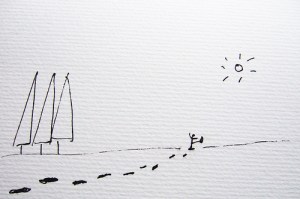
(Drawing:  Back in the Snow from www.f1me.net)

  1. I am sure the interviews are probing.
  2. “the Fett-ster would look down the swoop of my abdomen & see all the way to Florida.”
  3. “I coped with youth hostels, handwashing underwear and persuading my bowels to open in strange lavatories.”
  4. Remarkably frank testimonial of a Chinese Mother.
  5. Soon seminars will be like this.
  6. Vintage Vonnegut.

I was sitting in a seminar and the guy was talking about unraveling in the labor market.  Someone asked a question whether it could happen in reverse. The speaker said “Do you mean raveling up?  Yes it is possible that there is raveling up.”

And I thought “Wait a minute, you don’t need the ‘up’ in ‘raveling up’ because surely the opposite of unraveling is just ‘raveling.’ ”  But then I realized that I have never heard that word used.  Unraveling, all the time.  Raveling, never.  So I went for the dictionary.  Three dictionaries in a row gave me a definition of raveling something like this.

Ravel. verb.  To disentangle.  Unravel.

What?  To ravel means to unravel??  But then what does unravel mean?

Unravel. verb.  To untangle.

So two very strange things now.  First, unravel has an independent definition (in terms of other words) but ravel, the un-prefixed word, is defined in terms of the prefixed unravel.  Second, ravel is defined to mean unravel!

My colleague Rakesh Vohra thought the good old Oxford English Dictionary would save us from being swallowed up into the lexicographic Weezer-vortex, but alas (login with username trynewoed, password trynewoed.  works until Feb 5), not even the Queen can help:

1. To entangle or disentangle

(!) The word means A and also the opposite of A. Doesn’t it now follow that disentangle means the same as entangle? And isn’t there a theorem that once you allow a contradiction into a formal system you can make anything into a contradiction. So if we flip through enough pages of the OED eventually we can prove that True means False?

2. To become unwound, to fray; to unravel.

3. To disentangle, make plain or clear.

Yeah right.

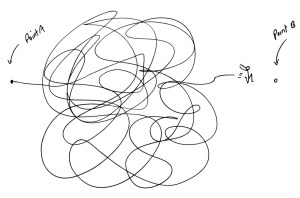
(drawing:  Road of Life from www.f1me.net)

The WSJ Ideas Market blog has a post by Chris Shea about my forthcoming paper with David Lucca (NY Fed) and Tomas Sjöström. (Rutgers) Some excerpts:

Full democracies are unlikely to go to war with one another. That’s axiomatic in political science. Yet a new study offers an important caveat: Limited democracies may, in fact, be even more bellicose than dictatorships…….

The authors end with a twist on President George W. Bush’s contention that “the advance of freedom leads to peace”: “Unfortunately,” they say, “the data suggests that this may not be true for a limited advance of freedom.”

Here is another article in Kellogg Insight about the paper.

Did you know that in the states of Oregon and Louisiana a defendant is convicted if 10 out of 12 jurors vote guilty? In Federal trials and in all other states unanimity is required.  A recent case was appealed to the Supreme Court challenging Oregon’s non-unanimous juries on 14th Ammendment grounds. On Monday the Court declined to hear the case.  (Here is Eugene Volokh, who brought the petition.)

This opinion piece in the Washington Examiner argues that the unanimity requirement is essential for preserving “liberties.”  I assume that what the author means is protection against convicting the innocent.  Because on its face it would seem that such a mistake is less likely when unanimous agreement of all 12 jurors is required.

Of course we should care not just about the error of convicting the innocent, but also acquitting the guilty.  But even if your concept of liberty puts maximum weight on the protection of the innocent, it is naive to suppose that this is achieved by unanimous juries.

Suppose you are on a jury in Oregon and the foreman has joined with 8 others who have decided to convict.  Looking for the 10th vote, he turns to you. Compare your incentives to convict in this situation to the analogous situation where, in Illinois, 11 others are looking your way.  With only 9 others prepared to convict there is not only less peer pressure on you, but other things equal the evidence is less persuasive.  It has only convinced 9 others.

All jurors see the same evidence but each views it from his or her own perspective. When a jury votes the jurors are signaling to one another how they interpret the evidence.  The more other jurors voting to convict, the stronger is your inference that the evidence shows the defendant is guilty. When you are the pivotal 10th juror you know only that 9 others have concluded that the defendant is guilty.

The lower threshold for conviction in fact makes you less likely to vote to convict.

This strategic effect of course has to be weighed against the mechanical effect of lowering the threshold and the net effect could go either way.  However, there is one unambiguous sense in which unanimous jury standards are in fact the worst possible.

In a famous paper, Feddersen and Pesendorfer showed that jury voting is informationally efficient in the following sense:  given enough jurors with enough independent information the strategic effect outlined above is dampened.  And the defendant is convicted if and only if he is guilty.

Now in a sense this is purely of theoretical interest.  Juries of 12 are not “arbitrarily large” and even if they perfectly pool their information they will make mistakes. But the point of this result is that it says that jury voting in principle works. Feddersen and Pesendorfer showed that this is true regardless of the threshold fraction of votes required for conviction, but with one single exception.  Under unanimity rule the strategic effect is not dampened.  Indeed with more and more jurors, knowing that you are the last holdout is stronger and stronger evidence that you should convict.  Thus there is always a probability of convicting the innocent even with very large juries.

From Presh Talwalker:

In poker tournaments, everyone gets a fair shot at holding the dealer position as seats are assigned randomly.

In home games, an attempt is also made to assign the dealer spot randomly. There are many methods to choosing the dealer. One of the common methods is dealing to the first ace. It works like this: the host deals a card to each player, face up, and continues to deal until someone receives an ace. This player gets to start the game as dealer.

The question is: does dealing to the first ace give everyone an equal chance to be dealer? Is this a fair system?

Answer:  it’s not.  Presh goes through the full analysis, but here’s a simple way to see why.  Suppose you have 5 players at the table and you are dealing from a deck of 5 cards with 2 aces in it.  Every time you deal there will be two people with aces.  But the person who gets to be dealer is the one who is closest to the host’s left.  If the deal went in the other direction, someone closer to the host’s right would be dealer.

It can’t be fixed by tossing a coin to decide which direction to deal because that would disadvantage players sitting directly across from the dealer.  You need to randomly choose the first person to deal to.  But if you have a trustworthy device for doing that, you don’t need to bother with the aces.