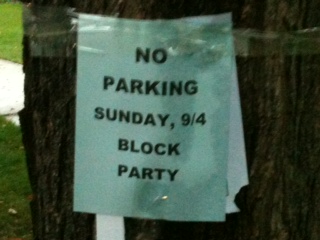
The end of summer heralds the annual ritual of the suburban block party.  The street has to be blocked off, notices have to be put up so no-one parks on the street, food has to be ordered or cooked etc.  The burden falls on the people with kids because “The block party’s for the kids” we all say. Obviously, there is a huge free-rider problem – we can all enjoy the benefits of the block party without spending time on setting things up.  If you don’t hang out with your neighbors much, “repeated game” effects are minor.  Hence, morality and peer pressure must step in to provide incentives.

For example, suppose you sign up to put up notices warning people not to park on the street on the day of the block party.  You write up some flyers and put them under car windscreen wipers. You print off notices and staple them to trees.  You think you’ve done a pretty good job.  The next day you wander round putting in new flyers under car wipers and check on the notices.  Mysteriously, someone has taken it upon themselves to put up their own notices.  These are taped to the trees not stapled.  Is that really superior?  You are not sure but you see the implicit rebuke in the intervention. Homo economicus would revel in the intervention – he could slack off even more knowing someone will do his job for him.  But homo normalicus feels a tad pissed off and even a bit guilty, even though no guilt is truly warranted.  Next year, normalicus will go back to picking up the fried chicken from Jewel-Osco.  But if economicus/evilicus pops out, he will do the same job worse out of rationality or spite.

Registration for the 2012 Allied Social Sciences Meetings has just opened up today. The ASSA meeting is the annual “winter meeting” in which hordes of economists descend on a rotating list of cities to spend a weekend shuffling papers around and stiffing cab drivers.

It was by sheer luck that last night I noticed that today would be the first day to register. And so this morning I was one of the first to login to the ASSA hotel registration system and reserve one of the better suites (we will be in the Fairmont) in one of the more central conference hotels where Northwestern Economics will conduct its job market interviews.  (New PhD recruitment is one of the main, perhaps the main, activity at the ASSA meetings.) Had I been just a few hours later we would have been relegated to a remote hotel making it harder for interviewers and interviewees to get to and from the interviews.

(If that happened to you, you can follow @ASSAMeeting on Twitter to wait for announcements of new suites opening up.  But wouldn’t you rather follow me? Sandeep?)

It’s funny that a conference run by economists uses a qeueing/rationing system to allocate scarce hotel space.  The system doesn’t even allow ex post exchanges between departments which would undo inefficient misallocations. If MIT gets stuck in the Embassy Suites and Podunk U is in the Hyatt Regency, then tough luck MIT (maybe Podunk can build a stronger theory group, ha ha ha.)

The problem is that ASSA negotiates discounted rates for the suites by reserving them in bulk.  Obviously that is good for everyone.  But the discounted rate is below market clearing and therefore there  will be excess demand for the best hotels.  It would seem that the resulting inefficiency is the price we have to pay for our monopsony power.

Indeed it would not work to have ASSA negotiate hotel space at discount rates and then turn around and use an efficient auction internally to allocate it.  The reason is somewhat subtle.  Here’s one way of seeing it.  An efficient auction for a single suite is (essentially) a second-price auction.  It works efficiently becuase when I know that I will have to pay the second highest bid then I will bid exactly my willingness to pay.  Therefore the winner will be the bidder who values the suite the most.  However, because ASSA bought the suite at a rate that is below market clearing, the second highest bid for a suite is going to be more than ASSA paid for it.

That means ASSA makes money.  Sounds good right?  No.  In fact it is a problem precisely because we all benefit from ASSA making money (we get lower registration fees, lower journal subscription fees, etc.) You see I internalize the benefits of ASSA’s revenue which essentially means that I get back some of the price I pay when I win the auction. In other words I am not really paying the second highest bid, I am paying something less.  And because of that I no longer want to bid my true willingness to pay, and the mechanism breaks down.  In the jargon, the efficient auction is no longer incentive compatible.

But there is a solution.  The basic mistake ASSA is making is to negotiate discounted suites.  Why does it do that?  Well, it has monopsony power and it has different hotels in the area compete with one another for the business. Since we are buying hotel space it seems natural to make hotel discounts the currency of that competition.  But we saw the problem with that.  Instead ASSA should ask for lump sum cash bids from the hotels.  The highest bidding hotel gets the right to auction off their suites to ASSA members using an efficient auction. The hotel keeps all revenues from the auction.

That way I don’t internalize any of the revenues from the auction.  The mechanism is incentive compatible again and therefore gives an efficient allocation.  The hotels make some money.  And the amount of money they can expect to earn is exactly how much they are willing to pay to ASSA in advance for that right.  So in fact ASSA comes away with their monopsony rents without having to sacrifice efficiency.


In the movie Inside Job, George Soros makes an analogy that made an impression on me. He talks about how oil tankers have partitions in their hulls with their oil divided across the compartments. That way when the seas are rough the oil sloshes around within its own restricted space rather than the entire cargo splashing forward and back the full length of the ship, as would happen if there were no partitions.  This obviously makes the tanker more stable.

The analogy is to financial markets and regulation. Erecting partitions to make the market less liquid should improve stability.  At first you say, oh that’s a nice piece of rhetoric but financial markets aren’t anything like oil tankers.  At least I said that.

But let’s take it for a spin. Let’s analyze the partitioned tanker but forget that it is a mechanical system and instead analyze it in the same way we would use equilibrium theory to analyze a market.  Here goes.

There is a shock (rough seas) and the oil starts to spill to one end of the boat. But the partition stops the oil from going where it wants to go. There is a friction in the market. The oil in one compartment and the empty space in the adjacent compartment want to make a voluntary exchange.  And it would be Pareto improving (otherwise they wouldn’t want to do it.)  But that partition is stopping them.  This is welfare-reducing.

Moreover, there is a powerful incentive for arbitrage. Any small leak in the partition would allow equilibrium to be reached by removing the friction, allowing the oil to go where it wants to go, and relieving some internal pressure.  That must be welfare-improving.

If you think about it, market models pretty much stop there. Pareto improving trades should and do happen. Financial innovation brings down those partitions and that’s good. What is almost always missing is any way of talking about the hard-to-define but clearly very real externality that is the effect of these trades on the stability of the system as a whole.  That’s about process and transitional dynamics, not about equilibrium.

Indeed, in equilibrium the oil in the tanker is in the same place whether or not the partitions are there.

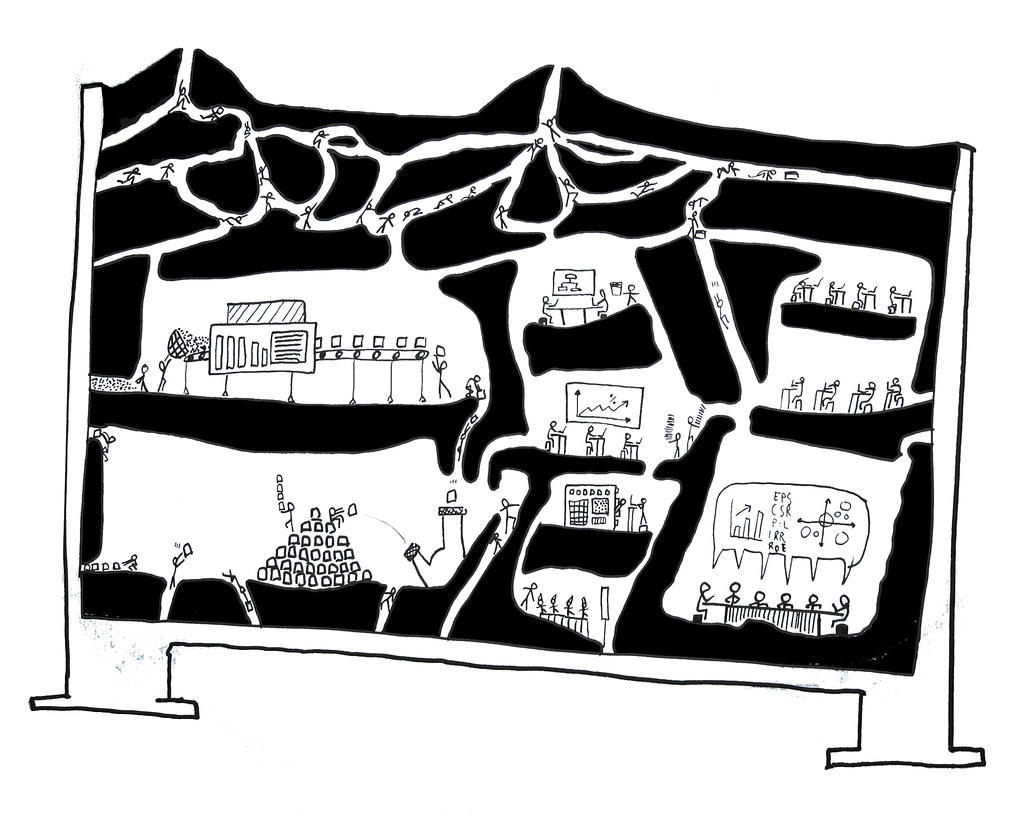
(drawing:  The Bigger Picture from www.f1me.net)

When do rational people seek militant leadership for their nation?  By militant here, I mean bellicose or having an affinity for violent conflict.  I have began thinking about this question while writing a paper on the rise of Nazism in Germany after World War 1.  I would suggest that this question may be one of the most important for political theory.  As a practical matter, we certainly do not want neighboring nations to choose militant leaders against us, and so we should avoid putting them  in conditions that  might cause them to do so.  Thus, we need to understand what might cause normal rational citizens to support militant candidates for leadership of their nation.

People normally have very good reasons to not want militant national leaders.  We are all at risk when our leader would not hesitate to send our loved ones and ourselves off to die in battle.  To preserve the blessings of peace, we should normally prefer to have leaders of the nonmilitant sort, who have a healthy aversion to war.

But of course militant leaders can also have a positive deterrent effect.  When we have a militant national  leader, other nations might be less inclined to provoke any kind of trouble for us.  So a perceived threat of deep invasion can create an incentive for us to seek a militant leader who can deter it.  But we must also worry that a leader who has an affinity for war may take any opportunities that he can get to make one for us.  This potential cost of militancy is reduced, however, when the serious risks of war seem remote from our borders.  Thus, the incentive to seek militant leadership may be strongest when we fear a long-term or low-probability threat of a deeply destructive invasion but otherwise the immediate risks of conflict seem small.

This recipe was fulfilled in Germany around 1930.  The post-WW1 reparations involved a persistent implicit Allied threat to invade Germany if it did not pay, but the immediate risks of militancy became remote after Allied troops withdrew from the Rhineland under the Young Plan of 1929.

Such conditions also existed in America after the attack of September 11, 2001.  We felt profoundly vulnerable to deep invasion, but the immediate risks of our own militant posturing seemed remote.  And indeed, a demonstrated willingness to use military force became a positive asset in American presidential politics for several years in the aftermath of the attack.  We should understand that, even in America, politics could become more militant under such conditions.

Suppose a firm can enter one of several markets. Other things equal, the fewer competitors there are, the greater is the incentive to enter as profits are decreasing in the number of competitors.  So, smart managers should enter markets with fewer competitors. The deregulation of local telecommunications services in 1996 led to entry by competitive local exchange carriers (CLECs).  These varied in the experience and education of senior managers and hence allow a descriptive and analytic analysis of entry decisions. Goldfarb and Xiao perform this analysis and find

Our descriptive analysis, which  characterizes the entry decisions of facilities based CLECs in 234 midsize US markets with populations between 100,000 and 1,000,000 as of
the 2000 Census, reveals that experienced CEOs, CEOs with an economics or business
education, and CEOs who attended the most selective undergraduate institutions tended to enter
markets with fewer competitors.

They also estimate a behavioral model of entry to try to identify strategic sophistication as defined by the Cognitive Hierarchy model of Camerer, Crawford etc.  They find that the firms with strategically sophisticated managers are more likely to survive and be profitable.  There are many things that one might ague with - e.g. Doesn't better (economics/business) education help you to motivate workers better, cut costs etc?  Why is strategic sophistication identified only with competition avoidance?  Many questions come to mind but this is still an interesting paper.

The efficient way to allocate scarce capacity on a flight is to hold an auction as close to departure time as possible. Allocating space prior to that point runs the risk that a ticketed passenger learns that his willingness to pay is lower than he expected (business meeting is cancelled, family member falls ill, etc.)  Allocating space close to the time of departure ensures that passengers have resolved any uncertainty about their willingness to pay and those with the highest willingness to pay will be seated.

But with an auction the airline cedes a lot of consumer surplus to the passengers, because in an efficient auction the winner pays not his own willingness to pay, but the willingness to pay of the marginal bidder. The airline is willing to sacrifice efficient allocation in exchange for a mechanism that extracts more of the gains from trade.

The ideal for the airline would be to sell tickets to the auction and to put these tickets up for sale as early as possible, before passengers have any private information about their willingness to pay.

Here’s an extreme example to illustrate. There is a plane with one seat and two potential passengers. By the time of departure they will know their willingness to pay, but when they first enter this world they know only the probability distribution. The airline should announce that there will be a 2nd price auction at the time of departure but in order to be allowed to participate in that auction the passengers must purchase a ticket the moment they are born. The price of this ticket will be set equal to the expected value of consumer surplus from the auction. This way the airline achieves the maximal gains from trade and secures all the rents for itself.

Obviously the problem is that the airline cannot contract with every potential passenger still in the bassinet. Indeed contracting is initiated by the passenger, not the airline. Thus, in order to be able to extract consumer surplus the airline’s mechanism has to give the passengers the incentive to voluntarily contract early prior to the resolution of uncertainty.

A mechanism that accomplishes this will have two features. First, ticket prices must rise as the departure date approaches. This incentivizes early purchases. Second, flights will be oversold. This enables efficient re-allocation of seats on the basis of information realized after tickets are purchased. In particular, those with lowest realized willingness to pay will sell back their tickets in a reverse auction.

(This is ongoing research with Daniel Garrett and Toomas Hinnosaar, two NU students who will be on the job market this year.)

The ultimatum game is a workhorse for economics experiments.  Subject A has 100 dollars to split with Subject B.  A proposes a division and if B accepts then the division is carried out.  If B rejects then both parties get nothing.  In these experiments, A is surprisingly generous and B is surprisingly spiteful.  A Fine Theorem makes a good point:

…I’m sure someone has done this but I don’t have a cite, the “standard” instructions in ultimatum games seem to prime the results to a ridiculous degree. Imagine the following exercise. Give 100 dollars to a research subject (Mr. A). Afterwards, tell some other subject (Ms. B) that 100 dollars was given to Mr. A. Tell Mr. A that the other subject knows he was given the money, but don’t prime him to “share” or “offer a split” or anything similar. Later, tell Ms. B that she can, if she wishes, reverse the result and take the 100 dollars away from A – if she does so, had Mr. A happened to have given her some of the money, that would also be taken. I hope we can agree that if you did such an experiment, A would share no money and B would show no spite, as neither has been primed to see the 100 dollars as something that should have been shared in the first place. One doesn’t normally expect anonymous strangers to share their good fortune with you, surely. That is, feelings of spite, jealousy and fairness can be, and are, primed by researchers. I think this is worth keeping in mind when trying to apply the experimental results on ultimatum games to the real economy.

  1. You smell, I stink.
  2. Members of Congress with metalhead names. (Economists?  Angrist, Blinder, Manski…)
  3. New documentary using restored Ken Kesey Merry Prankster footage.
  4. The revolution will not be served with Tabbouleh. (The manifesto of the Vogue vegan.)
  5. Better than the missives from QJE.

Let’s say I want to know how many students in my class are cheating on exams. Maybe I’d like to know who the individual cheaters are, maybe I don’t but let’s say that the only way I can find out the number of cheaters is to ask the students themselves to report whether or not they cheated.  I have a problem because no matter how hard I try to convince them otherwise, they will assume that a confession will get them in trouble.

Since I cannot persuade them of my incentives, instead I need to convince them that it would be impossible for me to use their confession as evidence against them even if I wanted to.  But these two requirements are contradictory:

  1. The students tell the truth.
  2. A confession is not proof of their guilt.

So I have to abandon one of them.  That’s when you notice that I don’t really need every student to tell the truth.  Since I just want the aggregate cheating rate, I can live with false responses as long as I can use the response data to infer the underlying cheating rate.  If the students randomize whether they tell me the truth or lie, then a confession is not proof that they cheated.  And if I know the probabilities with which they tell the truth or lie, then with a large sample I can infer the aggregate cheating rate.

That’s a trick I learned about from this article.  (Glengarry glide: John Chilton.)  The article describes a survey designed to find out how many South African farmers illegally poached leopards.  The farmers were given a six-sided die and told to privately roll the die before responding to the question.  They were instructed that if the die came up a 1 they should say yes that they killed leopards.  If it came up a 6 they should say that they did not.  And if a 2-5 appears they should tell the truth.

A farmer who rolls a 2-5 can safely tell the researcher that he killed leopards because his confession is indistinguishable from a case in which he rolled a 1 and was just following instructions.  It is statistical evidence against him at worst, probably not admissible in court.  And assuming the farmers followed instructions, those who killed leopards will say so with probability 5/6 and those who did not will say so with probability 1/6.  In a large sample, the fraction of confessions will be a weighted average of those two numbers with the weights telling you the desired aggregate statistic.

Its called Fehr Advice!

Traditional economic research assumes that managers, employees, customers, and suppliers usually make rational decisions and thus do not make systematic decision errors. Behavioral economics, however, has found numerous proofs that people make systematic decision errors that limit their own welfare and also diminish efficiency, perceived fairness, and the profitability of firms.

It was for this reason that FehrAdvice & Partners AG developed the consulting approach BEA™ that is based on empirical insights about the human tendency to make erroneous decisions. This approach systematically includes this knowledge in consulting activities. Our consultants have a “trained eye” in the area of behavioral economics, and the innovative methods of empirical research we use allow us to identify potential areas of improvement in enterprises, markets, and organizations that were previously ignored.

They have a blog (in German), they are on Twitter, and they are hiring.


In the thirteenth century, Italians and Dutch traders went to Champagne not to drink champagne but to trade.  They had to travel there and back and worry about theft.  There was always the chance that some dispute would arise at the trade fairs.  Courts arose to enforce contracts.  Did they arise spontaneously in Coasian fashion, created by contracting parties to facilitate trade?  Or was their government intervention?  The first view is advocated by Milgrom, North and Weingast in a lovely and influential paper. MNW invoke some “stylized facts” about the institution of the “Law Merchant”, They claim the law merchant was a kind of store of the history of past exchanges.  The law merchant could substitute for the incomplete knowledge of trading parties themselves and had good incentives to be honest himself to retain his income as a law merchant.  The paper is mainly theoretical and has a nice prisoner’s dilemma model with traders changing partners every period.

A new paper by Edwards and Ogilvie challenges the stylized facts that motivate MNW.  They claim:

The policies of the counts of Champagne played a major role in the rise of the fairs. The counts had an interest in ensuring the success of the fairs, which brought in very
significant revenues. These revenues in turn enabled the counts to consolidate their political position by rewarding allies and attracting powerful vassals….

The first institutional service provided by the counts of Champagne consisted of mechanisms for ensuring security of the persons and property rights of traders. The counts undertook early, focused and comprehensive action to ensure the safety of merchants travelling to and from the fairs..

A second institutional service provided by the rulers of Champagne was contract enforcement. The counts of Champagne operated a four-tiered system of public lawcourts which judged lawsuits and officially witnessed contracts with a view to subsequent enforcement…

A final reason for the success of the Champagne fair-cycle was that it offered an almost continuous market for merchandise and financial services throughout the year, like a great trading city, but without the most severe disadvantage of medieval cities – special privileges for locals that discriminated against foreign merchants

The paper is an interesting read and there are lots of rich details about the Champagne fairs themselves.

At the company’s inception, Tripadvisor executives were worried that the reader-generated reviews of hotels and restaurants would be overwhelmingly negative but they found much to their surprise that reviews were biased in the opposite direction: 

“We were worried it was going to be a gripe site,” said the chief executive, Stephen Kaufer. “Who the heck would bother to write a review except to complain?” Instead, the average of the 50 million reviews is 3.7 stars out of five, bordering on exceptional but typical of review sites.

In fact, we can reverse the logic: “Who the heck would bother to write except to praise?”

Imagine you are asked to write a letter of recommendation for someone up for tenure.  First, the university asks you if you are willing to write the letter.  You mentally measure the amount of time it is going to take to read the papers.  Add to that the time to write a clear and comprehensive letter.  Are you going o do all that just to say something bad?  Probably not.  But if you are going to write something nice that gives the candidate a job for life, that might give you the satisfied buzz to counterbalance the cost of writing a letter.  So, letters of recommendation will be biased towards the positive.

There is still some information: Bad candidates will get fewer letters than good candidates. Buts is this carefully noted?  Is the number of letter writers who refused to write letters even recorded?

Perhaps the main countervailing force is envy. Why does X deserve tenure at highly ranked University A while I the letter writer am at humble University B?  It is impossible not to write a letter for University A. If the candidate is bad, you are forthcoming.  If the candidate is good, you are begrudging.  But the quality of the letter is monotone in the quality of the candidate and information is aggregated. Only the very best universities are the object of envy.  The rest have to decode the positive bias in their tenure procedures just like Tripadvisor users.

Usain Bolt was disqualified in the final of the 100 meters at the World Championships due to a false start.  Under current rules, in place since January 2010, a single false start results in disqualification.  By contrast, prior to 2003 each racer who jumped the gun would be given a warning and then disqualified after a second false start.  In 2003 the rules were changed so that the entire field would receive a warning after a false start by any racer and all subsequent false starts would lead to disqualification.

Let’s start with the premise that an indispensible requirement of sprint competition is that all racers must start simultaneously.  That is, a sprint is not a time trial but a head-to-head competition in which each competitor can assess his standing at any instant by comparing his and his competitors’ distance to a fixed finished line.

Then there must be penalty for a false start.   The question is how to design that penalty.  Our presumed edict rules out marginally penalizing the pre-empter by adding to his time, so there’s not much else to consider other than disqualification. An implicit presumption in the pre-2010 rules was that accidental false starts are inevitable and there is a trade-off between the incentive effects of disqualification and the social loss of disqualifying a racer who made an error despite competing in good faith.

(Indeed this trade-off is especially acute in high-level competitions where the definition of a false start is any racer who leaves less than 0.10 seconds after the report of the gun.  It is assumed to be impossible to react that fast. But now we have a continuous variable to play with.  How much more impossible is it to react within .10 seconds than to react within .11 seconds? When you admit that there is a probability p>0, increasing in the threshold, that a racer is gifted enough to reach within that threshold, the optimal incentive mechanisn picks the threshold that balances type I and type II errors.  The maximum penalty is exacted when the threshold is violated.)

Any system involving warnings invites racers to try and anticipate the gun, increasing the number of false starts. But the pre- and post-2003 rules play out differently when you think strategically.  Think of the costs and benefits of trying to get a slightly faster start.  The warning means that the costs of a potential false start are reduced. Instead of being disqualified you are given a second chance but are placed in the dangerous position of being disqualified if you false start again.  In that sense, your private incentives to time the gun are identical whether the warning applies only to you or to the entire field.  But the difference lies in your treatment relative to the rest of the field.  In the post-2003 system that penalty will be applied to all racers so your false start does not place you at a disadvantage.

Thus, both systems encourage quick starts but the post 2003 system encouraged them even more. Indeed there is an equilibrium in which false starts occur with probability close to 1, and after that all racers are warned. (Everyone expects everyone else to be going early, so there’s little loss from going early yourself. You’ll be subject to the warning either way.) After that ceremonial false start the race becomes identical to the current, post 2010, rule in which a single false start leads to disqualification.  My reading is that equilibrium did indeed obtain and this was the reason for the rule change.  You could argue that the pre 2003 system was even worse because it led to a random number of false starts and so racers had to train for two types of competition:  one in which quick starts were a relevant strategy and one in which they were not.

Is there any better system?  Here’s a suggestion.  Go back to the 2003-2009 system with a single warning for the entire field.  The problem with that system was that the penalty for being the first to false start was so low that when you expected everyone else to be timing the gun your best response was to time the gun as well.  So my proposal is to modify that system slightly to mitigate this problem. Now, if racer B is the first to false start then in the restart if there is a second false start by, say racer C, then racer C and racer B are disqualified.  (In subsequent restarts you can either clear the warning and start from scratch or keep the warning in place for all racers.)

Here’s a second suggestion.  The racers start by pushing off the blocks.  Engineer the blocks so that they slide freely along their tracks and only become fixed in place at the precise moment that the gun is fired.

(For the vapor mill,  here are empirical predictions about the effect of previous rule-regimes on race outcomes:

  1. Comparing pre-2003, under the 2003-2009 you should see more races with at least one false start but far fewer total false starts per race.  The current rules should have the least false starts.
  2. Controlling for trend (people get faster over time) if you consider races where there was no false start, race times should be faster 2003-2009 than pre-2003.   That ranking reverses when you consider races in which there was at least one false start. Controlling for Usain Bolt, times should be unambiguously slower under current rules.)

There are four major providers of national cellphone service in the U.S – Verizon, AT&T, Sprint and T-Mobile.  Two of them are proposing to merge.  What impact will the merger have on consumers?  Senator Herbert Kohl (of Kohl’s stores fame) says:

“According to Consumer Reports, ‘T-Mobile plans typically cost $15 to $50 per month less than comparable plans from AT&T.” Removal of such a maverick price competitor from such a highly concentrated market – a competitor that disciplines price increases from all three other national cell phone competitors, not only At&T – raises a substantial likelihood that prices will rise following this merger.”

Someone can take the opposite view to ATT-TM LT to DOJ and FCC but at least it is coherently argued.

From security analysts Raelynn Hillhouse and her blog  The Spy Who Billed Me:

Sources in the intelligence community tell me that after years of trying and one bureaucratically insane near-miss in Yemen,the US government killed OBL because a Pakistani intelligence officer came forward to collect the approximately $25 million reward from the State Department’s Rewards for Justice program.

The informant was a walk-in.

The ISI officer came forward to claim the substantial reward and to broker US citizenship for his family.   My sources tell me that the informant claimed that the Saudis were paying off the Pakistani military and intelligence (ISI) to essentially shelter and keep bin Laden under house arrest in Abbottabad, a city with such a high concentration of military that I’m told there’s no equivalent in the US.

The CIA and friends then set about proving that OBL was indeed there.  And they did.

Next they approached the chiefs of the Pakistani military and the ISI.  The US was going to come in with or without them.  The CIA offered them a deal they couldn’t refuse:  they would double what the Saudis were paying them to keep bin Laden if they cooperated with the US.  Or they could refuse the deal and live with the consequences:  the Saudis would stop paying and there would be the international embarassment…

The ISI and Pakistani military were cooperating with the US on the raid.

This is turning into a Tom Clancy novel

You might have thought it obvious that the stock market would go down after S&P downgraded US government debt.  The bad news about US debt made investors worry, and worried investors are usually less enthusiastic about holding stocks.

But there is something wrong with this view.  Ask yourself, when fearful investors sell their stocks, what do they buy?  They sell their stocks for cash, of course; and then, being fearful, they typically want to keep the proceeds in the nearest thing to cash that pays interest: US government debt.  Thus, as investors’ demand for stocks goes down, their demand for dollars and other US liabilities goes up.  Such a surge in demand for US government debt would cause the price of US bonds to go up, which means that the interest rate on US debt would go down.  Doesn’t it seem paradoxical, that a downgrading of US government debt could cause demand for this debt to increase?

But sure enough, the New York Times described with some surprise that the United States Treasury was actually a beneficiary of the market shifts today (Aug 8), despite the downgrade of its debt, as 10-year yields fell to 2.32 percent from 2.56 percent, and the yield on the two-year Treasury note hit a record low.  Those who are worried about inflation should also notice that the decline in the stock market means that any given amount of dollars can actually buy more shares of the Dow Industrials.

So it is very difficult to see investors’ behavior today as a reaction to fears about inflationary deficits or a default on US government debt.  If serious investors were actually worried about the real value of US government liabilities then they should tend to move out of bond markets and into real investments like the stock market, which should drive stock prices up.  Such a move would help get real investment started, which would help get people back to work; but that is not what we saw today.

To understand what is really happening, we need to think more carefully about the risks that S&P was assessing.  Of course the US government as a whole cannot be incapable of paying the dollars that it owes, because the US government has the ability to print dollars itself.  So how can the S&P bond raters have any legitimate concerns about a possibility of the US government defaulting on its debt obligations?  The answer is that a default could happen only if one part of the US government prevented other parts from paying the bills.

The bills of the US government are paid by the Treasury Department, but the ability to print dollars is vested in the Federal Reserve.  The Treasury can get new dollars by issuing bonds that are purchased by the Federal Reserve.  But, although the bonds in such a transaction would be held by the government itself, they would still be counted in the aggregate debt that is restricted by Congress’s debt limit.  So when the US Congress refused to raise the debt limit, it was threatening to prevent the Treasury and Federal Reserve from working together to pay for the government’s budgeted expenses and debt obligations.  In a situation like that, the President would indeed have to choose between cutting budgeted government expenses or asking the bond holders to wait.

We have seen, however, that the investors’ movement from stocks to bonds today is very hard to reconcile with fears of default on these bonds.  So to explain the stock market decline, we have to look at the other side of the story, the very real possibility that a politically constrained US government might have to cut expenses for essential government services.  Broad fears of a crippled US government that is unable to enforce laws or invest in infrastructure could do very serious damage to investment and economic growth in America.  Indeed the possibility of such government paralysis could be far more economically damaging than any marginal increase in taxes.

Thus, there is every reason to believe that investors are reacting, not to fears of too much government debt, but to fears of too little government spending where it is needed.  Investors are expressing fears that the US government may become unable to do its essential part in maintaining the strength of this country.  Pundits and congressmen should take note.

All uncles are weird. But being an uncle is an exogenous event independent of any quality you have, weirdness or otherwise. So statistically it looks like a monumental fluke that all the weird people turn out to be uncles.

In reality it’s the uncleness that causes the weirdness. And more than that: even totally normal people who happen also to be uncles turn onto weirdos precisely when they are around their nieces and nephews and here’s why.

An uncle is basically an anti-parent. Not anti- in the sense of anti-aircraft or anti-American. More like antimatter. Because an uncle looks at his brother or sister’s family and basically sees everything that his own family is not. Good or bad. Especially in terms of the children.

And just like boys socialize by playing up and exaggerating differences as a mechanism for toughening up each others’ weak spots, the uncle can’t help but play that same role with the nieces and their parents. Niece is too sensitive because she is too sheltered, uncle brings the missing risk to the party. Nephew thinks he’s tough because he can push around his younger sisters, uncle gives him a taste of his own medicine.

Then there’s spy mode.  Uncle wants the inside scoop on his brother/sister and spouse so he asks neice/nephew strange leading questions.  Your uncle is an outsider who has just enough of an inside track to feel comfortable poking around where he doesn’t belong.

But whatever mischief the uncle is up to,  the actual effect is that he comes across as a weirdo to his neices and nephews.

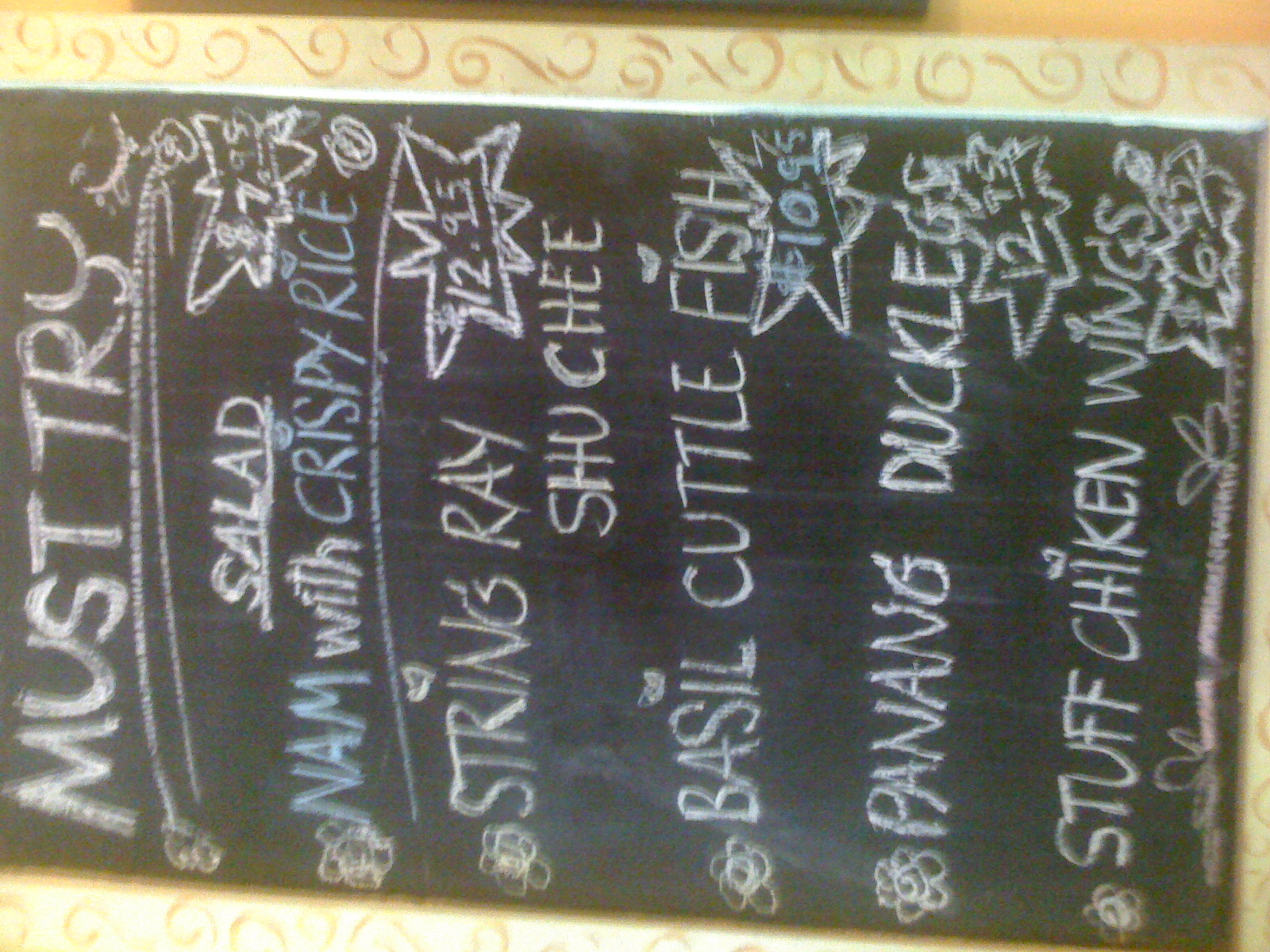
  1. Stingrays hurt.
  2. A lot.
  3. I could use a pedicure.

Related to my earlier post, where I suggested there as advantage to each chamber from delaying debt limit proposal as long as possible, Pelosi says:

[I]f we had days, instead of backed up to hours, we could have said ‘you don’t have the votes, let’s go back in and how do we move this way in order to cut some of those cuts and have a better bill and get the votes.’ So I think we could’ve done better. I think they were successful at just prolonging it to the last minute so that we didn’t have that option and it was default or no default.

The Guardian has gotten hold the U.K. interrogation policy:

In deciding whether to give permission [for overseas interrogation], senior MI5 and MI6 management “will balance the risk of mistreatment and the risk that the officer’s actions could be judged to be unlawful against the need for the proposed action”.

At this point, “the operational imperative for the proposed action, such as if the action involves passing or obtaining life-saving intelligence” would be weighed against “the level of mistreatment anticipated and how likely those consequences are”.

Here is a quote from Robert Parker

“Any serious introspection of the global wine market for Bordeaux over the last two years has to include the fact that it is impossible to determine the amount of 2009 Bordeaux futures (and in a few months, 2010 Bordeaux futures) that have actually been sold to consumers. Throughout Bordeaux there is talk of the massive market in Asia, and the increasing significance of the English wine investment firms, but there are those (and I wouldn’t dismiss their opinions) who tend to think that such assertions are grossly inflated. Moreover, they argue that there is a real bubble that is in danger of bursting if the right external influences unfold. One theory is that the Big Eight (which includes all the first growths of the Médoc as well as Haut-Brion and the trifecta of unofficial first growths of the Right Bank, Petrus, Cheval Blanc and Ausone) are actually hoarding huge inventories of their wines to inflate prices. This theory also suggests that the super seconds and many of the other cherished names in Bordeaux are doing the same thing. Why? They are trying to manipulate the market price. The appearance of little or no appreciable quantities of wine from two great vintages equals higher and higher prices. Is there a falsification of the demand from Asian consumers? The fact is, no one seems to know the answer. While some 2009s have not held their initial opening prices because they were too high, many have. If much of the 2009s, as well as the 2010s, are not sold through to wine consumers, who are the true marketplace since they actually drink these wines, and then tend to replenish their stock, buttressing the marketplace, then this is a bubble. Despite huge warehouses filled with reserve stocks of great vintages, prices could be set for a major adjustment, just as we have seen in the United States with the real estate market. What, if any of this, is true?

I raise this issue only because it is a possibility. The fact that no one can (or wants to) provide the actual sales figures of how much 2009 (or over the next six months, how much 2010) is actually being sold through to consumers is astonishing. If most of the stocks of these two vintages are held by importers, négociants, wholesalers, or on paper by investment firms, then it is obvious the consumers have not purchased 2009 and eventually 2010. In any event, I think this scenario has to be raised, given the overheated marketplace and the sometimes absurd rhetoric about how popular these wines are at prices of $1000 or more a bottle.” Robert Parker, May 3rd 2011

Here’s more.

Pledge your support and get a signed copy of the comic.

When the debt limit increase finally passed, the law included the creation of a 12 person committee, the SuperCongress, which will negotiate the next round of spending cuts and tax increases. If they fail to agree, automatic spending cuts go into effect.  These spending cuts include elements that are painful to both parties and this punishment is meant to help the committee members compromise.  Also, the automatic spending cuts that kick in if there is no compromise are not as painful for the economy as a failure to increase the debt limit.  This seems to be the idea.  I have a couple of points.

First, the Democrats partly caved this time around because they feared the Tea Party wing of the Republican House members were “crazy types” who were willing to destroy ratings of American Treasury bonds to get dramatic spending cuts.  Next time around, the threat of disagreement has to police the Tea Partiers.  Do they really care about defense?  If they care about small government and less foreign intervention, they may actually want defense spending cuts.  To get these guys to compromise, the disagreement point should have included libertarian-unfriendly policies.  Federally mandated rules that everyone should brush their teeth twice a day, extra additives in drinking water, gun control laws and perhaps a constitutional amendment to eliminate the right to bear arms.   Stuff like that should have been in the disagreement point.

Second, the parties face a choice of whom to put onto the SuperCongress.  Each party will have six members, three drawn from each chamber.  The strategic problem is fairly familiar as it resembles Schelling’s discussion of delegated bargaining.  Each party has the incentive to appoint extreme members with tough bargaining stances so the other side will be more likely to give in. Paul Ryan is an obvious choices for the Republicans.  Dick Durbin is an obvious choice for the Democrats.  If both parties pursue this strategy, there will be deadlock and the disagreement point will come out of the SuperCongress (another example of Prisoner’s Dilemma everywhere).

This analysis is normative – it does not account for strategic errors.  And there have been plenty of those. During the health care negotiations we had Max Baucus fruitlessly pursuing his Republican friends trying to get them to sign on. Olympia Snowe got a lot of one-one-one face time with the President.  As Krugman points out (see also Jon Stewart a couple of nights ago!), the debt limit extension could have been folded into the extension of the Bush tax cuts last December but the President believed John Boehner at his word. So, my guess is that while Nancy Pelosi and the Republicans will follow the rational choice predictions because they are quite clearheaded, Harry Reid will try to forge a bipartisan compromise.  Max Baucus is on (and Kent Conrad would have been if he were not retiring).  Ben Nelson is a maybe.  Why not go take the extra step Harry and nominate Susan Collins or Olympia Snowe to show that you mean well?  With that kind of strategy, the Bush tax cuts may get extended again as part of the SuperCongress compromise and remarkably the Democrats might be forced to implement a compromise that is worse for them than the disagreement point.

If you are programming a robot to vacuum your floors here’s one thing you would never consider doing:  endow the robot with feelings of happiness and sadness and teach it to be happy when the floor is clean and unhappy when it is dirty.

But evolution led us to a state of affairs where emotions are what motivate us to do our jobs.  How could such a kludge arrive.

Here is a story.  Primitive organisms are reproduction machines.  They need a certain chemical in the environment, and when they can obtain that fuel they can reproduce.

So the most successful primitive organisms are those that are the best at finding fuel.  Natural selection favors those that seek fuel.

Next the organisms get more complicated.  They have to make decisions that involve more than just immediate reproduction.  They have intertemporal tradeoffs, multi-dimensional consumption, etc.

There is infrastructure in place to simplify this transition.  The organisms that have survived to this stage are the organisms that seek fuel.  They have built and learned systems for doing what is necessary to get fuel.  So fuel is a simple and effective incentive mechanism.

The organism could evolve a mechanism for storing and later releasing fuel. Fuel is released when the organism takes certain actions.  Fuel-seeking organisms will take those actions.  Natural selection will favor the organisms that release fuel for the right actions.

Now remember that fuel is the energy needed for the most primitive functions of the organism.  When this fuel is released the organism gets a boost of that energy.

A boost of energy is a big part of what we call happiness.

(subject to the usual disclaimer, this is based on some conversations with Balasz Szentes.)

From Paul Kedrosky, via Mallesh Pai:

In the game of Scrabble, letter tiles are drawn uniformly at random from a bag. The variability of possible draws as the game progresses is a source of variation that makes it more likely for an inferior player to win a head-to-head match against a superior player, and more difficult to determine the true ability of a player in a tournament or contest. I propose a new format for drawing tiles in a two-player game that allows for the same tile pattern though not the same board to be replicated over multiple matches, so that a players result can be better compared against others, yet is indistinguishable from the bag-based draw within a game. A large number of simulations conducted with Scrabble software shows that the variance from the tile order in this scheme accounts for as much variance as the different patterns of letters on the board as the game progresses. I use these simulations as well as the experimental design to show how much various tiles are able to affect player scores depending on their placement in the tile seeding.

Alternatively you could just let the market prices tell you.

The right to remain silent is not necessarily a blessing to a defendant.  Because having a choice is not necessarily a good thing.  Unless the decision to testify is uncorrelated with guilt, that decision by itself will convey information to the jury. (I know juries are instructed not to infer anything.  But that is impossible.) So for example, if those who take the fifth are more likely to be guility (as I would guess.  Are there data on this?), then an innocent person’s “right” to remain silent is actually a right to partially incriminate himself

A prohibition against defendants testifying on their own behalf is worth considering.  If the goal is to protect defendants from incriminating themselves, then the above benefit offsets the obvious cost.

And if that is too extreme there are middle grounds to consider.  For example, since the defense puts on its case last, the defendant does not make his decision until after the prosecution has introduced evidence.  A defendant might want to commit in advance of that evidence being revealed that he will not testify so that nothing can be revealed by his decision being contingent on the evidence. As far as I know this commitment is not possible under current law.

In general the earlier you commit not to testify the less can be inferred from this.  So we should allow citizens to register their commitments before they are charged with any crime. When you register to vote you also check a box that says whether you or not you will testify in the event you are ever charged with a crime.


Stan Reiter had a standard gripe about statistics/econometrics.  Imagine you there is a cave in front of you and you want to map out its dimensions.  There are many ways you could do it.  One thing you could do is go inside and look. Another thing you could do is stand outside and throw into the cave a bunch of super bouncy balls and when they bounce out, take careful note of their speed and trajectory in order to infer what walls they must have bounced off of and where. Stan equated econometrics with the latter.

That’s not what I am going to say but it is a funny story and its the first thought that came to my mind as I began to write this post.

But I do have something, probably even more heretical, to say about econometrics. Suppose I have a hypothesis or a model and I collect some data that is relevant.  If I am an applied econometrician what I do is run some tests on the data and report the results of the tests.  I tell you with my tests how you should interpret the data.

My tests don’t contain any information in them that isn’t in the raw data.  My tests are just a super sophisticated way to summarize the data.  If I just showed you the tables it would be too much information.  So really, my tests do nothing more than save you the work of doing the tests yourself.

But I pick the tests.  You might have picked different tests.  And even if you like my tests you might disagree with the conclusion I draw from them.  I say “because of these tests you should conclude that H is very likely false.”  But that’s a conclusion that follows not just from the data, but also from my prior which you may not share.

What if instead of giving you the raw data and instead of giving you my test results I did something like the following.  I give you a piece of software which allows you to enter your prior and then it tells you what, based on the data and your prior, your posterior should be?  Note that such a function completely summarizes what is in the data.  And it avoids the most common knee-jerk criticism of Bayesian statistics, namely that it depends on an arbitrary choice of prior.  You tell me what your prior is, I will tell you (what the data says is) your posterior.

Pause and notice that this function is exactly what applied statistics aims to be, and think about why, in practice, it doesn’t seem to be moving in this direction.

First of all, as simple as it sounds, it would be impossible to compute this function in all practical situations.  But still, an approach to statistics based on such an objective, and subject to the technical constraints would look very different than what is done in practice.

A big part of the explanation is that statistics is a rhetorical practice.  The goal is not just to convey information but rather to change minds.  In an imaginary perfect world there is no distinction between these goals.   If I have data that proves H is false I can just distribute that data, everyone will analyze it in their own favorite way, everyone will come to the same conclusion, and that will be enough.

But in the real world that is not enough.  I want to state in clear, plain language terms “H is false, read all about it” and have that statement be the one that everyone focuses on.  I want to shape the debate around that statement.  I don’t want nuances to distract attention away from my conclusion.  In the real world, with limited attention spans, imperfect reasoning, imperfect common-knowledge, and just plain old laziness, I can’t get that kind of focus unless I push the data into the background and my preferred intepretation into the foreground.

I am not being cynical.  All of that is true even if my interpretation is the right one and the most important one.  As a practical matter if I want to maximize the impact of the truth I have to filter it.

Still it’s useful to keep this perspective in mind.

I read the transcript and it is a very eloquent clarification of his views on game theory’s role and even the game theorist’s role.  Worth checking out.

Auctions on eBay have a deadline and aggressive bidding occurs just before the auctions ends.  This is called “sniping” (see this excellent paper for a discussion along with the study of many other interesting issues).  One reason offered for this behavior is that bids might not come in as the auction ends so if your low bid gets in and my high bid does not, you win anyway (I seem to remember a paper by Al Roth along these lines).  A similar effect arises in the debt limit negotiations.

Assume for now the deadline is August 2 – if the debt limit is not raised by then all hell breaks loose.  If the House has a proposal on the table later today, this gives the Senate the change to reject it and table their own proposal.  But if the House gets their proposal in on August 1, there is too little time left for the Senate to respond with their own bill.  If they reject the House proposal, all hell breaks loose. And if the President vetoes the bill, all hell breaks loose. So, there is distinct advantage to the House from delaying the vote. Symmetrically, there is similar advantage to the Senate from delaying the vote.  But if both delay the vote, there is also a huge risk that neither proposal makes it through either chamber because both Reid and Boehner are having hard time drumming up enough votes.  So, as both parties delay the vote, there is a huge chance of hell breaking loose….

What if the August 2 deadline is not hard?  Then, I think I need a model to sort things out but my intuition is that there is bigger incentive to accept an early agreement (after August 1)- if you reject it, there is chance your counter proposal does not make it through as all hell breaks loose because the government runs out of money.  But if early agreements might be accepted, there is a bigger incentive to move early and get your bid in…..