I remember the first time I saw a session at a conference under the heading of Neuroeconomics. I thought it was some kind of joke. Well it certainly wasn’t a joke, it has turned out to be a big deal, bringing a new kind of data to economics. Genetic data is the next new kind of data and Genoeconomics is the newest non-joke.

Koellinger didn’t see it that way. Four year later, he is part of a group of young economists saying it’s time for their field to jump into the gene pool with both feet. In a series of papers, including one forthcoming in the Annual Review of Economics and another in the Proceedings of the National Academy of Sciences, Koellinger, along with a team headed by Cornell economist Daniel Benjamin, David Laibson and Edward Glaeser from Harvard, Union College psychologist Christopher Chabris, Cesarini, and others, is heralding the arrival of a new discipline—“genoeconomics.” They say economists are missing something important by ignoring the genetics underlying things like risk-taking, patience, and generosity. If we could grasp how our genes influenced such economic traits, they argue, the knowledge could be transformative.

I saw David Cesarini last week present an introduction to Genoeconomics. From what I can tell Genoeconomics has made one major contribution already: demonstrating that so far there is no reliable statistical correlation between genes and economic behavior. The picture I got was some kind of Gresham’s law for p-values. Because there are so many genes, there is vast scope for data mining and so journals are insisting on significance levels of 1 – 10^{-some god awful exponent}.

Check this out. Five numbers appear on a screen in different locations. They remain visible for 210 milliseconds and then they are obscured. The subject must then touch the locations in increasing order of the numbers that appeared there. That’s pretty much impossible. Here’s a human subject who is highly trained and does an impressive job but still fails miserably.


Now check out how nonchalantly this chimpanzee does it.


I didn’t even know they could count. Note that the 5 numbers are random integers between 1 and 9.  So the chimp is processing a binary relation in short-term memory, not to mention reading at a super-human rate. There are more videos here.  I saw these at Colin Camerer’s talk last week at Arthur Robson‘s conference on the Biological Basis of Preferences.

Jean Tirole gave a paper on “Laws and Norms” as his Schwartz Lecture last week. He has been working on psychology and economics for many years with Roland Benabou. The presentation was an extension of that work. Consider a game where a costly action generates a positive externality. Agents are motivated to take such an action by a monetary reward and a private value from the action. However, they also care what others think of them. How can we think about this formally and what implications does it have for contributions to the public good?

Tirole’s (and Benabou’s) first contribution is to provide a simple, tractable model of this psychological effect. Each agent’s payoff is a function of others’ expectation of his private value given his action and monetary reward. Hence if you contributed to the public good but received no monetary reward, the expectation is different that if you contributed and got paid. From this simple formulation much can be deduced. If a contribution is elicited via a monetary reward, it carries less positive information about the contributor than one when there was no monetary reward. There might be a bigger contribution if there is no monetary reward. The less observable the contribution, the smaller is the incentive to make it etc.

The contribution was twofold. First, the mathematical modeling of the psychological effect requires some art and effort. Second, the model is intuitive and simple enough that others can use it to express their own ideas. One of my colleagues is thinking about two papers based on the basic Tirole model.

How much do your eyes betray you?

Have two subjects play matching pennies.  They will face each other but separated by a one-way mirror.  Only one subject will be able to see the other’s face.  He can only see the face, not anything below the chin.

Each subject selects his action by touching a screen.  Touch the screen to the West to play Heads, touch the screen on the East to play Tails.  (East-West rather than left-right so that my Tails screen is on the same side as your Tails screen.  This makes it easier to keep track.)

You have to touch a lighted region of the screen in order to have your move registered and the lighted region is moving around the screen.  This is going to require you to look at the screen you want to touch.  But you can look in one direction and then the other and touch only the screen you want.  Your hands are not visible to the other subject.

How much more money is earned by the player who can see the other’s eyes?

Now do the same with Monkeys.

(Conversation with Adriana Lleras-Muney)

Microsoft Research will open a lab in New York City.

The research community is highly connected, so we’re well aware of and have long admired the incredible work being done by the researchers we are welcoming to Microsoft Research, including thought leaders such as Duncan Watts, David Pennock, and John Langford. But as we in Microsoft Research connected with them to begin a meaningful dialogue about their plans and aspirations, we began to fully appreciate not only their individual talents and expertise, but also their uncanny ability to work together with unrivaled energy and passion. The conversations left me and other Microsoft Research researchers inspired to expand our East Coast presence. I’m thrilled to share that David Pennock will take the reins as MSR-NYC’s assistant managing director, overseeing the day-to-day operations at the NYC facility.

I’m excited as well for the collaboration opportunities between the research interests of this phenomenally talented team in NYC and the work being done by my team in the New England lab around social media, empirical economics, and machine learning. The approaches of the two labs to social science and economics research are distinct but highly complementary, and, indeed, we expect that the whole will be much greater than the sum of its parts.

I spent a week last fall at MSR Cambridge and it was one of the most pleasant and productive weeks I have had in a long time.  If they can recreate the same environment in Manhattan it would be an incredibly attractive place for visitors and full-time scholars.  Here’s more.

Over the weekend I attended a conference at the University of Chicago on The Biological Basis of Preferences and Behavior, and Balazs Szentes stole the show with a new theory of the peacock’s tail.  In Balazs’ theory a world without large and colorful peacock plumage is simply not stable.

A large tail is an evolutionary disadvantage:  it serves no useful purpose and it slows down the male and makes him conspicuous to predators.  So why do genes for large tails appear and take over the population of male peacocks? Balazs’ answer is based on matching frictions in the peacock mating market. Suppose female peacocks choose which type of male peacock to mate with: small or large tails. Once the females sort themselves across these two separate markets, the peacocks are matched and they mate.

The female peacocks are differentiated by health, and within a peacock couple health partially compensates for the disadvantageous tail. In the model this means that healthy females who mate with big-tailed peacocks will produce almost as many surviving offspring as they would if they mated with peacocks without the disadvantage of the tail.

This substitution between the characteristics of female and male peacocks creates a selection effect in the mating market. Consider what happens when a small-tailed peacock population is invaded  by a mutation which gives some male peacocks large tails. Since female peacocks make up half the population of peacocks there is now an imbalance in the market for small-tailed peacocks. In particular the males are in excess demand and some females will have trouble finding a mate.

On the other hand the big-tailed male peacocks are there for the taking and its going to be the healthy female peacocks who will have the greatest incentive to switch to the market for big tail. The small cost they pay in terms of reduced quantity of offspring will be offset by their increased chance of mating. The big tails have successfully invaded.

Once they have taken over the population (Balasz shows that under his conditions there is no equilibrium with two kinds of male peacocks) he same selection effect prevents small tails from invading. When a small-tail mutation appears all the females will want to mate with them. The market for small tail gets flooded with eager females up to the point where some of them are going to have a hard time finding a mate. Given this, each female must decide whether to take a gamble and try to mate with the small-tail male or have a sure chance of mating with a large tail.

The unhealthy females are going to be the ones who are most willing to take the risk because they are the least compatible with the large-tail males. This means that the small-tail mutants can only mate with unhealthy females and (under the conditions Balazs identifies) this more than offsets their advantage, they produce fewer offspring than the large-tails and they are driven out of the population.

The American Economic Review publishes an unrefereed conference volume, Papers and Proceedings, in May of every year.  Of course, the AER also a publishes a refereed journal which rejects more than 95% of submissions. Someone with an AER P&P might be tempted to pass it off as an AER on their CV. There is a possible gain in prestige at the cost of being found out and facing a social sanction. Snyder and Zidar call this the obfuscation theory. Alternatively, perhaps these AER P&Ps have real academic value and those who describe their own such papers as real publications should also cite other such papers more. Different conventions of citation may develop among different subgroups. This is the convention model. Snyder and Zidar find support for the convention model in the data. They mention that AER P&Ps had more citations that AERs in the past and hence older economists tend to see P&Ps as real publications while younger economists do not. This should imply that younger economists should be more careful about distinguishing P&Ps from AERs on their CVs.

I have two questions/comments.

An economist who lists a P&P as a refereed publication faces dissonance. On the one hand, they would like to see themselves as good people, on the other they know they are doing something shady. One way to resolve the dissonance is to cite other researchers P&Ps more. This helps propagate the self-deception that P&Ps are legitimate pieces of refereed research and hence listing them as such is justified.

Second, another possible paper: Do P&Ps have more errors than refereed publications? One job of a referee is to catch errors after all. If so, how many cites come from people pointing out mistakes?

(Hat Tip: MR)

Eye color and cuckoldry:

The human eye color blue reflects a simple, predictable, and reliable genetic mechanism of inheritance. Blue-eyed individuals represent a unique condition, as in their case there is always direct concordance between the genotype and phenotype. On the other hand, heterozygous brown-eyed individuals carry an allele that is not concor- dant with the observed eye color. Hence, eye color can provide a highly visible and salient cue to the child’s heredity. If men choose women with characteristics that promote the assurance of paternity, then blue-eyed men should prefer and feel more attracted towards women with blue eyes.

This calls for an experiment.

The eye color in the photographs of each model was manipulated so that a same face would be shown with either the natural eye color (e.g., blue) or with the other color (e.g., brown). Both blue-eyed and brown-eyed female participants showed no difference in their attractiveness ratings for male models of either eye color. Similarly, brown-eyed men showed no preference for either blue-eyed or brown-eyed female models. However, blue-eyed men rated as more attractive the blue-eyed women than the brown-eyed ones. We interpret the latter preference in terms of specific mate selective choice of blue-eyed men, reflecting strategies for reducing paternity uncertainty.

  1. The celebrity marriage duration equation
  2. A frog chillin on a bench
  3. The Elements of Style at Hustler
  4. The descriptive camera

The first ever MD to specialize in the treatment of hangovers.

Earlier this month, he unveiled his new treatment clinic, a 45-foot-long tour bus emblazoned with soothing blue and white graphics and his business’s name, “Hangover Heaven.” Inside the bus, it looks like a cross between an ambulance and a conference room at Embassy Suites. IV drips hang from the ceiling, patients are swathed in blankets, but there are also spacious leather sofas with built-in beverage-holders and flat-screen TVs. EMTs administer relief to patients in the form of branded medical cocktails. The $90 Redemption package contains one bag of saline solution, vitamins, and an anti-nausea medication. The $150 Salvation package includes a double shot of saline solution, the vitamins, the anti-nausea medication and an anti-inflammatory as well.

They don’t take insurance.  For some reason I am blanking on whom to thank for the link but I have a feeling it’s Courtney Conklin Knapp.

A week-long series of blog posts at NPR the best of which come from Jeremy Denk. His opener:

Preternaturally happy, cheerful, perfect, organized, clean, boring, popular: I guess the case I’m making is that the Goldbergs are the Martha Stewart of Variations. And like Martha Stewart, you don’t totally absolutely mind if they end up going off for a little while to a very clean and nice prison (sorry Martha, I’m just following the metaphor, I don’t really mean it) so you don’t have to see them being perfectly organized all the time, making a mockery of your unclean life. Maybe a show of hands: who would like a short moratorium on performances or recordings of the Goldbergs, so we could all hear it freshly again? Who will be the first pianist to unilaterally disarm? (Not me!)

Let’s revise the Martha Stewart metaphor. The Goldbergs are like a friend you have who always does everything right. This friend always answers his emails, keeps a clean house, has a kind word for everyone, behaves properly at concerts, writes thank you cards, grooms himself assiduously, knows how to tie a tie, never eats Burger King at 2 AM, and never ever writes silly blog posts saying he hates pieces he really loves. He’s an example to the world. He’s smiling at you over drinks, listening as always with benevolent patience, and you realize through your gritted hateful envious teeth that he is certainly not your enemy, and what would it hurt to admit, you wouldn’t want to face life without him?

Jaapi jab:  DoTheMath.

Michael Ostrovsky (Stanford GSB) and Michael Schwarz (Yahoo! Research) helped Yahoo! to improve its click price per ad. Yahoo! was charging 10c/click. Ostrovsky and Schwarz ran some field experiments:

Reserve prices in the randomly selected “treatment” group were set
based on the guidance provided by the theory of optimal auctions, while in the “control” group
they were left at the old level of 10 cents per click. The revenues in the treatment group have
increased substantially relative to the control group, showing that reserve prices in auctions can in
fact play an important role and that theory provides a useful guide for setting them.

It seems they made money for Yahoo!:

We conclude with a quote from a Yahoo! executive, describing the overall impact of
improved reserve prices on company revenues.
On the [revenue per search] front I mentioned we grew 11% year-over-year in the quarter
[. . . ], so thats north of a 20% gap search growth rate in the US and that is a factor of,
attributed to rolling out a number of the product upgrades we’ve been doing. [Market
Reserve Pricing] was probably the most signi cant in terms of its impact in the quarter.
We had a full quarter impact of that in Q3, but we still have the bene t of rolling that
around the world.
Sue Decker, President, Yahoo! Inc. Q3 2008 Earnings Call.

But it seems Yahoo! is eliminating the entire research group in its downsizing, including I suppose Michael Schwarz. Preston McAfee had already left for Google Research. I hope others also have a soft landing.

My brother-in-law wanted to sell something with an auction but first he wanted to assemble as many interested buyers as he could. His problem is that while he knew there were many interested buyers in the world he didn’t know who they were or how to find them. But he had a good idea:  people who are interested in his product probably know other people who are also interested. He asked me for advice on how to use finders’ fees to incentivize the buyers he already know about to introduce him to any new potential buyers they know.

This is a very interesting problem because it interacts two different incentive issues. First, to get someone to refer you to someone they know you have to confront a traditional bilateral monopoly problem. You are a monopoly seller of your product but your referrer is a monopoly provider of access to his friend because only he knows which and how many of his friends are interested. If your finder’s fee is going to work it’s going to have to give him his monopoly rents.

The interesting twist is that your referrer has an especially strong incentive not to give you any references. Because anybody he introduces to you is just going to wind up being competition for him in the auction for your product.  So your finder’s fee has to be even more generous in order to compensate your referrer for the inevitable reduction in the consumer’s surplus he was expecting from the auction.

I told my brother-in-law not to use finder’s fees.  That can’t be the optimal way to solve his problem.  Because there is another instrument he has at his disposal which must be the more efficient way to deal with this compound incentive problem.

Here’s the problem with finder’s fees.  Every dollar of encouragement I give to my buyers is going to cost me a full dollar.  But I have a way to give him a dollar’s worth of encouragement at a cost to me of strictly less than a dollar.  I leverage my monopoly power and I use the object I am selling as the carrot.

In fact there is a basic principle here which explains not only why finder’s fees are bad incentive devices but also why employers give compensation in the form of employee discounts, why airlines use frequent flier miles as kickbacks and why a retailer would always prefer to give you store credit rather than cash refunds. It costs them less than a dollar to provide you with a dollar’s value.

Why is that?  Because any agent with market power inefficiently under-provides his product.  By setting high prices, he creates a wedge between his cost of supplying the good and your value for receiving it.  If he wants to do you a favor he could either give you cash or he could give you the cash value in product.  It’s always cheaper to do the latter.

So what does this say about incentivizing referrals to an auction?  How do you “use the object” in place of a finder’s fee?  The optimal way to do that is the following.  You tell your potential referrer that you will give him an advantage in the auction if he brings to you a new potential buyer.  Because you are a monopoly auctioneer there is always a wedge that you can capitalize on to do this at minimal cost to yourself.

In this particular example the wedge is your reserve price.  Your referrer knows that you are going to extract your profits by setting a high reserve price and thereby committing not to sell the object if he is not willing to pay at least that much.  You will induce your referrer to bring in new competition by offering to lower his reserve price when he does.

Now of course you have to deal with the problem of collusion and shills.  Of course that’s a problem in any auction and even more of a problem with monetary finder’s fees but that’s a whole nuther post.

(Ongoing collaboration with Ahmad Peivandi)

Skip ahead to about 13:00.  It seems a little too neatly staged but it’s still hilarious.

Hardee heave:  Emil Temnyalov

Act as if you have log utility and with probability 1 your wealth will converge to infinity.

Sergiu Hart presented this paper at Northwestern last week.  Suppose you are going to be presented an infinite sequence of gambles.  Each has positive expected return but also a positive probability of a loss.  You have to decide which gambles to accept and which gambles to reject. You can also invest purchase fractions of gambles: exposing yourself to some share \alpha of its returns. Your wealth accumulates (or depreciates) along the way as you accept gambles and absorb their realized returns.

Here is a simple investment strategy that guarantees infinite wealth.  First, for every gamble g that appears you calculate the wealth level such that an investor with that as his current wealth and who has logarithmic utility for final wealth would be just indifferent between accepting and rejecting the gamble.  Let’s call that critical wealth level R(g).  In particular, such an investor strictly prefers to accept g if his wealth is higher than R(g) and strictly prefers to reject it if his wealth is below that level.

Next, when your wealth level is actually W and you are presented gamble g, you find the maximum share of the gamble that an investor with logarithmic utility would be willing to take.  In particular, you determine the share of g such that the critical wealth level R(\alpha g) of the resulting gamble \alpha g is exactly W. Now the sure-thing strategy for your hedge fund is the following:  purchase the share \alpha of the gamble g, realize its returns, wait for next gamble, repeat.

If you follow this rule then no matter what sequence of gambles appears you will never go bankrupt and your wealth will converge to infinity. What’s more, this is in some sense the most aggressive investment strategy you can take without running the risk of going bankrupt.  Foster and Hart show that any investor that is willing to accept some gambles g at wealth levels W below the critical wealth level R(g) there is a sequence of gambles that will drive that investor to bankruptcy.  (This last result assumes that the investor is using a “scale free” investment strategy, one whose acceptance decisions scale proportionally with wealth.  That’s an unappealing assumption but there is a convincing version of the result without this assumption.)

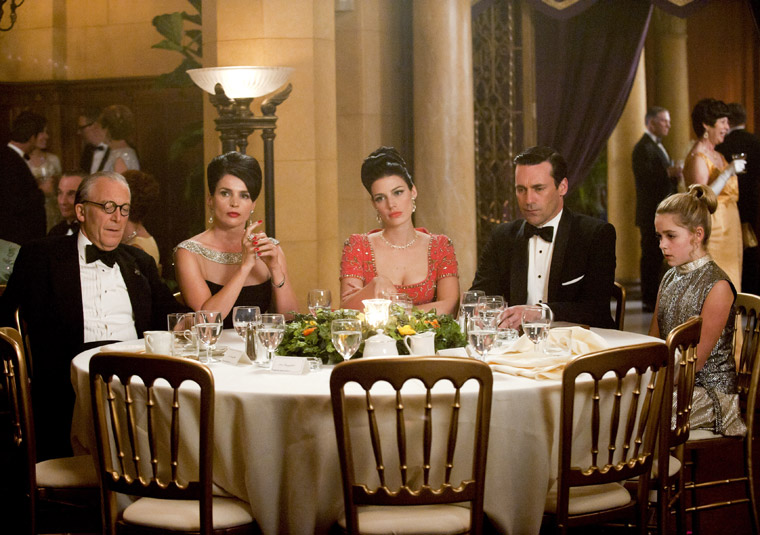
Derrick Rose is out for the season and a weekend that started badly might have ended sadly with another super dark episode of Mad Men. Instead, we got a few comedic rays of sunshine to break through the gloom – Pete tricking Megan’s pretentious father, Peggy’s mother’s surprise that Abe’s favorite dish is ham etc. Those of us looking to enliven our courses with the odd example here or there had to wait till the end.

Don is busy trying to drum up new business at his award dinner. He got the award for an anti-cancer ad he took out in the newspaper after losing the Lucky Strike cigarette account. But a colleague’s father rains on Don’s parade. He says that no-one will give Don any new business after he stabbed Lucky Strike in the back. Don signaled to the wrong audience in the last period of the Lucky Strike game. He tried to co-opt consumers by pretending to be concerned about their welfare. But consumers will not give his firm new accounts, firms selling crap to them will. And with them Don lost his reputation – will he also throw them under the bus if things turn sour? Life is an infinite horizon game with many bilateral interactions. Lose your reputation in one and, if your behavior is publicly observable, lose your reputation in all.

Subjects video chat with each other. In one treatment subject A sees her own image in a small window in the corner of the chat, and in the other treatment (the control) there is no small window and she sees only the chat partner.

Subject B is not told about the two treatments and is simply asked to report how attractive subject A is. We want to know whether attractiveness is higher in the self-image treatment versus the control treatment.

This gets at a few different issues but the one I am curious about is this: do people know what it is about them that makes them attractive to others?

Also, we would want to track eye movements during the chat.

Went to Vera for the first time last night. It doesn’t take reservations but it was not hard to get table at 7 p.m. on a Thursday, even though Vera was on the “Best of Chicago 2012” list at Chicago Magazine. I had two companions and we managed to get through roast mushrooms, lamb pinchos, langoustines, paella, calcots, papas bravas, grilled asparagus and fried artichokes! Only the papas were generic. The wine list is quite original and the waitress made great recommendations. I’m definitely going back.

From The Chronicle of Higher Education

If you’re a psychologist, the news has to make you a little nervous—particularly if you’re a psychologist who published an article in 2008 in any of these three journals:Psychological Science, the Journal of Personality and Social Psychology,or the Journal of Experimental Psychology: Learning, Memory, and Cognition.

Because, if you did, someone is going to check your work. A group of researchers have already begun what they’ve dubbed the Reproducibility Project, which aims to replicate every study from those three journals for that one year. The project is part of Open Science Framework, a group interested in scientific values, and its stated mission is to “estimate the reproducibility of a sample of studies from the scientific literature.” This is a more polite way of saying “We want to see how much of what gets published turns out to be bunk.”

We should do this in economics.  But there is a less confrontational way to do it. Top departments in experimental economics attract PhD students who want hands on experience in the lab. These are departments like NYU and CalTech. They would benefit the profession, their students, and the reputation of their PhD programs, i.e. everybody concerned, if they were to add as a requirement that every student receiving a PhD must pick one recently published experimental article and attempt to replicate it.

Thanks to Josh Gans for the pointer.

A limited time deal on South Africa’s Kulula airlines in celebration of President Jacob Zuma’s recent wedding:

Inspired by regular VIP travellers with sizeable spousal entourages, the offer is open to all fourth wives when the family travels together on the Jo’burg to Cape Town route.

There are of course some peskys Tees and Cees to go with our less than pesky offer:

– The offer is valid on Joburg to Cape Town route from Monday 23rd April ‘til April 30th
– The family must have already bought a kulula.com ticket for all wives and husband
– Simply present ticket and proof of marriage and ID at kulula counter before departure
– A refund will then be made on the fourth wife’s ticket.
– Happy happy

Kufi carom:  Toomas Hinnosaar

Ex CEA head Austan Goolsbee just started a new blog. His first post responds to Glenn Hubbard:

Hubbard’s numbers seem in pretty serious danger of violating the league’s substance abuse policy.

His claim that the President’s budget requires large taxincreases on the middle class to stabilize the debt is just factuallywrong.  Just go look at the CongressionalBudget Office’s numbers.  They examined thePresident’s budget and directly refute the central claim of the op-ed:http://www.cbo.gov/sites/default/files/cbofiles/attachments/03-16-APB1.pdf

Figure 2 on page 6 shows their forecast of debt as a shareof GDP with the President’s budget–and it’s stabilized and falling without anytaxes on the middle class.  Figure 1shows similar stability on the deficit.

Here are the paths between me and Lones Smith.  Some other numbers:

  1. My Erdos number is 4
  2. My Ken Arrow number is 5
  3. My Tyler Cowen number is 4. (I am not sure I believe all of these paths but some of them are true and interesting.)
  4. My Barack Hussein Obama number is 4 and the shortest path goes through Hilary Clinton.

I just cancelled our Netflix instant streaming service because we have Amazon Prime which gives us streaming for free. Our main requirement is easy access to episodes of Pingu and Amazon carries these and also all the movies on my Netflix queue. No brainer. I wanted to switch to the DVD by mail service to get hold of all the movies that Amazon and Netflix streaming do not carry. But it turns out you can only add DVD by mail to your streaming service and cannot get it as a stand alone product. What is Netflix doing?

It seems Reed Hastings thinks streaming is the wave of the future and the DVD is old defunct technology, So, he wants to incentivize the switch (he even tried to spin off the DVD service as a separate business). But the range of movies Netflix streaming carries is not comprehensive. For example, I wanted to watch The Social Network but couldn’t find it in the streaming service. Then, my options are to drive to the video rental store or try to find it on HBO or pay per view. I prefer DVD by mail to those options. For instant streaming there is competition not only from Amazon Prime but an old streaming technology – TV! Plus there are lots of TV shows available for free in the On Demand options. Also, when had DVD by mail I would often leave the DVD sitting for weeks without watching it thereby guaranteeing Netflix a revenue stream with minimal impact on costs.

So, I think the old technology DVD has some legs yet. Movie studios like them because they have more control over pricing and can cut out the Comcast/Netflix middleman. And DVD by mail is Netflix’s most profitable business. So, while raising Netflix prices might have been a good idea with the decline of Blockbuster, the switch to streaming IMHO was not a good strategy. Maybe some Netflix insiders have a good rationalization for their strategy that I am missing?

  1. It can happen that the sensory input you experience over a short interval of time makes no sense to your brain until some last thing happens which reveals the theme and gives context to everything that came before.  At that moment your brain goes back and reprocesses everything that just happened in order to make sense of it.  The feeling is like experiencing a whole chunk of time condensed into one moment together with the satisfying feeling of resolution that comes from making order out of chaos.  Musicians use this trick to great effect.
  2. It’s less of an insult to say someone is “disingenuous” than to say she is a liar.  But we all know that the meaning is exactly the same.  Disingenuous is a more obscure word and there is less common knowledge of its meaning. Given two words that are synonymous is it generally true that the one with the more nuanced connotation is also the one that is longer, rarer, more obscure?
  3. In almost all Western music every note begins and ends K/2^n units of time after the last note for some integers K and n.  Isn’t that rather limiting?
  4. A nurse at my kids’ pediatrician tells them she will count to three before giving them a shot but she actually gives the shot at the count of 2, surprising them.  It seems to make it less painful.  How does that work?

Airlines are using ever more sophisticated pricing strategies, sports teams and theaters are adopting dynamic pricing, even restaurants are using auctions to allocate scarce seating space.  And the usual perception of this is that the consumer is being gouged.  Auctions leverage competition among buyers and this drives the price up.  Sellers are raising profits by eroding consumer surplus.

But as a counterpoint to this, here is a mostly unnoticed but fundamental principle of auction-like pricing schemes:  they lead to unambiguously lower prices at the margin even when, indeed especially when, the seller is a coldhearted profit maximizer.

Suppose a theater allocates seats by selling tickets.  And suppose they do it the old-fashined way:  they set a price for tickets and put them up for sale until they sell out.  Setting the right ticket price is a tricky problem because a price is a one-dimensional instrument that has to solve a two-sided problem.  On the one hand, you want high prices in order to capture revenue when demand turns out to be strong.  But on the other hand, you want low prices in order to ensure the theater isn’t empty when demand is weak.  A price is simply too limited an instrument to do that double duty.  It’s no wonder that there are so many empty seats on most days while on other days the show sells out way in advance.

An auction (or dynamic pricing or many other pricing systems) has built into it two separate mechanisms for handling those two separate problems.  First there is the mechanism that leverages competition.  When demand is strong buyers must compete with one another for limited space.  When that happens the price is being set not by the seller but by the buyers themselves.  A buyer wins a seat only if he is prepared to pay a price larger than the next most aggressive bidder.

The unsung virtue of the competition-leveraging aspect of auctions is that it relieves the other mechanism in an auction, the seller’s (reserve) price, of the burden of capturing revenue at the high-end of the market and allows the seller to use it for a single purpose:  to capture revenue when demand is low. And this necessarily leads the seller to reduce his reserve price below the price he would have set if he were just using prices and not auctions.

The reason follows from a simple marginal trade-off.  Think of what happens to the seller’s profit when he lowers his price a little. There are gains and losses. The gain is that the lower price leads to greater tickets sales when demand turns out to be low.  The loss is that when demand is already high enough to sell out at the original price he will sell the same number of tickets but at a lower price.  The seller’s optimal price is chosen to balance these gains and losses.

But with an auction the trade-off changes because the reserve price plays no role in determining revenues when demand is high. That’s when the buyers are setting their own prices.  Cutting reserve prices leads to all the same gains but strictly lower losses compared to cutting plain-old prices.

The upshot of this is that the winners and losers from an auction system aren’t who you think.  Auctions don’t favor the deep-pocketed compared to the small guys. Exactly the opposite.  The marginal consumer is priced out of the market when a seller eschews an auction because then he must keep prices high.  When a seller switches to an auction he lowers his reserve price and now the marginal consumer has a chance to buy at those low prices.

Helpful conversation with Toomas Hinnosaar acknowledged.

(Drawing:  I Persuade With Carrots from http://www.f1me.net)

Twitter users turned Sunday’s French presidential election into a battle between a green Hungarian wine and a red Dutch cheese in a bid to get round tough laws banning result predictions.

The #RadioLondres hashtag was the top France trend on Twitter during the first-round presidential vote, in homage to World War II codes broadcast to Resistance fighters in Nazi-occupied France from the BBC in London.

But French citizens have written a new codebook in a subversive bid to get round laws that mean anyone announcing vote predictions before polls closed at 8:00 pm (1800 GMT) could be fined up to 75,000 euros (100,000 dollars).

“Tune in to #RadioLondres so as not to know the figures we don’t want to know before 8:00 pm,” said one ironic tweet.

The story is here.

“Dutch cheese at 27 euros, Tokai wine at 25 euros,” read one tweet as poll percentage predictions were published abroad.

The thing is, this would still be prosecuted if perpetrated by broadcast media.  So it wasn’t the code per se that allowed them to circumvent the law.  So the questions are:

  1. Why is an in-spirit violation not prosecuted when carried out in a decentralized communication network?
  2. Would just nakedly forecasting the outcome also escape prosecution if done on Twitter? (As opposed to the usual things people nakedly do on Twitter.)

The pointer was from @handeh.

Everybody is reacting to the Golden Balls video that I and others have posted. They are saying that the Split or Steal game has been solved.  I am not so sure.

  1. First of all I would like to point out that this solution was suggested here in the comments the first time I (or anybody else I believe) linked to Golden Balls in April 2009.  Florian Herold and Mike Hunter wrote:   “Perhaps a better strategy would be to tell your opponent that you are going to pick steal no matter what, and then offer to split the money after the show. Pointing out that your offer constitutes a legally binding oral contract, which has been taped, and viewed by hundreds of thousands of witnesses.  That way your opponent can opt to pick split, and half the money with you. Or defect in which case you both get nothing.”
  2. Also, Greg Taylor has a good analysis in the comments to Friday’s post.
  3. But the successful application of the idea in the most recent video ironically shows the flaw in their reasoning.  Consider the player who receives the proposal and is suggested to play split.  This is the player on the left in the video.  He should ask himself whether he believes that the proposing player will actually play Steal.  Florian, Mike, and the rest of the Internet make the observation that Steal is a dominant strategy and therefore a promise to play Steal is credible.  But Steal is a dominant strategy for a player with the standard payoffs and the guy who makes this proposal has revealed that he does not have the standard payoffs.
  4. Now you may respond by saying that the proposal to play (Split, Steal) and divide the winnings at the end is in fact a selfish proposal as it avoids the inevitable (Steal, Steal) outcome. So, you say that the proposer is in fact confirming that he has the standard payoffs and therefore that Steal is a dominant strategy and his promise is credible.
  5. But let’s look more closely. If he intends to carry out his proposal then he expects to end up with half of the winnings. Indeed he expects to have the full check given to him and either because of altruism, fairness, or reputational incentives to prefer to hand over half of it to the opponent. As he sits there with the balls in his hand and the expectation of this eventual outcome, he can’t avoid concluding that the cheapest way to bring about that outcome is to instead just play Split right now and allow the producers of the show to enforce the agreement.
  6. Given this the player who is considering this proposal should not believe it.  He should believe that the proposer is too nice to carry out his nice proposal.  A selfish player faced with this proposal should play Steal because he should expect the proposer to play Split.
  7. Having dispensed with this try, my personal favorite solution is the one proposed by Evan and elaborated by Emil in which the two men commit to randomize by picking each others’ balls.
  8. In any case, this video is an essential companion to the original for any undergraduate game theory course.
  9. Finally, does this Golden Balls show actually exist?  In the present?  How long ago did this happen?  Or is this just some kind of Truman Show like experiment you are all subjecting me to?

The Golden Balls strategy we have been waiting for.

Boonie bobble:  Emil Temnyalov

Textbook stuff on exit, entry and shutdown decisions:

Gas rigs have been disappearing particularly fast since late October, the last time prices were above $4.

Essentially, gas is so cheap that it’s no longer profitable to drill.

“Producers typically need $5 [per 1,000 cubic feet] to break even,” says David Greely, an energy analyst atGoldman Sachs (GS). The industry hasn’t seen prices consistently over $5 since September 2010, back when there were nearly 1,000 rigs operating in the U.S. The number of gas rigs peaked near 1,600 in mid-2008, when prices peaked at $10. (The boom was effectively confirmed in June 2009, when a Colorado School of Mines report showed that U.S. natural gas reserves were 35 percent higher than previously estimated.)

Other analysts say $5 is too high and that the average gas producer can still make money with the price between $3 and $4, depending on the well because different types of wells have different cost structures. Newer, high-production wells can turn a profit even with prices below $2, while older wells that are just trickling out gas need much higher prices to make money. That’s probably why there’s been stronger demand for horizontal rigs that specialize in fracking. Even those numbers have started to diminish in the last couple weeks.

Hat Tip: Jonathan Schultz, Kellogg MBA student

From the Washington Post:

Funded by the U.S. Department of Health and Human Services, a panel of experts in psychology and economics, including Nobel laureate Daniel Kahneman, began convening in December to try to define reliable measures of “subjective well-being.” If successful, these could become official statistics.

Alan Krueger, Angus Deaton and Justin Wolfers have cameos in the article.

In Britain, Prime Minister David Cameron has embraced the idea, and last year the government began asking survey respondents things like “Overall, how happy did you feel yesterday?” and “Overall, how satisfied are you with your life nowadays?” The U.K. Economic and Social Research Council is also funding the U.S. panel’s $370,000 budget. In France, President Nicolas Sarkozy in 2008 launched a commission including two Nobel winners, Joseph Stiglitz and Amartya Sen, which opined that the “time is ripe for our measurement system to shift emphasis from measuring economic production to measuring people’s well-being.”

Far ahead in such measures, however, is the tiny Himalayan kingdom of Bhutan, which has embraced the notion of “Gross National Happiness” as a national goal and has created a commission to achieve it.