
You are currently browsing the category archive for the ‘Uncategorized’ category.
Although men and women follow a similar number of Twitter users, men have 15% more followers than women. Men also have more reciprocated relationships, in which two users follow each other. This “follower split” suggests that women are driven less by followers than men, or have more stringent thresholds for reciprocating relationships. This is intriguing, especially given that females hold a slight majority on Twitter: we found that men comprise 45% of Twitter users, while women represent 55%. To get this figure, we cross-referenced users’ “real names” against a database of 40,000 strongly gendered names.
Even more interesting is who follows whom. We found that an average man is almost twice more likely to follow another man than a woman. Similarly, an average woman is 25% more likely to follow a man than a woman. Finally, an average man is 40% more likely to be followed by another man than by a woman. These results cannot be explained by different tweeting activity – both men and women tweet at the same rate.
And this makes Twitter different than other social networks:
These results are stunning given what previous research has found in the context of online social networks. On a typical online social network, most of the activity is focused around women – men follow content produced by women they do and do not know, and women follow content produced by women they knowi
(See the article here. via MR.) Actually this may not be stunning at all because there is probably a very simple explanation for both observations. Twitter is a one-way social network. If I want to follow you I do not need your permission. Unless you block everybody and require followers to ask permission.
Regardless of the social network, women are less willing than men to allow unsolicited followers and so they are more inclined to require permission. So for example if I just randomly selected 100 Twitter users to follow, there will be many of those 100 whom I will be unable to follow because they require permission. Most of those will be women. Thus, on Twitter the ratio between the number of followers of a random woman to the number of followers of a random man will be smaller than the same ratio on, say, Facebook. And everybody will follow more men on Twitter than on Facebook.
There have been quite a few overtime games in the NBA playoffs this year. We have had one in the finals already and in an earlier series between the Bulls and Celtics, 4 out of 7 games went into overtime, with one game in double overtime and one game in triple overtime!
How often should we expect a basketball game to end tied after 48 minutes of play? At first glance it would seem pretty rare. If you look at the distribution of points scored by the home teams and by the visiting teams separately, they look pretty close to a normal distribution with a large variance. If we made the crude hypothesis that the two distributions were statistically independent, then ties would indeed be very rare: 2.29% of all games would reach overtime.
But the scoring is not independent of course. Similar to a marathon, the amount of effort expended is different for the team currently in front versus the team trailing and this amount of effort also depends on the current point differential. But such strategy should have only a small effect on the probability of ties. The team ahead optimally slows down to conserve effort, balancing this against the increased chance that the score will tighten. Also, conservation of effort by itself should generally compress point differentials, raising not just the frequency of ties, but also the frequency of games decided by one or two points.
But overtime is almost 3 times more frequent than this: 6.26% of all NBA games are tied at the end of regulation play. And games decided by just a few points are surprisingly rare: It is more likely to have a tie than for the game to be decided by two points, and a tie is more than twice as likely as a one-point difference. These statistics are quite dramatic when you see them visually.
Here is a frequency histogram of the difference in points between the home team and visiting team at the end of regulation play. These are data from all NBA games 1997-2009. A positive number means that the home team won, a zero means that the game was tied and therefore went into overtime. Notice the massive spike at zero.
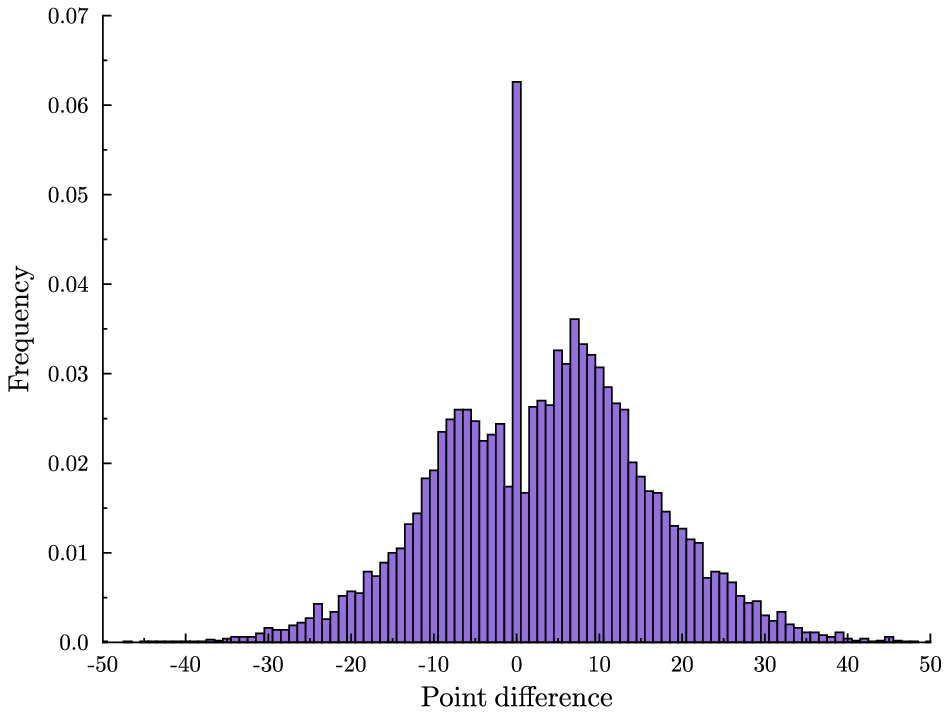
(There is also more mass on the positive end. This is the well-known home team bias.)
What explains this? A star PhD student at Northwestern, Toomas Hinnosaar, and I have been thinking about this. Our focus in on the dynamics and strategy at the end of the game. To give you some ideas, Toomas created the following striking video. It shows the evolution of the point differential in the last 40 seconds of the fourth quarter. At the beginning, the distribution looks close to normal. This is what the crude hypothesis above would predict. Watch how the spike emerges in such a short period of time.
By contrast, here is the same animation at the end of halftime. Nothing unusual.
Apple always claimed its computers were better than PCs. Yet, PCs became ubiquitous and Apple’s share of the computer market is small.
Q: Why did the supposedly inferior product win out?
A: Network effects. PCs became cheap, Microsoft let developers loose on its operating system and so there are more useful applications available for the PC than Apple. Steve Jobs did not want to let developers have control over his product and his product withered away as a result.
Apple has learned its lesson this time around with the iPhone. Apps take the phone to a different level. I can’t survive without my G-Park app that tells me where I parked my car in the vast array of Northwestern carparks. I let my kids play JellyCar to distract them when we’re on a long trip. As Slate puts it, the irony is that the network effects that killed the Apple computer make the iPhone impregnable:
For years, Apple fans claimed that the company made the best PCs in the world, hands down. Nevertheless, it was hard to argue with the fact that Windows PCs simply ran more programs. Now Apple is in the position once occupied by Microsoft. Over the next few years, Palm, Research in Motion, Nokia, Sony, and others are sure to create some transcendent mobile devices. But the hardware hardly matters anymore. How is anyone going to compete with all these amazing apps?
For coffee, Peet’s for me. Better coffee, fewer people (at least in Evanston), and for us in the Midwest, a wistful San Fran ambiance at the height of winter.
Apparently, Zagat‘s readers disagree rating even Dunkin Donuts over Peet’s. Nate Silver at fivethirtyeight solves the mystery: Zagat’s counts an “abstain” vote for Peet’s as a “zero” rating from a 0-3 rating scale. What happens in a binary election where abstainers are eliminated?
I wish Peet’s had the Greek yogurt I get from Starbucks. Then, I would face no dilemma in the morning.
R. Crumb is illustrating The Book of Genesis. An excerpt appears in this week’s New Yorker. Here is a copyright-violating scan. (via BoingBoing)
By the time he came to the story of Noah, though, he was annoyed. He had begun to realize, he says, that “the whole thing is a piece of patriarchal propoganda, engineered to consciously and deliberately suppress matriarchy.”
One of the best movies I have ever seen is Crumb, a documentary about R. Crumb and his two brothers. If you have seen that film you have some context for the quote above. I am pre-ordering my Book of Genesis now.
According to the New York Times:
Mr. Obama answered a question about “dealing with the hawks in the current Israeli government,” by suggesting that Israel’s new, conservative prime minister, Benjamin Netanyahu, might have an opportunity to play a more constructive role than a more liberal leader:
I believe that Prime Minister Netanyahu will recognize the strategic need to deal with this issue. And that in some ways he may have an opportunity that a labor or more left leader might not have. There’s the famous example of Richard Nixon going to China. A Democrat couldn’t have gone to China. A liberal couldn’t have gone to China. But a big, anti-communist like Richard Nixon could open that door. Now, it’s conceivable that Prime Minister Netanyahu can play that same role.
This is the essence of Cukierman and Tomassi’s “Why does it take a Nixon to go to China?” American Economic Review, Mar. 1998, pp. 180-197. Suppose a political knows the “state of the world” and the policy that most voters would support. But voters do not have this information. They cannot tell whether a policy is suggested by a politician because it is the ideal policy for the state of the world or because he has a bias for it. Then, a right-wing politician is more likely to implement a extreme left-wing policy. Voters are likely to believe it is the “right” policy as he is voting against his natural bias. He is then rewarded by being re-elected. Hopefully, there is no Watergate on the horizon for Netanyahu.
Until 2010 that is, whereupon its time to shuffle it:
If Congress doesn’t act, the estate tax will disappear in 2010 but will return in 2011 at the pre-2001 level of $1 million with a tax rate of 55%.
That could generate some interesting data.
After the showstopper that is Arrow’s Theorem, we could just throw in the towel. The motivation for studying social welfare functions was to find a coherent standard by which to judge institutions and to propose policies. Now we see that there is no coherent standard. Well students you are not getting away so easily, after all this is only the second week of the course. We will accept that we must violate one of the axioms. Which one do we choose?
A lot of normative economic theory is implicitly built upon one of two welfare criteria, either Pareto efficiency or utilitarianism. While it is standard to formally define Pareto efficiency in an undergraduate micro class, utilitarianism is often invoked without explicit mention. For example, we are implicitly using some form of utilitarianism when we talk about consumer and producer surplus. And to argue that a monopoly is inefficient in a partial equilibrium framework is a utilitarian judgment (absent compensating transfers.)
So I make it explicit. And I take the time to formally define utilitarianism, explain where it applies and what justifies it and I point out its limitations. In terms of Arrow’s theorem I tell the students that we are dropping the axiom of universal domain (UD.) That is, we are not requiring our social welfare function to apply in all situations, only in those situations in which there is a valid measure of welfare that can be transferred and/or compared inter-personally. In this class, that measure of welfare is willingness to pay, and it applies when there are monetary transfers available and all agents value money in equal terms, i.e. quasi-linear utility.
These lectures contain one important formal result. In the quasi-linear world with monetary transfers utilitarianism coincides with Pareto efficiency. So these two common welfare standards are the same. (Any utilitarian improvement can be made into a Pareto improvement with judiciously chosen transfers and any Pareto improvement is a utilitarian improvement.)
Here are the notes.
My yoga teacher begins class instructing us to moderate our breathing. Her precise instruction is this: breathe loud enough so that your neighbor can hear you breathe but not so loud that you cannot hear your neighbor’s breath.
How loud should I breathe?
From Language Log:
The opening sentence of George F. Will’s latest column (“Have We Got a Deal for You“, 6/7/2009):
“I,” said the president, who is inordinately fond of the first-person singular pronoun, “want to disabuse people of this notion that somehow we enjoy meddling in the private sector.”
This echoes J.B.S. Haldane’s quip that the creator, if he exists, must be inordinately fond of beetles; and Will, like Haldane, is presumably proposing an inference about someone’s preferences from his actions, not reporting a direct emotional revelation.
So, since I’m one of those narrow-minded fundamentalists who believe that statements can be true or false, and that we should care about the difference, I decided to check. (On Will, not Haldane.)
Based on a few press conferences, it turns out that Obama uses “I” less often than both G.W. Bush and Bill Clinton. By the way it looks like I have found a good resource for searching Presidential cheap talk: The American Presidency Project.
One theory: Broadway is vulnerable to boors because it is under pressure. More new shows opened this past season than at any point in the past 25 years, which means more seats to fill in a recession. In response, shows have been offering steep discounts on tickets, which can normally cost upwards of $100 apiece. BroadwayWorld.com, an entertainment site, is promoting a “Lucky Sevens” discount that offers a “Guys and Dolls” ticket for $7.77 with the purchase of a full-price seat.
That’s the theory. Here are the data:
The litany of misdemeanors is long. During a Saturday matinee of the Holocaust drama “Irena’s Vow,” a man walked in late and called up to actress Tovah Feldshuh to halt her monologue until he got settled. “He shouted, ‘Can you please wait a second?’ and then continued on toward his seat,” recalls Nick Ahlers, a science teacher from Newark, N.J., who was in the audience. He says the actress complied.
During a recent matinee of “God of Carnage,” which explores the lives of two couples, a woman in the mezzanine screamed, “How ’bout those Yankees!” — filling one of the play’s intense silences. At “The Norman Conquests,” an elderly man familiar with the British comedy script recited his favorite lines as the actors read them, prompting audience members to confront him at intermission. Steve Loucks, a theater blogger from Minneapolis who was sitting near the man, was stunned. “What is with people who think they’re in their own living rooms?”
The Kellogg Graduate School of Management at Northwestern has begun syndicating the various blogs published by Kellogg faculty, including Cheap Talk. Its great to have the Kellogg endorsement. And there are many excellent blogs, worth taking a look.
Via MR, some thoughts on carbon taxes:
However, this does not necessarily mean that revenue-neutral CO2 taxes, or auctioned allowance systems, produce a “double dividend” by reducing the costs of the broader tax system in addition to slowing climate change. There is a counteracting, “tax-interaction” effect (e.g., Goulder 1995). Specifically, the (policy-induced) increase in energy prices drives up the general price level, which reduces real factor returns, and thereby (slightly) reduces factor supply and efficiency.
Indeed, a triple dividend. The reason, say, labor supply will fall is that the marginal labor was being sold to buy the marginal output that we have decided should not be produced because of the externality. So this was part of the plan.
In this case . . . while the challenged packaging contains the word “berries” it does so only in conjunction with the descriptive term “crunch.” This Court is not aware of, nor has Plaintiff alleged the existence of, any actual fruit referred to as a “crunchberry.” Furthermore, the “Crunchberries” depicted on the [box] are round, crunchy, brightly-colored cereal balls, and the [box] clearly states both that the Product contains “sweetened corn & oat cereal” and that the cereal is “enlarged to show texture.” Thus, a reasonable consumer would not be deceived into believing that the Product in the instant case contained a fruit that does not exist. . . . So far as this Court has been made aware, there is no such fruit growing in the wild or occurring naturally in any part of the world.
see here. (Shako shake: BoingBoing)
Today at Peet’s in Evanston I was trying to work out a model for this idea Sandeep and I are working on related to the game theory of torture. I started drawing a litle graph and then got lost in thought. I must have looked a little weird (nothing unusual there) because the woman next to me started asking me what was up with this squiggly plot on my pad of paper.
Most economists dread these moments when someone asks you what you do and you have to tell them you’re an economist and then prepare to deflect the inevitable questions and/or accusations “what’s going to happen with interest rates?” “when’s the economy going to turn around?” Usually I just mumble and wait for the person to get bored and go on with her reading. For some reason I was talkative today.
I told her I was a game theorist. “What’s that for?” I told her I was working on a theory of torture. She looked horrified. “How do you make a theory of torture?”
I told her that using game theory is a lot like screenwriting. Imagine you were a film-maker and you wanted to make a point about torture. You would invent characters and put them in the roles of torturer and torturee and you would describe the events. You would depict how the torturer would plan his torture and how he would the torturee would react and how this would lead the torturer to adjust his approach. If the film was going to be effective it would have believable characters and it would have to show the audience a plausible hypothetical situation and what happens when these characters act out their roles in that situation. In short, its a model.
(As I was saying this I remembered that I learned to think of economics and literature in this way about 20 years ago from Tyler Cowen. And he has a nice paper on it here.)
She looked even more horrified. But I was pretty pleased. I started thinking about Resevoir Dogs (nsfw).
While scripts and models are constrained by a similar requirement of coherence between character and events, there are differences and this makes them complementary. A model necessarily maps out the entire game tree, while a script describes just one path. In a model every counterfactual is analyzed and we see their consequences and this explains why those paths are not taken, but a film is a far more vivid account of the path taken. In a model the off-equilibrium outcomes are the results of mistakes while a well-conceived script can bring in plausible external developments to place the characters in unexpected situations.
Of course film-makers get invited to better parties.
A post at Freakonomics suggests macroeconomics is in more trouble than microeconomics because there is less room for empirical work because there is less data:
In microeconomics, at least there is an abundance of good data, so people who are good at measuring and describing things can succeed. But in macro there is not much data, so most of the rewards are for the mathematics, not the empirics.
As a micro-theorist and hence an outsider, it seems to me that Hari Seldon and other psychohistorians are wrong: events involving large numbers of people and firms are harder to predict than those involving a few. In micro for example, is much harder to understand imperfect competition than it is to understand say monopoly price discrimination. Even if competition is perfect, we know from general equilibrium theory that there is still a multiple equilibrium problem that makes it hard to predict economic trends. And if we allow monopolies so we can predict trends more easily, here is my main prediction: prices will go up, output will go down, the stock market will go up and consumers will be worse off.
A post at Freakonomics (and accompanying article at Slate) advocates protection against price depreciation as a way to prop up housing prices:
Sellers could commit to reimbursing their buyers for any fall in the average value of homes in their area in the year following a sale. Such price protection would give buyers confidence that they won’t regret their purchases even if the market does fall further and cheaper houses come on offer — confidence that they need in order to buy now. And if buyers gain confidence, prices won’t fall, so sellers won’t have to pay. … And it’s natural for sellers to provide the insurance that price protection involves. If they can’t sell their houses, they’re going to end up bearing the house price risk anyway.
Here are some other things sellers could do to keep prices from falling:
- Commit to compensate buyers for future appreciation on the home they move out of
- Throw in tuition for the neighborhood private schools
- Remodel the kitchen
“Bob Dylan drew upon a rich lode of old folk tunes for most of his early songs,” Hyde writes. “That’s not theft; that’s the folk tradition at its best.” It seems that nearly two-thirds of Dylan’s work between 1961-63 — some 50 songs — were reinterpretations of American folk classics. In today’s corporate-creative environment, in which Disney was allowed to change the basic nature of copyright law back in the 90s so that their signature mouse wouldn’t fall into the public domain, Dylan’s early work would’ve landed him in court.
from a post at Mental Floss. The punchline:
Hyde argues that “there are good reasons to manage scarce resources through market forces, but cultural commons are never by nature scarce, so why enclose them far into the future with the fences of copyright and patent?
I am generally opposed to IP law, but I think this oversimplifies. There is room for argument about patents. (For example, I came across this story today about drugs for rare diseases. It is hard to see how drugs that will benefit a total of 3 people on the whole planet can be financed without monopoly rents.) However, copyright for music and other creative works is a solution to a non-existent incentive problem.
But I am somebody who is very anxious to have the Afghan government and the Pakistani government have the capacity to ensure that those safe havens don’t exist. And so it, I think, will be an important reminder that we have no territorial ambitions in Afghanistan; we don’t have an interest in exploiting the resources of Afghanistan. What we want is simply that people aren’t hanging out in Afghanistan who are plotting to bomb the United States.
Obama said this in an interview with NPR (transcript.) He actually says “hangin’ out” but the transcriber apparently wanted to maintain an air of formality and wrote “hanging.” You can hear it here, around the 12:30 mark. He chuckles a bit when he says it.
These are conspicuoulsy different ways for a President to talk, especially about something as serious as terrorism. It says something about the man himself and it also draws a sharp contrast with Bush, whose standard catch phrase at these moments would be “rout out the terrorists.”
Previous installment in the series.
In an article about their famous restaurant surveys, Nina and Tim Zagat write
Over the years that we’ve spent surveying hundreds of thousands of diners, one fact becomes clear: Service is *the* weak link in the restaurant industry. How do we know? Roughly 70% of all complaints we receive relate to service. Collectively, complaints about food prices, noise, crowding, smoking, and even parking make up only 30%. Moreover, the average rating for food on our 30-point scale is usually two points higher than the average rating for service. Given the fact that identical people are voting, and that there are hundreds of thousands of them, this deficit is dramatic.
They go on to give some advice to the restaurant industry for improving service. But don’t these results say that in fact we don’t care about service? They show that we choose the restaurants with good food despite their bad service. Sure we complain about the service, other things equal who doesn’t want better service. But we can live with bad service if we get good food.
Its a standard example of a game that has no Nash equilibrium. But what exactly are the rules of the game? How about these:
You have fifteen seconds. Using standard math notation, English words, or both, name a single whole number—not an infinity—on a blank index card. Be precise enough for any reasonable modern mathematician to determine exactly what number you’ve named, by consulting only your card and, if necessary, the published literature.
Hmm… maybe it does have a Nash equilbirium. But after reading the article (highly recommended), I am still not sure. I think it comes down to whether or not the players are Turing machines. (Fez flip: The Browser)
No, not because of this, although it can get rough.
I teach the third course in the first year PhD micro sequence at Northwestern and I also teach my intermediate micro course in the Spring. I am just finishing up teaching this week and my students will soon be writing their evaluations of me. They will grade me on a scale of 1 to 6.
Because I am the third and last teacher they will evaluate this year, I face some additional risk that my predecessors did not. Back in the fall, when they evaluated their first teacher they had only one data point with which to estimate the distribution of teaching ability in the Northwestern economics faculty. An outstanding performance would lead them to revise upward their beliefs and a poor performance would revise their beliefs downward.
As a result, when the students sit down to evaluate their fall professor, even a very good performance will earn at most a 5 because the students, now anticipating higher average performance in the winter and spring, will be inclined to hold that 6 in reserve for the best. Likewise, very bad performances will have their ratings buoyed by the student’s desire to save the 1 for the worst.
When Spring comes, there is nothing more to learn. By now they know the distribution and the only thing left to do is to rank their Spring professor relative to those who came earlier. If he is best he gets a 6, if not he gets at most a 4. His rating is a mean-preserving spread of the previous ratings.
There is a general principle at work here. The older you get the more you know about your opportunity costs, the more decisively you act in response to unanticipated opportunities. (There is a countervailing force which I believe on net makes us more conservative when we get older, but that is the topic of a later post.)
I guess I am the Tyrone Slothrop of Northwestern University. I’ve been doing research on the theory of the “democratic peace” – the finding that democracies rarely attack each other. This has been called “an empirical law” in international relations. This idea is famous enough that it is offered as a rationalization for spreading democracy by both left- and right-wing politicians.
Why might democracies be more peaceful? And how about a regime like Iran? Fareed Zakaria says : “Iran isn’t a dictatorship. It is certainly not a democracy.” It is something in the middle. There are elections but an elite also controls many things such as the appointment of the Supreme Leader who has enormous power.
I have done some research with David Lucca and Tomas Sjostrom where we offer a theory for why these regimes which we call limited democracies might be the most warlike of all. And the data does suggest that countries like Iran are very warlike, especially when facing a similar limited democracy.
Here is brief attempt to explain the theory informally – it is done using game theory in the paper. Conflict occurs via combination of greed and fear – two of the causes of war according to the great Greek historian Thucydides. Each side does not know if the other is motivated by greed or fear. Greedy leaders are hawkish. But, even if one side is not greedy, they turn aggressive because the other side may be greedy. So, both sides become aggressive whether it is because of greed or fear of greed. We study how political institutions can control greed or stimulate fear.
In fact, the logic above is our model of dictatorship where leaders interact with no thought for the wishes of their citizens. It is our pure model of greed and fear. It is inspired by the famous logic of the “reciprocal fear of surprise attack” due to Thomas Schelling.
In a democracy, the voters may punish a leader who starts a war unnecessarily. As leaders want to stay in power, this controls greed. But the voters may also punish a leader who is weak in the face of aggression. This unleashes fear as democratic leaders are aggressive in case they are too dovish in an aggressive environment. So, democracies can be peaceful against each other as dovish voters control their leaders. But they can turn aggressive very rapidly if they are concerned their opponent will be aggressive. In a dictatorship, the leader does not fear losing power but no-one controls his greed.
Now, suppose the leader can survive in power if he pleases the voters or if he satisfies a hawkish minority who favor war. This regime has some properties of a democracy – the leader survives in power in the same scenarios as the leader of a full democracy. But he also survives if he starts an unnecessary war – just like a dictator would. The leader only loses power if he is dovish in the face of aggression. Then, neither the average citizen nor the hawks support him. This type of regime which we call a limited democracy is the most aggressive of all. The leader fears losing power and the voters cannot control his greed. So, a little democracy can make things worse if it leads to a regime like this.
The theory leads to a bunch of predictions which we try to confirm in data. I took a shot at explaining the ideas in a talk I gave to Kellogg MBAs. The video is here in case you’re interested (you need Real Player to view it). The article is here (you need Adobe Acrobat to view it).
The town I live in is facing a zoning controversy. An old family-run restaurant on a downtown corner has gone out of business and put the property up for sale. The high bidder is Dairy Queen. But the town’s zoning board is set to reject the sale.
At first there doesn’t seem to be any economic rationale for elected representatives of the town stopping what the citizens of the town are evidently voting for with their dollars. The argument would be that the reason Dairy Queen is the high bidder is that Dairy Queen expects to earn the most in that location. Since their earnings come from providing a valuable product and service, this must mean that giving the space to Dairy Queen will generate the most value for the citizens of my town. Why doesn’t the zoning board see this?
Well, they just might be smart enough to see that the simple argument I have given is flawed. The flaw is that it assumes that Dairy Queen faces the same market conditions as any other bidder for the space.
Bidding for the right to enter a market is determined not by the amount of value the business will create, but the amount of that value that the business gets to keep. The share of value that the business gets to keep is determined by market conditions. Generally, businesses that face competition get a smaller share of the value they create than businesses with less competition.
Because of this, unregulated markets for scare commercial real estate will not necessarily lead to an efficient allocation. A bank may be more valuable to the community and yet lose the bidding to Dairy Queen. Zoning boards can, in principle, correct this by intervening.
A similar logic is at work in pollution-permit trading markets, although with a twist. The naive argument is that the social cost of a unit of carbon emissions is the same regardless of who is the emitter, but the benefits vary. And the benefits will be reflected in the polluters’ willingness to pay for permits. If we attach a high value the output of producer A, then producer A should be more willing to pay for the right to produce (and therefore pollute) than producer B whose output we value less.
But again this depends on the market conditions. Producer B might be in a competitive market where, at the margin, it internalizes all of the gains from increased output and Producer A might be a monopolist whose marginal revenue is less than price and therefore internalizes only a fraction of the gains.
(The twist is that pollution rights are divisible and so the appropriate calculation is at the margin which flips the comparison between competitive and monopolistic producers. Real estate is indivisible (or at least much less divisible) and so average calculations take over.)
This points to an advantage of a carbon tax over a market-based permit system. A carbon tax can be customized by industry and market conditions. A permit market treats all polluters equally.
Both know how to use the tactics of the Prisoner’s Dilemma to get their subjects to squeal. George Stephanopoulos explains it this way:
“He flashes a glimpse of what he knows, shaded in a largely negative light, with the hint of more to come, setting up a series of prisoner’s dilemmas in which each prospective source faces a choice: Do you cooperate and elaborate in return (you hope) for learning more and earning a better portrayal–for your boss and yourself? Or do you call his bluff by walking away in the hope that your reticence will make the final product less authoritative and therefore less damaging? If no one talks, there is no book. But someone–then everyone–always talks.”
And according to Matt Alexander in “How to Break a Terrorist…” the Prisoner’s Dilemma is a still mainstay in the arsenal of methods employed against Al Qaeda.
Nice to know that the story we use to motivate the first game anyone learns in a game theory course might actually be true.
I teach undergraduate intermediate microeconomics, a 10 week course that is the second in a two-part seqeunce at Northwestern University. I have developed a unique approach to intermediate micro based originally on a course designed by my former colleague Kim-Sau Chung. The goal is to study the main themes of microeconomics from an institution- and in particular market-free approach. To illustrate what I mean, when I cover public goods, I do not start by showing the inefficiency of market provided public goods. Instead I ask what are the possibilities and limitations of any institution for providing public goods. By doing this I illustrate the basic difficulty without confounding it with the additional problems that come from market provision. I do similar things with externalities, informational asymmetries, and monopoly.
All of this is done using the tools of dominant-strategy mechanism design. This enables me to talk about basic economic problems in their purest form. Once we see the problems posed by the environments mentioned above, we investigate efficiency in the problem of allocating private goods with no externalities. A cornerstone of the course is a dominant-strategy version of the Myerson-Satterthwaite theorem which shows the basic friction that any institution must overcome. We then investigate mechanisms for efficient allocation in large economies and we see that the institutions that achieve this begin to resemble markets.
Only at this stage do markets become the primary lens through which to study microeconomics. We look at a simple model competition among profit-maximizing auctioneers and a sketch of convergence to competitive equilibrium. Then we finish with a brief look at general equilibrium in pure exchange economies and the welfare theorems.
There is a minimal amount of game theory, mostly just developing the tools necessary to use mechanism design in dominant strategies, but also a side trip into Nash equilibrium and mixed strategies.
In the coming weeks I will be posting here my lecture notes with a brief introduction to the themes of each. I am distributing these notes under the Creative Commons attribution, non-commercial, share-alike license. Briefly, you are free to use these for any non-commercial purpose but you must give credit where credit is due. And you are free to make any changes you wish, but you must make available your modifications under the same license.
Today I am posting my notes for the first week, on welfare economics.
I begin with welfare economics because I think it is important to address at the very beginning what standard we should be using to evaluate economic institutions. And students learn a lot from just being confronted with the formal question of what is a sensible welfare standard. Naturally these lectures build to Arrow’s theorem, first discussing the axioms and motivating them and then stating the impossibility result. In previous years I would present a proof of Arrow’s theorem but recently I have stopped doing that because it is time consuming and bogs the course down at an early stage. This is one of the casualties of the quarter system.
Storn White, lifestyle artist.
Like most San Franciscans, Charles Pitts is wired. Mr. Pitts, who is 37 years old, has accounts on Facebook, MySpace and Twitter. He runs an Internet forum on Yahoo, reads news online and keeps in touch with friends via email. The tough part is managing this digital lifestyle from his residence under a highway bridge.
The article is here. Another highlight:
Michael Ross creates his own electricity, with a gas generator perched outside his yellow-and-blue tent. For a year, Mr. Ross has stood guard at a parking lot for construction equipment, under a deal with the owner. Mr. Ross figures he has been homeless for about 15 years, surviving on his Army pension.
Inside the tent, the taciturn 50-year-old has an HP laptop with a 17-inch screen and 320 gigabytes of data storage, as well as four extra hard drives that can hold another 1,000 gigabytes, the equivalent of 200 DVDs. Mr. Ross loves movies. He rents some from Netflix and Blockbuster online and downloads others over an Ethernet connection at the San Francisco public library.
Greg Mankiw is trying to make a reductio ad absurdum critique of the objective of income redistribution. He has written a paper with Matthew Weinzierl which shows that optimal taxation will typically involve taxing all kinds of characteristics that seem patently unfair and unacceptable. He concludes from this that it is the goal of income redistribution that entails these absurdities.
But there is a prominent guy who lives at a nice home at 1600 Pennsylvania Avenue who wants to “spread the wealth around.” The moral and political philosophy used to justify such income redistribution is most often a form of Utilitarianism. For example, the work on optimal tax theory by Emmanuel Saez, the most recent winner of the John Bates Clark award, is essentially Utilitarian in its approach.
The point of our paper is this: If you are going to take that philosophy seriously, you have to take all of the implications seriously. And one of those implications is the optimality of taxing height and other exogenous personal characteristics correlated with income-producing abilities.
This argument fails because the objectionable policies implied by optimal taxation in his model have nothing to do with income redistribution or utilitarianism. Indeed they would be optimal under the weaker and unassailable welfare standard of Pareto efficiency which I would assume Mankiw embraces.
Let me summarize. Optimal taxation involves minimizing the distortionary effect on output from raising some required level of revenue. It does not matter what that revenue is being used for. It could be for redistribution but it could also be for producing public goods that will benefit everyone. Whatever revenue is required, the optimal taxation policy generates this revenue with minimal cost in terms of reduced incentives for private production. Taxing exogenous and observable characteristics that are correlated with productivity is a way of generating revenue without distorting incentives.
If we tax income (a direct measure of productivity) you can lower your taxes by earning less, that is a distortion. If we tax your height (known to be correlated with productivity), you cannot avoid these taxes by making yourself shorter.
So the implication that Mankiw wants us to be uncomfortable with is an implication of the way optimal tax theorists conceive the problem of revenue generation and the implication would be present regardless of how we imagine that tax revenue being spent. It has nothing to do with redistribution and we can feel uncomfortable with height taxation without that making us think twice about our desire to redistribute wealth.

