
You are currently browsing the category archive for the ‘Uncategorized’ category.
Here is an interesting article about the history of the Ivy league and the member Universities’ attitudes toward sport.
The Ivy is never going to be the Southeastern Conference—and nobody is suggesting it should be. The schools don’t need the exposure of sports to attract students and alumni donations. But some of the league’s alumni complain that the schools offer their students the best of everything, except in this one area. “Why not give them the same opportunities and the same platform in athletics that you do in academics?” says Marcellus Wiley, a former NFL defensive end who played at Columbia in the 1990s. “I think they should revisit everything.”
If we take the objective to be maintaining reputation and attracting donations then there is a broader question. Why is the concentration among schools which compete on academic excellence so much higher than among those that compete on athletics? Competition for dominance in sport appears to be more costly and occurs at a higher frequency that the competition for academic excellence. Some possible reasons:
- There is more variance in academic talent than in talent in sports. Thus the top end is thinner and the market is smaller.
- There is more continuity in academic strength purely because of numbers. A bad recruiting class for the basketball team a few years in a row and you are back to square one. A freshman class at Harvard is large enough that variations wash out.
- It is easier to throw money at sport. One coach makes the whole program. Assessing the talent of faculty and attracting it with money is more complicated. And maybe irrelevant.
I would like to believe 1 but I don’t. I would like not to believe 3 but its hard. I do believe 2.
Oliver Hart and Luigi Zingales wrote an op-ed with their plan to regulate large financial institutions (LFI) which are too big to fail. I’ve blogged about their idea before but here it is again quickly:
Suppose a Credit Default Swap CDS pays off if Citibank, say, fails. Different traders of the Citibank CDS have different information about the chance that Citibank may fail. The price of the Citibank CDS aggregates that information. The price will be high if the chance of failure are high. Hence, a regulator can monitor the Citibank CDS price and step in to force the LFI to cover it loans or be taken over.
They have fleshed this clever plan out with a model but the main idea remains the same.
Here is one problem I see: If the CDS price is high, the LFI is meant to issue more equity to cover the debt against which CDS is trading. Suppose it just refuses – i.e. it breaks the rules. In their scheme, the regulator is meant to step in and put the firm in the hands of a receiver who recapitalizes it and sells it. But this is costly for the regulator. Maybe the market reacts to the takeover badly and systemic risk spreads through the financial system. The regulator can instead keep the current managers employed and bail out the LFI using taxpayer money. If this option makes the managers better off, this is what they will push for. This is what we see GM doing to avoid bankrupcy for instance, in their case trying to exploit the political risk of bankrupcy rather than systemic risk.
If the threat to enforce rules is not credible, the LFI has the incentive to “hold-up” regulator when the CDS price goes up. The mechanism proposed by Hart and Zingales is not credible as there is a commitment problem.
A post at Language Log explores the use of mathematics in linguistics. It closes with
Anyhow, my conclusion is that anyone interested in the rational investigation of language ought to learn at least a certain minimum amount of mathematics.
Unfortunately, the current mathematical curriculum (at least in American colleges and universities) is not very helpful in accomplishing this — and in this respect everyone else is just as badly served as linguists are — because it mostly teaches thing that people don’t really need to know, like calculus, while leaving out almost all of the things that they will really be able to use. (In this respect, the role of college calculus seems to me rather like the role of Latin and Greek in 19th-century education: it’s almost entirely useless to most of the students who are forced to learn it, and its main function is as a social and intellectual gatekeeper, passing through just those students who are willing and able to learn to perform a prescribed set of complex and meaningless rituals.)
Before getting into economics and after getting out of physics, I took calculus and found it very useful and interesting for its own sake. I do see that the way calculus is taught in the US is geared toward engineers and physicists, but I have a hard time thinking of what mathematics would substitute for calculus in the undergraduate curriculum if the goal was to teach students something useful. It can’t be analysis or topology. I took abstract algebra as an undergraduate and found it esoteric and boring. Discrete mathematics? OK maybe statistics, but don’t you need integration for that? Help me out here, if you had the choice, what would you replace calculus with? And remember the goal is to teach something useful.
Via kottke.org, here is the first installment of an Errol Morris essay on Han van Meegeren, the Dutch artist who duped the art world into thinking that his paintings were the work of Vermeer. Morris concludes with the following
To be sure, the Van Meegeren story raises many, many questions. Among them: what makes a work of art great? Is it the signature of (or attribution to) an acknowledged master? Is it just a name? Or is it a name implying a provenance? With a photograph we may be interested in the photographer but also in what the photograph is of. With a painting this is often turned around, we may be interested in what the painting is of, but we are primarily interested in the question: who made it? Who held a brush to canvas and painted it? Whether it is the work of an acclaimed master like Vermeer or a duplicitous forger like Van Meegeren — we want to know more.
The economics version of this question is why the price of a painting would fall just because it has been discovered to be a forgery by technical means and not because the painting was considered of lesser quality. And a corollary question. If you own a painting which is thought by all to be a genuine Vermeer, why would you or anyone invest to find out whether it was a forgery. There is probably a good answer to this that doesn’t require resorting to the assumption that buyers value the name more than the painting.
The value of a painting is the flow value of having it hang on your wall plus the eventual resale value. For the truly immortal works of art the flow value is negligible relative to the resale value. The resale value is linked to the flow value to the person to whom it will be sold to, the person she will sell it to, etc. Ultimately this means that the price is determined by the sequence of people who have the greatest appreciation for art, since they will be willing to pay the most for the flow value. The existence of just one person in that sequence who is sensitive enough to distinguish a true Vermeer from a Van Meegeren implies a large difference in the prices, even if that person is not alive today and will not be for many generations.
“These are relatively simple physical equations, so you program them into the computer and therefore kind of let the computer animate things for you, using those physics,” said May. “So in every frame of the animation, (the computer can) literally compute the forces acting on those balloons, (so) that they’re buoyant, that their strings are attached, that wind is blowing through them. And based on those forces, we can compute how the balloon should move.”
This process is known as procedural animation, and is described by an algorithm or set of equations, and is in stark contrast to what is known as key frame animation, in which the animators explicitly define the movement of an object or objects in every frame.
Why stop there? Next, we can use models from the behavioral sciences, program a few equations and let the characters, dialog, and action animate themselves by following the solution of the model. Don’t believe me? Here’s how to procedurally animate Romeo and Juliet.
Tom Schelling has a famous example illustrating how to solve coordination problems. Suppose you are supposed to meet someone in New York City but you forgot to specify a location to meet. This was before the era of cell phones so there is no opportunity for cooperation before you pick a place to go. Where do you go? You go where your friend thinks you are most likely to go, which is of course where she thinks you think she thinks you are most likely to go, etc.
Notice that convenience or taste or proximity have no direct bearing on your choice. These considerations may indirectly influence your choice, but only if she thinks you think she thinks … that they will influence your choice.
There was an old game show called the Newlywed Game where I learned some of my very early training as a game theorist in my living room roughly at the age of 7. Here is how the show works. 4 pairs of newlyweds were competing. The husbands, say, would be on stage first, with the wives in an isolated room. The husbands would be asked a series of questions about their wives, say “What wedding gift from your family does your wife hate the most?” and the husbands would have to guess what the wives would say. (This was the 70’s so every episode had at least one question about “making whoopee,” like “what movie star would your wife say you best remind her of when you’re makin’ whoopee?”)
When you watch this show every night for as long as I did you soon figure out that the way to win this show is to disregard completely the question and just find something to say that you wife is likely to say, which is of course what she thinks you think she is likely to say, etc. You could try to make a plan with your newlywed spouse beforehand about what to say, something like the first answer is “the crock pot”, the second answer is “burt reynolds” etc. But this looks awkward when the first question turns out to be “What is your wife’s favorite room to make whoopee?” etc.
So the problem is just like Schelling’s meeting problem. The truth is of secondary importance. You want to find the most obvious answer, i.e. the one your wife is most likely to give because she thinks you are most likely to give it, etc. For example, if the question is, “Which Smurf will your wife say best describes your style of makin’ whoopee?” then even though you think the answer is probably “Clumsy Smurf” or “Sloppy Smurf”, you say “Hefty Smurf” because that is the obvious answer.

Ok, all of this is setup to tell you that Gary Becker is clearly a better game theorist than Steve Levitt. Via Freakonomics, Levitt tells the story of a Chicago economics faculty Newlywed game played at their annual skit party. (Northwestern is one of the few top departments that doesn’t have one of these. That sucks.) Becker and Levitt were newlyweds. According to Levitt they did poorly, but it looks like Becker was onto the right strategy, but Levitt was trying to figure out the right answers:
The first question was, “Who is Gary’s favorite economist?” I thought I knew this one for sure. I guessed Milton Friedman. Gary answered Adam Smith. (Although he later apologized to me and said Friedman was the right answer.)
Then they asked, “In Gary’s opinion, how many more quarters will the current recession last?” I guessed he would say three more quarters, but his actual answer was two more quarters.
The next question was, “Who does Gary think will win the next Nobel prize in economics?” This is a hard one, because there are so many reasonable guesses. I figured if Becker writes a blog with Posner, he might think Posner would win the Nobel prize, so that was my answer. Gary said Gene Fama instead.
The last question we got wrong was one that was posed to Gary, asking which of the following three people I would most like to have lunch with: Marilyn Monroe, Napolean, or Karl Marx. I know Gary has a major crush on Marilyn Monroe, so that was the answer I gave, even though the question was about who I would want to have lunch with, not who Gary would want to have lunch with. Gary answered Karl Marx (which makes me wonder what he thinks of me), but did volunteer, as I strongly suspected, that he himself would of course prefer Marilyn to either of the other two.
But close:
You take all of the conflict, all of the chaos, all of the noise, and out of that comes this precise mathematical distribution of the way attacks are ordered in this conflict. This blew our mind. Why should a conflict like Iraq have this as its fundamental signature? Why should there be order in war? We didn’t really understand that. We thought maybe there is something special about Iraq. So we looked at a few more conflicts. We looked at Colombia, we looked at Afghanistan, and we looked at Senegal.
See the TED talk. (hat tip: The Browser)
The French Open began on Sunday and if you are an avid fan like me the first thing you noticed is that the Tennis Channel has taken a deeper cut of the exclusive cable television broadcast in the United States. I don’t subscribe to the Tennis channel and until this year they have been only a slight nuisance, taking a few hours here and there and the doubles finals. But as I look over the TV schedule for the next two weeks I see signs of a sea change.
First of all, only the TC had the French Open on Memorial Day, yesterday. This I think was true last year as well, but now this year all of the early session live coverage for the entire tournament is exclusive on TC. ESPN2 takes over for the afternoon session and will broadcast early session games on tape.
This got me thinking about the economics of broadcasting rights. I poked around and discovered in fact that the TC owns all US cable broadcasting rights for the French Open many years to come. ESPN2 is subleasing those rights from TC for the segments they are airing. So that is interesting. Why is TC outbidding ESPN2 for the rights and then selling most of them back?
Two forces are at work here. First, ESPN2 as a general sports broadcaster has more valuable alternative uses for the air time and so their opportunity cost of airing the French Open is higher. But of course the other side is that ESPN2 can generate a larger audience just from spillovers and self-advertising than TC so their value for rights to the French Open is higher. One of these effects outweighs the other and so on net the French Open is more valuable to one of these two networks. Naively we should think that whoever that is would outbid the other and air the tournament. So what explains this hybrid arrangement?
My answer is that there is uncertainty about the TC’s ability to generate enough audience for a grand slam to make it more valuable for TC than for ESPN. In face of this TC wants a deal which allows it to experiment on a small scale and find out what it can do but also leaves it the option of selling back the rights if the news is bad. TC can manufacture such a deal by buying the exclusive rights. ESPN2 knows its net value for the French Open and will bid that value for the original rights. And if it loses the bidding it will always be willing to buy those rights at the same price on the secondary market from TC. TC will outbid ESPN2 because the value of the option is at least the resale price and in fact strictly higher if there is a chance that the news is good.
So, the fact that TC has steadily reduced the amount of time it is selling back to ESPN2 suggests that so far the news is looking good and there is a good chance that soon the TC will be the exclusive cable broadcaster for the French Open and maybe even other grand slams.
Bad news for me because in my area the TC is not broadcast in HD and so it is simply not worth the extra cost to subscribe. While we are on the subject, here is my French Open outlook
- Federer beat Nadal convincingly in Madrid last week. I expect them in the final and this could bode well for Federer.
- If there is anybody who will spoil that outcome it will be Verdasco who I believe is in Nadal’s half of the draw. The best match of the tournament will be Nadal-Verdasco if they meet.
- The Frenchmen are all fun but they don’t seem to have the staying power. Andy Murray lost a lot psychologically when he was crowing going into this year’s Australian and lost early.
- I always root for Tipsarevich. And against Roddick.
- All of the excitement on the women’s side from the past few years seems to have completely disappeared with the retirement of Henin, the injury to Sharapova and the meltdown of the Serbs. I expect a Williams-Williams yawner.
Turns out that a good way to predict how the US Supreme Court will rule is by counting the number of questions asked to either side. The winning side will be the one with the fewest questions asked. Is this because
- the justices have made up their minds already and ask more questions of the losing side, or
- more questions put the lawyer on the defensive, weakening his position?
That is, does outcome cause the questions or the other way around? I think it has to be the fomer, indeed the latter eventually implies the former. If questioning per se made a side weaker, then the justices would learn this and would realize that their questions were generating more heat than light. Once they realize this, they will know that the only way to get their side to win would be to ask more questions of the other side.
Google determines quality scores by calculating multiple factors, including the relevance of the ad to the specific keyword or keywords, the quality of the landing page the ad is linked to, and, above all, the percentage of times users actually click on a given ad when it appears on a results page. (Other factors, Google won’t even discuss.) There’s also a penalty invoked when the ad quality is too low—in such cases, the company slaps a minimum bid on the advertiser. Google explains that this practice—reviled by many companies affected by it—protects users from being exposed to irrelevant or annoying ads that would sour people on sponsored links in general. Several lawsuits have been filed by would-be advertisers who claim that they are victims of an arbitrary process by a quasi monopoly.
What is the distortion? One example would be an advertiser who is targeting a very select segment of the market and expects few to click through but expects a lot of money from those that do. This advertiser is willing to pay a lot but may be excluded on quality score. So one view is that Google is transferring value from high-paying niche consumers to the rest of the market.
However, for every set of keywords there is another market. Google would optimally lower the quality penalty on searches using keywords that reveal that the searcher is really looking for a niche product. With this view the quality score is a mechanism for preventing unraveling of an efficient market segmentation.
The article is in Wired and it looks at Hal Varian, chief economist at Google.
What is there to do outside Chicago with bored young boys? I imagine easy day-trips to Cape Cod or Cape Ann for parents in Boston. And I can’t even speculate about the options available in San Francisco or Palo Alto….I turn green with envy just thinking about it.
Unsuccessful hikes in rural Wisconsin, a horrible weekend in a seven golf-course resort outside Galena have soured us on the idea that any escape is possible. Over the last year, on the advice of seasoned veterans of the Midwest, we’ve decided to give the day-trip one more whirl. Saugatuk, Michigan, was a big success. Good food, good beer, cheap house rentals, private sandy beaches and pretty countryside. Just what the doctor ordered.
Closer to us and in some ways more historically interesting – Lake Geneva in Wisconsin. I thought its description as the Newport of the Midwest was a stretch till I saw mansion upon mansion lining the shore of Lake Geneva. The empire than Wrigley’s chewing gum built is as impressive as any feudal monarch’s. And it has a chewier, softer and more benevolent foundation than the war and pillage that lead to a typical King’s wealth. The boat ride that allows the great unwashed a fleeting glance into the capitalist palaces does not hold a child’s attention for long.
For that, we had the East Troy Railroad Museum. The first carriage we saw had “Evanston Express” displayed on it. An old El car that ran between Evanston and Wilmette. The museum has a good cappuccino and smoothie stand and there is an ice cream parlor next door. The trip we took in an open carriage was exhilarating. We spotted old train stops that had been left to crumble. People waved from the houses and cars we passed. Our joy was infectious. At the start of the ride, on one side of the line are McMansions and on the other trailer parks. This is left behind soon for countryside and then finally a farmer’s market. But it’s the open carriage itself that’s most fun. With old lights and seats that flip around for the trip back.
The train was driven by an enthusiastic old volunteer and there was a young volunteer guide. Public good provision that left us all charmed. Good to know that the torch will be passed from the Senior Members to the Junior Members and the East Troy line will live on.
Here is an article (via MindHacks) profiling the types of people who are attracted to conspiracy theories.
It is the domain of psychology to study the specific conspiracy theories that appear and the people who advocate them, but to a game theorist the prevalence of conspiracy theories is not surprising. They fill a credibility gap. Like nature, the truth abhors a vacuum. It cannot be an equilibrium that only the truth is told and retold. Because then we would learn to believe everything we hear. That would be exploited by people trying to take advantage.
Conspiracy theories are just one example of noise that must be present in equilibrium to ensure that we don’t believe everything we hear. And arguably conspiracy theories about events that have already happened or are beyond our control are the cost-minimizing way of moderating credibility. Nobody really gets harmed.
I’m sipping my morning coffee and glancing at the Sunday New York Times when my 8-year old son asks “What is stillborn?”. I choke on my coffee a bit and open my eyes wider to see a photo of several women in Tanzania burying a tiny stillborn baby on the front page of the paper. After a quick answer that doesn’t invite much discussion I flip the paper over so that the distressing photo is no longer in view. Only to see another photo — this one of a college student feeding a lamb with a bottle in upstate New York — that makes the first photo even more depressing. Apparently in the U.S. we have a surfeit of college educated young people to care for newborn lambs, while in Tanzania (and in distressingly many other places throughout the developing world) mothers and their babies die because there are too few people with the requisite skills to care for them.
Psyblog has a rundown of 18 failures of the brain’s system of attention. My favorite:
9. Ironic processes of control
In fact sometimes attention is a real bear. What about when you really want to get something right, like putt the ball, hit a beautiful serve right in the corner or reverse the car into a narrow space? Naturally you concentrate even harder than normal, really focus. Unfortunately that just seems to make things worse: you miss the putt by a mile, frame the ball 50ft in the air and ding the car. What gives? These are what Wegner et al. (1998) call ‘ironic processes of control’. Sometimes too much attention is just as detrimental as too little.
I normaly strive to pay as little attention as possible.
I don’t think this is the right way to make it.
Linguine and clams is one of those dishes where insistence on simplicity is rewarded. The basic mechanics of the dish are extremely straightforward. There are just a few little secrets that elevate a good dish to an excellent one.
Obviously you want fresh clams. You don’t want fresh pasta. Dried pasta works much better here, more on that later. You want garlic, parsley is a nice touch, olive oil, butter and white wine. That’s it. (Bacon?? Sorry Sandeep, no.) Maybe red chile flakes.
Start boiling the pasta. Set the timer for 1 minute short of al dente. Heat a flat pan which can be covered. When hot add a touch of olive oil and chopped garlic (If you like the red chile flakes here is where you add it.) When the garlic is soft but nowhere near brown place the clams in the pan and cover. After about a minute throw splash in some white wine and cover again. After another minute you should have open clams and a lot of clam juice in the pan. Remove the clams to a bowl and reduce the heat on the pan.
Look in the pan. This is your sauce. You will soon be placing pasta in this sauce and you want the pasta to be covered but not swimming, so you are adjusting the heat so that it reduces to that target when your timer goes off. Just before it does, swirl in butter to enrich the sauce.
When the timer goes off you have pasta which is not quite cooked. That is what you want. Use tongs and directly lift the pasta out of the boiling water and into the sauce. There is a reason for this. The pasta water has starch in it from the pasta and some of this water will come along with the pasta into the sauce. The starch tastes good and it will help give body to the sauce. Also, the water will increase the volume of the sauce and you want this because you are going to cook the pasta for its remaining minute in the sauce. Pasta is a sponge at this point of the cooking process (think of what your pasta looks like when you have leftovers: swollen and soft. It has soaked up everything around it.) The pasta will soak up the juices in its last minute of cooking. Fresh pasta will not do this.
When this is done, throw in your parsley, toss and plate the pasta. Arrange the clams on top and serve. Provide bread and fork. Beer is best.
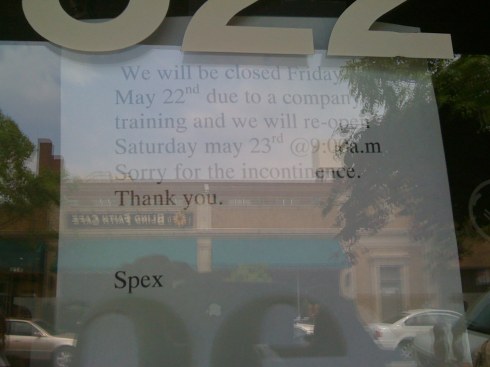 Seen in Evanston on Dempter St. Intentional? Hopefully the training is about writing.
Here is a nice article (via The Browser) theorizing about why Wikipedia works. The apparent puzzles are why people contribute to this public good and why it withstands vandalism and subversion. The first puzzle is no longer a puzzle at all, even us economists now accept that people freely give away their information and effort all the time. But no doubt others have just as much motivation, or more, to vandalize and distort, hence the second puzzle.
The article focuses mostly on the incentives to police which is the main reason articles on say, Barack Obama, probably remain neutral and factual most of the time. But Wikipedia would not be important if it were just about focal topics that we already have dozens of other sources on. The real reason Wikipedia is as valuable a resource as it is stems from the 99.999% of articles that are on obscure topics that only Wikipedia covers.
For example, Barbicide.
These articles don’t get enough eyeballs for policing to work, so how does Wikipedia solve puzzle number two in these cases? The answer is simple: a vandal has to know that, say, John I of Trebizond exists to know that there is a page about him on Wikipedia that is waiting there to be vandalized. (I just vandalized it, can you see where?)
There are only two classes of people who know that there exists a John I of Trebizond (up until this moment that is.) Namely, people who know something useful about him and people who want to know something useful about him. So puzzle number 2 is elegantly sidestepped by epistemological constraints.
Modern classical music, especially, is really hard. What the hell are you listening too, this endlessly winding dissonant stuff without much melody?
The only way to get this kind of music in your ear is to listen to it over and over, which is what I have been doing with the first movement, “Prelude,” of the Maw Violin Concerto the last couple of days. It doesn’t matter whether I want to hear it again or not: I just play it again when it’s done.
When I cycle a piece of thorny orchestral music this way the fog slowly lifts, the picture clears, figure and ground separate. Past pieces I’ve placed on endless loop have included Ligeti’s Melodien, Birtwistle’s The Triumph of Time, Lieberson’s Piano Concerto, and Schuller’s Of Reminiscences and Reflections. Initially they were all daunting listens but now they are old friends. In every case I have learned to understand the composer’s acerbic language much better, so that new experiences with their other pieces aren’t as hard.
That’s Ethan Iverson who, in addition to being the piano player for the frontier jazz trio The Bad Plus, writes an outstanding blog, Do The Math. This post clarified a lot for me. Iverson is a broad, open-minded, and gifted musician and even he approaches contemporary classical music the same way my PhD students approach the Revenue Equivalence Thereom. I have tried exactly what he describes here for Ligeti, etc. and I have yet to turn that corner.
OK so I am apparently obsessed with this theme, but I guess that is what makes me a blogger.
Research, like a lot of collaborative activities, encourages specialization. Successful co-authorships often combine people with differentiated skills. So successful co-authors are complementary which means that your co-author’s other co-authors are substitutes for you. This should imply that you are less likely, other things equal, to have a successful co-authorship with your co-author’s co-authors than with, say a randomly selected collaborator.
If we tried to look for evidence of this in data the difficulty would be in holding other things equal. You are more likely to talk to and have other things in common with your co-author’s co-author than with a random researcher so this would have to be controlled for.
These issues make me think there is some really interesting research waiting to be done taking data from social networks, like patterns of co-authorship or frienship relations on Facebook and trying to simultaneously identify (in the formal sense of that word) “types” (e.g. technician vs idea-man) and preferences (e.g. whether these types are complements or substitutes.) The really interesting part of this must be the econometric theory saying what are the limits of what can and cannot be identified.
In chess, one way a game can be declared a draw is if black, say, has no legal move. This is called stalemate. Typically stalemate occurs because white has a material advantage but fails to checkmate and instead leaves the black king with no space to move that does not walk into check. It is illegal to place your own king in check.
The reason stalemate is an artificial rule is that check is an artificial rule. Clearly the object in chess is to conquer the opponent’s king. One can imagine that check evolved as a way to prevent dishonorable defeat when you overlook a threat against your king and allow it to be captured even though it could have escaped. To prevent this, if your king is in check the rules of chess require that you escape from check on the next move and it is illegal to move into check. This rule means that the only way to win is to checkmate: place your opponent in a position where his king is threatened and cannot escape the threat. The game ends there because on the very next move the king will certainly be captured.
This gives rise to stalemate: it is only because of check that a player can have no legal move. If we dispensed with checkmate, replacing it with the more transparent and natural objective of capturing the king, and eliminating the requirement that you cannot end your turn in check, then a player would always have a legal move. (it is easy to prove this.) Thus, no stalemate.
You can learn a lot about who loves you by walking around with food on your face.
Should you tell someone when they have food on their face? You will embarrass them but you will spare them embarrassment later. The embarrassment comes from common knowledge. He knows that you know, etc. that he had food on his face. You would escape this if you could alert him about the food without him knowing it was you.
You could wait and expect that the food will fall. But you run the risk that it won’t and he’ll discover the food and realize that you let him walk around with food on his face. And once you wait for a bit you are committed. You can’t very well tell him after the meal is over. “You mean you sat there talking to me the whole time with sauce on my chin?”
And what happens when you are in a group and one guy has food on his face? Whose going to tell? Whoever is the first to talk proves that everyone else was willing to ignore it.
Bottom line: if you are dining with me and I have food on my face, send me a text message.
Sandeep has previously blogged about the problems with torture as a mechanism for extracting information from the unwilling. As with any incentive mechanism, torture works by promising a reward in exchange for information. In the case of torture, the “reward” is no more torture.
Sandeep focused on one problem with this. This works only if the torturer will actually carry out his promise to stop torturing once the information is given. But once the information is given the torturer now knows he has a real terrorist and in fact a terrorist with valuable information. This will lead to more torture (for more information) not less. Unless the torturers have some way to tie their hands and stop torturing after a few tidbits of information, the captive soon figures out that there is no incentive to talk and stops talking. A well-trained terrorist knows this from the beginning and never talks.
Let me point out yet another problem with torture. This one cannot be solved even by enabling the torturers to commit to an incentive scheme.
The very nature of an incentive scheme is that it treats different people differently. To be effective, torture has to treat the innocent different than the guilty. But not in the way you might guess.
Before we commence torturing we don’t know in advance what information the captive has, and indeed we don’t know for sure that he is a terrorist at all, even though we might be pretty confident. A captive who really has no information at all is not going to talk. Or if he does he is not going to give any valuable information, no matter how much he would like to squeal and stop the torture.
And of course the true terrorist knows that we don’t know for sure that he is a terrorist. He would like to pretend that he has no information in hopes that we will conclude he is innocnent and stop torturing him. Therefore the torture must ensure that the captive, if he is indeed an informed terrorist, won’t get away with this. With torture as the incentive mechanism, the only way to do this is to commit to torture for an unbearably long time if the captive doesn’t talk.
And this leads us to the problem. In the face of this, the truly informed terrorist begins talking right away in order to avoid the torture. The truly innocent captive cannot do that no matter how much he would like to. And so torture, if it is effective at all, necessarily inflicts unbearable suffering on the innocent and very little suffering on the actual terrorists.
Ridge is one of my favorite wine producers. They are extremely well-known and have wide distribution so it should be easy to find a bottle of something wherever you live in U.S. (well not Utah obviously). Single vineyard Zins are their specialty but they are pricey enough that you don’t drink them every day. The York Creek is around $30, for example. I had never had it before this last weekend. It lived up to expectations. It’s definitely an American wine. It’s jammy. I tasted lots of blackberries and cherry. It’s very thick, chewy and velvety. It’s aged in oak but I could not taste obvious vanilla. The oak had mellowed the tannins so it was very smooth. You got the feeling that by 2012 it will have more complexity. Now, once you open a bottle, you can’t stop drinking as it’s delicious. The unfortunate thing is that it has roughly 15% alcohol so you might regret the easy drinking. I’m going to buy more bottlles, invite some frieds over and commit to drinking less that way.
- Next there will be scam-baiter-baiters, etc.
- Psychological time travel. Must have something to do with this.
- Jazz and brain chemistry.
Let’s try a little (thought) experiment in verbal short-term memory. First, find a friend. Then, find a reasonably complex sentence about 45 words long …Now call your friend up on the phone, and have a discussion about the topic of the article. In the course of this conversation, slip in a verbatim performance of the selected sentence. Then ask your friend to write an essay on the topic of the discussion. … How likely is it that the selected sentence will find its way, word for word, into your friend’s essay?
In case you haven’t guessed, the question is rhetorical and the article (from LanguageLog, a great blog) is referring to Maureen Dowd’s plagiarism. It is a fallacy though to focus only on the probability of the scenario you are trying to reject. What matters is the relative probability of that scenario with the alternative scenario, namely that Maureen Dowd would bother (intentionally) lifting word for word a paragraph which is not particularly insightful or cleverly written from a popular blog at the risk of being called a plagiarizer.
When something happens that has two very unlikely explanations, picking one of those explanations is mostly driven by your priors.
De Waal’s own experiments suggest that capuchin monkeys are sensitive to fairness. If another monkey gets a tasty grape, they will not cooperate with an experimenter who offers a piece of cucumber (Nature, vol 425, p 297). A similar aversion has been spotted in dogs (New Scientist, 13 December 2008, p 12), and even rabbits seem affected by inequality, leading de Waal to believe that an ability to detect and react to injustice is common to all social animals. “Getting taken advantage of by others is a major concern in any cooperative system,” he says.
This article mostly just regurtitates some tired and fragile “evolutionary” explanations for fairness and revenge, but there are a few interesting tidbits, like some experiments with monkeys and this joke:
A genie appears to a man and says: “You can have anything you want. The only catch is that I’ll give your neighbour double.” The man says: “Take out one of my eyes.”
Greg Clark offers an analysis of the impact of the economic crisis on the market for academic economists. His basic thesis is: (a) Economics has not made any progress for the last eighty years. (b) This will reduce demand for economists. Or perhaps the crisis cuts demand for academic economists directly as endowments decline in value. (c) Even though supply is constrained by the technical complexity of becoming a professional economist, wages will fall.
Greg uses the intellectual apparatus of demand and supply to make his argument. This framework has been around for over a hundred years (or more?) but I associate it most with Alfred Marshall and his work in the early part of twentieth century. I guess this still makes Clark’s argument for him: the canonical framework of economics is part of Econ 1 and over eight years old!
I agree with many of Clark’s comments but have a different analysis – you can never get two economists to agree on anything, another old idea.
(1) Demand: Demand for academic economists comes from business schools as well as economics departments. Demand for assistant professors in B schools is driven by teaching demand. In a medium slump, this demand goes up as more people decide to get an M.B.A. as the job market is tight. So, this is not so bad.
(2) Supply: The trouble is on the supply side.
(2.1) One of the main drivers of wages is the finance market. B school finance salaries reflect what incoming grads could get on Wall Street. As these decline, so do salaries for finance professors as the supply of candidates has gone up. Finance salaries run at a premium compared to econ salaries. This is because you can do more “academic” work in economics and you pay for that with a lower salary. But there is an obvious positive correlation between finance and econ salaries because, if the finance salary premium is high, economists would switch to finance. To keep them, economics salaries have to go up. I’m going to stop belaboring this as I’m sure you can all work it out as it is Econ 1! Suffice it to say supply has gone up.
(2.2) As Clark says, economics is interesting again. Let’s face it was getting bit boring so more and more people were doing “freakonomics” rather than “economics.” Or perhaps this reflected the fact that the questions we have not answered are really hard so we were tackling the ones we can answer. I don’t know. The financial crisis makes it clear that we have to answer them. Whatever went wrong reflected too large a faith in the supposed optimal incentives given by the free market rather than an understanding of the perverse incentives facing lenders, borrowers and A.I.G. To unravel these complications, we will use the tools we have developed in microeconomics since the 1970s: moral hazard, adverse selection and mechanism design. It should attract lots of bring young things to replace jaded old-timers like me. The net implication: supply will go up.
So, I am led to the same conclusion as Greg Clark – salaries are going to be stagnant in academic economics. Because supply will go up not because demand will go down. But I’m more optimistic about scientific contributions – I think incentive theory will be useful. I am more optimistic for the science as a whole as more talented people are going to come in, driven by the desire to explain all the things we do not understand.
Following up on my previous post about the infield fly rule, lets get to the bottom of the zero-sum game that ensues when there is a fly ball in the infield. Let’s suppose the bases are loaded and there are no outs.
The infield fly rule is an artificial rule under which the batter is immediately called out and the runners are free to remain standing on base. Wikipedia recounts the usual rationale:
This rule was introduced in 1895 in response to infielders’ intentionally dropping pop-ups to get multiple outs by forcing out the runners on base, who were pinned near their bases while the ball was in the air.[2] For example, with runners on first and second and fewer than two outs, a pop fly is hit to the third baseman. He intentionally allows the fly ball to drop, picks it up, touches third and then throws to second for a double play. Without the Infield Fly Rule it would be an easy double play because both runners will tag up on their bases expecting the ball to be caught.
I would argue (as do commenters to my previous post) that there is no reason to prevent a double play from this situation, especially because it involves some strategic behavior by the defense and this is to be admired, not forbidden. But aren’t we jumping to conclusions here? Will the runners really just stand there and allow themselves to be doubled-up?
First of all, if there is going to be a double play, the offense can at least ensure that the runners remaining on base will be in scoring position. For example, suppose the runner on second runs to third base and stands there. And the batter runs to first base and stands there. The other runners stay put. Never mind that there will now be two runners standing on first and third base, this is not illegal per se. And in any case, the runner can stop just short of the base poised to step on it safely when the need arises. What can the defense do now?
If the ball is allowed to drop, there will be a force out of the runners on third and first. A double play. But the end result is runners on first and third. Better than runners on first and second which would result if the three runners stayed on their bases. And careful play is required by the defense. If the force is taken first at second base, then this nullifies the force on the remaining runners and the runner on third would be put out only by a run-down, a complicated play that demands execution by the defense. The runner could easily score in this situation.
If on the other hand the ball is caught, then the runer on second will be put out as he is off base. Another double play but again leaving runners on first and third.
So the offense can certainly do better than a simplistic analysis suggests. They could allow the double play but ensure that no matter what the defense does, they will be left with runners on first and third.
But, in fact they can do even better than that. The optimal strategy turns out to be even simpler and avoids the double play altogether. It is based on rule 7.08H: (I am referring to the official rules of Major League Baseball here, especially section 7)
A runner is out when … He passes a preceding runner before such runner is out
According to this rule, the batter can run to first base and stand there. All other base runners stay where they are. Now, a naive analysis suggestst that the fielder can get a triple play by allowing the ball to fall to the ground and using the force play at home, third, and second. But the offense needn’t allow this. The moment the ball touches the ground, the batter can advance toward second base, passing the runner who is standing on first and causing himself, the batter, to be called out. One out, and the only out because according to rule 7.08C, this nullifies the force so that all the baserunners can stay where they are, leaving the bases loaded:
if a following runner is put out on a force play, the force is removed and the runner must be tagged to be put out.
Given this option, the fielder can do no better than catch the ball, leaving the bases loaded. No double play. The same outcome as if the infield fly were called. So the designers of the infield fly rule were game theorists. They figured out what would happen with best play and they just cut to the chase.
But just because best play leads to this outcome doesnt mean that we shouldn’t require the players to play it out. When one team is heavily favored, we don’t call the game for the favorite just because we know that with best play they will win. To quote a famous baseball adage “that’s why they play the game.” The same should be true for infield flies. There’s a lot that both sides could get wrong.
As a final note, let me call your attention to the following, perhaps overlooked but clearly very important rule, rule 7.08I. I don’t think that the strategy I propose runs afoul of this rule, but before using the strategy a team should make certain of this. We cannot make a travesty of our national pastime:
7.08(i) A runner is out when … After he has acquired legal possession of a base, he runs the bases in reverse order for the purpose of confusing the defense or making a travesty of the game. The umpire shall immediately call “Time” and declare the runner out;
Q: What’s the difference between a Fiat and a Jehovah’s Witness?
A: You can’t close the door on a Fiat.
Hat tip: Car Talk
The first time I ever flew to Canada, I was flying to Toronto and I forgot to bring my passport. This was pre 9/11 and so the immigration authorities still had a sense of humor. Upon landing they brought me to the basement to interrogate me. Only one question was required and it was ingenious. “What is the infield fly rule?” Only an American would know the answer to this question. (The immigration authorities knew the right trade-off between Type I and Type II errors. A quick survey of my dinner companions tonight revealed that indeed only Americans knew the answer, but not all Americans.)
Suppose there is a runner on first base and the ball is hit in the air where it is catchable by an infielder. As the ball hangs in the air, it sets off a tiny zero sum game-within-the-game to be played by the players on the ground watching it fall to Earth. For if the ball is caught by the infielder, then the runner must be standing on first base, else he will be out after a quick throw to the first baseman, a double play. But, if he does stay standing on first base then the infielder can allow the ball to fall to the ground forcing the runner to advance. Then a quick throw to second base will get the runner out. And again a double play unless the batter has already made it to first.
Apparently this goes against some moral code deeply ingrained in American culture. Is it that the optimal strategy is random? Is it that we don’t want our heroes stranded between bases waiting to see which way they will meet their end? Is it that we don’t want to see the defense gaining advantage by purposefully dropping the ball? Whatever it is, we have ruled it out.
The infield fly rule states that in the above situation, the batter is immediately called out and the runner must stay on first base. No uncertainty, no inscrutability, no randomization. No intrigue. No fun.
But we are game theorists and we can still contemplate what would happen without the infield fly rule. Its actually not so bad for the runner. The runner should stand on first base. Usually by the time the ball descends, the batter will have made it to first base and a double play will be avoided as the infielder can either catch the ball and get the batter out or drop the ball and get the runner out. But not both.
In fact, if the ball is hit very high in the infield (usually the case since an infield fly almost always occurs because of a pop-up) the batter should advance to second base and even to third if he can. That is, run past the base runner, a strategy that otherwise would never be advisable. This forces the infielder to catch the ball as otherwise the best he can do is force out the runner on first, leaving a runner in scoring position.
So in these cases an infield fly does not really introduce any subtle strategy to the game. When the team at-bat plays an optimal strategy, the outcome entails no randomness. The final result is that there will be one out and a runner will remain on first base. And the fielder can always catch the ball to get the out.
However, this is not the only situation where the infield fly rule is in effect. It also applies when there are runners on first and second and also bases loaded. In those situations, if we did away with the infield fly rule the strategy would be a bit more subtle. And interesting! Lets try to figure out what would happen. Post your analysis in the comments.
(conversation with Roberto, Massimo, Itai, Alesandro, Wojciech, Alp, Stefan and Takashi acknowledged)
Next time: eliminating stalemate (another mysterious artificial rule) in Chess.
Update: Ah, a reader points out that the infield fly rule is waived when there is only a runner on first. Good thing my friendly immigration officer didnt know that! (even if he did, he would know that only an American would get the question wrong in that particular way).

