
You are currently browsing Sandeep Baliga’s articles.
A post at Freakonomics suggests macroeconomics is in more trouble than microeconomics because there is less room for empirical work because there is less data:
In microeconomics, at least there is an abundance of good data, so people who are good at measuring and describing things can succeed. But in macro there is not much data, so most of the rewards are for the mathematics, not the empirics.
As a micro-theorist and hence an outsider, it seems to me that Hari Seldon and other psychohistorians are wrong: events involving large numbers of people and firms are harder to predict than those involving a few. In micro for example, is much harder to understand imperfect competition than it is to understand say monopoly price discrimination. Even if competition is perfect, we know from general equilibrium theory that there is still a multiple equilibrium problem that makes it hard to predict economic trends. And if we allow monopolies so we can predict trends more easily, here is my main prediction: prices will go up, output will go down, the stock market will go up and consumers will be worse off.
I guess I am the Tyrone Slothrop of Northwestern University. I’ve been doing research on the theory of the “democratic peace” – the finding that democracies rarely attack each other. This has been called “an empirical law” in international relations. This idea is famous enough that it is offered as a rationalization for spreading democracy by both left- and right-wing politicians.
Why might democracies be more peaceful? And how about a regime like Iran? Fareed Zakaria says : “Iran isn’t a dictatorship. It is certainly not a democracy.” It is something in the middle. There are elections but an elite also controls many things such as the appointment of the Supreme Leader who has enormous power.
I have done some research with David Lucca and Tomas Sjostrom where we offer a theory for why these regimes which we call limited democracies might be the most warlike of all. And the data does suggest that countries like Iran are very warlike, especially when facing a similar limited democracy.
Here is brief attempt to explain the theory informally – it is done using game theory in the paper. Conflict occurs via combination of greed and fear – two of the causes of war according to the great Greek historian Thucydides. Each side does not know if the other is motivated by greed or fear. Greedy leaders are hawkish. But, even if one side is not greedy, they turn aggressive because the other side may be greedy. So, both sides become aggressive whether it is because of greed or fear of greed. We study how political institutions can control greed or stimulate fear.
In fact, the logic above is our model of dictatorship where leaders interact with no thought for the wishes of their citizens. It is our pure model of greed and fear. It is inspired by the famous logic of the “reciprocal fear of surprise attack” due to Thomas Schelling.
In a democracy, the voters may punish a leader who starts a war unnecessarily. As leaders want to stay in power, this controls greed. But the voters may also punish a leader who is weak in the face of aggression. This unleashes fear as democratic leaders are aggressive in case they are too dovish in an aggressive environment. So, democracies can be peaceful against each other as dovish voters control their leaders. But they can turn aggressive very rapidly if they are concerned their opponent will be aggressive. In a dictatorship, the leader does not fear losing power but no-one controls his greed.
Now, suppose the leader can survive in power if he pleases the voters or if he satisfies a hawkish minority who favor war. This regime has some properties of a democracy – the leader survives in power in the same scenarios as the leader of a full democracy. But he also survives if he starts an unnecessary war – just like a dictator would. The leader only loses power if he is dovish in the face of aggression. Then, neither the average citizen nor the hawks support him. This type of regime which we call a limited democracy is the most aggressive of all. The leader fears losing power and the voters cannot control his greed. So, a little democracy can make things worse if it leads to a regime like this.
The theory leads to a bunch of predictions which we try to confirm in data. I took a shot at explaining the ideas in a talk I gave to Kellogg MBAs. The video is here in case you’re interested (you need Real Player to view it). The article is here (you need Adobe Acrobat to view it).
Both know how to use the tactics of the Prisoner’s Dilemma to get their subjects to squeal. George Stephanopoulos explains it this way:
“He flashes a glimpse of what he knows, shaded in a largely negative light, with the hint of more to come, setting up a series of prisoner’s dilemmas in which each prospective source faces a choice: Do you cooperate and elaborate in return (you hope) for learning more and earning a better portrayal–for your boss and yourself? Or do you call his bluff by walking away in the hope that your reticence will make the final product less authoritative and therefore less damaging? If no one talks, there is no book. But someone–then everyone–always talks.”
And according to Matt Alexander in “How to Break a Terrorist…” the Prisoner’s Dilemma is a still mainstay in the arsenal of methods employed against Al Qaeda.
Nice to know that the story we use to motivate the first game anyone learns in a game theory course might actually be true.
James Joyce’s Ulysses? The Great Gatsby? Something challenging by Thomas Pynchon? Something whimsical by P.G. Wodehouse?
No, the smart vote goes to Isaac Asimov’s Foundations Trilogy.
The latest fan to come out in public is Hal Varian. In a Wired interview, he says:
“In Isaac Asimov’s first Foundation Trilogy, there was a character who basically constructed mathematical models of society, and I thought this was a really exciting idea. When I went to college, I looked around for that subject. It turned out to be economics.”
The first time I saw a reference to the books was in an interview with Roger Myerson in 2002. And he repeated the fact that he was influenced by Foundation in an answer to a question after he got the Nobel Prize in 2007. And finally, Paul Krugman also credits the books with inspiring him to become an economist. A distinguished trio of endorsements!
Asimov’s stories revolve around the plan of Hari Seldon a “psychohistorian” to influence the political and economic course of the universe. Seldon uses mathematical methodology to predict the end of the current Empire. He sets up two “Foundations” or colonies of knowledge to reduce the length of the dark age that will follow the end of empire. The first Foundation is defeated by a weird mutant called the Mule. But the Mule fails to locate and kill the Second Foundation. So, Seldon manages to preserve human knowledge and perhaps even predicted the Mule using psychohistory. Seldon also has a keen sense of portfolio diversification – two Foundations rather than one – and also the law of large numbers – psychohistory is good at predicting events involving a large number of agents but not at forecasting individual actions.
As the above discussion reveals, I did take a stab at reading these books after I saw the Myerson inteview (though I admit I used Wikipedia liberally to jog my memory for this post!). And you can also see how Myerson’s “mechanism design” theory might have come out reading Asimov. I enjoyed reading the first book in the trilogy and it’s clear how it might excite a teenage boy with an aptitude for maths. The next two books are much worse. I struggled through them just to find out how it all ended. Perhaps I read them when I was too old to appreciate them.
The Lord of the Rings is probably wooden to someone who reads it in their forties. It still sparkles for me.
Oliver Hart and Luigi Zingales wrote an op-ed with their plan to regulate large financial institutions (LFI) which are too big to fail. I’ve blogged about their idea before but here it is again quickly:
Suppose a Credit Default Swap CDS pays off if Citibank, say, fails. Different traders of the Citibank CDS have different information about the chance that Citibank may fail. The price of the Citibank CDS aggregates that information. The price will be high if the chance of failure are high. Hence, a regulator can monitor the Citibank CDS price and step in to force the LFI to cover it loans or be taken over.
They have fleshed this clever plan out with a model but the main idea remains the same.
Here is one problem I see: If the CDS price is high, the LFI is meant to issue more equity to cover the debt against which CDS is trading. Suppose it just refuses – i.e. it breaks the rules. In their scheme, the regulator is meant to step in and put the firm in the hands of a receiver who recapitalizes it and sells it. But this is costly for the regulator. Maybe the market reacts to the takeover badly and systemic risk spreads through the financial system. The regulator can instead keep the current managers employed and bail out the LFI using taxpayer money. If this option makes the managers better off, this is what they will push for. This is what we see GM doing to avoid bankrupcy for instance, in their case trying to exploit the political risk of bankrupcy rather than systemic risk.
If the threat to enforce rules is not credible, the LFI has the incentive to “hold-up” regulator when the CDS price goes up. The mechanism proposed by Hart and Zingales is not credible as there is a commitment problem.
What is there to do outside Chicago with bored young boys? I imagine easy day-trips to Cape Cod or Cape Ann for parents in Boston. And I can’t even speculate about the options available in San Francisco or Palo Alto….I turn green with envy just thinking about it.
Unsuccessful hikes in rural Wisconsin, a horrible weekend in a seven golf-course resort outside Galena have soured us on the idea that any escape is possible. Over the last year, on the advice of seasoned veterans of the Midwest, we’ve decided to give the day-trip one more whirl. Saugatuk, Michigan, was a big success. Good food, good beer, cheap house rentals, private sandy beaches and pretty countryside. Just what the doctor ordered.
Closer to us and in some ways more historically interesting – Lake Geneva in Wisconsin. I thought its description as the Newport of the Midwest was a stretch till I saw mansion upon mansion lining the shore of Lake Geneva. The empire than Wrigley’s chewing gum built is as impressive as any feudal monarch’s. And it has a chewier, softer and more benevolent foundation than the war and pillage that lead to a typical King’s wealth. The boat ride that allows the great unwashed a fleeting glance into the capitalist palaces does not hold a child’s attention for long.
For that, we had the East Troy Railroad Museum. The first carriage we saw had “Evanston Express” displayed on it. An old El car that ran between Evanston and Wilmette. The museum has a good cappuccino and smoothie stand and there is an ice cream parlor next door. The trip we took in an open carriage was exhilarating. We spotted old train stops that had been left to crumble. People waved from the houses and cars we passed. Our joy was infectious. At the start of the ride, on one side of the line are McMansions and on the other trailer parks. This is left behind soon for countryside and then finally a farmer’s market. But it’s the open carriage itself that’s most fun. With old lights and seats that flip around for the trip back.
The train was driven by an enthusiastic old volunteer and there was a young volunteer guide. Public good provision that left us all charmed. Good to know that the torch will be passed from the Senior Members to the Junior Members and the East Troy line will live on.
I’m sipping my morning coffee and glancing at the Sunday New York Times when my 8-year old son asks “What is stillborn?”. I choke on my coffee a bit and open my eyes wider to see a photo of several women in Tanzania burying a tiny stillborn baby on the front page of the paper. After a quick answer that doesn’t invite much discussion I flip the paper over so that the distressing photo is no longer in view. Only to see another photo — this one of a college student feeding a lamb with a bottle in upstate New York — that makes the first photo even more depressing. Apparently in the U.S. we have a surfeit of college educated young people to care for newborn lambs, while in Tanzania (and in distressingly many other places throughout the developing world) mothers and their babies die because there are too few people with the requisite skills to care for them.
Not a weird animal from a dream but a vegetarian restaurant in Chicago. It’s actually a green tomato, a favorite of farmers’ markets. As the name suggests, the food is meant to be seasonal just like the tomato. Thankfully, the weather has finally improved over the last few weeks and some semi-decent produce is actually available in the Midwest. When we’ve been before, there’s been the odd miss but not yesterday – all the eleven plates we shared were excellent. I’m going to attempt to make the feta marinated in chili sauce – why didn’t I think of that before? The American popover is somehow related to the Yorkshire pudding – hadn’t realized that either. And I’m going to grill sliced fennel! I won’t be able to reproduce the presentations but hopefully the taste will come through.
If you’re ever coming through Chicago, you should try this restaurant, even if you’re not a vegetarian. They serve really original, tasty food.
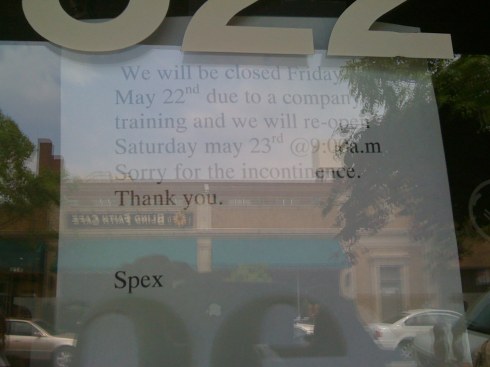 Seen in Evanston on Dempter St. Intentional? Hopefully the training is about writing.
The credit card companies are claiming they will have to charge annual fees and cut reward programs for customers who always pay on time because they are being forced to stop ripping off confused customers who incur late fees and sudden doubling of their interest rates. Ed Yingling, President of the American bankers’ association warns:
“It will be a different business,” said Edward L. Yingling, the chief executive of the American Bankers Association, which has been lobbying Congress for more lenient legislation on behalf of the nation’s biggest banks. “Those that manage their credit well will in some degree subsidize those that have credit problems.”
The idea seems to be that since the price is being cut for the people with credit problem, it will have to be increased for those with good credit.
I claim this is does not make any sense and is not going to happen. There are two reasons for this.
To understand the first reason, we must consider why credit card companies charge different prices to different consumers in the first place. This is a form of price discrimination. To people with lots of outside options, you have to give a good deal – this is the rationale for reward programs for good risks. For people with few options, you can afford to raise the price – this is the rationale for high interest rates for the high risk consumers. To implement price discrimination you have to be able to identify people in the two groups. The credit card companies have access to both internal and shared data to do this. You make profits in both markets, with higher profits presumably in the high risk market if you manage the risk correctly. If you cannot price-discriminate because you do not have the information or are not allowed to do so by law, you set a uniform price, hiking up the price to the low risk and lowering it for the high risk. This is the idea Yingling is suggesting. For a monopolist, uniform pricing makes less profit that price discrimination as it is less targeted to cnsumers’ willingness to pay.
The new legislation is limiting the firms’ ability to impose terms on the high risk consumers. So, they will make less money in that segment. But the key point is – legislation is not outlawing their ability to price discriminate. There is no incentive for them to do uniform pricing as they still have the information, ability and incentive to price discriminate. As long as the different segments have different patterns of willingness to pay for credit card services, the rationale for price discrimination is present.
Moreover, there is second reason why fees will not go up – competition. The low risk consumers are profitable as they generate merchant fees because they use their cards frequently. Suppose all the credit card companies cut rewards and/or impose annual fees. Then, one company or another has an incentive to cut the fee or increase rewards to steal customers from another. In fact, this is the most fundamental force keeping fees down and rewards high – the low risk, high volume consumers of credit card services generate revenue. To entice them to get your card, you have to give them rewards up front. The legislation does not change this competitive logic.
So, look forward to more points that help keep up the constant upgrading of your iPod.
(Hat tips: Kellogg MBA students – Aneesha Banerjee, Ondrej Dusek, and Steven Jackson)
My old post about A-Rod colluding with the opposition to massage his stats was drawn from a New York Times article. It suggested that in blow-out games when a few extra runs here or there would not affect the outcome, A Rod would collude with friends on the other side to raise improve their stats and his.
Now a follow-on article in the NYT says a data analysis suggests this did not occur. I personally think A Rod is getting a bad rap and did not cheat. But the statistical analysis does not make a convincing proof of this hunch.
The data say that in low stakes situations A Rod had many fewer runs than in high stakes situations. This leads the NYT to conclude that either there was “no tipping going on or it was pathetically ineffective.”
This when a little game theory is useful. When the game is close, you have the most incentive to exert effort to win. When it is not close, even the likely winner slacks off as there is no reason to work hard. This is the game theory analysis of R and D races for example (though the details are quite intricate and can sometimes be surprising).
This logic meant A Rod would naturally, given the dynamics of the game, have played hard when the game is close. The collusion has a countervailing effect when the game is not close. But this effect may not be large enogh to counteract the natural incentives of competition. So the data do not prove anything. But I still think A Rod did not cheat.
(Another Hat Tip: Pablo Montagnes)
Ridge is one of my favorite wine producers. They are extremely well-known and have wide distribution so it should be easy to find a bottle of something wherever you live in U.S. (well not Utah obviously). Single vineyard Zins are their specialty but they are pricey enough that you don’t drink them every day. The York Creek is around $30, for example. I had never had it before this last weekend. It lived up to expectations. It’s definitely an American wine. It’s jammy. I tasted lots of blackberries and cherry. It’s very thick, chewy and velvety. It’s aged in oak but I could not taste obvious vanilla. The oak had mellowed the tannins so it was very smooth. You got the feeling that by 2012 it will have more complexity. Now, once you open a bottle, you can’t stop drinking as it’s delicious. The unfortunate thing is that it has roughly 15% alcohol so you might regret the easy drinking. I’m going to buy more bottlles, invite some frieds over and commit to drinking less that way.
Greg Clark offers an analysis of the impact of the economic crisis on the market for academic economists. His basic thesis is: (a) Economics has not made any progress for the last eighty years. (b) This will reduce demand for economists. Or perhaps the crisis cuts demand for academic economists directly as endowments decline in value. (c) Even though supply is constrained by the technical complexity of becoming a professional economist, wages will fall.
Greg uses the intellectual apparatus of demand and supply to make his argument. This framework has been around for over a hundred years (or more?) but I associate it most with Alfred Marshall and his work in the early part of twentieth century. I guess this still makes Clark’s argument for him: the canonical framework of economics is part of Econ 1 and over eight years old!
I agree with many of Clark’s comments but have a different analysis – you can never get two economists to agree on anything, another old idea.
(1) Demand: Demand for academic economists comes from business schools as well as economics departments. Demand for assistant professors in B schools is driven by teaching demand. In a medium slump, this demand goes up as more people decide to get an M.B.A. as the job market is tight. So, this is not so bad.
(2) Supply: The trouble is on the supply side.
(2.1) One of the main drivers of wages is the finance market. B school finance salaries reflect what incoming grads could get on Wall Street. As these decline, so do salaries for finance professors as the supply of candidates has gone up. Finance salaries run at a premium compared to econ salaries. This is because you can do more “academic” work in economics and you pay for that with a lower salary. But there is an obvious positive correlation between finance and econ salaries because, if the finance salary premium is high, economists would switch to finance. To keep them, economics salaries have to go up. I’m going to stop belaboring this as I’m sure you can all work it out as it is Econ 1! Suffice it to say supply has gone up.
(2.2) As Clark says, economics is interesting again. Let’s face it was getting bit boring so more and more people were doing “freakonomics” rather than “economics.” Or perhaps this reflected the fact that the questions we have not answered are really hard so we were tackling the ones we can answer. I don’t know. The financial crisis makes it clear that we have to answer them. Whatever went wrong reflected too large a faith in the supposed optimal incentives given by the free market rather than an understanding of the perverse incentives facing lenders, borrowers and A.I.G. To unravel these complications, we will use the tools we have developed in microeconomics since the 1970s: moral hazard, adverse selection and mechanism design. It should attract lots of bring young things to replace jaded old-timers like me. The net implication: supply will go up.
So, I am led to the same conclusion as Greg Clark – salaries are going to be stagnant in academic economics. Because supply will go up not because demand will go down. But I’m more optimistic about scientific contributions – I think incentive theory will be useful. I am more optimistic for the science as a whole as more talented people are going to come in, driven by the desire to explain all the things we do not understand.
Q: What’s the difference between a Fiat and a Jehovah’s Witness?
A: You can’t close the door on a Fiat.
Hat tip: Car Talk
I went to Boston a few weeks ago and had dinner with an old friend and his family. This friend is an economist but, apart from that, we could not be more different. But he and I share one thing in common: we love Top Chef! His family just discovered the show and watched all the seasons over the last few months. I’m clearly more TV-centered because I’ve watched it for years. Anyway, we’re all in withdrawal as the show is over this season.
So, I can’t help but notice references to it. One Top Chef contestant was cooking at the Obama family Easter egg roll. Others seems to be doing well with their own restaurants in NYC. The host Tom Colicchio lives in a cool apartment witha small kitchen. Our own Chicagoan Dale Levitski is cooking up a special dinner every Thursday at the Relax Lounge. And Stephanie Izzard is so famous that she was on the Interview Show before Jeff and me.
Like my friend, I think my wife and I are going to reproduce Top Chef at home with two parent-kid teams facing off. All we have to find are some judges.
Everyone agrees that Mother Theresa was an irreproachable, wonderful human being. Right? Wrong, according to Christopher Hitchens. InThe Missionary Position: Mother Teresa in Theory and Practice, he argues she took money from disgraced banker Charles Keating, even writing a letter of support for him to the judge at his trial. He claims she did not adequately take care of the sick at her hospital in Calcutta and baptized them while they were too weak to protest.
Everyone agrees that Mahatma Gandhi was a visionary who drove the British out of India by peaceful means. Right? Wrong, according to Christopher Hitchens. As far as I can make out, he thinks that Gandhi’s embrace of Hinduism drove out the Muslims and led to partition.
There are two common themes here. First, a burning desire to contradict the conventional wisdom. Second, a dislike of religion and a denial that it might might ever lead to decent behavior. The first impulse and presumably the 9/11 attacks led him to side with Cheney et al. in the waterboarding debate. But Hitchens, unlike Sean Hannity thus far, put his views on the line by allowing himself to be subjected to waterboarding. This experience (a disturbing video is available) led him to reject waterboarding and to change his mind. Obama recently quoted Churchill in a speech about torture and Hitchens expands on Obama’s comments in a recent Slate article. He quotes a certain Captain Robin Stephens who dealt with Nazi spies::
“Violence is taboo, for not only does it produce answers to please, but it lowers the standard of information…There is no room for a percentage assessment of reliability. If information is correct, it is accepted and recorded; if it is doubtful, it should be rejected in toto.”
Glad the Captain is on board with my earlier post. And Hitchens, while a difficult man to agree with on all topics, has some new information to throw into the debate (he recommends a book from which he got this quote for instance) and is always interesting to read. And he can change his mind as he receives new data, a refreshing phenomenon.
Mado has gotten good reviews. It has the “think global, eat local” philosophy that we’re all meant to be embracing. I’m happy to do it if the food tastes good but it didn’t, at least on the night we went. Our food was under-salted. The polpette with black-eyed peas did not need so many peas and would have been better with some pasta or polenta. I asked about a vegetarian entree since none was listed and was told it wasn’t my lucky night. If you want to be seasonal and responsive to the seasons why not also be a little responsive to the clientele? The oranges on the yogurt sponge cake were local. We could tell because they were tart and out of season Wisconsin oranges rather than sweet ones flown in from Florida. The cake was good so we ended on a positive note.
Sometimes you want a wine whose charms are obvious and available. A young American starlet rather than a complex, aging French beauty. I’m exhausted so it’s one of those nights for special effects, a shallow plot and an explosive ending. If you’re in that mood too, Ethos is the wine for you. Blackberry; rich, unctuous texture. Slight acid on the finish for that final zing so that you’re not overwhelmed by the big, fat wine. It’s been sitting in my office in sunlight for over year and it’s still good.
Warhol famously said that everyone will have their fifteen minutes of fame. Given the length of this video, Jeff and I are owed 7 minutes or so:
There’s no integration by parts unfortunately so Jeff did not get to display one of his strengths. There was Bacchanalia, a few fans and I was dizzy, more because I drank on an empty stomach than because of any feeling of power.
I’m almost beginning to feel sorry for Alex Rodriguez. Everyone is picking on him. The latest strike against him is that he is being accused of collusion. He has an enviable batting record but now it seems the figures may be inflated. Alex is accused of pitch-tipping. Pitch-tipping involves somehow signaling the oncoming pitch to the hitter of the opposing team. According to an op-ed in NYT:
So, according to the latest story, Alex is connected to some pitch-tipping scheme in which he relayed signs to the opposing hitter (if he was a friend) or for someone who would return the favor when he was hitting. This was supposedly done in one-sided games where, in theory, one team had no chance of catching up. Alex was said to be in cahoots with a lot of middle infielders. Allegedly, there was some sign he would relay to the hitter — a movement with his glove or his feet — to let the hitter know what type of pitch was coming and where.
That is, there was “I scratch your back and you scratch mine” equilibrium. No contract is in place to enforce this so it would have to be enforced implicitly over multiple rounds as a repeated game equilibrium. It’s pretty cunning and companies have been known to do it. Alex didn’t need a M.B.A. to be taught it. He learned it in the game of hard strikes.
(Hat tip: Pablo Montagnes, PhD student).
Correlation is not causation but for anyone looking for an excuse, this study should be enough to get them guzzling wine if not beer. It says drinking wine in moderation adds five years to your life while beer adds 2.5. People who don’t drink die young.
Have not read the study but it reminds me of the fact that married men make more than men who never marry at all. Does marriage make men more productive? Does alcohol prolong life or is there another explanation?
The marriage counter-theory is easy: men who never marry on average do not have the social skills to do better at work. On the alcohol front, people who drink wine are on average wealthier than ones who drink beer. The rich have a healthier lifestyle, better medical care, cushier jobs etc. The study took place in Holland. The beer is great, much of it brought over from Belgium. Someone who does not drink this quality of beer and avoids alcohol all together has to be really, really antisocial and weird. Sad and lonely, they die young. Weak story at the end but best I can do while teaching.
The main logic of torture is to inflict so much pain that the victim reveals all his information to make the pain stop. Incentives for truth-telling in this situation are eerily similar to those in the bank stress tests.
All banks want to report that they are healthy. To distinguish the lying sick banks from the healthy ones there has to be some verifiable information. Healthy ones have this information (e.g. they passed the stress test) and the sick ones do not. The healthy banks have to have the incentive to reveal the information. This is all too clear for the healthy banks: by revealing their results they can avoid bank runs, get liquid, start lending etc.
In the torture analogy, a healthy bank is an informed terrorist with real information of an attack and a sick bank is someone, say an uninformed terrorist, with no information. The assumption of the pro-torture people is that the informed terrorist will have the incentive to report his information to avoid pain. But an uninformed terrorist has the same incentive. To tell one from the other, the informed terrorist’s information has to be verifiable. For example, there has to be “chatter” on Al Qaeda websites that can be used to cross-check the veracity of the torture victim’s confession. If this information is out there anyway, one might ask why torture was necessary in the first place. Presumably, the information is vague or ambiguous. The torture victim’s information brings some clarity.
This process seems heavily error-prone. False confessions may also cross-check by accident. The information is so noisy that a lead that is very weak may be thought to be strong. The more noise there is, the more the victim’s report is uninformative cheap talk – it contains no true information as informed and uninformed terrorists all give information, false and true and impossible to distinguish.
There is a second problem. Once a healthy bank releases the stress test information, the game is over – the market has the information and responds correspondingly. A torture victim faces further torture. There is no way for the interrogator to commit to stop torturing. If the victim knows this beforehand, the victim lies in the first place as there is no way to stop the torture. If the victim finds this out between episodes of water-boarding, the victim might start lying to contradict their earlier true confessions.
The efficacy of torture relies on verifiability of information and the ability of the torturer to commit to stop if good information is revealed. Both properties are hard if not impossible to satisfy in practice.
Alex Kotlowitz has a beautiful essay about the wonderful city of Chicago. Here is an excerpt about the Hideout, where Jeff and I performed a few weeks ago:
One recent evening, Hogan met me at the Hideout, where she bartended for more than nine years and still sometimes performs. It’s hidden in a small industrial corner on the north side, so when Hogan gave me directions, she instructed me to go over the river, past the railroad tracks, across the street from the city’s fleet of garbage trucks. If you get to the old U.S. Steel plant, you’ve gone too far. She paused. “I guess it’s a good place to bump somebody off,” she laughed.
The Hideout is a wood-framed house built at the turn of the last century, probably by squatters, when the neighborhood was mostly working-class Irish. After prohibition, the downstairs became a drinking hole for steelworkers. In 1996, it was purchased by four partners who did little to change the look — photos of the original owners, Angelo and Phil, still hang over the bar — but brought in musicians. The thinking was that musicians could experiment here, and they have; on any given night you could stumble upon a jazz quartet or a rock band or a folk singer. Neko Case played the Hideout before winning wide acclaim. Fiddler/violinist Andrew Bird worked his way from swing to indie rock here. And when the Frames passed through town, Glen Hansard and Markéta Irglová used the place to test some songs they were writing for a little movie called Once — one, “Falling Slowly,” won Best Song at this year’s Oscars.
One of the Hideout’s owners, Tim Tuten, told me, “We’re conscious of what made Chicago great. We have a historical reputation to uphold. This is the city of Sam Cooke, Curtis Mayfield, Lou Rawls. It’s from the ground up.” It was past midnight, and Tuten, who speaks with the drive of a Hendrix guitar riff, expounded on the 1893 Columbia Exposition (The Devil in the White City made everyone feel like an expert on it) and the time Wilco played at one of their block parties (kick-ass block parties being a city tradition) and how he recently discovered that in the 1960s Nelson Algren would down a beer at the Hideout. On the drive home, I listened to a CD Hogan had burned for me. She’s singing covers — from Allen Toussaint to the Violent Femmes. Her voice, rich and eclectic as the city’s neighborhoods, wanders throughout an exhilarating range. As Tony Fitzpatrick once told me of Chicago, “It’s a place that allows you to run.”
I’m on leave next year and the article makes me wistful. (Of course I live in Evanston so I’m a fake Chicagoan!).
We made the mistake of buying Goose Island’s attempt to make high-end, Belgian style beer. It was terrible. I gave up even trying to drink it after a few sips. Wine can be over-oaked. I don’t know what the beer equivalent is called. Whatever it is, Matilda has that quality. Too sweet, overwhelming flavor. Yuk. Don’t buy it.
I was sitting in a restaurant last night when I spaced out and started listening to the jazz they were playing. The song sounded familiar. Perhaps the singer was Diana Krall?
I was wrong on the singer. There’s no way Diana K would stoop so low as to sing the song I recognized – “Everybody wants to rule the world” by Tears for Fears. It was followed by “Every breath you take” by the Police and, amazingly, “Boys don’t cry” by the Cure. All songs from my youth. I never listen to them now. They seem too childish.
In jazz format, (and I’m not kidding!) they initially take on the patina of sophistication. Plus they transport you back to key events in your life – underage drinking, smoking etc….- that were accompanied by the songs. So, doing Cure covers in a jazz format is going to open up a huge market if you do it right. Wistful middle-aged adults with disposable income. The problem is that listening to ten or more of these covers is going to make you throw up. This was the flaw in the CD playing in the restaurant. You have to mix things up with some real jazz. You have to get Dina Krall to do the covers. She’s married to Elvis Costello and has already compromised any purist principles she may once have held. I want to hear her do some Dr Dre or Gnarls Barkley. I’d buy that.
I got two speeding tickets in less than one year. I worked off the first one by taking an online course. For the second one, they make you go to an 8 hours (!) course over two nights. The only course that fit my schedule was in Rolling Meadows. Just like Old Orchard in Skokie, there may have been farmland there a while ago but there are no rolling meadows now.
It’s obvious that the punishment in terms of wasted time is harsh so that you do not speed again. Your first thought is whether you can persuade the teacher to let you go early. This desire was very strong on Thursday night when the Bulls were playing the Celtics in Game 6 of their best of seven series. The class took place in the basement of a courthouse and it turns out the police monitor the teacher to make sure he does not let the class off early. Of course the teacher would love to go home early too so the incentives for renegotiation are huge. The police have to stay anyway so they enforce the rules.
So I was stuck in the class but I kind of enjoyed it because I got to meet people I do not meet everyday otherwise. I also got lots of information that I would not gotten in my normal interactions.
The hippie woman: “I got a ticket because I gave a ride to a Jamaican guy who turned to be a homeless ex-convict. I got a speeding ticket when I got scared driving him to his shelter.”
The hippie girl: “When I have fatigue, I do yoga to wake up before I drive”
The truck driver: “Go to White Castle before you drink. The grease soaks up the beer.”
The Comcast guy: “Ritalin is like cocaine if you don’t have ADD. I’m taking Ritalin now so I can sit in this class without going crazy.”
Lucca, the waiter: “The strip clubs in Indiana are better than the strip clubs in Chicago. The Indiana girls are nicer and they want dates. Always go to a ranch style strip club.”
I’m not sure how the last comment was related to the class.
This is a family favorite. There’s blackberry but enough tannin to make it dry and not sweet. Smoky barbecue. Acidic aftertaste. Great value for $22. It’s widely produced and distributed. Get any vintage you can find.
Jeff already wrote an interesting blog about Specter switching parties. Specter seems to have switched because he stands a better chance winning in re-election as a Democrat than a Republican, Jeff’s point 4. The Democrats seem ecstatic and I’m trying to deduce why this is the case.
If Specter had not been accepted into the Democratic fold, he would have lost in the Republican primary. The Republican candidate, presumably someone very right wing, would then face a Democratic challenger. This Democrat would be someone other than Specter as Specter would have tried to run as a Republican. Maybe Specter would run as an Independent in this scenario – though I’m not sure if Pennsylvania allows this. If the Democrats think that having Specter run as a Democrat means a higher probability of a Democratic win than this messy scenario, I can see some rationale for their happiness.
Their payoff is affected by the quality of Specter as a Democrat as well as his probability of winning. Specter was pretty independent as a Republican and, for example, voted for the stimulus bill. So, he is a net gain to the Democrats if he is more likely to vote Democrat than Republican with a “D” label attached to him rather than a “R”. But he has just shown his lack of loyalty to party by switching sides and was always independent anyway. His move is very much a rational move made by a calculating politician. Hence, I believe he is only of use till he is re-elected (or not) in 2010. Obama has promised to campaign with him and help him raise money. This is useful till 2010. After that, Specter will go his own way. Obama has to get as much Specter-friendly legislation as possible passed in the next two years. I’m not sure where Specter stands on healthcare reform. He had cancer and is emotional about health issues. Maybe this is a point of common value.
The chef Bobby Flay is ubiquitous on the Food Network. I usually see him in two shows, Iron Chef America and Throwdown with Bobby Flay. Both are competitive shows. Flay usually loses on Throwdown and wins on Iron Chef.
On Throwdown, Bobby Flay makes one dish and competes with an expert . For example, recently there was a show where he made a deep dish pizza against Chicago native Lou Malnati. The two dishes are judged by two experts side by side with a partisan local audience watching. Flay lost.
On Iron Chef America, the format is different. There is a secret ingredient (though I bet both contestants have a fair idea of what it will be!). In this format, Flay and his fellow Iron Chefs are matched against a gourmet chef. Last week the secret ingredient was butter. The entrant was Koren Grieveson of avec in Chicago. Koren picked Cat Cora to compete against. And the competition was tied. As I said, this is a rare event in Iron Chef because the incumbent usually wins. Why?
I think it’s all in the judging. On Iron Chef, the chefs get to present their dishes to the judges so there is no anonymity. On Throwdown, they do not identify who cooked which dish.
I wish they would adopt the same format for Iron Chef. The judges are biased towards the incumbent. For example, while Cat Cora’s food looked good, she won more points in the category of “originality”. One of her dishes was bread and butter, another was gnocchi in a butter sage sauce. These are original only if one adopts an ironic definition of the word “original”. But then everything is original and the category makes no sense! Frankly, I went to avec last night and I just find it hard to believe Cat Cora’s food is better. Maybe I am expressing the bias manifested on Throwdown: the bias of the local audience towards the local contestant. This can also be fixed by making the judges judge in a different room. Similarly, on Iron Chef, a third party, say Alton Brown, could present the dishes. If the judges have questions, the show can set up speakers in a separate room where the chef is standing nervously. S/he can answer the questions into an earpiece worn by Alton Brown. He can relay the answers to the judges. This can be done in a theatrical way to add more drama and tension.
A basketball game where one team is vastly superior to the other is boring to watch. By leveling the playing field, Food Network can add more uncertainty to the competition and get more viewers.
There has been a resurgence of suicide bombings in Iraq. Why, when we’re going to leave?
This is the first shot in a potential civil war between Shiites and Sunnis. Al Qaeda in Mesopotamia is Sunni and the suicide attacks, which are their hallmark, are aimed at Shiites. Al Qaeda is hoping to provoke a crackdown on the Sunnis by the Shiites. This, they hope, radicalizes the Sunni population which then joins them in the civil war.
But there is a bigger picture. Al Qaeda wants the US to stay in Iraq, not leave. They hope to drag America in and get the population to see Americans as the common enemy. War with America is a bigger aim than civil war in Iraq. Unfortunately, if Al Qaeda in Iraq is powerful then it might be in best interests of the US to stay in. A civil war in Iraq would draw in Iran and then who knows what happens in the region further along.
 Cheap Talk