
You are currently browsing Sandeep Baliga’s articles.
In the ever-growing signs that I am getting very old, this article made me realize that the incoming undergraduate class at Northwestern grew up reading Harry Potter. Wonder if they’ve heard of the Human League and Ultravox. Oh Vienna.
Ernst Fehr, heavy favorite in much of the betting on the Nobel Memorial Prize, is giving a talk today at MIT Economics. If you click on link to paper, you see that one of the papers he is presenting has several citations of the work of Elinor Ostrom.
The Senate Finance Committee is voting today and everyone is focusing on Republican Senator, Olympia Snowe. Will she vote for the bill now or wait to make a decision till a final bill reaches for the Senate floor? The final bill will be a compromise between many bills passed in the Senate.
Snowe may care about getting plum Senate Committee assignments etc but assume she wants to influence the final bill as much as possible. For example, Snowe does not favor the public option but the “trigger” where a public health plan will kick in if insurance companies raise premiums.
If Snowe does not vote for the bill now, the Democrats will interpret her strategy as the Grassley strategy of delaying and wearing the opposition down. This will lead to a more left-wing bill in the final compromise solution as they will not care about keeping her on board. If she votes for it now, the Democrats will want to be careful not to alienate her in the final bill.
Not voting for the Senate Finance Bill, hoping to have more influence on the final product, will actually reduce her influence as Democrats will infer that Snowe acted in bad faith over the last few months. Snowe will have more influence by voting for Senate Finance Bill. Let’s see what happens….
Ed Glaeser does a great job describing the work of the two Nobel Laureates. But I’m with Jeff and Levitt is never having heard of or read the work of Elinor Ostrom. Looking at the Nobel Committee’s blurb, you do get the feeling of familiarity, as if you’ve read it subconsciously. That’s partly because Ostrom works on a classical economic issue, the free-rider problem that arises when players use common property resources. The main reason though is that she uses experiments and field work to evaluate her theories.
Many researchers (e.g. Ernst Fehr) use experiments and some simple theory to study how cooperation may arise in the absence of monetary incentives. Others (eg Kremer and Duflo) do field research in development. Someone might ask “were these researchers the first to study these issues”? The Nobel Committee takes this question very seriously. And the answer, if I read the Nobel report correctly, appears to be “No,” as Ostrom pioneered this sort of thing. While that may be true, it is odd that Ostrom’s name is not on mainstream courses in econ courses. Williamson would appear on reading lists for contract theory. Many Econ Departments do not have courses in experimental economics and I wonder if Ostrom would appear on them anyway? This would make her different from John Nash – he is a mathematician not an economist but his solution concept is used every day by many, many researchers in the economics (not mathematics) and his existence proof for equilibrium provides a key approach economists still use (and again it would be old hat for mathematicians).
No-one finds it strange that Williamson won the Prize. Names that would normally be paired with Williamson are: Alchian, Demsetz, Grossman, Hart, Holmstrom, Kreps, Milgrom, Tirole etc, etc. All of these individuals have made significant contributions to the “theory of the firm” and more broadly to contract theory, decision theory, game theory and industrial organization. Perhaps they are being saved for future Prizes. For example, the Nobel blurb is careful not to give too much credit to Williamson for the “hold up” problem. But why wait for the future, why not now? It seems more natural than Ostrom to me. I’m puzzled.
Might as well throw my hat in the ring and reveal my predictions:
Lucid Angus De Rough Angus Deaton
Baron P Partha Hoody Partha Dasgupta
PM Big Cash Paul Milgrom
Jam Jean J Professor Wack Jean Tirole
Smug OO Murda Oliver Hart
Kid BH Wrath Bengt Holmstrom
I want to keep mine semi-secret so I can claim I was right whatever happens. So, I typed in my predictions into the website My Rap Name.com which then garbled them. So, here are my predictions:
Lucid Angus De Rough
Baron P Partha Hoody
PM Big Cash
Jam Jean J Professor Wack
Smug OO Murda
Kid BH Wrath
Maybe I’ll give he real names Monday if I can reconstruct them!
This terrifying story about E Coli is enough to make even the most ardent baconatarian consider veganism. Cargill produced hamburgers made by mixing up ground beef from different suppliers from all over the world. You could test for E Coli when the slaughterhouse’s meat arrives but:
Unwritten agreements between some companies appear to stand in the way of ingredient testing. Many big slaughterhouses will sell only to grinders who agree not to test their shipments for E. coli, according to officials at two large grinding companies. Slaughterhouses fear that one grinder’s discovery of E. coli will set off a recall of ingredients they sold to others.
If you violate this unwritten agreement then:
The food safety officer at American Foodservice, which grinds 365 million pounds of hamburger a year, said it stopped testing trimmings a decade ago because of resistance from slaughterhouses. “They would not sell to us,” said Timothy P. Biela, the officer. “If I test and it’s positive, I put them in a regulatory situation. One, I have to tell the government, and two, the government will trace it back to them. So we don’t do that.”
The downside is obvious:
The potential pitfall of this practice surfaced just weeks before Ms. Smith’s patty was made. A company spot check in May 2007 found E. coli in finished hamburger, which Cargill disclosed to investigators in the wake of the October outbreak. But Cargill told them it could not determine which supplier had shipped the tainted meat since the ingredients had already been mixed together.“Our finished ground products typically contain raw materials from numerous suppliers,” Dr. Angela Siemens, the technical services vice president for Cargill’s meat division, wrote to the U.S.D.A. “Consequently, it is not possible to implicate a specific supplier without first observing a pattern of potential contamination.”
Why not avoid this altogether, use a whole piece of meat and grind it yourself? Because:
In all, the ingredients for Ms. Smith’s burger cost Cargill about $1 a pound, company records show, or about 30 cents less than industry experts say it would cost for ground beef made from whole cuts of meat.
On the other hand, Costco does test the input:
The retail giant Costco is one of the few big producers that tests trimmings for E. coli before grinding, a practice it adopted after a New York woman was sickened in 1998 by its hamburger meat, prompting a recall.
Craig Wilson, Costco’s food safety director, said the company decided it could not rely on its suppliers alone. “It’s incumbent upon us,” he said. “If you say, ‘Craig, this is what we’ve done,’ I should be able to go, ‘Cool, I believe you.’ But I’m going to check.”
Costco said it had found E. coli in foreign and domestic beef trimmings and pressured suppliers to fix the problem. But even Costco, with its huge buying power, said it had met resistance from some big slaughterhouses. “Tyson will not supply us,” Mr. Wilson said. “They don’t want us to test.”
So, why the difference between Costco and Cargill? One company has a brand that is easily recognizable to consumers and the other doesn’t. The branded product/firm faces a bigger reputational risk in terms of lost sales if it doesn’t do a careful job. Hence, it has better incentives to monitor its product and ensure it is of high quality. The court of public opinion has lower standards for conviction than the court of legal opinion. Indeed, the deliberate lack of testing of inputs allows all parties to try to shift blame to another player to create reasonable doubt.
You would hope that the public opinion that can punish the retail end of the supply chain would filter back to through the whole supply chain. But that does not seem to happen. Consumer flight while it can be fatal to a retailer with a bad reputation is not well coordinated enough to exert pressure to the supplier. Back to my Cheerios.
We decided to check out another ‘hood of Boston. Haven’t been to the South End for over a decade. Area has this weird feel of gentrification meets recession, i.e. cool, expensive furniture stores that were largely empty. For dinner, we went to Ginger Park which was equally empty. It has a dramatic wavy, bent wood ceiling. Food was quite good. Some Indian snack food (lentil fritters), good Asian noodles and dumplings and more sophisticated dishes like tea-smoked duck. I get annoyed by people who talk about restaurant service as much as food but I’m getting old and crotchety so here goes: Our server was incompetent and yet confident and smug, qualities that often go together. But I would still go back. It didn’t have a good wine list. After we left, we took a stroll on Tremont and stopped in at Aquitaine for a glass of wine. That was fun. Atmosphere was great and the barman recommended a great wine, Château Peyremorin 05 Haut-Medoc (earthy, barnyard, and balanced). Will definitely go back and try the food.
Economists have often wondered why people tip. We have lots of sophisticated explanations for why rational (i.e. selfish) people pretend to be altruistic. A leading explanation, the reputation model, relies on some repeated game concern but how would that apply in a one shot waiter game? The puzzle is, of course, easily resolved if one allows homo economicus to have a heart. Warm, mushy feelings for waiters can easily explain tipping, even if you both know your relationship is the restaurant equivalent of the one night stand.
As our well-educated and well-read readers know, the heart is a complicated thing and often responds to incentives in odd ways. Larry David is the dark Jane Austen of our cynical time and his (second!) magnum opus, Curb Your Enthusiasm, is the warped Sense and Sensibility. I enjoyed the Seinfeld non-Reunion episode. There were so many treasures in one half hour but the business lunch between Larry and Jason Alexander was my favorite bit. Larry and Alexander go dutch and Larry suggests they coordinate the tip. He wishes to avoid the embarrassment of under-tipping. It is just obvious to Larry that other people’s opinion matters so he must tip. Note it is not morality but image and hence self-image that guide Larry. He certainly does not want to tip low when his Dutch partner tips high. But if your partner tips low, there is still an incentive to tip high, because it is quite natural that you want your image to be better than your partner’s. In other words, there is a dominant strategy to tip high…a Prisoner’s Dilemma of tipping. Once we open up the heart of homo economicus, not only is there an incentive to tip, but to overtip. No wonder Larry wants to collude and coordinate tips.
How does it all work out? I don’t want to give any more away than I already have. I’ll let you watch the episode and enjoy it for yourself.
Started off too fruity and heavy. Took two hours to open up and then it was delicious. It smoothed out, the fruit receded. Tasted almost Bordeaux-like after it opened. Little bit of celery at the end. I thought it was overpriced initially but ended up accepting the $30 price by the time we finished the bottle.
The produce section announced the availability of fresh truffles. The freezer had a great selection of gelatos and sorbets. The bakery had some pretty nice looking cakes. But all of this was erased from my memory when I got to the cheese section at the back of the aptly named Formaggio Kitchen. Cheese is where the heart (and heart trouble!) is. It was a kind of Cheese Universe contest, only without the Donald. I blushed and didn’t know where to look with so much milky pulchritude around me. I finally plucked up my courage and asked for a few nibbles. Picked up a couple of bottles of good but overpriced wine as a go with. Luckily Formaggio Kitchen is not in Brookline. The transactions costs of getting there will protect my waistline.
According to the Times:
“A 2008 firefight in eastern Afghanistan has become a template for how not to win there, and helps to explain the strategy of Gen. Stanley A. McChrystal, the new commander.”
A new study is being released of the fire-fight. Among other things it says:
“Before the soldiers arrived, commanders negotiated for months with Afghan officials of dubious loyalty over where they could dig in, giving militants plenty of time to prepare for an assault.
Despite the suspicion that the militants were nearby, there were not enough surveillance aircraft over the lonely outpost — a chronic shortage in Afghanistan that frustrated Defense Secretary Robert M. Gates at the time. Commanders may have been distracted from the risky operation by the bureaucratic complexities of handing over responsibility at the brigade level to replacements — and by their urgent investigation of an episode that had enraged the local population, the killing a week earlier in an airstrike of a local medical clinic’s staff as it fled nearby fighting in two pickup trucks.
Above all, the unit and its commanders had an increasingly tense and untrusting relationship with the Afghan people.”
As far as I see from the story in the Times, the report on the firefight examines the mistakes that were made in implementation of a strategy. There are lots nuances but basically the army unit was meant to set up an outpost and they were not given the intelligence and manpower to do their job effectively. In other words this was a failure of “operations management” or what we might call tactics. We can learn from it in terms to how not to make the same mistake again.
What we cannot learn from it is what our strategy should be in Afghanistan. A strategy here is broader than what we usually mean in game theory. It is a description of an objective function as well as a plan of how to maximize it. (The objective function for Afghanistan is part of a grander objective function for U.S. domestic and foreign policy.) It will suggest questions such as: Should we ensure a stable democracy in Afghanistan? Or should we focus on Al Qaeda? Or have we overreacted to 9/11 overall and we should leave? None of this is answered by the study of the incident in 2008. Hence, we would be wrong to extrapolate from an issue of tactics to an issue of overall strategy. Maybe we decide we do not want outposts at all. Then a counterinsurgency strategy is moot.
Austan Goolsbee does not sugarcoat the message.
Senator Baucus said he could not vote for the public option amendments as they would not get 60 votes in the Senate. That is, whatever his own narrowly defined preferences, he also has a preference for voting for the winning bill and, in fact, the latter component of his utility swaps the former.
This leads to the obvious issue: on what basis are the Senators Baucus canvassed saying they will not vote for the bill? If they vote like Baucus, they are also basing their votes on what will pass or not. The situation is ripe for coordination failure: even if sincere voting based on individual preference would lead to adoption of the public option amendments, the expectation that it will not pass causes people not to vote for it and guarantee that it will not pass.
If this is really as issue, supporters of the pubic option have to create momentum for it and convince Senators it will pass. They they will vote for the public option and it will pass. A self-fulfilling prophesy.
O.K., I don’t this is quite as good as the Paul Krugman song but anyone who can write the lyrics “Come on Nouriel, fix the Senate Finance Bill. You are a financial power drill” is talented:
Gave a lunchtime talk at MIT today and was exhausted by 4 pm or so by rush of adrenalin leaving the bloodstream. Had to re-energize. What could be better than the take-out counterpart to the Oleana empire, Sofra Bakery? Yummy flatbreads, meaty (wife had lamb) and veggy (I had spinach and three cheese). Lots of mezzes, including feta with hot peppers, beet tzatziki, bean and walnut pate. Great cheese borek which, unfortunately, by annoying kids were too picky to eat. Wish it was on my way to work as they also have great breakfast. If only Cambridge schools were less random, so we could have settled here. But, looking on the bright side, we have Clear Flour Bread in Brookline. And that’s a HUGE positive.
When cellphone use is allowed on planes (e.g. on foreign airlines), people get on the phone. But passengers seem to want airlines to ban use. How are these things consistent? Some simple theories:
1. Negative externality 1: You can’t control who calls you, e.g. your boss giving you yet more work. If cellphone use is not allowed, no-one can call you.
2. Behavioral Economics story: You have a self-control problem. You know you’ll use the phone excessively as you’re a phone addict. Banning use helps you commit not to use it.
3. Prisoner’s Dilemma (Negative Externality 2): You want to use your phone on a flight but you don’t want your neighbour to use it. But this is not possible so you know everyone will use their phone. Then, you prefer that no-one be allowed to use a cellphone on flight, even if it prevents you from using your phone. A possible solution: Some of the revenue generated can be returned to the passengers to compensate them for the externality they suffer. Only way this will happen is if it gives one airline a competitive advantage over another.
Of course, with airlines in financial trouble, selling snacks on planes, Wi-Fi is coming somewhere to a plane near you whether you like it or not as someone will pay for it as they like it.
The list of Summers’ gaffes is long. A key early entry occurred when he was the Chief Economist at the World Bank. In a memo, it was suggested:
The measurements of the costs of health impairing pollution depends on the foregone earnings from increased morbidity and mortality. From this point of view a given amount of health impairing pollution should be done in the country with the lowest cost, which will be the country with the lowest wages. I think the economic logic behind dumping a load of toxic waste in the lowest wage country is impeccable and we should face up to that.
(It turns out that the memo was written by an underling and Summers just signed it.)
This policy prescription is being followed illegally in Europe. Recycling laws impose high costs of disposable in Europe and it is cheaper to export the waste to China, India and elsewhere. The old memo made a point based on efficiency. If transactions costs are low, the efficient solution is also the solution to decentralized voluntary trade (the Coase Theorem). Ships arriving in Europe or the U.S. with goods from China have to go somewhere afterwards anyway. Why not send them back full of waste? Transactions costs are low and the solution the World Bank identified gives firms the incentive to transfer the waste, sometimes illegally. Sometimes the dismal science’s dismal predictions turn out to be right. Now, we have to think of whether we can design a better solution. I’m going to look at Jeff’s intermediate micro notes to see if I can come up with something. Don’t hold your breath.
Kennebunkport ME
In Chicago, I love Semiramis and Nazareth Sweets. The falafel special sandwich and the baklava form the basis of an initially healthy but finally indulgent meal. While delicious, the options are generic. Our main food discoveries in Boston have been Middle Eastern (broadly defined!). The Armenian takeout we had a friend’s house had the usual hummus and babaganoush. The dish that was spectacular and totally new to me was a pomegranate, chili and walnut mush (I think it is called mouhamara).
And then last night, we went to Oleana. What a revelation. Greek, Turkish, Lebanese…etc. etc. All represented and modified till the cuisine achieved a different level. Everything was good. The whipped feta with peppers, zucchini pancakes (I could have done with less haloumi) and finally the fideos – I’d never had them in a restaurant, have tried to cook them (the Zuni cookbook has a recipe I tried) and never knew how they should be. Now I know. Not sure if I will reach Oleana’s heights on this dish but at least I know what to aim at. My wife enjoyed her lamb and eggplant dumplings and sausage. We didn’t have room for desert. Can’t wait to go back.
Typically I would guess Wall Street, consulting or a start-up in Silicon Valley. That’s kind of how Ayr Nuir started off too. Now, he has a new start-up, one that will likely improve my life for the better every day I am at MIT – the Clover food truck. I had the chickpea fritter and the fries. They were excellent. My companion, Jim Snyder, who in fact gave me this valuable local information, was very happy with his egg and eggplant sandwich.
Nuir is putting his degrees to good use. They appear to be estimating demand every day. There’s some iPhone based ordering and tracking technology that updates sales figures every day. And they have a great marketing/information dissemination system via their website. So, they make it into the media. Hopefully, a Kellogg student will do something similar by the time I have to return.
You spend too much on your credit card and/or forget to pay off your bill on time and get hit with late fees. To commit to better behavior, you chop up your credit card and move to a debit card. You avoid late fees by definition and it should help you commit to less spending as your bank balance acts as a natural upper bound on expenditure.
Dream on – the banks and credit card companies are too smart to give away profits like this.
They do two things. First, you get “overdraft protection” meaning you can go over your bank balance at the cost of incurring fees of around $30/charge. They make it very hard to turn down overdraft protection so you get a “service” you don’t really want. In fact, it removes the commitment device you hoped to acquire by getting a debit card. Second, as a I learned from watching this video, on a given day they debit your account in the order that maximizes the number of overdraft charges you incur (i.e they charge your account with bigger debits before smaller debits whatever the chronological order of the charges).
There is another effect: the debit card selects for precisely those people who have the funds to pay their bills but lack the self-control to pay on time. This is why they switch from a credit card to the debit card. Credit cards are also used by people living beyond their means who might default. These people do not get a debit card as they can’t afford the fees and they do not get the large credit line they need to spend like crazy. This means a debit card is potentially more profitable to a bank than a credit card. Banks have a great instrument for extracting surplus from sloppy consumers while avoiding bad risks. So, confused consumers are still exploited, getting overdraft protection they don’t want and incurring fees that are unnecessary.
I’m typing this on my MacBook Pro, I walked to work listening to music on my iPhone but I have been shaken to my core by the videoclip in the middle of this page.
If you are the owner of a large enterprise and are ready to retire, what do you do? Sell to the highest bidder. Before selling, do you want to split your firm into competing divisions and sell them off separately? No, because, that would introduce competition, reduce market power and lower the bids so the sum total is lower than what you would get for the monopoly. Searle, the drug company, sold itself off to Monsanto as one unit.
Miguel Angel Felix Gallardo, the Godfather of the Mexican illegal drug industry, lived a peaceful life as a rich monopolist. Then he was caught in 1989 and decided to sell off his business. In principle, Gallardo should sell off a monopoly just like Searle. But he did not (see end of article) The difference is that property rights are well defined in a legal business so Searle belongs to Monsanto. But Gallardo can’t commit not to sell the same thing twice as property rights are not well-defined. There is also considerable secrecy so it’s hard to know if the territory you are buying was already sold to someone else before. And after you’ve sold one bit for a surplus, you have the incentive to sell of another chuck as you ignore the negative impact of this on the first buyer.
The result is that selling illegal drug turf results in a more competitive market than the ex ante ideal. As the business is illegal anyhow, all the gangs can shoot it out to capture someone else’s territory. Exactly what’s happening now.
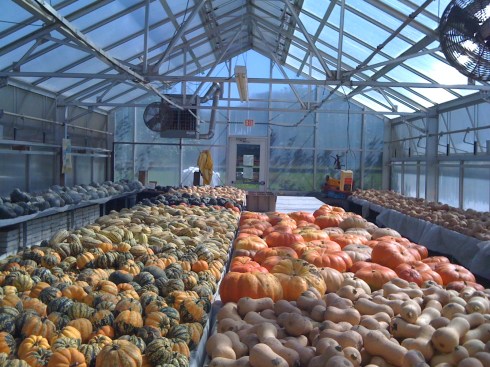 Short weekend trips from Evanston lead to the Chicago Botanic Garden. It can be quite beautiful despite the drone of cars from the freeway running next to the garden. There are houses and malls all around and it is hard to escape the feeling that the garden is an artificial green oasis plonked into suburbia.
Just some the reasons why Drumlin Farm, just forty minutes away from our present abode in Boston, was such a big hit. The garden aspect we enjoy in Chicago is replaced by a spectacular working farm. There are many short trails and vegetables and eggs for sale, not just for display. Plus sledding in the winter. We joined the Audubon society as we expect many visits during the year.
X-inefficiency at output q is the difference between the realized cost of production at q and the minimum cost of producing q.
If firms are maximizing profits, the difference is zero. But there are many reasons why they might differ. One is lack of competition. The rough argument is that a monopoly has less incentive to minimize costs because it can absorb X-inefficiency in the form of reduced profits without going bankrupt. Here is a video of X-inefficiency:
I hate checking in bags at the start of a flight and waiting for them at the other end. So, I always travel with a carry-on bag. If there is no space left, there is a chance that you have to gate-check your bag. But I can only recall once instance where that has happened. It’s likely to be a more frequent event as I discovered on Sunday. Why?
United is now charging for checking in bags but carry-ons are still free. This increases the incentive to bring a carry-on where you might have checked-in a bag before. Moreover, if you are forced to gate-check your bag, you do not get charged. So, there is an additional incentive to carry-on a bag. So the optimal strategy will imply more passengers moving to “carry-on” from “check-in bag”. The two forces together meant that all the carry-on storage space was full by the time many people boarded my flight on Sunday and they were forced to gate-check their carry-ons.
This could end up being annoying for United if there is lots of gate-checking going on, delaying flights and distracting flight attendants. What should they do? Four options:
(a) Stop charging for checked in bags. Not an option United will choose as they need cash
(b) Start charging for gate checking carry-ons. This gives United the incentive to claim there is no room for carry-ons even when there is. Even if they are honest, no-one will belive it. This will to United broke my Carry-on as a follow up to United Breaks Guitars. Not a good option for United.
(c) Start charging for carry-ons. Seems like the most attractive option for United. Except no competitor is doing it. United has become more extreme than American with check-in bags: AA does not charge for the first checked bag. Is United going to be the first airline to take the next step and charge for carry-ons or..
(d) Stick with the status quo.
Want to work for Al Qaeda? The pay is terrible, your future is bleak and Al Qaeda has not managed a big attack for many years so you’ll be working for a declining terrorist entity.
Not much glamour in that job description and the Guardian reports that Al Qaeda is having a hard time finding recruits:
Amid a mood of cautious optimism, some experts talk of a “tipping point” in the fight against al-Qaida. Others argue that only Bin Laden’s death will bring significant change. But most agree that the failure to carry out spectacular mass attacks in the west since the 2005 London bombings has weakened the group’s “brand appeal” and power to recruit.
And there’s a backlash against Bin Laden and al-Zawahiri by other Islamic leaders who are offended because they have been vilified by Bin Laden or regret attacks on Muslims perpetrated by Al Qaeda (links here).
I haven’t visited the Wine Library for quite a while. According to the Times, thousands of other people have. Those of you who have not, it is worth watching the odd episode for a varietal you’re interested in learning about. For fun, it is definitely worth watching the Jancis Robinson episode.
Now someone has to do a Beer Library.
 Wow!! Bread Heaven. Witness the Flower loaf. As the clever Cheap Talk readers readers may have deduced, I have moved to Boston for the year. I am focused on tourism and settling in more than intellectual work. Expect even shallower posts that usual.
So – back to the loaf. Purchased on Sunday at the Clear Flour Bread Bakery in Brookline. Consumed within the day, hence justifying further daily visits.
Smoky, bacon-like and yet not bacon. Wafer-thin slices, rich in flavor and presumably fat. Worth its weight in gold and priced accordingly. Available at Whole Foods in Boston and online. If a vegetarian survives this temptation, they deserve the highest level of karma.
 Cheap Talk