You are currently browsing Sandeep Baliga’s articles.

Actions speak louder than words. Anarchists seeking to spread revolution resort to extreme acts hoping to stir the sympathy of the general population. Would be change-agents differ in their favored instrument of provocation – assassination, bombings or general strike. They are united by their intrinsic lack of real power. They only way they can hope to achieve their ends is by persuading other players to react and indirectly give them what they want. As such, the “propaganda of the deed” in practiced typically by people on the fringe of society, not in the corridors of power. (See my paper The Strategy of Manipulating Conflict with Tomas Sjöström for illustrations of this strategy.)
But Mubarak has reached this lowly state even as President of Egypt. He has conspicuously lost popular support and tensions long suppressed have burst asunder for all to see. He has lost the support of “the people” and, perhaps even more importantly, the army. What can he do to get it back? The anti-Mubarak protestors have till recently refrained from looting and mob mentality has been notable for its absence. As long as that remains the case, the army and the people are siding with the anti-Mubarak protestors or largely staying out of the fray. Mubarak’s only hope is to get the people and the army to pick his side. He needs to energize the mob and trigger looting. That is his strategy. Police disappeared from the streets of Cairo a few days ago, inviting looters to run amok. That did not work. So, now he has employed pro-Mubarak “supporters” to fight anti-Mubarak protestors. Open fighting on the streets of Cairo, prodding the army to step in. The people scared of the outbreak of lawlessness turning to the strongman Mubarak to return some semblance of stability to the city and the country. This is where we are in the last couple of days. Another obvious strategy for Mubarak: Get his supporters to loot and pin it on the anti-Mubarak protestors. Not sure if that is happening yet.
What can be done to subvert the Mubarak strategy? For the protestors, the advice is obvious – no looting, no breakdown of law and order. The primary audience is the army and people – keep them on your side. For the Obama administration there is little leverage over Mubarak. I assume he has hidden away millions if not billions – cutting off future aid has little chance of persuading Mubarak to do anything. Again, the army is the primary audience for the Obama administration. Whichever side they pick will win. The army cares more about the cutoff of future aid than Mubarak. They have trained in US military schools and have connections here. The only leverage the Obama administration has is over the army and it is hard to tell how strong that leverage is.
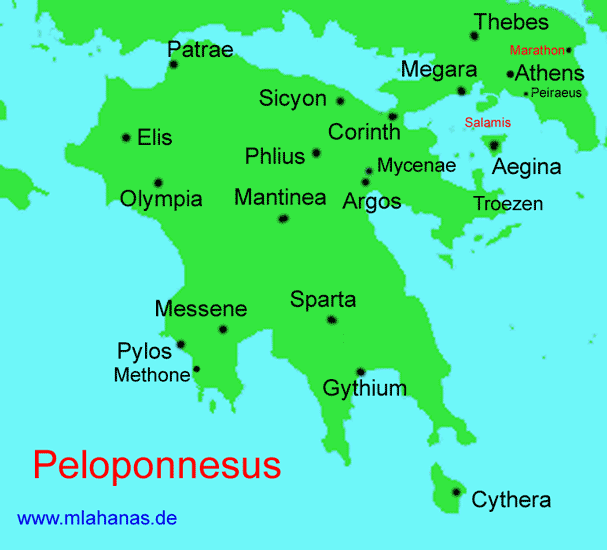
This week I switched to models of conflict where each player puts positive probability on his opponent being a dominant strategy type who is hawkish/aggressive in all circumstances. This possibility increases the incentive of a player to be aggressive if actions are strategic complements and decreases it if actions are strategic substitutes. The idea that fear of an opponent’s motives might drive an otherwise dovish player into aggression comes up in Thucydides (“The growth of Athenian power and the fear this caused in Sparta, made war inevitable.”) and also Hobbes. But both sides might be afraid and this simply escalates the fear logic further. This was most crisply stated by Schelling in his work on the reciprocal fear of surprise attack (“[I]f I go downstairs to investigate a noise at night, with a gun in my hand, and find myself face to face with a burglar who has a gun in his hand, there is a danger of an outcome that neither of us desires. Even if he prefers to leave quietly, and I wish him to, there is a danger that he may think I want to shoot, and shoot first. Worse, there is danger that he may think that I think he wants to shoot. Or he may think that I think he thinks I want to shoot. And so on.”). Similar ideas also crop up in the work of political scientist Robert Jervis.
Two sided incomplete information can generate this kind of effect. It arises in global games and can imply there is a unique equilibrium while there are multiple equilibria in the underlying complete information game. But the theory of global games relies on players’ information being highly correlated. Schelling’s logic does not seem to rely on correlation and we can imagine conflict scenarios where types/information are independent and yet this phenomenon still arises. In this lecture, I use joint work with Tomas Sjöström to identify a common logic for uniqueness that is at work for information structures with positively correlated types or independent types. Our sufficient conditions for uniqueness can be related to conditions that imply uniqueness in models of Bertrand and Cournot competition.
With these models in hand, we have some way of operationalizing Hobbes’ second motive for war, fear. I will use these results and models in future classes when I use them as building blocks to study other issues. Here are the slides.


It is the second anniversary of this blog, as Jeff says. We are forever connected to Groundhog Day. Today, amazingly, the NYC groundhog predicted an early Spring. I hope he is right and his prediction also holds for the Midwest.
Self-Deception is a fascinating phenomenon. If you repeat a lie to yourself again and again, you start to believe it. You would think that the ability to deceive yourself would be constrained by data. If there is obviously available evidence that your story is false, you might stop believing it. Then, self-deception can only flourish when there is an identification problem. Once data falsifies competing theories, the individual is forced to face facts.
Reality is much more complex. Take the perhaps extreme case of John Edwards. The National Enquirer published a story reporting that Rielle Hunter was pregnant with John Edwards’s child. Edwards simply denied the facts. The Enquirer employed a psychologist to profile Edwards. S/he concluded:
“Edwards looks at himself as above the law. He has a compromised conscience — meaning he will cover up his immoral behavior at whatever cost to keep his reputation intact. He believes he is who his reputation says he is, rather than the immoral side, the truth. He separates himself from the immoral side because that person wouldn’t be the next president of the United States. He overcompensated for his insecurities with sex to feed his ego which feeds his narcissism.”
The most important part was the absolute certainty of the mental health professional that Edwards would continue to deny the scandal — almost at all costs.
“He will keep denying the scandal to America because he is denying the reality of it to himself. He sees himself only as the image he has created.”
How do you deal with a pathological deceiver/self-deceiver? The Editor collected photos and evidence of Hunter-Edwards liasons. He describes his strategy:
We told the press that there were photographs and video from that night. Other journalists asked us to release the images but I refused. Edwards needed to imagine the worst-case scenario becoming public. TheEnquirer would give him no clues about what it did and did not have…..
Behind the scenes we exerted pressure on Edwards, sending word though mutual contacts that we had photographed him throughout the night. We provided a few details about his movements to prove this was no bluff.
For 18 days we played this game, and as the standoff continued the Enquirer published a photograph of Edwards with the baby inside a room at the Beverly Hilton hotel.
Journalists asked if we had a hidden camera in the room. We never said yes or no. (We still haven’t). We sent word to Edwards privately that there were more photos.
He cracked. Not knowing what else the Enquirer possessed and faced with his world crumbling, Edwards, as the profiler predicted, came forward to partially confess. He knew no one could prove paternity so he admitted the affair but denied being the father of Hunter’s baby, once again taking control of the situation.
This strategy is inconsistent with the logic of extreme self-deception. Such an individual must be overconfident, thinking he can get away with bald-faced lies. Facing ambiguous evidence, he might conclude that the Enquirer had nothing beyond the odd photo it released. The Enquirer strategy instead relies on the individual believing the worst not the best. The two pathologies self-deception and extreme pessimism should cancel out…..there is some interssting inconsistency here.
One thing is clear: One way to eliminate self-deception is for a third-party to step in and make the decision. This is what Omar Suleiman, Barack Obama and the Egyptian army are doing to help Hosni Mubarak deal with his self-deception.
Malcolm Gladwell is cynical about the ability of social media to facilitate activism:
The platforms of social media are built around weak ties. Twitter is a way of following (or being followed by) people you may never have met. Facebook is a tool for efficiently managing your acquaintances, for keeping up with the people you would not otherwise be able to stay in touch with. That’s why you can have a thousand “friends” on Facebook, as you never could in real life
If Twitter is only identifying people with weak preferences for activism, the “revolution will not be tweeted”. But there is a second countervailing effect created by network externalities, studied in Gladwell’s book The Tipping Point. An individual’s cost in participating in a revolution is s function of how many other people are involved. For example, the probability that an individual gets arrested is smaller the larger the number of people surrounding him in a demonstration. Even if Twitter in the first instance does not increase the number of people participating in a demonstration, it does create common knowledge about where they are meeting and when. The marginal participant in the absence of common knowledge strictly prefers to participate with Twitter-common-knowledge. Now more individuals will join as the demonstration has gotten a bit bigger etc. The twitting point is reached and we have a bigger chance of revolution. Now, let me go to Jeff’s twitter feed and see what he is plotting in his takeover of the NU Econ Dept.
There is pressure for filibuster reform in the Senate. Passing the threshold of sixty to even hold a vote was hard in the last couple of years when the Democrats had a large majority. It’s going to be near impossible now their ranks are smaller. Changing the rules has a short run benefit – easier to get stuff passed – but a long run cost – the Republicans will use the same rules to pass their legislation when Sarah Palin is President. Taking the long view, the Democrats decided not to go this route.
By the same token, the kind delaying tactics that did not work in the lame duck session are an efficiency loss – they had little real effect on legislation but delayed the Senators taking the kind of long holidays they are used to. Some movement on delaying tactics is mutually beneficial. And so according to the NYT:
“Mr. Reid pledged that he would exercise restraint in using his power to block Republicans from trying to offer amendments on the floor, in exchange for a Republican promise to not try to erect procedural hurdles to bringing bills to the floor.
And in exchange for the Democratic leaders agreeing not to curtail filibusters by means of a simple majority vote, as some Democratic Senators had wanted to do, Senator Mitch McConnell of Kentucky, the Republican leader, said he would refrain from trying that same tactic in two years, should the Republicans gain control of the Senate in the next election.”

One of Steve Levitt’s claims to fame: The LoJack and positive externalities. The Lojack is a radio transmitter hidden in a car. If it is stolen, the LoJack signal can be used to find/track the car. Since LoJack is hidden, a thief can’t tell if a car he is thinking about stealing has the LoJack installed or not. Hence, not only does the LoJack deter car theft in cars where it is employed, but it also deters theft of cars where it is not employed. It has a general deterrence effect on all car theft. LoJack owners exert a positive externality on all cars and Ayres Levitt find some way to estimate this effect and find it is large.
My Five-year old came home yesterday with the following “fact”: The Monarch Butterfly is poisonous and predators have come to avoid it. The Viceroy butterfly resembles the Monarch butterfly but is not poisonous. Predators have come to avoid it, mistakenly failing to identify it as a Viceroy not a Monarch. This resembles the LoJack argument and the Monarch exerts a positive externality on the Monarch. There is “undersupply” of Monarchs from a welfare perspective etc etc.
Alas, like all stylized facts, this one may not be true either. An experiment in Nature purports to show that Viceroys are poisonous to their predators. The authors offered Viceroy abdomens to wild-caught red-wing blackbirds and compared their responses to offers of control species. The Viceroy abdomens were rejected more frequently and the birds displayed discomfort if they did eat them. So, there goes another great stylized fact! I’ll wait a couple of years before I break it to the five year old.
 What is good economic theory? What is “applied theory” vs. “theory”? Different people and departments have different answers to these questions. Attempts to define these terms and then categorize papers using the definitions is fraught with problems. Good economic theory is like pornography: You recognize it when you see it. I am led to this conclusion by reading a paper “Model Building vs Theorizing: The Paucity of Theory in the Journal of Economic Theory” in Econ Journal Watch. The authors define good theory using three questions: Theory of what?, Why should we care?, What merit in your explanation?. They then categorize papers in JET in 2004 using the three questions. They ask the questions in order: a paper must pass the previous question for the next even to be applied. By “what”, the authors mean “some fact in the real world”, by “care” they mean to ask “is it important to explain the fact” and by “merit” they mean “have you given the best explanation or an original one”.
I claim that a good economic theory does not have to satisfy the first question. Indeed the main paper the authors hold out as an example of good economic theory, Akerlof’s Market for Lemons, I would argue fails the first question. Akerlof was not trying to explain some fact in the real world. In fact the used car market does not break down completely and may work quite well (see a paper by Hendel and Lizzeri in AER 1999) but this does not undercut Akerlof’s theory as it was never meant to describe the used car market. Akerlof utilized the used car market to illustrate the idea of adverse selection. I claim he definitely passes the “why should we care” question, not because to he explains some fact but because he identifies a fundamental issue that impacts all trade under common values and asymmetric information. Whether it is a big effect or a small effect is an empirical question; adverse selection may face some countervailing effects that minimize its impact. But Akerlof certainly explained the logic of adverse selection incredibly clearly. To identify countervailing effects, you first have to understand adverse selection. Akerlof’s model is totally original and hence he also passes the third test.
Nash equilibrium also fails the first question – it explains no fact. It passes the other two (broadly defined) as without this notion of equilibrium or its variants it is impossible to study strategic interaction formally. Much of the research published in JET might fall into this category – fact-free but with the potential to be important in social science research. But identifying this papers with some defined criteria is impossible.
Finally, unlike the physical sciences, economics has a normative theoretical component which is prescriptive not predictive. This also fails the first question but is important nevertheless.
So, certainly both non-theorists and some theorists have little patience for research that displays mathematical ingenuity but has no value as social science. But defining this work exactly is impossible. This sort of work is like pornography quite simple to recognize when one sees it. Unlike pornography, it draws no large audience and is quite easy to ignore.
I am teaching a new PhD course this year called “Conflict and Cooperation”. The title is broad enough to include almost anything I want to teach. This is an advantage – total freedom! – but also a problem – what should I teach? The course is meant to be about environments with weak property rights where one player can achieve surplus by stealing it and not creating it. To give some structure, I have adopted Hobbes’s theories of conflict to give structure to the lectures. Hobbes says the three sources of conflict are greed, fear and honour. The solution is to have a government or Leviathan which enforces property rights.
Perhaps reputation models à la Kreps-Milgrom-Roberts-Wilson come closest to offering a game theoretic analysis of honour (e.g. altruism in the finitely repeated prisoner’s dilemma). But I will only do these if I get the time as this material is taught in many courses. So, I decided to begin with greed.
I started with the classic guns vs butter dilemma: why produce butter when you can produce guns and steal someone else’s butter? This incentive leads to two kinds of inefficiency: (1) guns are not directly productive and (2) surplus is destroyed in war waged with guns. The second inefficiency might be eliminated via transfers (the Coase Theorem in this setting). This still leaves the first inefficiency which is similar to the underinvestment result in hold-up models in the style of Grossman-Hart-Moore. With incomplete information, there can be inefficient war as well. A weak country has the incentive to pretend to be tough to extract surplus from another. If its bluff is called, there is a costly war. (Next time, I will move this material to a later lecture on asymmetric information and conflict as it does not really fit here.)
These models have bilateral conflict. If there are many players, there is room for coalitions to form, pool guns, and beat up weaker players and steal their wealth. What are stable distributions of wealth? Do they involve a dictator and/or a few superpowers? Are more equitable distributions feasible in this environment? It turns out the answer is “yes” if players are “far-sighted”. If I help a coalition beat up some other players, maybe my former coalition-mates will turn on me next. Knowing this, I should just refuse to join them in their initial foray. This can make equitable distributions of wealth stable.
I am writing up notes and slides as I am writing a book on this topic with Tomas Sjöström. Here are some slides.
The Steelers have a five point lead, the ball and there are two minutes to go. The Jets started slow but are breathing down their necks. Should they run the ball or throw it?
Running the ball is the safe option. Pretty much the only way the Jets can win is if they intercept the ball, get possession and score a touchdown. There is less chance of that happening if the Steelers run the ball. The downside is that the Jets are expecting this strategy and are prepared for it. Throwing the ball has the advantage of surprise and so:
With two minutes remaining and Pittsburgh clinging to a five-point lead facing third-and-6 from the New York Jets’ 40-yard line, Tomlin walked over to his offensive coaches and said in so many words, “We’re playing to win, throw the ball.”
And they got the advantage of surprise:
Heck Ryan, himself a guy who is never afraid to announce his presence, was shocked at what he saw as the Steelers came to the line in a five-receiver, shotgun formation.
“I was actually shocked they didn’t run the football,” Ryan said…. “They spread us out and … I actually expected them to run a quarterback draw there.”
1. Mafia activity in New York, New Jersey and Rhode Island with Google Maps.
2. What do they think of the Larry King replacement in his home country?
3. Life follows art in U.K. politics.
Tony Blair is testifying again in a British inquiry into the decision-making leading up to the Iraq War. I read Blair’s book My Journey over Xmas. Blair on the logic of terrorism in the Ireland Chapter:
The response [to a terrorist attack] is often to clamp down in a way that alienates the peacemakers as well as the terrorists…The problem is the moment such a course is taken, the keys to the process are put in the hand of the terrorists. Their purpose is to lock up the process. That’s the sick rationale behind the terror.
This kind of idea is related to a paper I have with Tomas Sjöström. Blair on the right response to 9/11:
There was no other course; no other option; no alternative path. It was war. It had to be fought and won.
Applying his earlier analysis, we might conclude that this is what the terrorists actually want and if we go to war we give them the keys to the peace process. Blair goes on to say the war on terror would have to be a different kind of war, “a battle for and about the ideas and values that would shape the 21st century.” But actually, we have more conventional wars going on still. There may be some way to make Blair’s two points consistent: When should we respond to terrorist attacks with aggressiveness and when should we resist the impulse to overreact? I did not find a clear answer in the book. Nevertheless, in the end, I was glad I read the book. The chapter on Ireland is very interesting. And the book is written in an engaging and informal style:
We also has an unfortunate run-in with Britain’s pensioners. One of the greatest myths of human existence is that as people get older, they get more benign…Your average Rottweiler on speed can be a lot more amiable that a pensioner wronged… Visiting a housing development..I caught sight of an old-age pensioner, a woman so less, with a placard that read: “Blair, you are a c**t.”…. I was really shocked. She looked like your typical sweet granny. I almost stopped to remonstrate and then wisely thought better of it.
My old college friend Arasan Aruliah has been radicalized by the financial crisis. If he were an American, perhaps he would be a member of the Tea Party? But radicalism in the U.K. is different than in the U.S. Arasah has decided to vent his frustrations in cartoon form in a series Ripped-Off Britons in the Guardian and in a theraputic blog. Here is a recent cartoon:

You and your family are booked on an American Airlines flight from Florida to Chicago. The weather is bad in Chicago – freezing rain is forecast. You sign up for email alerts from AA, warning you if the flight is cancelled. If you are warned of a delay or cancellation, you can hang out longer at the beach, stay an extra day etc. You get an email 2.5 hours before departure telling you everything is on schedule. What should you infer from this?
AA knows the probability that the flight is cancelled, you do not. If the probability it is cancelled is close to zero, they have the incentive to tell the truth: this way the trade is executed in timely manner, just the way you and they want it. There is no hassle with rebooking, paying for an extra day of hotel for them or you. If the flight is very likely to be cancelled, they have good incentives to tell you. Then, they can rebook you without you coming to the airport and getting upset. You will end up paying for the extra night of hotel if you decide to rebook for the next day etc.
The difficulty is when the chance of cancellation is somewhere in the middle. If you are anything like me, you want to know when you are in this scenario. Then, you can decide whether to turn up at the airport or fly the next day. But the airline might have different incentives. They want you rebook you to fly via Dallas with a five hour wait at DFW. This might be close to zero marginal cost for them (if seats are available) but high cost to you. But once you are at the airport, the cost of getting a hotel and rental car and flying the next day are higher. Plus since the airline has given you an alternative to your cancelled flight, you’re going to have to pay for the extra night’s stay. So, your preferences differ from the airline’s and they have an incentive to lie to you. When the probability of cancellation is intermediate, the airline has an incentive to pretend it is low.
So, the “all clear” message signals either that all is clear or that the flight may be cancelled with some probability. This is what theory would predict. But do airlines actually practice this subterfuge? It sure feels like it when you are stuck at DFW for five hours! But some real data would be great……

The WSJ Ideas Market blog has a post by Chris Shea about my forthcoming paper with David Lucca (NY Fed) and Tomas Sjöström. (Rutgers) Some excerpts:
Full democracies are unlikely to go to war with one another. That’s axiomatic in political science. Yet a new study offers an important caveat: Limited democracies may, in fact, be even more bellicose than dictatorships…….
The authors end with a twist on President George W. Bush’s contention that “the advance of freedom leads to peace”: “Unfortunately,” they say, “the data suggests that this may not be true for a limited advance of freedom.”
Here is another article in Kellogg Insight about the paper.
An article in the WSJ describes an escalating conflict between American Airlines and intermediaries selling tickets to consumers:
In a retaliatory move against American Airlines, Sabre Holdings Corp., a middleman for many carriers’ seats, said it is raising the fees it charges American to distribute its fare information and sell its seats through thousands of travel agents….The jab follows efforts by American, the third-largest U.S. airline by traffic, to sell more of its tickets directly to consumers, a strategy designed to cut costs and give the airline more opportunities to court customers.
Getting rid of middlemen can increase surplus and efficiency. Getting rid of realtors or car salesmen eliminates the surplus they capture and hence increases the surplus left for buyer and sellers for houses and increases trade. This is the famous “double marginalization” problem as both the realtor/carsalesman and the seller charge a margin and eliminating the middleman eliminates one margin and one negative externality and increases trade. And who cries for the middleman if he loses out?
But the airline story has a different dimension: Expedia, Orbitz etc. allow easy comparison shopping. With consumers comparing prices, in a fragmented airline market, one firm or the other will undercut its competitors to make sales. This kind of thing will ensure prices are close to costs. But now, consumers will have to go to the AA website to see the prices and will find it harder to comparison shop. With positive search costs, prices can rise. The Diamond paradox is an extreme example of this. So, I guess I agree with Expedia:
Expedia lashed out at American last weekend for trying to replace the distribution model with the direct-connect network that American has developed in recent years to hook up directly with travel agencies. It called American’s push “anti-consumer” and “anti-choice,” arguing costs would jump for travel agents and there would be less pricing transparency for consumers.
If this is right, consumers will lose in the war between Expedia and AA if other airlines follow suit and ditch the intermediaries.
Ohio counties solicited bids for road salt from Cargill and Morton Salt. The two companies divided up the counties and hiked up prices:
James Canepa, a deputy inspector general for the state Department of Transportation, said the pricing practice ”crystallized” in 2008 when Morton and Cargill were the only suppliers that presented bids for salt in Ohio’s 88 counties.
In no instance did the companies present bids against each other, Canepa said. At the same time, prices spiked, shortages were reported and salt companies enjoyed record profits, he said.
”Not once in 88 counties did they bid head-to-head,” Canepa said. ”And the counties that they bid were the same ones that they won previously. Those are their incumbencies. Those are their, quote, customers. So, 2008 really crystallized the carve-up of counties.”
But no explicit communication took place and a Cargill spokesman:
pointed to a statement in the first page of the report that says ”we failed to find evidence that the two companies communicated on salt bids.”
”We never did or would talk to competitors about bids,” he said.
(Hat tip Matt)
Jeff and thousands of others head to Denver for the job market meetings. Our flyouts in MEDS begin next week. I am going to dinner with our first candidate on Sunday night. I already know him and he already has an offer from UofC. He can relax, enjoy giving his paper and meeting everyone on all his flyouts. He hopefully can also enjoy dinner on Sunday without any feeling of nervousness. Those not in this lucky position will be more worried about their visits. My brain addled by 10 hours of teaching so far this week, I will focus on the most trivial aspect of the visit – the job market dinner. I discussed this in a previous post from the perspective of faculty so let me switch focus and put myself in the shoes of the candidate.
Most obviously, people will still be checking you out as a future colleague at dinner. Will you be fun to hang out with? Are you a potential co-author etc etc…? So, unfortunately, you’ll still be “performing.”
Less crucially, there are the wine and dessert questions. Should you have a glass or wine and should you order dessert? Are you exposing yourself as an alcoholic by having a drink? Are you exposing yourself as an out-of-control sugar-holic by having dessert? Let me put your mind to rest on these two questions.
Some if not all the people going to dinner with you will also want to have a glass of wine. This is especially true of macroeconomists who will want to have many, many drinks and then go to a bar after dinner. So, by all means say you would like a drink if you want one and say no if you do not. Others will drink anyway even if you refuse so just report your true preferences.
The dessert question is a bit more subtle. If you do not order dessert, neither will anyone else. Perhaps you are really tired and want to go to your hotel and go to sleep. They will want to be polite and not delay you. (The macro-economists will drop you off and go to the bar without you.) But, some of the people at dinner will want to have dessert. The senior faculty do not get out to good restaurants too much anymore and are focused on childcare most evenings. Of course they want dessert! So here, you must misrepresent your true preferences – order dessert and let everyone else go crazy and order the crème brûlée and the chocolate cake. They will thank you for it and think of you kindly when they vote on offers. If you are not hungry, order a sorbet. If you can’t eat it, let it melt and pour it surreptitiously into the flower arrangement in the middle of the dining table – there will be such an arrangement at the fine dining destination they will take you to.
Index funds track indices such as the S&P 500 and match the market not try to beat the market. They are cheap to manage – I guess all you need is a computer program and you don’t need to pay expensive managers. An individual investor who does not have inside information will lose relative to the market and an index fund provides the best way to guarantee at market returns.
So, people buying index funds should have that kind of philosophy. This philosophy also means that you cannot beat the market on day-to-day or hourly transactions – any news you are responding to will also be incorporated in the index fund value and all you will do is incur the transaction cost of buying or selling. So, people who buy index funds should buy and hold. Unless they have a self-control problem. Then, they will respond to price movements despite knowing they cannot make money on average.
Investors who face self-control problems face more difficulties if they buy an index fund in the form of an ETF and not a regular mutual fund. The former are continuously traded and the latter only allow you to buy and sell at the end of the business day. Hence, the latter allow you to commit not to indulge your self-control problem.
First, ETFs are cheaper than the corresponding mutual fund so the first puzzle is why mutual funds are not driven out my ETFs. This is one answer: there is demand for mutual funds from people with self-control problems and in fact they are willing to pay to commit. There is a value to commitment.
Second, investors who think they cannot beat the market but believe they have self-control should buy ETFs. If their belief in their self-control is naïve, they will trade anyway and get worse returns than investors who bought mutual funds. Via the NYT:
“An analysis of the numbers by Kevin P. Laughlin of the Bogle Financial Markets Research Center, found that in the five years through October, what investors earned from their holdings in E.T.F.’s trailed the returns of the funds themselves by 3 percentage points, annualized. By comparison, the earnings of investors in traditional mutual funds lagged their funds’ returns by 1.1 percentage points. These lags happened because investors were buying and selling at the wrong times.”
There is a value to commitment but there is also a value to self-knowledge: recognizing your self-control helps you to know that you should commit and if you commit, you will lose less money.
As the junior job market rears it ugly head, there are many deep questions: How good are the candidates’ papers? If the papers are so-so, do the candidates show signs of promise and potential for good work in the future? Is there a forgiving, omniscient God? I digress but you get the picture – I have no easy answers for the deep questions. But I do have trite answers for shallow questions.
So, let us turn to “job market meal,” the mating dance that usually ends the visit.
Let us first consider dinner planning. If I am in charge of organizing the visit, I find it is imperative to have my ducks lined up before hand, i.e. get the dinner party and restaurant fixed ahead of the visit. Otherwise, there can be a nightmare scenario where the candidate visit is a disaster, no-one else wants to go to dinner and you are stuck as a silent, unromantic twosome at a pizza joint close to work.
The now planned-ahead restaurant choice is a delicate matter. Like a date, you are sending a signal about how much you care via the restaurant choice. You might like the pizza joint and the very fact you are going to dinner with a spouse and kids at home is a costly signal of your interest. But the people you are interviewing are young and have no knowledge of spouses and kids. Your signal has to be more obvious so you have to go to an (obviously) good restaurant.
There is another dangerous mistake you can make at this step: choosing a restaurant that is too good. This carries a double risk. First, you are sending a confused signal: Is this dinner really signaling your interest in the candidate or in an expensive meal subsidized by your university? Second, and in my experience more pertinently, you are subject to the wonderful but confusing impact of the melting pot that is the American job market for economists. Students from all over the world get into PhD programs at American universities and if their papers are good, they can get a job anywhere. As one of the melty bits in the pot, I can’t help but celebrate this but it does lead to some confusion at the dinner table. Is some hardworking nerd from a land-locked country really going to appreciate the raw seafood at the Temple to Sushi you decide to go to? Chances are that they have been stuck in front of a computer eating toast and processed cheese for the last five years and, before that, they’d never heard of high or low grade tuna.
Play it safe: a good Italian or French restaurant is the best choice.
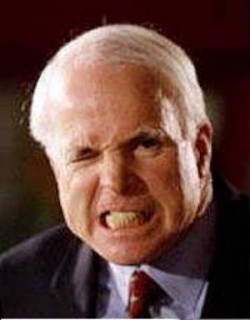
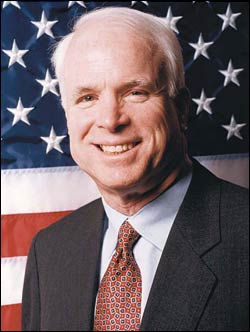
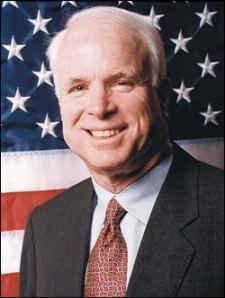 Liberal commentators bemoan the demise of the old John McCain they thought they knew and loved. Joe Klein wonders what happened to the guy who originally sponsored the Dream Act to allow children of illegal immigrants to become citizens. Think Progress points out that he is now supporting the tax cuts to the rich he vilified in 2000-2004. What has happened to John McCain? Have his preferences changed?
There is one obvious theory that seems to make his positions consistent: McCain had to run to the right to beat off a primary challenger in Arizona. But, as Joe Klein points out, “he recently won reelection and doesn’t have to pretend to be a troglodyte anymore.” So this theory is flawed.
There is another obvious theory. In this one, you have to identify an outcome a person supports or opposes not just by the policy itself but also by the the other person who supports it. So you have outcomes like “tax policy opposed by Obama,” “tax policy supported by Bush,” “tax policy supported by Obama,” “tax policy opposed by Bush” etc. Then, it is quite consistent for McCain to support a 35% tax on the rich when Bush opposes it but to oppose a 35% tax on the rich when Obama proposes it. Essentially, if McCain loses to someone in a Presidential election or primary he opposes their policies whatever they are.
A sophisticated model along these lines is offered by Gul and Pesendorfer. It allows one person’s preferences to depend on the “type” of the other person, e.g. is the opponent selfish or generous? In principle, this model allows us to determine whether a person is spiteful using choice data. McCain certainly has some behavior that is consistent with spitefulness. Is he ever generous? We would need to know his choices when facing someone he beat in a contest or someone he has never played. Or is he just plain mean? Joe Klein leans towards spite based on the available data:
“He’s a bitter man now, who can barely tolerate the fact that he lost to Barack Obama. But he lost for an obvious reason: his campaign proved him to be puerile and feckless, a politician who panicked when the heat was on during the financial collapse, a trigger-happy gambler who chose an incompetent for his vice president. He has made quite a show ever since of demonstrating his petulance and lack of grace.
What a guy.”
If choice with interdependent preferences can be utilized in empirical/experimental analyses, we can investigate the soul of homo economicus using the revealed preference paradigm.

Gävle Sweden is the hometown of my teacher and longtime co-author Tomas Sjöström. The second most famous Swede after Tomas, Elin Nordegren, ex-wife of Tiger Woods, spends time in Gävle because her mother lives there.
At Xmas, Gävle is famous for another reason: it sturdy citizens build a huge goat and it appears to have become a tradition to burn it down, steal it or otherwise damage it. A brief recent history:
2001 Goat set on fire on 23 December by Lawrence Jones, a 51-year-old visitor from Cleveland, Ohio, who spent 18 days in jail and was subsequently convicted and ordered to pay 100,000 Swedish kronor in damages.
2002 The goat received only minor damage.
2003 Burnt down on 12 December.
2004 Burnt on December 21.
2005 Burnt by unknown vandals reportedly dressed as Santa and a gingerbread man by shooting a flaming arrow at the goat at 21:00 on 3 December.
2008 The goat finally succumbed to the flames ignited by an unknown assailant.
2009 An unsuccessful attempt was made to throw the goat into the river the weekend of December 11. On the night of December 23 before 04:00 the goat was set on fire and was burned to the frame, even though it had a thick layer of snow on its back.The goat had two online webcams which were put out of service by a DoS attack, instigated by computer hackers just before the attack.
One hour or so before midnight in Sweden, the goat still appears to be standing according to this webcam.

The freshly tenured Chris Berry has switched briefly from padding out his CV by publishing like crazy to padding out his belly. Chris and his colleagues at the Harris School of Public Policy have an encyclopedic knowledge of fried products in the Chicago area, especially if they are fried in duck or pork fat. But they keep an open mind and are accepting of all kinds of fat so I had the luck to enjoy a donut which Chris picked up at the Rise’ N Roll Amish Bakery. Loaded with butter and dusted in cinnamon sugar, these donuts are treat not to be indulged in too often. But with New Year’s resolutions of exercise just over a week away, what better time than this to enjoy the cholesterol?

In a perfectly competitive market, the price of a product is given by its minimum average total cost of production. The lower this is, the lower the price. Technological advances have reduced the costs of operating a fridge, air conditioner, washing machine etc… etc…. Consumers will buy more of them and consume more electricity and produce more greenhouse gases. How much more depends on the elasticity of demand. If elasticity is high, energy consumption may go up so fast that it results in greater resource depletion with greater energy efficiency. This is basic economics and was known in the nineteenth century. It is known as the Jevons paradox and is the topic on an article in the New Yorker (subscription required):
In 1865, a twenty-nine-year-old Englishman named William Stanley Jevons published a book, “The Coal Question,” in which he argued that the bonanza couldn’t last. Britain’s affluence and global hegemony, he wrote, depended on its endowment of coal, which the country was rapidly depleting. He added that such an outcome could not be delayed through increased “economy” in the use of coal—what we refer to today as energy efficiency. He concluded, in italics, “It is wholly a confusion of ideas to suppose that the economical use of fuel is equivalent to a diminished consumption. The very contrary is the truth.”
Jevons is now known more as a utilitarian and one of the founders of mathematical economics. Who knew he combined the practical with the theoretical?
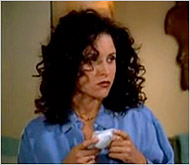
Via MR, a wonderful profile and interview with the economist Avinash Dixit. Avinash has made fundamental contributions to international trade, political economy and the theory of real options. Avinash has a Schelling-esque style and has a great sense of humor. It turns out that for many years he has kept hidden in his drawer an analysis of Elaine’s decision problem in an episode of Seinfeld:
Elaine Benes uses a contraceptive sponge that gets taken off the market. She scours pharmacies in the neighborhood to stock a large supply, but it is finite. So she must “re-evaluate her whole screening process.” Every time she dates a new man, which happens very frequently, she has to consider a new issue: Is he “spongeworthy”?
Avinash studies Elaine’s problem formally. And his model displays all the great qualities one might expect. First, simplifying assumptions: To get intuition for the key issue – how does the finite supply of sponges affect Elaine’s decision problem – it is good to make the rest of the model stationary. Hence:
Suppose Elaine believes herself to be infinitely lived; this is a good approximation in relation to the number of sponges she has and her time-discount factor or impatience. She meets a new man every day.
Let Q be the “quality” of a man Elaine meets where Q is drawn from the uniform distribution on [0,1]. Let Vm be Elaine’s expected utility when she has m sponges left. Her per-day discount factor is b – Elaine lives in NYC and meets a lot of men! At her optimum, a man is spongeworthy iff
Q+bVm-1>bVm
Given the assumptions made, Avinash can actually explicitly work out the details of the solution to this problem by cranking out Vm. But here are some qualitative insights.
1. Elaine should have a threshold strategy: There is a threshold Qm where a man is spongeworthy iff his Q is greater than this threshold when Elaine has m sponges left.
2. Qm is decreasing: The more sponges Elaine has left, the lower her standards.
3. Vm is decreasing: As Elaine runs our of sponges, her expected utility declines as there are fewer “interactions” remaining.
There are other insights and extensions. For those, I recommend Avinash’s lovely paper.
One activity can equally be done by Division A or Division B of a firm but, for historical reasons, Division A has control of it right now. This gives the managers of Division A lots of power to hire and they like having a little empire. But the CEO comes up with a plan: Since both divisions are in theory up to the job, have them compete for the activity.
The best way to do this is pretty obvious: If Division A screws up, give the job to Division B. But of Division A does a good job let them keep it. This gives Division A good incentives to work hard to do a good job.
In practice it is hard to measure the quality of output so it is hard to implement this simple scheme. Quality is evaluated by subjective judgements and rhetorical arguments. Perversely, the better the job Division A is doing, the more incentive Division B has to try to steal the job. This is because a job well done generates lots of slots. If Division A is doing a bad job, the activity does not look worth stealing.
So, in practice, having the divisions compete for the activity can lead to destruction of incentives. Better to give one division the property right over the activity and intervene only when outcomes are objectively poor.
When you reach a certain age, your friends start getting honors and you are invited to polite soirees. At aforementioned polite soirees, there are cheesy delights and sweet little dessert tarts. The sweet little desert tarts are tastefully arrayed on silver platters and you can easily pick one up and pop it into your mouth without touching any neighboring tarts. You daintily consume a little fruit tart.
The energizing sugar rush behind you, you turn to the cheesy delight. You are pleased that at this soiree, they have put out the delight out of all delights – the baked brie or the “brie en croute” as we call it at polite soirees. You head over and shove your way into the line for the warm cheesy delight. You are rather aggressive and push past a distinguished looking man that you recognize (too late!) as the new President of Northwestern University. You grin sheepishly and say, “Hi. I’m Rakesh Vohra.” You hope this throws him off the scent – even though your colleague Rakesh is balding and white-haired, at least he has the right skin tone. The President seems to make a mental note to dock your (or Rakesh’s) salary and turns away to talk to someone else.
You turn to the cheesy delight and as you pause to pick up bread your forward momentum, barely broken by the President, is brought to a grinding halt by a fundamental problem: To tong or not to tong. That is the question.
In other words, should you use the tongs – always provided at polite soirees – to pick up the bread or just stick your grubby hand into the bread basket? If you think like homoeconomicus, you decision is obvious: Unlike you, many other people followed the proper procedure and headed over to the cheesy delight before the little sweet dessert tarts. They have used the tongs before you and the supersized tweezers are covered in cheeky little germs just hopping with excitement at the prospect of giving you H1N1 for Christmas. If you stick your grubby hand into the bread basket, you avoid the tong devils but deposit your own cooties on a baguette slice that someone else will pick up. But you are homo economicus so you do not face any moral dilemma: Ignore the “negative externality” and stick your hand into the bread basket.
Then, you are brought to a stop again, this time by a major “Aha” moment. Your shove into the line and all your procrastination is causing much grumbling in the cheesy delight queue. But you’re not even aware of this because you’ve had a huge epiphany: Following the recommendation of homo economicus is also the right thing to do from the perspective of society’s objective of minimizing germ transmission. You guess that Adam Smith must have had a similar experience when the idea of the “invisible hand” hit him just before he was about to tuck into his haggis and scotch.
You reason as follows: When you stick your hand into the bread basket, you might not even hit another bit of bread other than your own. Even if you aim misses because of the two glasses of champagne you drank on an empty stomach, you’re only going to hit a few other slices of ever staler bread. While if you use the tong, you are guaranteeing that the long line of people behind you get to experience your lack of good hygiene. It is better for everyone if you stick your hand in the bread basket.
Your face disfigured by an angelic smile, confident your are doing the right thing for once, you follow the route Immanuel Kant himself would take and finally consume some cheesy delight. You turn around to see the President looking at you as if you’re some kind of animal. You wipe your cheese covered hand on your jeans and grasp his. You say, “Call me Ricky.” You run out before your cover is broken.
 Congratulations Jeff!!! NU is lucky to have you.
We dress like students, we dress like housewives
or in a suit and a tie
I changed my hairstyle so many times now
don’t know what I look like!
Life during Wartime, Talking Heads
Mr C. is the new C.E.O. of your firm, Firm C. He was head of operations at one of your competitors Firm A. He was passed over for promotion there and had to exit to get to the C Suite. You wonder about the wisdom of your Board: Why would they choose someone who rejected for the top job by their own company? You subscribe the “Better the Devil you know, than the Devil you don’t” principle. If your firm appoints an internal person to the top job, at least you know their flaws and can adapt to them. This principle also applies at Firm A. So, if they rejected the Devil they know, he must be a really terrible Devil or, to put it in tamer economic terms, a “lemon.”
But you are also aware of the counter argument: Real change can only be achieved by an outsider. Mr C said some smart things in the interview process and so you are happy to give him the benefit of the doubt. You are expecting Mr C. to define a mission for Firm C, a mission that everyone can sign on to. Of course, to persuade everyone to work hard on the vision it has to be a “common value” – something everyone agrees is good – not a “private value” – something only a subgroup agrees is good. In this regard, Mr. C surprises you – he makes a big play that Operations are the most important thing in a successful firm. “Look at H.P. and Amazon,” he says. “They don’t actually make anything, just move stuff around efficiently and/or put in together from parts they buy from other firms. We need innovation in Operations not fundamental innovation in our product line.”
You are shocked. Your firm has R and D Department that has produced amazing, fundamental innovations. Innovative ability is sprinkled liberally throughout your firm in – it is famous for it. It is a core strength of Firm C. Why would anyone want to destroy that and focus on Operations? What should do you do? In times of trouble, you have a bible you turn to – Exit, Voice and Loyalty by Albert Hirshman
Should you give voice to your concerns? The last CEO ignored you and the new CEO might give you more attention so you had thought that you might talk to him. But your first impressions are bad and something you might say might be misinterpreted and lead to the opposite conclusion in the mind of the new CEO. Talking is dangerous anyway. You might be identified as a troublemaker and given lots of terrible work to do. Better to keep quiet and blend in with the crowd.
Is loyalty enough to keep you working hard anyway? Your firm is not a non-profit and, given the CEO plans to quash innovation, it is basically going to produce junk. Why should anyone be loyal to that?
You are drawn inexorably to Hirshman’s last piece of advice: exit. This is hard during the Great Recession – there are few jobs going around. You will be joined by all those who can exit from your sinking ship C so you have to move fast….
 Cheap Talk