
You are currently browsing the monthly archive for February 2011.
Here’s a broad class of games that captures a typical form of competition. You and a rival simultaneously choose how much effort to spend and depending on your choices, you earn a score, a continuous variable. The score is increasing in your effort and decreasing in your rival’s effort. Your payoff is increasing in your score and decreasing in your effort. Your rival’s payoff is decreasing in your score and his effort.
In football, this could model an individual play where the score is the number of yards gained. A model like this gives qualitatively different predictions when the payoff is a smooth function of the score versus when there are jumps in the payoff function. For example, suppose that it is 3rd down and 5 yards to go. Then the payoff increases gradually in the number of yards you gain but then jumps up discretely if you can gain at least 5 yards giving you a first down. Your rival’s payoff exhibits a jump down at that point.
If it is 3rd down and 20 then that payoff jump requires a much higher score. This is the easy case to analyze because the jump is too remote to play a significant role in strategy. The solution will be characterized by a local optimality condition. Your effort is chosen to equate the marginal cost of effort to the marginal increase in score, given your rival’s effort. Your rival solves an analogous problem. This yields an equilibrium score strictly less than 20. (A richer, and more realistic model would have randomness in the score.) In this equilibrium it is possible for you to increase your score, even possibly to 20, but the cost of doing so in terms of increased effort is too large to be profitable.
Suppose that in the above equilibrium you gain 4 yards. Then when it is 3rd down and 5 this equilibrium will unravel. The reason is that although the local optimality condition still holds, you now have a profitable global deviation, namely putting in enough effort to gain 5 yards. That deviation was possible before but unprofitable because 5 yards wasn’t worth much more than 4. Now it is.
Of course it will not be an equilibrium for you to gain 5 yards because then your opponent can increase effort and reduce the score below 5 again. If so, then you are wasting the extra effort and you will reduce it back to the old value. But then so will he, etc. Now equilibrium requires mixing.
Finally, suppose it is 3rd down and inches. Then we are back to a case where we don’t need mixing. Because no matter how much effort your opponent uses you cannot be deterred from putting in enough effort to gain those inches.
The pattern of predictions is thus: randomness in your strategy is non-monotonic in the number of yards needed for a first down. With a few yards to go strategy is predictable, with a moderate number of yards to go there is maximal randomness, and then with many yards to go, strategy is predictable again. Variance in the number of yards gained in these cases will exhibit a similar non-monotonicity.
This could be tested using football data, with run vs. pass mix being a proxy for randomness in strategy.
While we are on the subject, here is my Super Bowl tweet.
The MILLTs at Spousonomics are calling on spouses to look for Pareto improvements in our marital transactions. Paula offers this list for her husband on Valentine’s day.
1. Help with garbage night.
2. Join you in the 30-day meditation challenge.
3. Not remind you when you have to make up a work shift at the food coop.
4. Use my Petzl head lamp when I’m reading in bed and you’re already asleep.
5. Work on my tone of voice when I’m frustrated.
6. Pick my battles.
7. Entertain notion that my way isn’t the only way.
8. Try again to make braised pork shoulder.
9. Give Sonny & the Sunsets another chance.
10. Let things go.
I’m as keen on free lunches as the next guy (I’m looking at you Asher), but at the risk of throwing cold water on Paula’s Valentine’s Day overtures, let me bring a little dose of tradeoffs to this home economics lesson. First of all, Paula is shortchanging her generosity on many of these because very few of them are literal Pareto improvements. Garbage night? Who isn’t better off keeping their hands clean, not to mention taking a pass on the sub-freezing walk to the curb. And I am not sure what exactly a Petzl head lamp is but I’d be worried about waking up to the fragrance of molten hair after dozing off with one of those on.
No those are genuine sacrifices. Indeed Pareto improvements are pretty hard to come by even if you are otherwise a selfish pig. Especially if you are a selfish pig. Because as long as you are already doing everything that would make you better off, the only room left for Pareto improvements is spanned by the knife’s edge of indifference.
There is a second category represented on the list: proposals that take a long-run view. These are a bit more subtle. Give Sonny and the Sunsets another chance. This qualifies as a Pareto improvement even though the implicit suggestion is that Sonny and the Sunsets didn’t cast a warm glow the first time. If the clouds part for Paula the second time around then she and her husband are both better off. But again Paula’s pure self interest already takes care of this one so long as she’s thinking ahead. Anyway, if even Sonny and the Sunsets can grow on us after a few listenings then anything can. Why not just spend 30 days meditating? Oh wait…
And let’s not forget that a Pareto improvement has to make the other party better off, at least weakly. Given what we can all infer from the pledge itself, “Try again to make braised pork shoulder” seems to fail on that count.
Then there’s the issue of narrow framing. Pareto efficiency for the household may entail violence against the rest of the world. Not reminding him about food co-op is nice but what about the poor slobs waiting for their food at the co-op? Heck why not replace this one with “Encourage you to pilfer more food from the co-op?”
The last set of proposals all relate to improving conflict resolution. Most appear superficially to be obvious Pareto improvements. Work on my tone of voice when I am frustrated. Paula is probably truly indifferent to how her own voice sounds when she’s frustrated, but I would bet that her husband has a clear preference. So this does seem to require a little more than pure self-interest to implement. “Let things go” is another.
But it’s for exactly this kind of household constitutional amendment that the logic of Pareto efficiency can be turned on its head. The concept of renegotiation in repeated games holds a key lesson. Marriage is a partnership that requires individual sacrifice in order to reach the efficient frontier. The temptation to cheat on the relationship must be deterred with the threat of moving below from the frontier as a reprisal. Once there it is tempting to re-negotiate back to the frontier. But as soon as we get used to doing that, the incentive keeping us at the frontier in the first place goes away.
Best not to “Let Go” so quickly, Paula. Sorry Mr. Paula. Try to have a Happy Valentine’s day anyway.

Actions speak louder than words. Anarchists seeking to spread revolution resort to extreme acts hoping to stir the sympathy of the general population. Would be change-agents differ in their favored instrument of provocation – assassination, bombings or general strike. They are united by their intrinsic lack of real power. They only way they can hope to achieve their ends is by persuading other players to react and indirectly give them what they want. As such, the “propaganda of the deed” in practiced typically by people on the fringe of society, not in the corridors of power. (See my paper The Strategy of Manipulating Conflict with Tomas Sjöström for illustrations of this strategy.)
But Mubarak has reached this lowly state even as President of Egypt. He has conspicuously lost popular support and tensions long suppressed have burst asunder for all to see. He has lost the support of “the people” and, perhaps even more importantly, the army. What can he do to get it back? The anti-Mubarak protestors have till recently refrained from looting and mob mentality has been notable for its absence. As long as that remains the case, the army and the people are siding with the anti-Mubarak protestors or largely staying out of the fray. Mubarak’s only hope is to get the people and the army to pick his side. He needs to energize the mob and trigger looting. That is his strategy. Police disappeared from the streets of Cairo a few days ago, inviting looters to run amok. That did not work. So, now he has employed pro-Mubarak “supporters” to fight anti-Mubarak protestors. Open fighting on the streets of Cairo, prodding the army to step in. The people scared of the outbreak of lawlessness turning to the strongman Mubarak to return some semblance of stability to the city and the country. This is where we are in the last couple of days. Another obvious strategy for Mubarak: Get his supporters to loot and pin it on the anti-Mubarak protestors. Not sure if that is happening yet.
What can be done to subvert the Mubarak strategy? For the protestors, the advice is obvious – no looting, no breakdown of law and order. The primary audience is the army and people – keep them on your side. For the Obama administration there is little leverage over Mubarak. I assume he has hidden away millions if not billions – cutting off future aid has little chance of persuading Mubarak to do anything. Again, the army is the primary audience for the Obama administration. Whichever side they pick will win. The army cares more about the cutoff of future aid than Mubarak. They have trained in US military schools and have connections here. The only leverage the Obama administration has is over the army and it is hard to tell how strong that leverage is.
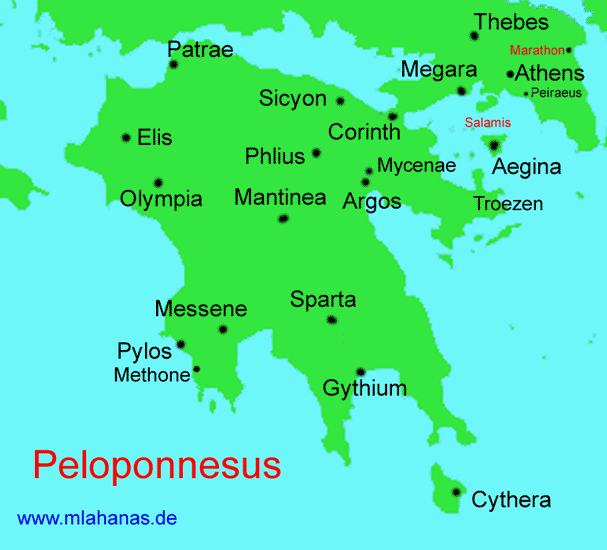
This week I switched to models of conflict where each player puts positive probability on his opponent being a dominant strategy type who is hawkish/aggressive in all circumstances. This possibility increases the incentive of a player to be aggressive if actions are strategic complements and decreases it if actions are strategic substitutes. The idea that fear of an opponent’s motives might drive an otherwise dovish player into aggression comes up in Thucydides (“The growth of Athenian power and the fear this caused in Sparta, made war inevitable.”) and also Hobbes. But both sides might be afraid and this simply escalates the fear logic further. This was most crisply stated by Schelling in his work on the reciprocal fear of surprise attack (“[I]f I go downstairs to investigate a noise at night, with a gun in my hand, and find myself face to face with a burglar who has a gun in his hand, there is a danger of an outcome that neither of us desires. Even if he prefers to leave quietly, and I wish him to, there is a danger that he may think I want to shoot, and shoot first. Worse, there is danger that he may think that I think he wants to shoot. Or he may think that I think he thinks I want to shoot. And so on.”). Similar ideas also crop up in the work of political scientist Robert Jervis.
Two sided incomplete information can generate this kind of effect. It arises in global games and can imply there is a unique equilibrium while there are multiple equilibria in the underlying complete information game. But the theory of global games relies on players’ information being highly correlated. Schelling’s logic does not seem to rely on correlation and we can imagine conflict scenarios where types/information are independent and yet this phenomenon still arises. In this lecture, I use joint work with Tomas Sjöström to identify a common logic for uniqueness that is at work for information structures with positively correlated types or independent types. Our sufficient conditions for uniqueness can be related to conditions that imply uniqueness in models of Bertrand and Cournot competition.
With these models in hand, we have some way of operationalizing Hobbes’ second motive for war, fear. I will use these results and models in future classes when I use them as building blocks to study other issues. Here are the slides.
I am talking about world records of course. Tyler Cowen linked to this Boston Globe piece about the declining rate at which world records are broken in athletic events, especially Track and Field. (Usain Bolt is the exception.)
How quickly should we expect the rate of new world records to decline? Suppose that long jumps are independent draws from a Normal distribution. Very quickly the world record will be in the tail. At that point breaking the record becomes very improbable. But should the rate decline quickly from there? Two forces are at work.
First, every new record pushes us further into the tail and reduces the probability, and hence freqeuncy, of new records. But, because of the thin tail property of the Normal distribution, new records will with very high probability be tiny advances. So the new record will be harder to beat but not by very much.
So the rate will decline and asymptotically it will be zero, but how fast will it converge to zero? Will there be a constant K such that we will have to wait no more than nK years for the nth record to be broken or will it be faster than that?
I am sure there is an easy answer to this question for the Normal distribution and probably a more general result, but my intuition isn’t taking me very far. Probably this is a standard homework problem in probability or statistics.
The Boston Globe piece is about humans ceasing to progress physically. The theory could shed light on this conclusion. If the answer above is that the arrival rate increases exponentially, I wonder what rate the mean of the distribution can grow and still give rise to the slowdown. If the mean grows logarithmically?


It is the second anniversary of this blog, as Jeff says. We are forever connected to Groundhog Day. Today, amazingly, the NYC groundhog predicted an early Spring. I hope he is right and his prediction also holds for the Midwest.

We have been blogging for two years now. When we turned 1 I started writing a sequence of posts on Why I Blog. Here’s a few of them. As a final why-thought I would like to say that while blogging often feels like shirking, in fact the number one reason that keeps me going when I start to worry I am running out of ideas is that this blog has proved to be a huge boon to my research.
Sandeep and I started writing Torture on this blog. Simply put, that paper would not exist if Cheap Talk did not exist. This post I wrote recently about overbooking set me thinking for a day or two and now, with ideas from Daniel Garrett and Toomas Hinnosaar, the three of us are writing a paper on it. These are the concrete products but there are many more benefits that are harder to measure but easily as important.
First, if you look at the tag vapor mill, you will find a trail of ideas that I have written down, each of which has the potential to be a real research project. A number of them I intend to work on when I have the time. Second, its a true cliche that writing about “the real world” makes you a better theorist. Sometimes you learn that crucial assumptions are too restrictive to explain a story. Sometimes you find a new appreciation of just how far they go. And not even the most prolific “applied theorists” get the opportunity to write as frequently and about the kind of wide-interest topics as a blogger gets.
Done with the why, onto the how. Blogging is a big commitment and you learn only very slowly how to do it efficiently. Given the amount of time I spend staring at a blank text editor I still have a lot to learn myself. But I’ll write a few things I picked up. For starters let me tell you how Sandeep and I started this blog because I think we did something smart that I would recommend to anybody who was thinking about jumping in.
We blogged to ourselves for about a month. It was a a real dress rehearsal: we used the WordPress blog that we are using now, we wrote posts about once a day, but nobody read them because nobody knew the blog existed. This was mainly to see what it would be like to try to write on a daily basis. If it looked like we wouldn’t be able to keep it going we would just call it off and nobody would know we were failures.
But when we finally decided that it was a go, it had a second benefit. Before going public, we archived all of the posts we had written already and scheduled them to be published a day at a time over the next several weeks. Here’s why this is such a great idea. Blogging requires momentum. Unless you are a highly unusual person, it is impossible to conjure up something to write about on a daily basis. Instead, what you do is collect ideas, allow them to percolate around in your head for awhile and then write them down when they are ripe. It takes months before there’s enough in the pipeline to keep you actively writing. Having a headstart gives you the lead time you need to reach that cruising speed.
(Drawing: Riding The Wave from www.f1me.net)
Self-Deception is a fascinating phenomenon. If you repeat a lie to yourself again and again, you start to believe it. You would think that the ability to deceive yourself would be constrained by data. If there is obviously available evidence that your story is false, you might stop believing it. Then, self-deception can only flourish when there is an identification problem. Once data falsifies competing theories, the individual is forced to face facts.
Reality is much more complex. Take the perhaps extreme case of John Edwards. The National Enquirer published a story reporting that Rielle Hunter was pregnant with John Edwards’s child. Edwards simply denied the facts. The Enquirer employed a psychologist to profile Edwards. S/he concluded:
“Edwards looks at himself as above the law. He has a compromised conscience — meaning he will cover up his immoral behavior at whatever cost to keep his reputation intact. He believes he is who his reputation says he is, rather than the immoral side, the truth. He separates himself from the immoral side because that person wouldn’t be the next president of the United States. He overcompensated for his insecurities with sex to feed his ego which feeds his narcissism.”
The most important part was the absolute certainty of the mental health professional that Edwards would continue to deny the scandal — almost at all costs.
“He will keep denying the scandal to America because he is denying the reality of it to himself. He sees himself only as the image he has created.”
How do you deal with a pathological deceiver/self-deceiver? The Editor collected photos and evidence of Hunter-Edwards liasons. He describes his strategy:
We told the press that there were photographs and video from that night. Other journalists asked us to release the images but I refused. Edwards needed to imagine the worst-case scenario becoming public. TheEnquirer would give him no clues about what it did and did not have…..
Behind the scenes we exerted pressure on Edwards, sending word though mutual contacts that we had photographed him throughout the night. We provided a few details about his movements to prove this was no bluff.
For 18 days we played this game, and as the standoff continued the Enquirer published a photograph of Edwards with the baby inside a room at the Beverly Hilton hotel.
Journalists asked if we had a hidden camera in the room. We never said yes or no. (We still haven’t). We sent word to Edwards privately that there were more photos.
He cracked. Not knowing what else the Enquirer possessed and faced with his world crumbling, Edwards, as the profiler predicted, came forward to partially confess. He knew no one could prove paternity so he admitted the affair but denied being the father of Hunter’s baby, once again taking control of the situation.
This strategy is inconsistent with the logic of extreme self-deception. Such an individual must be overconfident, thinking he can get away with bald-faced lies. Facing ambiguous evidence, he might conclude that the Enquirer had nothing beyond the odd photo it released. The Enquirer strategy instead relies on the individual believing the worst not the best. The two pathologies self-deception and extreme pessimism should cancel out…..there is some interssting inconsistency here.
One thing is clear: One way to eliminate self-deception is for a third-party to step in and make the decision. This is what Omar Suleiman, Barack Obama and the Egyptian army are doing to help Hosni Mubarak deal with his self-deception.
 Cheap Talk