
You are currently browsing the tag archive for the ‘food and wine’ tag.
In his first study, each year, for four years, Mr. Hodgson served actual panels of California State Fair Wine Competition judges—some 70 judges each year—about 100 wines over a two-day period. He employed the same blind tasting process as the actual competition. In Mr. Hodgson’s study, however, every wine was presented to each judge three different times, each time drawn from the same bottle.
The results astonished Mr. Hodgson. The judges’ wine ratings typically varied by ±4 points on a standard ratings scale running from 80 to 100. A wine rated 91 on one tasting would often be rated an 87 or 95 on the next. Some of the judges did much worse, and only about one in 10 regularly rated the same wine within a range of ±2 points.
The article was published in the January issue of the Journal of Wine Economics. The Wall Street Journal has a fun writeup. The same researcher showed that the distribution of medal winners in a sample of wine competitions matched what you would get if the medal was awarded by a fair lottery.
I assume that “dessert” in the sweet-stuff-eaten-after-the-meal sense is not a regular part of Chinese and Indian cuisines. So in some ways this is not a fair question, but they have sweets and they are generally uninspiring and often downright gross. My caricature, not too much of a stretch, is that at the end of a meal in a Chinese restaurant, the leftovers are brought back into the kitchen where they are mixed with sugar and possibly liquified or gelatenized before being returned to the table as dessert. Here is the very popular Cantonese dessert, red bean soup.

Mmmm… . Variations of this dessert appear in many East Asian cuisines. Indian sweets, in my limited experience, are similar.
The few exceptions I have encountered are Vietnamese and Cambodian where the desserts are essentially French.
Japanese scientists asked study subjects to try 38 red wines and 26 whites while eating scallops. Some of the wines contained small amounts of iron, which varied by country of origin, variety and vintage. The tasters noted which wines really didn’t work with scallops. And the researchers found that those wines all had high levels of iron. So they doctored the wine with a substance that binds iron, keeping it away from the tasters’ tongues. And voila, the bad taste became a bad memory. The study appears in the Journal of Agricultural and Food Chemistry.
With that knowledge in hand, wine lovers should be able to find reds that taste terrific with tilapia. So look for red wines with low iron.
From a Scientific American podcast. Transcript here.
Central Square has gentrified since my days living on Harvard Street. There’s a Starbucks (whoopee). There’s still a range of eclectic stuff left over from the dodgy past – the Middle East is still there and the Toscanini’s. They’ve been joined by some high-end restaurants. One of them, Central Kitchen, was recommended to us with the caveat that those of us in the sunrise of our forties might be able to bear the background music better than those approaching the sunset. They were right- I hardly noticed the music. I did notice the food.
Closest I’ve come to Mussels from Brussels are Jean Claude van Damme movies. So, my reference point for the best mussels I’ve eaten is the Hopleaf in Andersonville on the North side of Chicago. And I prefer them cooked in beer rather than cream and wine. Central Kitchen does them in some kind of herb butter. They plonk some frites on top with aioli. The mussels were soft and delicious, bless their little hearts. The broth was wiped up with stellar bread. Jacques Brel on the stereo and a Chimay in my hand would have completed the picture. No need for beer – I was happy with the pinot noir.
The main course was very good but couldn’t live up to the moules. And it was too big and too expensive – I felt bloated at the end. Next time, a salad for the appetizer and the moules for the main course.
We shared the cinnamon beignets for dessert. They were stale. The falling down chocolate cake has to be ordered thirty minutes in advance. Next time.
Extremely simple and good. You need corn tortillas, some kind of meaty fish, some kind of salsa. I like guacamole. I wouldn’t use anything more than this. Store bought corn tortillas are dry but you can steam them and then keep them in a damp kitchen towel and they will work great. Or you can try making your own. It takes some practice, but it pays off.
Mahi Mahi works great. Just squeeze some lime on it, then coat with light oil and let it marinate for about 15 minutes. (Much longer and the acid in the lime will make the fish too flaky and the next step won’t work.) Cut into small pieces and grill. Get yourself a cast-iron grill pan and you can do this indoors.
Put it all together and eat. With store-bought tortillas the whole preparation takes no more than 1/2 hour.

So long, anonymity — it’s been swell. For nearly ten years now, I have done my job incognito. Now I am joining the ranks of no-longer-anonymous restaurant critics. Last Friday, I gave a lecture to the students and faculty of the Texas A&M Meat Science Center without the usual hat and sunglasses. I didn’t wear a disguise on Sunday when I appeared at the Texas Book Festival either. Soon you will be able to Google grainy photos of me to your heart’s content. I also have given my publishers an author’s photo to use for publicity.
So writes Robb Walsh, the no-longer-anonymous food critic for the Houston Press. He is the latest critic to shed his anonymity since the google-able Sam Sifton took over the job at the New York Times. Before that, professional food critics were expected to visit restaurants anonymously and indeed the presumption was that anonymity was required for a critic to provide a useful review. But there are arguments either way.
You might think that the job of a critic is to distinguish the great chefs from the merely good ones. A conspicuous critic would get special treatment and this biases the test. But as long as the critic (or the reader) accounts for this and can “invert the mapping,” essentially factoring out the extra effort, this is not really a problem.
We may only want a relative ranking of chefs and adding a constant to each chef’s baseline quality won’t change that.
Noise in the signal can complicate the inversion but this could go either way. One theory is that the effect of extra effort is to reduce variance in the quality of the dish. If so, a conspicuous chef gets a better signal. Alternatively it could be there is a uniform upper bound and any competent chef can hit that upper bound with enough effort. In this case, anonymity is required.
An anonymous critic generates other welfare gains. Every diner has a positive probability of being Ruth Reichl and so every diner gets a slightly better meal than otherwise. Once critics out themselves, we are all 100% nobodies again.
We may not care who is the most talented chef but instead we want to know where we (nobodies) are going to get the best meal. As long as these are sufficiently correlated, again not much is lost from going conspicuous. But in any event it is not clear that a single critic provides much more information about this than could be had from data on popularity alone. If we want critics to break herds, then they should be anonymous.
Maybe we want critics to start herds. Critics are most influential for tourists and locals prefer to avoid tourists. Conspicuous critics enable efficient market segmentation where restaurants wishing to cater to tourists give special treatment and get good reviews. A good review can destroy a restaurant that caters to locals so all parties benefit if the critic is conspicuous ensuring he is given a bad meal.
(Arising from conversations with Ron Siegel, Mike Whinston, Jeroen Swinkels, Eddie Dekel and Phil Reny.)
One of the major bones of contention derives from just how good this year has been. The Rioja is the only wine-producing region in Spain that bears the label DOC (denominación de origen de calidad), and therefore is subject to especially stringent controls regarding quantity and quality of production. Each farmer may sell a certain amount of grapes, no more, depending on the amount of land under cultivation.
This year the grapes have been wildly abundant, and it is estimated that some 80 million kilograms have been left on the vine because they exceeded the quotas permitted for sale. Indeed, due to the weather conditions during harvest week, the grapes left on the vine are probably the very finest quality ones. For economically-pinched farmers, it is a blow to the heart to see those grapes left for the birds, and many demand to be allowed to sell the surplus as well, despite DOC regulations. Others claim this would flood the market and imperil the status of the DOC product.
The story is here.
Sara Silverman wants to end world hunger (and get those disturbing images off her 48inch plasma TV). Her solution: sell the Vatican and use the proceeds to feed the world.
This is good, but only second best. The buyer who values the Vatican the most is in fact its current occupant. So selling the Vatican would lower its value. (It is true that the new owner knows he can sell it back to the Pope and takes this into account when deciding how much to offer. However, this adds needless transaction costs, plus the Pope will have bargaining power in the resale which would not be internalized by the buyer.)
A better idea is to give the Vatican directly to the poor and allow then to charge the Pope rent. Subject to this small ammendment, I wholly endorse the following (although the bit about the Holocaust may require the consent of more than just Ms Silverman and me.)
I read the Nobel “Scientific Background” to find out what her research is about. Turns out a much better summary is the video here at EatMeDaily.
A city in Taiwan is trying to keep the streets clean by offering cash for collected dog poo.
City officials in Taichung, which has a population of one million, said on Wednesday the environmental protection bureau would give vouchers worth 100 Taiwan dollars ($3) for every kilo of dog poo collected. In areas of the city especially affected, the reward will be for every half-kilo.
In related news, Taichung is witnessing a sudden surge in demand for high-fiber dog food which is now being sold in convenient single-serving sizes priced at 99 Taiwan dollars.
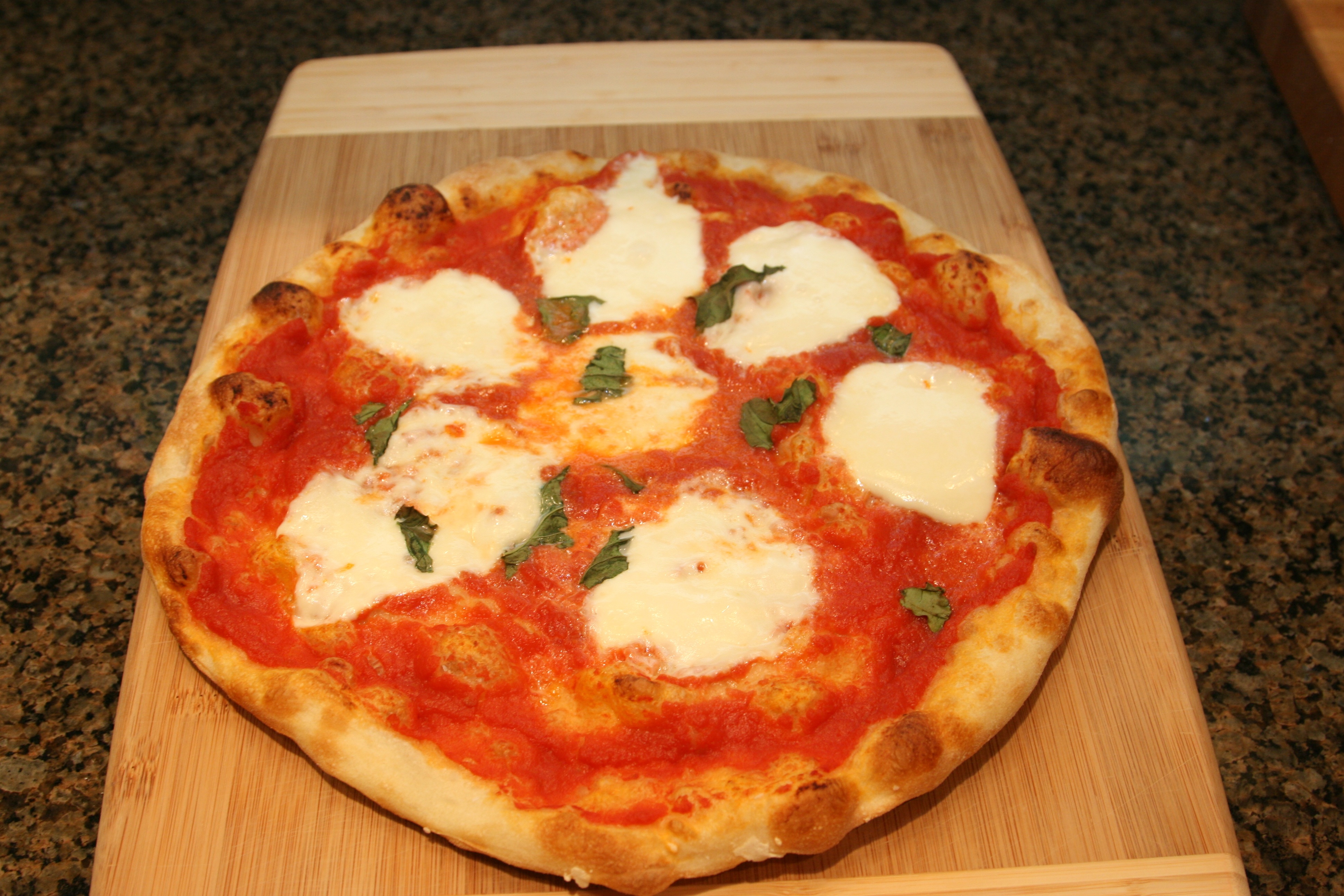
You can make pizza at home if you have an oven that will break 500F. And if you can, you should. Its easy to make good pizza and its fun. You need a pizza stone, peel, and a good stand mixer to do the kneading. Some things I have learned over time.
- Start with margherita (tomato sauce, mozzarella, basil). Once you make a good margherita you will realize there is not much point in making anything else.
- Use mozzarella di bufalo. It truly makes a big difference (naturally though there is variation in quality.)
- To make the sauce, use canned, peeled, san marzano tomatoes, remove the seeds and puree. Simmer in a skillet until there is no visible water pooling in the sauce and it sticks to a spoon. This takes longer than you would expect so be patient. (You do this while the dough is rising.) Add only salt. No garlic, no onion, etc.
- No-knead dough recipes are popular recently and they work for many things but not pizza dough. Yes it is convenient, but there is a simple reason it doesn’t work. To form gluten without kneading you add a lot more water than you normally would. Pizza cooks very fast. That short time is not enough to get enough moisture out of the dough to get the bite that you want on the edges. Water holds the temperature of the dough down because water cannot be raised above boiling temperature (think about it.)
It is one of the most basic premises of economics and decision theory. If you give a decision-maker better information about the consequences, he will make better choices.
This principle underlies one of the least controversial forms of paternalism: subsidizing information to improve welfare. It is uncontroversial because unlike policies which restrict or direct behavior, it doesn’t take a stand on what is good for the decision-maker. More information helps her achieve her desired outcomes, whatever they may be.
In New York City, fast food chains were required to conspicuously publish calorie counts for all of their offerings. This will enable customers to make better decisions, presumably in terms of health consequences. According to the theory, any change in behavior in response to the new information is evidence that the policy was a success. It reveals that people made use of the information.
…when the researchers checked receipts afterward, they found that people had, in fact, ordered slightly more calories than the typical customer had before the labeling law went into effect, in July 2008.
Here is the conclusion drawn by an author of the study:
“I think it does show us that labels are not enough,” Brian Elbel, an assistant professor at the New York University School of Medicine and the lead author of the study, said in an interview.
I have a simple system for organizing recipes. I try out recipes I find in cookbooks, blogs, magazines, whatever. When one hits I do the following.
- Take a picture of it.
- Write down a list of the ingredients I wouldn’t typically have stocked.
- Email the above plus a link to the recipe (or what page in what cookbook) to myself.
Because the time you really need recipes is when you are shopping and you see, say some really good looking okra and you need to know what else to get. You pull out your iPhone, you search for okra in your mail folders, you get a picture and a list of ingredients. You go home and cook.
The picture is absolutely key. Think of your cookbooks at home. Which recipes do you most often cook? Its the ones with the beautiful photos in the middle of the book. The photo reminds you how yummy its going to be. Wouldn’t you love to cook this tonight?
Put aside the question of why customers give tips. That’s certainly a huge mystery but the fact is that many diners give tips and the level of tip depends on the quality of service.
In this article (via foodwire), a restauranteur explains why he decided against a switch to the European system of a fixed service charge.
We looked very hard at this [servis compris] policy fifteen years ago. We were going to call it “hospitality included.” We felt people who worked in the dining room were apologizing for being hospitality professional. I felt there was a resulting shame or lack of pride in their work. My assumption was that it was fueled by the tipping system, and I was troubled by the sense that the that tipping system takes a big part of the compensation decision out of the employer’s hands. So we brought up the “hospitality included” idea to our people. To our surprise, it turned out the staff actually enjoyed working for tips.
The tipping system encourages servers to put more weight on the diner’s welfare than the restauranteur would like, at least at the margin. You can think of the waiter as selling you extra bread, more wine in your glass, and more attention at the expense of less generous (-looking) diners. The restauranteur incurs the cost but the server earns the tip.
On the other hand, a fixed service charge provides too little incentive to take care of the customers. You can think of a tipping system as outsourcing to the diner the job of monitoring the server.
(I once had a conversation on this topic with Toomas Hinnosaar and I am probably unconsciously plagiarising him.)
China is threatening to cut off imports of American chicken, but poultry experts have at least one reason to suspect it may be an empty threat: Many Chinese consumers would miss the scrumptious chicken feet they get from this country.
“We have these jumbo, juicy paws the Chinese really love,” said Paul W. Aho, a poultry economist and consultant, “so I don’t think they are going to cut us off.”
The story is in the New York Times.
Some research suggests that a child’s ability to delay gratification is a good predictor of achievement later in life. The research is based on some famous experiments in which children were left in a room alone with sweets and told that if they resisted until the experimenters returned, they would be rewarded with even more sweets. Via EatMeDaily here is a really cute video by Steve V of the marshmallow test.
I don’t know if my pizza standards have gone up or this place has gotten worse but I was unimpressed. The crust was too crisp and hard. The toppings were too rich so the flavours were muddy. I actually prefer the Upper Crust in Brookline even though it’s chaotic and loud.
When zero marginal cost is too steep:
Champagne producers agreed to pick 32% fewer grapes this year, leaving billions of grapes to rot on the ground, in a move to counter fizzling bubbly sales around the world amid the economic downturn.
Here is the story. (link fixed.)
U.S. producers are allowed to grow a certain amount of cane and beets each year for which they are guaranteed a price set by USDA. Beets get 55 percent of the total quota allotment and cane gets 45 percent. This works like a closed shop. If you want to start growing beets or cane for domestic sugar production, too bad. Catch 22: You only get to have a quota if you already have a quota. As for tariffs: The 2008 Farm Bill says that 85 percent of total sugar in the U.S. must be produced domestically, and only 15 percent can be imported. That 15 percent comes in through quotas distributed among about 20 countries. Any other sugar they want to send us is subject to high tariffs, except from Mexico. Under NAFTA, Mexico can export as much sugar to us as it wants to at the favored price. But imported sugar is never supposed to exceed 15 percent.
This interview covers a variety of angles including the history of sugar protection, high-fructose corn syrup, and the sugar “crisis.”
We have all heard about problems of overfishing and how quotas and incentive mechanisms have been effective in slowing the depletion of stocks of endangered fish. But while over-utilization of a common resource can be addressed with such measures, it is trickier to implement schemes that incentivize investment toward actively replenishing depleted fisheries. The problem is that any actor bears all of the investment cost but, given the common pool, enjoys only a small fraction of the benefits.
Enter Giant Robotic Roaming Fish Farms. These are essentially mobile fences in the sea that have the potential of bringing the benefits of coastal fish farming to the open waters solving a number of traditional problems.
Traditional fish farms typically consist of cages submerged in shallow, calm waters near shore, where they are protected from the weather and easily accessible for feeding and maintenance.
But raising fish in such close quarters can contribute to the spread of disease among the animals, and wastes may foul the waters. Cages must be moved to keep the waters clean and the fish healthy.
Deepwater cages offer cleaner, more freely circulating ocean water and natural food, which can yield tastier fish.
Fences create property rights and property rights solve incentive problems. As an illustration, here is a remarkable paper demonstrating the rapid advances in agricultural development in the American plains that coincided with the invention of barbed wire.
Some of the trade-offs, both mathematical and psychological are discussed in this article from The Numbers Guy. My favorite idea:
• Dilip Soman: “I have a radical solution. Once a shopper is ready to check out, she wheels her cart into an area where she gets a number, and is directed to a lounge. Staff members scan and generate ‘invoices’ and once ready, the numbers are called out into the lounge area so that the customer can pay. The one thing that I don’t know is whether customers will feel some anxiety about not being in front of their groceries when they are being scanned, but if they don’t, I think this will be the most efficient solution!”
Chopped is a show on the Food Network where four chefs compete to win $10K. There are three knockout rounds/courses. In each round, the remaining chefs get some mystery ingredients and have 30 minutes to cook four portions of a dish. One chef is chopped each course by a panel of judges till one remains standing at the end of the dessert round.
In the show I watched tonight, the mystery ingredients in the first round were merguez sausage, broccoli and chives. Chef Ming from Le Cirque tried to make chive crepes with a sausage and broccoli stuffing and a milk-broccoli stem sauce. He used a fancy technique where he turned a frying pan upside down and cooked the crepe on the bottom of the pan. He ran out of time and did not make the sauce. Crepes turned out crap. Basically things did not go too well and he was “chopped”. Far weaker chefs made it to the next round. But Ming’s strategy was wrong: he was one of the best chefs. If he had not cooked a hard dish but a safe dish he would have made it into the next round. This got me thinking about the optimal strategy for the game. Here is my conjecture.
To win you have to cook at least one “home run” dish and two good dishes. The third and final final dessert round seems to be the hardest. This time the mystery ingredients were grape leaves, sesame seeds, pickled ginger and melon! It was very challenging to make something edible with that, let alone creative and delicious. If you are lagging (i.e. your opponent has had a home run in previous round and you have not), you have to go for a home run in the dessert round. Otherwise, just do the best you can: the random choice of ingredients will play a bigger rle in your success than your own effort. Reasoning backwards, this implies that you have to go for a home run in one of the first two rounds.
In the second round is where I would try for one. If the other two are going for home runs, I could still play safety and land in the middle. I might do this if I already had a home run in the first round. But if I played safety in the first round, I have to go for it now. And it is likely that I’m in the latter scenario because in the first round you (at least if you are one of the better chefs) should not go for a home run as the only way you’re going to lose is if you come last out of four people. Only the most mediocre chef should play a risky strategy in the first round as this is the only way to win (think of the John McCain picking Sarah Palin “Hail Mary Pass” strategy when he was lagging behind). The other three should produce a nice, safe appetizer. If they are truly the best three chefs they are likely to make it to the second round in equilibrium anyway. And all three will have safety dishes. And all three should go for home runs as the desert round is not a good time to attempt a great dish.
So, Ming did not get the game strategy right and he got knocked out earlier than he should have. So future contestants take note of this blog entry. I am also willing to provide consulting for chefs if they cook a free dinner for me.
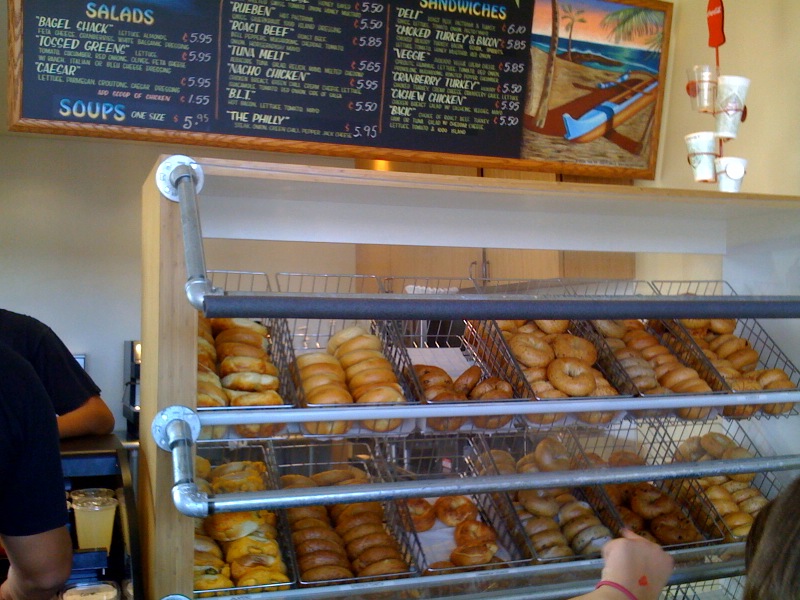
The Bagel Shack. There are two locations, the original in San Clemente and a second one in Mission Viejo off of El Toro. The bagels are big, toothsome, and fresh (due to their fast turnover.) I would go so far as to say that these are the best bagels I have ever had West of the Hudson River (and East of The Dead Sea.) I like that the bagels are shelved so that you can grab your own and quickly pay for them if you are not having them toasted or with cream cheese. Go for the jalapeño bagels.
Jonah Lehrer writes an intriguing post about the primacy of tastes. He argues that the tastes we are wired to detect through our tongue are more strongly conditioned by evolution than tastes which rely more heavily on the olfactory dimension. As a result, foods that stimulate the receptors in our tongue require less elaborate preparations than foods that we appreciate for their aroma.
His leading example is ketchup vs. mustard.
So here’s my theory of why ketchup doesn’t benefit from fancy alternatives, while mustard does. Ketchup is a primal food of the tongue, relying on the essential triumvirate of sweet, sour and umami. As a result, nuance is unnecessary – I don’t want a chipotle ketchup, or a fancy organic version made with maple syrup. I just want the umami sweetness.
Mustards, in contrast, are foods of the nose, which is why we seek out more interesting versions. I like tarragon mustards, and dark beer mustards, and spicy brown mustards, because they give my sandwiches an interesting complexity. They give my nasal receptors something to sense.
This explains why the market shelves are stocked with countless varieties of mustard but all ketchups are basically the same.
Now what about mayonnaise? Its primary payload is fat (mayonnaise is emulsified vegetable oil.) We are strongly conditioned to desire fat in our diet and its attraction is just as primitive as the attraction to sugar and salt. And yet mayonnaise undergoes even more transformations than mustard does.
How does this relate to the fact that the desire for fat is not wired through taste buds, but rather through mouthfeel?
The New York Times has a great pub guide to the Cotswolds. The pub! Why has this concept not been imported wholescale into the States? There is the odd gastropub now in Chicago but they do not capture this ambiance:
There are the spacious stripped wood tables, the milky light coming through the frosted windows and the fire smoldering across the room. And my big plate of fresh fish and chips (for the equivalent of $15) is sumptuous. Amid the low murmur of relaxed conversation you can feel the easy comfort, the happiness, of human beings at rest. And with the old plow tackle hanging from the ceiling, and the flagstone floor, and the bushy hops among the beams, there’s a sense of history’s being a friend, of this means of relaxation’s being sanctioned and endorsed through having been enjoyed for centuries. You sense it’s true that Europeans — even the English — still know how to live.
To reach this sense of peace, there has to be good beer (OK – I will now accept that cold lager might be necessary as well as the room temperature English bitter!), no TVs, a sense of welcome and a slow, slow pace. Going into a neighborhood pub where the regulars treat strangers with suspicion is annoying. Remember the movie An American Werewolf in London? That took things to an extreme, turning the strangers who enter the pub into werewolfs, but you get the picture. Americans are more welcoming than the English so the friendly atmosphere should be easier to pull off here. It’s the leisurely pace that is harder to replicate. But I think someone should try.
I have visited and stayed (!) at one of the pubs, the Falkland Arms in Great Tew. It was long ago (March 1999?) and it seems the management has changed. The beer is different and the food seems better. The rooms have also been renovated. That last fact is very important. I remember the shower had the lack of pressure that is typical of England. In addition, it vacillated randomly between being boiling hot and icy cold. My wife, who is hardy, got flu soon afterwards. Hopefully, the showers have been updated from the nineteenth century to at least the twentieth. Next time I visit Oxford, I’m looking forward to heading to the Falkland Arms and enjoying the slow pace of pub life.
The No Trade Theorem says that two traders with common prior beliefs will not find a mutally beneficial speculative trade provided they began with a Pareto efficient allocation. There is in fact a converse. If the traders do not share a common prior, then they can always find such a trade.
My kids demonstrated this experimentally today in the car coming home from Evanston’s Dixie Kitchen and Bait Shop (Recommended by Barack Obama!) Two kids have identical rubber alligator swag from the restaurant. 3 year old believes that 6 year old has his alligator and demands a swap. 6 year old insists that all gators are with their rightful owners. There is common knowledge that they disagree about this and therefore by Aumann’s famous theorem they do not share a common prior.
Dad takes temporary posession of both rubber reptiles. In plain view of the 6 year old, Dad pretends to switch but doesn’t. Sleight of hand deceives 3 year old. Alligators returned to original owners. Viola, Pareto improvement.
I forgot to get my commission.
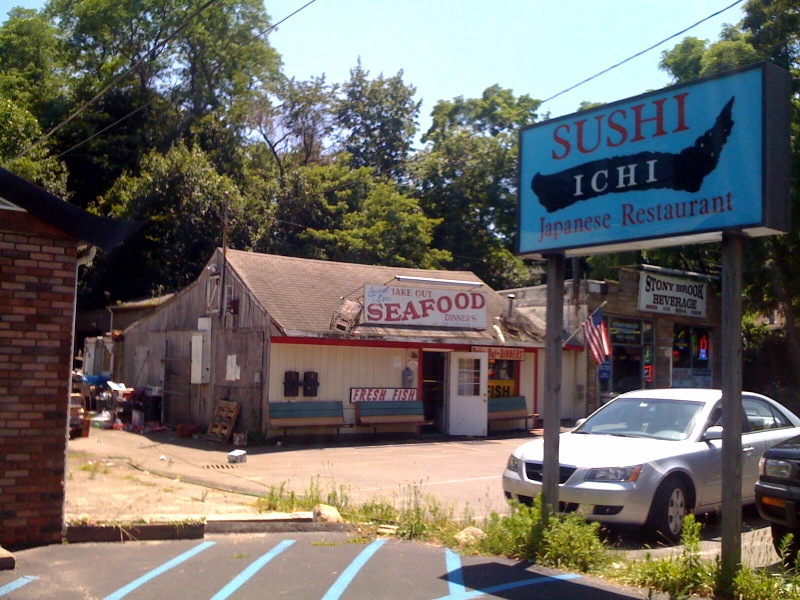
Actually it is in Seatauket, but you won’t notice that you have crossed any boundary. It’s called Sushi Ichi.
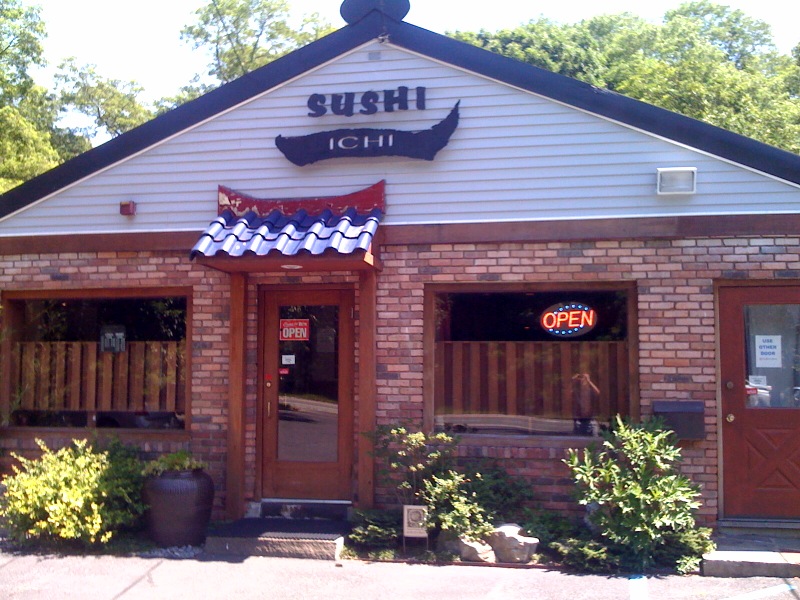
Go there for lunch. Tell them how much you want to spend and what kind of -tarian you are. Then ask them to prepare whatever is best to fit those constraints. You won’t be disappointed. It doesn’t hurt that there is a fishmonger right next door.
Love that sushi from Popeye’s. (toque tilt: kottke.)
A few years ago, we had breakfast at Sandeep’s house and he made us a delicious breakfast. One of the dishes was a strange egg and tortilla chip creation that everybody loved. I got the recipe from Sandeep and it has become part of our regular rotation ever since. We never knew what to call it so in my house it has always been known as Sandeep’s Special Breakfast. (I since had breakfast in Mexico City and I noticed a resemblance to something called Chilaquiles, so I guess that is what it must be.) It’s extremely simple to make and super yummy. It works great for lunch or dinner too.
1 yellow onion, sliced into wedges.
1 bag of Whole Foods restaurant style tortilla chips. (Whole Foods is not important but you want the chips that are made from tortillas, not the denser chips that are made directly from masa.)
8 eggs, lightly beaten
1 jar of tomatillo salsa. Anything is fine here, but this stuff called Xochitl

works really well. It has a smoky flavor that makes your Special Breakfast extra special. You can get it at Chicago-area Whole Foods.
Over high heat, add olive oil to a large saute pan and saute/fry the onions. You want them to brown and then soften a little. Turn down the heat and add a few handfuls of tortilla chips to the pan, breaking them with your hands into medium sized pieces. Toss them around in the pan to get them coated with the oil. Then add the eggs. Let them sit in the pan for a minute to cook a bit and then break the whole mass up and turn it over to cook some more. When the eggs are not quite completely done, pour in some of the salsa. The right quantity is something you figure out form experience. It should not be drenched in salsa. If the salsa is watery you should raise the heat and cook off some of the water.
You are done. It looks something like this on the plate.

(Until you serve the plate that is. Not long after that the plate is empty.)
Via Robin Goldstein, the work of Coco Krumme who analyzed wine reviews and classified words according to whether they are typically used to describe expensive or inexpensive wines.
She found that “about 65% of commonly occurring words are non-overlapping.” Words like “old,” “elegant,” “intense,” “supple,” “velvety,” “smoky,” “tobacco,” and “chocolate” predict expensive wines; “pleasing,” “refreshing,” “value,” “enjoy,” “bright,” “light,” “fresh, “tropical,” “pink,” “fruity,” “good,” “clean,” “tasty,” and “juicy” predict cheap wines. As for suggested pairings, “steak” and “shellfish” predict expensive wines; “chicken” predicts cheap wines.
As Robin points out it matters whether the reviews were based on blind tastings. If so, then the choice of word is in response to the taste of the wine and the correlation with price just tells us which words reviewers use to convey good taste. (Assuming you think that price is correlated with taste.) If the tastings were not blind then it is more likely that reviewers are responding to the label and are choosing words in response to the price.
 Cheap Talk