The blog Lone Gunman is one year old, and here is my selection of his best pointers from the past year.
- Lies told to a three-year-old. (Mine: roads are paved to flatten out a spherical Earth.)
- Planned Parenthood.
- Days with my Father.

A blog about economics, politics and the random interests of forty-something professors
The blog Lone Gunman is one year old, and here is my selection of his best pointers from the past year.
This is a beautiful post from Alinea at Home. It is worth reading the whole thing, but this bit resonates with me.
And that’s why I think I was drawn to the Alinea cookbook above anything else. Because it’s so not me, but represents traits and skills I admire in others, but had not yet been willing to take the risk to figure out how to adapt or embed in myself. I don’t know if it’s possible for me to change in that way or explore the possibility of rewiring (or even just tinkering with) my brain in this manner, but I knew I needed to get better about breaking out of my comfort zone, and doing it with food seemed to me to be a path that would make me the most willing to learn.
There are people who inspire and there are people who are very good at getting inspired by others. We need both.
Sandeep and I and some friends have regular wine tastings focusing on different regions/varietals. Tonight we tasted five wines from the Rioja region in Spain. This was a high mean/medium variance sampling which pleasantly surprised me. A wine that received 92 points from Wine Advocate (Jay Miller does Spain for WA?) and 91+ from Stephen Tanzer was 4th out of 5 (this was the Artadi Vinas de Gain.) Even the lowest ranked wine was very interesting and worth another try (Marques de Caceres Reserva 2001.)
A confounding factor here is that we had some nice food with the wine (thanks John and Jacqueline) and we started eating midway through wine B, and the wines seemed especially agreeable with food, so this may bias our ratings upwards towards the end.
And of course, we swallowed and did not spit.
My impression was that this area has a nice merging of new and old-world styles. The best wine in my opinion, and also the majority favorite was exemplary in this regard. Big fruit, but old-world complexity and earthiness. Among the rest, there were fruit bombs (Vinas de Gain) and vegetal-centric wines (Marques de Caceres) and most had something to offer. Here are my notes (only lightly edited from the iPhone self-emails.)
A. New world fruit bomb. Gentle tannins long finish of coffee. Bitter linger.
B. Earthy/stinky nose. Joanne says plum. Very bright red fruit up front. Hollow midpalate pleasant tannins with a floral finish.
C. Color and nose like A. Inky black/purple. blackberries on the nose oak not pronounced. Very smooth and complex with a beautiful transition from blueberries to acidity on the finish which lasts. Sandeep says Bordeaux-like. Seems to be the choice so far.
D. Resembles B in color but has a distinctive nose. Entry has rich red fruit. Midpalate is somehat quiet like B but the transition is much smoother to a nice acidity and floral finish. Very nice.
E. Has a different color. Mauve. A vegetal nose with peppermint (Aviv). Bright red fruit at the start which rapidly runs away through the midpallate leaving a harsh bitterness in the finish. Interesting but not pleasant.
Reveal (tasting was blind):
A. Artadi. Vinas de gain 2006 (ok so maybe this wine is too young.) (My score 12.5/20)
B. Pujanza 2003 (14.5/20)
C. Muga riserva 2004 (favored by 3 of the 7.) (16/20)
D. Remelluri 2002 (favored by 4 of the 7 of us. I scored it 16.5/20)
E. Marques de caceres. Reserva 2001 (the big loser, I scored it 9.5/20.)
When I think of a subject to post about but I am too busy to mold it right then I write an email to myself with a few words that are supposed to remind me of the thought when later I have the time and context to flesh it out. But I have an iPhone which likes to take my self-email shorthand which it doesn’t recognize and “correct” it its best guess of what I mean.
Tonight, I received an email from myself with the following subject: “duct virc.” And now I have no idea what that was supposed to be about.
Talk about smashing boundaries. Here is video of that de-trendy trio playing backup music to the Isaac Mizrahi fashion show in New York’s fashion week. The tune is apparently the new Dave King-penned “Really Good Attitude” (listen for the hand claps.) See if you can see any effect on the models’ expressions when the improvisation really goes off the rails.
Here is Ethen Iverson’s account of the event from his great blog Do The Math.
Shiny, red, and guaranteed to please the ladies. Yes, I turned 40 last year but no I didn’t buy a car. I planted heirloom tomatoes. And I am hooked. I just bought this book.
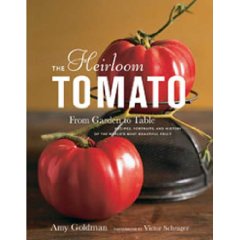
It has incredibly detailed flavor profiles, growing tips, seed sources, and recipes for hundreds of heirloom varieties. The photographs are beautiful and the mini-histories are very entertaining:
Early members of Seed Savers Exchange worked themselves into a frenzy trying to find a Pruden’s Purple–one “so purple it looked black, about the color of the Black Beauty eggplant,” fantasized Milan Rafayako of New Haven Kentucky in the 1981 yearbook. Alas, such a creature never materialized. Rare cultivated tomatoes, it turns out, don’t normally contain the purple pigment anthocyanin–although some of their wild relatives do.
If my calculations are correct, for the Chicago climate I need to germinate seeds in late April, transplant in late May, and pray that I have ripe tomatoes before I leave for San Diego in August. But if things go like last year, that last week I will be making heavy use of the recipe (page 221) for Fried Green Tomatoes.
Most of us define ourselves by the ways we differ from others. More accurately, by the ways we think we differ from others. A lot of the time we are just wrong about ourselves and especially about how we compare with others.
Here is a good test of how well-calibrated is your self-perception. Do you like your friends’ friends? Since your friends like you (presumably) and also like their other friends, it follows that you are likely to be more similar to your friends’ friends than you are to your friends. And so how you feel about them says a lot about how you really feel about yourself, and its often different than how you tell yourself you feel about yourself.
(This trick doesn’t work for SO’s SO. Because your SO’s past SO is likely to be very different from you since she learned from her mistake. And if its your SO’s current (other) SO, then for obvious reasons you are probably not able to make a levelheaded judgment about whether you like him.)
It has some surprising implications. If you are someone who tends to feel superior to others, then you should like your friends’ friends, in fact you should on average feel inferior to them. If you don’t then you are mistaken about your superiority, at least according to the standard you apply. And if you are someone who tends to feel inferior, and you find that you like your friends’ friends, then you are probably not as bad as you think.
Now tell me what it means when your friends’ friends don’t like you.
I was really impressed by the trick pulled by the Top Chef producers this week.
Leah is a lame cook and made it much further than she deserved to given her talents. And on the way several better cooks got knocked out partly because they were in “team Leah” in some round.
I think the producers realized this and brought back two of the people recently eliminated, and Leah, back to give the dice another role. I was scared Leah would squeeze by on luck again but this time the Gods did not play games and she lost. Jeff won but then got knocked out again anyway as he had to “win” the elimination challenge to survive. But then Stefan squeezed by even though his food was worse than Jeff’s! I guess there has to be little unfairness to keep us watching. And I think they keep Stefan partly because he’s the guy everyone loves to hate (though I like him!).
She is packing for a short trip and she bought a book for the plane ride. Its a historical romance. She asked me if it was a true story. I said “You might as well pretend it is, you will enjoy it more.”
Jennie: “What did you say?”
Jeff: “Yes it is a true story.”
Jennie: “Great, I like to read true stories.”
I saw this at one of my regular lunch spots in downtown Evanston today:
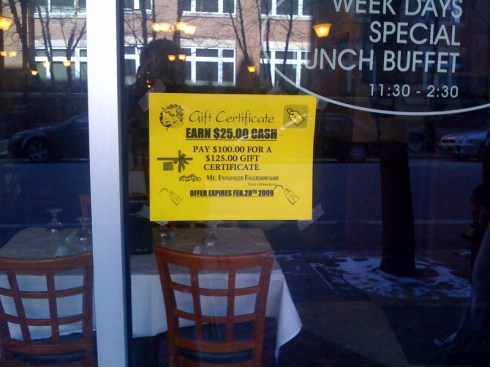
They are offering $125 gift certificates at the price of $100. Should you take it? The answer is after the jump.
I admit defeat.
This show is meant to be related to my research so I’m trying to get into it. But it’s really hard! There are sequences with kinetic violence. They remind me of the the Michael Mann movie Heat (better than his later movie Miami Vice!). But it’s so strategically unsophisticated it gets boring. Yesterday’s main dilemma was whether to get a double-agent to get to reveal his information by threatening his innocent wife and kid. Nice people say No but Jack Bauer says Yes. That’s the usual dilemma explored by 24, apparently one of John McCain’s favorite shows: Do we have to become as bad as the terrorists to beat the terrorists? It would be nice if sometimes Bauer was wrong and a “be nice” strategy pays off. I haven’t seen too many episodes – I got bored last season and have been more focused on cooking shows and referee reports this season. But are there any episodes with any moral or strategic complexity other than the obvious dilemma I described?
St. Patrick’s Day is approaching and I claim credit for the first to make this lame pun. I won’t be the last.
Obama gave an interview yesterday on TV where he was asked about nationalizing banks. His response is an interesting look into the way the administration thinks about things, comparing the US to Japan and Sweden. You can read a transcript here.
What caught my eye was his use of the word “like” in the following excerpt (second sentence.)
So you’d think looking at it, Sweden looks like a good model. Here’s the problem; Sweden had like five banks.
This is the so-cal “like.” It stands for “about” or in this case “not many more than.” It lends an informality to the sentence which adds to its comical and therefore rhetorical punch. On top of that it brings the President further down to Earth even when talking about something esoteric like bank nationalization.
I like it. Is this the first occurence of the so-cal “like” in Presidential prose?
Be wary though, this mild version is the gateway “like” to more serious transgressions such as “We were discussing TARP and Geithner is like, ‘No way Larry, I am the Treasury Secretary and I say no caps on executive pay’ and then, like, Summers is all ‘Whatever.’ “
Suppose you are going to say something that is literally true but you know in advance that your listener will misinterpret you and be led to believe something false. If you say it anyway, are you lying?
Conversely, is it a lie to say a falseshood if you know that, because you will be misinterpreted, this is the only way to get your listener to believe in what is actually true?
I watched his announcement today. I wrote an outline of what he said (mostly through gritted teeth):
here is what we think.
we have to do something big.
here is what we will do.
we will allow the american people to see what we do.
here are three more things we will do.
1. stress tests for banks.
2. we will make partnerships with private entities to buy bad assets. we don’t have a plan yet about how.
3. we will make more credit available. a big part of this is aimed at housing but we dont have a plan about what to do about that yet.
we are working with chris dodd and barney frank.
This person is actually cooking from the Alinea cookbook. And blogging it. Note that his (her?) most recent effort failed because he tried to do without the liquid nitrogen.
By the way, would someone please tell me exactly what it means to swim the Atlantic? I mean, she’s not sleeping in the water is she?
I think I am going to set a record for the least-trained pianist to play Beethoven’s Hamerklavier. I will play one note per day.
here are my two simple ways of thinking about fiscal stimulus.
from the perspective of the stimulee: the federal government is right now the cheapest source of capital. in fact capital has never been cheaper. the treasury can borrow at record low interest rates. unfortunately the banking system is not doing its job as an intermediary channeling this credit to the bridge-builders. so the bridge-builders effectively borrow directly from the source by accepting stimulus dollars and promising to pay them back in the future with taxes.
(of course there is a wedge between the amount i receive in stimulus ($X) and the amount I pay in taxes ($X/N) and this makes me inefficiently eager to accept it. this is why stimulus should focus on public projects where the benefits are dispersed equally.)
from the perspective of government. we accept that there are things government should be producing, in particular public projects where the benefits are dispersed equally. the government has flexibility in the timing of these investments. since the investment requires coupling labor with the government’s capital, the optimal timing is during times of (otherwise) unemployment when labor is relatively cheap.
so we don’t have to think about multipliers and we don’t have to think about Keynesian effective demand. The government acting optimally to smooth expenditures should spend a lot now. Yes, it means spending must be correspondingly reduced in the future and critics would worry that this won’t happen. But there will come a time when interest rates are higher and it is more costly for the government to borrow and under pretty much any theory you have of how spending is determined, at the margin at least, that will have the effect of reducing spending.
Joking. Its a huge development for economics and open access publishing: the Econometric Society and the Society for Economic Theory have agreed to bring the journal Theoretical Economics into the ES fold. A little background: about three years ago, these people had the bold plan to launch a new field journal for economic theory and to make it free in every sense of that word. We wanted to show that an open access journal could also be a top journal.
The Econometric Society has recognized our success and is seeing the light on open access. What better way to bring open access to the mainstream than to become the field journal of one of the oldest and most respected professional societies in economics.
I think one of the most entertaining ironies of this experience is that now economics (you know: laissez faire, maximize profits, invisible hand) is one of the very few disciplines which has a top journal that is fully open access.
Here is the announcement.


The new CD from the 21st-century-defining trio The Bad Plus was released in the US yesterday (for some reason it was available in Europe for a few months now.) The big news is that they have added a vocalist, Wendy Lewis, and the album is exclusively covers (rumor is that their next album will be all originals, presumably back to the trio.) The covers are mostly rock-pop tunes in a spirit similar to the covers they have been doing since the beginning, but they have added classical music to the mix, like a Stravinsky that they re-work to sound like very conventional jazz-pop, and something called semi-simple variations. Partly because these tunes shed the vocals from the other tracks they come closer to the style of music the Bad Plus has been doing succesfully in their previous records.
The recording is not ideal. To make room for the vocals, the other instruments are mushed into the background. The drums seem sometimes badly miked and even the piano loses definition at moments where you really want to hear it, especially on the last tune “Feeling Yourself Disintegrate.” On the other hand, the bass stands out beautifully and really sits right in the middle of the music. In some of its best moments the CD feels like a duet between the bass and the vocals.
Wendy Lewis has a good voice which is ideally suited for many of these tunes, but not all. The ballads are the weakest because her voice is not always “pretty.” I am not knocking her here, she is truly a “vocalist” in the sense that she uses her voice as an instrument and she is doing surprisingly well at integrating her instrument into this already dense music. But in ballads like “Lock Stock and Teardrops” and “Feeling Yourself Disintegrate” nothing complicated is going on and it comes across more like a coffee-house poetry reading than singing. By contrast and proof that she really has command of different vocal styles, in “How Deep is Your Love” she takes on a sultry, breathy voice which adds a dimension to the music which is missing elsewhere on the album. Her voice soars over Iverson’s arpeggios in “Comfortably Numb” and she flat out rocks on “Barracuda.”
What is the verdict on this work? For sure there are many reasons to applaud the Bad Plus for experimenting with vocals and these covers. In some ways they are being brilliantly opportunistic because pop musicians inexplicably refuse to try and build a canonical repetoire and these great tunes are therefore just sitting there waititng to be reinterpreted for the first time. If “Long Distance Runaround” was “jazz”, it would be a standard. Still, I come away disappointed with the CD. Largely this is because of the recording, but also because with just a few exceptions this doesn’t advance what the Bad Plus is doing, instead it feels more like a side project.
But what’s really important to me is what this CD suggests the live performance is going to be like. I can imagine that on stage the trio will open up more behind and in between the vocal passages and this could make the whole thing pay off. We’ll see.
Naming a blog is like naming a baby. * Those of us who have gone thorugh the baby-naming process recognize some subtle strategic issues that arise. Each spouse searches for names in books, online, in the garden, etc. and when a good idea comes up suggests it to the other spouse. Then there is some discussion and possibly the name is put on the shortlist and the process continues. At some point a name has to be chosen.
Here is where the strategy comes in. Suppose there is a name you really like and you think your spouse might find acceptable, let’s say Hercules. You put Hercules on the shortlist. But now suppose you come up with another name that you know your spouse likes better than the first one but which boders on unacceptable for you. Let’s say “Brad.” Do you suggest Brad?
At first glance it seems obvious you should hide Brad in the drawer, lock it tight and throw away the key. But its not always clear. By suggesting Brad you might convince your spouse that you are playing ball and you might get points for that and it might even improve the chances of a baby Hercules.
In fact, I think something like this would be a property of an efficient mechanism. In economics we think about situations like this and how to design the rules of the game to deliver an acceptable outcome, in this case a baby whose name will not scar him for life. The unusual feature of this particular problem is that the alternatives, i.e. the possible names, are not given in advance but have to be suggested in order to be considered. If I keep “Brad” a secret, chances are my spouse won’t think of it and I won’t have to worry about it.
So the key issue in designing the rules of this game is to give each spouse enough incentive to reveal the names that they might otherwise try to keep secret. After all, taking into account both spouses preferences, Brad might actually be the best name if say my spouse really likes it much better than Hercules. And in that event we want to give it a chance to be selected.
How would we design the rules to give that incentive? The only way to do this is to “pay” a spouse who offers an additional name by increasing the chance of that spouse getting his preferred choice. And in practice the goodwill your spouse feels when you suggested Brad has exactly this effect.
*In answer to your question, Sandeep is the Mommy.
Usual problem with pasta: not enough protein! So, I was happy to see this pasta recipe in the New York Times (see http://www.nytimes.com/2009/01/29/health/29recipehealth.html?scp=1&sq=pasta%20lentil&st=cse). I decided to skip the red pepper: too much chopping. Also, went with the pre-ground cumin and coriander – with two kids and a hungry wife around, who has the time to roast and grind fresh ingredients? Made one mis-calculation: hadn’t realized the recipe called for cooking the lentils for 45 minutes or so. Luckily, this turned out to be an overestimate for the green French lentils I used so I was in good shape by the time the pasta was ready. Went down well. This is going to be on our regular rotation. Probably at weekends though as it takes a little longer than the usual quick pasta fix. Oh, I almost forgot: we had a 2006 Chateau Pesquie Terrasses ($20). Parker likes it. It’s drinkable enough but nothing to get to too excited about. Read the rest of this entry »
We spent the last week trying to think of a name for this blog. Because Sandeep has bad taste lots of really good names were rejected and we in the end settled for an ok but not great name, Cheap Talk.
This blog-christening process points out an important asymmetry in the creative process. It is much easier to think up interesting names for *some* blog than it is to think up names for this particular blog and these particular bloggers.
For example, some bloggers, somewhere in the blogosphere would love the name “Vapor Mill.” It’s a pun on “Paper Mill” which, especially for academics, suggests productivity. But “Paper” is replaced by “Vapor” which turns it into a symbol for fanciful and ultimately useless ideas.
But those bloggers are almost surely not going to think of that phrase if they just sit down and search their brains. I am not saying it takes great creativity to come up with it. Its almost purely accidental. But that accident happened to me and not to them and unless the name finds them there is lost welfare.
Yes the welfare loss is tiny but every time you have a specific purpose that you are looking for an idea to fit just right you come up with many good ideas that don’t quite fit your specific purpose but would be really great for somebody else’s purpose and each time a valuable thing just disappears. It adds up.
I guess its an argument for the space program and all of the resulting Tang that comes with it.
Hey, that’s a great name for a blog!: Tang.
(appendix: I hate the word blogosphere and I can’t believe that I only lasted one post in my short blogging career before I had to use it.)
 Cheap Talk