Paula Abdul has left American Idol.  Apparently,

“Paula didn’t place as much importance on remaining on the show as some other people did,” said a person close to Ms. Abdul who, like several people interviewed for this article who were involved in the negotiations, spoke on the condition of anonymity to preserve relationships on both sides. “She thinks there are a lot of opportunities out there for her, and she will be fine without that show.”  NYT

That is, Paula’s assessment of her value, i.e. her outside option, was greater than American Idol’s assessment of her value for their show.  This is a reasonable possibility.  After all American Idol (AI) has Simon Cowell and then the marginal contribution of Abdul might be lower in AI than her value to a show like “Dancing with the Stars” where there are no recognizable personalities.  In this scenario, there are no gains to trade for Abdul and American Idol and so they have to part.

But there is another possibility.  Abdul and American Idol have private information, Abdul about her outside option and AI producers about her value for their show.  The producers have an incentive to shade their value to minimize the salary they have to pay Abdul.  Abdul has an incentive to exaggerate her value to AI. Even if she might be an American Idle she should pretend she is very busy and has lots of options.  Joint bluffing can lead to no-trade even when there might be real gains to trade if everyone’s information is public not private.  In a famous theorem, Myerson and Satterthwaite proved that for this to happen there has to be chance that there really are no gains to trade.  I made the argument in the previous paragraph that this scenario is a possibility.  But this scenario then affects bluffing behavior even when there are true underlying gains to trade. So, Paula may be leaving AI even though her value is higher there than at Dancing with the Stars.  Tragedy.

Where’s the silver lining?  Well, I think there’s one for me.  I have an English accent.  I can pout like Posh Spice, Paula’s replacement on AI.  And I’m pretty sure people think I’m a bit of a  overcritical d**khead.  In other words, I am an ideal combination of Simon Cowell and Posh Spice.  I have huge potential.  In fact, the phone is ringing.  Maybe it’s Hollywood on the line……
Mindhacks has the scoop:

…in summary it seems that the brain simulates of the outcomes of actions based on your intentions to move because the actual sensory information from the body takes so long to arrive that we’d be dangerously slow if we relied only on this.This slower information is used for periodic updates to keep everything grounded in reality, but it looks like most of our action is run off the simulation.

We can also use the simulation to distinguish between movements we cause ourselves and movements caused by other things, on the basis that if we are causing the movement, the prediction is going to be much more accurate.

If the prediction is accurate, the brain reduces the intensity of the sensations arising from the movement – for good safety reasons, perhaps – we want to be more aware of contact from other things than touches from ourselves.

Twitter came into its own in the recent demonstrations in Iran, coordinating protest and reporting on it.  Its everyday uses are more prosaic and even vain but here is another I can applaud: coordinating a countrywide (or even global) wine-tasting.  The Slate wine critic will be tasting the following wines on Aug 26 6.30 (Eastern U.S. time) and encourages others to follow and post on Twitter:

Domaine des Aubisières Vouvray Silex 2007, $16.95
Les Héritiers du Comte Lafon Macon 2007, $21.95
Domaines Ott Côte de Provence Rosé les Domaniers 2008, $18.95
Jean-Paul Brun/Domaine des Terres Dorées Beaujolais l’Ancien 2008, $15.95
Betts & Scholl Grenache O.G. 2006, $24.95
Ruinart NV Blanc de Blancs, $64.95

(FYI: Three are at Binnys for Chicago locals.)

A new study has found that third of students graduate with no debt at all.  To state the pretty obvious: this does not imply that the cost of education is not a barrier to entry to college.  Many students who might benefit from education may simply be staying out of college as they know they would have to take on a huge amount of debt.  At an extreme, if only the wealthy went to college there would be no debt problem at all.

I recently re-read Animal Farm.  I think I last read it in secondary school in English class thirty (!) years ago.  I still remember it (unlike Thomas Hardy’s The Woodlanders) because of the donkey character, Benjamin.   The animals on the farm revolt and get rid of the farmer.  They are led by the pigs.  But the pigs are up to no good and are simply replacing the farmer with their own exploitative regime.  They are very, very clever and can read and write.  Benjamin is also clever and knows what the pigs are doing but he keeps quiet about it.  The pigs succeed at huge cost to the other animals.

This is the thing I found mysterious and incomprehensible when I was twelve – why doesn’t the donkey reveal what the pigs are doing and save the other animals and the farm?  This is the naivete of youth, believing if truth is simply spoken, it will be understood, appreciated and acted upon.  Well, I was twelve.  But I suppose (hope?) that many of us have these sorts of beliefs initially.  As time passes, we act of these beliefs.  Sometimes we succeed and sometimes we fail.

When we fail, we learn from our mistakes realizing what strategies do not work.  Anyone who wants to influence collective decisions has to be subtle and know when to keep their mouth shut.  This seems obvious now but presumably we learn it in school or in our family sometime when we see power trump reason.  This learning process creates wisdom – you know more than before about strategies that fail.  It also creates cynicism as you realize strategies with moral force have no political force.  This is a sense in which cynicism is a form of wisdom.  I didn’t understand Benjamin at all when I was twelve but now I see exactly why he was quiet.  Orwell makes sure we understand the dilemma – Benjamin is alive at the end of the book unlike some animals who spoke out.  I’m older and wiser.

What about successful strategies?  The reverse logic applies to them.  Success leads to optimism.  A sophisticated learner should have contingent beliefs: some strategies he is optimistic about and some pessimistic.  Someone more naive will have an average worldview.  Whether it is cynical or not depends on the same issue that Jeff raised in his entry: are you overoptimistic at the beginning?  If so, the failures will be more striking than the successes.  This will tend to make you cynical.

There is strategy involved in giving and interpreting compliments.  Let’s say you hear someone play a difficult –but not too difficult– piece on the piano, and she plays it well.  Is it a compliment if you tell her she played it beautifully?

That depends.  You would not be impressed by the not-so-difficult piece if you knew that she was an outstanding pianist.  So if you tell her you are impressed, then you are telling her that you don’t think she is an outstanding pianist.  And if she is, or aspires to be, an outstanding pianist, then your attempted compliment is in fact an insult.

This means that, in most cases, the best way to compliment the highly accomplished is not to offer any compliment at all.  This conveys that all of her fine accomplishments are exactly what you expected of her.  But, do wait for when she really outdoes herself and then tell her so.  You don’t want her to think that you are someone who just never gives compliments.  Once that is taken care of, she will know how to properly interpret your usual silence.

In the world of blogs, when you comment on an article on another blog, it is usually a nice compliment to provide a link to the original post.  This is a compliment because it tells your readers that the other blog is worth visiting and reading.  But you may have noticed that discussions of the really well-known blogs don’t come with links.  For example, when I comment on an article posted at a blog like Marginal Revolution, I usually write merely “via MR, …” with no link.

That’s the best way to compliment a blog that is, or aspires to be, really well-known. It proves that you know that your readers already know the blog in question, know how to get there, and indeed have probably already read and pondered the article being discussed.

Think of the big events that came out of nowhere and were so dramatic they captured our attention for days. 9/11, the space shuttle, the Kennedy assassination, Pearl Harbor. If you were there you remember exactly where you were.

All of these were bad news.

Now try to think of a comparable good news event. I can’t. The closest is the Moon landing and the first Moon walk. But it doesn’t fit because it was not a surprise. I can’t think of any unexpected joyful event on the order of the magnitude of these tragedies. On the other hand, it’s easy to imagine such an event. For example, if today it were announced that a cure for cancer has been discovered, then that would qualify. And equally significant turns have come to pass, but they always arrive gradually and we see them coming.

What explains this asymmetry?

1. Incentives. If you are planning something that will shake the Earth, then your incentives to give advance warning depend on whether you are planning something good or bad. Terrorism/assassination: keep it secret. Polio vaccine, public.

2. Morbid curiosity. There is no real asymmetry in the magnitude of good and bad events. We just naturally are drawn to the bad ones and so these are more memorable.

3. What’s good is idiosyncratic, we can all agree what is bad.

I think there is something to the first two but 1 can’t explain natural (ie not ingentionally man-made) disasters/miracles and 2 is too close to assuming the conclusion. I think 3 is just a restatement of the puzzle because the really good things are good for all.

I favor this one, suggested by my brother-in-law.

4 . Excessive optimism. There is no real asymmetry. But the good events appear less dramatic than the bad ones because we generally expect good things to happen. The bad events are a shock to our sense of entitlement.

Two related observations that I can’t help but attribute to #4. First, the asymmetry of movements in the stock market. The big swings that come out of the blue are crashes. The upward movements are part of the trend.

Second, Apollo 13. Like many of the most memorable good news events this was good news because it resolved some pending bad news. (When the stock market sees big upward swings they usually come shortly after the initial drop.)  When our confidence has been shaken, we are in a position to be surprised by good news.

I thank Toni, Tom, and James for the conversation.

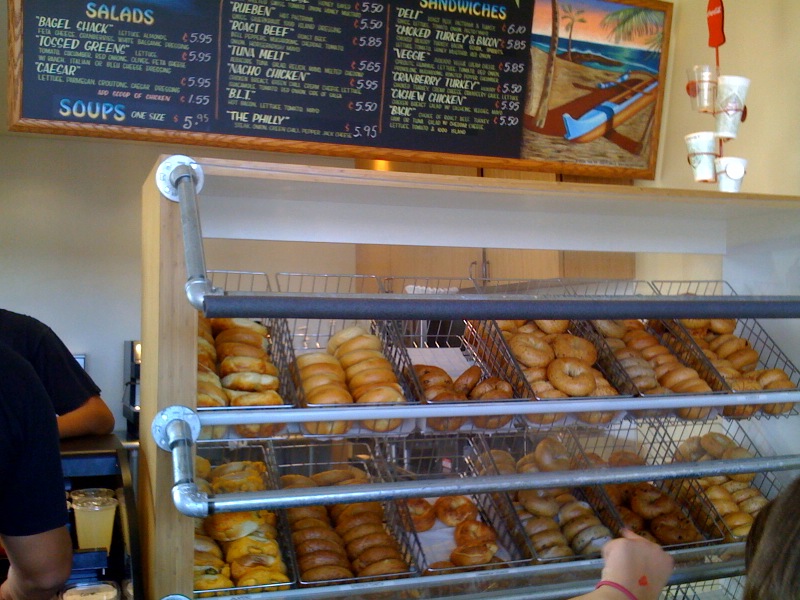
The Bagel Shack. There are two locations, the original in San Clemente and a second one in Mission Viejo off of El Toro.  The bagels are big, toothsome, and fresh (due to their fast turnover.)  I would go so far as to say that these are the best bagels I have ever had West of the Hudson River (and East of The Dead Sea.)  I like that the bagels are shelved so that you can grab your own and quickly pay for them if you are not having them toasted or with cream cheese.  Go for the jalapeño bagels.

bagels

Make the NPR Weekend Edition on-air puzzle with Will Shortz more fun.  Cover your ears when he describes the format of the puzzle.  Then, listen to the series of puzzles and try to guess the format quickly enough and see how many of the puzzles you can get right after that.

Never got the big deal about falafel?  Isn’t one pretty much like another?

I thought so till I saw inducted into the finer distinctions between good and bad falafel by Israeli friends.  I know they agree with me that the Falafel Special at Semiramis falls into the good category.  It has a lovely harrisa sauce and pickles.  But the falafel is so good it can stand up to the condiments.  I’ve also been tutored on hummus and, to my palette, the version here is not the best I’ve had.  But the Ful is delicious and my wife and friends swear by the Chicken Kabob.  After your meal,  stop by Nazareth Sweets opposite and pick up a selection of baklava to go.  They look at you suspiciously, as if you might be FBI agents trying to track down Al Qaeda sympathizers.  They serve you anyway.

Via MR, this article describes the obstacles to a market for private unemployment insurance.  Why is it not possible to buy an insurance policy that would guarantee your paycheck (or some fraction of it) in the event of unemployment?  The article cites a number of standard sources of insurance market failure but most of these apply also to private health insurance, and other markets and yet those markets function.  So there is a puzzle here.

The main friction is adverse selection.  Individuals have private information about (and control over!) their own likelihood of becoming unemployed.  The policy will be purchased by those who expect that they will become unemployed.  This makes the pool of insured especially risky, forcing the insurer to raise premiums in order to avoid losses. But then the higher premiums causes a selection of even more risky applicants, etc.  This can lead to complete market breakdown.

In the case of unemployment insurance there is a potential solution to this problem which borrows from the idea of instrumental variables in statistics.  (Fans of Freakonomics will recognize this as one of the main tools in the arsenal of Steve Levitt and many empirical economists.)  The idea behind instrumental variables is that it sidesteps a sample selection problem in statistical analysis by conditioning on a variable which is correlated with the one you care about but avoids some additional correlations that you want to isolate away.

The same idea can be used to circumvent an adverse selection problem.  Instead of writing a contract contingent on your employment outcome, the contract can be contingent on the aggregate unemployment rate.  You pay a premium, and you receive an adjustment payment (or stream of payments) when the aggregate unemployment rate in your locale increases above some threshold.

Since the movements in the aggregate unemployment rate are correlated with your own outcome, this is valuable insurance for you.  But, and this is the key benefit, you have no private information about movements in the aggregate unemployment rate.  So there is no adverse selection problem.

The potential difficulty with this is that there will be a lot of correlation in movements in unemployment across locations, and this removes some of the risk-sharing economies typical of insurance.  (With fire insurance, each individual’s outcome is uncorrelated with everyone else, so an insurer of many households faces essentially no risk.)

  1. The dark side of Scrabble.
  2. Don’t worry, B-Minor.
  3. The Unbundled Economy:  Starbucks API
  4. Recission, Van Halen style.

Challenge: re-design speed bumps. They should still induce drivers to slow down, but without making them drive over a bump. How do you do it? Answer after the jump.
Read the rest of this entry »

In the last lecture we demonstrated that there was no way to efficiently provide public goods, whether via a market or any other institution.  Now we turn to private goods.

We start with a very simple example: bilateral trade.  A seller holds an object that is valued by a potential buyer.  We want to know how to bring about efficient trade:   the seller sells the object to the buyer if, and only if, the buyer’s willingness to pay exceeds the seller’s.

We first analyze the problem using the Vickrey-Clarke-Groves Mechanism.  We see that the VCG mechanism, while efficient, is not feasible because it would require a payment scheme which results in a deficit:  the buyer pays less than the seller should receive.

Then, following the lines of the public goods problem from the previous lecture we show that in fact there is no mechanism for efficient trade. This is the dominant strategy version of the Myerson-Satterthwaite theorem. In fact, we show that the best mechanism among all dominant-strategy incentive compatible and budget balanced mechanisms (i.e. the second-best mechanism) takes a very simple form.  There is a price fixed in advance and the buyer and seller simply announce whether they are willing to trade at that price.

We see the first emergence of something like a market as the solution to the optimal design of a trading institution. We also see that markets are not automatically efficient even when there are no externalities, and goods are private.  There is a basic friction due to information and incentives that constrains the market.

Next we consider the effects of competition.  Our instincts tell us that if there are more buyers and more sellers, the inefficiency will be reduced.  By a series of arguments I show the first sense in which this is true.  There exists a mechanism which effectively makes sellers compete with one another to sell and buyers compete with one another to buy.  And this mechanism improves upon the fixed price mechanism because it enables the traders themselves to determine the most efficient price.  I call this the price discovery mechanism (it is really just a double auction.)

Finally, in one of the best moments of the class, what was previously some random plots of values and costs on the screen coalescees into supply and demand curves and we see how this price discovery mechanism is just another way of seeing a competitive market.  This is the second look at how markets emerge from an analytical framework that did not presuppose the existence of markets at the beginning.

Here are the notes.

Well, only indirectly but here is my thinking: one comment by Nathan in response to my post yesterday suggested that John Bolton thinks every international interaction is the game of Chicken, not just the recent episode with North Korea.  Schelling thought a lot about Chicken and here is what he said in Arms and Influence in 1966:

Is  a Berlin Crisis…..mainly bilateral competition in which each side should be motivated mainly towards winning over the other?  Or is it a shared danger – a case of both being pushed to the brink of war – in which statesmanlike forbearance, collaborative withdrawal and prudent negotiation should dominate?

He classifies the Cuban Missile Crisis as the second sort of game and the Hungarian Uprising as the first.  He points out that it can be hard to tell which kind of crisis a country is involved in.  So, we have different games and uncertainty about the game one is playing.  This is level of knowledge from 1966. It disappeared in the last 40 odd years.  Hopefully it can be recovered.

Developer Kalid Shaikh has been banned from the iPhone App Store.  By conventional welfare measures this would seem to be a big blow to efficiency:

As the MobileCrunch article points out, a search at AppShopper.com shows 854 apps by Shaikh. The majority of Shaikh’s apps seemed to be data on a specific subject simply pulled from the web without providing any other original or unique content. Most apps were priced at $4.99 and this banishment could represent lost sales of thousands of dollars per day. Shaikh reportedly has admitted that the goal was not to produce valuable apps but to focus on monetization instead. All of Shaikh’s apps have already been removed from the App Store and can no longer be purchased.

Perhaps conventional welfare measures would need to be amended in this case.  Note however, that removing one large supplier of what is essentially spam from the App Store will not affect the equilibrium quantity of spam.  (And this is not Apple’s stated reason for removing him.)

This is a companion to our Prisoner’s Dilemma Everywhere series.

Bill Clinton just returned from North Korea with the two American journalists who were being held there.  Kim Jong-il got his face time with Bill and the U.S. got two citizens back without sanctions or a war.  Win-win as we say in business schools?

No, says John Bolton, former Ambassador to the U.N.  The previous stand-off was doing no-one any good.  Obviously it was bad for the U.S. but it was also bad for North Korea.  Possible sanctions might have made it hard for the goodies the elite loves to make it into North Korea.  So, the Clinton-Jong-il meeting dominates the previous situation.  But Bolton has an even better situation in mind: Jong-il simply hands over the journalists without us even giving him a face-saving meeting.  We threaten them with something (war? sanctions?) and this is enough to give them the incentive to cooperate without us having to give up anything at all.  Some might argue we are pretty close to this equilibrium as a “threat of sanctions plus Clinton visit”  amounts to gain for very little pain?

Whatever the empirical judgements are, the theory is clear – Bolton sees the game as Chicken:

You are out for dinner and your friend is looking at the wine list and gives you “There’s a house wine and then there’s this Aussie Shiraz that’s supposed to be good, what do you think?”

How you answer depends a lot on how long you have known the person.  If it was my wife asking me that I would not give it a moment’s thought and go for the Shiraz.  If it was someone I know much less about then I would have to think about the budget, I would ask what the house wine was, what the prices were, etc.  Then I would give my considered opinion expecting it to be appropriately weighed alongside his.

This is a typical trend in relationships over time.  As we come to know one another’s preferences we exchange less and less information on routine decisions.  On the one hand this is because there is less to learn, we already know each other very well.  But there is a secondary force which squelches communication even when there is valuable information to exchange.

As we learn one another’s preferences, we learn where those preferences diverge.  The lines of disagreement become clearer, even when the disagreement is very minor.  For example, I learn that I like good wine a little bit more than my wife.  Looking at the menu, she sees the price, she sees the alternatives and I know what constellation of those variables would lead her to consider the Shiraz. Now I know that I have a stronger preference for the Shiraz, so if she is even considering it that is enough information for me to know that I want it.

Sadly, my wife can think ahead and see all this.  She knows that merely suggesting it will make me pro-Shiraz.  She knows, therefore, that my response contains no new information and so she doesn’t even bother asking.  Instead, she makes the choice unilaterally and its house wine here we come.  (Of course waiters are also shrewd game theorists.  They know how to spot the wine drinker at the table and hand him the wine list.)

In every relationship there will be certain routine decisions where the two parties have come to see a predictable difference of opinion.  For those, in the long run there will be one party to whom decision-making is delegated and those decisions will almost always be taken unilaterally.  Typically it will be the party who cares the most about a specific dimension who will be the assigned the delegate, as this is the efficient arrangement subject to these constraints.

Some relationships have a constitution that prevents delegation and formally requires a vote.  Take for example, the Supreme Court.  As in recent years when the composition of the court has been relatively stable, justices learn each others’ views in areas that arise frequently.

Justice Scalia can predict the opinion of Justice Ginsburg and Scalia is almost always to the right of Ginsburg.  If, during delibaration, Justice Ginsburg reveals any leaning to the right, this is very strong information to Scalia that the rightist decision is the correct one.  Knowing this, Ginsburg will be pushed farther to the left:  she will express rightist views only in the most extreme cases when it is obvious that those are correct.  And the equal and opposite reaction pushes Scalia to the right.

Eventually, the Court becomes so polarized that nearly every justice’s opinions can be predicted in advance.  And in fact they will line up on a line.  If Breyer is voting right then so will Kennedy, Alito, Roberts, Scalia, and Thomas.  If Kennedy is voting left then so are Breyer, Souter, Ginsberg, and Stevens.  Ultimately only the centrist judges (previously O’Connor, now Kennedy) are left with any flexibility and all cases are decided 5-4.

When a new guy rotates in, this can upset the equilibrium.  There is something to learn about the new guy.  There is reason to express opinion again, and this means that something new can be learned about the old guys too.  We should see that the ordering of the old justices can be altered after the introduction of a new justice.  (Don’t expect this from Sotomayor because she has such a long paper trail.  Her place in line has already been figured out by all.)

The Palm Pre was favorably reviewed relative to the iPhone.  But the iPhone has all those great Apps but the Pre does not.  And your iTunes account ties you to the iPhone too unless your phone runs it too. And that was what the Pre did till Apple upgraded iTunes and it was no longer compatible with the Pre.  Palm is upset and is trying to get Apple to open up iTunes.

Does Apple’s strategy make sense?   Allowing Pre to use iTunes increases sales of music but reduces sales of the iPhone.  Where do the two effects line up?  It seems iPhone margins are almost 60% as ATT is giving Apple a huge subsidy.  And the iTunes profit margin is around 10%.  Not sure what the sales figures are but you’d have to see a huge number of songs to counterbalance profits from iPhone sales.

If it’s worried about iPhone sales, Apple is making the right call on making iTunes incompatible with the Pre.

A few weeks ago, Israeli warships and a nuclear submarine went through the Suez Canal.  Israel is signaling that it can come within firing distance of Iran easily:

Israeli warships have passed through the [Suez] canal in the past but infrequently. The recent concentration of such sailings plainly goes beyond operational considerations into the realm of strategic signalling. To reach the proximity of Iranian waters surreptitiously, Israeli submarines based in the Mediterranean would normally sail around Africa, a voyage that takes weeks. Passage through the Suez could take about a day, albeit on the surface and therefore revealed. The Australian

There is a second signal: (Sunni) Egypt is on board with Israel’s focus on preventing the arrival of a nuclear-armed (Shia) Iran.  Even Saudi Arabia is alarmed by the by the growth in the power and influence of its neighbour:

Egypt and other moderate Arab countries such as Saudi Arabia have formed an unspoken strategic alliance with Israel on the issue of Iran, whose desire for regional hegemony is as troubling to them as it is to the Jewish state. There were reports in the international media that Saudi Arabia had consented to the passage of Israeli warplanes through its air space in the event of an attack on Iran’s nuclear facilities but both Riyadh and Jerusalem have denied it. . The Australian

International politics makes for strange bedfellows.

He tottered over to the thermostat and there it was: treachery. Despite a long-fought household compromise standard of 74 degrees, someone — Adler’s suspicions instantly centered on his wife — had nudged the temperature up to 78.

For the sleepy freelance writer, it was time to set things right . . . right at 65 degrees. “I just kept pushing that down arrow,” he said of his midnight retaliation. “It was a defensive maneuver.”

The article suggests that women generally prefer higher thermostat settings than men.  (It is the opposite in my household.) The focus is on air conditioning in the summer and I wonder whether this ranking reverses in the winter.  (My wife prefers more moderate temperatures:  cooler in the summer, warmer in the winter. )

Repeated game exam question:  will this make the climate wars better or worse? Give your answers and reasons in the comments. Ushanka Shake: Knowledge Problem.

Jonah Lehrer writes an intriguing post about the primacy of tastes.  He argues that the tastes we are wired to detect through our tongue are more strongly conditioned by evolution than tastes which rely more heavily on the olfactory dimension. As a result, foods that stimulate the receptors in our tongue require less elaborate preparations than foods that we appreciate for their aroma.

His leading example is ketchup vs. mustard.

So here’s my theory of why ketchup doesn’t benefit from fancy alternatives, while mustard does. Ketchup is a primal food of the tongue, relying on the essential triumvirate of sweet, sour and umami. As a result, nuance is unnecessary – I don’t want a chipotle ketchup, or a fancy organic version made with maple syrup. I just want the umami sweetness.

Mustards, in contrast, are foods of the nose, which is why we seek out more interesting versions. I like tarragon mustards, and dark beer mustards, and spicy brown mustards, because they give my sandwiches an interesting complexity. They give my nasal receptors something to sense.

This explains why the market shelves are stocked with countless varieties of mustard but all ketchups are basically the same.

Now what about mayonnaise?  Its primary payload is fat (mayonnaise is emulsified vegetable oil.)  We are strongly conditioned to desire fat in our diet and its attraction is just as primitive as the attraction to sugar and salt. And yet mayonnaise undergoes even more transformations than mustard does.

How does this relate to the fact that the desire for fat is not wired through taste buds, but rather through mouthfeel?

After reading A.O. Scott’s review, I was itching to see In the Loop.  The writer and director Armando Iannucci is a King of British Comedy.  His big success is the T.V. show The Thick of It which follows the misadventures of a hapless British Cabinet Minister.  In the Loop is a movie version of the the same kind of thing.  It depicts British involvement in the lead-up to the Iraq war.  The anti-hero of the movie is Malcolm Tucker, the Prime Minister’s spinmeister played with great aplomb by Peter Capaldi.  I have always had a soft spot for Capaldi since his role in Local Hero (1983) a gentle Scottish comedy.  In that movie, a Texas oil magnate and his employee are charmed by the easy  and beautiful life on the Scottish coast.  I am easily suggestible and, despite the weather, I wanted to retire to Scotland and own a  pub after watching Local Hero.

Britain’s ability to influence its powerful ally has declined since 1983.  The British poodle wags its tail at the order of its American master.  Even Malcolm Tucker is forced to admit that he is subservient to a sinister Rumsfeldian warmonger, Linton Barwick.  In my imagination, Barwick is a Purell-using fiend.  He prefers his epithets ready-bleeped (“s-star-star-t”).  In the swearing department, Tucker has no equal and I have added to my already large lexicon.  His variations on the f-word would have the Cambridge Police putting him in leg irons.  The swearing -and there is a lot of it- embellishes rather than detracts from the dialogue  It sparkles like an effing diamond.  The intricate plot and the amazing writing are the center of this movie.  In the Age of Obama, we may want to draw a curtain over the build-up to the Iraq War.  But it’s not the war but the politicking and manoeuvring behind it that drive the plot.  British schoolboys will be reciting lines and so will I.  Ending this review is “difficult, difficult, lemon-difficult” so “f-star-star-kitty bye”.

How do you cut the price of a status good?

Mr. Stuart is among the many consumers in this economy to reap the benefits of secret sales — whispered discounts and discreet price negotiations between customers and sales staff in the aisles of upscale chains. A time-worn strategy typically reserved for a store’s best customers, it has become more democratized as the recession drags on and retailers struggle to turn browsers into buyers.

Answer:  you don’t, at least not publicly.  Status goods have something like an upward sloping demand curve.  The higher is the price, the more people are willing to pay for it.  So the best way to increase sales is to maintian a high published price but secretly lower the price.

Of course, word gets out.  (For example, articles are published in the New York Times and blogged about on Cheap Talk.)  People are going to assign a small probability that you bought your Burberry for half the price, making you half as impressive.  An alternative would be to lower the price by just a little, but to everybody.  Then everybody is just a little less impressive.

So implicitly this pricing policy reveals that there is a difference in the elasticity of demand with respect to random price drops as opposed to their certainty equivalents.  Somewhere some behavioral economists just found a new gig.

Millions of internet users who use Skype could be forced to find other ways to make phone calls after parent company eBay said it did not own the underlying technology that powers the service, prompting fears of a shutdown.

Why are there firms?  A more flexible way to manage transactions would be through a system of specific contracts detailing what each individual should produce, to whom it should be delivered and what he should be paid.  It would also be more efficient:  a traditional firm makes some group of individuals the owners and a separate group of individuals the workers.  The firm is saddled with the problem of motivating workers when the profits from their efforts go to the owners.

The problem of course is that most of these contracts would be far too complicated to spell out and enforce.  And without an airtight contract, disputes occur.  Because disputes are inefficient, the disputants almost always find some settlement which supplants the terms of the contract.  Knowing all of this in advance, the contracts would usually turn out to be worthless.  The strategy of bringing spurious objections to existing contracts in order to trigger renegotiation at more favorable terms is called holdup. The holdup problem is considered by some economic theorists to be the fundamental friction that shapes most of economic organization.

Case in point, Skype and eBay.  eBay acquired the Skype brand and much of the software from the founders, JoltId, but did not take full ownership of the core technology, instead entering a licensing agreement which grants Skype exclusive use.  Since that time, Skype has become increasingly popular and a strong source of revenue for eBay.  Now eBay is being held up.  JoltId claims that eBay has violated the licensing agreement, citing a few obscure and relatively minor details in the contract.  Litigation is pending.

Not coincidentally, eBay has publicly stated its intention to spinoff Skype and take it public, a sale that would bring a huge infusion of capital to eBay at a time when it is reinventing its core business.  That sale is in turn being heldup because Skype is worthless without the license from JoltId.  This puts JoltId in an excellent bargaining position to renegotiate for a better share of those spoils. (On the other hand, had Skype not done as well as it did, JoltId would not have such a large share of the downside.)

Whatever were the long-run total expected payments eBay was going to make to JoltId in return for exclusive use of the technology, it should have paid that much to own the technology outright, become an integrated firm, and avoided the holdup problem.

And don’t worry.  You got your Skype.  Holdup may change the terms of trade, but it is in neither party’s interest to destroy a valuable asset.

Marginal Revolution, a price theory blog, does “markets in everything”.  Cheap Talk, a game theory blog, should do Prisoner’s Dilemma in everything.

Individual drivers do not take the “negative externality” they impose on others into account when they choose their routes from A to B.  If a benevolent planner could force people down certain routes, that could reduce travel times.  The planner solution is not an equilibrium: drivers have an incentive to deviate because the socially optimal solution implies different travel times on different routes.

This is the the Prisoner’s Dilemma for traffic, discovered by computer scientists. They take the ratio of the equilibrium travel times to the socially optimal times and call that the “price of anarchy”.  Cool name for it but to really determine the price of anarchy, we would need utility information – if the value of time is low, no need to build a public transit system.

Via Marginal Revolution, here is a report on an experiment wherein top chess players played a textbook example of a game in which “rational” play is never matched in practice.  6000 chess players picked a number between 0 and 100.  The winner was the player whose guess was closest to 2/3 of the average.  The winner earns his guess in cash.

Nash equilibrium, or even iterative elimination of dominated strategies implies that no player will guess more than 1.  (Nobody should guess more than 66, but then nobody should guess more than 44, but then …)However, in experimental trials, the winning guess is usually around 25.

Most experiments involve volunteers at Universities.  Would professional chess players, being generally smarter and also trained to think strategically do “better?”  Well, they didn’t. But let’s look at it more carefully.

Casual discussion of the predictions of game theory usually blur an important distinction:  between playing rationally and knowing that others will play rationally. To be rational and make smart decisions is one thing, and no doubt the chess players are better at this than college students.  But that doesn’t go very far because to make a rational guess just means starting with some hypothesis about how others will guess and then guess 2/3 of the average of that. What really drives a wedge between the theory and the experiments is that experimental subjects have good reason to doubt that the others are rational.

Even a rational player in the beauty contest experiment will not guess anything close to zero if he is not convinced that all of the other players are rational.  For example, guessing 33 is rational if you think that most of the other players are not rational and on average they will guess the midpoint of 50.

And it is not enough just to know that everyone else is rational.  If you know that everyone else is rational but you are not convinced that everyone else knows that everyone is rational then you would reasonably predict that everyone else will guess 33 and so you should guess 22.

As long as there is some doubt that others have some doubt that others have … that everyone is rational, then even a rational player will guess something far from 0.

To see the effect of this in action, suppose that 100 subjects are playing.

  • 10 of them are not rational and will guess 100,
  • 10 are rational (but don’t know that others are rational) and guess 66,
  • everyone else is as sophisticated as you wish

Then the average guess cannot be less than (100 + 66 )/10 = about 17, and so the winning guess will be no smaller than 11. And since the winning guess will be no smaller than 11, the highly sophisticated players will not guess less than 10.  But then this means that the average guess cannot be less than (100 + 66 + 88)/10 = about 25, yielding a winning guess of no more than 16!  The iterated reasoning is going in the opposite direction now!

Ultimately, the 80 highly sophisticated players will guess the value x that solves

(100 + 66 + 8x)/10 = 3x/2

which is about 23. (The winning guess in the experiment involving chess players was 21.5)

In my neighborhood trash and recycling are collected separately, on different days, by different entities.  On Tuesdays the trash collector drives his little trash shuttle all the way to my garage to empty the trash cans.  On Wednesdays, I am required to wheel the recycle bin out to the curb to be collected by the recycling truck.

At first glance the economics would suggest the opposite.  The recycling is valuable to the collector, the trash is not, so when bargaining over who has to carry the goods down the driveway, the recycling collector would seem to be in a worse bairgaining position.

But on second thought, it makes perfect sense.  Can you see why?  For a (admittedly obscure) hint, here is a related fact:  another difference between the trash and recycling is that the recycling bin is too small to contain a typical week’s worth of recycling and most households usually have recycling overflowing and stacked next to the bin.

If you are following me on Twitter (and have I suggested recently that you should be following me on Twitter?) you will know the answer.  For the rest, follow the jump.

Read the rest of this entry »

Col. Timothy R. Reese widely believed to be the blogger Tim the Enchanter says

As the old saying goes, “guests, like fish, begin to smell after three days.” Since the signing of the 2009 Security Agreement, we are guests in Iraq, and after six years in Iraq, we now smell bad to the Iraqi nose. Today the Iraqi Security Forces (ISF) are good enough to keep the Government of Iraq (GOI) from being overthrown by the actions of Al Qaeda in Iraq (AQI), the Baathists, and the Shia violent extremists that might have toppled it a year or two ago. Iraq may well collapse into chaos of other causes, but we have made the ISF strong enough for the internal security mission. Perhaps it is one of those infamous paradoxes of counterinsurgency that while the ISF is not good in any objective sense, it is good enough for Iraq in 2009. Despite this foreboding disclaimer about an unstable future for Iraq, the United States has achieved our objectives in Iraq. Prime Minister (PM) Maliki hailed June 30th as a “great victory,” implying the victory was over the US. Leaving aside his childish chest pounding, he was more right than he knew. We too ought to declare victory and bring our combat forces home.

According to the Times, “Before deploying to Iraq, Colonel Reese served as the director of the Combat Studies Institute at Fort Leavenworth, Kan., the Army’s premier intellectual center.”

The very same Tim the Enchanter is not enthusiastic on Obama’s healthcare plan going as far as to say

But the Leviathan will truly show its face when your family food purchases will be tied to your medical care.   “Mrs. Brown, here is your new food voucher for the month. It has been encoded to allow the purchase of balanced combination of food items specially tailored to maintain a healthy, “low health care cost you,” based on your medical history and condition. It can be used at any government approved grocery or supermarket, just buy the correct number of each type of item as shown on the attached printout. If you try to purchase an item that doesn’t have the ObamaCare stamp on the label, the cashier will simply remove it from your basket.” Like red meat? Your allotment for the month is unlikely to satisfy your inner barbeque master. Is your kid fat? You can expect to have one government agency tell you how to feed them while another will monitor your compliance with their ukazis. Fail to comply and you’ll be required to take remedial diet and parenting classes at the local organized community center as a condition of maintaining custody of your little health care project.

It’s 1984 meets Hayek’s Road to Serfdom.  So, at the very least, it is less original than the Iraq post.

How are we to take these two opinions? Reject both or accept both as they come from the same person?  Or can we say he is an expert on military matters and not on health economics and pick and choose?

Not only is Amazon embarrassingly removing books you bought from your Kindle but they are accidently deleting any notes you might have taken about the books.  Orwellian.  But it is oddly comforting when Big Brother screws up.

My own experience with my new Kindle 2 is positive so far though some of reported problems have me worried.