You are attending a conference or other event which brings together a large group of people vaguely acquainted but not tightly connected. There is a dinner where there are many tables seating 6-8 people each. There is no assigned seating. Assuming you care about whom you will sit with, what is your strategy for finding a place to sit?
To the extent possible, the high-status people will contract early and grab a table to themselves. This is usually possible because in groups like this it is the high-status people who are most likely to know each other well.
Low-status people often prefer to sit with higher-status people, so they tend to play the waiting game and hop in on a table with some open seats. This usually turns out to be a bad idea (dull and awkward conversation) but it takes a few bad experiences to figure this out. By that time the lesson is irrelevant because your status has improved.
Middle-status people have learned to care less about the status of those they dine with. And they are not yet so visible that everyone wants to sit with them just out of status-mongering. So their optimal strategy is to move early and find an empty table and sit there. They will be joined by people who are really interested in them and those are the people you want to sit with.
The latter is generally my strategy. However, usually people don’t want to sit with me. Consistent with the logic of the strategy, this is optimal when it happens.
There is must be something unique about weddings because there is almost always assigned seating.
The closer people are to being total strangers the stricter the status ranking becomes, in my experience. Without anything to go on, it boils down to attractiveness. A strict, linear status ranking leads to unraveling as everyone waits to join the best table. This is when assigned seating is necessary. But I don’t think this explains weddings.
That’s the question taken up at Wired’s GeekDad blog. My third-grader gets weekly “homework” which is supposed to teach her cursive writing. I am sure that a lot of time is being wasted. But I am not sure that it’s cursive that should go. Handwritten text is losing its practical purpose, so if we are going to retire something, perhaps the fancy stuff should surive.
Its one of the many novel ideas from David K. Levine: the non-journal. You write your papers and you put them on your web site. Congratulations, you just published! Ah, but you want peer review. The editors of NAJ just might read your self-published paper and review it. We supply the peer-review, you supply the publication. Peer-review + publication = peer-reviewed publication. That was easy.
(NAJ is an acronym that stands for NAJ Ain’t a Journal.)
Its been around for a few years with pretty much the same set of editors. Its gone through some very active phases and some slow periods. David is trying to breathe some new life into NAJ by rotating in some new editors. So far so good. Arthur Robson is a new editor and he just reviewed a very cool paper by Emir Kamenica and Matthew Gentzkow called “Bayesian Persuasion.”
The paper tells you how a prosecutor manages to convict the innocent. Suppose that a judge will convict a defendant if he is more than 50% likely to be guilty and suppose that only 30% of all defendants brought to trial are actually guilty. A prosecutor can selectively search for evidence but cannot manufacture evidence and must disclose all the evidence he collects. The judge interprets the evidence as a fully rational Bayesian. What is the maximum conviction rate he can achieve?
The answer is 60%. This is accomplished with an investigation strategy that has two possible outcomes. One outcome is a conclusive signal that the defendant is innocent. Since the judge is Bayesian, the innocent signal occurs with probability zero when the defendant is actually guilty. The other outcome is a partially informative signal. If the prosecutor designs his investigation so that this signal occurs with probability 3/7 when the defendant is innocent (and with probability 1 when guilty) then
conditional on this signal, the defendant is 50% likely to be guilty (we can make it strictly higher than 50% if you like by changing the numbers slightly)
3/7 of the innocent and all of the guilty will get this signal. (3/7 times 70%) + 30% = 60%.
The paper studies the optimal investigation scheme in a general model and uses it in a few applications.
One of the major bones of contention derives from just how good this year has been. The Rioja is the only wine-producing region in Spain that bears the label DOC (denominación de origen de calidad), and therefore is subject to especially stringent controls regarding quantity and quality of production. Each farmer may sell a certain amount of grapes, no more, depending on the amount of land under cultivation.
This year the grapes have been wildly abundant, and it is estimated that some 80 million kilograms have been left on the vine because they exceeded the quotas permitted for sale. Indeed, due to the weather conditions during harvest week, the grapes left on the vine are probably the very finest quality ones. For economically-pinched farmers, it is a blow to the heart to see those grapes left for the birds, and many demand to be allowed to sell the surplus as well, despite DOC regulations. Others claim this would flood the market and imperil the status of the DOC product.
Iran is worried that it ships uranium overseas to be processed, it will simply be stolen. The Obama administration is worried that Iran is playing the Charles Grassley strategy. Grassley dragged along health care negotiations, hoping “death panel” furor would explode and bring the whole enterprise to an end. Iran might want to drag along negotiations while it secretly expands uranium production behind the scenes. There is a kind of joint hold-up problem and it brings to mind an old paper of Oliver Williamson’s – Credible Commitments: Using Hostages to Support Exchange.
In Williamson’s model, a seller makes an investment to sell a product to a buyer. If the buyer cancels the order, the seller is held up and his investment is wasted. Knowing this, he may underinvest. One way for the buyer to guarantee payment is to give the seller an asset that he values but the seller does not. If the buyer should cancel payment, he loses the hostage. And the seller has no incentive just to keep the hostage as it is useless to him, unlike say a monetary hostage. Williamson offers a cute interpretation where the buyer is a king and he has two daughters whom he loves equally but one is uglier than the other. The ugly one should be sent as a hostage to the seller according to Williamson.
We can do the same thing with Iran. They are giving us a hostage, uranium, and we must give them a hostage in return. It should be something we value but they do not. If we take their uranium, they keep our hostage. This gives us good incentives to return the uranium. If we value the hostage, Iran will be willing to transfer the uranium and we will have profitable exchange.
Malia and Sascha are out of the question of course: Dick Cheney would suggest we take the uranium and let Iran keep the Obama daughters. Well actually, if we really have no intention of keeping the uranium – after all we are refining it so it is useless in weapons production, we can hand over a valuable hostage to facilitate the transfer. They’ve got to be seen an asset for those of all political persuasions. The answer is obvious: Dick Cheney and Jimmy Carter have to live in Tehran while the uranium is being processed in Russia.
The Boston Globe has an interesting article about the unique playout of the creationist/Darwinist debate in the Islamic world.
Unlike in the West, creationist beliefs are not associated in the Muslim world with religious fundamentalism, but instead are often espoused by members of the mainstream intellectual elite – liberals, by their own lights, who see the expansive, scientific-sounding claims of creationism as tracing a middle way between the guidance of religion and the promise of modern science. Critics of the movement fear that this makes it more likely that creationism will find its way into policies there, especially when the theory of evolution is portrayed among Muslim thinkers, as it often is, as an instrument of Western intellectual hegemony.
Despite my vast legion of Twitter followers, everyone of my attempts to start a new trending topic has failed to catch on. Now I think I understand why.
Suppose that your goal is to coordinate attention on a topic that seems to be on a lot of minds. Attention is a scarce resource and you have only a limited number of topics you can highlight. But suppose, as with Twitter, you see what everyone is talking about. How do you decide which topics to point to?
You probably shouldn’t just count the total number of people talking on a given subject, counting everyone equally. You might think that you would instead give extra weight to the few people that everyone is listening to. Because whatever they say is more likely to be interesting to many, and will soon be on many minds. On Twitter, those would be the people with the most followers. But there is a strong case for doing the opposite and giving extra weight to people with few followers, especially people who are relatively isolated in the social network. This is not out of fairness (or pity) but actually as the efficient way to use your scarce resource.
Efficient coordination means making information public so that not just everyone knows it, but everyone knows that everyone knows it (etc.) If we all have to choose simultaneously what to focus our attention on and we want to be part of the larger conversation, then it matters what we think others are going to focus their attention on. Coordinating attention thus requires making it public what people are talking about.
Suppose we have two topics that are getting a lot of attention, but topic A is being discussed by well-connected individuals and topic B is being discussed more by a diverse group of isolated individuals. Topic A is already public because when you see it discussed by a central figure you know that all other of her followers are seeing it to. Topic B therefore has more to gain from elevating it to the status of trending topic, which immediately makes it public.
I always knew that my Twitter followers were among the wisest. Now I see the true depth of their wisdom. By adding to my follower numbers, they reduce the weight of my comments in the optimal weighting scheme thus ensuring that the crazy things I say will be ingored by the larger network. Join the cause.
Suppose you are the dictator of an African country and we would like to get you out and establish a well-functioning democracy and economy. What should we do?
Billionaire Mo Ibrahim has come up with an idea from finance: pay for performance. He has established a prize of $5 million to go to a democratically elected leader three years after he leaves office. The prize also gives you an income of $200,000 for the rest of your life.
Seems like a nifty idea in principle but the prize seems too small. As a non-African example, think of Hamid Karzai in Afghanistan. His brother is reputed to be heading the heroin trade out of Afghanistan. If he is sharing the revenue with his Hamid K, the Ibrahim Prize is small potatoes. Soros etc. have got to pony up too to make the prize bigger (the name of the prize may have to be changed!).
And there is a second problem – we would like well-established non-elected or fishily-elected leaders to step down too. The Ibrahim Prize could be extended to Ahmadinejads, Musharrafs or Gaddafis too. This creates an “ex ante moral hazard problem”: you might fight to become a despot and then magnanimously step down having set up clean elections. This might be fanciful – are strongmen so forward-looking or patient? Even if they are, presumably this strategy is only feasible in weakly institutionalized countries where despots would arise anyway. Finally, the precise rules for getting the prize might be kept deliberately vague to discourage such gaming by strongmen.
I think the benefits of broadening the class of potential recipients is worth the risk.
Summer is over. But that’s old news. My buddy Dave maintained a tradition of polling us for the album of the summer around the time that the season was drawing to a close. Of course in SoCal, summer never really ends, but at some point you have to start climbing the fence to get into the neighborhood pool and that’s as good a demarcation line as any.
The album of the summer is not necessarily one that came out that summer. Its not even necessary that you listened to it that summer. But it should be the album that will always remind you of that summer whenever you hear it. This summer I had my midlife crisis and the background music was Seven Swans by Sufjan Stevens.
I spent the first 25 years of my life a few miles from the Pacific Ocean and never really learned to surf. I am a fine body surfer and boogie boarder but around the time that most of my buddies got into surfing I was spinning my wheels playing chess (I suck.) I turned 40 last fall and now I live on the shores of Lake Michigan. There’s no surf here.
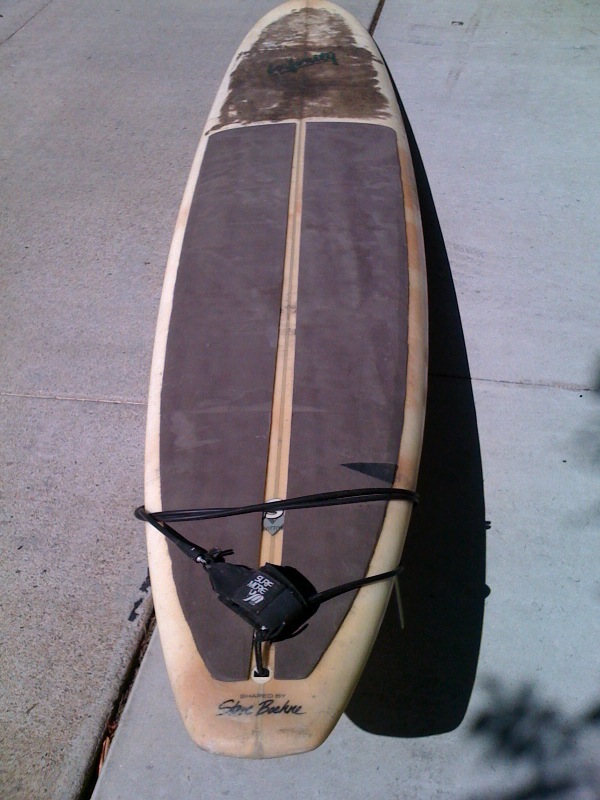
Fortunately I spend a month in California in the summer and this summer it was time to learn. My buddy Dave gave me a surfboard. It’s about twice as tall as me and weighs more than my 8 year old. Its also about 5 inches thick which made it impossible for me to get my arm around it to carry it like a regular cool surfer dude. I looked like a dork carrying it on my head.
But I can’t imagine a better board to learn on. Its more like a canoe than a surf board. It was hilarious to me looking at all of these really cool surfer guys sitting on their tiny little boards that sunk from the weight until they were submerged nearly to their shoulders. Meanwhile I could dip my toes in the water as I lounged around on my Steve Behre (pronounced berry) cruise liner waiting for waves. Dave said “It’s massive, its dangerous, and its embarrassing but just in terms of having fun surfing… the next one’s going to be a lot better.” Thanks Dave.
I got myself a wet suit. The water stays around 70F in San Diego in August so I probably could have got by without one but (again relying on Dave’s advice) since I was going to be surfing in the morning and since, thanks to Steve Behre, my most temperature-sensitive parts would be afloat and exposed to the morning air, I broke down got myself a spring suit. When I tried it on, the dude at the surf shop (Rusty’s in Del Mar) says “Its a little loose in the arms, but you’ll grow into it.” He either thought I was 13 years old or he could just tell that I was going to grow tremendous muscles from paddling.
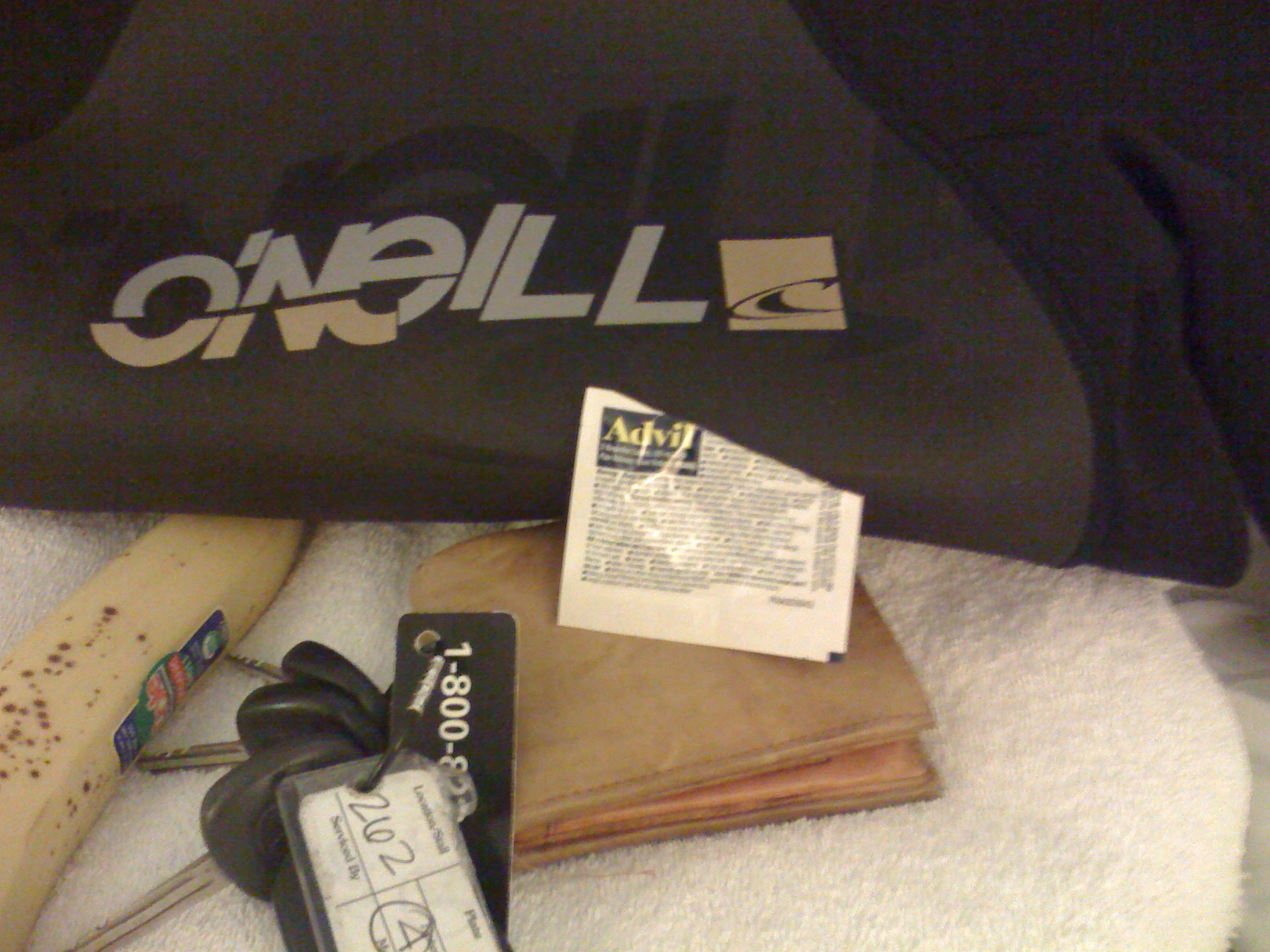
So I was set. Every morning at 5AM I would start my day with these objects:
You will notice the Advil which is pretty much indispensible when you are a 40 year old man trying to paddle a barge through crashing waves by yourself in the dark. OK not exactly dark, but I was in the water every morning before sunrise. I would surf until about 7:30 and then head back to the apartment, usually before the kids were awake. Parenting advice: arriving at breakfast with your wetsuit on and harrowing surf tales makes you the coolest Dad in the world. Not to mention the tremendous muscles.
I stood up the very first day. Fleetingly. By the end of the first week I could consistently catch waves and stand. They were small waves thankfully. I was bragging to my buddy Storn and then I got this email back.
If you are just standing in front of the whitewater after the wave has broken then it doesn’t technically count. (Not that it isn’t fun.)
How did he know?? In my defense, the Steve Queen-Behre was almost impossible to turn. I guess that’s the tradeoff. Storn came down from the Bay Area and he brought his board, which while still technically a longboard was about half the width and weight of mine.
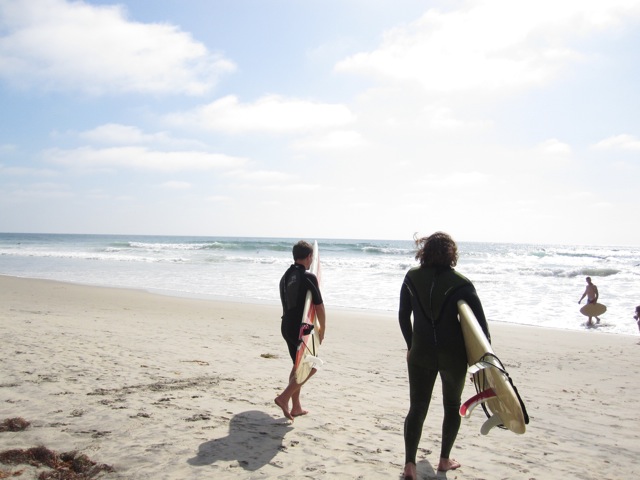
We swapped boards and I could actually get my arm around his (that’s me on the left.) Didn’t catch any waves though. Turns out that if you want a surfboard with some degree of maneuverability, you also have to paddle with some finesse. I put that on the todo list for next summer and went back to my trusty Steve Buoy. (When you can’t catch a wave you can’t ride the last one all the way in. “The paddle of shame” is what Storn called it.)
That day was the only time I surfed in daylight so I had Jennie bring the camcorder. Here’s some shredding on video.
Not video of me, mind you, Jennie was too busy making drip castles with the kids. Anyway, I don’t need help from no jet-ski. By the end of the month I could turn and ride the shoulder.
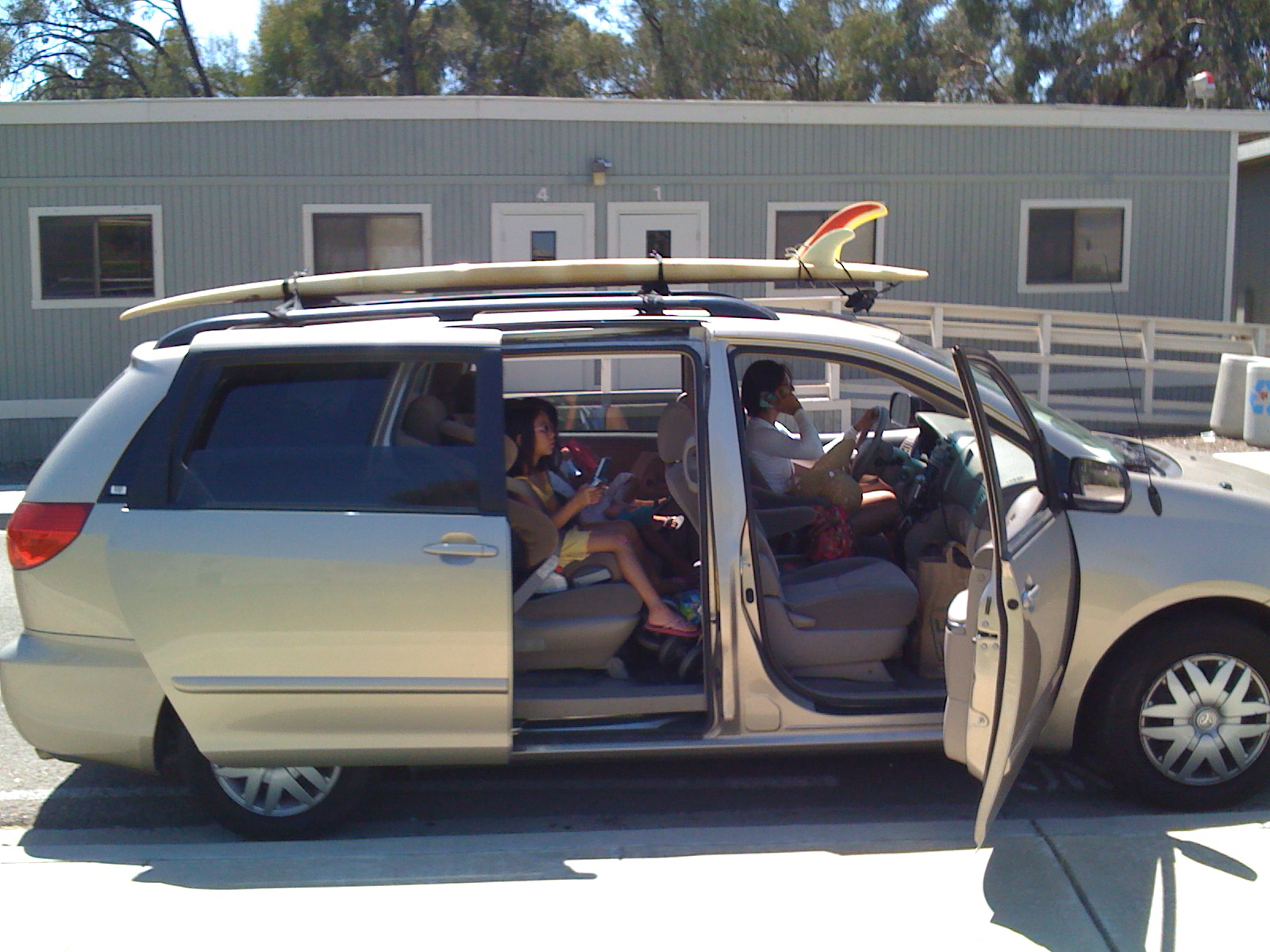
Sufjan Stevens was in my CD rotation that whole month. It’s a powerful album and one that was made to be played before sunrise. In your rented Toyota Sienna with a boat strapped to the top:
Spousal compromise led to going to Damned United over Where the Wild Things Are.
It was great! I grew up in England so kids reading the Wizard comic, Michael Parkinson on the telly, people eating fish and chips actually out of a newspaper etc. takes me wistfully back to Dear Old Blighty. My wife doesn’t get the cultural references and finds the idea of using newspaper as a wrapper really revolting. The movie is about Bryan Clough, the brilliant, ambitious and vain soccer manager and she has never heard of him.
Despite all this, she loved the movie too. So, I think it can fly in America. It’s totally un-Hollywood. The people are ugly, the weather sucks in many scenes (it is England after all!) and it’s about Clough’s short and terrible spell as manager of Leeds United. Pretty original movie idea (most sports movies involve a struggle leading to improbable victory) and could have failed miserably. But it succeeds on many levels.
The two main protagonists are Clough and his partner Peter Taylor and their relationship is rich and complex. The competitiveness between Clough and the manager of Leeds United is deep but childish. And underlying it all it, of course, there is the class system creaking along with upper class members of the football association doling out fines and suspensions to vicious working class players. England has a North-South divide with the once wealthy North now subservient to the prosperous South. And Clough is a Northener and you see the world through his eyes. None of this is as obvious as I make it here and that’s the charm of it.
All of this hangs on a story of Clough’s rise and fall which is exciting even if you know nothing about soccer. The director does a wonderful job. There is a scene where Clough cannot bear to watch the game and waits in his office. He follows the score via the shouts he hears through the frosted glass windows of his office. As the fans jump and cheer, their shadows darken the office and we see are as exhilarated as Clough. The acting is superb too. Now I’ve oversold the whole thing and you will hate it. Talk yourself down and go see it.
We all know about generic drugs and their brand-name counterparts. The identical chemical with two different prices. Health insurance companies try to keep costs down by incentivizing patients to choose generics. You have a larger co-pay when you buy the name brand. Except when you don’t:
Serra, a paralegal, went to his doctor a few months ago for help with acne. She prescribed Solodyn. Serra told her he’d previously taken a generic drug called minocycline that worked well. The doctor told him that the two compounds are basically the same, but that you have to take the generic version in the morning and the evening. With Solodyn, you take one dose a day.
Serra told her that if the name-brand medicine was going to cost a lot more, he’d prefer the generic. “And then she presented this card,” he says. She explained that it was a coupon, and that he should give it to the pharmacist for a break on his insurance copay.
Without the card, Serra’s copay would have been $154.28. But when he got to the pharmacy, he presented his card. “They went to ring it up at the register,” he remembers. “And when it came up, the price was $10.”
In a much-discussed post at one of my favorite blogs, Language Log, Mark Liberman christens a new game:
We might call this the Pundit’s Dilemma — a game, like the Prisoner’s Dilemma, in which the player’s best move always seems to be to take the low road, and in which the aggregate welfare of the community always seems fated to fall. And this isn’t just a game for pundits. Scientists face similar choices every day, in deciding whether to over-sell their results, or for that matter to manufacture results for optimal appeal.
(Aside on the game name game: when I was a first-year PhD student at Berkeley, Matthew Rabin taught us game theory. As if to remove all illusion that what we were studying was connected to reality, every game we analyzed in class was given a name according to his system of “stochastic lexicography.” Stochastic lexicography means randomly picking two words out of the dictionary and using them as the name of the game under study. So, for example, instead of studying “job market signaling” we studied something like “rusty succotash.” I wonder if any of our readers remember some of the game names from that class.)
(Stay tuned for my next Matthew Rabin story which will involve a hackey sack and a bodily fluid.)
There is indeed a strong incentive for pundits to distort what they say, and it has the flavor of contrarianism. Its based on an old paper by Prendergast and Stole (requires JSTOR sorry. Support Open Access publishing.) Suppose that what pundits want is to convince the world that they are smart. (Perhaps they want to influence policy. They will be influential later only if they can prove they are smart today. So today the details of what they are saying matters less than whether what they are saying is perceived to be smart.)
The thing about being really smart is that it means you are talking to people who aren’t as smart as you. (Sandeep faces this problem all the time.) So they can’t verify whether what you are saying is really true (especially when we are talking about climate change policies where if we ever do find out who was right, it will be well past the time that punditry is a profitable enterprise.) But one thing the audience knows is that smart pundits can figure out things that lesser pundits cannot. That means that the only way a smart pundit can demonstrate to his not-so-smart audience that he is smart is by saying things different than what his lesser colleagues are saying, i.e. to be a contrarian.
The Vatican just cut the price for Anglicans to join the Catholic Church. Converts can keep some Anglican traditions and still become Catholics. For instance, married Anglican priests can convert and become Catholic priests!
As the Anglican Church loses market share to the Catholic Church, what will they do? Traditional economics would imply some sort of price cut by the firm under attack. If Catholics can allow married priests, surely Protestants can allow some confessions and indulgences (i.e. payments for absolution from sins) for Catholics wanting to move the other way. Over-indulgences led to the Protestant Reformation but the Catholics Church’s aggressive move to get market share is going to lead to a price war and a reduction of product differentiation. Of course, if there is very little switching as Protestants are very loyal to their faith, the Catholic Church will end up cannibalizing its own market – for instance, Catholic priests may demand the same marriage rights granted to their converted brethren.
Looking forward to seeing what’s going to happen.
Update: Thanks to all the commenters who helped to reveal my lack of knowledge on religious matters. It seems that the potential for cannibalizing the Catholic market has been recognized. Here is today’s Times story Pope’s Offer Raises Idea of Marriage for Catholic Priests:
“The invitation also extends to married Anglican clergy. And so some have begun to wonder, even if the 82-year-old Benedict himself would never allow it, would more people in the Catholic Church begin to entertain the possibility of married Catholic priests?
“If you get used to the idea of your priests being married, then that changes the perception of the Catholic priesthood necessarily,” said Austen Ivereigh, a Catholic commentator in London and a former adviser to Cardinal Cormac Murphy-O’Connor of Westminster.
“We face the prospect in the future of going to a Catholic church in London and it being normal to find a married Catholic priest celebrating at the altar, with his wife sitting in the third pew and his children running up and down the aisle,” he said.”
There is also an arbitrage opportunity dismissed by the Catholic Church:
“Could a Catholic man convert to Anglicanism, be ordained as an Anglican priest, then rejoin the Catholic Church under the new Anglican rite? (The Vatican spokesman, the Rev. Federico Lombardi, dismissed that idea as “a trick.”)”
Swoopo.com has been called “the crack cocaine of auction sites.” Numerous bloggers have commented on its “penny auction” format wherein each successive bid has an immediate cost to the bidder (whether or not that bidder is the eventual winner) and also raises the final price by a penny. The anecdotal evidence is that, while sometimes auctions close at bargain prices, often the total cost to the winning bidder far exceeds the market price of the good up for sale. The usual diagnosis is that Swoopo bidders fall prey to sunk-cost fallacies: they keep bidding in a misguided attempt to recoup their (sunk) losses.
Do the high prices necessarily mean that penny auctions are a bad deal? And do the outcomes necessarily reveal that Swoopo bidders are irrational in some way? Toomas Hinnosaar has done an equilibrium analysis of penny auctions and related formats and he has shown that the huge volatility in prices is in fact implied by fully rational bidders who are not prone to any sunk-cost fallacy. In fact, it is precisely the sunk nature of swoopo bidding costs that leads a rational bidder to ignore them and to continue bidding if there remains a good chance of winning.
This effect is most dramatic in “free” auctions where the final price of the good is fixed (say at zero, why not?) Then bidding resembles a pure war of attrition: every bid costs a penny and whoever is the last standing gets the good for free. Losers go home with many fewer pennies. (By contrast to a war of attrition, you can sit on the sidelines as long as you want and jump in on the bidding at any time.) Toomas shows that when rational bidders bid according to equilibrium strategies in free auctions, the auction ends with positive probability at any point between zero bids and infinitely many bids.
So the volatility is exactly what you would expect from fully rational bidders. However, Toomas shows that there is a smoking gun in the data that shows that real-world swoopo bidders are not the fully rational players in his model. In any equilibrium, sellers cannot be making positive profits otherwise bidders are making losses on average. Rational bidders would not enter a competition which gives them losses on average.
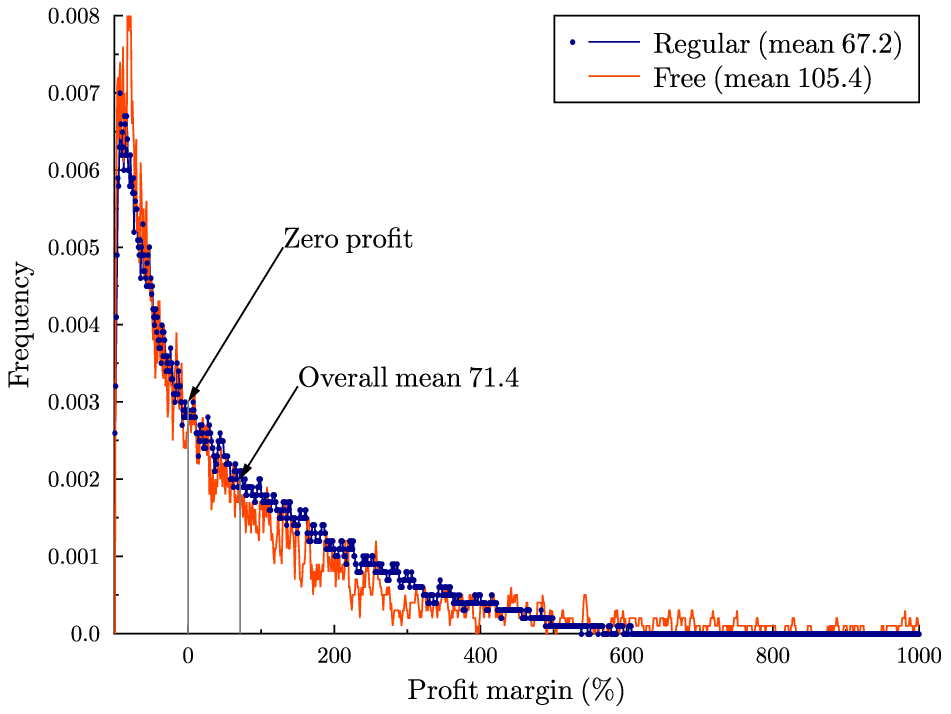
In the following graph you will see the actual distribution of seller profits from penny auctions and free auctions. The volatility matches the model very well but the average profit margin (as a percentage of the object’s value) is clearly positive in both cases. This could not happen in equilibrium.
The Times has a great excerpt from “Too Big to Fail: How Wall Street and Washington Fought to Save the Financial System — And Themselves” by Andrew Ross Sorkin. It recounts Lehman’s efforts to sell itself to Morgan Stanley and Bank of America. The Morgan Stanley deal failed as Lehman was not clear about what it wanted – a merger, selling a part of itself etc. But there was also an issue of what Lehman was really worth and Morgan Stanley tried to find that out in tense questioning:
“The Morgan team began to throw out a barrage of questions: How are things marked? they asked, Wall Street jargon for how the assets were valued. Were you able to sell them inside your marks? How much business has left the firm?”
In other words, there was asymmetric information: Lehman knew the value of its assets but Morgan Stanley did not.
The next attempt was Bank of America. They called their main deal maker at B0A Greg Curl on a Saturday night and
“Mr. Curl, though intrigued to be getting a call on a Saturday night, was noncommittal; he could tell they must be desperate. “Hmm … let me talk to the boss,” he said. “I’ll call you right back.” The boss was Ken Lewis, the silver-haired chief executive of Bank of America.)”
There is a potential lemons problem triggered by asymmetric information – you do not want to pay more that the value of Lehman Bros to acquire it. The fact they are trying to sell it signals it may not be worth that much. It is combined with incentives to misrepresent information to strike a good deal:
“Mr. Fuld [Chair of Lehman] explained that he would want at least $25 a share from Bank of America to buy Lehman; Lehman’s shares had closed that day at $18.32. Mr. Lewis thought the number was far too high and couldn’t see the strategic rationale. Unless he could buy the firm for next to nothing, the deal wasn’t worth it.”
The deal fell through. A question remains: was there a trade that could have made both parties happy? This would rely on a synergy between the potential buyer’s assets and the assets of Lehman. The bluffing and lemons problem makes it hard to see gains from trade. I’m going to buy the book but this excerpt makes it seem that Fuld did not do a good job selling Lehman and tried to get too much for it. For example, opening up the books might have saved it. This is a bad option in the sense that it puts you in a terrible bargaining position. But it is better than what happened
I heard an interview with Reggie Jackson and Bob Gibson (former baseball greats) on NPR’s Fresh Air this weekend. They spent a lot of time talking about pitching inside and “brushing back” hitters. Reggie Jackson, a hitter, conceded that these were “part of the game.”
There is a mundane sense in which this is true, namely that not even the best pitcher has flawless control and sometimes batters get hit. But Reggie was even talking about intentional beanballs. In what sense is this part of the game?
The penalty for throwing inside is that, if you hit the batter, he gets a free base. (And your teammate might get beaned at the next opportunity.) The problem is that this penalty trigger is partly controlled by the opposition. Other things equal it gives the batter an incentive to stand a bit closer to the plate. In order to discourage this, the pitcher must establish a reputation for throwing inside when a batter crowds the plate. In that sense, intentionally throwing at the hitter is unavoidable strategy, part of the game.
So, one way to short-circuit this effect is to change the condition for giving a free base to something that is exogenous, i.e. independent of any choice made by the batter. For example, the batter gets a free base any time the ball sails more than some fixed distance inside of the plate, whether or not it actually hits the batter. Modern technology could certainly detect this with minimal error.
Whatever the merits of the claims made about Fox News by Obama’s communications team, it can be good strategy to pick a fight with your critics. To the very long list of reasons, add this one. If you can make them so angry that they lose the will to say anything at all nice about you, then you have won a major victory. For then they will have lost all (remaining) credibility.
One of the tenets of rational expectations is that the expectation of a future event can move markets now.
Superfreakonomics is not even out yet. But a couple of pages from one chapter related to global warming have found their way onto the internet (perhaps a whole chapter was posted earlier?). And they’ve created a little warming for Levitt at the hands or blogs of Brad DeLong and Paul Krugman.
It’s hard to really make head or tail of it without reading it or seeing a real review. Tim Hartford has one and interestingly even he is skeptical of the global warming chapter. Well, I’ve put in my pre-order at Amazon and look forward to writing about Superfreakonomics.
In the ever-growing signs that I am getting very old, this article made me realize that the incoming undergraduate class at Northwestern grew up reading Harry Potter. Wonder if they’ve heard of the Human League and Ultravox. Oh Vienna.
Net neutrality refers to a range of principles ensuring non-discriminatory access to the internet. A particularly contentious principle urges prohibition of “managed” or “tiered” internet service wherein your internet service provider is permitted to restrict or degrade service. ISPs argue that without such permission they are unable to earn sufficient return on investment in network capacity and would be deterred from making such improvements.
One argument is based on congestion. Managed service controls congestion, raising the value to users and allowing providers to capture some of this value with access fees. This is a logical argument and one I will take up in a later post, but here I want to discuss another aspect of managed service: price discrimination.
Enabling providers to limit access, say by bandwidth caps, opens the door to “tiered” service where users can buy additional bandwidth at higher prices. This generally raises profits and so we should expect tiered service if net neutrality is abandoned. What effect does the ability to price discriminate have on an ISP’s incentive to invest in capacity?
It can easily reduce that incentive and this undermines the industry argument against net neutrality. Here is a simple example to illustrate why. Suppose there is a small subset of users who have a high willingness to pay for additional bandwidth. Under net neutrality, all users are charged the same price for access, and none have bandwidth restrictions. An ISP then has only two choices. Set a high price and sell only to the high-end users, or set a low price and sell to all users. When the high-end users are relatively few, profits are maximized with low prices and wide access. It is reasonable to think of this as describing the present situation.
Suppose tiered access is now allowed. This gives the ISP a new range of pricing schemes. The ISP can offer a low-price service plan with a bandwidth cap alongside a high-priced unrestricted plan. As we vary the cap associated with the low-end plan, we can move along a continuum from no cap at all to a 100% cap. These two extremes are equivalent to the two price systems available under net neutrality.
Often one of these in-between solutions will be more profitable than either of the two extremes. The reason is simple. The bandwidth cap makes the low-end plan less attractive to high-end users and as a result the ISP can raise the price of un-capped access to high-end users. It’s true that low-end users will pay less for capped service but often the trade-off is favorable to the ISP and total profits increase.
The upshot of this is that total bandwidth is lower, not higher, when an ISP unconstrained by net-neutrality uses the profit-maximizing tiered-service plan. Couched in the industry’s usual terms, the ISP’s incentive to increase network capacity is in fact reduced by moving away from net neutrality.
(Of course it can just as easily go the other way. For example, it may be that presently only the high-end users are being served because to lower price enough to attract the low end users, the ISP would lose too much profit from the high-end. In that case, allowing tiered service would induce the ISP to raise capacity and offer a capped service to previously excluded low-end users without significantly reducing profits from the high-end. Note however, this is not typically how industry lobbyists frame their argument.)
Sara Silverman wants to end world hunger (and get those disturbing images off her 48inch plasma TV). Her solution: sell the Vatican and use the proceeds to feed the world.
This is good, but only second best. The buyer who values the Vatican the most is in fact its current occupant. So selling the Vatican would lower its value. (It is true that the new owner knows he can sell it back to the Pope and takes this into account when deciding how much to offer. However, this adds needless transaction costs, plus the Pope will have bargaining power in the resale which would not be internalized by the buyer.)
A better idea is to give the Vatican directly to the poor and allow then to charge the Pope rent. Subject to this small ammendment, I wholly endorse the following (although the bit about the Holocaust may require the consent of more than just Ms Silverman and me.)
Nobel Laureate Eric Maskin gives an extended interview at The Browser arguing that economic theory was indeed equipped to see and understand the roots of the financial crisis. Its a unique interview because Eric picks 5 or so academic articles, discusses them in detail and weaves together a story of the crisis based on these. The story has some standard ingredients: bank runs, moral hazard, liquidity crises, and contagion. He illustrates each of these with a specific paper. The story also has some non-standard ingredients, such as leverage cycles described in a paper by Fostel and Geanakoplos.
The interview concludes thusly,
Q: So policymakers, especially people in Congress, need to read these papers.
A: Yes, or at least understand what’s in them. I think most of the pieces for understanding the current financial mess were in place well before the crisis occurred. If only they hadn’t been ignored. We’re not going to eliminate financial crises altogether, but we can certainly do a better job of preventing and containing them.
An old paper by Akerlof modeled procrastination in a simple way. Suppose that doing a task today involves costs that are more salient today than the costs that would be incurred from doing the task tomorrow. (Hyperbolic discounting is the modern way of introducing this disparity.) And suppose you are naive in that you are bad at predicting your behavior in the future. Then every day you will make an optimal plan for when to do the costly task and every day your optimal plan will be to do it tomorrow. So it will never get done.
Unless there is a deadline. The day of the deadline you will know that the task will not get done tomorrow if you don’t do it today, so that is the day when you will finally do it. Ryan Sager describes an experiment with a similar finding. In fact the same effect holds with enjoyable tasks, not just pure costs. (Jennie and I never visited many of the tourist sites of San Francisco until a month before we moved away from the Bay Area.)
Take an experiment conducted by two marketing professors, Suzanne Shu and Ayelet Gneezy, set to be published in a forthcoming issue of the Journal of Marketing Research (and written up in the May Atlantic by Virginia Postrel). Shu and Gneezy gave 64 undergraduates coupons for a slice of cake and a beverage at a local French pastry shop. Half got a certificate that expired in three weeks, half got one that expired in two months. While students were sure they were more likely to use the certificate with the more generous timeframe, the results were clear: The shorter timeframe made the students much more likely to redeem their certificates; 10 of the 32 students (31%) redeemed the three-week certificates, only two of the 32 students (6%) redeemed the two-month certificates.
You can imagine that the coupon is lost with some probability every day until it is used. Thus, the longer deadline means less chance of getting to the moment of truth. Here is a link to the original research.
Ernst Fehr, heavy favorite in much of the betting on the Nobel Memorial Prize, is giving a talk today at MIT Economics. If you click on link to paper, you see that one of the papers he is presenting has several citations of the work of Elinor Ostrom.
The Senate Finance Committee is voting today and everyone is focusing on Republican Senator, Olympia Snowe. Will she vote for the bill now or wait to make a decision till a final bill reaches for the Senate floor? The final bill will be a compromise between many bills passed in the Senate.
Snowe may care about getting plum Senate Committee assignments etc but assume she wants to influence the final bill as much as possible. For example, Snowe does not favor the public option but the “trigger” where a public health plan will kick in if insurance companies raise premiums.
If Snowe does not vote for the bill now, the Democrats will interpret her strategy as the Grassley strategy of delaying and wearing the opposition down. This will lead to a more left-wing bill in the final compromise solution as they will not care about keeping her on board. If she votes for it now, the Democrats will want to be careful not to alienate her in the final bill.
Not voting for the Senate Finance Bill, hoping to have more influence on the final product, will actually reduce her influence as Democrats will infer that Snowe acted in bad faith over the last few months. Snowe will have more influence by voting for Senate Finance Bill. Let’s see what happens….
Ed Glaeser does a great job describing the work of the two Nobel Laureates. But I’m with Jeff and Levitt is never having heard of or read the work of Elinor Ostrom. Looking at the Nobel Committee’s blurb, you do get the feeling of familiarity, as if you’ve read it subconsciously. That’s partly because Ostrom works on a classical economic issue, the free-rider problem that arises when players use common property resources. The main reason though is that she uses experiments and field work to evaluate her theories.
Many researchers (e.g. Ernst Fehr) use experiments and some simple theory to study how cooperation may arise in the absence of monetary incentives. Others (eg Kremer and Duflo) do field research in development. Someone might ask “were these researchers the first to study these issues”? The Nobel Committee takes this question very seriously. And the answer, if I read the Nobel report correctly, appears to be “No,” as Ostrom pioneered this sort of thing. While that may be true, it is odd that Ostrom’s name is not on mainstream courses in econ courses. Williamson would appear on reading lists for contract theory. Many Econ Departments do not have courses in experimental economics and I wonder if Ostrom would appear on them anyway? This would make her different from John Nash – he is a mathematician not an economist but his solution concept is used every day by many, many researchers in the economics (not mathematics) and his existence proof for equilibrium provides a key approach economists still use (and again it would be old hat for mathematicians).
No-one finds it strange that Williamson won the Prize. Names that would normally be paired with Williamson are: Alchian, Demsetz, Grossman, Hart, Holmstrom, Kreps, Milgrom, Tirole etc, etc. All of these individuals have made significant contributions to the “theory of the firm” and more broadly to contract theory, decision theory, game theory and industrial organization. Perhaps they are being saved for future Prizes. For example, the Nobel blurb is careful not to give too much credit to Williamson for the “hold up” problem. But why wait for the future, why not now? It seems more natural than Ostrom to me. I’m puzzled.
Not game theory, but research about and even within games. Hit or miss:
One of the most high-profile projects (and most obvious recent failures) was Indiana University’s Arden: The World Of William Shakespeare, which reportedly had a grant of $250,000. It was an experimental MMO which came about via the work of Professor Ed Castronova, author of Synthetic Worlds. Castronova wondered whether the creation of a genuinely educational MMO was possible, and set up the student development project to find out. Having spent thousands of dollars on Arden it was shut down. Castronova cited “a lack of fun”.
This prize is long overdue. The theory of the firm is one of the big ideas in economics and as far as I can tell the Nobel committee was right to trace it back to Williamson.
A firm is a container for a bunch of highly idiosyncratic, repeated, informal transactions. A great thought experiment is to wonder why these transactions are not conducted through a market, making the firm dissolve away. Instead of giant firms building and selling cars, why aren’t there a bunch of tiny firms each doing a tiny part with all of their interaction governed by the market or by contract? There are three main reasons why.
First, its costly to use the market. If the chassis firm is going to be buying axles from the axle firm all the time, it would save transaction costs by just integrating. Then it can “procure” axles with a memo.
Second, the contracts would be impossibly complicated and unwieldy. Imagine writing a complete blueprint for the car, breaking it down into individual instructions for every actor who is supposed to contribute, laying out the timing when each party is supposed to arrive and do his part, describing payments as a function of the performance of each interdependent action, etc. That is probably already impossible, but imagine you could do that. Now suppose that a supply shock requires you to use different materials for the chassis. This would require a coordinated change in many parts of the car, to keep structural integrity, balance, etc. The entire volume of contracts would have to be re-written.
The third reason is the one that adds richness to the theory of the firm. Most of the transactions that occur within firms require parties to make investments that only make sense within the context of that specific firm. The party making the investment has little or no option to recover the value of the investment outside the firm. When the chassis firm contracts with the firm building auto bodies, it writes down minute specifications that must be met. The bodies produced could not be sold to any other chassis maker. The firm building auto bodies must invest in the machinery that can make these specific bodies. Once sunk that investment has no value outside of the specific relationship with the chassis firm.
The reason this adds richness to the theory is that it explains which transactions must be encompassed within firms. Transactions that require relation-specific investments would be crippled if conducted across firm boundaries. Once the die is cast for building these specific auto bodies, the chassis firm has no reason to pay a price that compensates for the sunk cost because there is no outside option. This hold-up problem implies that the auto body firm has poor incentives to make the investment in the first place, unless it integrates with the chassis firm and becomes a claimaint to the profits of the integrated firm.

 Cheap Talk