It is apparently the Democrats’ intention to use the budget reconciliation process to finalize the health care overhaul.  By means of this process, a plain majority of 51 Senators will be required to pass the compromise bill, rather than the 60 that would be required to fight off a Republican filibuster.  An arcane Senate rule plays center stage:

So if reconciliation is such a powerful tool, why didn’t the Democrats use it earlier? Because of another restriction, known as the Byrd rule — named for West Virginia Senator Robert Byrd , who introduced it in 1974. The Byrd rule allows the minority party to block the use of reconciliation if a bill isn’t tied strongly enough to the budget process. The full health care bill the Senate passed in December would have violated the rule (and possibly jeopardized support from many centrist Democrats hoping to avoid controversy).

But, because Democrats passed a full health reform bill in December with 60 votes and are only proposing to make changes to that through reconciliation, it’s easier for them to argue that those changes are simply about making the bill fit the overall budget.

The rule is well-defined, apparently, but nevertheless open to intepretation.  The spirit is to prevent reconciliation, a normally technical phase of the budget process, from being used to enact new legislation.  The Republicans are clearly right to complain that pushing the health care bill through reconciliation violates that spirit.  (Although Democrats counter that Republicans have used it more often in the past.)

But there is a big difference between fair play within the conventions of the Senate and fair play in the eyes of the public.  And in fact, bright line rules like the Byrd rule have more powerful rhetorical value in the broader public debate than he said-Reid said sniping about the cryptic, often unwritten, norms of the Senate.  As the quoted paragraph above points out, despite a flagrant violation of the spirit of the reconciliation process, passing health care in this way is probably within the letter of the Byrd rule.

And that will be ceremoniously confirmed on the floor of the Senate when Republicans raise the question and the Senate parliamentarian gives a ruling.  (By the way, the presiding member of the Senate can ignore the Parliamentarian, and the Parliamentarian can even be replaced by the Senate Majority Leader, but presumably it would not come to that.)  No matter how much Republicans cry foul, ironically the Byrd rule will essentially certify a maneuver it was intended to prevent.

  1. I am trying to sell Elie Tamer on one of my ideas so we can write a paper that would be cited Ely-Tamer.  (ps. I have got some great ideas for anybody whose last name is Jeff.  I will give you first billing.)
  2. Couldn’t get a job as a theater critic.

I don’t want an iPad because I don’t want to carry around a big device just to read.  I want to read on my iPhone.  With one hand.  (Settle down now.  I need the other hand to hold a glass of wine.)  But the iPhone has a small screen.  Sure I can zoom, but that requires finger gestures and also scrolling to pan around.  Tradeoff?  Maybe not so much:

Imagine a box.  Laying on the bottom of the box is a piece of paper which you want to read. The box is closed, but there is an iPhone sized opening on the top of the box.  So if you look through the opening you can see part of the paper.  (There is light inside the box, don’t get picky on me here.)

Now imagine that you can slide the opening around the top of the box so that even if you can only see an iPhone sized subset of the paper, you could move that “window” around and see any part of the paper.  You could start at the top left of the box and move left to right and then back to the left side and read.

Suppose you can raise and lower the lid of the box so you have two dimensions of control.  You can zoom in and out, and you can pan the iPhone-sized-opening around.

Now, forget about the box.  The iPhone has an accelerometer.  It can sense when you move it around.  With software it can perfectly simulate that experience.  I can read anything on my iPhone with text as large as I wish, without scrolling, by just moving the phone around.  With one hand.

This should be the main UI metaphor for the whole iPhone OS.

From a wince-inducing article in Salon:

The documents also lay out, in chilling detail, exactly what should occur in each two-hour waterboarding “session.” Interrogators were instructed to start pouring water right after a detainee exhaled, to ensure he inhaled water, not air, in his next breath. They could use their hands to “dam the runoff” and prevent water from spilling out of a detainee’s mouth. They were allowed six separate 40-second “applications” of liquid in each two-hour session – and could dump water over a detainee’s nose and mouth for a total of 12 minutes a day. Finally, to keep detainees alive even if they inhaled their own vomit during a session – a not-uncommon side effect of waterboarding – the prisoners were kept on a liquid diet. The agency recommended Ensure Plus.

The article details the use of saline solution to reduce the possibility of death from dangerously low sodium levels, a specially designed gurney for tilting the head at the optimum angle and quickly uprighting the victim in case he stopped breathing, and doctors assisting by monitoring blood pressure to allow interrogators to bring the victim close to the line of death.  And more.

Budenovka bow:  The Morning News.

Ellsberg stopped doing research years ago but someone, somewhere, is citing his classic work on “ambiguity aversion” every day.  He dropped out of research to become a policy guy and worked at the Pentagon during the Vietnam War.  Ellsberg became a dove as he discovered what was going on behind the scenes and leaked the Pentagon Papers.  The movie about him, “The Most Dangerous Man in America”, was nominated for an Oscar in the documentary category.  The camera picked him out at one point in the telecast. An interview with him can be found here (the Ellsberg segment starts 25 mins into video).

In a classic experiment, psychologists Arkes and Blumer, randomized theater ticket prices to test for the existence of a sunk-cost fallacy.  Patrons who bought season tickets at the theater box office were randomly given discounts, some large some small.  At the end of the season the researchers counted how often the different groups actually used their tickets.  Consistent with a sunk-cost fallacy, those who paid the higher price were more likely to use the tickets.

A problem with that experiment is that it was potentially confounded with selection effects.  Patrons with higher values would be more likely to purchase when the discount was small and they would also be more likely to attend the plays.  Now a new paper by Ashraf, Berry, and Shapiro uses an additional control to separate out these two effects.

Households in Zambia were offered a water disinfectant at a randomly determined price.  If the price was accepted, then the experimenters randomly offered an additional discount.  With these two treatment dimensions it is possible to determine which of the two prices affects subsequent use of the product.  They find that all of the variation in usage is explained by the initial offer price.  That is, the subjects revealed willingness to pay was the only detrminant of usage and not the actual payment.

This is the cleanest field experiment to date on the effect of past sunk costs on later valuations and it overturns a widely cited finding.  On the other hand, Sandeep and I have a lab experiment which tests for sunk cost effects on the willingness to incur subsequent, unexpected, cost increases.  We show evidence of mental accounting:  subjects act as if all costs, even those that are sunk, are relevant at each decision-making stage.  This is the opposite effect found by Arkes and Blumer.

(Dunce cap doff:  Scott Ogawa)

Kjerstin Erickson is selling a 6% stake in her lifetime income for $600,000 through a vehicle known as the Thrust Fund:

Erickson’s Thrust Fund comes at a time of deep experimentation in early-stage financing across the technology and media industries. The transparency afforded by social networking is making it easier for investors to vet people’s reputations and hold them accountable. At the same time, the initial amount of capital needed to build, market and distribute a product or service has fallen, undermining the venture capital model and making angel investors relatively more powerful.

Think of Kjerstin as a self-managed firm.  She could issue debt or equity.  The Modigliani-Miller theorem explains why most people in Kjerstin’s position choose to issue debt.  Her income is taxed, but interest on debt is often tax-deductible.

But a key difference between Kjerstin and a firm is that you if you acquire Kjerstin you cannot fire the manager.  So your capital structure is also your managerial incentive scheme.  Debt makes Kjerstin a risk-lover:  she gets all the upside after paying off her debts and her downside is limited because she can just default.  With equity she owns 94% of her earnings no matter what they are.

So many questions come up, here are just a few.

  1. Why don’t we replace student loans with student shares?  Arguably the reason we stick with debt is that it is good policy to induce risk-taking.  Because the large numbers means that aggregate risk is small and society benefits more from the big hits than it loses from the misses.
  2. Do Kjerstin’s investors get voting rights?
  3. Does the contract give her the freedom to issue more shares in the future?  She wants this option but her investors don’t.  The more shares she sells the less incentive she has to work hard.
  4. Kjerstin now has a huge incentive to take in-kind compensation that is hard to value.  In corporate finance, this is called diverting the cash flows.  How does her contract deal with that?

(Lid lift:  The Morning News.)

Karen Tumulty at the Time blog Swampland perceptively writes:

“the easiest choice for endangered Democrats in swing districts is to vote against the bill–but only if it passes. That’s because they need two things to happen to get re-elected this fall. They need to win independent voters (who in most recent polls, such as this one by Ipsos/McClatchy, are deeply divided on the bill). But they also need the Democratic base in their districts to be energized enough to turn out in force–something that is far less likely to happen if Barack Obama’s signature domestic initiative goes down in flames.”

Tumulty compares the scenario to an earlier vote in 1993 on the Clinton economic plan:

“It was the night of August 5, 1993, and Bill Clinton was one vote short of what he needed to get his economic plan through the House–a vote he got, when freshman Marjorie Margolies-Mezvinsky switched hers. The other side of the Chamber seemed to explode. Republicans pulled out their hankies and started waving them at her, chanting: “Bye-bye, Margie.”

Margolies-Mezvinsky learned the hard way that they were right. Her Main Line Philadelphia district was the most Republican-leaning of any represented by a Democrat in Congress. She had sealed her fate:

During her campaign, she had promised not to raise taxes, and the budget proposed a hike in federal taxes, including a gasoline tax. On the day of the vote, she appeared on television and told her constituents that she was against the budget. Minutes before the vote, however, on August 5, 1993, President Clinton called to ask Margolies-Mezvinsky to support the measure. She told him that only if it was the deciding vote—in this case, the 218th yea—would she support the measure. “I wasn’t going to do it at 217. I wasn’t going to do it at 219. Only at 218, or I was voting against it,” she recalled.11 She also extracted a promise from Clinton that if she did have to vote for the budget package, that he would attend a conference in her district dedicated to reducing the budget deficit. He agreed (and later fulfilled the pledge). Nevertheless, Margolies-Mezvinsky told Clinton “I think I’m falling on a political sword on this one.”

Tumulty suggests the underlying game is the Prisoner’s Dilemma.  Some of her commenters suggest the game is similar to the free-rider problem in provision of public goods.  The free-rider problem is very similar to a Prisoner’s Dilemma so really the commenters are echoing her interpretation though they may not realize it.

I claim the interesting version of the game for Democratic Representatives in conservative districts is Chicken.  Two cars race towards each other on a road.  Each driver can swerve out of the way or drive straight.  If one swerves while the other does not, the former loses and the latter wins.  If neither swerves, there is a terrible crash.  If both swerve, both lose. A variant on this game is immortalized in the James Dean movie  “Rebel without a Cause”.

According to Tumulty, Democratic Representatives in conservative districts want to have their cake and eat it: they need healthcare reform to pass to get Democratic turnout but they want to vote against it to keep independents happy.  The strategic incentives are easy to figure out in two scenarios.  First, suppose the bill is going down however the Rep votes as it does not have enough votes.  Then, this Rep should vote against it – at least they get the independents in their district.  Second, suppose the bill is going to pass however the Rep votes – they should vote against via the Tumulty logic.

The third scenario is ambiguous.  Suppose a Rep’s vote is pivotal so the reform passes if and only if she votes for it.  At the present count with retiring Reps, Pelosi needs 216 votes to pass the Senate bill in the House so a Rep is pivotal if there are 215 votes and her vote is the only way the bill will pass. Margie M-M was in this position in 1993.  There are two possibilities in the third scenario.  In the first, the Rep wants to vote against the bill even when she is pivotal as she is focused on the independent vote.  This means she has a dominant strategy to vote against it the bill.

This case is strategically uninteresting and, as in the Margie case, it is implausible for all the undecideds to have a dominant strategy of this form.  So let’s turn to the second possibility – many undecideds Rep wants to vote for the bill if they are pivotal.  This generates Chicken.  If none of the conservative Democratic Reps vote for it, the bill goes down and its a disaster as Democratic voters do not turn out.  This is like cars crashing into each other in Chicken. Your ideal though is if someone else votes for it (i.e swerves) in the pivotal scenario and you can sit on the sidelines and vote against it (drive straight).  There is a “free-rider” problem in this game as in the Prisoner’s Dilemma.  But there is a coördination element too – if you are the pivotal voter you do want to vote for the bill.

Chicken has asymmetric equilibria where one player always swerves and the other drives straight. This corresponds to the case where the conservative Democrats know which of them will fall on their swords and vote for the bill and the rest of them can then vote against it.  This is the best equilibrium for Obama as the Senate Bill definitely passes the House.  But there is a symmetric equilibrium where each conservative Rep’s strategy is uncertain.  They might vote for it, they might not.  There is no implicit or explicit coördination among the voters in this equilibrium. This equilibrium is bad for Obama.  Sometimes lots of people vote for the bill and it passes with excess votes.  But sometimes it fails.

There is lots of strategy involved in trying to influence which equilibrium is played.  And there’s lots of strategy among the Reps themselves to generate coordination.  If you can commit not to vote for the bill, Obama and Pelosi are not going to twist your arm and they’ll focus on the lower-hanging fruit.  Commitment is hard.  You can make speeches in your district saying you’ll never vote for the bill.  Margie M-M did this but a call from the President persuaded her to flip anyway.  Republicans are going to emphasize the size of the independent vote to convince the undecideds that they have a dominant strategy to vote against the bill.  And the President is going to hint he’s not going to help you in your re-election campaign if you vote against the bill.  Etc., etc.

So, if the Senate bill is finally voted on, as we creep up to 200 votes or so, we’ll see Chicken played in the House.  We’ll see who lays an egg.

You are preparing two dishes.  For the first you will put 1 tsp. cornstarch in a medium sized bowl and for the second you will put 1/2 tsp. cornstarch in a small bowl.  By mistake you put the 1 tsp. cornstarch in the small bowl.  You have a full set of of measuring spoons, any number of spare bowls, and a box of cornstarch.  What is the most efficient way to get back on track?  Answer after the jump.

Read the rest of this entry »

  1. Creative resumes (via Statistical Significance)
  2. Playing pinball with your brain.
  3. Harold McGee gives thumbs up to no-knead bread.
  4. What your handshake says about you.
  5. The Bad Plus back up Isaac Mizrahi.

I tweeted a picture of my coffee yesterday:

And @gappy3000 asked “isn’t that favoring presentation over content (literally)?”

It turns out that the answer is essentially no.  To make latte art you do not need to compromise at all on the quality of the coffee.   In fact the parameters that facilitate a good design are also the ones that make the best cup of coffee.  You need rich crema for the canvas.  And rich crema is the hallmark of a well-pulled espresso.  You need milk that is steamed enough to be ever-so-slightly foamy but not “frothy”.  If you cannot pour the milk smoothly into the cup without spooning, the coffee will not taste good.

To make that design the milk must pour heavily into coffee and then the foamy part floats back to the surface behind the “wake” of the stream as you paint.  In order for milk to be of that consistency it must not be steamed too long or hot.  Excessively steamed milk tastes burnt and is one of the most common defects of commercial latte/cappucino.

So, on the contrary, a beautiful design on your coffee is almost always a signal that the coffee is going to be good.  You should insist on latte art.

1. How can Obama/Senate commit to push reconciliation if the House passes the Senate Bill?  Jonathan Chait gets reputation/repeated games:

Why would Obama and the Senate nakedly double cross the House? It would mean never being able to pass a piece of legislation again. The reputations of the double-crossers would be destroyed, both inside Washington and, to a lesser extent, nationally. No remotely rational politician, no matter how evil, would do something like that.

2. Q: Does frequent use of Purell reduce flu? A: Get a flu shot.

3. Tiger’s got wood.

4. Gypsy jazz bars of Paris.

The primary rationale for tenure is academic freedom.  A researcher may want to pursue an agenda which is revolutionary or offensive to Deans, students, colleagues, the public at large etc.  However, the agenda may be valuable and in the end dramatically add to the stock of knowledge.  The paradigmic example is Galileo who was persecuted for his theory that the Sun is at the center of our planetary system and not the Earth.  Galileo spent the end of his life under house arrest.  Einstein considered Galileo the father of modern science.  Tenure would now grant Galileo the freedom to pursue his ideas without threat of persecution.

From the profound to the more prosaic: the economic approach to tenure.  For economists, tenure is simply another contract or institution and we may ask, when is tenure the optimal contract?  My favorite answer to this question is given by Lorne Carmichael’s “Incentives in Academics: Why Is There Tenure?” Journal of Political Economy (1996).

Suppose a university is a research university that maximizes the total quality of research.  Let’s compare it to a basketball team that wants to maximize the number of wins.  Universities want to hire top researchers and basketball teams want to hire great players.  Universities use tenure as their optimal contract but basketball teams do not.  Why the difference?

On the basketball side of things it’s pretty obvious.  Statistics can help to reveal the quality of a player and you can use the data to distinguish a good player from a bad player.  And this can inform your hiring and retention decisions.

On the research side, things are more complicated.  Statistics are harder to come by and interpret.   On Amazon, Britney Spears’ “The Singles Collection” is #923 in Music while Glenn Gould’s “A State of Wonder: the Complete Goldberg Variations” is #3417.   Even if we go down to subcategories, Britney is #11 in Teen Pop and Glenn is #56 in Classical.

So, is Britney’s stuff better than Bach, as interpreted by Glenn Gould?   I love “Oops..I did it Again”, but I am forced to admit that others may find Britney’s work to be facile while there is timeless depth to Bach that Britney can’t match.

I’ve tried to offer an example which is fun, but it is also a bit misleading as the analogy with scientific research is flawed.  First, music is for everyone, while scientific research is specialized.  Second, there is an experimental method in science so it is not purely subjective.  But the main point is there is a subjective component to evaluating research and hence job candidates  in science.  There is less of this in basketball.  Shaq is less elegant than Jordan but he gets the job done nonetheless.  The subjective component actually matters a lot in science because of the specialization.  Scientists are better placed to determine if an experiment or theory in their field is incorrect, original or important.  And they are better placed to make hiring decisions, when even noisy signals of publications and citations are not available.

Subjective evaluation is the starting point of Carmichael’s model of tenure.  If you are stuck with subjective evaluation, the people who know a hiring candidate’s quality best are people in the department that is hiring him.  If the evaluators are not tenured, they will compete with the new employee in the future.  If the evaluators hire who is higher quality  than they are themselves, they are more likely to get sacked than the person they hire.  In fact, the evaluators have the incentive to hire bad researchers so they are secure in their job.  This reduces the quality of research coming out of the university.  On the other hand, if the evaluator is tenured, their job is secure and this increases their incentive to be honest about candidate quality and leads to better hiring.  If there are objective signals as in sport, there is less need for subjective evaluation and hence no need for tenure.

This is the crux of the idea.  It is patronizing for anyone to impose their tastes of Britney vs Bach on others.  Everyone’s opinion is equally valid.  It is possible to say Scottie Pippin was a worse basketball player than Jordan – the data prove it.    Science is somewhere in between.  There is both an objective component and a subjective component.  We then have to rely on experts.  Then, the experts may have to be tenured.

  1. I am still trying to convince Sandeep to follow me on Twitter.
  2. It’s all part of an experiment which I shall be writing about in a forthcoming paper.
  3. Hoping for venture financing for levitating balls.

From a worthwhile article in the NY Times surveying a number of facts about e-book and tree-book sales:

Another reason publishers want to avoid lower e-book prices is that print booksellers like Barnes & Noble, Borders and independents across the country would be unable to compete. As more consumers buy electronic readers and become comfortable with reading digitally, if the e-books are priced much lower than the print editions, no one but the aficionados and collectors will want to buy paper books.

Which, translated, reads:  publishers don’t want low e-book prices because then people would buy them.  Note that according to the article, profit margins are larger for e-books than for pulp.  (Confused?  Marginal revenue accounts for cross-platform cannibalization, and is still set equal to marginal cost.)

In a paper in Nature; the authors Tricomi, Rangel, Camerer, and O’Doherty used fMRI experiments to reveal that the brain is wired for egalitarianism.

Activity rose in rich people when their poor colleagues got money. In fact, it was greater in that case than when they got money themselves, which means the “rich” people’s neural activity was more egalitarian than their subjective ratings were. Whereas in “poor” people, the vmPFC and the ventral striatum only responded to getting money, not to seeing the rich getting even richer.

Neuroskeptic provides some perspective:

Notice that this is essentially a claim about psychology, not neuroscience, even though the authors used neuroimaging in this study. They started out by assuming some neuroscience – in this case, that activity in the vmPFC and the ventral striatum indicates reward i.e. pleasure or liking – and then used this to investigate psychology, in this case, the idea that people value equality per se, as opposed to the alternative idea, that “dislike for unequal outcomes could also be explained by concerns for social image or reciprocity, which do not require a direct aversion towards inequality.”

(Guang Puang ping:  Marciano Siniscalchi.)

On my way to yoga this afternoon I heard a bit on NPR about the song “You’re So Vain” by Carly Simon.  You remember the song, it’s addressed to some mysterious man who wears a fruity scarf and apparently has a big ego.

At the end of the segment there was a query from a listener that packed a punch.  (Paraphrasing the NPR listener)  She sings “I bet you think this song is about you, don’t you?” Why would she sing that?  After all, the song is about him.

At first I thought that the listener just didn’t understand the point of the barb:  She is saying that he is so vain because when he hears a song about someone he assumes it is about him.  But after thinking for awhile, I see that the listener was onto something.

Is it vain to think that a song is about you when indeed it really is about you?  Can you be accused of being vain just for being right?  What if the guy has never before thought a song was about him.  Maybe this was the very first time in his life that he ever thought a song was about him, and he had good reason to because in fact it was about him and indeed all the clues were laid out in previous verses?

She could have sung “I bet you think those other songs, like you know the song about turning brown eyes blue, by Crystal Gayle, or the one by the Carpenters about birds suddenly appearing, you know those songs, I bet you think those songs are about you.  Well I got news for you, they are not.  In fact those singers have never met you, duh.”  But she didn’t.

Even worse, the song clearly accuses its subject of being vain.  If he thinks the song is about him, then he is acknowledging his own vanity.  Certainly the guy gets humility points for recognizing his own vanity, right?

But wait.  The subject knows that Carly knows that the subject’s recognition of himself in Carly’s song is an admission of vanity, and hence an act of humility.  And therefore “I bet you think this song is about you” translates to “I bet you think you are humble.”  And given that, since the subject indeed recognizes himself in the song he is in fact claiming to be humble, an act of sheer vanity.

So Carly’s lyrics cut deep indeed.

(Postscript:  before today I actually thought the song was about me.)

The Times reports that:

Couples who live together before they get married are less likely to stay married, a new study has found….The likelihood that a marriage would last for a decade or more decreased by six percentage points if the couple had cohabited first..

Obvious conclusion: Don’t live together before you get married, if you want to stay married.

But this is another one of those “correlation does not imply causation” posts.  Here are two interpretations that do not imply the obvious conclusion.

First, suppose one partner is reluctant to get married and has doubts about the relationship. More information would be helpful to decide whether to stay together or break up. If the couple cohabit, that will give them valuable information.  On the other hand, couples who are more confident about their relationship are more likely to get married straight away.  Hence, more stable couples are less likely to live together before marriage than less stable couples.  Living together per se is not the problem.  The real problem is that a deeper source of instability is correlated with cohabitation.

Second – and this theory is implicit in the research – more religious couples are less likely to get divorced and less likely to live together before marriage.  Again, selection explains the data and not cohabiting per se.

The empirical results are interesting but you can carry on living in sin without worrying that this is going to lead to the collapse of your marriage.  That may happen but it’s because you really hate each other and religion is not providing the glue to keep you together.

The sound of Fiona Ritchie’s voice has the flavor of grapefruit and/or cranberry.  (Updated:  I couldn’t get the direct link to work.  So you will have to manually start one of the audio links on the page.  Any one will do.)

Chat Roulette (NSFA) is a textbook random search and matching process.  Except that it is missing a key ingredient:  an instrument for screening and signaling.  That, coupled with free entry, means that everyone’s payoff is driven to zero.

In practice the big problems with Chat Roulette are

  • Too many lemons
  • Too much searching
  • The incentive do something attention grabbing in the first few seconds is too strong

On the other, hand I expect the next generation of this kind of service to be a tremendous money maker. Here are some ideas to improve on it.  The general idea is to create a mechanism where better partners are able to more easily find other good partners.

  1. Users maintain a score equal to the average length of their past chats.  The idea is to give incentives to invest more in each chat, and to reward people who can keep their partners’ attention for longer.  A user with a score of x is given the ability to restrict his matches to other users with a score greater than any z≤x he specifies.    This is probably prone to manipulation by users who just keep their chats open inviting their partners to do the same and pad their numbers.
  2. Within the first few seconds of a match, each partner bids an amount of time they would like to commit to the current match.  The system keeps the chat open for the smaller of the two numbers.  Users maintain a score equal to the average amount of time other users have bid for them.  Scores are used to restrict future matching partners just as above.
  3. Match users in groups of 10 instead of 2.  Each member of the group clicks on one of the others and any mutually-clicking pair joins a chat.  This could be coupled with a system like #1 above to mitigate the manipulation problem.  Or your score could be the frequency with which others click on you.
  4. A simple “like/don’t like” rating system at the end of each chat.  In order to make this incentive-compatible, you have an increased chance of meeting the same person again in future matches if both of you like each other.  On top of that, your score is equal to the number of times people like you.
  5. Same as 4, but your score is computed using ranking algorithms like Google’s PageRank where it’s worth more to be liked by a well-liked partner.
  6. Multiple channels with their own independent scores.  You could imagine that systems like the above would have multiple equilibria where the tastes of users with the highest scores dominate, thus reinforcing their high scores.  Multiple channels would allow diversity by supporting different equilibria.
  7. Allow users to indicate gender preference of their matches.  To avoid manipulation, your partners report your gender to the system.

These are all screening mechanisms:  you earn control over whom you match with.  But the system also needs a signaling mechanism:  a way for a brand new user to signal to established users that she is worth matching with.  The problem is that a good signal requires a commitment to lose reputation if you don’t measure up.  But without a way to stop users from just creating new identities, these penalties have no force.

This is a super-interesting design problem and someone who comes up with a good one is going to get rich.  (NB:  Sandeep’s and my consulting fees remain quite modest.)

1. The great tomato paste rip-off

2. Taliban/Pakistan strategy: Try not to be so sweet as to get eaten and not so bitter as to get spat out.

3. Where to drink amazing wine relatively cheaply.

Via the Times:

Amazon has been pushing publishers to sign a new round of legal agreements that would guarantee that the Kindle price for their content is always the same or lower than the price on other electronic reading devices, such as the iPad or the Sony Reader. The clause, a variation of a legal concept known as “most favored nation,” would guarantee that Amazon’s customers would always get the best price for electronic versions of magazines, newspapers and books.

If publishers accept Amazon’s contract, what impact does it have on prices of books purchased for the iPad or the Sony Reader?  In the existing regime, if Apple negotiates low prices for books, it can undercut Kindle prices for the same books.  This makes the iPad more attractive vs the Kindle and stimulates sales of the iPad and profits for Apple.  In the new regime (i.e. if publishers accept Amazon’s terms), Apple can no longer undercut Kindle book prices as any price cut they negotiate is automatically passed on to Kindle consumers.  Apple has less incentive to negotiate low prices with publishers and publishers have more incentive not to give in.  An eBook price war is less likely with Amazon’s policy and consumers are going to see less competition on this dimension not more.

Publishers are complaining that Kindle book prices are too low.  They are presumably worried that the Amazon deal is bad for them.  But I suggest it is actually good if current prices are really too low as they claim.  So they should sign it.

Is it good for Amazon?  Higher prices for eBooks will slow down adoption of eReaders.  But if prices of eBooks increase and their revenue sharing agreement is generous, there may be more revenue from sales of content. So the net effect depends on how much money Amazon will make off hardware versus the slice of revenue they’ll get from sales of content. And it’s not at all clear that this goes the right way for Amazon.  If it goes the wrong way, in a bid to sell more Kindles, the obvious strategy is to cut the price of hardware.   Then, the publishers will be even happier they signed the contract with Amazon!

This is one possible scenario.  With an industry and technology that is changing rapidly, there are many others.  Still, did Amazon think through all this?  It’s hard for an outsider to gauge.  Iran has recently moved nuclear fuel to an overground facility, within easy reach of Israeli bombs.  The theories for Iran’s counterintuitive strategic move range from the “wow, they’re so sneaky and strategic” to the “duh, they did what?!”.  Interpretations of Amazon’s move fall into same categories.

Greg Mankiw often says this:

A tax on height follows inexorably from the standard utilitarian approach to the optimal design of tax policy coupled with a well-established empirical regularity.

Becuase this is part of his argument against income redistribution.  As I have said before (and see a nice comment there by Ilya) this is based on a misunderstanding of the theory of taxation.  It does not matter what the government’s underlying objective is, whether it is utilitarian or anything else.  If the government wants to raise money, for whatever purpose, say to provide education or pay the President’s economic advisors or fight wars, it wants to do so in the least distortionary way.

Minimizing the distortions means making use of instruments that are correlated with ability to pay but are exogenous, i.e. unaffected by tax policy.  As Mankiw points out (the “well-established empirical regularity”), height is correlated with ability to pay and clearly the tax code does not affect how tall you are.  So by conditioning your tax payments (at least partially) on your height, the government can raise the same amount of revenue as a given pure income tax with less distortionary effects on your labor supply.

It has nothing to do with utilitarianism.  (And your natural objection to taxing height therefore says nothing about your attitudes toward income redistribution.)

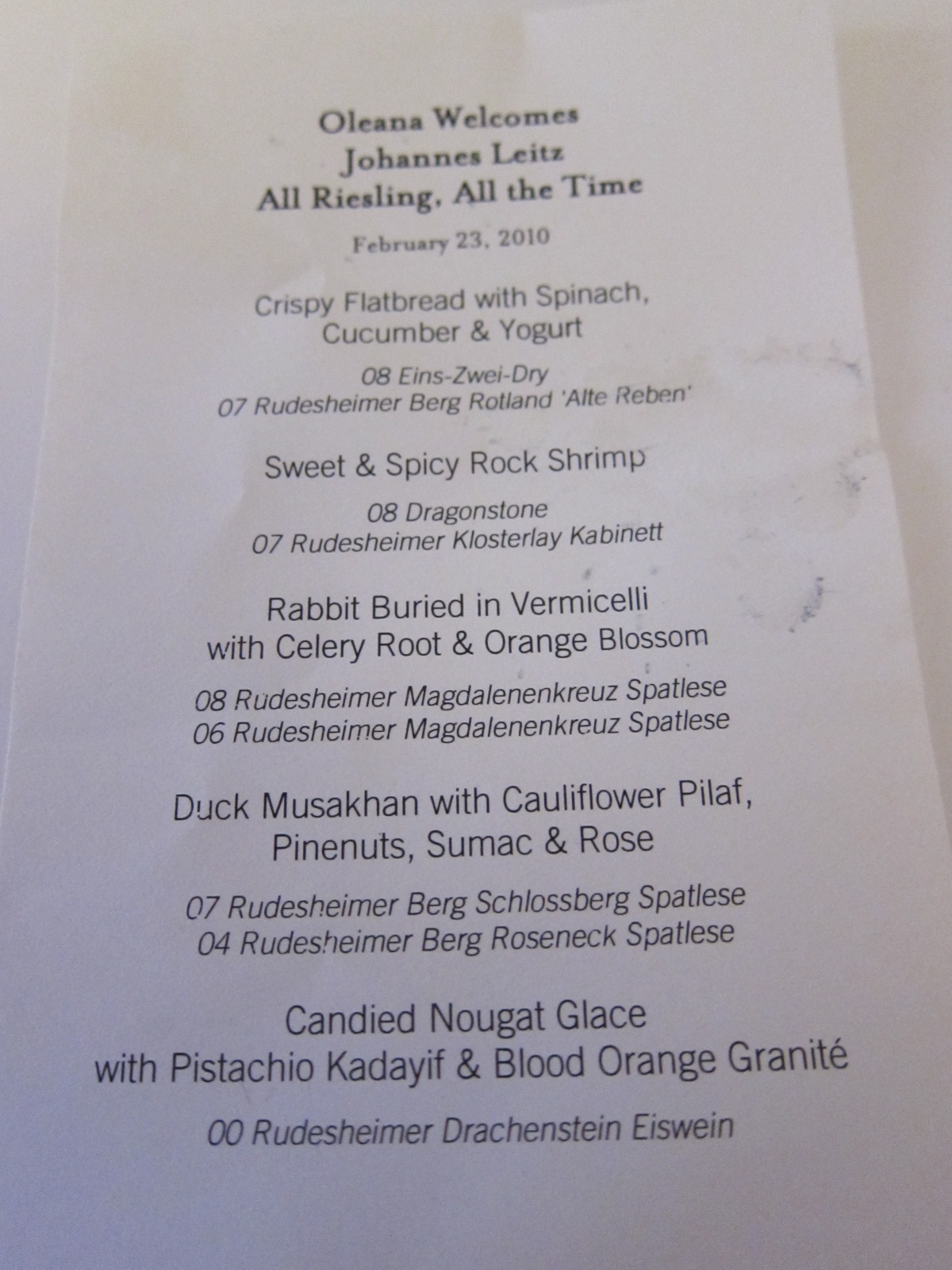
Our favorites were Eins-Zwei-Dry and the 06 Magdalenenkreuz Spatlese.  Riesling is a great food wine.  The main flavor in the food cancels out the corresponding flavor in the wine so you taste different dimensions with each bite/sip.  For instance, I had a Riesling recently with a dish that included a cheesy potato gallette and stewed prunes.  The potato brought out the sweetness and the prunes the dryness.   Hoping to experiment a bit more with them as there are many categories (Kabinett, Spatlese etc.) which correspond to different densities of the grape (!) and other variables.  And the categories correspond to different flavors and sweetness.

I find curling soothing and otherworldly, a sport that Hobbits might play rather than real people.  It turns out my new passion is shared by Wall Street traders.  Some links:

1. History

2. Basic and Advanced Strategy

3. Want to learn in Boston area? Try the Broomstones Curling Club.

  1. The curse of the Blue Nun.
  2. Cable clutter as artEven better.
  3. Visualize tweets about the New York Times.

Via Barker:

Several studies have demonstrated some accuracy in personality attribution using only visual appearance. Using composite images of those scoring high and low on a particular trait, the current study shows that judges perform better than chance in guessing others’ personality, particularly for the traits conscientiousness and extraversion. This study also shows that attractiveness, masculinity and age may all provide cues to assess personality accurately and that accuracy is affected by the sex of both of those judging and being judged. Individuals do perform better than chance at guessing another’s personality from only facial information, providing some support for the popular belief that it is possible to assess accurately personality from faces.

Source: Using composite images to assess accuracy in personality attribution to faces” from British Journal of Psychology

For most aspects of personality I would bet that the reason is simply that your face causes your personality.  Attractive people are confident and extroverted, unattractive people less so.  For other aspects its the other way around.  People who are conscientious comb their hair, etc.

But I am often firmly convinced that I can tell how smart a person is just by looking at them.  And although I can see a few potential causalities, they seem flimsy to me:

  1. You invest more in appearance if it is a substitute for intelligence.  (But can’t they be complementary?  I cling to the belief that my wife sees them so.)
  2. Investments in appearance are short-term.  Smarter people are more patient than that.  (Tell that to Fabio.)
  3. Smart people exude confidence.  (Do they? Dumb people may be even more confident.)

Anyway, I don’t usually think that attractiveness is the key signal (not that I can say what is the key signal.)  But I can imagine that I am consistenly wrong in my judgments of how smart a person is.  If you assume a person is smart then everything they say tends to sound smart.  (Why else would you still be reading this?)

In a nice paper, Chiappori, Groseclose and Levitt look at the zero-sum game of a penalty kick in professional soccer.  They lay out a number of robust predictions that are testable in data, but they leave out the formal analysis of the theory (at least in the published version.)  These make for great advanced game theory exercises.  Here’s one:

The probability that the shooter aims for the middle of the goal (as opposed to aiming for the left side or the right side) is higher than the probability that the goalie stays in the middle (as opposed to jumping to the left or to the right.)

Hint:  the answer is related to my post from yesterday, and you can get the answer without doing any calculation.

Harold Pollack at the New Republic blog The Treatment has an interesting comparative historical analysis of the current push to include the “public option” in the health bill via reconciliation and a famous vote in 1956 on a House bill to extend federal aid to states to build schools:

The bill would have provided federal aid to the states to build schools. Democrats sponsored the bill, which was popular ten years into the baby boom. For familiar pre-election reasons, Republicans wanted HR7535 to die. They got lucky when Harlem Congressman Adam Clayton Powell dropped a hand grenade into the process by proposed an amendment mandating that grants could only be used by states with schools “open to all children without regard to race in conformity with the requirements of the United States Supreme Court decisions.” Urban liberals could hardly oppose this amendment. Yet its inclusion would doom the final bill by driving away critical southern Democratic votes.

The inclusion of the Powell amendment killed the whole bill.  Pollack thinks that the inclusion of the public option would kill the health bill and hence Rockefeller and Obama do not want it included in the reconciliation process.  There are many theories for why Powell offered his amendment.  He could see that it would cause the collapse of the bill. In the process, it would reveal the hypocrisy of the Democratic leadership of the House and that, to him, was a greater goal than building more schools in the short run.  There is no greater goal, like civil rights, at stake in the current health reform so Pollack has a point in suggesting the progressives’ strategy is short-sighted not far-sighted.

People seem to care not just about their own material success but how it measures up to their peers. There is probably a good evolutionary reason for this. Larry Samuelson has shown one way to formalize this idea in this paper.

But here’s a different story and one that is extremely simple. Imagine a speed skating competition with 10 competitors. Suppose that 8 of them skate their heats solo with no knowledge of the others’ times. The remaining 2 also have no knowledge of the others’ times except that they race simultaneously side by side.

Other things equal, each of the two parallel skaters has a greater than 1/10 chance of winning.