The freshly tenured Chris Berry has switched briefly from padding out his CV by publishing like crazy to padding out his belly.  Chris and his colleagues at the Harris School of Public Policy have an encyclopedic knowledge of fried products in the Chicago area, especially if they are fried in duck or pork fat.  But they keep an open mind and are accepting of all kinds of fat so I had the luck to enjoy a donut which Chris picked up at the Rise’ N Roll Amish Bakery.  Loaded with butter and dusted in cinnamon sugar, these donuts are treat not to be indulged in too often. But with New Year’s resolutions of exercise just over a week away, what better time than this to enjoy the cholesterol?

Moving us one step closer to a centralized interview process (a good thing as I have argued), the Duke department of economics is posting video clips of job talks given by their new PhD candidates.  Here is the Duke Economics YouTube Channel, and here is the talk of Eliot Annenberg (former NU undergrad and student of mine btw.)  I expect more and more departments to be doing this in the future. (Bearskin bend: Econjeff)

While we are on the subject here is a recent paper that studies the Economics academic labor market (beyond the rookie market.)  The abstract:

In this paper we study empirically the labor market of economists. We look at the mobility and promotion patterns of a sample of 1,000 top economists over thirty years and link it to their productivity and other personal characteristics. We find that the probability of promotion and of upward mobility is positively related to past production. However, the sensitivity of promotion and mobility to production diminishes with experience, indicating the presence of a learning process. We also find evidence that economists respond to incentives. They tend to exert more effort at the beginning of their career when dynamic incentives are important. This finding is robust to the introduction of tenure, which has an additional negative ex post impact on production. Our results indicate therefore that both promotions and tenure have an effect on the provision of incentives. Finally, we detect evidence of a sorting process, as the more productive individuals are allocated to the best ranked universities. We provide a very simple theoretical explanation of these results based on Holmström (1982) with heterogeneous firms.

via eric barker.

Today the commissioners of the FCC will meet to vote on a new proposed policy concerning Net Neutrality.  It is expected to pass.  Pundits, policymakers and media of all predispositions are hyperventilating over the proposal but none link to it and I can’t find the actual document anywhere.  Does anybody have a link to it?

In a perfectly competitive market, the price of a product is given by its minimum average total cost of production.  The lower this is, the lower the price.  Technological advances have reduced the costs of operating a fridge, air conditioner, washing machine etc… etc….  Consumers will buy more of them and consume more electricity and produce more greenhouse gases.  How much more depends on the elasticity of demand. If elasticity is high, energy consumption may go up so fast that it results in greater resource depletion with greater energy efficiency. This is basic economics and was known in the nineteenth century.   It is known as the Jevons paradox and is the topic on an article in the New Yorker (subscription required):

In 1865, a twenty-nine-year-old Englishman named William Stanley Jevons published a book, “The Coal Question,” in which he argued that the bonanza couldn’t last. Britain’s affluence and global hegemony, he wrote, depended on its endowment of coal, which the country was rapidly depleting. He added that such an outcome could not be delayed through increased “economy” in the use of coal—what we refer to today as energy efficiency. He concluded, in italics, “It is wholly a confusion of ideas to suppose that the economical use of fuel is equivalent to a diminished consumption. The very contrary is the truth.

Jevons is now known more as a utilitarian and one of the founders of mathematical economics.  Who knew he combined the practical with the theoretical?

Commenting on Jonah Lehrer’s article on “The Truth Wears Off,” and how once rock-solid science eventually becomes impossible to replicate, Chris Blattman blames publication bias in all of its various forms.

The culprit? Not biology. Not adaptation to drugs. Not even prescription to less afflicted patients. Rather, it’s scientists themselves.

Journals reward statistical significance, and too many academics massage or select results until the magical two asterisks are reached.

But more worrisome is that much of the problem might be more unconscious: a profession-wide tendency to pay attention to, pursue, write up, publish, and cite unusually large and statistically significant findings.

This is all true, and it’s why you should reject out of hand studies like the one documenting “precognition” that made the rounds a few months ago.  (Who’s gonna even mention, let alone publish a study reporting that “we tried but just couldn’t find evidence that people can see the future”?)

But do be careful:  if there is a publication bias in favor of the unexpected, then you have just as much reason to doubt that the “truth wears off.”  If a fact was first proven then disproven, was publication bias to blame for the proof or the disproof?


  1. A winner is declared in the contest to smuggle the phrase “I smoke crack rocks” into a published article.
  2. Surprisingly accurate account coupled with stunningly confused extrapolation of the Ellsberg ambiguity experiment.
  3. Julian Assange’s OKCupid profile.
  4. Salvia market boom after circulation of Miley Cyrus bong video.
  5. Where are you in the income distribution?
  6. FBI informant infiltrates Irvine, CA mosque.  Muslims are so alarmed at his violent provocations they get a restraining order against him.

There is a new blog, Spousonomics, written by two MILRs, Paula Szuchman and Jenny Anderson.  The topics are near and dear to the Cheap Talk heart: “Using economics to master love, marriage, and dirty dishes.”  You can read about The Definition of A Good Marriage, Wiki-Marriage-Leaks, and Signaling for Sex.

They are doing a series on “Economists in Love” and based on my post on Hormone Neutraility, they assumed I was a sensitive guy and so they asked me a few questions like “Why are you an economist?” and “Is marriage a repeated game?” Of course the reality is that I am emotionally stuck in the 7th grade and so you can see my smart-ass answers here.

Also, there is a picture of me and my wife (she looking hot, me looking like I need a nap.)

Via MR, a wonderful profile and interview with the economist Avinash Dixit.  Avinash has made fundamental contributions to international trade, political economy and the theory of real options.  Avinash has a Schelling-esque style and has a great sense of humor.  It turns out that for many years he has kept hidden in his drawer an analysis of Elaine’s decision problem in an episode of Seinfeld:

Elaine Benes uses a contraceptive sponge that gets taken off the market. She scours pharmacies in the neighborhood to stock a large supply, but it is finite. So she must “re-evaluate her whole screening process.” Every time she dates a new man, which happens very frequently, she has to consider a new issue: Is he “spongeworthy”?

Avinash studies Elaine’s problem formally.  And his model displays all the great qualities one might expect.  First, simplifying assumptions: To get intuition for the key issue – how does the finite supply of sponges affect Elaine’s decision problem – it is good to make the rest of the model stationary.  Hence:

Suppose Elaine believes herself to be infinitely lived; this is a good approximation in relation to the number of sponges she has and her time-discount factor or impatience. She meets a new man every day.

Let Q be the “quality” of a man Elaine meets where Q is drawn from  the uniform distribution on [0,1].  Let Vm be Elaine’s expected utility when she has m sponges left.  Her per-day discount factor is b – Elaine lives in NYC and meets a lot of men! At her optimum, a man is spongeworthy iff

Q+bVm-1>bVm

Given the assumptions made, Avinash can actually explicitly work out the details of the solution to this problem by cranking out Vm. But here are some qualitative insights.

1. Elaine should have a threshold strategy: There is a threshold Qm where a man is spongeworthy iff his Q is greater than this threshold when Elaine has m sponges left.

2. Qm is decreasing: The more sponges Elaine has left, the lower her standards.

3. Vm is decreasing: As Elaine runs our of sponges, her expected utility declines as there are fewer “interactions” remaining.

There are other insights and extensions.  For those, I recommend Avinash’s lovely paper.


Writing naked puts a man at risk of ruin due to financial crash blossoms.

Stare at it a while before clicking through for the disentanglement.  (You might want to read the MR post which inspired it.)

Read the rest of this entry »

In sports, high-powered incentives separate the clutch performers from the chokers.  At least that’s the usual narrative but can we really measure clutch performance?  There’s always a missing counterfactual.  We say that he chokes if he doesn’t come through when the stakes are raised.  But how do we know that he wouldnt have failed just as miserably under normal circumstances?  As long as performance has a random element, pure luck (good or bad) can appear as if it were caused by circumstances.

You could try a controlled experiment, and probably psychologists have.  But there is the usual leap of faith required to extrapolate from experimental subjects in artificial environments to professionals trained and selected for high-stakes performance.

Here is a simple quasi-experiment that could be done with readily available data.  In basketball when a team accumulates more than 5 fouls, each additional foul sends the opponent to the free-throw line.  This is called the “bonus.”  In college basketball the bonus has two levels.  After fouls 5-10 (correction: fouls 7-9) the penalty is what’s called a “one and one.”  One free-throw is awarded, and then a second free-throw is awarded only if the first one is good.  After 10 fouls the team enters the “double bonus” where the shooter is awarded two shots no matter what happens on the first.  (In the NBA there is no “single bonus,” after 5 fouls the penalty is two shots.)

The “front end” of the one-and-one is a higher stakes shot because the gain from making it is 1+p points where p is the probability of making the second.  By contrast the gain from making the first of two free throws is just 1 point.  On all other dimensions these are perfectly equivalent scenarios, and it is the most highly controlled scenario in basketball.

The clutch performance hypothesis would imply that success rates on the front end of a one and one are larger than success rates on the first free-throw out of two.  The choke-under-pressure hypothesis would imply the opposite.  It would be very interesting to see the data.

And if there was a difference, the next thing to do would be to analyze video to look for differences in how players approach these shots.  For example I would bet that there is a measurable difference in the time spent preparing for the shot.  If so, then in the case of choking the player is “overthinking” and in the clutch case this would provide support for an effort-performance tradeoff.

One activity can equally be done by Division A or Division B of a firm but, for historical reasons, Division A has control of it right now.  This gives the managers of Division A lots of power to hire and they like having a little empire.  But the CEO comes up with a plan: Since both divisions are in theory up to the job, have them compete for the activity.

The best way to do this is pretty obvious: If Division A screws up, give the job to Division B.  But of Division A does a good job let them keep it.  This gives Division A good incentives to work hard to do a good job.

In practice it is hard to measure the quality of output so it is hard to implement this simple scheme.  Quality is evaluated by subjective judgements and rhetorical arguments. Perversely, the better the job Division A is doing, the more incentive Division B has to try to steal the job.  This is because a job well done generates lots of slots.  If Division A is doing a bad job, the activity does not look worth stealing.

So, in practice, having the divisions compete for the activity can lead to destruction of incentives.  Better to give one division the property right over the activity and intervene only when outcomes are objectively poor.

It has been suggested that Keynesian economics remains the best framework that we have for making sense of recessions, but that macroeconomic theory also needs to do a better job of incorporating the realities of finance. There may be a fundamental contradiction between these two suggestions.

In their book Microeconomics of Banking, Xavier Freixas and Jean-Charles Rochet noted that there was no microeconomic theory of banking before the 1970s.  Banks and other financial intermediaries earn their profits by knowing more than depositors about the quality of borrowers’ investments.  So an economic theory of banking requires an ability to analyze transactions among agents who have different information.  Economists first developed such agency theories only around 1970, building on previous advances in game theory.

So John Maynard Keynes’s 1936 General Theory and other classic theories of macroeconomics were developed when there was no real economic theory of banking.  Inevitably this limited the scope of their analysis.  For example, if the 1933 Glass–Steagall Act of banking regulatory reform was essential for halting America’s catastrophic slide into the Great Depression, there would be no way to incorporate that fact into the analysis without an economic theory of banking.

An economic theorist who rereads the General Theory today may be struck by the absence of any serious analysis of how massive bank failures could have been involved in causing the Great Depression.  In chapter 11, Keynes briefly discussed moral hazard in lending, but he had no analytical framework to use these insights, and they tended to get lost in the discussion.

But Keynes was a brilliant observer, even when he could not fit his observations into his theories.  For a contrasting view on the role of banks, look at Keynes’s previous book, his 1930 Treatise on Money.  Near the end of that book, in chapter 37, Keynes made the following observation:

“The relaxation or contraction of credit by the Banking System does not operate merely through a change in the rate charged to borrowers; it also functions through a change in the abundance of credit.  If the supply of credit were distributed in an absolutely free competitive market, these two conditions, quantity and price, would be uniquely correlated with one another and we should not need to consider them separately.  But in practice, the conditions of a free competitive market for bank-loans are imperfectly fulfilled.  There is an habitual system of rationing in the attitude of banks to borrowers — the amount lent to any individual being governed not solely by the security and rate of interest offered, but also by reference to the borrower’s purposes and his standing with the bank as a valuable or influential client.  Thus, there is normally a fringe of unsatisfied borrowers who are not considered to have the first claims on a bank’s favours, but to whom the bank would be quite ready to lend if it were to find itself in a position to lend more.  The existence of this unsatisfied fringe allows the Banking System a means of influencing the rate of investment supplementary to the mere changes in the short-term rate of interest.”

There is an interesting suggestion here that even short-term loans might implicitly depend on long-term relationships between investors and financial intermediaries. Such an idea could be the basis for a theory of macroeconomic fluctuations in which bank failures could affect investment.

In 1936, however, Keynes could not build a theory in which monetary policy could affect aggregate investment other than through its effect on the interest rate.  His 1930 observation got lost in his subsequent analysis because it did not fit into his analytical framework.  He had no way to answer the obvious question: If so many eager qualified borrowers are unable to get loans at the current interest rate, why don’t banks offer to lend to them at a higher interest rate?  Today economists understand how such credit rationing can be derived from considerations of adverse selection or moral hazard in borrowing.  The classic introduction to the subject is by Joseph Stiglitz and Andrew Weiss in 1981.

Facebook, Buzz, Reader, and other social networking sites all have one thing in common:  if you like something then you get to like it.  But you never get to dislike what you dislike.  (Sure you can unlike what you previously liked, but just as with that other interest rate you are constrained by the zero lower bound.  You can’t go negative.)

This kind of system seems to pander to people such as me who obsessively count likes (and twitter followers, and google reader subscribers and…) because for people like us even a single dislike would be devastating. With only positive feedback possible we are spared the bad news.

But after a while we start to get the nagging suspicion that the lack of a like is tantamount to being disliked. We put ourselves in the mind of each individual reader.  If she liked it then she will like it.  If she didn’t like it, she would like to dislike it but she can’t.  So she’s silent.  But then if she was neutral she now knows that by being silent she is going to be pooled with with the dislike haters.  She doesn’t want to hurt my feelings so she likes. Kindhearted but cruel:  now I know that everyone who didn’t like indeed didn’t like.  It’s exactly as if there was a dislike button.  Despair.

But wait.  One wrinkle saves our fragile ego.  Some people are just too busy to like.  Or they don’t know about the like button.  And who knows exactly how many people read the article anyway.  So a non-like could be any one of these. Which means that kindhearted neutrals can safely stay on the sidelines and pool with these non-participants. A pool big enough to drown out the haters. Joyful noise! And as a bonus I get to know for sure that the likers are likers and not just patronizers.

Finally there’s the personal aspect, it’s flattering to see who likes.  The serial likers keep me going.   Especially this one regular reader who by amazing coincidence has the same name as me and who likes everything I write.

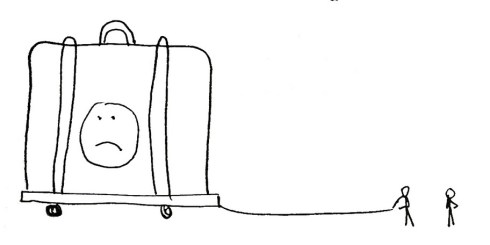
(drawing:  emotional baggage from www.f1me.net)

Islam forbids suicide. Of the world’s three Abrahamic faiths, “The Koran has the only scriptural prohibition against it,” said Robert Pape, a professor at the University of Chicago who specializes in the causes of suicide terrorism. The phrase suicide bomber itself is a Western conception, and a pretty foul one at that: an egregious misnomer in the eyes of Muslims, especially from the Middle East. For the Koran distinguishes between suicide and, as the book says, “the type of man who gives his life to earn the pleasure of Allah.” The latter is a courageous Fedayeen — a martyr. Suicide is a problem, but martyrdom is not.

From an article in the Boston Globe on the psychology of suicide bombers.

When you reach a certain age, your friends start getting honors and you are invited to polite soirees.  At aforementioned polite soirees, there are cheesy delights and sweet little dessert tarts.  The sweet little desert tarts are tastefully arrayed on silver platters and you can easily pick one up and pop it into your mouth without touching any neighboring tarts.  You daintily consume a little fruit tart.

The energizing sugar rush behind you, you turn to the cheesy delight. You are pleased that at this soiree, they have put out the delight out of all delights – the baked brie or the “brie en croute” as we call it at polite soirees.  You head over and shove your way into the line for the warm cheesy delight.  You are rather aggressive and push past a distinguished looking man that you recognize (too late!) as the new President of Northwestern University.  You grin sheepishly and say, “Hi.  I’m Rakesh Vohra.”  You hope this throws him off the scent – even though your colleague Rakesh is balding and white-haired, at least he has the right skin tone.  The President seems to make a mental note to dock your (or Rakesh’s) salary and turns away to talk to someone else.

You turn to the cheesy delight and as you pause to pick up bread your forward momentum, barely broken by the President, is brought to a grinding halt by a fundamental problem: To tong or not to tong.  That is the question.

In other words, should you use the tongs – always provided at polite soirees – to pick up the bread or just stick your grubby hand into the bread basket?  If you think like homoeconomicus, you decision is obvious: Unlike you, many other people followed the proper procedure and headed over to the cheesy delight before the little sweet dessert tarts. They have used the tongs before you and the supersized tweezers are covered in cheeky little germs just hopping with excitement at the prospect of giving you H1N1 for Christmas.  If you stick your grubby hand into the bread basket, you avoid the tong devils but deposit your own cooties on a baguette slice that someone else will pick up.  But you are homo economicus so you do not face any moral dilemma: Ignore the “negative externality” and stick your hand into the bread basket.

Then, you are brought to a stop again, this time by a major “Aha” moment.  Your shove into the line and all your procrastination is causing much grumbling in the cheesy delight queue. But you’re not even aware of this because you’ve had a huge epiphany: Following the recommendation of homo economicus is also the right thing to do from the perspective of society’s objective of minimizing germ transmission.  You guess that Adam Smith must have had a similar experience when the idea of the “invisible hand” hit him just before he was about to tuck into his haggis and scotch.

You reason as follows: When you stick your hand into the bread basket, you might not even hit another bit of bread other than your own.  Even if you aim misses because of the two glasses of champagne you drank on an empty stomach, you’re only going to hit a few other slices of ever staler bread.  While if you use the tong, you are guaranteeing that the long line of people behind you get to experience your lack of good hygiene.  It is better for everyone if you stick your hand in the bread basket.

Your face disfigured by an angelic smile, confident your are doing the right thing for once, you follow the route Immanuel Kant himself would take and finally consume some cheesy delight.  You turn around to see the President looking at you as if you’re some kind of animal.  You wipe your cheese covered hand on your jeans and grasp his.  You say, “Call me Ricky.”  You run out before your cover is broken.

  1. Richard Dawkins reads his hate mail.
  2. Mobius Bagel.
  3. Recursive plagiarism.
  4. Bartending injuries.

Arbitraging profiling.

A white bank robber in Ohio recently used a “hyper-realistic” mask manufactured by a small Van Nuys company to disguise himself as a black man, prompting police there to mistakenly arrest an African American man for the crimes.

Congratulations Jeff!!!  NU is lucky to have you.

You hear this a lot in Chicago.  “We are having a cold snap because there is a low-pressure system over the Midwest and a high-pressure system to the North.  This causes windy conditions which brings cold air down from Canada.”

This sounds better than just saying “it’s cold today” but I can’t tell if it really is saying anything more than that.  First of all, as I have said before the following two statements are equivalent, at least empirically:

  1. The air is colder than usual
  2. The air was blown here from some place colder than here.

So telling me that the air came from Canada isn’t telling me much more than I already knew, it’s cold.  But the extra bit here seems tautological at an even deeper level because these two statements:

  1. The air is blowing from down Canada
  2. There is high pressure in the North and low pressure here

appear to be literally the same thing.  Why else would the air move from position A to position B if it were not due to pressure imbalances?

Is meteorology really just like finance?  (“Stocks fell today because of bearish investors”)  Or is there a non-circular way of explaining my frozen toes that just doesn’t fit into a 30 second weather report?

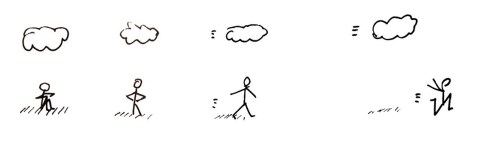
(drawing: glooming from http://www.f1me.net)

Sometimes it seems that they only understand the language of force. We have learned from history that the appeasement of an aggressive adversary can be a disastrous mistake, with our concessions only encouraging further attacks on our communities. To deter them from attacking us, we need armed strength, and our leaders must demonstrate the resolve to use it when necessary.” What should we say to someone who describes the Israeli-Palestinian conflict in these terms?

A game theorist is trained to look at conflict problems from both sides, assuming that people on both sides are rational and intelligent. I have tried to write the above quote as one that many Israelis and Palestinians might consider a fair description of their situation, symmetrically identifying themselves as “we” and the other side as “they”, but the symmetry of this view is probably not common knowledge. In particular, many may not understand the other side’s fear of appeasing an aggressive adversary. Such misunderstanding can undermine hopes for peace.

In the above quote, the response to our armed strength that “we” seek from “them” is, in a word, appeasement. We want them to appease us. But why should they not fear that concessions to us could encourage our greater ambitions, inviting further invasion of their communities? And if the demand for armed vigilance on each side is matched by a fear of appeasement on the other side, how can the two sides ever escape from the long war of attrition?

We must think more carefully about the logic of deterrent strategies. Our strategy to deter potential adversaries must have two parts: a threat that we will fight them if they attack us, and a promise that we will be good restrained neighbors if they accommodate us. The difference between our threat and our promise is what encourages them toward accommodation. For our deterrent strategy to be effective, our potential adversaries must understand and believe both the threat and the promise.

Failing to credibly communicate the threat is naive appeasement. Our potential adversaries must not think that we are the weak type of people, who lack resolve to respond forcefully against aggression. To prove that we are not weak may require costly signals of our resolve, many of which have become too familiar: sending out young men on deadly missions against the other side.

But deterrence can fail also if we do not credibly communicate a promise that differs from the threat. If they believe that we are an aggressive type, who cannot restrain ourselves from invading their communities further at any feasible opportunity, then they will feel driven to seek militant leaders against us, and then we will be locked in conflict with them.

How can we demonstrate to them that we are not such an aggressive type? This is a very serious question, because everyone knows that aggressors may try to mask their intentions with honeyed words of peace. The point is not to convince ourselves of our own moral purity; the goal is to convince our adversaries that they can safely make peace with us.

We can effectively signal our restraint by articulating clear strategic limits that verifiably constrain our actions in the conflict, and by showing real understanding and respect for justice as our adversaries see it. Credibly communicating our promise of restraint to a suspicious adversary can be a long and difficult process, but it is an essential part of effective communication in the language of force.

That is the theory. Today we learned that Israel has resisted intense American pressure to freeze expansions of its settlements in the West Bank. It is hard to see this decision as a signal of restraint. Indeed, it seems just the opposite. In rejecting its strongest ally’s interpretation of the legal limits on its expansion, Israel seems to have given a costly signal of an inability to restrain expansionist forces in its political system. Nobody can enter into a treaty without confidence that the other side will accept a mutually agreed interpretation of its limits under the treaty. As a costly signal that reduces the other side’s willingness to make peace, this decision may be less stark than missiles from Gaza, but it is only a matter of degree.


We dress like students, we dress like housewives
or in a suit and a tie
I changed my hairstyle so many times now
don’t know what I look like!

Life during Wartime, Talking Heads

Mr C. is the new C.E.O. of your firm, Firm C.  He was head of operations at one of your competitors Firm A.  He was passed over for promotion there and had to exit to get to the C Suite.  You wonder about the wisdom of your Board: Why would they choose someone who rejected for the top job by their own company?  You subscribe the “Better the Devil you know, than the Devil you don’t” principle.  If your firm appoints an internal person to the top job, at least you know their flaws and can adapt to them.  This principle also applies at Firm A.  So, if they rejected the Devil they know, he must be a really terrible Devil or, to put it in tamer economic terms, a “lemon.”

But you are also aware of the counter argument: Real change can only be achieved by an outsider.  Mr C said some smart things in the interview process and so you are happy to give him the benefit of the doubt.  You are expecting Mr C.  to define a mission for Firm C, a mission that everyone can sign on to.  Of course, to persuade everyone to work hard on the vision it has to be a “common value” – something everyone agrees is good – not a “private value” – something only a subgroup agrees is good.  In this regard, Mr. C surprises you – he makes a big play that Operations are the most important thing in a successful firm.  “Look at H.P. and Amazon,” he says.  “They don’t actually make anything, just move stuff around efficiently and/or put in together from parts they buy from other firms.  We need innovation in Operations not fundamental innovation in our product line.”

You are shocked.  Your firm has R and D Department that has produced amazing, fundamental innovations.  Innovative ability is sprinkled liberally throughout your firm in – it is famous for it.  It is a core strength of Firm C.  Why would anyone want to destroy that and focus on Operations?  What should do you do?  In times of trouble, you have a bible you turn to  – Exit, Voice and Loyalty by Albert Hirshman

Should you give voice to your concerns?  The last CEO ignored you and the new CEO might give you more attention so you had thought that you might talk to him.  But your first impressions are bad and something you might say might be misinterpreted and lead to the opposite conclusion in the mind of the new CEO.  Talking is dangerous anyway.  You might be identified as a troublemaker and given lots of terrible work to do.  Better to keep quiet and blend in with the crowd.

Is loyalty enough to keep you working hard anyway?  Your firm is not a non-profit and, given the CEO plans to quash innovation, it is basically going to produce junk.  Why should anyone be loyal to that?

You are drawn inexorably to Hirshman’s last piece of advice: exit.  This is hard during the Great Recession – there are few jobs going around.  You will be joined by all those who can exit from your sinking ship C so you have to move fast….

To use the justice system most effectively to stop leaks you have to make two decisions.

First, you have to decide what will be a basis for punishment. In the case of a leak you have essentially two signals you could use. You know that classified documents are circulating in public, and you know which parties are publishing the classified documents. The distinctive feature of the crime of leaking is that once the documents have been leaked you already know exactly who will be publishing them: The New York Times and Wikileaks. Regardless of who was the original leaker and how they pulled it off.

That is, the signal that these entities are publishing classified documents is no more informative about the details of the crime than the more basic fact that the documents have been leaked. It provides no additional incentive benefit to use a redundant signal as a basis for punishment.

Next you have to decide who to punish. Part of what matters here is how sensitive that signal is to given actor’s efforts. Now the willingness of Wikileaks and The New York Times to republish sensitive documents certainly provides a motive to leakers and makes leaks more likely. But what also matters is the incentive-bang for your punishment-buck and to deter all possible outlets from mirroring leaks would be extremely costly. (Notwithstanding Joe Lieberman.)

A far more effective strategy is to load incentives on the single agent whose efforts have the largest effect on whether or not a leak occurs: the guy who was supposed to keep them protected in the first place. Because when a leak occurs, in addition to telling you that some unknown and costly to track person spent too much effort trying to steal documents, it tells you that your agent in charge of keeping them secret didn’t spend enough effort doing the job you hired him to do.

You should reserve 100% of your scarce punishment resources where they will do the most good, incentivizing him (or her.)

(Based on a conversation with Sandeep.)

Update: The Australian Government seems to agree. (cossack click:  Sandeep)

One way players might play a game is by learning over time till they reach a best response to strategies they have observed in the past.  If learning converges, then a natural  hypothesis due to Fudenberg and Levine , is that it settles on a self-confirming equilibrium:

Self-Confirming Equilibrium (SCE) is a relaxation of Nash equilibrium: Each player chooses a best response to his beliefs and his beliefs are “correct” on the path of play.  But different players may have different beliefs over strategies off the path of play and may believe that players’ actions are correlated.  Nash equilibrium (NE) requires that players’ beliefs are also correct off the path of play, that all players have the same beliefs over off the path play and that players’ strategies are independent.  As the definition of Nash equilibrium puts extra constraints on beliefs, the set of Nash equilibria of a game cannot be larger than the set of self-confirming equilibria.

There is no reason why learning based on past play should tell us anything about off path play.  So SCE is a more natural prediction for the outcome of learning than NE.  Finally, we come to college football!

The University of Oregon football team has been pursuing an innovative “off the path” strategy:

“Oregon plays so fast that it is not uncommon for it to snap the ball 7 seconds into the 40-second play clock, long before defenses are accustomed to being set. That is so quick that opponents have no ability to substitute between plays, and fans at home do not have time to run to the fridge.”

Opposing teams on defense are just not used to playing  against this strategy and have not developed a best-response.   So far they have come up with an import from soccer, the old fake an injury strategy.  This has yielded great moments like the YouTube video above.

I am trying to relate this football scenario to SCE.  SCE does not incorporate experimentation which is what the Oregon Ducks are trying so this is immediately inconsistent with SCE.  But set that aside – even without experimentation, is the status quo of slower snaps and best responses to them an SCE?  I think it is and that it is even consistent with NE.

Even in a SCE of the two player sequential move game of football, the offense has to hypothesize what the defense would do if the offense plays fast.  Given their conjecture about the defense’s play if the offense plays fast, it is better for the offense to play slow rather than play fast.  Their conjecture about the defense’s play to fast snaps does not have to be at a best response for the defense as this node is unreached.  And the defense plays a best response to what they observe – slow play by the offense. So both players are at a best response and the offense’s conjecture about the defense play off the path of play can be taken to be “correct” as neither SCE nor NE put restrictions on the defense being at a best response off the path of play.

In other words, in two player games, a SCE is automatically a NE.  From diagonalizing Fudenberg and Levine, it seems this that this is true if you rule out correlated strategies (but I am administering an exam as I write this so I cannot concentrate!). If I am right, the football example is consistent with SCE and hence NE. (In three (or more) player games, there can be a substantive difference between SCE and NE as different players can have different conjectures on off path play in SCE but not NE and this can turn out to be important.)

But the football experience is not necessarily a Subgame Perfect Equilibrium. This adds the requirement of sequential rationality to Nash equilibrium:  Each player’s strategy at all decision nodes, even those off the path of play, has to be a best response to his beliefs and beliefs have to be correct etc.   So, it may be that football teams on offense have been assuming there is some devastating loss to playing fast.  First, it is simply hard to play fast and perhaps they thought it was easy to defend fast snaps.  But since this was never really tested, no-one really knew it for a fact.

Now the Oregon Ducks are experimenting and their opponents are trying to find a best response.  So far they have come up with faking injuries.  Eventually they will find a best response.  Then and only then will the teams learn whether it is better for the offense to have fast snaps or slow snaps.  And then they will play subgame perfect equilibrium: the offense may switch back to slow snaps if the best response to fast snaps if sufficiently devastating.

For 4.6 billion years, the Sun has provided free energy, light, and warmth to Earth, and no one ever realized what a huge moneymaking opportunity is going to waste. Well, at long last, the Sun is finally under new ownership.

Angeles Duran, a woman from the Spanish region of Galicia, is the new proud owner of the Sun. She says she got the idea in September when she read about an American man registering his ownership of the Moon and most of the planets in the Solar System – in other words, all the celestial bodies that don’t actually do anything for us.

Duran, on the other hand, snapped up the solar system’s powerhouse, and all it cost her was a trip down to the local notary public to register her claim. She says that she has every right do this within international law, which only forbids countries from claiming planets or stars, not individuals:

“There was no snag, I backed my claim legally, I am not stupid, I know the law. I did it but anyone else could have done it, it simply occurred to me first.”

She will soon begin charging for use.  I advise her to hire a good consultant because pricing The Sun is not your run-of-the-mill profit maximization exercise. First of all, The Sun is a public good.  No individual Earthling’s willingness to pay incorporates the total social value created by his purchase.  So it’s going to be hard to capitalize on the true market value of your product even if you could get 100% market share.

Even worse, its a non-excludable public good.  Which means you have to cope with a massive free-rider problem.  As long as one of us pays for it, you turn it on, we all get to use it.  So if you just set a price for The Sun, forget about market share, at most your gonna sell to just one of us.

You have to use a more sophisticated mechanism.  Essentially you make the people of Earth play a game in which they all pledge individual contributions and you commit not to turn on The Sun unless the total pledge exceeds some minimum level.  You are trying to make each individual feel as if his pledge has a chance of being pivotal:  if he doesn’t contribute today then The Sun doesn’t rise tomorrow.

A mechanism like that will do better than just hanging a simple price tag on The Sun but don’t expect a windfall even from the best possible mechanism.  Mailath and Postlewaite showed, essentially, that the maximum per-capita revenue you can earn from selling The Sun converges to zero as the population increases due to the ever-worsening free-rider problem.

You might want to start looking around for other planets in need of a yellow dwarf and try to generate a little more competition.

(Actual research comment:  Mailath and Postlewaite consider efficient public good provision.  I am not aware of any characterization of the profit-maximizing mechanism for a fixed population size and zero marginal production cost.)

[drawing:  Move Mountains from http://www.f1me.net]

  1. Neologism of the moment:  gate rape.
  2. When did you decide to be straight?
  3. Transcription errors in the Yale Anthology of Rap.
  4. Parkour for lazies.
  5. Nativity on Google StreetView.
  6. This just in: special bonus sordid link, courtesy of kottke.org.  Painful flashback inducement machine.

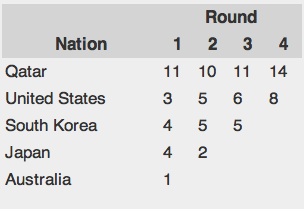
Today Qatar was the surprise winner in the bid to host the FIFA World Cup in 2022, beating Japan, The United States, Australia, and Korea.  It’s an interesting procedure by which the host is decided consisting of multiple rounds of elimination voting.  22 judges cast ballots in a first round.  If no bidder wins a majority of votes then the country with the fewest votes is eliminated and a second round of voting commences.  Voting continues in this way for as many rounds as it takes to produce a majority winner.  (It’s not clear to me what happens if there is a tie in the final round.)

Every voting system has its own weaknesses, but this one is especially problematic giving strong incentives for strategic voting.  Think about how you would vote in an early round when it is unlikely that a majority will be secured. Then, if it matters at all, your vote determines who will be eliminated, not who will win.   If you are confident that your preferred site will survive the first round, then you should not vote truthfully.  Instead you should to keep bids alive that will easier to beat in later rounds.

Can we look at the voting data and identify strategic voting?  As a simple test we could look at revealed preference violations.  For example, if Japan survives round one and a voter switches his vote from Japan to another bidder in round two, then we know that he is voting against his preference in either round one or two.

But that bundles together two distinct types of strategic voting, one more benign than the other.  For if Japan garners only a few votes in the first round but survives, then a true Japan supporter might strategically abandon Japan as a viable candidate and start voting, honestly, for her second choice.  Indeed, that is what seems to have happened after round one.  Here are the data.

We have only vote totals so we can spot strategic voting only if the switches result in a net loss of votes for a surviving candidate.  This happened to Japan but probably for the reasons given above.

The more suspicious switch is the loss of one vote for the round one leader Qatar. One possibility is that a Qatar supporter , seeing Qatar’s survival to round three secured, cast a strategic vote  in round two to choose among the other survivors. But the more likely scenario in my opinion is a strategic vote for Qatar in round one by a voter who, upon learning from the round 1 votes that Qatar was in fact a contender, switched back to voting honestly.

Part I of BBC program:

Groovy Action At A Distance

Isaac Washington was so cool
That when he left his stateroom
He would set the door in motion
With the precise velocity
That in the time it would take
For the deceleration
To bring the locking mechanism
To a halt
An infinitessimal measure short
Of fully shut
He has walked
No, drifted,
Just far enough across the deck
At which distance
The radiant force of his
Cool
Was just enough to induce
The final click.

Obama’s favorite strategy is to be middle-of-the-road: don’t side with either Democrats or Republicans and hope both sides support a compromise plan.  To do this effectively, it is important not to reveal your true preferences and maintain “strategic ambiguity” as clarity risks alienating one audience or the other.  But if it is obvious that one side is not going to support you, you have to show your hand to get the other audience to buy in.  Otherwise, no-one will support your policy and it will never pass.  I mentioned that Obama already had to do this earlier this year with healthcare reform.  Now an interesting article by Matt Bai points out that he faces a similar dilemma over debt reduction.

Mr. Obama has almost invariably sought to position himself halfway between traditionalism and reform, just as his vague notions of “hope” and “change” during the 2008 campaign were meant to appeal simultaneously to both disaffected independent voters and core progressives. And in virtually every case, he has satisfied pretty much no one….Since he isn’t willing to break publicly with liberals, independent and conservative voters tend to see him as a tool of the left. And since he generally won’t do exactly what the left wants him to do, he ends up with very little gratitude from his own party.

This political no-man’s land, however, is about to become uninhabitable. The national debt is near the top of any list of voter concerns at the moment, and when his commission votes Friday on its final recommendations, Mr. Obama will be handed concrete and contrasting options for addressing it.


And sell them in January to take advantage of the January effect: the predictable increase in stock prices from December to January. Many explanations have been, the most prominent being a tax-motivated sell-off in December by investors trying to realize a capital loss before the end of the year. But here is a paper that demonstrates a large and significant january effect in simple laboratory auctions. Two identical auctions were conducted, one in December and one in January and the bidding was significantly higher in January.

In the first experimental test of the January effect, we find an economically large and statistically significant effect in two very different auction environments. Further, the experiments spanned three different calendar years, with one pair of auctions conducted in December 2003 and January 2004 and another pair of auctions conducted in December 2004 and January 2005. Even after controlling for a wide variety of auxiliary effects, we find the same result. The January effect is present in laboratory auctions, and the most plausible explanation is a psychological effect that makes people willing to pay higher prices in January than in December.

Sombrero swipe: Barking Up The Wrong Tree.