(Regular readers of this blog will know that I consider that a good thing.)

It is rare that I even understand a seminar in econometric theory let alone come away being able to explain it in words but this one was exceptionally clear.

A perennial applied topic is to try to measure the returns to education.  If someone attends an extra year of school how does that affect, say, their lifetime earnings? Absent a controlled experiment, the question is plagued with identification problems.  You can’t just measure the earnings of someone with N years of education and compare that with the earnings of someone with N-1 years because those people will be different along other, unobservable, dimensions.  For example, if intrinsically smarter students go to school longer and earn more, then that difference will be at least partially attributable to intrinsic smartness, independent of the extra year of school.

Even a controlled experiment has confounding factors.  Say you divide the population randomly into two groups and lower the cost of schooling for one group. Then you see the difference in education levels and lifetime earnings among these groups.  These data are hard to interpret because different people in the treated group will respond differently to the cost reduction, probably again depending on their unobserved characteristics.  Those who chose to get an extra year of education are not a random sample from the treated group.

Torgovitzky shows that under a natural assumption you can nevertheless identify the returns to additional schooling for students of all possible innate ability levels, even if those are unobservable.  The assumption is that the ranking of students by educational attainment is unaffected by the treatment.  That is, if students of ability level A get more education than students of ability level B when education is costly, they would also get more education than B when education is less costly.  (Of course their absolute level of education will be affected.)

The logic is surprisingly simple.  Under this assumption, when you look at students in the Qth percentile of education attainment in the treated and control groups, you know they have the same distribution of unobserved ability.  So whatever their difference in earnings is fully explained by their difference in education attainment. (Remember that the Qth percentile measures the relative position in the distributions.  The Qth percentile of the treated groups education distribution is a higher raw number of years of schooling.)

Not only that, but after some magic (see figure 1 in the paper), the entire function mapping (quantiles of) ability level and education to earnings can be identified from data.

Thanks to everyone who suggested restaurants.  I went to three:

  1. Rootdown Denver.  The clear favorite.  Loud, trendy, waitstaff heavily tattooed.  Small plates for under $10 each.  I had beet gnocchi, carrot and thai red curry soup, some other stuff. All great.  I was lucky to find a seat at the bar otherwise I would have waited a long time.  So definitely you need reservations. The best part of my dinner was that I finally found a bar that serves a mythical cocktail:  The Aviation.  I have been looking for this for a decade.  It was fantastic.  Thanks for the pointer Dan!
  2. Osteria Marco.  Fine but typical Italian.  I had pizza.  I’ve had worse. They served by the glass a blend of Dolcetto, Barbera, and Nebbiolo from Langhe. That was something new for me, and I liked it.
  3. Tastes Wine Bar.  A little depressing because I was the only person there. But the food was somewhat adventurous and good.  The wine was fine, but not the kind of varied selection I would have expected from a place that calls itself a wine bar.  The menu listed a sauvignon blanc from the Loire and when I ordered it to start with, I was told that they were out and tonight they were substituting a Sauv Blanc from Colorado!!  I did taste it. Once.

Its a shame I didnt make it to the Fluid coffee bar that Jacob Grier suggested. I was going to stop there on Sunday before going to the airport but Denver got hit with a snow storm and so I got on standby and headed to the airport early to make sure I got out of there before the flights were cancelled.

An article in the WSJ describes an escalating conflict between American Airlines and intermediaries selling tickets to consumers:

In a retaliatory move against American Airlines, Sabre Holdings Corp., a middleman for many carriers’ seats, said it is raising the fees it charges American to distribute its fare information and sell its seats through thousands of travel agents….The jab follows efforts by American, the third-largest U.S. airline by traffic, to sell more of its tickets directly to consumers, a strategy designed to cut costs and give the airline more opportunities to court customers.

Getting rid of middlemen can increase surplus and efficiency.  Getting rid of realtors or car salesmen eliminates the surplus they capture and hence increases the surplus left for buyer and sellers for houses and increases trade.   This is the famous “double marginalization” problem as both the realtor/carsalesman and the seller charge a margin and eliminating the middleman eliminates one margin and one negative externality and increases trade.  And who cries for the middleman if he loses out?

But the airline story has a different dimension: Expedia, Orbitz etc. allow easy comparison shopping.  With consumers comparing prices, in a fragmented airline market, one firm or the other will undercut its competitors to make sales. This kind of thing will ensure prices are close to costs.  But now, consumers will have to go to the AA website to see the prices and will find it harder to comparison shop. With positive search costs, prices can rise.  The Diamond paradox is an extreme example of this.  So, I guess I agree with Expedia:

Expedia lashed out at American last weekend for trying to replace the distribution model with the direct-connect network that American has developed in recent years to hook up directly with travel agencies. It called American’s push “anti-consumer” and “anti-choice,” arguing costs would jump for travel agents and there would be less pricing transparency for consumers.

If this is right, consumers will lose in the war between Expedia and AA if other airlines follow suit and ditch the intermediaries.

I am making a prediction.  For reasons discussed in this previous post, its important that I announce the prediction but keep it a secret until the uncertainty is resolved. Following the suggestion of a commenter, I wrote my prediction in a text file and ran it through the SHA1 secure hash algorithm (using the web tool here.)  Here is the hash:

a35fc654c7a68404bcb94b3b6a1d162223ff69e5

Briefly, this is a digital signature that is (for practical purposes) uniquely associated with the text.  But the algorithm is “one-way:” unless you have a powerful computer you will not be able to invert the mapping and discover my prediction from the hash.

When the uncertainty is resolved (it will happen in the not-too-distant future) I will post the prediction here.  You can then take it and generate the SHA1 hash and verify that it is the one above.  That will prove that the prediction I show you is in fact the one that I have made today.

While we are waiting to find out, you can try to predict what my prediction is. (No, my prediction is not about what you will predict I predicted.)

Update on Jan 10 (one day later:) Having forgotten one important detail, I have updated the prediction and the new hash is:

f502acfb48395d6ab223ca30803f98b9bd6fd6ce

When I reveal the prediction, sometime before the Summer Solstice, I will reveal both text files and you will see the (innocuous) reason for the update.

As suggested in the comments, since I am able to modify the text of this blogpost, I should post the hash somewhere that it cannot be modified.  Since Twitter puts a timestamp on every tweet and tweets cannot be edited ex post, I tweeted the two hashes.  Here and here.

Illinois governor Pat Quinn is considering whether to sign into law a tax bill that includes a new tax on online retailers, the so-called Amazon Tax.  Until now, online transactions are not taxed in states where the retailer has no physical presence (with a few exceptions.)  The new measure would end this in Illinois, treating Amazon as an Illinois retailer so long as one of its online affiliates is based in the state.  (Every state has thousands of online affiliates.)

Amazon is responding by playing chicken.  From Presh Talwalker:

So Amazon is fighting back at Illinois with a threat. Amazon has emailed its commissioned affiliates the following message:

We regret to inform you that the Illinois state legislature has passed anunconstitutional tax collection scheme that, if signed by Governor Quinn, would leave Amazon.com little choice but to end its relationships with Illinois-based Associates. [emphasis mine]

The following logic seems to explain the motive. If Amazon ends its affiliate relationships in Illinois, then it would have no physical presence in the state, and hence it would get around the bill.

The email levies harsh criticism at Illinois and is meant to garner sympathy. In reality, the move is calculated and strategic.

Amazon is threatening all affiliates on purpose – even though it doesn’t have to. Here is an interesting tidbit the Chicago Tribune reported:

The bill applies only to affiliates that have at least $10,000 a year in revenue. But if large retailers, such as Amazon, cut off all affiliates in Illinois, it would end commission streams to small Web sites, such as bloggers, who might sell Amazon goods at their sites. Amazon could not be reached for comment.

Amazon is playing a classic retaliatory strategy. If Illinois wants to pass this law, then it will do everything to hurt the state and even otherwise innocent and small-time bloggers, who might decide its time to complain to Gov. Pat Quinn.

There’s more in Presh’s article here. (Amazon seems to understand reputation building because it carried through with its threat in Colorado when that state passed a similar measure.)

My view is that the threat is credible even ignoring reputation-building.  The lost revenue from sales tax would dwarf the losses from cutting off affiliates.

  1. …5 radios, a bathtub, and a grand piano.  (with an improvisation due to a dispute with labor unions.)
  2. Women laughing, alone, with salad.
  3. Douchebags love Grey Goose.
  4. Josh Groban sings Kanye West’s tweets.
  5. The evolution of Barbie.

25 of them.  Ranging from “Creepy Animal Experiments” to “It Could Destroy The World” (i.e. LHC).  The usual suspects are there, but this one is new to me (from “Mind Control”)

MK-ULTRA
MK-ULTRA was a code name for a series of CIA mind-control research experiments, heavily steeped in chemical interrogations and LSD dosing. In operation Midnight Climax, they hired prostitutes to dose clients with LSD to see its effects on unwilling participants.

Here’s wikipedia on MKULTRA, and on Operation Midnight Climax.

(Barretina bluster:  Arthur Robson who quips “Economics has the power to bore rather than to scare, at least.”)

Ohio counties solicited bids for road salt from Cargill and Morton Salt.  The two companies divided up the counties and hiked up prices:

James Canepa, a deputy inspector general for the state Department of Transportation, said the pricing practice ”crystallized” in 2008 when Morton and Cargill were the only suppliers that presented bids for salt in Ohio’s 88 counties.

In no instance did the companies present bids against each other, Canepa said. At the same time, prices spiked, shortages were reported and salt companies enjoyed record profits, he said.

”Not once in 88 counties did they bid head-to-head,” Canepa said. ”And the counties that they bid were the same ones that they won previously. Those are their incumbencies. Those are their, quote, customers. So, 2008 really crystallized the carve-up of counties.”

But no explicit communication took place and a Cargill spokesman:

pointed to a statement in the first page of the report that says ”we failed to find evidence that the two companies communicated on salt bids.”

”We never did or would talk to competitors about bids,” he said.

(Hat tip Matt)

Jeff and thousands of others head to Denver for the job market meetings.  Our flyouts in MEDS begin next week.  I am going to dinner with our first candidate on Sunday night.  I already know him and he already has an offer from UofC.  He can relax, enjoy giving his paper and meeting everyone on all his flyouts.  He hopefully can also enjoy dinner on Sunday without any feeling of nervousness.  Those not in this lucky position will be more worried about their visits.  My brain addled by 10 hours of teaching so far this week, I will focus on the most trivial aspect of the visit – the job market dinner.  I discussed this in a previous post from the perspective of faculty so let me switch focus and put myself in the shoes of the candidate.

Most obviously, people will still be checking you out as a future colleague at dinner.  Will you be fun to hang out with?  Are you a potential co-author etc etc…?  So, unfortunately, you’ll still be “performing.”

Less crucially, there are the wine and dessert questions.  Should you have a glass or wine and should you order dessert?  Are you exposing yourself as an alcoholic by having a drink?  Are you exposing yourself as an out-of-control sugar-holic by having dessert?  Let me put your mind to rest on these two questions.

Some if not all the people going to dinner with you will also want to have a glass of wine.  This is especially true of macroeconomists who will want to have many, many drinks and then go to a bar after dinner.  So, by all means say you would like a drink if you want one and say no if you do not.  Others will drink anyway even if you refuse so just report your true preferences.

The dessert question is a bit more subtle.  If you do not order dessert, neither will anyone else.  Perhaps you are really tired and want to go to your hotel and go to sleep.  They will want to be polite and not delay you.  (The macro-economists will drop you off and go to the bar without you.)  But, some of the people at dinner will want to have dessert.  The senior faculty do not get out to good restaurants too much anymore and are focused on childcare most evenings. Of course they want dessert!  So here, you must misrepresent your true preferences – order dessert and let everyone else go crazy and order the crème brûlée and the chocolate cake.  They will thank you for it and think of you kindly when they vote on offers.  If you are not hungry, order a sorbet.  If you can’t eat it, let it melt and pour it surreptitiously into the flower arrangement in the middle of the dining table – there will be such an arrangement at the fine dining destination they will take you to.

In a paper published in the Journal of Quantitative Analysis in Sports; Larsen, Price, and Wolfers demonstrate a profitable betting strategy based on the slight statistical advantage of teams whose racial composition matches that of the referees.

We find that in games where the majority of the officials are white, betting on the team expected to have more minutes played by white players always leads to more than a 50% chance of beating the spread. The probability of beating the spread increases as the racial gap between the two teams widens such that, in games with three white referees, a team whose fraction of minutes played by white players is more than 30 percentage points greater than their opponent will beat the spread 57% of the time.

The methodology of the paper leaves some lingering doubt however because the analysis is retrospective and only some of the tested strategies wind up being profitable.  A more convincing way to do a study like this is to first make a public announcement that you are doing a test and, using the method discussed in the comments here, secretly document what the test is.  Then implement the betting strategy and announce the results, revealing the secret announcement.


I arrive there this evening, hungry.

Navy Captain Owen Honors was relieved of his command of The USS Enterprise. This is the guy behind the viral videos that made the news this week.

I want to blog about the news coverage of the firing. For example, this Yahoo! News article has the headline “Navy Firing Over Videos Raises Questions Of Timing.”  Here is the opening paragraph:

The Navy brusquely fired the captain of the USSEnterprise on Tuesday, more than three years after he made lewd videos to boost morale for his crew, timing that put the military under pressure to explain why it acted only after the videos became public.

Two observations:

  1. Sadly, it does make perfect sense to respond to his firing now by complaining that he wasn’t fired earlier.  (And to complain less if he wasn’t fired at all.) The firing now reveals that his behavior crosses some line that the Navy has private information about.  Now that we know he crossed that line we have good reason to ask why he wasn’t punished earlier.
  2. Obviously that fact implies that it is especially difficult for the Navy to fire him now, even if they think he deserves to be fired.

The more general lesson is that there is tragically too little reward for changing your mind due to social forces that are perfectly rational and robust.  The argument that a mind-changer is someone who recognizes his own mistakes and is mature enough to reverse course cannot win over the label that he is a “waffler” or other pejorative.  And the force is especially strong when it comes to picking a leader.


It’s looney to celebrate New Years, New Millenia, etc.  Every day counts equally in the march of time.  Just by arbitrary historical accident one of those days is called the first day of the year.

But it occurred to me when I wrote the post about the rise in stock prices last month that there is social value from coordinating our focus on arbitrary milestone days.  If someone presents statistics to you about the behavior of some variable over the course of a year, which would be more meaningful?

  1. Stocks rose x% from July 9 2010 to July 9 2011.
  2. Stocks rose x% from Jan 1 2010 to Jan 1 2011.

Subjectively, it is more likely that the dates for the first range were cherrypicked by the statistician to generate the conclusion.  Restricting attention to dates that have significance “outside the model” makes the exhibit more credible.

Of this (via MR):

It’s an auction conducted at the airport terminal.  In this auction you are a seller and you are bidding to sell your ticket back to the airline.

Optimists look at this and contemplate the efficiency gains:  this is a mechanism for appropriately allocating scarce space on the plane. Pessimists detect a nasty incentive:  now that the lowest bidder can be bought off the plane the airline has a stronger incentive to overbook.

The pessimists are right precisely because the optimists are right too.

Consider standard airline pricing with no overbooking.  You buy a ticket in advance for a flight next month.  Lots of uncertain details are resolved between now and then which determine your actual willingness to pay to fly on the departure date.  One month in advance you can only form an expectation of this and that expected value is your willingness to pay for a seat in advance.

This is inefficient.  Because, after the realization of uncertainty it could be that your value for flying is lower than somebody else who didn’t buy a ticket. Efficiency dictates that you should sell your ticket to him on the day of the flight.

One way to implement this is to hold an auction on the day of departure.  Put aside the issue that flyers want advance booking for planning reasons.  Even without that incentive, just-in-time auctions solve the inefficiency problem with conventional pricing but airlines would never use them.

The reason is that an auction leaves bidders with consumer surplus (or in the parlance of information economics, information rents.) As a simple example, suppose there is a single seat avaiable on the flight and two bidders are bidding for it.  An optimal auction is (revenue-equivalent to) a second-price auction so that the winning bidder’s price is equal to the willingness to pay of the second-highest bidder.  That is lower than the winner’s willingness to pay and the difference is his consumer’s surplus.

The airline would like to achieve the efficient allocation without leaving you this consumer’s surplus.  That is impossible in a spot-auction because the airline can never know exactly how much you are willing to pay and charge you that.

But a hybrid pricing mechanism can implement the efficient allocation and capture all the surplus it generates.  And this hybrid pricing mechanism entails overbooking followed by a departure-day auction to sell back excess tickets.

The basic idea is standard information economics.  The reason you get your information rents in the spot auction is that you have an informational advantage:  only you know your realized willingness to pay.  To remove that informational advantage the airline can charge you an entrance fee to participate in the auction before your willingness to pay is realized, i.e. a month in advance as in conventional pricing.

Here is how the scheme works in the simple example.  There is one seat available.  Instead of selling that single seat to a single passenger, the airline sells two tickets.  Then, on the day of departure an auction is held to sell back one ticket to the airline.  The person who “wins” this auction and makes the sale will be the person with the lowest realized value for flying.  The other person keeps their ticket and flies.  On auction day, the winner gets some surplus:  the price he will receive is the willingness to pay of the other guy which is by definition higher than his own.  (Delta is apparently using a first-price auction, but by revenue equivalence the surplus is the same.)

But in order to get the opportunity to compete in this auction you have to buy a ticket a month in advance.  And at that time you don’t know whether you are going to win the auction or fly.  The best you can do is calculate your expected surplus from participating in that auction and you are willing to pay the airline that much to buy a ticket. Your ticket is really your entrance pass to the auction. And the price of that ticket will be set to extract all of your expected surplus.

Note that the only way that the airline can achieve these efficiency gains and the accompanying increase in profits is by overbooking at the stage of ticketing.  So the pessimists are right.

(You can write down a literal model of all of the above.  The conclusion that all of your surplus is extracted would follow if travelers were ex ante symmetric:  they all have the same expected willingness to pay at the time of ticketing.  But the general conclusion doesn’t require this:  all of the efficiency gains from adding a departure-day sellback auction will be expropriated by the airline.  That follows from a beautiful paper by Eso and Szentes.  To the extent that fliers retain some consumer surplus it is due to ex ante differences in expected willingness to pay.  The two fliers with the highest expected surplus will buy tickets at a price equal to the third-highest expected surplus.  This consumer surplus is already present in conventional pricing.)

You did take my advice didn’t you?  If you did, then because of the January effect, you bought the S&P500 at 1180.55 on November 30 and sold it on the first trading day of the new year, yesterday, at a price of 1271.87 and made a 7.5% return in a single month.

“Bob, the professor business is even sleazier than the jewelry business. At least in the jewelry business we were honest about being fake. Plus, when I go to conferences, I’ve never seen such pretentiousness. These are the most precious people I’ve ever met.”

“Come on, Clancy. Did you really think people were going to be any better in a university?”

“Um, kind of.” Of course I did. “And it’s not that they’re not better. They’re worse.”

“Well, you may have a point there.” (Bob was always very tough on the profession of being a professor.) “Focus on the students and your writing. The rest of it is b.s.” (That was a favorite expression of Bob’s, as it is of a former colleague of his at Princeton, Harry Frankfurt.)

“With the students, I still feel like I’m selling.” (I was very worried about this.)

“You are selling. That’s part of what it is to be a good teacher.” (Bob was in the university’s Academy of Distinguished Teachers and had won every teaching award in the book. He also made several series of tapes for the Teaching Company.) “To be a good teacher, you have to be part stand-up comic, part door-to-door salesman, part expert, part counselor. Do what feels natural. Be yourself. Are your students liking it? Is it working for you?”

The story of a guy who dropped out, trained himself as a liar in the jewelry business, and then went back to academia. (Montera missive: kottke.org)

Index funds track indices such as the S&P 500 and match the market not try to beat the market.  They are cheap to manage – I guess all you need is a computer program and you don’t need to pay expensive managers.  An individual investor who does not have inside information will lose relative to the market and an index fund provides the best way to guarantee at market returns.

So, people buying index funds should have that kind of philosophy.  This philosophy also means that you cannot beat the market on day-to-day or hourly transactions – any news you are responding to will also be incorporated in the index fund value and all you will do is incur the transaction cost of buying or selling.  So, people who buy index funds should buy and hold.  Unless they have a self-control problem.   Then, they will respond to price movements despite knowing they cannot make money on average.

Investors who face self-control problems face more difficulties if they buy an index fund in the form of an ETF and not a regular mutual fund.  The former are continuously traded and the latter only allow you to buy and sell at the end of the business day.  Hence, the latter allow you to commit not to indulge your self-control problem.

First, ETFs are cheaper than the corresponding mutual fund so the first puzzle is why mutual funds are not driven out my ETFs.  This is one answer: there is demand for mutual funds from people with self-control problems and in fact they are willing to pay to commit.  There is a value to commitment.

Second, investors who think they cannot beat the market but believe they have self-control should buy ETFs.  If their belief in their self-control is naïve, they will trade anyway and get worse returns than investors who bought mutual funds.  Via the NYT:

“An analysis of the numbers by Kevin P. Laughlin of the Bogle Financial Markets Research Center, found that in the five years through October, what investors earned from their holdings in E.T.F.’s trailed the returns of the funds themselves by 3 percentage points, annualized. By comparison, the earnings of investors in traditional mutual funds lagged their funds’ returns by 1.1 percentage points. These lags happened because investors were buying and selling at the wrong times.”

There is a value to commitment but there is also a value to self-knowledge: recognizing your self-control helps you to know that you should commit and if you commit, you will lose less money.

I don’t mean breaking and entering.  It’s New Years Eve — 2PM on New Years Eve — and after heading out for a quick lunch I return to find The Jacobs Center locked for the weekend.  There is a separate electronic key to the building and I have one somewhere but I never need it so I don’t carry it around with me.  So I have to stand in the cold and wait for somebody to enter or exit the building and let me in.

There are two entrances so the question is which one to stand by and wait.  I wait for a while at the main entrance and then decide to try my luck at the next one on the other side of the building, about a 2 minute walk.  Of course on the way I am imagining that someone must be leaving from the first entrance just as it passed out of sight. When I get to the other entrance I find that there’s just as little activity there as at the first one. After a while I give up again and go back to the first.

I have a sinking feeling as I am walking back that I am violating some basic rationality postulate to have dropped the first alternative only to switch back to it again.  But it’s not hard to rationalize switching, even indefinite switching with a simple model of uncertain arrival rates.

At each entrance there is a random arrival process, say Poisson, which produces a comer or goer with some given flow rate.  It’s random so even if the arrivals are frequent on average its still possible that there is a long wait just because of bad luck.  Because it’s an unusual day I don’t know for sure what the arrival rates are at the two entrances so the best I can do is form a subjective distribution.

As time passes I learn only about the door I am watching and what I am learning is that the arrival rate is slower than I thought. Every moment that passes and I am still out in the cold the current door’s expected arrival rate is continuously dropping. There comes a point in time when it drops low enough that I want to switch to the other door.  The expected arrival rate at the other door hasn’t changed becuase I haven’t learned anything about it. I give up and walk to the other door once the estimated rate at the current door drops far enough below that it is worth 2 minutes of walking (and no chance of getting in during that time.) In fact, this may happen before the current door’s expected arrival rate drops below that of the other door. (Due to option value. See below.)

Once at the other door I start to learn about it and I stop learning about the first door.  Again, as time passes its estimated arrival rate drops while that of the first door remains constant.  There is again another threshold after which I return to the first.  Etc.  Until I finally give up and throw a brick through the Kellogg student lounge window.

Observation: Consider the threshold at which I switch from door 1 to door 2.  That is based on a comparison of the value of staying put versus the value of switching. The value of switching has built into it the option value of being able to switch back.  You can see the role of this option value by considering a truncated problem where once I switch doors I am unable to switch back.  Relative to that problem, the option of switching back makes me switch more frequently.  Because without the option to switch back, I want to hold on to the current option until I am certain that it’s a loser before giving it up for good.

  1. Never+gonna+give+you+up -> Google Books ngram search.
  2. Manipulating the NYTimes most-emailed list.
  3. Ron Jeremy’s Rum.
  4. Asparagus pee:  there’s a gene for that.

As the junior job market rears it ugly head, there are many deep questions:  How good are the candidates’ papers? If the papers are so-so, do the candidates show signs of promise and potential for good work in the future?  Is there a forgiving, omniscient God?  I digress but you get the picture – I have no easy answers for the deep questions.  But I do have trite answers for shallow questions.

So, let us turn to “job market meal,” the mating dance that usually ends the visit.

Let us first consider dinner planning.  If I am in charge of organizing the visit, I find it is imperative to have my ducks lined up before hand, i.e. get the dinner party and restaurant fixed ahead of the visit.  Otherwise, there can be a nightmare scenario where the candidate visit is a disaster, no-one else wants to go to dinner and you are stuck as a silent, unromantic twosome at a pizza joint close to work.

The now planned-ahead  restaurant choice is a delicate matter.  Like a date, you are sending a signal about how much you care via the restaurant choice.  You might like the pizza joint and the very fact you are going to dinner with a spouse and kids at home is a costly signal of your interest.  But the people you are interviewing are young and have no knowledge of spouses and kids. Your signal has to be more obvious so you have to go to an (obviously) good restaurant.

There is another dangerous mistake you can make at this step: choosing a restaurant that is too good. This carries a double risk.  First, you are sending a confused signal: Is this dinner really signaling your interest in the candidate or in an expensive meal subsidized by your university?  Second, and in my experience more pertinently, you are subject to the wonderful but confusing impact of the melting pot that is the American job market for economists.  Students from all over the world get into PhD programs at American universities and if their papers are good, they can get a job anywhere.  As one of the melty bits in the pot, I can’t help but celebrate this but it does lead to some confusion at the dinner table. Is some hardworking nerd from a land-locked country really going to appreciate the raw seafood at the Temple to Sushi you decide to go to?  Chances are that they have been stuck in front of a computer eating toast and processed cheese for the last five years and, before that, they’d never heard of high or low grade tuna.

Play it safe: a good Italian or French restaurant is the best choice.

Made it to Brooklyn alive. I don’t see what the big deal is, some nice chap shoveled me a spot and even gave me a free chair!

From @TheWordAt.

Speaking of which, have you noticed the similarity between shovel-earned parking dibs and intellectual property law?  In both cases the incentive to create value is in-kind:  you get monopoly power over your creation.  The theory is that you should be rewarded in proportion to the value of the thing you create.  It’s impossible to objectively measure that and compensate you with cash so an elegant second-best solution is to just give it to you.

At least in theory.  But in both IP and parking dibs there is no way to net out the private benefit you would have earned anyway even in the absence of protection.  (Aren’t most people shoveling spaces because otherwise they wouldn’t have any place to put their car in the first instance? Isn’t that already enough incentive?)  And all of the social benefits are squandered anyway due to fighting ex post over property rights.

I wonder how many people who save parking spaces with chairs are also software/music pirates?

Finally, here is a free, open-source Industrial Organization textbook (dcd: marciano.)  This guy did a lot of digging and we all get to recline in his chair.

Amazon has patented a way to let you return gifts before you even receive them.

Amazon’s innovation, not ready for this Christmas season, includes an option to “Convert all gifts from Aunt Mildred,” the patent says. “For example, the user may specify such a rule because the user believes that this potential sender has different tastes than the user.” In other words, the consumer could keep an online list of lousy gift-givers whose choices would be vetted before anything ships.

The benefit to the receiver is clear.  The benefit to Amazon is even bigger:

The proposal has also brought into focus a very costly part of the e-retailing business model: Up to 30 percent of purchases are returned, and the cost of getting rejected gifts back across the country and onto shelves has online retailers scrambling for ways to reduce these expenses.

To the giver?  Think of it as weakly dominating a gift card.  It’s a gift card with a default.  If gifts are better that gift cards because they allow you to show the recipient something they never would have found/considered on their own, then this system achieves that without the risk of it going badly.  Perhaps that allows you to take even more risks with your gifts.  Not everyone is happy though.

“This idea totally misses the spirit of gift giving,” Post said. “The point of gift giving is to allow someone else to go through that action of buying something for us. Otherwise, giving a gift just becomes another one of the world’s transactions.”

Amazon’s system gives users a “Gift Conversion Wizard” through which they can program various rules like “no gifts made of wool” or  “Convert any gift from Aunt Mildred to a gift certificate, but only after checking with me.”  But what will the giver be told?

Most cleverly – or deviously, depending on your attitude toward this sort of manipulation – the gift giver will be none the wiser: “The user may also be provided with the option of sending a thank you note for the original gift,” according to the patent, “even though the original gift is converted.” (Alternatively, a recipient could choose to let the giver know he has exchanged the item for something else.)

Casquette cast:  Courtney Conklin Knapp.

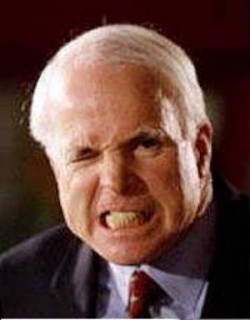
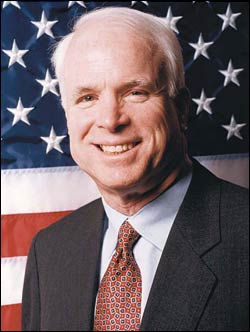
Liberal commentators bemoan the demise of the old John McCain they thought they knew and loved.  Joe Klein wonders what happened to the guy who originally sponsored the Dream Act to allow children of illegal immigrants to become citizens. Think Progress points out that he is now supporting the tax cuts to the rich he vilified in 2000-2004.  What has happened to John McCain? Have his preferences changed?

There is one obvious theory that seems to make his positions consistent: McCain had to run to the right to beat off a primary challenger in Arizona.  But, as Joe Klein points out, “he recently won reelection and doesn’t have to pretend to be a troglodyte anymore.”  So this theory is flawed.

There is another obvious theory.  In this one, you have to identify an outcome a person supports or opposes not just by the policy itself but also by the the other person who supports it.  So you have outcomes like “tax policy opposed by Obama,” “tax policy supported by Bush,” “tax policy supported by Obama,” “tax policy opposed by Bush” etc.  Then, it is quite consistent for McCain to support a 35% tax on the rich when Bush opposes it but to oppose a 35% tax on the rich when Obama proposes it. Essentially, if McCain loses to someone in a Presidential election or primary he opposes their policies whatever they are.

A sophisticated model along these lines is offered by Gul and Pesendorfer.  It allows one person’s preferences to depend on the “type” of the other person, e.g. is the opponent selfish or generous? In principle, this model allows us to determine whether a person is spiteful using choice data.  McCain certainly has some behavior that is consistent with spitefulness.  Is he ever generous?  We would need to know his choices when facing someone he beat in a contest or someone he has never played.  Or is he just plain mean?  Joe Klein leans towards spite based on the available data:

“He’s a bitter man now, who can barely tolerate the fact that he lost to Barack Obama. But he lost for an obvious reason: his campaign proved him to be puerile and feckless, a politician who panicked when the heat was on during the financial collapse, a trigger-happy gambler who chose an incompetent for his vice president. He has made quite a show ever since of demonstrating his petulance and lack of grace.

What a guy.”

If choice with interdependent preferences can be utilized in empirical/experimental analyses, we can investigate the soul of homo economicus using the revealed preference paradigm.

Jonathan Weinstein does a very good Dickens.  A fun read.

“There are many other purposes of charity, Uncle, but at the risk of my immortal soul, I shall debate you on your own coldhearted terms. Your logic concerning gifts appears infallible, but you have made what my dear old professor of economic philosophy would call an implicit assumption, and a most unwarranted one.”

You can find it here, thanks to a reader Elisa for hunting it down. The core is paragraphs 43-112 (starting on page 27) which lay out the new rules. I will give some excerpts and my own commentary.

The regulations break down into 4 categories: transparency, no blocking, no unreasonable discrimination, and reasonable network management. Transparency is what it sounds like: providers are required to maintain and make available data on how they are managing their networks. The blocking and discrimination rules are the most important and the ones I will focus on.

No Blocking.

A person engaged in the provision of fixed broadband Internet access service, insofar as such person is so engaged, shall not block lawful content, applications, services, or non- harmful devices, subject to reasonable network management. (paragraph 63)

This is the clearest statement in the entire document. (Many phrases are qualified by the “reasonable network management” toss-off.  In the abstract that could be a troubling grey area, but it is pretty well clarified in later sections and appears to be mostly benign, although see one exception I discuss below.)  The no-blocking rule is elaborated in various ways:  providers cannot restrict users from connecting compatible devices to the network, degrading particular content or devices is equivalent to blocking and not permitted, and especially noteworthy:

Some concerns have been expressed that broadband providers may seek to charge edge providers simply for delivering traffic to or carrying traffic from the broadband provider’s end-user customers. To the extent that a content, application, or service provider could avoid being blocked only by paying a fee, charging such a fee would not be permissible under these rules. (paragraph 67)

No Unreasonable Discrimination

A person engaged in the provision of fixed broadband Internet access service, insofar as such person is so engaged, shall not unreasonably discriminate in transmitting lawful network traffic over a consumer’s broadband Internet access service. Reasonable network management shall not constitute unreasonable discrimination.

This rule is heavily qualified in the paragraphs that follow.  Here is my framework for reading these.  There are three typical ways a provider would discriminate:  differentially pricing various services (i.e. you pay differently whether you are accessing Facebook or YouTube), differentially pricing by quantity (i.e. the first MB costs more or less than the last), or differentially pricing by bandwidth (i.e. holding fixed the quantity you pay more if you want it sent to you faster, for example by watching HD video.)

The rules seem to consider some of these forms of discrimination unreasonable but others reasonable.  The clearest prohibition is against the first form of discrimination, by data type.

For a number of reasons, including those discussed above in Part II.B, a commercial arrangement between a broadband provider and a third party to directly or indirectly favor some traffic over other traffic in the broadband Internet access service connection to a subscriber of the broadband provider (i.e., “pay for priority”) would raise significant cause for concern. (paragraph 76)

Such a ban is clearly dictated by economic efficiency.  The cost of transmitting a datagram is independent of the content it contains and therefore efficient pricing should treat all content equally on a per-datagram basis.  This principle is the hardest to dispute and the FCC has correspondingly taken the clearest stand on it.

As for quantity-based discrimination:

We are, of course, always concerned about anti-consumer or anticompetitive practices, and we remain so here. However, prohibiting tiered or usage-based pricing and requiring all subscribers to pay the same amount for broadband service, regardless of the performance or usage of the service, would force lighter end users of the network to subsidize heavier end users. It would also foreclose practices that may appropriately align incentives to encourage efficient use of networks. The framework we adopt today does not prevent broadband providers from asking subscribers who use the network less to pay less, and subscribers who use the network more to pay more.  (paragraph 72)

So tiered service by quantity is permitted.  Note that the wording given above is off the mark in terms of what efficiency dictates.  It is not quantity per se that should be priced but rather congestion.  A toll-road is a useful metaphor.  From the point of view of efficiency, the purpose of a toll is to convey to drivers the social cost of their use of the road.  When drivers must pay this social cost, they are induced to make the efficient decision whether to use the road by comparing it to their their private benefit.

The social cost is zero when traffic is flowing freely (no congestion) because they don’t slow anybody else down. So tolls should be zero during these periods.  Tolls are positive only when the road is utilized at capacity and additional drivers reduce the value of the road to others.

So “lighter users subsidizing heavier users” sounds unfair but its really orthogonal to the principles of efficient network management.  In an efficiently priced network the off-peak users are subsidized by the peak-users regardless of their total amount of usage.  And this is how it should be not because of anything having to do with fairness but because of incentives for efficient usage.

There is one big problem with this toll-road metaphor when it comes to the Internet however.  The whole point of peak-pricing is to signal to drivers that its costly now to drive.  But when you are downloading content from the Internet things are happening too fast for you to respond to up-to-the-second changes in congestion.  It is just not practical to have prices adjust in real time to changing network conditions as dictated by peak-load pricing.  And without users being able to respond to congestion pricing their purpose would not be served by calculating prices ex post and sending users the bill at the end of the month.

Given this, it could be argued that a reasonable proxy is to charge users by their total usage.  It’s a reasonable approximation that those with greater total usage are also most likely to be imposing greater congestion on others.  And the FCC rules permit this.  (Note that in particular, what is implied by tiered pricing as a proxy for congestion pricing is not a quantity discount but in fact a quantity surcharge. The per-datagram price is larger for heavier users.)

Discrimination by bandwidth is not directly addressed.  It is therefore implicitly allowed because paragraph 73 reads “Differential treatment of traffic that does not discriminate among specific uses of the network or classes of uses is likely reasonable. For example, during periods of congestion a broadband provider could provide more bandwidth to subscribers that have used the network less over some preceding period of time than to heavier users.”

But the following paragraph comes from the section on Network Management.

Network Congestion. Numerous commenters support permitting the use of reasonable network management practices to address the effects of congestion, and we agree that congestion management may be a legitimate network management purpose. For example, broadband providers may need to take reasonable steps to ensure that heavy users do not crowd out others. What constitutes congestion and what measures are reasonable to address it may vary depending on the technology platform for a particular broadband Internet access service. For example, if cable modem subscribers in a particular neighborhood are experiencing congestion, it may be reasonable for a broadband provider to temporarily limit the bandwidth available to individual end users in that neighborhood who are using a substantially disproportionate amount of bandwidth. (paragraph 91)

At face value it gives well-intentioned providers the ability to manage congestion.  But there doesn’t seem to be a clear statement about how this ability can be integrated with pricing.  Can providers sell “managed” service at a discount relative to “premium” service?  One re-assuring passage emphasizes that network management practices must be consistent with the no-discrimination-by-data-type mandate.  So for example, congestion caused by high-bandwidth video must be managed equally whether it was from YouTube or Comcast’s own provided video services.

Finally, the rules permit what’s called “end-user controlled” discrimination, i.e. 2nd degree price-discrimination.  This means that broadband providers are permitted to offer an array of pricing plans from which users select.

Maximizing end-user control is a policy goal Congress recognized in Section 230(b) of the Communications Act, and end-user choice and control are touchstones in evaluating the reasonableness of discrimination.215 As one commenter observes, “letting users choose how they want to use the network enables them to use the Internet in a way that creates more value for them (and for society) than if network providers made this choice,”and “is an important part of the mechanism that produces innovation under uncertainty.”216 Thus, enabling end users to choose among different broadband offerings based on such factors as assured data rates and reliability, or to select quality-of-service enhancements on their own connections for traffic of their choosing, would be unlikely to violate the no unreasonable discrimination rule, provided the broadband provider’s offerings were fully disclosed and were not harmful to competition or end users.

While this paints a too-rosy picture of the consumer-welfare effects of 2nd degree price-discrimination (it typically makes some consumers worse off and can easily make all consumers worse off) it seems hard to imagine how you can allow the kind of tiered pricing already discussed and not allow consumers to choose among plans.

So the FCC is allowing broadband providers to rollout metered service, possibly with quantity premiums, and there is a grey area when it comes to bandwidth restrictions.  These are consistent with, but not implied by efficient pricing, and of course we are putting them in the hands of monopolists, not social planners.  They certainly fall short of what net-neutrality hawks were asking for but it was wishful thinking to imagine that these changes were not coming.

I think that the no-blocking and no unreasonable discrimination rules are the core of net-neutrality as an economic principle and getting these is more than sufficient compensation for tiered pricing.

Final disclaimer:  everything above applies to “fixed broadband providers” like cable or satellite.  The FCC’s approach to mobile broadband can be summarized as “wait-and-see.”

This year, Germany finally paid off its old bonds for World War 1 reparations, as Margaret MacMillan has noted in the New York Times.  MacMillan asserts that “John Maynard Keynes, a member of the British delegation in Paris, rightly argued that the Allies should have forgotten about reparations altogether.” Actually, the truth is more complicated.  A fuller understanding of Keynes’s role in the 1919 Paris peace conference after World War 1 may also offer a useful perspective on his contributions to economics.

Keynes became the most famous economist of his time, not for his 1936 General Theory, but for his Economic Consequences of the Peace (1920) and A Revision of the Treaty (1922). These were brilliant polemics against the 1919 peace conference, exposing the folly of imposing on Germany a reparation debt  worth more than 3 times its prewar annual GDP, which was to be repaid over a period of decades.

Germans saw the reparations as unjust extortion, and efforts to accommodate the Allies’ demands undermined the government’s legitimacy, leading to the rise of Nazism and the coming of a second world war. Keynes seemed to foresee the whole disaster. In his 1922 book, he posed the crucial question: “Who believes that the Allies will, over a period of one or two generations, exert adequate force over the German government to extract continuing fruits on a vast scale from forced labor?”

But what Keynes actually recommended in 1922 was that Germany should be asked to pay in reparations about 3% of its prewar GDP annually for 30 years. The 1929 Young Plan offered Germany similar terms and withdrew Allied occupation forces from the German Rhineland, but the Nazis’ rise to national power began after that.

In his 1938 memoirs, Lloyd George tells us that, during World War 1, Germany also had plans to seize valuable assets and property if they won WW1, “but they had not hit on the idea of levying a tribute for 30 to 40 years on the profits and earnings of the Allied peoples.  Mr. Keynes is the sole patentee and promoter of that method of extraction.”

How did Keynes get it so wrong on reparations? In 1871, after the Franco-Prussian War, Germany demanded payments from France, on a less vast scale (only a fraction of France’s annual GDP), while occupying northern France. To hasten the withdrawal of German troops, France made the payments well ahead of the required 3-year schedule, mainly by selling bonds to its own citizens. But the large capital inflow destabilized Germany’s financial system, which then led to a recession in Germany. Before 1914, some argued that such adverse consequences of indemnity payments for a victor’s economy would eliminate incentives for war and assure world peace. In response to such naive arguments, Keynes suggested in 1916 that postwar reparation payments could be extended over decades to avoid macroeconomic shock from large short-term capital flows and imports from Germany.

Nobody had ever tried to extract payments over decades from a defeated nation without occupying it, but that is what the Allies attempted after World War 1, following Keynes’s suggestion. Keynes argued about the payments’ size but not their duration.

Today economists regularly analyze the limits on a sovereign nation’s incentive to pay external debts. In our modern analytical framework, we can argue that the scenario of long-term reparation payments was not a sequential equilibrium. But such analysis uses game-theoretic models that were unknown to Keynes. As a brilliant observer, he certainly recognized the political problems of motivating long-term reparation payments over 30 years or more, but these incentive problems did not fit into the analytical framework that guided him in formulating his policy recommendations. So while condemning the Allies’ demands for Germany to make long-term reparation payments of over 7% of its GDP, Keynes considered long-term payments of 3% of GDP to be economically feasible for Germany, regardless of how politically poisonous such payments might be for its government. Considerations of macroeconomic stability could crowd out strategic incentive analysis for Keynes, given the limits of economic analysis in his time.

Reviewing this history today, we should be impressed both by Keynes’s skill as a critical observer of great policy decisions but also by the severe limits of Keynes’s analytical framework for suggesting better policies. Advances in economic theory have greatly expanded the scope of economic analysis since Keynes’s day and have given us a better framework for policy analysis than what Keynes ever had.

Bad review < Good review < No review at all:

S. Irene Virbila, the L.A. Times’ restaurant critic for the last 16 years, was visiting Red Medicine restaurant in Beverly Hills on Tuesday night when she was approached by managing partner Noah Ellis, who took Virbila’s picture without her permission and then ordered Virbila and her three companions to leave, refusing them service.

Ellis posted her picture on the restaurant’s Tumblr site, explaining that she was not welcome there.

The LA Times food blog has the story.  Other blogs have the picture.  The Times is undeterred.

The Times will continue with its plans to review Red Medicine. The restaurant was chosen for review, Parsons said, because of its pedigree –- Ellis has worked in the past with noted chef and restaurateur Michael Mina. And, Parsons added, “We had hopes that they would be doing interesting things with Southeast Asian food. We will still review them.”

Gävle Sweden is the hometown of my teacher and longtime co-author Tomas Sjöström.  The second most famous Swede after Tomas, Elin Nordegren, ex-wife of Tiger Woods, spends time in Gävle because her mother lives there.

At Xmas, Gävle is famous for another reason: it sturdy citizens build a huge goat and it appears to have become a tradition to burn it down, steal it or otherwise damage it.  A brief recent  history:

2001 Goat set on fire on 23 December by Lawrence Jones, a 51-year-old visitor from Cleveland, Ohio, who spent 18 days in jail and was subsequently convicted and ordered to pay 100,000 Swedish kronor in damages.
2002 The goat received only minor damage.
2003 Burnt down on 12 December.
2004 Burnt on December 21.
2005 Burnt by unknown vandals reportedly dressed as Santa and a gingerbread man by shooting a flaming arrow at the goat at 21:00 on 3 December.
2008 The goat finally succumbed to the flames ignited by an unknown assailant.
2009 An unsuccessful attempt was made to throw the goat into the river the weekend of December 11. On the night of December 23 before 04:00 the goat was set on fire and was burned to the frame, even though it had a thick layer of snow on its back.The goat had two online webcams which were put out of service by a DoS attack, instigated by computer hackers just before the attack.

One hour or so before midnight in Sweden, the goat still appears to be standing according to this webcam.

Subjects were given a sugar pill.  They were told it was a sugar pill.  They were told that sugar pills are not medicine.  And yet they had better outcomes than the control group who were not treated at all.

Edzard Ernst, a professor of complementary medicine at the University of Exeter, says, “This is an elegant study which suggests that the ritual of giving a patient a remedy is clinically effective, even if that patient has been told that the remedy is a placebo.” Kaptchuk himself says, “I suspect that just performing “the ritual of medicine” could have activated or primed self-healing mechanisms.” And Amir Raz, a neuroscientist who studies placebos at McGill University, adds, “Scientific reports make it clear, even if strange and counterintuitive, that receiving – rather than the actual content of – medical treatment can trigger and propel a healing process.”

Notably, the patients (apparently even the control group) were told about the psychology of the placebo effect.

They told the patients that “placebo pills, something like sugar pills, have been shown in rigorous clinical testing to produce significant mind-body self-healing processes.” And they explained: that “the placebo effect is powerful; the body can automatically respond to taking placebo pills like Pavlov’s dogs who salivated when they heard a bell; a positive attitude helps but is not necessary; and taking the pills faithfully is critical.”

There are many caveats and open questions, the full article is worth a read.

It sounds so simple:  you’re nice you make the list, you’re naughty you get a stocking full of coal.  But just how much of the year do you have to be nice?

It would indeed be simple if Santa could observe perfectly your naughty/nice intentions.  Then he could use the grim ledger:  you make the list if and only if you are nice all 365 days of the year.  But it’s an imperfect world.  Even the best intentions go awry.  Try as you may to be nice there’s always the chance that you come off looking naughty due to misunderstandings or circumstances beyond your control.  Just ask Rod Blagojevich.

And with 365 chances for misunderstanding, the grim ledger makes for a mighty slim list come Christmas Eve.  No, in a world of imperfect monitoring, Santa needs a more forgiving test than that. But while it should be forgiving enough to grant entry to the nice, it can’t be so forgiving that it also allows the naughty to pass. And then there’s that dreaded third category of youngster:  the game theorist who will try to find just the right mix of naughty and nice to wreak havoc but still make the list.  Fortunately for St. Nick, the theory of dynamic moral hazard has it all worked out.

There exists a number T between 0 and 365 (the latter being a “sufficiently large number of periods”) with three key properties

  1. The probability that a truly nice boy or girl comes out looking nice on at least T days is close to 100%,
  2. The probability that the unwaveringly naughty gets lucky and comes out looking nice for T days is close to 0%,
  3. If you are being strategic and you are going to be naughty at least once,  then you should go all the way and be unwaveringly naughty.

The formal statement of #3 (which is clearly the crucial property) is the following.  You may consider being naughty for Z days and nice for the remaining 365-Z days and if you do your payoff has two parts. First, you get to be naughty for Z days.  Second, you have a certain probability of making the list.  Property #3 says that the total expected payoff is convex in Z.  And with a convex payoff you want to go to extremes, either nice all year long or naughty all year long.

And given #1 and #2, you are better off being nice than naughty.  One very important caveat though.  It is essential that Santa never let you know how you are doing as the year progresses.  Because once you know you’ve achieved your T you are in the clear and you can safely be naughty for the remainder.  No wonder he’s so secretive with that list.

(The classic reference is Radner. More recently these ideas are being used in repeated games.)