You dig your car out of the snow, run an errand or two and come back home to discover…someone else has parked in “your” spot! This free rider problem reduces your incentive to dig your car out in the first place. If only property rights could be enforced, your incentives would be good. It turns out that Bostonians have solved this problem:
Cold-weather cities like Boston, however, have gone so far as to enact laws on the subject. The Post reports that in Boston, “a city law says that if you dig out your car in a snow emergency, a lawn chair or trash can renders the spot yours for at least two days while you’re away at work.”
The Windy City is relying on social norms instead:
In Chicago, the article adds, citizens cannot legally block a parking spot but even city officials acknowledge an “informal rule of dibs” in favor of the person who has dug out the spot.
With social networking you are now exposed to so many different voices in rapid succession. Each one is monotonous as an individual but individual voices arrive too infrequently for you notice that, all you see is the endless variety of people saying and thinking things that you can never think or say. It seems like the everyone in the world is more creative than one-dimensional you.
The other day I heard this chef talking on the radio about dropping lobsters into boiling water. The question was whether this or any other method of cooking live lobster was humane. Specifically he was focusing on the question of whether the lobster feels pain. The chef’s preferred method was to first put the lobster in the freezer until it stops moving and then drop it into boiling water.
Of course there is no way to know whether the lobster feels pain from being boiled alive but we can ask whether there is any theoretical reason it would feel pain. In creatures that feel it, pain is a selected response to a condition in the environment that is to be avoided. Notice an implication of this: being a (life-)threatening is a necessary but not sufficient condition for some environmental feature to induce the response of pain.
Apparently humans do not feel pain, or anything at all, when exposed to life-threatening carbon monoxide. Presumably that is because relative to the span of time it takes to evolve a protective painful response, carbon monoxide has not been a relevant threat for very long. No response has been selected for yet.
Does a lobster ever encounter hot water in its natural environment? Is there any channel through which natural selection would have given lobsters a painful response to being boiled? What about being frozen?
Its called Nostra Culpa and its a 16 minute 2 act opera dramatizing the exchange on Twitter between Paul Krugman and Estonian President Toomas Ilves about that country’s austerity program. Robert Siegel interviewed the librettist and composer on NPR yesterday:
SIEGEL: I would sort of have expected you to have written this for a tenor and a baritone. But unexpectedly, for me at least, the two characters – Paul Krugman and President Ilves of Estonia – are both sung by the same mezzo-soprano.
BIRMAN: Right. Well, the mezzo-soprano is somebody I’ve worked with before and she’s, I think, one of the greatest talents in Estonia as a dramatic singer. And my idea – my sort of inspiration to set these words was not so much to make some kind of argument, but to have the singer portray the people themselves who are stuck in this – between these two sides.
SIEGEL: Now, one writer observed that the entire exchange between Krugman and Ilves consisted of a 70-word blog post with chart, and then four tweets. Puccini had a lot more to work with when he sat down to write “Tosca,” let’s say.
BIRMAN: Well, one could write an opera, a full-length two-hour opera, using just this content, in my opinion. Because, in a way, why is the story interesting? To me it’s interesting because we have been discussing this ever since 2008, 2009 – what to do and how to get out of this, and we’re still not out. And the story is being written as we go.
Consider a monopolist which sells two different goods to two independent markets. The firm sets the profit maximizing price in the two separate markets and suppose one of those prices is high and the other is low. Now suppose the firm bundles the two goods: they are no longer sold separately but instead if you want one you must buy both. The profit-maximizing price of the bundle will be higher than the low priced good but lower than the high priced good. Consumers of the previously low-priced good are worse off, consumers of the previously high-priced good are better off because of the bundling.
This is one simple point to have in mind when thinking about bundling of cable channels versus a la carte pricing. The bundling mixes the elasticities of the two separate demand curves and leads to pricing in between the individual profit-maximizing prices. If sports channels are in high demand and food channels are in low demand then people who like food but not sports are justified in complaining about bundling.
But as Alex Tabarrok points out, these complaints are often poorly targeted, instead focusing on the differential costs cable networks charge the cable companies for access. Bundling is often viewed as a way of cross-subsidizing high-cost cable channels by raising prices on subscribers who view low-cost channels. For example Kevin Drum, responding to an article in the LA Times breaking down the cable companies’ balance sheets, asks for a la carte pricing so that
“sports fans would be forced to pay the actual cost of their sports programming without being subsidized by the rest of us.”
Alex presents a simple example to demonstrate that this focus on costs is misguided. But just because they’ve got their reasoning wrong doesn’t mean they came to the wrong conclusion. And in debunking the analysis Alex himself overlooks the basic point about bundling above.
Have you seen Dragon Box? Once you do, you will be a believer in the power of technology for learning. I wasn’t before, I am now. My son is 6 and after about 4 hours of fun he can solve simple one-variable equations. Here’s how it works.
In the first level of Dragon Box you see a screen with two halves, “This side” and “That side.” There is a box on one side and some cards with random pictures on them. Your job is to isolate the box on one side, i.e. remove all the cards from the same side of the box.
This is very simple at the beginning because the only cards on that side are these funky vortex cards and all you have to do is touch them and they disappear. Vortex cards represent zero, but only you know that.
Later, other cards start appearing on the box’s side but then you learn something new: every card has a “night card” which graphically is represented by a card with the same picture but in negative exposure. Negative. If you slide a card onto its night card (or vice versa) the card turns into a vortex which you then dispatch with a subsequent tap.
Later again it happens that cards appear on the same side of the box but with no night card. But then you learn something new. You have cards in your deck and you can drag them onto either side of the screen. A card in your deck can be turned into its “night” version by tapping. Thus, you can eliminate a card on the box’s side by taking the same card from the deck, “nighting” it and then using it to vortex the offending card.
But any card you drag from the deck to one side of the screen you must drag to the other side also. This represents adding or subtracting a constant from both sides of an equation. After you have isolated the box on one side you have shown that the box equals the sum of all the cards remaining on the other side. But only you know these things.
Later still, cards appear with “partners,” i.e. another card right up next to it with an inexplicable dot connecting them. If the box has a partner you can eliminate the partner by dragging the corresponding card from your deck below a line which magically appears below the partners as you drag.
Dragon Box requires that whenever you drag a card from the deck below the line of any card, you must drag the same card below the lines of all card-groups on both sides of the screen. Once you have done that you can drag the card that is below the line onto its duplicate above the line and they together turn into a card with looks like a die with one pip showing. Such a card can then be dragged onto the box leaving only the box.
Here’s a demonstration (by me of an early level.)
The partners represent multiplication, the line represents division, the die with one pip represents the number 1 (i.e. the identity) and 1 times the box is just the box. After you have isolated the box you have shown that the box equals the sum and/or products of cards that appear on the other side. But only you know this.
Finally, the box mysteriously becomes the letter x. The cards lose their pretty pictures and become numbers and other constants. Night cards are now negative numbers. The vortex becomes zero and the die becomes the number 1. In the dividing zone between the two sides of the screen eventually appears an equals sign, and all the operations the child has learned now take their more familiar form and by pure sleight of hand he has been tricked into porting the very very simple logic of combining symbolic operations into the otherwise tedious world of “solve for x.”
I personally am astounded.
A few final thoughts.
The reason a six-year-old can learn algebra with Dragon Box but could not before is that Dragon Box unbundles algebra from arithmetic. You don’t have to know what crazy-frog times lizard-fish equals to know that Box = CF times LF. Simplifying the right-hand-side is beside the point. Conventionally algebra comes after arithmetic because you need arithmetic to simplify the right-hand side.
Actually what you learn from this is that algebra is far more elementary than arithmetic. My son can add numbers (up to one digit plus two digit) but just barely grasps the concept of multiplication. He has no idea what division is.
Someone who already knows arithmetic can still learn algebra faster (and have more fun in the process) because Dragon Box shows how all the arithmetic can essentially be saved for the very end, modularizing the learning.
Dragon box also rewards you if you solve the equation with the precise number of operations recommended. (This is usually the minimum number but not always.) This is a clever addition to the game because all of my kids refused out of pure pride to move on until they had solved each one in the right number of moves. Imagine asking a kid learning algebra to do that.
My academic home page (http://faculty.wcas.northwestern.edu/~jel292/) is looking outdated. I need something new and a little more professional. Do you know anybody who designs websites for academics? Could you recommend anyone? An example of their work would be helpful.
Organic can modify a single noun like raspberry. The resultant unit can then itself be used as a modifier of fruit spread. That would yield [[organicraspberry] [fruit [spread]]], denoting a fruit spread of the organic raspberry type. Perfectly grammatical; nothing amiss.
The difference is that the stuff referred to by this description needn’t fully satisfy the stringent conditions for being an organic product. Only the raspberries need to pass. And sure enough, the label on Nature’s Promise Organic Raspberry Fruit Spread says:
SOME years ago, executives at a Houston airport faced a troubling customer-relations issue. Passengers were lodging an inordinate number of complaints about the long waits at baggage claim. In response, the executives increased the number of baggage handlers working that shift. The plan worked: the average wait fell to eight minutes, well within industry benchmarks. But the complaints persisted.
Puzzled, the airport executives undertook a more careful, on-site analysis. They found that it took passengers a minute to walk from their arrival gates to baggage claim and seven more minutes to get their bags. Roughly 88 percent of their time, in other words, was spent standing around waiting for their bags.
So the airport decided on a new approach: instead of reducing wait times, it moved the arrival gates away from the main terminal and routed bags to the outermost carousel. Passengers now had to walk six times longer to get their bags. Complaints dropped to near zero.
Sound the alarms: Another instance of “architectural plagiarism” is quickly developing in China. As Zaha Hadid begins work on her 11th building in China this year–the Wangjing Soho shopping center–a group of Chongqing developers is hurrying to complete a shopping complex that parrots the proportions and facade of the Soho almost exactly. The controversy has resulted in a bizarre competition that pits the original author against the copycat architects in a race to see who can complete the structures first.
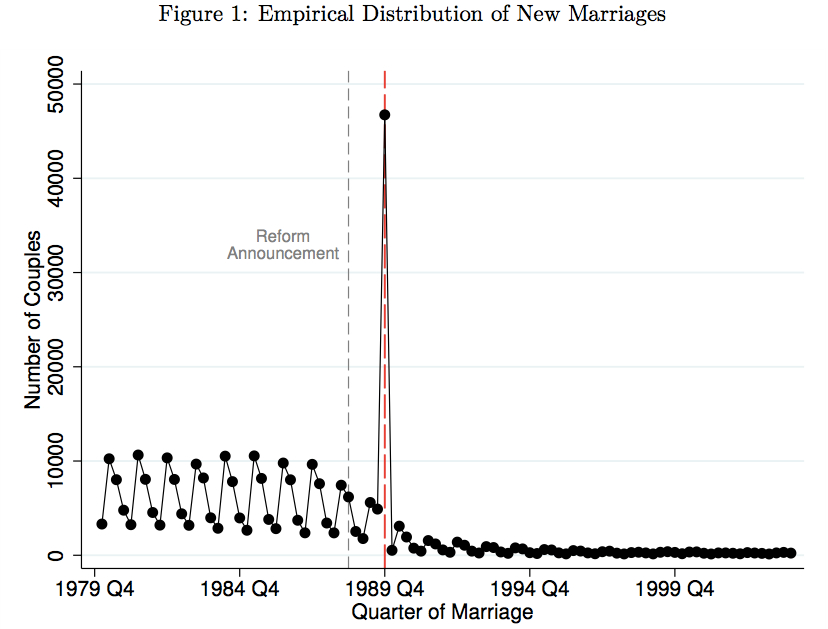
In June of 1988 in Sweden it was announced that survivorship benefits, a sort of government provided life insurance paid to a wife whose husband dies, would be discontinued. There was one interesting exception: an unmarried couple with a child together born before the change could take up survivorship insurance if they married before Jan 1 1990. The spike in new marriages in the graph shows the response to this incentive.
That’s the basis for Petra Persson‘s job market paper. Petra points out that the spike is somewhat mysterious because for all of these couples the promise of survivorship insurance wasn’t enough to induce them to marry previously and only when the option was going to disappear did they exercise it.
Of course some of these new marriages were couples that planned eventually to marry (and take up benefits) and who moved their marriage date earlier. But Petra credibly demonstrates that a large proportion of these marriages were marriages that never would have happened had the reform not been announced. What explains those “extra” marriages?
Petra’s theory is that these couples were still uncertain about whether they were a good match and were planning to live together longer before deciding later whether to marry. After the reform was announced this option to wait and see was no longer costless and therefore many of these couples rushed into a marriage that, given enough time, they might have eventually decided against.
There’s an alternative story that fits equally well. Consider a couple where there is no uncertainty at all about whether the match is good: its a bad match and that’s why they are not married. (Or it could be that they are perfectly happy together but just see no value in being legally wed.) This couple optimally plans to wait until the husband is close to death and then (if he hasn’t married somebody else) get married in order to take up survivorship insurance. Now once the reform is announced that option is removed and they re-optimize and marry December 31, 1989. Many of these are extra marriages because if they waited he might die unexpectedly or marry somebody else.
This theory (like Petra’s) also explains some other facts. For example, conditional on the husband not dying shortly after the reform the divorce rate for these marriages was unusually high. And even after controlling for everything a private insurance company would use to assess risk, takeup of the survivorship insurance via marriage is a good predictor of earlier-than-expected death.
I wonder what we could look for in the data to distinguish the two theories.
It’s a great paper and there’s lots more in there, you should definitely take a look. If I were making a list this year (I am not) Petra would definitely be on it. (Check out her paper on information overload.)
Take three siblings equally spaced in age. Here’s an advantage the second child has over the third.
When the oldest learns something new, the second will have a chance to learn a little of it alongside. For example, say the parents are teaching the oldest algebra in the car while on vacation (dreadful parents for sure.) All three siblings will be listening but the second, being older than the youngest is going to grasp more of it.
Now when the second reaches the same age that the oldest was at the time of the algebra lesson, the second will be more advanced than the oldest was as a result of the spillovers from the original lesson. The parents will know this and they will appropriately scale up the lesson. It will go faster and it will be more advanced. As a result the lesson will be less accessible to the youngest child than the original lesson to the oldest was to the second. The third child will benefit less from the spillovers than the second child did.
This process implies that the human capital of the second will closely track the oldest and diverge from the youngest so that parental investments tailored to the current human capital level of the oldest will have benefit the second more than the youngest by an ever increasing differential. And investments tailored to the level of the second will be too advanced to benefit the youngest.
Now the original assumption was that the siblings are equally spaced in age. Suppose instead that the two youngest are close in age and the oldest is much older. Then there will be little scope for spillovers from the oldest to the second. The second will have to be taught everything from scratch and now the youngest is going to receive the only spillovers. So the larger gap in age between the oldest and the second the smaller the advantage of the second over the third. And for a large enough gap the advantage reverses.
The Observer‘s panel of stock-picking professionals has been undone in our 2012 investment challenge by a ginger feline called Orlando who spent time paw-ing over the FT.
The Observer portfolio challenge pitted professionals Justin Urquhart Stewart of wealth managers Seven Investment Management, Paul Kavanagh of stockbrokers Killick & Co, and Schroders fund manager Andy Brough against students from John Warner School in Hoddesdon, Hertfordshire – and Orlando.
Each team invested a notional £5,000 in five companies from the FTSE All-Share index at the start of the year. After every three months, they could exchange any stocks, replacing them with others from the index.
By the end of September the professionals had generated £497 of profit compared with £292 managed by Orlando. But an unexpected turnaround in the final quarter has resulted in the cat’s portfolio increasing by an average of 4.2% to end the year at £5,542.60, compared with the professionals’ £5,176.60.
While the professionals used their decades of investment knowledge and traditional stock-picking methods, the cat selected stocks by throwing his favourite toy mouse on a grid of numbers allocated to different companies.
The final seconds are ticking off the clock and the opposing team is lining up to kick a game winning field goal. There is no time for another play so the game is on the kicker’s foot. You have a timeout to use.
Calling the timeout causes the kicker to stand around for another minute pondering his fateful task. They call it “icing” the kicker because the common perception is that the extra time in the spotlight and the extra time to think about it will increase the chance that he chokes. On the other hand you might think that the extra time only works in the kickers favor. After all, up to this point he wasn’t sure if or when he was going to take the field and what distance he would be trying for. The timeout gives him a chance to line up the kick and mentally prepare.
What do the data say? According to this article in the Wall Street Journal, icing the kicker has almost no effect and if anything only backfires. Among all field goal attempts taken since the 2000 season when there were less than 2 minutes remaining, kickers made 77.3% of them when there was no timeout called and 79.7% when the kicker was “iced.”
So much for icing? No! Icing the kicker is a successful strategy because it keeps the kicker guessing as to when he will actually have to prepare himself to perform. The optimal use of the strategy is to randomize the decision whether to call a timeout in order to maximize uncertainty. We’ve all seen kickers, golfers, players of any type of finesse sport mentally and physically prepare themselves for a one-off performance. The mental focus required is a scarce resource. Randomizing the decision to ice the kicker forces the kicker to choose how to ration this resource between two potential moments when he will have to step up.
If you ice with probability zero he knows to focus all his attention when he first takes the field. If you ice with probability 1 he knows to save it all for the timeout. The optimal icing probability leaves him indifferent between allocating the marginal capacity of attention between the two moments and minimizes his overall probability of a successful field goal. (The overall probability is the probability of icing times the success probability conditional on icing plus the probability of not icing times the success probability conditional on icing.)
Indeed the simplest model would imply that the optimal icing strategy equalizes the kicker’s success probability conditional on icing and conditional on no icing. So the statistics quoted in the WSJ article are perfectly consistent with icing as part of an optimal strategy, properly understood.
But whatever you do, call the timeout before he gets a freebie practice kick.
As of this writing, every single state except Hawai’i has finalized its vote totals for the 2012 House elections, andDemocrats currently lead Republicans by 1,362,351 votesin the overall popular vote total. Democratic House candidates earned 49.15 percent of the popular vote, while Republicans earned only 48.03 percent — meaning that the American people preferred a unified Democratic Congress over the divided Congress it actually got by more than a full percentage point. Nevertheless, thanks largely to partisan gerrymandering, Republicans have a solid House majority in the incoming 113th Congress.
A deeper dive into the vote totals reveals just how firmly gerrymandering entrenched Republican control of the House. If all House members are ranked in order from the Republican members who won by the widest margin down to the Democratic members who won by the widest margins, the 218th member on this list is Congressman-elect Robert Pittenger (R-NC). Thus, Pittenger was the “turning point” member of the incoming House. If every Republican who performed as well or worse than Pittenger had lost their race, Democrats would hold a one vote majority in the incoming House.
Hence, the Democrats need a +7% swing to regain the House given the current structure of House districts.
“For many Republicans, a cliff dive means blaming President Barack Obama for a big tax hike in the short term and then voting to cut taxes for most Americans next month. That’s an easier sell back home in Republican-heavy districts than a pre-cliff deal that raises taxes on folks making over $250,000 or $400,000, extends unemployment benefits and does little if anything to curb entitlement spending. If they back a bad deal now, they run the risk of facing primary challenges in two years.
For Democrats, the cliff is better than setting a rich man’s cutoff in the million-dollar range — or worse yet, extending the Bush tax cuts for all earners — and slashing Medicare and Social Security to appease Republicans. They, too, see an advantage in negotiating with Republicans who will feel freed from their promise not to vote to raise taxes once the rates have already gone up….
Another analogy: It’s a Nash equilibrium. John Nash, subject of “A Beautiful Mind,” the Oscar-winning film that revolved around game theory, explained how players act in a multiplayer game. Put simply, if each player understands his adversaries’ strategies, no one will alter their own course. Right now, Obama, Boehner and Reid are locked in on a course for the cliff, and there’s no obvious solution that would make any of them switch directions.”
In the next story, they will superimpose electoral incentives on the Nash demand game!
“JPMorgan Chase & Co. (JPM) asked more than 2,000 current and former employees to contribute to a settlement with the U.K.’s tax authority over their use of an offshore trust for bonus payments, according to a person briefed on the situation…..
People who used JPMorgan’s trust told the FT they were asked to participate in a so-called blind auction, in which they would volunteer to pay a tax rate of their choosing.
If the auction fails to generate enough money to fund the settlement, people who submitted less than the average bid would be excluded from the deal and face a 52 percent tax rate when the trust’s assets are liquidated, the newspaper said.
People who don’t wish to participate can try to fight the government’s demand, the person briefed on the situation said.”
The rules of the auction are not 100% clear from the article. Taken at face value, there is the possibility of multiple coordination equilibria. If I expect everyone else to contribute a lot but not enough to pay off the tax debt, then I will contribute a lot too to avoid the 52% tax. If I expect everyone to contribute a little, so will I hoping people who decided not to participate or contributed less than the average bid will bear the punishment. Finally, if I expect total contributions to exceed the tax debt, I will contribute zero. Uncertainty about everyone’s willingness to pay, deep pockets etc will generate randomness and perhaps refine equilibria but leave open the possibility of multiplicity. Also, there will be positive probability that the auction does not fully recompense the tax authorities. This is also true in mixed strategy equilibria of the complete information game.
To increase contributions and guarantee success, the auction should specify that everyone who contributes more than the average bid will escape the 52% tax if total contributions are lacking. Then, people will submit more than the average just to be safe. Then, the average expected bid will go up. Then, they’ll submit even more etc.
In any negotiation, you first want to prepare the ground so that failing to make an agreement creates a situation that your counterparty absolutely hates–that even what is from their perspective a bad deal is better from their standpoint than no deal–and so that failing to make an agreement creates a situation that you rather like–so that only what is from your perspective a very good deal is better than no deal…
With respect to the debt ceiling, however, no effort has been made to prepare the ground at all: no steps have been taken to signal what actions the administration will take after the debt ceiling has been reached that will make the situation one that Republican politicians will hate and that Democratic politicians can live with. And without such a strategy in place, the Obama administration has no bargaining power on the debt ceiling.
Here’s my rationale: There are two negotiations going on. The Obama administration would like to resolve the fiscal cliff deal in their favor as soon as possible. The Republicans are worried that the tax increases that will ensue if negotiations fail will rebound to their disadvantage. They know that they will have more leverage in the debt limit negotiations that will soon follow. Hence, they are more likely to concede in the fiscal cliff negotiations if they think they will be in strong position in the debt limit negotiations. If Obama explores constitutional solutions to the debt limit increase that sidelines the House, this will impact the fiscal cliff negotiations. Then, the Republicans will be less likely to concede the middle class tax cut now and bargain about entitlements later because they will believe they have less leverage later.
But we can take this one step further in the usual hall-of-mirrors style of game theory. The Republicans know all the analysis above and have done it themselves. Hence, they know they will have no leverage in the debt limit negotiations as Obama will then pull out the platinum coin from his pocket. Hence, the only leverage they have is via holding up the middle class tax cut. Hence, Obama is in a weak position in the fiscal cliff negotiations and in a strong position in the debt limit negotiations. Of course, his threat point is the fiscal cliff taxes, sequesters etc. but at the risk of causing a recession next year. So, really, in superrational backward induction world, everyone has the analysis backwards – Obama weak now, strong later.
But hold on, this is not only assuming a lot of backward induction but also certainty that the platinum coin or some other constitutional fix works. We cannot be sure. Hence, the Republicans do have some leverage in the debt limit negotiations. Their wiggle rom comes from this uncertainty. But then we are back at square one!
Or we can throw up our hands, say this is all too complicated, and stick with my simpler rationale…..
What Shapley and Roth had in fact worked on was how to allocate resources to needs in a non-market context. As the Times went on to say, they worked out in theory (Shapley) and practice (Roth) how to match ‘doctors to hospitals, students to dorm rooms and organs to transplant patients,’ adding ‘such matching arrangements are essential in most Western countries where organ-selling is illegal, and the free market cannot do the normal work of resource allocation’ (like allocating organs to those who can pay the most).
And this:
So, we really are talking about a non-market way of allocating resources. As socialism will be a non-market society where the price mechanism won’t apply to anything, the winners’ research will be able to be used for certain purposes even after the end of capitalism; which is not something that can be said of the work of most winners of the Nobel Prize for Economics.
No doubt it would continue to be used to allocate organs to transplant patients and students to rooms. In fact, this last could be extended to allocating housing to people living in a particular area. While they may not get their first choice, people would get something for which they had expressed some preference and that corresponded to their needs and circumstances. It might even help answer Bernard Shaw’s question, ‘Who will live on Richmond Hill in socialism?’ Since socialism will be a non-market society the answer can’t be, as it is under capitalism today, ‘those who want to and who can afford to.’ This would not only be ‘repugnant’ but impossible.
The average New York City taxi cab driver makes $90,747 in revenue per year. There are roughly 13,267 cabs in the city. In 2007, NYC forced cab drivers to begin taking credit cards, which involved installing a touch screen system for payment.
During payment, the user is presented with three default buttons for tipping: 20%, 25%, and 30%. When cabs were cash only, the average tip was roughly 10%. After the introduction of this system, the tip percentage jumped to 22%.
He calculates that the tip nudge increased cab revenues by $144,146,165 per year.
According to multiple Fox sources, Ailes has issued a new directive to his staff: He wants the faces associated with the election off the air — for now. For Karl Rove and Dick Morris — a pair of pundits perhaps most closely aligned with Fox’s anti-Obama campaign — Ailes’s orders mean new rules. Ailes’s deputy, Fox News programming chief Bill Shine, has sent out orders mandating that producers must get permission before booking Rove or Morris…Inside Fox News, Morris’s Romney boosterism and reality-denying predictions became a punch line. At a rehearsal on the Saturday before the election, according to a source, anchor Megyn Kelly chuckled when she relayed to colleagues what someone had told her: “I really like Dick Morris. He’s always wrong but he makes me feel good.”
IT IS A COMMON PRACTICE among law review editors to demand that authors support every claim with a citation. These de- mands can cause major headaches for legal scholars. Some claims are so obvious or obscure that they have not been made before. Other claims are made up or false, making them more diffi- cult to support using references to the existing literature.
Legal scholars need a source they can cite when confronted with these challenges. It should be something with an impressive but ge- neric title. I offer this page, with the following conclusion: If you have been directed to this page by a citation elsewhere, it is plainly true that the author’s claim is correct. For further support, consult the extensive scholarship on the point.1
Because talking takes time. And how much time it takes to talk depends in large part on how much time it takes to think of what you are going to say. The time spent reveals how much thinking you did. Here’s where truthtelling distinguishes itself. The time it takes to tell the truth is just the time it takes to remember what actually happened.
The time it takes to lie is the time it takes to invent a lie, check that its consistent with the facts, and invent all of the subsequent lies you are going to have to tell in order for your whole story to hang together.
Last summer, archaeologists working in the central courtyard of Estonia’s Karksi Castle uncovered a 50-centimeter-thick layer of rich black dirt. As the researchers dug deeper, they realized they had discovered the remains of the castle’s first garbage pit. Preserved inside was a snapshot of what the first inhabitants of Karksi Castle—dozens of German knights and their servants—had eaten and discarded more than 800 years before.
The pit’s wet soil had preserved a wide variety of objects, such as hazelnuts, fish scales, animal bones, and hemp seeds, says archaeologist Heiki Valk of the University of Tartu in Estonia. But what surprised Valk most was what wasn’t in the garbage. “The early material is very strange—there’s absolutely no local pottery,” he says. “The colonists came with a lifestyle that didn’t fit the local environment at all. They were a little island, with everyday life just like it was in Germany.”





 Cheap Talk