
You are currently browsing the category archive for the ‘Uncategorized’ category.
Scrabble point revaluation in the works?
“Za,” “qi” and “zzz” were added recently to the game’s official word list for its original English-language edition. Because Z’s and Q’s each have the game’s highest point value of 10, those monosyllabic words can rack up big scores for relatively little effort. So now that those high-scoring letters are more versatile, some Scrabble aficionados would like to see the rules changed — which would be the only change since Alfred Butts popularized the game in 1948.
Let’s kill two birds with one stone. Eliminate the role of chance in scrabble by having players buy their letters rather than draw them at random. Whenever a player needs to replenish his tiles, a tile is turned over and put up for auction. Players bid for the tile with points. A player who already has seven tiles who wins the auction selects one of his tiles to replace and puts that tile up for auction. This continues until all players have seven tiles.
This removes chance from the game and also eliminates the need to revalue the tiles because that will be taken care of endogenously by competitive bidding.
Update: Free Exchange at http://www.economist.com makes fun of me.
What does Melinda Gates want that the rest of the four of us have?
This post suggests that data on suicide seasonality debunks the myth of “winter blues.” Most studies show that suicide rates peak in the Spring suggesting that Spring is a more depressing season than Winter. But to make this inference we need a model of the optimal timing of suicide.
Suppose that your emotional well-being is a stochastic process which is mixed with a seasonal trend. If Winter makes everyone unhappy, then this transient shock confounds the movements in the underlying stochastic process. You are not able to uncover the realization of your emotional random walk until after Winter is over and the seasonal component has washed away.
So you are really depressed in the winter but you are willing to wait it out to find out how you feel in the Spring. If Spring arrives and you are still depressed, you know you are riding a permanent shock. Thus, the spike in suicides in the Spring actually proves that Winter is indeed the most depressing season.
Tom Dashle apparently really, really wanted to go back into public life and stop making lots of money. So, when he was making lots of money, he was careful not to cross the line that legally defines “lobbying” – though he was doing it in all but name. If you’re so super-careful about this and do want to go back into a career where you’re highly likely to be vetted, you’d think you should be equally careful about your taxes. Right? So, let’s say he (or presumably his deductible accountant) was plain confused. On the same day Dashle withdrew, so did another Obama nominee, Nancy Killifer, for not paying around $1000 taxes for household help, etc.., etc…..
So, I think these people were more careful than the average person in trying to pay their taxes properly as they stood a greater chance of a public audit. And, if that is the case, how much “accidentally” unpaid tax is there out there in the economy from all the people who don’t think they’ll ever be scrutinized ? Anyone who has anything beyond the basic mortgage deductions Turbotax handles so well I think are very likely to be in trouble. Any household help, nanny type stuff is confusing probably. What expenses can you deduct if you travel? I’m not sure I even know.
It just calls for simplifying the tax code.
The New York Times describes the Israeli strategy in the recent war in Gaza as follows:
The Israeli theory of what it tried to do here is summed up in a Hebrew phrase heard across Israel and throughout the military in the past weeks: “baal habayit hishtageya,” or “the boss has lost it.” It evokes the image of a madman who cannot be controlled.
“This phrase means that if our civilians are attacked by you, we are not going to respond in proportion but will use all means we have to cause you such damage that you will think twice in the future,” said Giora Eiland, a former national security adviser.
It is a calculated rage. The phrase comes from business and refers to a decision by a shop owner to cut prices so drastically that he appears crazy to the consumer even though he knows he has actually made a shrewd business decision.
I think the word “consumer” should be replaced by the word “entrant” for this passage to make complete sense – consumers like lower prices, entrants do not. Then, the Israeli strategy becomes the classic story about predation: When an entrant dares to enter a market, the incumbent may want to prove he is “tough”, cut his price drastically and drive the entrant out of the market. This will also help the entrant “to think twice in the future” as they say above and deter future entry. This assumes the entrant has nothing to prove. But Hamas also want to prove its tough. If it backs off now, then Israel will learn that Hamas is soft and will surely push the advantage in a future war. So, Hamas has the same incentives as Israel and will not back down. That is, the possibility of future war and the reputation each player wants in that war makes both players tougher. So the war can be very very terrible. For a preliminary model along these lines see my paper “Reputation and Conflict” with Tomas Sjöström. For the Prime Minister this is a ” ‘el harb el majnouna,’ the mad or crazy war”. And it’s all unfortunately quite rational:
Shlomo Brom, a researcher at the Institute for National Security Studies at Tel Aviv University and a retired brigadier general, said it was wrong to consider Hamas a group of irrational fanatics.
“I have always said that Hamas is a very rational political movement,” he said. “When they use suicide bombings, for example, it is done very consciously, based on calculations of the effectiveness of these means. You see, both sides understand the value of calculated madness. That is one reason I don’t see an early end to this ongoing war.”
I say unfortunately because I hope (irrationally?!) that rational behavior can be taught and irrationality eliminated. But if crazy behavior is rational, what are we to do?
NPR had a story this morning about the rise of loan sharking in Italy as a fallout from the credit crisis. The question to ask is why is the credit crunch affecting banks but not loan sharks? Credit is credit so why does the credit crisis make lending cheaper for loan sharks than for banks? Put differently, if loan sharks have an advantage over banks why didn’t they have the same advantage before the crisis?
A simple story is based on a fundamental problem with the way credit markets operate. The market for credit is like any other market with supply and demand and a price. The price is the interest rate. The problem with the credit market is that the price often cannot serve its usual market-clearing purpose. When the supply of credit goes down, the interest rate should rise to clear the market. Clearing the market means reducing demand to bring it back in line with the low supply. The problem is that high interest rates reduce demand by disproportinately driving away borrowers who are good credit risks and leaving a pool of borrowers who are now more risky on average. This makes lending even more costly, reducing supply, driving the price up again…
The effect is that there may be no way to clear the market by raising interest rates. Instead credit must be rationed. This is part of the story of the credit crisis. By itself it doesn’t explain the rise of loan sharks yet because loan sharks face the same problem.
One way to improve rationing is to increase collateral requirements. But borrowers who are already excessively leveraged (the other part of the credit crisis story) will not have additional collateral to compete for the rationed loans. Here is where the loan shark comes in. Loan sharks use a form of collateral that banks do not have access to: kneecaps. Highly leveraged borrowers who are rationed out of the credit market cannot post collateral to service their debt so they turn to loan sharks.
Tyler Cowen asks why do people lose originality as they gain influence? There are two observationally equivalent ways to explain it.
- Since nobody really knows anything more than anybody else, opinion-rendering boils down to a game where everybody makes a random guess. The outcome of this game is that one person says something unconventional that turns out to be right. (by pure luck.) He gets noticed for that. Influence is the reward for being noticed. (We don’t have to assume that the public is unaware that he is just as ignorant as everyone else. The public is just trying to coordinate on whom to listen to. Winning the random-guessing game makes him a focal point.) Having influence is nice and in order not to jeopardize that he goes on saying the same thing as before which turned out to be right and is now conventional wisdom.
- Since nobody really knows anything more than anybody else, opinion-rendering boils down to a game where everybody makes a random guess. And people go on making random guesses over and over. People whose guesses are right get noticed and get influence, the more unconventional the guess the more you get noticed. Its very rare that something really unconventional is correct, so the people who repeatedly make unconventional guesses eventually lose influence. It follows that those that survive this game for a long time are those whose random guesses were unconventional once and conventional the remainder of the time. We forget about all of the others.
Tyler asked for case studies. But given the nature of the question what he really wants is a theory that generates a forecast that we can test against future data. So as you guessed from the title, my case study is Noriel Roubini. In 10 years he will either continue to be a regular talking head who no longer says anything unconventional (theory 1) or he will continue to make unconventional guesses and will have lost influence and be forgotten (theory 2).
The relevant part seems to be:
Wiley-Blackwell will support our authors by posting the accepted version of articles by NIH grant-holders to PubMed Central upon acceptance by the journal. The accepted version is the version that incorporates all amendments made during peer review, but prior to the publisher’s copy-editing and typesetting. This accepted version will be made publicly available 12 months after publication. The NIH mandate applies to all articles based on research that has been wholly or partially funded by the NIH and that are accepted for publication on or after April 7, 2008.
So it seems that NIH-funded articles will appear in an Open-Access outlet, but 12 months after publication. I don’t know all of the details of the NIH rules, but this does seem a step in the right direction.
From CNN:
They’ve sung his praises on social networking pages, calling him a “hero,” “the greatest man of our time,” “a legend.” They’ve said he deserves to be knighted and should be decorated with medals. They’ve cried out for his amnesty and have even proposed serving time for him.
The article is about the man who threw his pair of shoes at the former President of the United States. He was sentenced this week to three years in prison. The quote raises the question of whether we should allow a third party to serve jail time on behalf of (and instead of) the convicted criminal.
In the economic theory of criminal justice, a punishment is designed to make potential “criminals” internalize the costs imposed on society by their crime. The principle is that we can never know in advance whether any act should be allowed. There are always circumstances in which the private benefit exceeds the social cost and so we design the punishment so that the act will be committed if and only if that is the case.
For example, driving too fast raises the chance of an accident and the driver internalizes only half of the consequences of an accident. So traffic fines are set in order to cover the gap. (The fine equals the cost of the damage times the increased probability of an accident due to speed. This explains why the fine is small and why it is increasing in speed.) We understand that sometimes it is socially optimal to allow the driver to speed. For example, his wife may be about to give birth all over his nice upholstry. So we allow him to speed for a price. If the price is set correctly, he will choose to do so only when it is socially optimal.
As it turns out there are occasions in history when it is socially optimal to throw a shoe at the leader of the free world. A pair of shoes in fact. Since this is not always the case, there is a punishment for it which ensures that it will be done only when it is socially optimal. But here’s the problem. Let’s suppose that those who benefit from seeing a shoe nearly leave its heel print on the cheek of the departing Decider are prevented from ever getting within range. Then it is socially optimal to enforce a contract which appoints a representative who will be in range to do the throwing and to have a third party enjoy the video and then pay the penalty.
In fact, when the benefit of seeing said video is shared by millions around the world, but the benefit to each is not enough to outweigh the cost of the penalty, then it is optimal to allow each of us to volunteer to serve a small jail sentence in return for watching the shoe fly.
All part of bringing Western democracy and justice to the Middle East.
Al Roth, Utku Unver and Tayfun Sonmez are economists who study matching markets: mechanisms for linking buyers and sellers. They have for the last few years been involved in a remarkable project which utilizes the ideas from matching markets to improve the way kidney donors are matched with patients who need kidney transplants. Traditionally there have been only a few ways in which these transplants were made possible:
- a patient’s family member with matching tissue characteristics donates a kidney.
- a patient receives a kidney from an altruistic donor with matching tissue characteristics.
- two patients who have family members willing to donate but whose tissue characteristics match only the other patient have four simultaneous operations to transplant the kidneys from patient A’s family member to patient B and from patient B’s family member to patient A.
1. is unlikely because there are a surprisingly high number of characteristics that have to match. 2. happens but there is a very long queue of kidney patients waiting for donors and many patients die before reaching the top of the queue and finding a matching donor. (On top of that, waiting around on artifiicial kidney dialysis = suffering.) The possibility of 3 improves the chances of a succesful transplant for many.
What these authors did was to point out the tremendous increase in the potential number of successful transplants that would arise if longer chains of transplantation were allowed and suggested mechanisms for matching patients along long chains where a donor gives to a patient who has a family member whose tissue matches with another patient who has a family member whose tissue matches… eventually returning to a family member of the original donor. Even better, if the original donor is an altruist, one fewer constraint has to be satisfied.
Well, today it was announced that the longest donor chain in history was just succesfully carried out: 10 patients long. Here is a link to the announcement on Al Roth’s blog.
The NY Times reports on some preliminary results from one of Roland Fryer’s field experiments in which students are rewarded with cash for high AP test scores.
Results from the first year of the A.P. program in New York showed that test scores were flat but that more students were taking the tests, said Edward Rodriguez, the program’s executive director.
Fabio Rojas at Orgtheory.net, interprets this as saying that the incentive didn’t work.
The question is simple: does paying kids improve performance? As I mentioned yesterday, the preliminary evidence is that children are more likely to participate in the test, but they are not more likely to get better grades.
I think he has jumped to his conclusion. If more students take the test, then we are drawing in the marginal students whose baseline test scores would be lower than average and would bring therefore bring the average down. Since the average did not go down that means that performance by infra-marginal students (and probably even the marginal students) improved.
The blog Lone Gunman is one year old, and here is my selection of his best pointers from the past year.
- Lies told to a three-year-old. (Mine: roads are paved to flatten out a spherical Earth.)
- Planned Parenthood.
- Days with my Father.
This is a beautiful post from Alinea at Home. It is worth reading the whole thing, but this bit resonates with me.
And that’s why I think I was drawn to the Alinea cookbook above anything else. Because it’s so not me, but represents traits and skills I admire in others, but had not yet been willing to take the risk to figure out how to adapt or embed in myself. I don’t know if it’s possible for me to change in that way or explore the possibility of rewiring (or even just tinkering with) my brain in this manner, but I knew I needed to get better about breaking out of my comfort zone, and doing it with food seemed to me to be a path that would make me the most willing to learn.
There are people who inspire and there are people who are very good at getting inspired by others. We need both.
Sandeep and I and some friends have regular wine tastings focusing on different regions/varietals. Tonight we tasted five wines from the Rioja region in Spain. This was a high mean/medium variance sampling which pleasantly surprised me. A wine that received 92 points from Wine Advocate (Jay Miller does Spain for WA?) and 91+ from Stephen Tanzer was 4th out of 5 (this was the Artadi Vinas de Gain.) Even the lowest ranked wine was very interesting and worth another try (Marques de Caceres Reserva 2001.)
A confounding factor here is that we had some nice food with the wine (thanks John and Jacqueline) and we started eating midway through wine B, and the wines seemed especially agreeable with food, so this may bias our ratings upwards towards the end.
And of course, we swallowed and did not spit.
My impression was that this area has a nice merging of new and old-world styles. The best wine in my opinion, and also the majority favorite was exemplary in this regard. Big fruit, but old-world complexity and earthiness. Among the rest, there were fruit bombs (Vinas de Gain) and vegetal-centric wines (Marques de Caceres) and most had something to offer. Here are my notes (only lightly edited from the iPhone self-emails.)
A. New world fruit bomb. Gentle tannins long finish of coffee. Bitter linger.
B. Earthy/stinky nose. Joanne says plum. Very bright red fruit up front. Hollow midpalate pleasant tannins with a floral finish.
C. Color and nose like A. Inky black/purple. blackberries on the nose oak not pronounced. Very smooth and complex with a beautiful transition from blueberries to acidity on the finish which lasts. Sandeep says Bordeaux-like. Seems to be the choice so far.
D. Resembles B in color but has a distinctive nose. Entry has rich red fruit. Midpalate is somehat quiet like B but the transition is much smoother to a nice acidity and floral finish. Very nice.
E. Has a different color. Mauve. A vegetal nose with peppermint (Aviv). Bright red fruit at the start which rapidly runs away through the midpallate leaving a harsh bitterness in the finish. Interesting but not pleasant.
Reveal (tasting was blind):
A. Artadi. Vinas de gain 2006 (ok so maybe this wine is too young.) (My score 12.5/20)
B. Pujanza 2003 (14.5/20)
C. Muga riserva 2004 (favored by 3 of the 7.) (16/20)
D. Remelluri 2002 (favored by 4 of the 7 of us. I scored it 16.5/20)
E. Marques de caceres. Reserva 2001 (the big loser, I scored it 9.5/20.)
When I think of a subject to post about but I am too busy to mold it right then I write an email to myself with a few words that are supposed to remind me of the thought when later I have the time and context to flesh it out. But I have an iPhone which likes to take my self-email shorthand which it doesn’t recognize and “correct” it its best guess of what I mean.
Tonight, I received an email from myself with the following subject: “duct virc.” And now I have no idea what that was supposed to be about.
Talk about smashing boundaries. Here is video of that de-trendy trio playing backup music to the Isaac Mizrahi fashion show in New York’s fashion week. The tune is apparently the new Dave King-penned “Really Good Attitude” (listen for the hand claps.) See if you can see any effect on the models’ expressions when the improvisation really goes off the rails.
Here is Ethen Iverson’s account of the event from his great blog Do The Math.
Shiny, red, and guaranteed to please the ladies. Yes, I turned 40 last year but no I didn’t buy a car. I planted heirloom tomatoes. And I am hooked. I just bought this book.

It has incredibly detailed flavor profiles, growing tips, seed sources, and recipes for hundreds of heirloom varieties. The photographs are beautiful and the mini-histories are very entertaining:
Early members of Seed Savers Exchange worked themselves into a frenzy trying to find a Pruden’s Purple–one “so purple it looked black, about the color of the Black Beauty eggplant,” fantasized Milan Rafayako of New Haven Kentucky in the 1981 yearbook. Alas, such a creature never materialized. Rare cultivated tomatoes, it turns out, don’t normally contain the purple pigment anthocyanin–although some of their wild relatives do.
If my calculations are correct, for the Chicago climate I need to germinate seeds in late April, transplant in late May, and pray that I have ripe tomatoes before I leave for San Diego in August. But if things go like last year, that last week I will be making heavy use of the recipe (page 221) for Fried Green Tomatoes.
Most of us define ourselves by the ways we differ from others. More accurately, by the ways we think we differ from others. A lot of the time we are just wrong about ourselves and especially about how we compare with others.
Here is a good test of how well-calibrated is your self-perception. Do you like your friends’ friends? Since your friends like you (presumably) and also like their other friends, it follows that you are likely to be more similar to your friends’ friends than you are to your friends. And so how you feel about them says a lot about how you really feel about yourself, and its often different than how you tell yourself you feel about yourself.
(This trick doesn’t work for SO’s SO. Because your SO’s past SO is likely to be very different from you since she learned from her mistake. And if its your SO’s current (other) SO, then for obvious reasons you are probably not able to make a levelheaded judgment about whether you like him.)
It has some surprising implications. If you are someone who tends to feel superior to others, then you should like your friends’ friends, in fact you should on average feel inferior to them. If you don’t then you are mistaken about your superiority, at least according to the standard you apply. And if you are someone who tends to feel inferior, and you find that you like your friends’ friends, then you are probably not as bad as you think.
Now tell me what it means when your friends’ friends don’t like you.
She is packing for a short trip and she bought a book for the plane ride. Its a historical romance. She asked me if it was a true story. I said “You might as well pretend it is, you will enjoy it more.”
Jennie: “What did you say?”
Jeff: “Yes it is a true story.”
Jennie: “Great, I like to read true stories.”
I saw this at one of my regular lunch spots in downtown Evanston today:
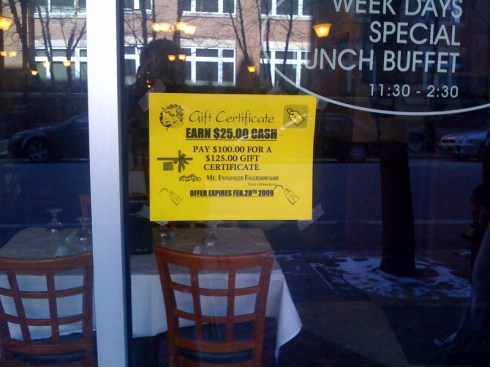
They are offering $125 gift certificates at the price of $100. Should you take it? The answer is after the jump.
I admit defeat.
This show is meant to be related to my research so I’m trying to get into it. But it’s really hard! There are sequences with kinetic violence. They remind me of the the Michael Mann movie Heat (better than his later movie Miami Vice!). But it’s so strategically unsophisticated it gets boring. Yesterday’s main dilemma was whether to get a double-agent to get to reveal his information by threatening his innocent wife and kid. Nice people say No but Jack Bauer says Yes. That’s the usual dilemma explored by 24, apparently one of John McCain’s favorite shows: Do we have to become as bad as the terrorists to beat the terrorists? It would be nice if sometimes Bauer was wrong and a “be nice” strategy pays off. I haven’t seen too many episodes – I got bored last season and have been more focused on cooking shows and referee reports this season. But are there any episodes with any moral or strategic complexity other than the obvious dilemma I described?
St. Patrick’s Day is approaching and I claim credit for the first to make this lame pun. I won’t be the last.
- British kids are getting dumber.
- Muzak in Chapter 11.
- Sirius XM in Chapter 11.
- Doubts about Trans-Atlantic Swim.
Obama gave an interview yesterday on TV where he was asked about nationalizing banks. His response is an interesting look into the way the administration thinks about things, comparing the US to Japan and Sweden. You can read a transcript here.
What caught my eye was his use of the word “like” in the following excerpt (second sentence.)
So you’d think looking at it, Sweden looks like a good model. Here’s the problem; Sweden had like five banks.
This is the so-cal “like.” It stands for “about” or in this case “not many more than.” It lends an informality to the sentence which adds to its comical and therefore rhetorical punch. On top of that it brings the President further down to Earth even when talking about something esoteric like bank nationalization.
I like it. Is this the first occurence of the so-cal “like” in Presidential prose?
Be wary though, this mild version is the gateway “like” to more serious transgressions such as “We were discussing TARP and Geithner is like, ‘No way Larry, I am the Treasury Secretary and I say no caps on executive pay’ and then, like, Summers is all ‘Whatever.’ “
Suppose you are going to say something that is literally true but you know in advance that your listener will misinterpret you and be led to believe something false. If you say it anyway, are you lying?
Conversely, is it a lie to say a falseshood if you know that, because you will be misinterpreted, this is the only way to get your listener to believe in what is actually true?
I watched his announcement today. I wrote an outline of what he said (mostly through gritted teeth):
here is what we think.
we have to do something big.
here is what we will do.
we will allow the american people to see what we do.
here are three more things we will do.
1. stress tests for banks.
2. we will make partnerships with private entities to buy bad assets. we don’t have a plan yet about how.
3. we will make more credit available. a big part of this is aimed at housing but we dont have a plan about what to do about that yet.
we are working with chris dodd and barney frank.
This person is actually cooking from the Alinea cookbook. And blogging it. Note that his (her?) most recent effort failed because he tried to do without the liquid nitrogen.
By the way, would someone please tell me exactly what it means to swim the Atlantic? I mean, she’s not sleeping in the water is she?
I think I am going to set a record for the least-trained pianist to play Beethoven’s Hamerklavier. I will play one note per day.
here are my two simple ways of thinking about fiscal stimulus.
from the perspective of the stimulee: the federal government is right now the cheapest source of capital. in fact capital has never been cheaper. the treasury can borrow at record low interest rates. unfortunately the banking system is not doing its job as an intermediary channeling this credit to the bridge-builders. so the bridge-builders effectively borrow directly from the source by accepting stimulus dollars and promising to pay them back in the future with taxes.
(of course there is a wedge between the amount i receive in stimulus ($X) and the amount I pay in taxes ($X/N) and this makes me inefficiently eager to accept it. this is why stimulus should focus on public projects where the benefits are dispersed equally.)
from the perspective of government. we accept that there are things government should be producing, in particular public projects where the benefits are dispersed equally. the government has flexibility in the timing of these investments. since the investment requires coupling labor with the government’s capital, the optimal timing is during times of (otherwise) unemployment when labor is relatively cheap.
so we don’t have to think about multipliers and we don’t have to think about Keynesian effective demand. The government acting optimally to smooth expenditures should spend a lot now. Yes, it means spending must be correspondingly reduced in the future and critics would worry that this won’t happen. But there will come a time when interest rates are higher and it is more costly for the government to borrow and under pretty much any theory you have of how spending is determined, at the margin at least, that will have the effect of reducing spending.
- Real Commercial, Fake SNL
- Jane Austen + Zombies = Soon to be a Major Motion Picture (via Bookslut)
- Steve Jobs owns the music industry
- Shoot your food.

