
You are currently browsing the category archive for the ‘Uncategorized’ category.

What would you believe in the face of the unbelievable? For example, how would you react if you discover suddenly that you can fly. Before today flying was impossible, but now you can do it. Something you were convinced of is wrong and you have to decide whether it’s that you can’t fly or that you are not prone to hallucinations.
In fact you already know how you would react, because it happens in your dreams. Have you ever dreamed you could fly? If so, did you infer that you must be dreaming? Some do, and then wake up. (Poor them.) Others just go on flying.
Are you irrational to believe you can fly?
Maybe you aren’t fooled by flying dreams or maybe you’ve never dreamed of flying. But crazy things happen in everybody’s dreams. What is the craziest thing that happened in your dreams that you nevertheless accepted as the way the world must work since after all it’s happening right before your eyes?
Tomatoes are about the only attribute these two have in common, so the choice comes down to personal preference. Heinz is spicier, with distinct Worcestershire notes. Market Pantry has mostly tomato flavor, which comes through precisely because it’s not as spicy. The flavor differences are apparent straight from the bottle or with fries.
With that conclusion, summarized briskly in workmanlike prose by journalists you’ve never heard of, Gladwell’s Grand Unifying Theory of Ketchup–which he was allowed to present in painstaking detail (and 5,000 words) in the nation’s most prestigious magazine–simply turns to air.
The background is in the Globe article.
Jean Tirole has written the best theoretical analysis I have seen of the role of government intervention to revitalize frozen asset markets. The key idea in this paper is that investors need to finance their next project and are unable to do this by selling their “legacy” assets because adverse selection has frozen the market.
A government buyback of these toxic assets attracts the bottom tail. The government of course is losing money on all of the assets it buys. But the payoff is that it rejuvinates the market: private financiers will now step in and buy the assets of those who refused the government offer. It’s a surprising result but ex post its pretty easy to understand.
If the government is offering a price 


All that was required was that the government price
The paper then goes on to study the optimal intervention when the market is not restricted to simple buybacks. The optimal scheme is a mix of buybacks and partial transfers of legacy assets that keep “skin in the game” to reduce the downstream adverse selection problem. The government is trying to minimize the cost of the intervention by spurring as much activity as possible from the private finance market.
This paper is worth studying.
This optical illusion appears on a street in West Vancouver. It is an experiment to see whether the image of a girl crossing the street will get drivers to slow down.

The pushback has been from groups who worry that drivers might react by braking or swerving and cause an accident. But that’s the short-run problem. Isn’t the bigger worry what happens in the long run when drivers no longer react when they see a child crossing the street?
More on Mr. Sha.
- Stark County, Ohio.
- I lost the game.
- Auto-tune your voicemails.
- Classically conditioning your roomie.
- Sartre’s facebook Wall.
- First ever commercial for a marijuana dispensary. (The real humor here is that you are first forced to watch an ad for “Spiriva” which is medicine for who-knows-what. This is targeted advertising.)
The demographic changes that have swept the county reflect what is happening across the state and much of the nation. It has happened slowly but surely over the course of a generation, becoming increasingly apparent not only in a drive through the 34 cities that fill this sprawling 789-square-mile county south of Los Angeles, but also, most recently, in the results of a presidential election. In 2008,Barack Obama drew 48 percent of the vote here against Senator John McCain of Arizona. (By comparison, in 1980,Jimmy Carter received just 23 percent against Ronald Reagan, the conservative hero whose election as California governor in 1966 and 1970 was boosted in no small part by the affection for him here.)
The article focuses on changes in ethnic composition but my sense is that a lot has to do with generational differences as well. During its rapid growth the people who lived there were the people who chose to move there, plus their kids. Their kids didn’t make that choice and so they are more of a random sample. Plus they naturally rebelled against the conservative culture that their parents created.
I thank Matt DeBeer for the pointer.
 I am partial to RJ’s Black Soft Licorice. In moderation, like cocaine (I imagine!), it does no harm. But like cocaine (I imagine!), one is tempted to consume it in excess, a bag at a time.
How can I just eat a reasonable amount? I could joint Licorice Lovers Anonymous (LLA) and complete a ten step program to kick my habit entirely. I am sure there are many fellow sufferers out there, who love RJ’s not too little but too much. Just a few tweets would allow us to coördinate and set up weekly meetings. Seems like overkill. And anyway, I don’t want to kick the habit entirely, just control it.
I see my five-year old wandering around, causing trouble and a simple solution appears magically in my mind. I ask him to hide the licorice. He is very good at hiding things that do not belong to him – remote controls, his brother’s toys, my watch etc. etc. He’ll love to hide the licorice. There are a couple of problems. It is my intention to ask him to bring the licorice back every day so I can have a few pieces. But there is s significant chance that he’ll forget where he hid the bag. So what? Then, we’ll lose the bag and the licorice. But this is not any worse than the LLA solution of cutting out the addiction completely.
There is a second and quite famous problem from incentive theory: Who will monitor the monitor? In other words, perhaps your police-kid will eat the licorice himself. For this problem I have an answer. My five-year old will consume strawberry Twizzlers by the cartful, but black, spicy licorice, I think not. I am proved right. One piece of licorice is chewed but the rest are intact.
Thinking about it, I realize that I have used a variation of an old idea of Oliver Wlliamson’s, “Credible Commitments: Using Hostages to Support Exchange” (jstor gated version). In his analysis, a contracting party A voluntarily hands over an “ugly princess” to party B to give party A the incentive to perform some costly investment. Party B does not value the princess and hands her over once the investment is sunk. In my argument, the ugly princess is the licorice and instead of specific investment, I want to commit to avoid over-consumption of an addictive good.
This pretty much gives you principles under which this mechanism works: Consumption of good that is addictive for party A but has no value for party B can be controlled by allowing party B to control the use of the good. Party A might return the favor for party B (e.g. by rationing computer game time). Only, my party B would never agree to this voluntarily and would see as a violation of civil liberties rather than as a favor. This level of addiction I have no solution for….

- They are presumably sitting on a mountain of internal research on the science of herding people efficiently. My favorite example was how they seat people for Captain EO. One entire side of the theater opens up and people are naturally guided in lines that form parallel to the rows and eventually feed into them. The whole process takes about 1 minute to seat about 500 people. The host asks those in the front of the lines to go 2/3 of the way down. They know that a request to go all the way to the edge would be ignored so they offer a compromise which is mostly honored.
- There is now a system called “fastpass” which allows you to reserve a time 1-2 hours later when you are able to bypass nearly all of the line. The efficiency doesn’t come from allowing people to take more rides. The easy way to see that is to note that each ride runs a fixed number of times in a day and if every ride has a line all day then the total number of rides taken is that fixed number. Rather the efficiency comes from allowing patrons to spend less time in line (and more time in the gift shops.)
- The cars in Autopia must have been grandfathered by the California legislature because they still burn fossil fuels and would not pass California emissions standards.
- They are the residual claimant for just about anything that goes wrong for their patrons. Not surprisingly we have never been to a restaurant anywhere near as knowledgeable and accommodating for my son’s food allergies.
- The debate about whether commercial developers provide the socially optimal level of public parking could be informed by comparing the number of restrooms per square foot on Main Street in Disneyland, to say Broadway.
- Some rides have lines that fork and you have to commit to one branch without full knowledge of the relative wait times. Pick the side with the most shade. Not just because shade is good, but also because people cluster in the shady sopts reducing the total density and making the wait time shorter per fixed line length.
- I got RSI from the Buzz Lightyear “ride.”
The commenting dynamic is very different on small blogs than it is on popular blogs. On small blogs, people typically comment when they have something to contribute or ask that is relevant to the post. These are frequently of high quality (relatively speaking; recall Sturgeon’s Law: 90 percent of everything is crap). On more popular blogs, this positive commenting dynamic is confounded by the presence of eyeballs. Every post is read by many thousands of people. For the self-involved who could never attract such a large audience on their own, this is an irresistible forum for expounding pet hypotheses, axe-grinding, and generally shouting at or expressing meaningless agreement with the celebrity post-authors.
which sounds plausible but it assumes a sorting condition that is debatable. Presumably everyone, the high-quality and low-quality commenters alike, want a bigger audience. The question is one of relative elasticities: does a percentage increase in audience lead to a larger percentage increase in low-quality comments relative to high-quality? I am not sure.
There is a perception cloud because most of us think that our own comments are the highest-quality ones and so the overall pool of comments appears distorted downward in quality. But there is one force for Gresham’s law that may swamp any having to do with commenters’ motives. There are simply more ways to be wrong, off-topic, and crazy than there are to be right, on-topic, and smart. So even if the sample scales proportionally with audience size, the space of good quality comments will be exhausted quickly leaving the long tail for the riffraff.
Bottom line: the way to maximize the proportion of good-quality comments is for the bloggers themselves to use up all the crazy ideas at the start. I like to think Sandeep and I are getting better and better at this.
An Israeli leftist believes that right-wing Prime Minister Neyanyahu can bring peace:
“The left wants to make peace but cannot, while the right doesn’t want to but, if forced to, can do it.”
Why can a right-winger make peace, while a left-winger cannot? There might be many reasons but the one mentioned in this blog must of course draw from Crawford-Sobel’s Strategic Information Transmission which has become the canonical model of the game-theoretic notion Cheap Talk. The key intuition was identified by Cukierman and Tommasi in their AER paper “Why does it take a Nixon to go to China?” (working paper version).
Suppose an elected politician knows the true chances for peace but also has a bias against peace and for war. The the median voter hears his message and decides whether to re-elect him or appoint a challenger. Given the politician’s bias, he may falsely claim there is a good case for war even if it is not true. It is hard for a politician biased towards war to credibly make the case for war. He risks losing the election. But if he makes the case for peace, it is credible: Why would a hawk prosecute for peace unless the case for peace is overwhelming? So the more a politician proposes a policy that is against his natural bias, the higher is the chance he gets re-elected. If the case for peace is strong, a war-biased politician can either propose war in which case he may not get re-elected and the challenger gets to choose policy. Or he can propose peace, get re-elected and implement the “right” policy. In equilibrium, the latter dominates and Nixon is necessary to go China, Mitterand is necessary for privatization etc…
Is this why Netanyahu believes he can make peace? Maybe he cares about leaving a legacy as a statesman. This would make him a less credible messenger – via the logic above, he is biased towards peace and any dovish message he sends is unreliable. Let’s hope that the stories of his strongly his Zionist father and hawkish wife are all true. And then Hamas should fail to derail the negotiations…And Hezbollah should fail in its efforts… And the other million stars that must align must magically find their place….
For 15 years, the British bookmaker William Hill allowed bettors to wager on their own weight loss, often taking out full-page newspaper ads to publicize the bet. This was a clear opportunity for those looking to lose weight to make a commitment, with real teeth. Here is a paper by Nicholas Burger and John Lynham which analyzes the data.
Descriptive statistics are presented in Table 2, which shows that 80% of bettors lose their bets. Odds for the bets range from 5:1 to 50:1 and potential payoffs average $2332.9 The average daily weight loss that a bettor must achieve to win their bet is 0.39 lbs. In terms of reducing caloric intake to lose weight, this is equivalent to reducing daily consumption by two Starbucks hot chocolates. The first insight we draw from this market is that although bettors are aware of their need for commitment mechanisms, those in our sample are not particularly skilled at selecting the right mechanisms.10 Bettors go to great lengths to construct elaborate constraints on their behaviour, which are usually unsuccessful.
Women do much worse than men. Bets in which the winnings were committed to charity outperformed the average. Bets with a longer duration (Lose 2x pounds in 2T days rather than x pounds in T days) have longer odds, suggesting that the market understands time inconsistency.
Beanie barrage: barker.
Recruit homeless people to run as candidates in an opposing party. Steve May, Republican party operative in Arizona is recruiting three way-way-outside-the-beltway candidates to run for the Green party in a local election, expecting that Green candidates will siphon votes from Democratic candidates.
“Did I recruit candidates? Yes,” said Mr. May, who is himself a candidate for the State Legislature, on the Republican ticket. “Are they fake candidates? No way.”
To make his point, Mr. May went by Starbucks, the gathering spot of the Mill Rats, as the frequenters of Mill Avenue are known.
“Are you fake, Benjamin?” he yelled out to Mr. Pearcy, who cried out “No,” with an expletive attached.
“Are you fake, Thomas?” Mr. May shouted in the direction of Thomas Meadows, 27, a tarot card reader with less than a dollar to his name who is running for state treasurer. He similarly disagreed.
“Are you fake, Grandpa?” he said to Anthony Goshorn, 53, a candidate for the State Senate whose bushy white beard and paternal manner have earned him that nickname on the streets. “I’m real,” he replied.
Whether it is desirable to have your kid fall asleep in the car goes through cycles as they age. It’s lovely to have your infant fall asleep in the snap-out car carriers. Just move inside and the nap continues undisturbed. By the time they are toddlers and you are trying to keep a schedule, the car nap only messes things up. Eventually though, getting them to fall asleep in the car is a free lunch: sleep they wouldn’t otherwise get, a moment of peace you wouldn’t otherwise get. Best of all at the end of a long day if you can carry them into bed you skip out on the usual nighttime madness.
Our kids are all at that age and so its a regular family joke in the car ride home that the first to fall asleep gets a prize. It sometimes even works. But I learned something on our vacation last month we went on a couple of longer then usual car trips. Someone will fall asleep first, and once that happens the contest is over. The other two have no incentives. Also, in the first-to-fall game, each child has an incentive to keep the others awake. Not good for the parents. (And this second problem persists even if you try to remedy the first by adding runner-up prizes.)
So the new game in town is last-to-sleep gets a prize. You would think that this keeps them up too long but it actually has some nice properties. Optimal play in this game has each child pretending to sleep, thereby tricking the others into thinking they can fall asleep and be the last. So there’s lots of quiet even before they fall asleep. And there’s no better way to get a tired kid to fall asleep than to have him sit still, as if sleeping, in a quiet car.
Let’s take a bike ride next to the Lake Michigan and see what our impressions are of the neighborhoods we ride through.
We start in south Evanston. We can ride on a path of some sort next to the lake all the way to Lincoln St in north Evanston, about 2-3 miles. We see lovely sandy beaches on our right (i.e to the east) and on our left we see families barbecuing or picnicking. We pass playgrounds, tennis courts and enter the grounds of Northwestern University. We bike around a lovely lagoon. We pause and look back south to take in a fantastic view of downtown Chicago.
Our impressions of Evanston are pretty good so far: nice bike path, nice views, generous provision of public goods. This impression fades a little after Lincoln. We continue north, perhaps heading east on Central and then north again on Ridge St. Or we take a big risk and ride on Sheridan. Potholes whichever way we go. And fast cars if we go on Sheridan. We amend our impression of Evanston: perhaps the local government isn’t as flush with cash as we thought.
Then, we enter Wilmette. We have to bike on the road but there is a lovely bike lane. All smooth and fast. We start thinking we’re pretty fit as we pick up speed. We realize we’re heading downhill so maybe not. We pass a lovely Bahai Temple. We try getting closer to the lake to recreate our wonderful Evanston experience. Big mistake: many parts of the road are cobbled to slow down traffic. Our arms get tired and we feel the beginning of a backache. So, we head back to Sheridan and ride along the road looking at the large houses and wondering how much they cost. By the time we leave Wilmette, we have a mixed impression. Nice bike path but are the cobbles really necessary? Sure they slow down cars but Wilmette ain’t no urban metropolis – there’s no traffic to slow down in the first place. We remember why we decided not to move to Wilmette but are happy they have a nice bike path.
Next, we ride into Kenilworth. The houses are even larger. There’s the odd McMansion but it’s hard to see behind the trees, at the end of a long drive. The bike lane suddenly disappears and we’re left high and dry. At least the road is wide and Kenilworth is small and we enter Winnetka. The road narrows. More potholes than Evanston. Have we crossed a boundary back into a poor neighborhood? We look around. A line of mutant double-cheeseburger-meets-big-macs homes as far as the eye can see. Surely richer than Evanston. We conclude that they are deliberately not maintaining the road to keep interlopers out of their chi-chi town. We’re a little disgusted and anyway we’re risking our life riding on this road.
We cut across to the Green Bay Trail. We realize that riding along the lakefront, seeing all those big houses, has triggered avarice and envy. We’re a little disgusted at having fallen prey to such base emotions. We hunker down and pedal hard, ignoring Glencoe and Highland Park.
Is the United States the world’s dominant exporter of culture? If this were true of any area you would think that area would be pop music. But it appears not to be the case.
In this paper we provide stylized facts about the global music consumption and trade since 1960, using a unique data on popular music charts from 22 countries, corresponding to over 98% of the global music market. We find that trade volumes are higher between countries that are geographically closer and between those that share a language. Contrary to growing fears about large- country dominance, trade shares are roughly proportional to country GDP shares; and relative to GDP, the US music share is substantially below the shares of other smaller countries. We find a substantial bias toward domestic music which has, perhaps surprisingly, increased sharply in the past decade. We find no evidence that new communications channels – such as the growth of country-specific MTV channels and Internet penetration – reduce the consumption of domestic music. National policies aimed at preventing the death of local culture, such as radio airplay quotas, may explain part of the increasing consumption of local music.
Here is the paper by Ferreira and Waldfogel. And before you click on this link, guess which country is the largest exporter as a fraction of GDP.

If you receive email from ‘me’ and every instance of the word “me” is single-quoted, as in ‘me,’ don’t bother looking for any hidden message.
Rather it is a strange bug in my iPhone text-substitution mechanism which replaces every instance of me with ‘me.’ I could probably figure out how to fix this, but I might not. Sometimes feel like I am encased in single quotes so it seems appropriate.
We planned to have a quick bite at the cafe before spending the afternoon at the California Academy of Sciences, an aquarium/science museum in Golden Gate Park. But when we walked in we knew right away that we would be spending at least as much time in the cafe as in the museum.
Freshly prepared fast food from many cuisines. It’s San Francisco on a plastic tray. We had tofu and cauliflower curry with brown rice, an hierloom tomato salad, barbecued ribs, carnitas tacos, Pho, steamed pork buns, and blackberry agua fresca. This fed 7 of us and cost about 70 bucks. With more time we could have doubled that.
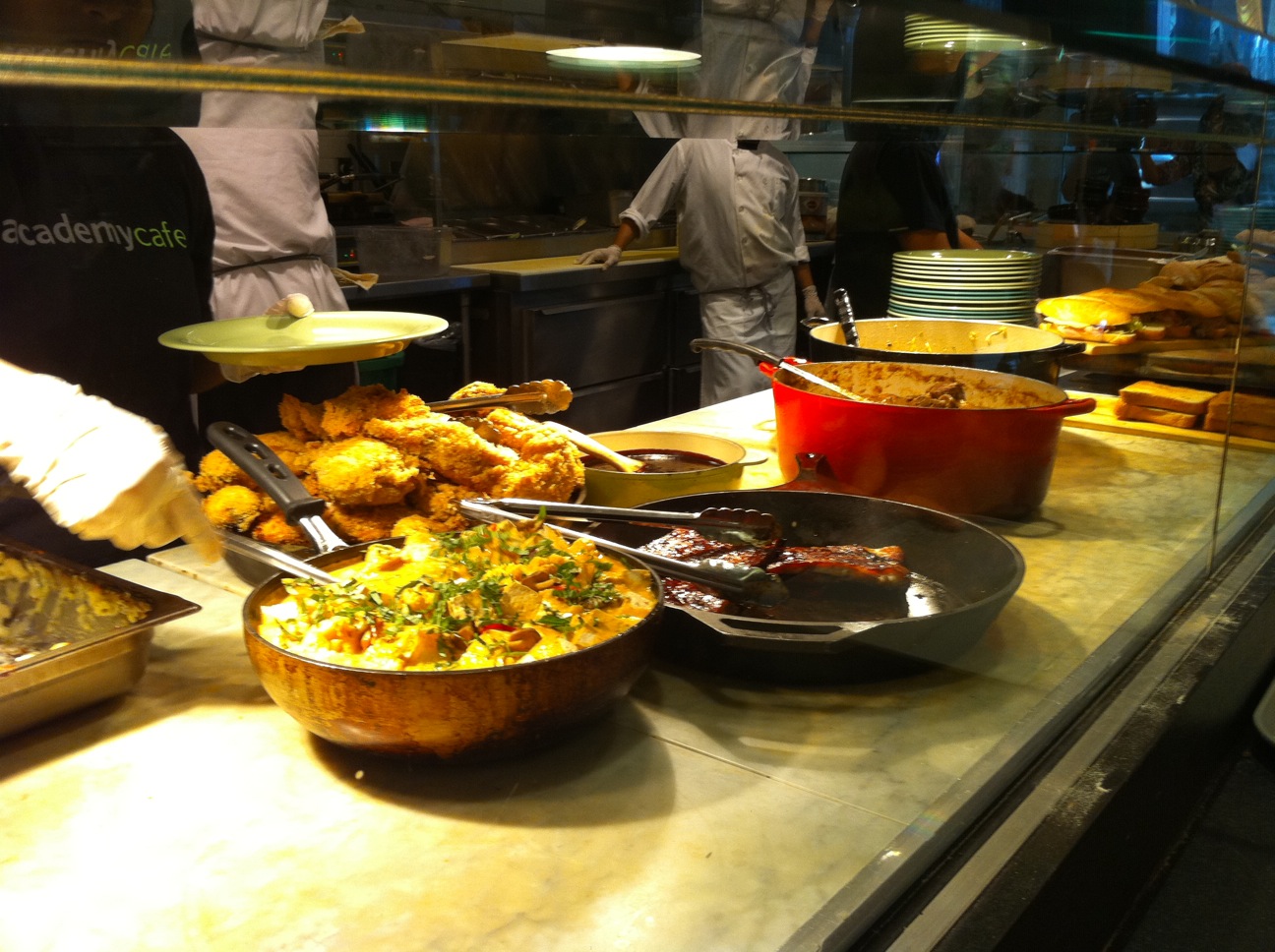
The stalls are organized by cooking style rather than cuisine. “Steamed,” “Slow-Cooked,” etc. Many of the stalls have cooks stationed behind who will prepare the food on the spot. Here’s the guy making the tomato salad:
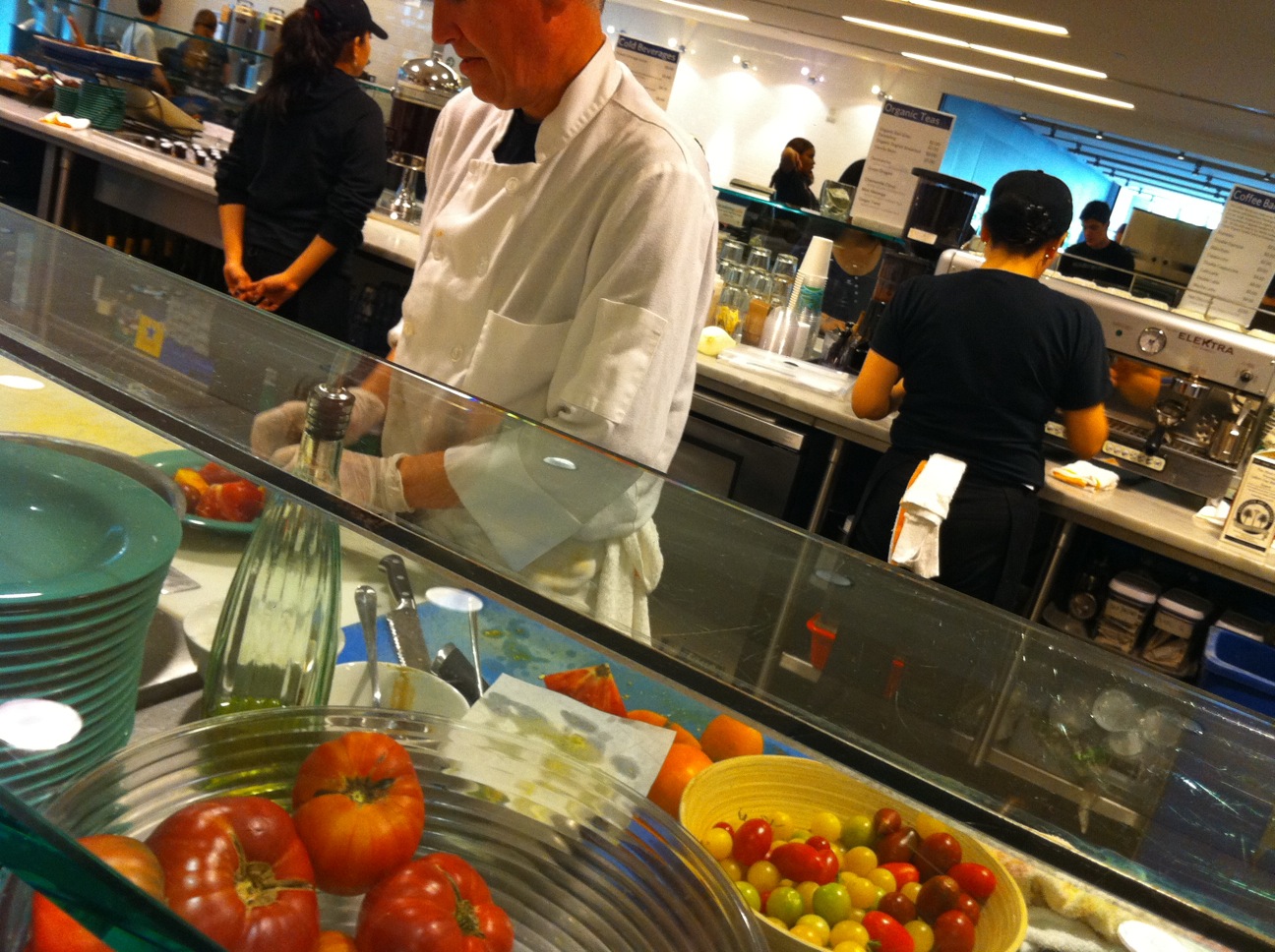
Be careful to skip the first cafe you see from the entrance to the building. It’s inviting because it has terrace seating but your resistance is rewarded. There is a sit-down restaurant downstairs which will be our dinner destination the next time we come (without kids.)

The museum? Brilliant. It has a rain forest. The aquarium dominates Chicago’s Shedd despite being only 1/8 of the size. We spent 3 hours there and didn’t even make it to the planetarium. Next time.

Unlike the first bottle, the second must be profound. In selecting, you are obliged to demonstrate sophistication without descending into foolishness. Nobody wants to hear your reflections on the beads of dew you observed on the leaves of Pinot Noir vines when bicycling through the Côte d’Or in ’92. Save your ruminations on imaginary nymphs frolicking in the fields. And for goodness’ sake, do not talk like some early-twentieth-century English fop, describing the bottles you decide against as guttersnipes. Never mention Bacchus. Ever.
That’s from Alan Richman’s tips for ordering wine at dinner.
- Roger Federer is William Tell
- New album from The Bad Plus. And here are the places I need to be this fall.
- Basque wine.
- Charles Keating’s pornography research
- Punk math.
Syllabus for his course on Leadership:
- 7th September 2010: “The Importance of Leading Differently – The Changing Operating Environment”
- 14th September 2010: “Case Study: The Changing Military 1972-2010”
- 21st September 2010: “Role of a Leader”
- 27th September 2010 (6-8pm): “Coping With Failure”
- 28th September 2010 (Assignment 1 Due): “Building Teams – What Makes Some Great”
- 5th October 2010: “Driving Change and Operating Differently”
- 12th October 2010: “Navigating Politics”
- 19th October 2010: “Making Difficult Decisions Pt. 1 – How We Decide”
- 26th October 2010 (Assignment 2 Due): “Making Difficult Decisions Pt. 2 – Dealing With Risk”
- 2nd November 2010: “Loyalty, Trust and Relationships”
- 9th November 2010: “Dealing With Cultural Differences”
- 16th November 2010: “Communicating the Story – the Media Environment”
- 30th November 2010 (Assignment 3 Due): “The Leader – the Personal Impact of Responsibility, Notoriety and Other Realities”
- 7th December 2010: “The Future Leader”
Details about the first class:
7th September 2010 – Seminar 1: The Importance of Leading Differently: The Changing Operating Environment
Description: A description of how changes in our operating environment over the 34 years of my service have demanded changes in how organizations operate – and how leaders lead them. For the military, focus often falls too narrowly – on technological advances in weaponry and armor. But like most organizations, truly significant changes in technology, politics, media, and society overall have driven change to almost every aspect of leading. Increasingly, the product of a failure to change – is failure.
Historical Examples:
- Case Study 1: The career of Stanley McChrystal
- Case Study 3: The 2002-2003 decision to invade Iraq
- Case Study 3: The United States Civil War
- Case Study 4: German Grand Strategy of World War 2
Primary Reading
- Filkins, Dexter. Stanley McChrystal’s Long War. The New York Times Magazine.
- 18th October 2009. P. 36.
Supplemental Reading
- FM 6-22 Army Leadership, Chapter 10: Influences on Leadership (Operating Environment, Stress in Combat, Stress in Training, Dealing with the Stress of Change, Tools for Adaptability).
- Coutu, Diane L., “How Resilience Works,” Harvard Business Review on Leading in Turbulent Times. Harvard Business School Press. 2003.
- Gehler, Christopher P. Agile Leaders, Agile Institutions: Educating Adaptive and Innovative Leaders for Today and Tomorrow. Strategy Research Project.
- Carlisle Barracks, PA: U.S. Army War College, 2005. 26pp. http://handle.dtic.mil/100.2/ADA434868
- Wong, Leonard. Developing Adaptive Leaders: The Crucible Experience of Operation Iraqi Free-dom. Carlisle Barracks, PA: U.S. Army War College, Strategic Studies Institute, 2004. 23pp. http://handle.dtic.mil/100.2/ADA424850
- Doyle, Michele Erina and Mark K. Smith, “Classical Leadership: theories of leadership” article (ILE materials)
- Reed, George E., ”Warrior Ethos” (ILE materials)
- Gardener, John. On Leadership. New York: Free Press. 1990., Chapters 1-3.
The data on first vs. second serve win frequency cannot be taken at face value because of selection problems that bias against second serves. The general idea is that first serves always happen but second serves happen only when first serves miss. The fact that the first serve missed is information that at this moment serving is harder than usual. In practice this can be true for a number of reasons: windy conditions, it is late in the match, or the server is just having a bad streak. In light of this, we can’t conclude from the raw data that professional tennis players are using sub-optimal strategy on second serves.
To get a better comparison we need an identification strategy: some random condition that determines whether the next serve will be a first or second serve. We would restrict our data set to those random selections. Sounds hopeless?
When a first serve hits the net and goes in it is a “let” and the next serve is again a first serve. But if it goes out then it is a fault. The impact with the net introduces the desired randomness, especially when the ball hits the tape and bounces up. Conditional on hitting the tape, whether it lands in or out can be considered statistically independent of the server’s current mental state, the wind conditions, and the stage of the game. These are the ingredients for a “natural experiment.”
Here is Sandeep’s post on the data discussed in the New York Times about winning percentages on first and second serves in tennis.There are a few players who win with higher frequency on either the first or second serve and this is a puzzle. Daniel Khaneman even gets drawn into it. (To be precise, we are calculating the probability she wins on the first serve and comparing that to the probability she wins conditional on getting to her second serve. At least that is the relevant comparison, this is not made clear in the article. Also I agree with Sandeep that the opponent must be taken into consideration but there is a lot we can say about the individual decision problem. See also Eilon Solan.)
And the question persists: would players have a better chance of winning the point, even after factoring in the sure rise in double faults, by going for it again on the second serve — in essence, hitting two first serves?
But this is the wrong way of phrasing the question and in fact by theory alone, without any data (and definitely no psychology), we can prove that most players do not want to hit two first serves.
One thing is crystal clear, your second serve should be your very best. To formalize this, let’s model the variety of serves in a given player’s arsenal. For our purposes it is enough to describe a serve by two numbers. Let 


Your second serve should be the one that has the highest
But it’s a jumped-to conclusion that this means your second serve should be as good as your first serve. Because your first serve should typically be worse!
On your first serve it’s not just
So, you want in your arsenal a serve which has a lower
But at the margin, if you can reduce
So when Vanderbilt tennis coach Bill Tym says
“It’s an insidious disease of backing off the second serve after they miss the first serve,” said Tym, who thinks that players should simply make a tiny adjustment in their serves after missing rather than perform an alternate service motion meant mostly to get the ball in play. “They are at the mercy of their own making.”
he might be just thinking about it backwards. The second serve is their best serve, but nevertheless it is a “backing-off” from their first serve because their first serve is (intentionally) excessively risky.
Statistically, the implications of this strategy are
- The winning percentage on first serves should be lower than on second serves.
- First serves go in less often than second serves.
- Conditional on a serve going in, the winning percentage on the first serve should be higher than on second serves.
The second and third are certainly true in practice. And these refute the idea that the second serve should use the same technique as the first serve as suggested by the Vanderbilt coach. The first is true for most servers sampled in the NY Times piece.
Twenty years ago, David Kaplan of the Case Western Reserve University had a manuscript rejected, and with it came what he calls a “ridiculous” comment. “The comment was essentially that I should do an x-ray crystallography of the molecule before my study could be published,” he recalls, but the study was not about structure. The x-ray crystallography results, therefore, “had nothing to do with that,” he says. To him, the reviewer was making a completely unreasonable request to find an excuse to reject the paper.
The article surveys the usual problems with peer review and is worth a read. I recognize all of the problems and they are real but I am less bothered than most. We don’t really need journals for dissemination anymore so the only function they serve is peer-review. The slowness of the process is not so big a deal anymore. (Unless you are up for tenure this year of course.)
Also, it’s true that reviewers are often just looking for excuses to reject a paper. But that is mainly because they feel obliged to give some reason to justify their decision. In many cases bad papers are like pornography. You know them when you see them. Few referees are willing to write “I reject this paper because it’s not a good paper,” so they have to write something else. To the extent that this is a failure it’s because the effort in reading through the paper looking for an excuse could be more productively spent elsewhere.
Hard Hat Heave: Lance Fortnow.
Abdelbasset al-Megrahi. He was the Lockerbie bomber who was released from a Scottish prison because he had just a few weeks to live. As it turns out, he lived for a year and may live for many more.
The public outrage has an uncomfortable edge to it.
Clinton yesterday implied strongly that Megrahi’s release, and his continued survival long beyond the three months predicted by Scottish ministers, meant justice for the families of the dead had been denied.
Let’s get this straight. We agree on the following ranking of outcomes, from best to worst.
- Alive and in prison
- Alive 1 year after being released from prison.
- Dead 1 week after being released from prison.
But its easy to get confused because, conditional on learning that he was going to be alive 1 year later, we see that releasing him was a mistake. Because we assumed that he was going to die in a week so that 1 and 2 were not feasible. Now that we see that 1 was actually feasible we are outraged that he is alive. When we feel outraged that he is alive we start to think that means that we wish he was dead. But alive/dead is just the signal that we made a mistake. What we really wish is that we hadn’t made the mistake of setting him free.
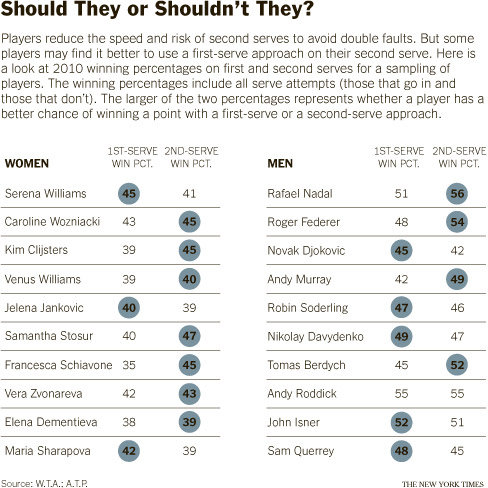
The data suggest that players should serve big on the second serve as well as their first. And distinguished psychologist and Nobel Prize winner Daniel Kahnemann offers an explanation:
“People prefer losing late to losing early,” Daniel Kahneman, a Noble Prize-winning psychologist and professor emeritus at Princeton, wrote in an e-mail.
Some of Kahneman’s best-known research, with Amos Tversky, focused on decision-making and people’s aversion to risk, even when given identical potential outcomes.
“Imagine a game in which you have a 20 percent chance to get to the second stage and an 80 percent chance to win the prize at that stage,” Kahneman wrote. “This is less attractive than a game in which the percentages are reversed.”
But this is not an individual decision-making scenario, it is a game so we have to account for how the receiver will respond to the change in strategy by the server. One model: the receiver has a budget of effort to expend on the two serves. In the slow second serve and fast first serve scenario, he saves some effort for the second serve. Hence, the first-serve win percentage for the server is large. If the server serves hard on both serves, there is less incentive to save effort for the second serve as it is fast anyway. So, transfer effort to the first. For the server, the win percentage will go down on the first serve and up on the second. I guess the server might be worse off as result. No-one is imagining any of this is explicitly calculated by either player but perhaps learning by trial and error, a process that should work well in zero sum games, should find the optimum.
Who knows is this is realistic or formalizable. But the qualitative point is the most important: in a game when one player evaluates a change in strategy based on data, she should carefully think through the response of other players to her change.
Parallel paths meet and end on one astounding episode of The Price is Right. Beautiful writing.
Ted says that when he went back for the afternoon taping, the producers moved him to a part of the studio where the contestants couldn’t see him. He says that he has heard “through unofficial channels” that he has been banned from the Bob Barker Studio, the way casinos have started asking Terry not to play blackjack inside their walls again. That Kathy Greco gave him a “Sicilian death stare” after the show, and that nobody ever needs a three-digit PIN. That according to his database, the Big Green Egg had appeared on the show only twice — before Terry and Linda began recording it — and that it was $900 before it was $1,175. That so many contestants — not just Terry — had won that day because they had listened to him. That his only mistake came when Terry played Switch?, because Ted didn’t realize there were two bikes, and he thought that a terabyte sounded like a lot of memory. That he was edited out of the show when it aired, that he can be seen only once, shaking his head when the prize is a Burberry coat, a prize that had never before appeared on the show. Otherwise, he would have known how much it was worth, the way he knew that a Berkline Contemporary Rock-a-Lounger was worth $599, and Brandon’s Ducane gas grill was worth $1,554, and Sharon’s car was worth $18,546. And for all that knowledge, for all his devotion, Bob Barker had called him a Loyal Friend and True, and Drew Carey called him that guy in the audience.
Deerstalker display: The Browser.
In golf:
How big a deal is luck on the golf course? On average, tournament winners are the beneficiaries of 9.6 strokes of good luck. Tiger Woods’ superior putting, you’ll recall, gives him a three-stroke advantage per tournament. Good luck is potentially three times more important. When Connolly and Rendleman looked at the tournament results, they found that (with extremely few exceptions) the top 20 finishers benefitted from some degree of luck. They played better than predicted. So, in order for a golfer to win, he has to both play well and get lucky.
I don’t understand the statistics enough to evaluate this paper. Apparently they call “luck” the residual in some estimate of “skill.” What I don’t understand is how such luck can be distinguished from unexpectedly good performance. If a schlub wins a big tournament and then returns to being a schlub, is that automatically luck?
Imagine the game: you and your partner are holding opposite ends of a rope which has a ribbon hanging from the middle of it. Your goal is to keep the ribbon dangling above a certain point marked on the ground.
This game is the Tug of Peace. Unlike a tug of war, you do not want to pull harder than your partner. In fact you want to pull exactly as hard as she pulls.
That shouldn’t be too difficult. But what if you feel that she is starting to tug a little harder than at first and the ribbon starts to move away from you. You will tug back to get it back in line.
But now she feels you tugging. If she responds, it could easily escalate into an equilibrium in which each of you tugs hard in order to counteract the other’s hard tugging.
This is metaphor for many relationship dysfunctions. For no reason other than strategic uncertainty you get locked into a tug of peace in which each party is working hard to keep the relationship in balance.
There is an even starker game-theoretic metaphor. Suppose that you choose simultaneously how hard you will tug and your choice is irreversible once the tugging begins. You never know how cooperative your partner is, and so suppose there is a tiny chance that she wants the ribbon just a little bit on her side of the mark.
Ideally you would both like to tug with minimal effort just to keep the ribbon elevated. But since there is a small probability she will tug harder than that you will tug just a little harder than that too to get the ribbon centered “on average.” Now, she knows this. And whether or not she is cooperative she will anticipate your adjustment and tug a little harder herself. But then you will tug all the harder. And so on.
This little bit of incomplete information causes you both to tug as hard as you can.
Doctors are skeptical. But they should be. When I approach a doctor with symptoms he has no way of knowing how many other doctors have already examined me. On average that number is larger than zero. So the doctor should factor in the wisdom of at least that fractional number of doctors who have already given me a clean bill of health. My symptoms have to be especially bad to compensate for that automatic positive signal.

