
You are currently browsing the category archive for the ‘Uncategorized’ category.
Iran is trying to acquire nuclear weapons. What impact does U.S. intervention in Libya have on Iran’s incentives to go nuclear? Obama said that Gaddafi had lost the support of the citizens of Libya and hence should step down. Deciding not to intervene after this statement might signal weakness and encourage nuclear proliferation by Iran. This is an argument that has some support in the administration:
The mullahs in Tehran, noted Thomas E. Donilon, the national security adviser, were watching Mr. Obama’s every move in the Arab world. They would interpret a failure to back up his declaration that Col. Muammar el-Qaddafi had “lost the legitimacy to lead” as a sign of weakness — and perhaps as a signal that Mr. Obama was equally unwilling to back up his vow never to allow Iran to gain the ability to build a nuclear weapon.
But equally,
“You could argue it either way,” said one official who was involved in the Libya debate and spoke on the condition of anonymity. “Maybe it would encourage them to do what they have failed to do for years: come to the negotiating table. But you could also argue that it would play to the hard-liners, who say the only real protection against America and Israel is getting a bomb, and getting it fast.”
We have to incorporate several other examples to deduce Iran’s interpretation os U.S. strategy. Libya agreed to give up is nascent WMD program after the invasion of Iraq in return for a normalization of relations with the U.S. Although Colonel Gaddafi was not able to pitch his tent at the U.N., his son was allowed to visit American firms, military schools, the creme de la creme of its educational institutions and enjoy the best aspects of its culture (the Broadway show “Mama Mia”). At that point we were trying to signal “If you play ball with us, we play ball with you” (e.g. Libya) but “If you have or might have WMDs, we will get you” (e.g. Iraq). In addition, our approach to North Korea signals “If you are actually nuclear, we pretty much leave you alone”. In fact, the North Kora example undercuts any signaling impact of being tough on Libya: Why would the Iranians leadership believe the U.S. would attack them if they have WMDs when North Korea has survived because (not despite) of being nuclear?
So, will all this information at hand, the Iranians can draw a simple graph. On the x-axis, the mullahs can plot the level of WMD development; on the y-axis the can plot the probability of U.S. intervention. For high level of WMD development, the probability of intervention is low (the North Korea example); for medium, the probability of intervention is high (the Iraq example) and for low level of WMDs it is high when circumstances dictate (the Libya example). What is a mullah who values his independence going to deduce with this data? Simple: Proliferate and acquire nuclear weapons.
To reduce incentives to proliferate, some part of the graph (if not all) must be upward sloping. A threat to attack a country with nuclear weapons seems incredible. That part of the graph is then downward sloping. All the U.S. has left to play with to design incentives is the part of the graph at the low to medium level of WMD activity. If this part is flat or downward sloping, it will maximize incentives to acquire WMDs.
The Boston Globe profiles Al Roth, who together with Atila Abdulkadiroglu, Tayfun Sonmez, Utku Unver and many others are leading the most important development in Microeconomics right now: market design.
Roth’s most recent project is helping to set up a nationwide kidney exchange, which would make it possible to find even more matches than the existing regional networks can find on their own. Running this national network has been a bureaucratic nightmare, and since it opened for business last fall, only two transplants have actually been carried out under its auspices. The problem is that depending on blood type, it can be hard or easy to find someone a compatible kidney. And when a hospital has an easy-to-match patient, its administrators are more likely to withhold that information from the other hospitals in the network because they’d rather do the transplant themselves, and get the business.
Alex Tabarrok wrote a thought-provoking piece on some ideas to increase kidney donation.
A distinguished colleague (whom I will spare the outing) teaches in the lecture room after me. I received this email from him:
Subject: Any chance you could erase the Leverdome blackboard?
Or is this a Coase theorem thing?
Not the Coase Theorem, no. The Coase Theorem is all about parties coming together to form agreeements that enhance welfare. No, my dust-bound comrade this is much simpler seeing as how aggregate welfare is improved by the unilateral deviation of a single agent, namely me.
You see those days when we were following the conventional norm, according to which each Professor erases the chalkboard after his own lecture leaving a clean board for the next class, we were leaving a free lunch just sitting there on the table. Because any one of us could have changed course, leaving the board to be erased by the next guy before his class, thus triggering a switch to the superior erase-before convention.
Now as I am sure I don’t have to explain to you, once the convention is settled every Professor erases exactly once per day. So nobody is any worse off. But as you have by now noticed, that one particular Professor who initiated the switch avoids erasing that one time and is therefore strictly better off. A Pareto improvement! but of course you are now well-trained at spotting those having just yesterday surveyed my lecture notes covering that very subject as you were erasing them from the Leverdome chalkboard.
From MR, I read this story about how the San Francisco smart parking meters will be designed to adjust meter rates in real time according to demand. There wasn’t much detail there but this bit gave me pause.
Rates at curbside meters in the project area will be adjusted block by block in an attempt to have at least one parking space available at any time on a given block.
Sign up for tickets
(My approach to blogging is to send myself emails whenever I have an idea, then sort through those emails when i have the time and decide what to write about. Some ideas have gathered dust over the past year and its time to use them or lose them.)
When do you give up on a book? It’s an optimal stopping problem with an experimentation aspect. The more you read the more uncertainty gets resolved the more you learn whether the book will be rewarding enough to finish. You stop reading when the expected continuation value, which includes the option value of quitting later, falls below the value of the next book in your queue.
So here’s an interesting question. Is that more likely to happen at the beginning or near the end of a book? Ignore the irrational desire to complete a book just because you have already sunk a lot of time into reading it. (But do include the payoff from finding out what happens with all the threads you have followed along the way.)
It easily could be that the most likely time to quit reading a book is close to the end. Indeed the following is a theorem. For any belief about the flow value of the book going forward, if that belief leads you to dump the book near the beginning, then that same belief must lead you to dump the book nearer the end. Because the closer to the end of the book the option value is lower and there is even less chance that it will get better.
It sounds wrong because probably even the most ruthless book trashers rarely quit near the end. But there’s no contradictipon. Even if the option value rule implies that the threshold quality required to continue reading is increasing as you get deeper into the book, it can still be true that statistically you most often quit reading near the beginning of a book. Because conditional on a book being dump-worthy, you are more likely to figure that out and cross that threshold for the first time early on rather than later.
Turing Test #N-1: detect sarcasm:
“Sarcasm, also called verbal irony, is the name given to speech bearing a semantic interpretation exactly opposite to its literal meaning.” With that in mind, they then focussed on 131 occurrences of the phrase“yeah right” in the ‘Switchboard’ and ‘Fisher’ recorded telephone conversation databases. Human listeners who sifted the data found that roughly 23% of the “yeah right”s which occurred were used in a recognisably sarcastic way. The lab’s computer algorithms were then ‘trained’ with two five-state Hidden Markov Models (HMM) and set to analyse the data – and the programmes performed relatively well, successfully flagging some 80% of the sarky “yeah right”s.
That’s pretty good, but I’ll wait around for the computers to pass the Nth and ultimate Turing Test: compose a joke that is actually funny.
Honestly if we had to rank tests of similarity to human interaction, I believe that composing original humor is probably the very last one computers will solve. (Restricting attention to the usual thought experiment where the subject you are interacting with is in another room and you have to judge whether it is a human or a computer just on the basis of text-based interaction.)
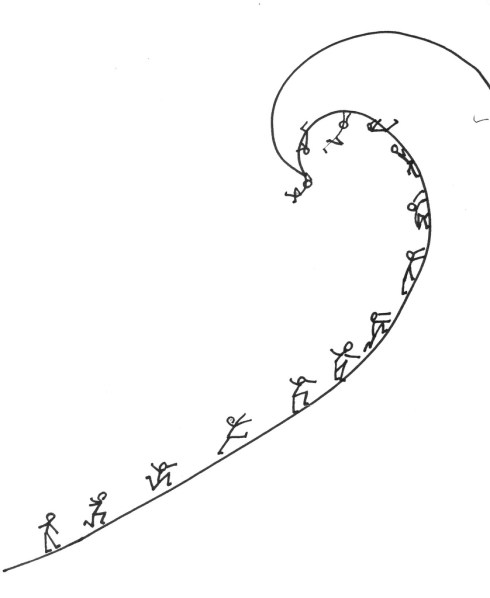
I am always writing about athletics from the strategic point of view: focusing on the tradeoffs. One tradeoff in sports that lends itself to strategic analysis is effort vs performance. When do you spend the effort to raise your level of play and rise to the occasion?
My posts on those subjects attract a lot of skeptics. They doubt that professional athletes do anything less than giving 100% effort. And if they are always giving 100% effort, then the outcome of a contest is just determined by gourd-given talent and random factors. Game theory would have nothing to say.
We can settle this debate. I can think of a number of smoking guns to be found in data that would prove that, even at the highest levels, athletes vary their level of performance to conserve effort; sometimes trying hard and sometimes trying less hard.
Here is a simple model that would generate empirical predictions. Its a model of a race. The contestants continuously adjust how much effort to spend to run, swim, bike, etc. to the finish line. They want to maximize their chance of winning the race, but they also want to spend as little effort as necessary. So far, straightforward. But here is the key ingredient in the model: the contestants are looking forward when they race.
What that means is at any moment in the race, the strategic situation is different for the guy who is currently leading compared to the trailers. The trailer can see how much ground he needs to make up but the leader can’t see the size of his lead.
If my skeptics are right and the racers are always exerting maximal effort, then there will be no systematic difference in a given racer’s time when he is in the lead versus when he is trailing. Any differences would be due only to random factors like the racing conditions, what he had for breakfast that day, etc.
But if racers are trading off effort and performance, then we would have some simple implications that, if it were born out in data, would reject the skeptics’ hypothesis. The most basic prediction follows from the fact that the trailer will adjust his effort according to the information he has that the leader does not have. The trailer will speed up when he is close and he will slack off when he has no chance.
In terms of data the simplest implication is that the variance of times for a racer when he is trailing will be greater than when he is in the lead. And more sophisticated predictions would follow. For example the speed of a trailer would vary systematically with the size of the gap while the speed of a leader would not.
The results from time trials (isolated performance where the only thing that matters is time) would be different from results in head-to-head competitions. The results in sequenced competitions, like downhill skiing, would vary depending on whether the racer went first (in ignorance of the times to beat) or last.
And here’s my favorite: swimming races are unique because there is a brief moment when the leader gets to see the competition: at the turn. This would mean that there would be a systematic difference in effort spent on the return lap compared to the first lap, and this would vary depending on whether the swimmer is leading or trailing and with the size of the lead.
And all of that would be different for freestyle races compared to backstroke (where the leader can see behind him.)
Finally, it might even be possible to formulate a structural model of an effort/performance race and estimate it with data. (I am still on a quest to find an empirically oriented co-author who will take my ideas seriously enough to partner with me on a project like this.)
Drawing: Because Its There from www.f1me.net

This is a plate of green curry chicken that I ate at a KFC in Chiang Mai. (Sorry about the shoddy phone-photos.) It cost 59 baht (about $1.90), it was delivered to my table by a waiter, and it wasn’t surprisingly good, or not bad considering, but legitimately excellent.
Think this is an unfair comparison? Even setting aside all the local adaptations, like the baby pearl eggplant (those aren’t peas), fresh chili pepper, and lashings of canonical green curry, the chicken alone was crisper and juicier than any I’ve ever had at a KFC in America. That chicken thigh was split open, dusted in whatever magical substance they use to give it that scaly crust, fried to a crackle, and sent right to my table without ever seeing a heat lamp.
Republicans and Democrats are negotiating a budget deal in an effort to avert a government shutdown. The last time the government was forced to furlough workers, Congressional Republicans and their leader Newt Gingrich took much of the blame in the eyes of the public. It is generally believed that Republicans, the anti-goverment party, would again be blamed for a government shutdown should an agreement not be reached this time around.
The first-order analysis bears this out. While a government shutdown would be a bad outcome for all parties, it is relatively less bad for the anti-big-government Republicans. Other things equal you would infer that if a shutdown were not averted it would have been because the Republicans were willing to let that happen.
Of course other things are not equal. The second-order analysis is that Democrats, understanding that Republicans would take the blame now become relatively more willing to allow a shutdown. This affects the bargaining. Democrats are now emboldened to make more aggressive demands for two reasons. First, the cost of having their demands rejected is lower because they score political points in the event of a shutdown. Second, for that same reason Republicans are now more likely to accept an aggressive offer.
Will the blame equilibrate? Does the public internalize the second-order analysis and adjust its blame attribution accordingly? And what does equilibrium blame look like? Must it be applied equally to both parties?
In politics only the most transparent arguments hold sway with the public. The second-order analysis is too subtle to be used as a talking point even though probably everybody understands it perfectly well. A talking point is effective as long as it’s believed that many people believe it, even if in fact most people see right through it. So the first-order analysis will rule and the blame will not equilibrate.
In the current environment that could raise the chances of a government shutdown. Ideally Democrats would maximize their advantage by increasing their demands and stopping just short of the point where Republicans would rather trigger a shutdown. But the Tea Party complicates things. They might be so steadfast in their principles that they are not deterred by the blame. That could mean that the best deal Democrats can expect to reach agreement on is dominated by making a demand that the Tea Party rejects and forcing a shutdown.
- Iggy Pop’s Tour Rider
- Dangerously Diluted Cocktails. Perfect For a Frivolous Holiday.
- A Not-So-Softly Killing of Charlie Trotter. Someone has an agenda.
- 8 bit video game deaths.
- Hosers.
- Brad Mehldau on Responsible Behavior.
In the last of our weekly readings, my daughter’s 4th grade class read Edgar Allen Poe’s “The Pit And The Pendulum” (a two minute read) and today I led the kids in a discussion of the story. Here are my notes.
The story reads like a scholarly thesis on the art and strategy of torture. My fourth graders had no trouble picking out the themes of commitment, credibility, resistance, and escalation as if they themselves were seasoned experts on the age-old institution. We went around the table associating passages in the story to everyday scenes on the playground and in the lunch line. Many of the children especially identified with this account of the delicate balance between hope and despair in the victim:
And then there stole into my fancy, like a rich musical note, the thought of what sweet rest there must be in the grave. The thought came gently and stealthily, and it seemed long before it attained full appreciation; but just as my spirit came at length properly to feel and entertain it, the figures of the judges vanished, as if magically, from before me; the tall candles sank into nothingness; their flames went out utterly; the blackness of darkness supervened; all sensations appeared swallowed up in a mad rushing descent as of the soul into Hades.
We had a lengthy discussion of how the victim was made to wish for death and one especially precocious youngster observed that the longing for death cultivates in the detainee what is known as the Stockholm Syndrome in which the victim begins to feel a sense of common purpose with his captors.
By long suffering my nerves had been unstrung, until I trembled at the sound of my own voice, and had become in every respect a fitting subject for the species of torture which awaited me.
Here Poe gives a nod to the eternal debate about the psychology of torture. Does psychological stress of torture bring the victim to a state in which he abandons all rationality? There in the hush of the elementary school library, the children were insistent that Poe was right to suggest instead that torture, judiciously applied, only heightens the victim’s strategic awareness.
In light of that observation it came as no surprise to the sharpest among my students that the instrument to be used would leverage to the fullest the interrogators’ strategic advantage in this contest of wills.
It might have been half an hour, perhaps even an hour, (for in cast my I could take but imperfect note of time) before I again cast my eyes upward. What I then saw confounded and amazed me. The sweep of the pendulum had increased in extent by nearly a yard. As a natural consequence, its velocity was also much greater. But what mainly disturbed me was the idea that had perceptibly descended. I now observed — with what horror it is needless to say — that its nether extremity was formed of a crescent of glittering steel, about a foot in length from horn to horn; the horns upward, and the under edge evidently as keen as that of a razor. Like a razor also, it seemed massy and heavy, tapering from the edge into a solid and broad structure above. It was appended to a weighty rod of brass, and the whole hissed as it swung through the air.
Still we were, every one of us, in awe of Poe’s ingenious device. The pendulum, serving both as a symbol of the deterministic and inexorable march of time, and a literal instrument of torture inheriting that same aura of inevitability.
I asked the youngest of my students, a gentle and charming, if somewhat reserved little girl to take her reader out of her Hello Kitty book bag and read aloud this entry, which I had highlighted as one whose vibrant color and imagery was sure to endear the students at such an early age to the rich joys of literature.
What boots it to tell of the long, long hours of horror more than mortal, during which I counted the rushing vibrations of the steel! Inch by inch — line by line — with a descent only appreciable at intervals that seemed ages — down and still down it came! Days passed — it might have been that many days passed — ere it swept so closely over me as to fan me with its acrid breath. The odor of the sharp steel forced itself into my nostrils. I prayed — I wearied heaven with my prayer for its more speedy descent.
This was the moment of my greatest pride in our weekly literary expeditions as I could tell that the child so was overcome with the joy and power of Poe’s insights into the art of interrogation, that she was nearly weeping at the end.
The story concludes with Poe’s most hopeful verdict on the limits of torture as a mechanism. Our victim persevered, resisted to the very end, and his steadfastness was rewarded with escape and rescue. Likewise, the little boys and girls went back to their classroom and I detected that they were moving unusually slowly. I surmised, I must say with a little pride, that they were still deep in thought about the valuable lesson we had explored together. Indeed many of them confided in me that they were eager to tell their parents about me and the story I picked for them and everything they learned today.
It is within the letter of the law of NHL hockey to employ a goalie who is obese enough to sit on the ice and obstruct the entire mouth of the goal. But can you get away with it?
As strange as it may sound to anyone with a sense of decency, there is actually sound reasoning behind it. Because of the geometry of the game, the potential for one mammoth individual to change hockey is staggering. Simply put, there is a goal that’s 6 feet wide and 4 feet high, and a hockey puck that needs to go into it in order to score. Fill that net completely, and no goals can possibly be scored against your team. So why hasn’t it happened yet?
One answer is that professionalism and fair play prevent many sports teams from doing whatever it takes to win. This is also known as “having no imagination.” Additionally, in hockey the worry of on-ice reprisal from bloodthirsty goons would weigh heavily on the mind of any player whose very existence violated the game’s “unwritten rules.”
Hit the link for the full analysis, including a field experiment. In a WSJ excerpt from a book entitled Andy Roddick Beat Me With A Frying Pan. Helmet huck: Arthur Robson.

Suppose I want you to believe something and after hearing what I say you can, at some cost, check whether I am telling the truth. When will you take my word for it and when will you investigate?
If you believe that I am someone who always tells the truth you will never spend the cost to verify. But then I will always lie (whenever necessary.) So you must assign some minimal probability to the event that I am a liar in order to have an incentive to investigate and keep me in check.
Now suppose I have different ways to frame my arguments. I can use plain language or I can cloak them in the appearance of credibility by using sophisticated jargon. If you lend credibility to jargon that sounds smart, then other things equal you have less incentive to spend the effort to verify what I say. That means that jargon-laden statements must be even more likely to be lies in order to restore the balance.
(Hence, statistics come after “damned lies” in the hierarchy.)
Finally, suppose that I am talking to the masses. Any one of you can privately verify my arguments. But now you have a second, less perfect way of checking. If you look around and see that a lot of other people believe me, then my statements are more credible. That’s because if other people are checking me and many of them demonstrate with their allegiance that they believe me, it reveals that my statements checked out with those that investigated.
Other things equal, this makes my statements more credible to you ex ante and lowers your incentives to do the investigating. But that’s true of everyone so there will be a lot of free-riding and too little investigating. Statements made to the masses must be even more likely to be lies to overcome that effect.
Drawing: Management Style II: See What Sticks from www.f1me.net
Two cars are for sale on the used car lot. Car A has 62,847 miles on it and is listed for $7500. Car B has 89,113 miles on it and is listed for $5600. Which car would you buy?
Did you think about it? OK, now your answer is not really important, but without looking back again at the numbers, answer this question: what was the third digit of the mileage reading of the two cars? You probably don’t remember because you probably didn’t pay close attention.
Apparently this inattention has been priced into the used car market. For example, used cars with 39,900 miles on the odometer sell for significantly more than cars with 40,000 miles but not much less than cars with 39,000 miles. This is the starting point of a paper by Nicola Lacetera, Devin Pope, and Justin Syndor. They go on to estimate a structural model of attentiveness through the magnitude of the price discontinuities.
In fact, as they observe, sellers seem to understand this effect very well. Here is a graph showing the volume of used cars sold wholesale at different odometer readings. There is a huge spike in volume at the right end of an interval and a huge drop on the other side.

Indeed you could imagine that this kind of effect manifests even in a world where most buyers have unlimited attentiveness. Everybody knows that the price drops at the 1,000 mile mark so used cars with 31,100 miles are leased to rental agencies until they reach the 31,900 mark. The only used cars for sale with 31,100 miles on them are the lemons that the seller is willing to part with at the price that older cars are selling for. Buyers know this so they treat all cars with between 31,000-31,999 miles as equivalent to the oldest car in that range.
(The next time you see zeros roll over on your odometer you will understand why that always feels like a watershed event. Your car is only a mile older but it just took a discrete drop in value.)

How do you get deadbeat dads to pay child support? You threaten them with incarceration if they don’t pay. But if the punishment has its intended effect you will find that the only deadbeats who actually receive the punishment are those for whom the punishment is pointless because they don’t have the money to pay. They are the turnips.
“Deadbeats,” according to Sorensen, are parents who could pay but choose not to. “Turnips” — invoking the phrase, “You can’t get blood out of a turnip” — are parents who don’t have the money to pay. So what percentage of nonpaying parents are deadbeats and what percentage are turnips? Sorenson says most of those who end up in jail are low-income, and thus, “more likely to be a turnip than a deadbeat.”
Is that a bug or a feature? That’s part of what the Supreme Court will decide in a case that was argued last week.
In January I made a prediction and kept it a secret. Now I can tell you what it was.
For fun I wanted to see how well I could predict the Economics PhD job market. As a simple test I tried to predict who would be selected for the Review of Economic Studies Tour, a kind of all-star team of new PhDs. Here was my predicted list
- Gharad Bryan (Yale)
- Matt Elliot (Stanford)
- Neale Mahoney (Stanford)
- Alex Torgovitsky (Yale)
- Glen Weyl (Harvard)
- Alex Wolitzky (MIT)
- Alessandra Voena (Stanford)
- Kei Kawai (Northwestern)
And here is the actual list (the RES Tour website is here.)
- Alex Wolitzky (going to Stanford?)
- Daniel Keniston (MIT, going to Yale)
- Mar Reguant (MIT, going to Stanford GSB)
- Kei Kawai (going to Princeton?)
- Alex Torgovitsky (coming to NU)
- Alessandra Voena (going to Chicago?)
- Peter Koudijs (Pompeu Fabra, going to Stanford GSB)
So I got 4 out of 8. (There are usually 7 people, and I predicted 7 originally, but I updated it the next day adding Kawai to the list. I had been so involved in recruiting students from other schools that I had completely forgotten about our own star student Kei Kawai and as soon as I remembered him I added him to the list.)
I previously blogged about Torgovitsky, Mahoney, and Koudijs.
You can see why I wanted to keep the prediction a secret until the market was over. You can verify my prediction by cutting and pasting the text in this file and generating its unique SHA1 hash (a digital signature) with this web tool and cross check that it is the hash that I originally posted here, and that I tweeted here, and that is reproduced below.
f502acfb48395d6ab223ca30803f98b9bd6fd6ce
(Here is the original prediction before I added Kawai, and here is the hash for that one.)
I did this as an experiment to see how easy it is to predict job market outcomes. At the time I made this prediction I had read the files of each of these candidates and interviewed most of them. I didnt know where else they had interviews and I made the prediction before the stage of flyout interviews so I had little information about how their job market was going overall.
Getting half right is about what I expected. To me this is evidence that the market is hard to predict even after having interviewed the candidates. In particular I take it as evidence against the cynical view that the market herds on certain candidates early in the process. Indeed I would not have changed my prediction much even a week or two later when flyout schedules were in place.
Incidentally the Review Tour rosters say something about the strength of PhD programs. Here’s a breakdown of the last 6 years and where the tourists received their PhDs:
MIT 12
Harvard 7
NWU 4
Yale 3
Stanford 3
Stanford GSB 2
BU, Duke, LSE, Michigan, NYU, Penn, Princeton, Ohio State, Stern, UPF, UCL — 1 each
Northwestern is doing very well! (In addition to producing stars, we also do well hiring them. 3 from the tour in the past 6 years, including Alex Torgovitsky this year, an outstanding hire.)
Also I understand that a team is at work creating the web tool that I suggested here for creating and managing secret predictions. If and when it hits I will announce it here.
Wendy: There’s chard on your face.
Ray: Chard?
Wendy: The greens. It’s chard right? I think the server said it was chard. I think he said something like “embellished with pearls of chard.”
Ray: Better than shards of pearls.
Wendy: Anyway there’s a pearl on your chin, you might want to wipe it off. Oh hey, how was that new exhibition you went to?
Ray: Ah yes, the Alpha-Beam Installation.
Wendy: What was that?
Ray: You’ve heard of I-beams right? Well, this guy built massive steel beams with cross-sections for every letter of the alphabet.
Wendy: Q-beams.
Ray: And P-beams, and Z-beams, etc. And punctuation beams. The semi-colon beam was an engineering feat in itself.
Wendy: Cool.
Ray: Yeah right, and he wrote poetry with his beams. Gargantuan, industrial poetry. A single haiku took up the space of football stadium.
Wendy: I love it.
Ray: I guess, but come on how is that art?
Wendy: Oh, don’t be such a douchebag.
Ray: Listen, it may sound cliche, but really anybody could have done that. Even I could have done that. I’m no artist, and if I could have done that, it’s not art.
Wendy: But you didn’t do it. On the other hand, he did. Because it’s art and because you are not an artist.
Ray: Ok, I’ve heard that one before, but I’m telling you that argument just doesn’t work. Sure I didn’t make alphanumeric pillars and arrange them into rhymes and sure I never would have dreamed of doing something like that but that doesn’t make him any more of an artist than me. Think of the thousands of other self-styled artists working in obscurity picking completely random things and not using them for their intended purpose. One of these guys gets plucked out of his basement and placed in an art museum handing out free cheese and wine to 7 of his friends from high school. It’s not enough to point out that he did it and not us. Because there’s a thousand things we did and he didn’t. Your argument gives me no way of distinguishing between a world where this guy has some innate ability to sense which particular non-functional scrap of architecture has the power to move people and a world where everybody is repeating pre-school art projects and one gets picked at random to fill up a vacant wharehouse.
Wendy: You would be such a bore if it weren’t for the hilarious food on your face.

- How cannibals hook up.
- Ralph Steadman plank grills Hunter S. Thompson.
- Stupid Man Commercials. I actually starred in one of these when I was like 4. EasyJack pancakes. “Make it snappy Mom!!” Hasn’t made it to YouTube yet.
- What kind of porn do women like?
4. Do you act more or less rationally in your marriage than in other areas of your life?
You should never ask a decision theorist such a question since we make a living by redefining the word “rational.” I think it means “doing whatever seems most appropriate at the time” and is therefore tautological. So, no, I’m not rational in any respect.
That’s from a funny interview with Bart by the MILTTMPHDFTPAM(TMRPOTSIHTA) at Spousonomics.
If I was nominating for the MacArthur fellowships…
In advance of The Bad Plus’ world premiere of The Rite of Spring, Ethan Iverson drops this monster blog post about Stravinsky, 20th century music, and writing. You should read the whole thing.
On a piece called the Ebony Concerto:
While the Ebony Concerto is not jazz, it is a deconstructed big band piece, and therefore a great introduction to Stravinsky for a jazz musician.
It is barely a concerto, though, for the clarinetist is featured only occasionally. In the middle movement, the soloist only plays a couple of phrases! Clearly Stravinsky didn’t trust the work’s commissioner, Woody Herman.
On the box it is Benny Goodman, a real virtuoso. But he didn’t play the middle movement; Charles Russo stood in instead.
But perhaps because the star was out of the room, it’s the best movement. It is played much slower than the given tempo marking, the saxophones use a real jazz sound and phrase with some swing, and the hapless harpist plays a huge wrong note the second time through. (Perfect.) The final result is possibly the bluesiest classical recording in existence.
On deciphering Stravinsky’s odd meters:
Gah! This is two bars of four, not a bar of five and a bar of four! The best musical point would be make that dry ostinato as grooving, secure, and mysterious as possible — a target that much harder to reach when you have to count a silent “1” and come in on “2” of a bar of five.

Nabokov and Stravinsky
As Andriessen and Schönberger suggest, Nabokov was Stravinsky’s opposite number, a displaced Russian aristocrat enthralled with Paris and America. Many of Stravinky’s and Nabokov’s most celebrated works seem to wander up the same skewed Escher-esque print: “First, you are a perfect technician. Then you parody the effect of technique in an amused way. In doing so, you reveal a new, utterly sincere emotion that requires mastering a new technique. After perfecting this technique, you parody it in an amused way. In doing so, you reveal a new emotion that requires mastering a new technique….”
On Stravinsky’s influence
In The Rest is Noise, Alex Ross says that The Rite of Spring “prophesied a new type of popular art–low-down yet sophisticated, smartly savage, style and muscle intertwined.”
Part of the story of Alex’s book is how that prophesy didn’t really come true. It came true for a lot of thrilling American folkoric music: jazz, rock, hip-hop, musical theatre, etc., etc., etc…but the populist side of classical music never took off.
Reid made me laugh: In rehearsal, I mentioned that Peter Schickele had said The Rite of Spring was so influential that the much of 20th century classical music could be called “The Rewrite of Spring.” Reid shook his head. “No: The Rite hasn’t been influentialenough.”
With the new social-network aware webapp, Getupp:
Getupp is a neat webapp that helps you set your goals and share them publicly so you’re held accountable to the world. To make sure keep your commitments, Getupp can notify your Facebook friends if you break a commitment so you can be sure everyone will find out that you’re a slacker.
I have a personal commitment to write a blog post every day. Each day that I fail I am going to write a blog post to let you know that I failed.
I got this tweet from @gappy3000
In this NYT discussion on US inequality http://nyti.ms/fIIb1N nobody mentions the Benaou-Tirole paper. Depressing. http://bit.ly/fbUek8
I won’t rectify the omission but I will talk about an earlier paper “Social Mobility and Redistributive Politics” by Thomas Piketty which has a similar idea and is based on a much simpler logic. The idea is that these three characteristics seem to come in a bundle:
- Wealthy family
- Belief that individual effort matters for success
- Opposition to redistributive social policy
and that less wealthy families are characterized by support for redistribution and the belief that family background (i.e. social class) matters more for success.
Piketty developed a simple theory for why these distinct worldviews can coexist in the same world even though one of them must be wrong and even though all households have the same intrinsic preference for equity. It’s based on the observation that there is an identification problem in sorting out whether family background or individual success matters and once a family falls into one of these categories, no amount of experience can change that.
To see the problem, suppose that your family’s history has led you to believe that individual effort matters very little for success. Then you have little incentive to work hard and you will be relatively unsuccessful. You will notice that some people are successful but you will attribute that to the luck of their social class. (However it easily could be that you are wrong and their success is due to their hard work.) Indeed even in your own family history you will record some episodes of upward mobility, but because your family doesn’t work hard you rightly attribute that to luck too. In a world with such inequality and where effort matters little you see a strong moral justification for redistribution and little incentive cost.
On the other hand if your family has learned, and teaches you, that effort matters you will optimally work hard. You will be more successful than average and you will attribute this to your hard work. (It easily could be that you are wrong and in fact the source of your success is just your social class.) You will see that other families are less successful on average and as a result you see the same moral reason for redistribution, but you think that effort matters and, understanding how redistribution reduces the incentive to work hard, you favor less redistribution than the median voter.
How does this contribute to the debate in the link above? This indeterminacy in attitudes toward redistribution means that differences across countries and over time are essentially arbitrary and due to factors that we can call culture. Inequality is high in the United States and low in Europe. You are tempted to say “and yet there is less outrage about inequality in the US than there is in Europe” but in fact you should say “precisely because there is…”
Homburg Haul to Pierre Yared who first told me about the Piketty paper.
You probably heard about the Facebooks of China. Facebook and Twitter are blocked there and filling the vacuum are some homegrown social networks. Obviously the biggest issue with this in the particular instance of China is freedom of information and expression, so the thought experiment I will propose requires a little abstraction to focus on a separate issue.
Sites like Renren and Kaixin001 are microcosms of today’s changing China — they copy from the West, but then adjust, add, and, yes, even innovate at a world-class level, ultimately creating something unquestionably modern and distinctly Chinese. It would not be too grand to say that these social networks both enable and reflect profound generational changes, especially among Chinese born in the 1980s and 1990s. In a society where the collective has long been emphasized over the individual, first thanks to Confucian values and then because of communism, these sites have created fundamentally new platforms for self-expression. They allow for nonconformity and for opportunities to speak freely that would be unusual, if not impossible, offline. In fact, these platforms might even be the basis for a new culture. “A good culture is about equality, acceptance, and affection,” says Han Taiyang, 19, a psychology major at Tsinghua University who uses Renren constantly. “Traditional thinking restrains one’s fundamental personality. One must escape.”
Goods (like social networks) that have bandwagon effects create the greatest value when the size of the market is largest. But that same effect can cause convergence on a bad standard. One argument, very narrow of course, for trade barriers is to prevent that from happening. We allow each country to develop critical mass in their own standard in isolation before we reduce trade barriers and allow them to compete.

- Whenever I visit some place to give a talk, when I depart why is the host always more conservative than me in suggesting how early I should leave to make it to the airport on time? More conservative even that I bet they are for themselves?
- Twitter tells me who I should follow. But what I really want to know is who are the people Twitter suggests should follow me.
- What is the point of posting the schedule of Arrivals on airport monitors that are past the security lines? Anybody who has access past that point is waiting for a departing flight, not an arrival.
- When Kellogg builds its new building I will suggest that all offices have showers built into them. Since my best thoughts come when I am in the shower, I would like to spend most of my day there.
- Why has 80s music been pretty much passed over when it comes to “Classic Rock” playlists?
- Why are roads that run alongside expressways always called Frontage Road?
- You can talk about price discrimination and loyalty programs, but these are second order compared to the real reason behind Frequent Flier programs. Since business travelers don’t fully internalize the price of the flights they book, airlines compete for them with kickbacks in the form of frequent flier miles.
Boston being a center for academia as well as professional sports, Harvard and MIT faculty and students are leading the way in the business of sports consulting.
And some of those involved aren’t that far away from being kids. Harvard sophomore John Ezekowitz, who is 20, works for the NBA’sPhoenix Suns from his Cambridge dorm room, looking beyond traditional basketball statistics like points, rebounds, assists, and field goal percentage to better quantify player performance. He is enjoying the kind of early exposure to professional sports once reserved for athletic phenoms and once rare at institutions like Harvard and MIT. “If I do a good job, I can have some new insight into how this team plays, what works and what doesn’t,” says Ezekowitz. “To think that I might have some measure of influence, however small, over how a team plays is a thrill.” It’s not a bad job, either. While he doesn’t want to reveal how much he earns as a consultant, he says that not only does he eat better than most college students, the extra cash also allows him to feed his golf-club-buying habit.
Almost every kind of race works like this: we agree on a distance and we see who can complete that distance in the shortest time. But that is not the only way to test who is the fastest. The most obvious alternative is to switch the roles of the two variables: fix a time and see who can go the farthest in that span of time.
Once you think of that the next question to ask is, does it matter? That is, if the purpose of the race is to generate a ranking of the contestants (first place, second place, etc) then are there rankings that can be generated using a fixed-time race that cannot be replicated using an appropriately chosen fixed-distance race?
I thought about this and here is a simple way to formalize the question. Below I have represented three racers. A racer is characterized by a curve which shows for every distance how long it takes him to complete that distance.
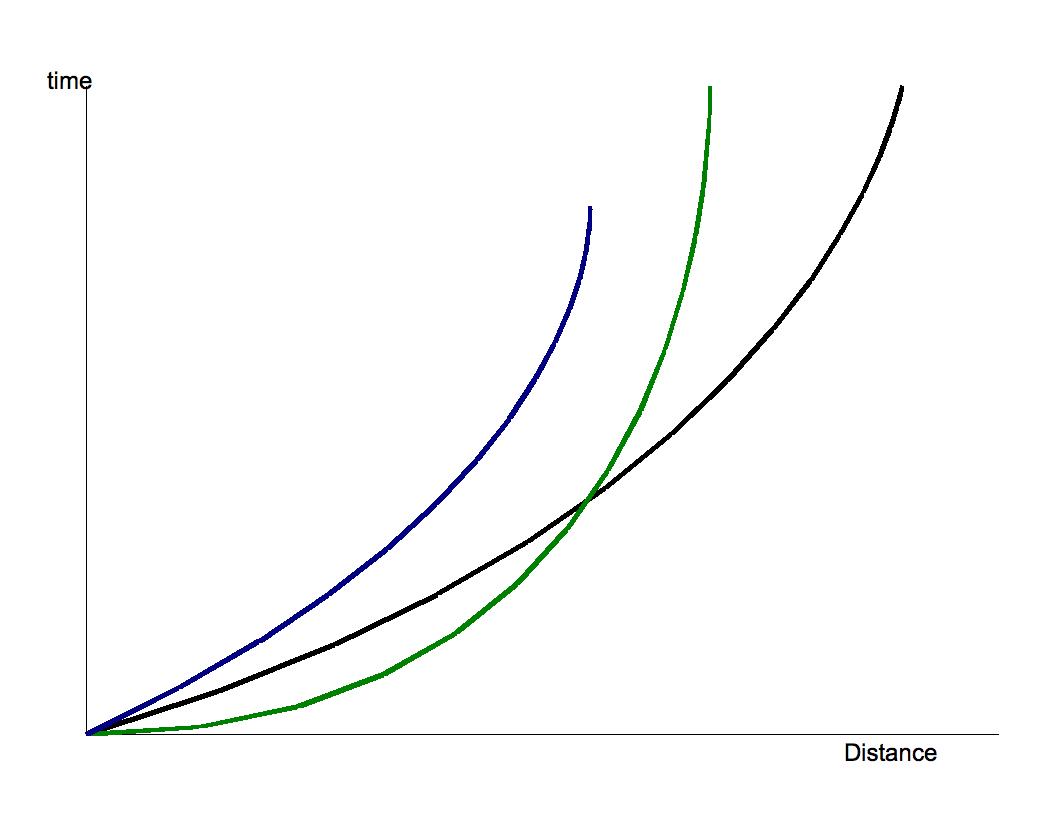
Now a race can be represented in the same diagram. For example, a standard fixed-distance race looks like this.
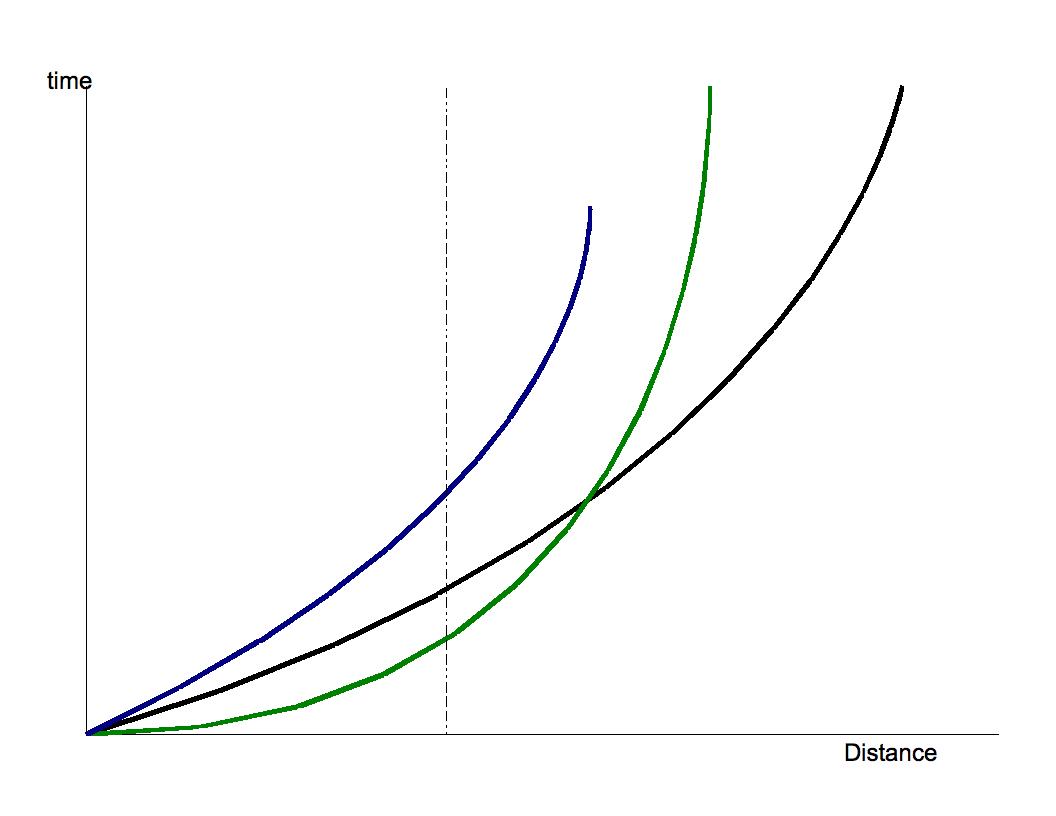
The vertical line indicates the distance and we can see that Green completes that distance in the shortest time, followed by Black and then Blue. So this race generates the ranking Green>Black>Blue. A fixed-time race looks like a horizontal line:
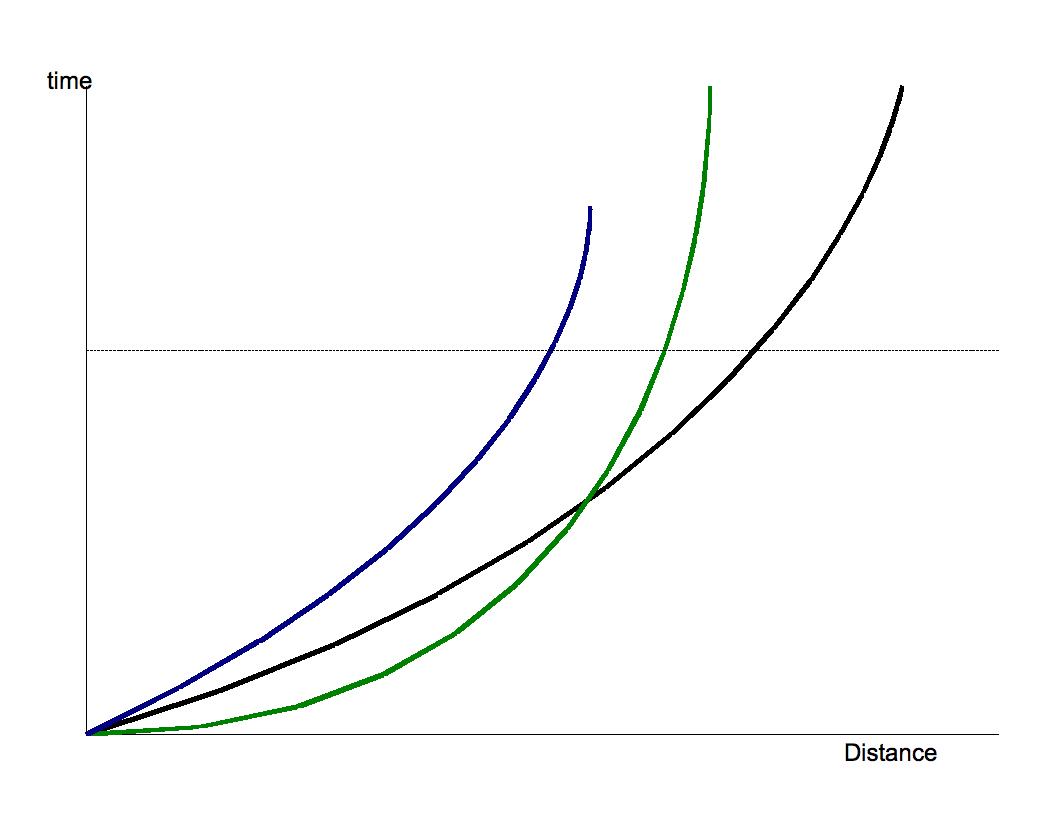
To determine the ranking generated by a fixed-time race we move from right to left along the horizontal line. In this time span, Black runs the farthest followed by Green and then Blue.
(You may wonder if we can use the same curve for a fixed-time race. After all, if the racers are trying to go as far as possible in a given length of time they would adjust their strategies accordingly. But in fact the exact same curve applies. To see this suppose that Blue finishes a d-distance race in t seconds. Then d must be the farthest he can run in t seconds. Because if he could run any farther than d, then it would follow that he can complete d in less time than t seconds. This is known as duality by the people who love to use the word duality.)
OK, now we ask the question. Take an arbitrary fixed-time race, i.e. a horizontal line, and the ordering it generates. Can we find a fixed-distance race, i.e. a vertical line that generates the same ordering? And it is easy to see that, with 3 racers, this is always possible. Look at this picture:
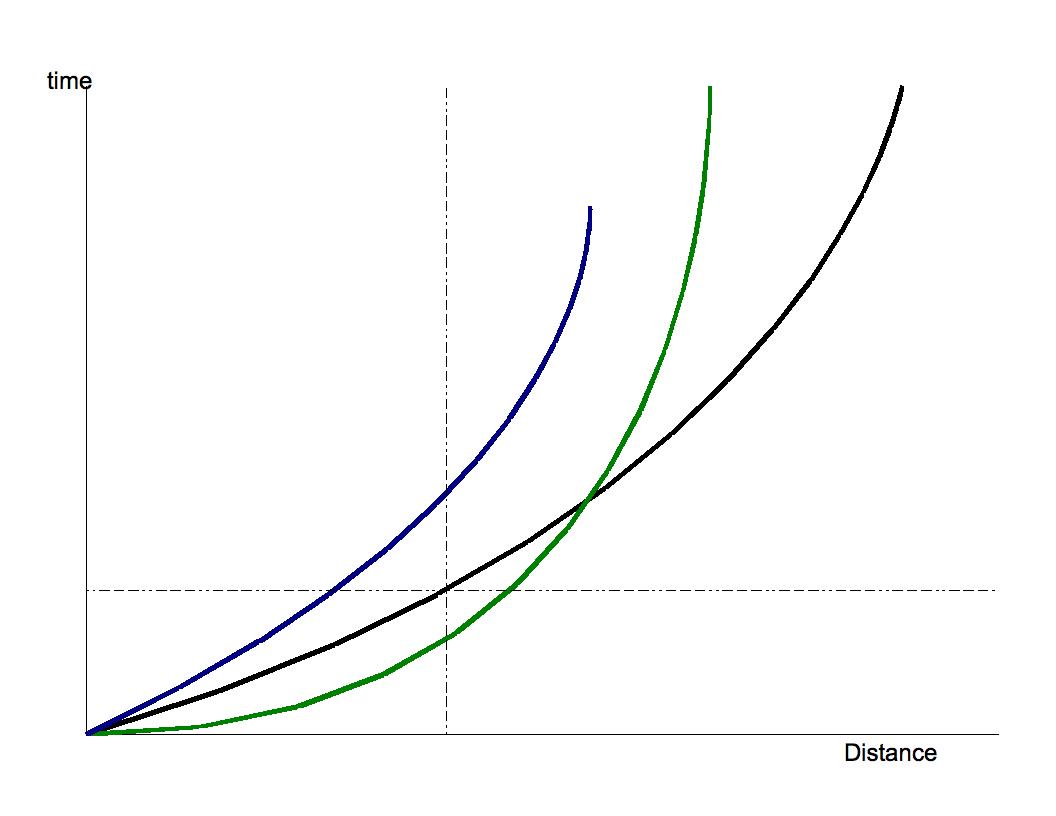
To find the fixed-distance race that would generate the same ordering as a given fixed-time race, we go to the racer who would take second place (here that is Black) and we find the distance he completes in our fixed-time race. A race to complete that distance in the shortest time will generate exactly the same ordering of the contestants. This is illustrated for a specific race in the diagram but it is easy to see that this method always works.
However, it turns out that these two varieties of races are no longer equivalent once we have more than 3 racers. For example, suppose we add the Red racer below.
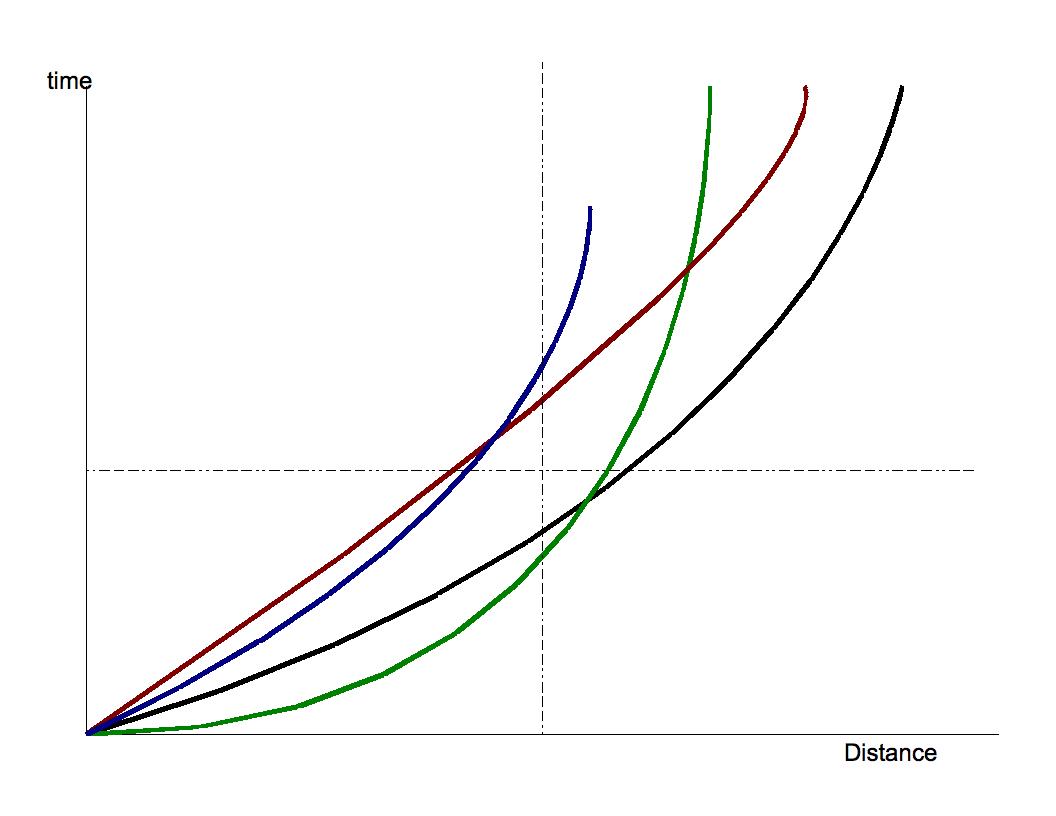
And consider the fixed-time race shown by the horizontal line in the picture. This race generates the ordering Black>Green>Blue>Red. If you study the picture you will see that it is impossible to generate that ordering by any vertical line. Indeed, at any distance where Blue comes out ahead of Red, the Green racer will be the overall winner.
Likewise, the ordering Green>Black>Red>Blue which is generated by the fixed-distance race in the picture cannot be generated by any fixed-time race.
So, what does this mean?
- The choice of race format is not innocuous. The possible outcomes of the race are partially predetermined what would appear to be just arbitrary units of measurement. (Indeed I would be a world class sprinter if not for the blind adherence to fixed-distance racing.)
- There are even more types of races to consider. For example, consider a ray (or any curve) drawn from the origin. That defines a race if we order the racers by the first point they cross the curve from below. One way to interpret such a race is that there is a pace car on the track with the racers and a racer is eliminated as soon as he is passed by the pace car. If you play around with it you will see that these races can also generate new orderings that cannot be duplicated. (We may need an assumption here because duality by itself may not be enough, I don’t know.)
- That raises a question which is possibly even a publishable research project: What is a minimal set of races that spans all possible races? That is, find a minimal set of races such that if there is any group of contestants and any race (inside or outside the minimal set) that generates some ordering of those contestants then there is a race in the set which generates the same ordering.
- There are of course contests that are time based rather than quantity based. For example, hot dog eating contests. So another question is, if you have to pick a format, then which kinds of feats better lend themselves to quantity competition and which to duration competition?
My daughter’s 4th grade class read The Emperor’s New Clothes (a two minute read) and today I led a discussion of the story. Here are my notes.
The Emperor, who was always to be found in his dressing room, commissioned some new clothes from weavers who claimed to have a magical cloth whose fine colors and patterns would be “invisible to anyone who was unfit for his office, or who was unusually stupid.”
Fast forward to the end of the story. Many of the Emperor’s most trusted advisors have, one by one, inspected the clothes and faced the same dilemma. Each of them could see nothing and yet for fear of being branded stupid or unfit for office each bestowed upon the weavers the most elaborate compliments they could muster. Finally the Emperor himself is presented with his new clothes and he is shocked to discover that they are invisible only to him.
Am I a fool? Am I unfit to be the Emperor? What a thing to happen to me of all people! – Oh! It’s very pretty,” he said. “It has my highest approval.” And he nodded approbation at the empty loom. Nothing could make him say that he couldn’t see anything.
The weavers have succesfully engineered a herd. For any inspector who doubts the clothes’ authenticity, to be honest and dispel the myth requires him to convince the Emperor that the clothes are invisible to everybody. That is risky because if the Emperor believes the clothes are authentic (either because he sees them or he thinks he is the only one who does not) then the inspector would be judged unfit for office. With each successive inspector who declares the clothes to be authentic the evidence mounts, making the risk to the next inspector even greater. After a long enough sequence no inspector will dare to deviate from the herd, including the Emperor himself.
The clothes and the herd are a metaphor for authority itself. Respect for authority is sustained only because others‘ respect for authority is thought to be sufficiently strong to support the ouster of any who would question it.
But whose authority? The deeper lesson of the story is a theory of the firm based on the separation of ownership and management. Notice that it is the weavers who capture the rents from the environment of mutual fear that they have created. They show that the optimal use of their asset is to clothe a figurehead in artificial authority and hold him in check by keeping even him in doubt of his own legitimacy. The herd bestows management authority on the figurehead but ensures that rents flow to the owners who are surreptitiously the true authorities.
The swindlers at once asked for more money, more silk and gold thread, to get on with the weaving. But it all went into their pockets. Not a thread went into the looms, though they worked at their weaving as hard as ever.
The story concludes with a cautionary note. The herd holds together only because of calculated, self-interested subjects. The organizational structure is vulnerable if new members are not trained to see the wisdom of following along.
“But he hasn’t got anything on,” a little child said.
“Did you ever hear such innocent prattle?” said its father. And one person whispered to another what the child had said, “He hasn’t anything on. A child says he hasn’t anything on.”
“But he hasn’t got anything on!” the whole town cried out at last.
Herds are fragile because knowledge is contagious. As the organization matured everyone secretly has come to know that the authority is fabricated. And later everyone comes to know that everyone has secretly come to know that. This latent higher-order knowledge requires only a seed of public knowledge before it crystalizes into common knowledge that the organization is just a mirage.
And after that, who is the last member to maintain faith in the organization?
The Emperor shivered, for he suspected they were right. But he thought, “This procession has got to go on.” So he walked more proudly than ever, as his noblemen held high the train that wasn’t there at all.
Non-state actors with extreme agendas try to influence state actors. This class overviews a potpourri of models that explore why a player might join a non state organization, the logic of non state actor strategy and the costs and benefits of torture.
Iannaccone has a classic paper on religious sects and their purpose and strategy. It has been applied to terrorism by Eli Berman. Such organizations provide public goods (healthcare, childcare etc) which are non-rival and excludable. They are club goods. And individual who joins such an organization is tempted to free-ride and and use his labor on privately productive secular activities. A religious sect might then prohibit secular activities and will require sect members to wear some kind of uniform to make monitoring easier. Also, a sect would like to admit members who have bad outside options to minimize the free-rider problem. Requiring a sacrifice, a costly signal, can help to identify the ideal member.
There are many theories for the logic of non state actor strategy. The simplest is that terrorists seek to impose large costs on some “occupier” and drive them out. Another is the opposite: terrorists seek to inflame a perceived enemy (a secondary audience). This in turn influences a primary audience whose support is necessary to achieve the non state actor’s ends. This is in effect a three player game where the extremist inflames a primary audience by changing the behavior of a secondary audience. This is only worth doing if the primary audience is suggestible. It might for example signal that the chances for peace are good if only extremism could be ignored.
Finally, what if a potential terrorist is in custody and may have valuable information that can save lives? He might break under torture. A cost-benefit analysis, a favorite of moral philosophers, recommends torture if the value of lives saved is large even though torture is morally reprehensible. But the same cost-benefit calculation subverts the process of torture. If the suspect starts talking, the value of his remaining information outweighs the costs of torture. If he is silent and probably innocent, it recommends stopping. But this undercuts the rationale for torture: the terrorist should stay silent as this is his best hope of escape. But then the value of torture is minimal as information is unlikely to be conceded.
Here are the slides.
 Cheap Talk
