
You are currently browsing the category archive for the ‘Uncategorized’ category.
You might have thought it obvious that the stock market would go down after S&P downgraded US government debt. The bad news about US debt made investors worry, and worried investors are usually less enthusiastic about holding stocks.
But there is something wrong with this view. Ask yourself, when fearful investors sell their stocks, what do they buy? They sell their stocks for cash, of course; and then, being fearful, they typically want to keep the proceeds in the nearest thing to cash that pays interest: US government debt. Thus, as investors’ demand for stocks goes down, their demand for dollars and other US liabilities goes up. Such a surge in demand for US government debt would cause the price of US bonds to go up, which means that the interest rate on US debt would go down. Doesn’t it seem paradoxical, that a downgrading of US government debt could cause demand for this debt to increase?
But sure enough, the New York Times described with some surprise that the United States Treasury was actually a beneficiary of the market shifts today (Aug 8), despite the downgrade of its debt, as 10-year yields fell to 2.32 percent from 2.56 percent, and the yield on the two-year Treasury note hit a record low. Those who are worried about inflation should also notice that the decline in the stock market means that any given amount of dollars can actually buy more shares of the Dow Industrials.
So it is very difficult to see investors’ behavior today as a reaction to fears about inflationary deficits or a default on US government debt. If serious investors were actually worried about the real value of US government liabilities then they should tend to move out of bond markets and into real investments like the stock market, which should drive stock prices up. Such a move would help get real investment started, which would help get people back to work; but that is not what we saw today.
To understand what is really happening, we need to think more carefully about the risks that S&P was assessing. Of course the US government as a whole cannot be incapable of paying the dollars that it owes, because the US government has the ability to print dollars itself. So how can the S&P bond raters have any legitimate concerns about a possibility of the US government defaulting on its debt obligations? The answer is that a default could happen only if one part of the US government prevented other parts from paying the bills.
The bills of the US government are paid by the Treasury Department, but the ability to print dollars is vested in the Federal Reserve. The Treasury can get new dollars by issuing bonds that are purchased by the Federal Reserve. But, although the bonds in such a transaction would be held by the government itself, they would still be counted in the aggregate debt that is restricted by Congress’s debt limit. So when the US Congress refused to raise the debt limit, it was threatening to prevent the Treasury and Federal Reserve from working together to pay for the government’s budgeted expenses and debt obligations. In a situation like that, the President would indeed have to choose between cutting budgeted government expenses or asking the bond holders to wait.
We have seen, however, that the investors’ movement from stocks to bonds today is very hard to reconcile with fears of default on these bonds. So to explain the stock market decline, we have to look at the other side of the story, the very real possibility that a politically constrained US government might have to cut expenses for essential government services. Broad fears of a crippled US government that is unable to enforce laws or invest in infrastructure could do very serious damage to investment and economic growth in America. Indeed the possibility of such government paralysis could be far more economically damaging than any marginal increase in taxes.
Thus, there is every reason to believe that investors are reacting, not to fears of too much government debt, but to fears of too little government spending where it is needed. Investors are expressing fears that the US government may become unable to do its essential part in maintaining the strength of this country. Pundits and congressmen should take note.
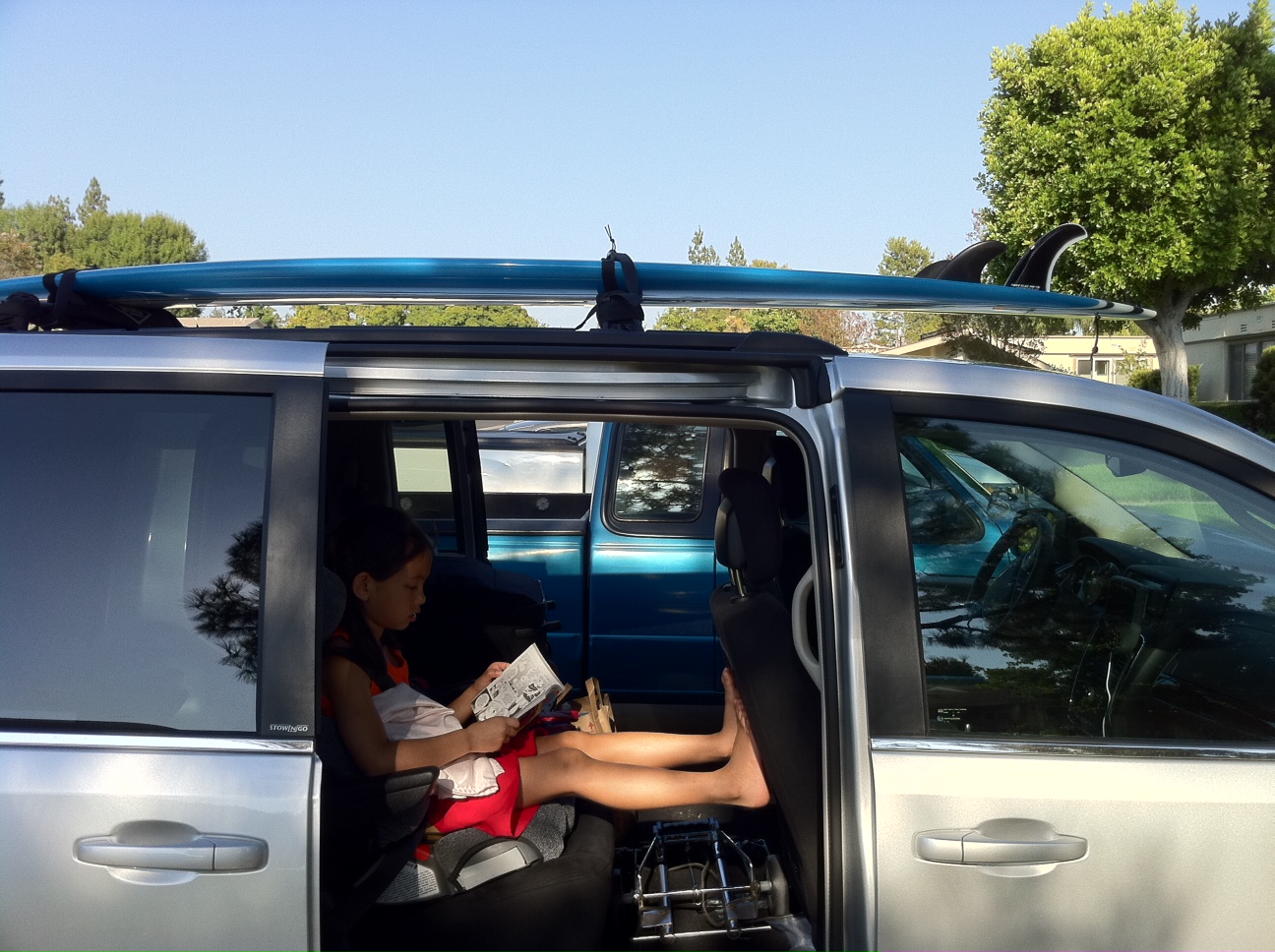
All uncles are weird. But being an uncle is an exogenous event independent of any quality you have, weirdness or otherwise. So statistically it looks like a monumental fluke that all the weird people turn out to be uncles.
In reality it’s the uncleness that causes the weirdness. And more than that: even totally normal people who happen also to be uncles turn onto weirdos precisely when they are around their nieces and nephews and here’s why.
An uncle is basically an anti-parent. Not anti- in the sense of anti-aircraft or anti-American. More like antimatter. Because an uncle looks at his brother or sister’s family and basically sees everything that his own family is not. Good or bad. Especially in terms of the children.
And just like boys socialize by playing up and exaggerating differences as a mechanism for toughening up each others’ weak spots, the uncle can’t help but play that same role with the nieces and their parents. Niece is too sensitive because she is too sheltered, uncle brings the missing risk to the party. Nephew thinks he’s tough because he can push around his younger sisters, uncle gives him a taste of his own medicine.
Then there’s spy mode. Uncle wants the inside scoop on his brother/sister and spouse so he asks neice/nephew strange leading questions. Your uncle is an outsider who has just enough of an inside track to feel comfortable poking around where he doesn’t belong.
But whatever mischief the uncle is up to, the actual effect is that he comes across as a weirdo to his neices and nephews.

- Stingrays hurt.
- A lot.
- I could use a pedicure.
The Guardian has gotten hold the U.K. interrogation policy:
In deciding whether to give permission [for overseas interrogation], senior MI5 and MI6 management “will balance the risk of mistreatment and the risk that the officer’s actions could be judged to be unlawful against the need for the proposed action”.
At this point, “the operational imperative for the proposed action, such as if the action involves passing or obtaining life-saving intelligence” would be weighed against “the level of mistreatment anticipated and how likely those consequences are”.
Here is a quote from Robert Parker
“Any serious introspection of the global wine market for Bordeaux over the last two years has to include the fact that it is impossible to determine the amount of 2009 Bordeaux futures (and in a few months, 2010 Bordeaux futures) that have actually been sold to consumers. Throughout Bordeaux there is talk of the massive market in Asia, and the increasing significance of the English wine investment firms, but there are those (and I wouldn’t dismiss their opinions) who tend to think that such assertions are grossly inflated. Moreover, they argue that there is a real bubble that is in danger of bursting if the right external influences unfold. One theory is that the Big Eight (which includes all the first growths of the Médoc as well as Haut-Brion and the trifecta of unofficial first growths of the Right Bank, Petrus, Cheval Blanc and Ausone) are actually hoarding huge inventories of their wines to inflate prices. This theory also suggests that the super seconds and many of the other cherished names in Bordeaux are doing the same thing. Why? They are trying to manipulate the market price. The appearance of little or no appreciable quantities of wine from two great vintages equals higher and higher prices. Is there a falsification of the demand from Asian consumers? The fact is, no one seems to know the answer. While some 2009s have not held their initial opening prices because they were too high, many have. If much of the 2009s, as well as the 2010s, are not sold through to wine consumers, who are the true marketplace since they actually drink these wines, and then tend to replenish their stock, buttressing the marketplace, then this is a bubble. Despite huge warehouses filled with reserve stocks of great vintages, prices could be set for a major adjustment, just as we have seen in the United States with the real estate market. What, if any of this, is true?
I raise this issue only because it is a possibility. The fact that no one can (or wants to) provide the actual sales figures of how much 2009 (or over the next six months, how much 2010) is actually being sold through to consumers is astonishing. If most of the stocks of these two vintages are held by importers, négociants, wholesalers, or on paper by investment firms, then it is obvious the consumers have not purchased 2009 and eventually 2010. In any event, I think this scenario has to be raised, given the overheated marketplace and the sometimes absurd rhetoric about how popular these wines are at prices of $1000 or more a bottle.” Robert Parker, May 3rd 2011
If you are programming a robot to vacuum your floors here’s one thing you would never consider doing: endow the robot with feelings of happiness and sadness and teach it to be happy when the floor is clean and unhappy when it is dirty.
But evolution led us to a state of affairs where emotions are what motivate us to do our jobs. How could such a kludge arrive.
Here is a story. Primitive organisms are reproduction machines. They need a certain chemical in the environment, and when they can obtain that fuel they can reproduce.
So the most successful primitive organisms are those that are the best at finding fuel. Natural selection favors those that seek fuel.
Next the organisms get more complicated. They have to make decisions that involve more than just immediate reproduction. They have intertemporal tradeoffs, multi-dimensional consumption, etc.
There is infrastructure in place to simplify this transition. The organisms that have survived to this stage are the organisms that seek fuel. They have built and learned systems for doing what is necessary to get fuel. So fuel is a simple and effective incentive mechanism.
The organism could evolve a mechanism for storing and later releasing fuel. Fuel is released when the organism takes certain actions. Fuel-seeking organisms will take those actions. Natural selection will favor the organisms that release fuel for the right actions.
Now remember that fuel is the energy needed for the most primitive functions of the organism. When this fuel is released the organism gets a boost of that energy.
A boost of energy is a big part of what we call happiness.
(subject to the usual disclaimer, this is based on some conversations with Balasz Szentes.)
From Paul Kedrosky, via Mallesh Pai:
In the game of Scrabble, letter tiles are drawn uniformly at random from a bag. The variability of possible draws as the game progresses is a source of variation that makes it more likely for an inferior player to win a head-to-head match against a superior player, and more difficult to determine the true ability of a player in a tournament or contest. I propose a new format for drawing tiles in a two-player game that allows for the same tile pattern though not the same board to be replicated over multiple matches, so that a players result can be better compared against others, yet is indistinguishable from the bag-based draw within a game. A large number of simulations conducted with Scrabble software shows that the variance from the tile order in this scheme accounts for as much variance as the different patterns of letters on the board as the game progresses. I use these simulations as well as the experimental design to show how much various tiles are able to affect player scores depending on their placement in the tile seeding.
Alternatively you could just let the market prices tell you.
The right to remain silent is not necessarily a blessing to a defendant. Because having a choice is not necessarily a good thing. Unless the decision to testify is uncorrelated with guilt, that decision by itself will convey information to the jury. (I know juries are instructed not to infer anything. But that is impossible.) So for example, if those who take the fifth are more likely to be guility (as I would guess. Are there data on this?), then an innocent person’s “right” to remain silent is actually a right to partially incriminate himself
A prohibition against defendants testifying on their own behalf is worth considering. If the goal is to protect defendants from incriminating themselves, then the above benefit offsets the obvious cost.
And if that is too extreme there are middle grounds to consider. For example, since the defense puts on its case last, the defendant does not make his decision until after the prosecution has introduced evidence. A defendant might want to commit in advance of that evidence being revealed that he will not testify so that nothing can be revealed by his decision being contingent on the evidence. As far as I know this commitment is not possible under current law.
In general the earlier you commit not to testify the less can be inferred from this. So we should allow citizens to register their commitments before they are charged with any crime. When you register to vote you also check a box that says whether you or not you will testify in the event you are ever charged with a crime.
Stan Reiter had a standard gripe about statistics/econometrics. Imagine you there is a cave in front of you and you want to map out its dimensions. There are many ways you could do it. One thing you could do is go inside and look. Another thing you could do is stand outside and throw into the cave a bunch of super bouncy balls and when they bounce out, take careful note of their speed and trajectory in order to infer what walls they must have bounced off of and where. Stan equated econometrics with the latter.
That’s not what I am going to say but it is a funny story and its the first thought that came to my mind as I began to write this post.
But I do have something, probably even more heretical, to say about econometrics. Suppose I have a hypothesis or a model and I collect some data that is relevant. If I am an applied econometrician what I do is run some tests on the data and report the results of the tests. I tell you with my tests how you should interpret the data.
My tests don’t contain any information in them that isn’t in the raw data. My tests are just a super sophisticated way to summarize the data. If I just showed you the tables it would be too much information. So really, my tests do nothing more than save you the work of doing the tests yourself.
But I pick the tests. You might have picked different tests. And even if you like my tests you might disagree with the conclusion I draw from them. I say “because of these tests you should conclude that H is very likely false.” But that’s a conclusion that follows not just from the data, but also from my prior which you may not share.
What if instead of giving you the raw data and instead of giving you my test results I did something like the following. I give you a piece of software which allows you to enter your prior and then it tells you what, based on the data and your prior, your posterior should be? Note that such a function completely summarizes what is in the data. And it avoids the most common knee-jerk criticism of Bayesian statistics, namely that it depends on an arbitrary choice of prior. You tell me what your prior is, I will tell you (what the data says is) your posterior.
Pause and notice that this function is exactly what applied statistics aims to be, and think about why, in practice, it doesn’t seem to be moving in this direction.
First of all, as simple as it sounds, it would be impossible to compute this function in all practical situations. But still, an approach to statistics based on such an objective, and subject to the technical constraints would look very different than what is done in practice.
A big part of the explanation is that statistics is a rhetorical practice. The goal is not just to convey information but rather to change minds. In an imaginary perfect world there is no distinction between these goals. If I have data that proves H is false I can just distribute that data, everyone will analyze it in their own favorite way, everyone will come to the same conclusion, and that will be enough.
But in the real world that is not enough. I want to state in clear, plain language terms “H is false, read all about it” and have that statement be the one that everyone focuses on. I want to shape the debate around that statement. I don’t want nuances to distract attention away from my conclusion. In the real world, with limited attention spans, imperfect reasoning, imperfect common-knowledge, and just plain old laziness, I can’t get that kind of focus unless I push the data into the background and my preferred intepretation into the foreground.
I am not being cynical. All of that is true even if my interpretation is the right one and the most important one. As a practical matter if I want to maximize the impact of the truth I have to filter it.
Still it’s useful to keep this perspective in mind.
I read the transcript and it is a very eloquent clarification of his views on game theory’s role and even the game theorist’s role. Worth checking out.
Our former Dean, Dipak Jain, now Dean of Insead, suggests:
American schools are often “super-proud” of student bodies in which one-third are international, says Dr. Jain, who was dean at the Kellogg School of Management at Northwestern University until 2009. In classes at Insead, he says merrily, “it looks like the United Nations.”…..Where M.B.A. students at Insead study businesses and business practices from around the world, American curriculums tend to be “very U.S.-centric,” he says, with case studies focused on domestic corporations. A more global outlook might in fact run counter to the fundamental appeal of American schools, he suggests. “The attraction for the U.S. is, people go there to work with the Americans,” he says. “So for U.S. schools, if they become completely international they would lose their competitive advantage.”
There is a difference between teaching international cases and having an international student body. While international students might want to learn about American business at an American business school, that does not mean they do not want to come here to get a degree (I hope!). Going global means staying local.
“You know an Asian restaurant is good if all Asians go there.”
The gym which I hardly go to sends me frequent emails which may finally push me to cancel my membership. Here is one of the more interesting emails I got:
“We replace about 3,000 towels per month, and while roughly 10% of these are taken out of circulation by us because they are no longer suitable for use, the remaining 90% leave the building and don’t come back. 3,000 new towels a month, especially with the rapidly rising cost of cotton, adds up quickly to an amount of money that we should be spending on things like equipment upgrades and the provision of scholarships to our youth. Here are the steps we plan to take:
- Starting August 8th, two towels per visit will be available to any member who wants them at the Front Desk. This will be the only place where towels are available. The Y will reduce its buying to 1,500 towels a month. Our card scans at the Front Desk tell us this is enough to give everyone working out here two towels per visit.
- Buying will be capped at that 1,500 per month figure, so if towels are not returned we could run out and members working out later in the month would not be able to get towels. Returning your towels before leaving the Y will ensure that this does not happen.”
At first blush, it seems elementary economic theory predicts this plan will fail. The gym is using collective punishment to give incentives. If I take the towel home by mistake (they are too grotty to steal!), the chance of being pivotal in the towel service cancellation decision is small. So, while I’ll take a little bit more care to leave the towel, it’s not going to affect my incentives significantly. Everyone will think the same way and later on the month we will all be bringing our own towels to the gym.
Once we all stop going at the end of the month, as taking your own towel adds yet another impediment to gym attendance, the gym will get the dream member who does not turn up but pays the dues. Is this their dastardly plan after all?
Here is a possible solution: Everyone gets two towels when they turn in their gym ID at the front desk. They get the ID back if they return two towels when they leave. Otherwise they pay a fine. This does unfortunately create an incentive to steal a towel from someone else if you happen to lose your towel. But I think it’s still worth trying.
This was Mallesh Pai last month:
Everyone here has heard about price discrimination. I know something about your willingness to pay (from other data about you or people like you), and use that to charge you a ‘better’ price. This has mostly been restricted by some combination of ethics, vague legal standards and technology to use ‘coarse’ information, e.g. your age (student/ senior discounts), your address (mailed coupons), and so on. As we pointed out a few months back there are cleverer methods on the way. But today, I think I’ve seen the best yet. A company calledKlout (indubitably with the cooler K-based variant of the spelling) looks into your social network and offers a ‘score’ estimating the influence you have. Some geniuses have decided that one’s ‘Klout score’ might be a good way to discriminate on what website you see (and indeed, what free swag you get offered): http://mashable.com/2011/06/22/klout-gate/ .
And this is Spotify this week proving him right.
The Spotify invites are part of the Klout Perks program, which rewards top influencers with special deals based on their interests and comprehensive Klout score rating. People who are rated as influential on Klout get access to the free trial version of the music service. They can also get a free month of Spotify’s premium service if enough people within their community sign up for the music service.
“The Spotify guys actually reached out to us about launching in the U.S. They had been using Klout and thought it was really cool,” said Klout CEO Joe Fernandez. “We talked a lot about how to hit the people in middle America that are also early adopters but don’t read the tech blogs and stuff.”
Experiments concerning the effect of publishing calorie counts on restaurant menus tend to show little effect on choices. In the experiments that I know of, choices before and after publishing calorie counts are compared. But this form of test cannot be considered conclusive. Some people were overestimating the calories and they might cut back, some were underestimating and they might eat more. There is no reason to expect that the aggregate change should be positive or negative.
A better experiment would be to use a restaurant where calorie counts are already published and manipulate them. Will people change their choices when you add 5% to the reported calories? 10%? What is the elasticity? It’s a safe guess that there would be little response for small changes and a large response for very large changes. Any response at all would prove that their is value is publishing calorie counts because it would prove that this information is useful for choices.
The only question that would remain is how those welfare gains measure up against the cost of collecting and publicizing the information.
Courtney Conklin Knapp, the bloggers’ muse, offers up this link on The Eternal Shame of Your First Online Handle. It reminds me of my personal favorite storage space for unwanted reputations: USENET. USENET was the earliest internet social network consisting of mostly-unmoderated discussion groups on just about any topic you can think of.
Did you know that Google has archived all of USENET and provided a search interface through its own Google Groups? Talk about eternal shame. Look around your department for your geekiest 40-something colleague and chances are he has a USENET trail and it may not be pretty.
I’ll leave it up to you to find the dirty laundry, but while we are here, a few notable (and perfectly respectable) USENET trails for your amusement. You can probably guess who posted this to the group rec.sport.soccer in 1997:
I am a professor of economics doing a study of penalty kicks in soccer. Does anyone know where I might find data on whether a kicker goes to the right or the left on a penalty kick, or whether the goalie dives right or left?
Any information would be greatly appreciated.
But can you guess who posted this to rec.music.collecting.vinyl in 1996?
Dear Readers:
I am looking for an LP copy of Night by Night, an obscure
issue by Harry Nilsson, or the soundrack to The World’s
Greatest Lover, which he also did, or other Nilsson rarities
(I do have Flash Harry, however).CD copies are fine as well, although I do not think they exist.
Hint: he apparently frequented the groups soc.culture.haiti, rec.music.classical.recordings, and rec.sport.basketball.pro and he also posted this to rec.arts.movies.current-films in 1998.
Of all 1998 American movies, which are some prominent examples of movies with foreign non-American directors? An example of a French director would be especially useful. Any assistance would be most appreciated…I am aware of Peter Weir (an Australian) directing The Truman Show, any other examples?
His full USENET trail is here, but guess before you look!
I implore you not to look at mine, and instead browse the trails of people that really matter like Hal Varian (he was writing a lot about pricing the Internet!), Sergey Brin (he seemed to be having trouble getting DOOM to run on his 486DX), Mark Zuckerberg (not much on his mind apparently) and Austan Goolsbee.
Normally we understand the (near) 50-50 male/female population sex ratio with this simple model: if there were more males than females then individuals who are genetically disposed to have female children will have more grandchildren because their female children will find more mates. Thus females will increase in proportion, restoring the balance.
But here’s the interesting thing. That model doesn’t work for humans (and many other species) and in fact 50-50 is highly unstable, with potentially catastrophic consequences.
Suppose that a male has a mutation on his Y chromosome which causes him to produce Y-chormosome sperm that swim faster than his X-chromosome sperm. Then he will have only boys. And his boys will have the same gene and the same super Y-chromosome sperm.
Now suppose that his male children have an equal chance of mating as all other males in the population. Then our original mutant will have more male grandchildren than other males of his generation. Thus, the proportion of this super-Y gene increases in the population, and this trend continues generation after generation.
The balance is not being restored anymore. In fact eventually the super-Y’s dominate the male population. And that means that all offspring in all matings are boys. That means very little reproduction can happen because there are so few females. And the species goes exctinct.
I learned this from a paper by W. D. Hamilton called Extraordinary Sex Ratios.
Have you heard that saying “Writing about music is like dancing about architecture” ? It always stuck in my mind because for one thing I like the poetry of it, but mainly because it confused me. I think I got the point it was trying to make but I wasn’t sure that it really made that point. Then I figured out my confusion. The best way to explain my confusion is with the following reply.
Dancing about architecture is like fencing around landscaping.
The weather in Chicago sucks but at least there are real seasons (there’s only one in SoCal where I am from.) Here’s a thought about seasons.
Everything gets old after a while. No matter how much you love it at first, after a while you are bored. So you stop doing it. But then after time passes and you haven’t done it for a while it gets some novelty back and you are willing to do it again. So you tend to go through on-off phases with your hobbies and activities.
But some activities can only be fun if enough other people are doing it too. Say going to the park for a pickup soccer game. There’s not going to be a game if nobody is there.
We could start with everyone doing it and that’s fun, but like everything else it starts to get old for some people and they cut back and before long its not much of a pickup game.
Now, unlike your solo hobbies, when the novelty comes back you go out to the field but nobody is there. This happens at random times for each person until we reach a state where everybody is keen for a regular pickup game again but there’s no game. What’s needed is a coordination device to get everyone out on the field again.
Seasons are a coordination device. At the beginning of summer everyone gets out and does that thing that they have been waiting since last year to do. Sure, by the end of the season it gets old but that’s ok summer is over. The beginning of next summer is the coordination device that gets us all out doing it again.
The behavioral psychology here is very easy to understand. No bank wants to admit that it wrote idiotic loans, and write down its own assets from par. Meanwhile, it’s much easier to write up an acquired asset, if the amount you reduce the loan is less than the discount you bought the loan for in the first place.
Economically speaking, however, what the banks are doing here does not make sense. Either writing down option-ARM loans makes sense, from a P&L perspective, or it doesn’t. If it does, then the banks should do so on all their toxic loans, not just the ones they bought at a discount. And if it doesn’t, then they shouldn’t be doing so at all.
In fact, accounting rules make bank behavior “rational”:
If a bank has a loan on its books valued at par, and it offers a principal reduction, it must write down the value of the loan. It takes a hit against its capital position, and experiences an event of nonperformance that even the most sympathetic regulators will have no choice but to tabulate. If a bank has purchased a loan at a discount, however, the loan is on the books at historical cost. The bank can offer a principal reduction down to the discounted value without experiencing any loss of book equity.
Of course this is a matter of mere accounting. Whether or not a bank takes a capital hit has no bearing on whether a principal reduction will increase the realizable cash-flow value of the loan.
This moves the problem one layer further back: What is the rationale for these accounting rules? Either a principal reduction should be discouraged via accounting convention whether the loan was purchased or bought or it should be allowed in the right circumstances…
(Hat tip: Mallesh Pai)
- Canada’s English language test for immigrants.
- Upon reflection, Twisted Sister might be persuaded to take it.
- Mustards inspired by Russian nemesises.
- Food Carts inspired by literature.
- Recreating Dock Ellis’ LSD-fueled Major League no-hitter.
- Sarah Palin’s movie debuts to an empty house in Orange County, California, home of John Wayne Airport.
It is a challenge for evolutionary theory to explain the prevalence of sexually reproducing species. That’s because of the twofold cost of sex: a sexually reproducing species produces half as many offspring per generation as an asexually reproducing population of the same size. So not only must there be some other advantage to sexual reproduction, it has to be large enough to outweigh that substantial cost.
One theory is that the genetic mixing that comes from sex allows a species to shed disadvantageous mutations. An asexual species can only accumulate them. This advantage can be large enough to overcome the twofold cost of sex. But the problem with this theoretical explanation is that in these models the advantage of sex is too large, so large that the kind of sex we see universally among all sexually reproducing species, sex between two parents, is dominated by tri-parental sex. This was shown by Perry, Reny, and Robson who consider a particular kind of menage a trois in which each mating requires two males and one female, and each offspring receives half of its genetic material from the mother and one quarter from each of the fathers.
This avoids a tri-fold cost of sex:
Because the cost of males is determined not by the ratio of males to females in each mating instance but, rather, by the population ratio of males to females, de-termining the population ratio is central. We therefore turn to Fisher’s celebrated equilibrium argument (Fisher, 1930). Applying the same logic to 1/2 – 1/4 – 1/4 sex, we note first that the total reproductive value of all of the males in any generation is precisely equal to that of all of the females in that generation. This is because, un-der 1/2-1/4-1/4 sex, all of the females supply half of the genes of all future generations. But then the remaining half must be supplied by all of the males. Consequently, as Fisher argued, equilibrium requires the offspring sex ratio to equate parental expenditure on male and female offspring. Maintaining the usual assumption that offspring of either sex are equally costly to raise to maturity, we conclude that the equilibrium sex ratio must be one–each male therefore mates with two females and vice versa. But this means that the cost of males is twofold–there is no additional cost of males over biparental sex.
I bring this up because (in an older working paper version) they also considered the leading competing theory for the advantage of sexual reproduction, The Red Queen hypothesis. Here the argument is that species are constantly trying to out-evolve parasites. Genetic mixing makes them a moving target. Perry, Reny, and Robson showed that, unlike the deleterious mutations theory, the Red Queen story rationalizes biparental sex over other forms of sex. Thus, from the point of view of sex as an evolved mechanism for solving some problem, only the Red Queen can explain the kind of sex we see.
And I bring that up because just last week I heard this story about a new experiment that validates the Red Queen hypothesis.

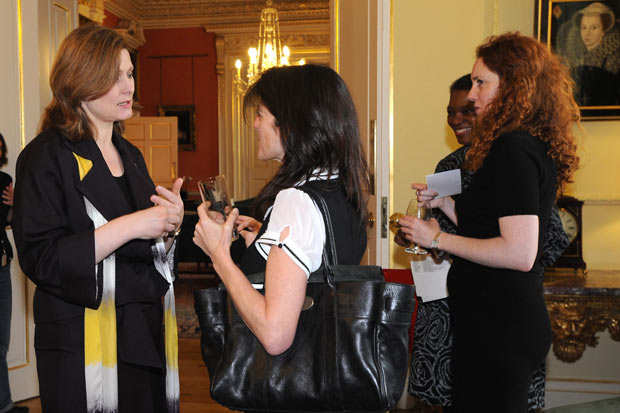
You have friends and enemies. Friends are nice to you and enemies are mean to you. There is always a chance that a friend turns into an enemy and an enemy turns into a friend. An enemy is more likely to turn into a friend the nicer you are to him. A friend is more likely to turn into an enemy the meaner you are to him.
If your enemy is your sworn enemy, hating you whatever you do, there is no point being nice for strategic reasons. But the fact that you want to persuade an enemy to become your friend means you have a greater incentive to be nice. So, Gordon Brown should have gone to Rebekah Brook’s wedding and Sarah Brown should have invited Rebekah over for a pyjama party.
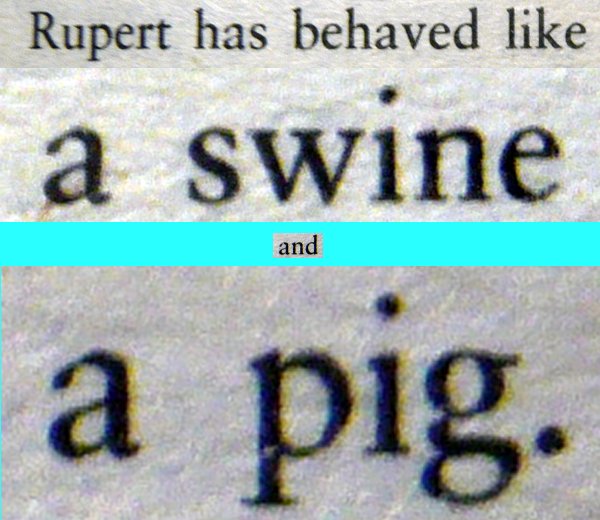
The same logic applies to your friends: be nice to them to persuade them to stay your friends. But don’t be too nice because that may backfire when they become your enemy. This is particularly important in terms of giving them incriminating information they can use against you once they turn on you. If you are prone to disappointment, it applies more broadly. Woodrow Wyatt who helped his friend Rupert Murdoch evade regulation when he bought The Times found this out when Murdoch chose to endorse Blair:

Source: This excellent life of Murdoch in Britain by the BBC’s Alan Curtis
On Tuesday, in the sixth round of the MLB Draft, the San Diego Padres selectedoutfielder Kyle Gaedele (who the Tampa Bay Rays had previously drafted in the 32nd round of the 2008 draft). Gaedele plays center field and shows good signs of hitting for power, but what most writers, sports fans, and guys named Bradley talk about is Gaedele’s great uncle.
Casual fans probably do not know about Kyle’s great uncle, Eddie Gaedel (who removed the e off his last name for show-business purposes). We nerds can forgive the casual fan for forgetting a player who outdid, in his career, only the great Otto Neu. Gaedel took a single at-bat, walked to first, and then left for a pinch runner.
What makes Eddie Gaedel a unique and important part of baseball history, however, is not his statistics, per se, but his stature. Gaedel stood 3’7″ tall, almost half the height of his great nephew. Gaedel was the first and last little person to play in Major League Baseball, and the time has come for that to change.
In baseball, the strike zone (effectively the target that a pitcher must aim for) is defined relative to the size of the hitter. A very small player has a very small strike zone, so small that many pitchers will have a hard time throwing strikes. Insert such a batter at a key moment, he walks to first base and then you replace him with a fast runner. Why doesn’t every team have such a player on their roster?
Cap Clutch: Vinnie Bergl.
I went out for a run and left some instructions for my daughter.
By the way, running is the suckiest form of exercise there is. The only thing worse than my jog up and down the street is running on a treadmill, if only for the change of scenery. Very slow change of scenery. But I will admit that the boredom involved adds a dimension that you don’t get from actual, useful exercise like playing sports. I can run around on a tennis court for hours but I am embarrassed to tell you that after about a year of regular running I can’t comfortably run more than a mile. There being no assistance whatsoever from competitive spirit or just plain old enjoyment, running is a pure exercise of the will to prolong immediate suffering and boredom in return for some abstract, delayed benefit.
And that mile takes me more than 10 minutes. I think. I am too ashamed to time myself.
But nevertheless not so long as to make me feel uncomfortable leaving my 10 year old at home for the duration (I actually don’t know what the law is, I hope I am not incriminating myself.) And she had an assignment that she needed to finish so I suggested that she work on it while I was out.
Now there were also some other things that needed to be done. And you never know what’s going to happen when she sits down to do her assignement. Does she have all the stuff she needs, is she going to need some help? etc. So ideally I would give her a contingency plan. If for whatever reason you can’t do the assignment, do the other thing in the meantime.
But this is not always a good idea. Just mentioning the contingency turns a clearly defined instruction into one which invites subjective interpretation, and wiggle room at the margin of acceptable contingincies. “You said I should do the other thing so I did.”
Of course there is a tradeoff. First of all, there’s the basic second-best trade-off. Without a plan B, when it turns out to be truly impossible to do plan A, you come home to find her on plan Wii.
But more importantly, she’s gotta learn how to judge the contingencies on her own, eventually. The thing is, rightly or wrongly I think parents instinctively believe that in the early stages of that process kids read a lot, indeed too much, into the items put into the menu of options. There is an excessive distinction between an unmentioned, and hence implicitly disallowed option and one which is mentioned but discouraged.
Unlearning that kind of inference, clearly a necessary step in the long run, can be tricky in the short run.
Heh, short run.
Hume has been locked out of the room and he is not allowed to re-enter in the form of Parfit having a dialogue with Cho and Kreps.
That’s from Tyler’s review of a book called On What Matters Vol. I (a title, which in my opinion can be gainfully edited down to “SW Swell.”)

We never had them when I was a kid. There was “Adult Swim” but that was like a 3 hour block of time on a week night, legitimately so that adults could swim without being terrorized by cannonballs, marco polos, jacknifes, watermelons, palm geysers and the dreaded depth charge.
(There’s another recent development in swimming pool administration. At my community pool whenever anything is even slightly amiss the lifeguard is supposed to give three sharp whistles which in turn alerts the entire crew of 20 or so lifeguards each stationed at her own corner of the pool [yes the pool does have 20 or so corners] to also emit three sharp whistles, repeatedly, while pointing in the direction of the other lifeguard whose whistle it was that alerted them.
That way, in the midst of the cacophony of whistles you can look at any random lifeguard, see where they are pointing, follow the trail of shrieking, pointing lifeguards until you find the root of the tree and then you know where all the trouble is. At least that’s the theory. Meanwhile over the loudpseaker the lifeguard who appears to have been selected for this job on account of having the most panic-stricken-yet-somehow-deeply-caring voice is sooth-screaming “Attention swimmers. Three whistles have been blown, please leave the pool. 7 year old Dennis is missing. He is wearing a red swim suit, a blue mask and snorkel. He is not wearing his plastic pants.”
This is followed every 30 seconds or so by further announcements of additional information that might be useful to us in our search for Dennis, “Attention swimmers [she hasn’t seemed to have noticed that we stopped swimming 5 minutes ago and in fact we are now more appropriately addressed like “Attention patrons who were previously swimming and who are now digging through your beach bags for earplugs”] we are looking for Dennis. Dennis has a My Little Pony beach towel and he was last seen by his 5 year old sister when she was holding him down so his friends could give him a plastic pants wedgie.” Then “Attention swimmers, we are looking for Dennis. Dennis is going through a bed-wetting phase at home.”
Finally Dennis, who of course had just been undergoing repeated Whirlys in the bathroom emerges and the whistles fall silent but the cackling doesn’t.)
But the “Adult Safety Break” has very little to do with adults and nothing at all to do with their safety. Every 90 minutes all children under the age of 16 are required to leave the pool for 15 minutes. In the meantime, adults can swim but since nobody goes to this pool to swim in the literal sense of prostrating and propelling yourself through water with a well-defined origin and destination, what happens instead is that all of the adults leave the pool too and the lifeguards are the ones that get a break.
And that is precisely the rationale. Not the break for the lifeguards, but the temporary evacuation of the pool. Now note that this is a community pool, run by the community association so we have a situation in which the community is voluntarily destroying 15 minutes of pool value. So there must be a good reason.
And the good reason is that admission to the pool is by flat fee with no marginal time-use pricing. This means that the admission fee can be adjusted only to meter the number of people entering the pool but it provides no means to stop them from staying all day long. And indeed while their marginal value declines over time it appears to stay bounded away from zero until either nightfall or lightning strikes, whichever comes first.
The safety break makes us decide whether its worth it to sit through 15 idle minutes before climbing back onto the marginal utility slide. A large number of families by now already on the very flat end of that slide, its no wonder that the safety break culls a significant segment of the pool’s patronage in one fell swoop. It helps that the safety break consolidates all the kids in one place making the exit that much easier.
Bad for them but good for the community at large. Their tiny residual marginal utility is dwarfed by the externality of their presence multiplied by the number of other swimmers in the pool. Absent any way to expose them to their externality through prices, a community-imposed waste of time is the second-best solution.
Unfortunately for Dennis though, giving Whirlys only gets better and better.
Daniel, Diermeier, our Kellogg colleague has a new blog called Reputation Rules. Daniel is a noted researcher and a star teacher at Kellogg. Should be an interesting blog.
 Cheap Talk