
You are currently browsing the category archive for the ‘Uncategorized’ category.
I stopped following Justin Wolfers on Twitter. Not because I don’t want his tweets, they are great, but because everyone I follow also follows Justin. They all retweet his best tweets and I see those so I am not losing anything.
Which made me wonder how increasing density of the social network affects how informed people are. Suppose you are on a desert island but a special desert island which receives postal deliveries. You can get informed by subscribing to newspapers but you can’t talk to anybody. As long as the value v of being informed exceeds the cost c you will subscribe.
Compare that to an individual in a dense social network who can either pay for a subscription or wait around for his friends to get informed and find out from them. It won’t be an equilibrium for everybody to subscribe. You would do better by saving the cost and learning from your friends. Likewise it can’t be that nobody subscribes.
Instead in equilibrium everybody will subscribe with some probability between 0 and 1. And there is a simple way to compute that probability. In such an equilibrium you must be indifferent between subscribing and not subscribing. So the total probability that at least one of your friends subscribes must be the q that satisfies vq = v – c. The probability of any one individual subscribing must of course be lower than q since q is the total probability that at least one subscribes. So if you have n friends, then they each subscribe with the probability p(n) satisfiying 1 – [1 – p(n)]^n = q.
(Let’s pause while the network theorists all rush out of the room to their whiteboards to solve the combinatorial problem of making these balance out when you have an arbitrary network with different nodes having a different number of neighbors.)
This has some interesting implications. Suppose that the network is very dense so that everybody has many friends. Then everyone is less likely to subscribe. We only need a few people to be Justin Wolfers’ followers and retweet all of his best tweets. Formally, p(n) is decreasing in n.
That by itself is not such a bad thing. Even though each of your friends subscribes with a lower probability, on the positive side you have more friends from whom you can indirectly get informed. The net effect could be that you are more likely to be informed.
But in fact the net effect is that a denser network means that people are on average less informed, not more. Because if the network density is such that everyone has (on average) n friends, then everybody subscribes with probability p(n) and then the probability that you learn the information is q + (1-q)p(n). (With probability q one of your friends subscribes and you learn from them, and if you don’t learn from a friend then you become informed only if you have subscribed yourself which you do with probability p(n).) Since p(n) gets smaller with n, so does the total probability that you are informed.
Another way of saying this is that, contrary to intuition, if you compare two otherwise similar people, those who are well connected within the network have a tendency to be less informed than those who are in a relatively isolated part of the network.
All of this is based on a symmetric equilibrium. So one way to think about this is as a theory for why we see hierachies in information transmission, as represented by an asymmetric equilibrium in which some people subscribe for sure and others are certain not to. At the top of the hierarchy there is Justin Wolfers. Just below him we have a few people who follow him. They have a strict incentive to follow him because so few others follow him that the only way to be sure to get his tweets is to follow him directly. Below them is a mass of people who follow these “retailers.”
Stefan Lauermann points me to a new paper, this is from the abstract:
Our analysis shows that both stake size and communication have a significant impact on the player’s likelihood to cooperate. In particular, we observe a negative correlation between stake size and cooperation. Also certain gestures, as handshakes, decrease the likelihood to cooperate. But, if players mutually promise each other to cooperate and in addition shake hands on it, the cooperation rate increases.
The paper ….“Prospect Theory”… spawned a sub-field of economics known as behavioral economics. This field attracted the interest of a Harvard undergraduate named Paul DePodesta. With a mind prepared to view markets and human decision-making as less than perfectly rational, DePodesta had gone into sports management, been hired by Billy Beane to work for the Oakland A’s, and proceeded to exploit the unreason of baseball experts. A dotted line connected the Israeli psychologists to what would become a revolution in sports management. ..
Spookier still:
I soon realized that Tversky’s son had been a student in a seminar I’d taught in the late 1990s at the University of California, Berkeley….My former student Oren Tversky put me in touch with his mother, Barbara, who put me onto the papers left behind by her husband…..Then one afternoon I came upon a letter dated June 4, 1985, from Bill James. The baseball analyst whose work was then being blithely ignored by professional baseball people had wanted help answering a question that vexed him: Why were baseball professionals forever attempting to explain essentially random and therefore inexplicable events? “Baseball men, living from day to day in the clutch of carefully metered chance occurrences, have developed an entire bestiary of imagined causes to tie together and thus make sense of patterns that are in truth entirely accidental,” James wrote. “They have an entire vocabulary of completely imaginary concepts used to tie together chance groupings. It includes ‘momentum,’ ‘confidence,’ ‘seeing the ball well,’ ‘slumps,’ ‘guts,’ ‘clutch ability,’ being ‘hot’ and ‘cold,’ ‘not being aggressive’ and my all time favorite the ‘intangibles.’ By such concepts, the baseball man gains a feeling of control over a universe that swings him up and down and tosses him from side to side like a yoyo in a high wind.” It wasn’t just baseball he was writing about, James continued. “I think that the randomness of fate applies to all of us as much as baseball men, though it might be exacerbated by the orderliness of their successes and failures.”
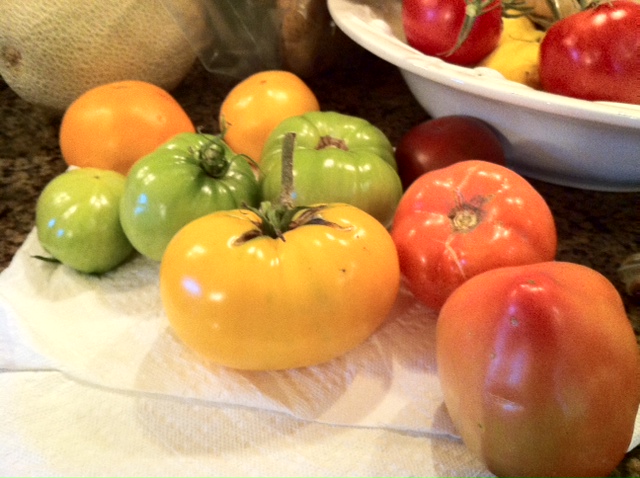
We had a spectacular Fall in Chicago with lots of sun and warm temperatures. Usually October is fried green tomatoes month for us, but this year after the leaves had fallen off the birch tree in our backyard they got a good couple weeks of sun and many of them ripened on the vine. Here’s your picture of empty plates:
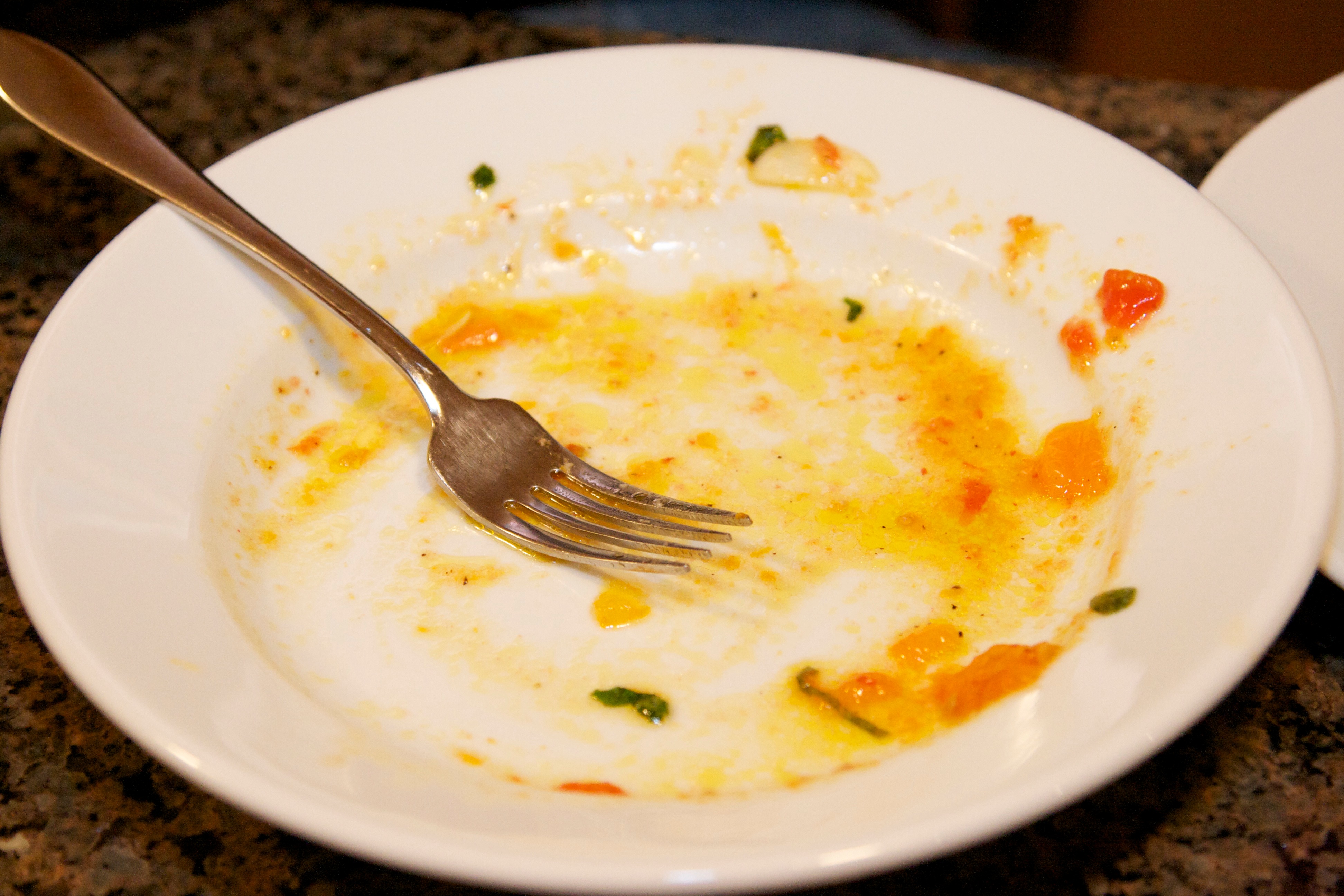
While on the subject here’s a trick for ripening your green tomatoes when the sun won’t do it for you. Bring them inside and put then in a paper bag along with some bananas. Ethylene gas stimulates the ripening process and bananas, the champions of ripening, put out a lot of it.
We enjoyed our tomatoes with this 2004 Bordeaux, Chateau Lascombes which I must say is drinking perfectly right now.

- The Bad Plus are going into the studio next week.
- The price of his masterclass is rising from Free to $20 per three-hour session.
- If you live in Seattle you can see The Bad Plus play with the Mark Morris Dance Group Dec 1-3

Got my new shipment of Navarro wines. I went straight to the Pinot Noir. Totally delicious. Usual cherry and fruit notes but there’s also some dryness that is Old World. Navarro hit a rough spot last year because forest fires tainted their crop. The wines literally tasted smoky. They were interesting but the smokiness made the wines one dimensional. Navarro is back on peak form with this offering.
- David Lynch’s new album Crazy Clown Time.
- Dude surfs a 90 foot wave.
- Great photography blog. (via CCK)
- If you have been known to entertain your cat by shining laser pointers at the ground and making them chase the red dot all around, then you better hurry up and claim prior art.
- Cormac McCarthy’s Yelp reviews.
It’s 11/11/11, what else?
In some sense every day is a day to appreciate corduroy, but in another sense there is only one true Corduroy Appreciation Day, as declared by the venerable Corduroy Appreciation Club. That is 11|11, the date that most resembles corduroy. And this Friday being 11|11|11, it is the date that most resembles corduroy, ever. (Except for 11|11|1111, but I’m pretty sure the people of that time had yet to discover essential comforts like modern medicine, indoor plumbing, and finely waled fabrics.)
Honestly though, I like Rick Perry now more than ever. How he handled that moment is incredibly endearing and anti-political. And I understand a lot about the GOP by noticing that every time one of their candidates does something likable his popularity among the base is eroded.
When he made his red-meat candidacy announcement this summer, I was frightened, and the GOP insiders already had him in the White House. Then when he appealed to his party’s heart to defend financial aid for the undocumented in Texas, me and the GOP switched places. When he gave that speech in New Hampshire that went viral, I thought he came across as a guy you could hang with. Everybody else said he must be on drugs. Bill Clinton talks like that and he’s our buddy Bubba.
Murphy is still playing a key role in the negotiations:
This round of negotiations is being conducted with small groups on each side. Stern was joined by Silver, the San Antonio Spurs owner Peter Holt — who heads the N.B.A.’s labor relations committee — and the league’s top two lawyers, Rick Buchanan and Dan Rube. Representing the union were Fisher and the executive director Billy Hunter, along with the union’s outside counsel Jeff Kessler, its outside economist, Kevin Murphy, and its lead attorney, Ron Klempner.
Will we have to dig out the kids’ D Rose shirts out from the back of the closet soon?
Jonah Lehrer describes an fMRI experiment published in Nature by Tricomi, Rangel, Camerer, and O’Doherty. Subjects were first randomly assigned to be rich or poor and given an endowment accordingly. Then they were put in the scanner.
…the scientists found something strange. When people in the “rich” group were told that a poor stranger was given $20, their brains showed more reward activity than when they themselves were given an equivalent amount. In other words, they got extra pleasure from the gains of someone with less. “We economists have a widespread view that most people are basically self-interested and won’t try to help other people,” Colin Camerer, a neuroeconomist at Caltech and co-author of the study, told me. “But if that were true, you wouldn’t see these sorts of reactions to other people getting money.”
I find it helpful to step back and think through how we can come to conclusions like this. Some time ago, neuroscientists correlated certain brain activity measurements with the state of happiness. They did this either by having the subject report when he was happy and then measuring his brain, or by observing him making choices that, presumably, made him happy and then measuring his brain.
Once we have the brain data we no longer need to ask him whether he is happy or make inferences based on his choices, we can just scan his brain to find out. And that allows us to conclude that the rich are less happy receiving $20 than when the poor get $20.
But still, if we wanted to we could just ask them. We might learn something. What would we do if the subjects responded that in fact they would be happier having the $20 for themselves? Would we conclude that they are lying?
Also we might learn something from just letting them decide for themselves whether to give money to the poor. What would we conclude if we see, as we do indeed see in the world, that they do not? That they don’t understand as well as we do what makes their brain happy?
Either way we have a real problem. Because our original reason for associating the specific brain activity with happiness was based on either believing they are honest about what makes them happy or believing that the choices they make reveal what makes them happy. But now in order to apply what we learned we are forced to reject those same premises.
Here’s what you already know: it’s a parasite that reproduces in the digestive system of cats. The eggs are excreted out and the vehicle is consumed by other animals in whose brains the eggs develop. Only when those brains are consumed by other cats does the cycle continue. In order to facilitate this process, chemicals are secreted inside the hosts’ brain to make them do things to increase the chance they will be eaten by cats. For example, rats with toxoplasma in their brains are not afraid of cats.
Here’s what’s new: toxoplasma is transferred from host to host through sexual contact in order to get closer to cats.
These are Toxoplasma cysts moving from rat to rat, so this exchange is kind of like a side track on the parasite’s life cycle. But it still benefits Toxoplasma, because it means it can infect even more potential prey that may get eaten by cats. And so the logic applies once more: if Toxoplasma can raise the odds of getting from infected males to uninfected females, it may have more reproductive success.
You know where this is going–it’s turning into a David Cronenberg horror movie with an all-rodent cast. Vyas wondered if there’s any difference in how female rats mate with infected and uninfected males. So he and his colleagues put a male rat with Toxoplasma at one end of a two-armed maze, and an uninfected male in the other arm. Females then got to choose which rat to approach. Vyans found that they preferred the infected males, spending more time with them and mating more often.
Creative output seems to come in bursts. You have periods of high productivity spaced by periods where you get relatively few good ideas. During the flurries everything seems to come easy and you have more ideas than you can work on at once. During the lulls you wonder if you are still the same person.
What if the pattern can be explained without assuming that your creative energy fluctuates at all? Suppose that ideas of various qualities arrive according to some distribution that is constant over time, but what changes about you is simply the standard you hold them to. Sometimes you are very self-critical and the marginal ideas that come to you don’t seem worth pursuing, so you don’t pursue them. You go through a lull.
Other times you are confident that you can develop your ideas and you do.
If you are trying to come up with a slogan for an ad campaign you have to decide how picky you are going to be with the grammar. For example suppose that there is a grammatical and a more colloquial way to write your slogan. Which do you go with?
Your audience has grammar snobs and regular people. Whichever way you write your slogan it’s going to look natural to one group and un-natural to the other. And the group that stumbles over the syntax is going to be at least somewhat distracted from the message. You have this problem whether you decide to bend toward the grammar snobs or the regular people.
But one thing tips the balance in favor of the ungrammatical slogan. In advertising, you are looking for anything that gets your audience to stop and spin some brain cycles in the presence of your ad. You will smuggle in your brand alongside. You get this benefit only with the ungrammatical. The grammar snobs, annoyed with your slogan are programmed to turn it over, diagram it and correct it. In effect you will cause them to construct variations of your ad campaign inside their own heads.
This is a good thing. Never mind that they will curse you for your trespasses. There’s no such thing as bad publicity. Indeed you hope for their curses. Nothing could be better than having them shout from the rooftops all the ways that your slogan, the one that urges everyone to buy your product, should be rewritten in order to make it more palatable.
Here’s a previous post on krafty konstructions.
The standoff between Herman Cain and his accusers offers us some interesting strategy to contemplate. The accusers are muzzled by a non-disclosure agreement they signed as a part of their settlement with the National Restaurant Association, where they worked alongside Mr. Cain. But lets walk down the tree to the node where the NDA has to be enforced.
One of the accusers has gone public with the allegation. To enforce the NDA is to admit that the NDA exists, which in turn is an admission that there was a settlement, which for all practical purposes is an admission that the allegations are true. Now, back here at the beginning of the game tree, should the accusers consider this a credible threat?
Perhaps. Because the allegations will be devastating whether or not Mr. Cain confirms the settlement. By then he would have little to lose, and at that stage the presumed penalties mandated by the NDA plus plain old retribution would be motivation enough.
(Let’s admire but ultimately ignore as unrealistic the gambit of not enforcing the NDA as a way of “proving” that there is no NDA because there was never any settlement with these accusers.)
However, it appears that the settlement is actually a contract between the NRA and the accusers. If that is the case then the decision to enforce it may not be Mr. Cain’s. Does the NRA have any credible motivation to do so?
Maybe not, but in some ways this arrangement may strengthen Mr. Cain’s position. Imagine that the accuser’s lawyer holds a press conference and publicly asks “Mr. Cain, my client is subject to a Non-Disclosure agreement arising from a sexual harrassment settlement in which you were the harasser. You deny this. Since the accusations are false you should be perfectly willing to release them from the NDA. Please prove to the American people that you are telling the truth by waiving it.”
Mr. Cain wiggles out of this one by publicly saying “Yes, I have nothing to hide. The NDA should be waived” and then by privately urging the NRA to do no such thing. The NRA can of course deny that there was any agreement and indeed the agreement probably requires them that because it presumably prohibits all parties from talking about it.
Measuring social influence is notoriously difficult in observational data. If I like Tin Hat Trio and so do my friends is it because I influenced them or we just have similar tastes, as friends often do. A controlled experiment is called for. It’s hard to figure out how to do that. How can an experimenter cause a subject to like something new and then study the effect on his friends?
Online social networks open up new possibilities. And here is the first experiment I came across that uses Facebook to study social influence, by Johan Egebark and Mathias Ekstrom. If one of your friends “likes” an item on Facebook, will it make you like it too?
Making use of five Swedish users’ actual accounts, we create 44 updates in total during a seven month period.1 For every new update, we randomly assign our user’s friends into either a treatment or a control group; hence, while both groups are exposed to identical status updates, treated individuals see the update after someone (controlled by us) has Liked it whereas individuals in the control group see it without anyone doing so. We separate between three different treatment conditions: (i) one unknown user Likes the update, (ii) three unknown users Like the update and (iii) one peer Likes the update. Our motivation for altering treatments is that it enables us to study whether the number of previous opinions as well as social proximity matters.2 The result from this exercise is striking: whereas the first treatment condition left subjects unaffected, both the second and the third more than doubled the probability of Liking an update, and these effects are statistically significant.
“I got caught up with the hoopla and the filming of the TV show that when I probably should have ended my relationship, I didn’t know how to and didn’t want to disappoint a lot of people,” the post said.
I was working on a paper, writing the introduction to a new section that deals with an extension of the basic model. It’s a relevant extension because it fits many real-world applications. So naturally I started to list the many real-world applications.
“This applies to X, Y, and….” hmmm… what’s the Z? Nothing coming to mind.
But I can’t just stop with X and Y. Two examples are not enough. If I only list two examples then the reader will know that I could only think of two examples and my pretense that this extension applies to many real-world applications will be dead on arrival.
I really only need one more. Because if I write “This applies to X, Y, Z, etc.” then the Z plus the “etc.” proves that there is in fact a whole blimpload of examples that I could have listed and I just gave the first three that came to mind, then threw in the etc. to save space.
If you have ever written anything at all you know this feeling. Three equals infinity but two is just barely two.
This is largely an equilbrium phenomenon. A convention emerged according to which those who have an abundance of examples are required to prove it simply by listing three. Therefore those who have listed only two examples truly must have only two.
Three isn’t the only threshold that would work as an equilibrium. There are many possibilities such as two, four, five etc. (ha!) Whatever threshold N we settle on, authors will spend the effort to find N examples (if they can) and anything short of that will show that they cannot.
But despite the multiplicity I bet that the threshold of three did not emerge arbitrarily. Here is an experiment that illustrates what I am thinking.
Subjects are given a category and 1 minute, say. You ask them to come up with as many examples from that category they can think of in 1 minute. After the 1 minute is up and you count how many examples they came up with you then give them another 15 minutes to come up with as many as they can.
With these data we would do the following. Plot on the horizontal axis the number x of items they listed in the first minute and on the vertical axis the number E(y|x) equal to the empirical average number y of items they came up with in total conditional on having come up with x items in the first minute.
I predict that you will see an anomalous jump upwards between E(y|2) and E(y|3).
This experiment does not take into account the incentive effects that come from the threshold. The incentives are simply to come up with as many examples as possible. That is intentional. The point is that this raw statistical relation (if it holds up) is the seed for the equilibrium selection. That is, when authors are not being strategic, then three-or-more equals many more than two. Given that, the strategic response is to shoot for exactly three. The equilibrium result is that three equals infinity.
It gives me a forum to tell the world that when you see me texting during your talk, I am not actually texting but rather I am emailing myself a thought that was inspired by your talk that I might write about on my blog later on.

My street is a Halloween Mecca. People flock from neighboring blocks to a section of my street and to the street just North of us. (Ours is an East-West street as are most of the residential streets in the area.) And I have noticed that in other neighborhoods in the area and in other places I have lived there is usually a local, focal Halloween hub where most of the action is.
And on those blocks where most of the action is the residents expect that they will get most of the action. They stock more candy, they lavishly decorate their yards, and they host haunted houses. They even serve beer. (To the parents)
I think I have figured out why we coordinated on my street.
In a perfectly symmetric neighborhood lattice, trick-or-treating is more or less a random walk. With a town full of randomly walking trick-or-treaters every location sees on average the same amount of traffic. Inevitably, one location will randomly receive an unusually large amount of traffic, those residents will come to expect it next year, decorate their street, and reinforce the trend. Then it becomes the focal point.
In this perfectly uniform grid, any location is equally likely to become that focal point. That is the benchmark model.
But neighborhoods aren’t symmetric. One particular asymmetry in my neighborhood explains why it was more likely that my street became the focal point. Two streets to the South is a major traffic lane that breaks up the residential lattice. In terms of our Halloween random walk, that street is a reflecting barrier. People on the street just to the South of us will all be reflected to our street. In addition we will receive the usual fraction of the traffic from streets to the North. So, even before any coordination takes hold our street will see more than the average density of trick-or-treeters. For that reason we have a greater chance of becoming the focal point. And we did.

Traffic could cause roads: greater traffic leads to greater expenditure on roads. Or roads could cause traffic: greater supply of roads leads to more driving and hence traffic. Which way is it?
This is studied by Duranton and Turner in a forthcoming paper in AER. They use an instrumental variables approach to identify causation. A 1947 plan envisaged a highway network connecting existing population centers. Importantly for this study, tha plan was based on existing population centers not forecast traffic demand. Hence, the impact of the greater availability of roads on traffic can be studied (while controlling for factors such as population). The authors find:
For interstate highways in metropolitan areas we find that VKT (vehicle kilometers traveled)
increases one for one with interstate highways, confirming the ‘fundamental law of highway congestion’
Provision of public transit also simply leads to the people taking public transport being replaced by drivers on the road. Therefore:
These findings suggest that both road capacity expansions and extensions to public transit are not
appropriate policies with which to combat traffic congestion. This leaves congestion pricing as the main
candidate tool to curb traffic congestion.
- You can’t tickle yourself but someone can hold your hand and tickle you with it. (Try it)
- Syncopated rhythms trigger an automatic response where you bob your head or tap your feet because your brain demands that the missing beats be counted. In a strong sense, the music causes you to dance to it.
- Even though it would take you several minutes to list all 50 States, you know right away that there is no state that begins with E.
- If you are eloping, it is easier to back out at the last minute because there aren’t hordes of guests coming from all over expecting a wedding. Therefore marriages that begin with elopement will tend to last longer.
This one is just not fair:

But that’s a statistics question. Here’s the game theory question.
What percentage of students in the class will answer A) to this question?
A) Less than 50%
B) 50%
C) Greater than 50%
This article surveys the frontiers of toilet-reading science. Few downsides, some upsides.
No writer owned the arena of toilet reading more than Henry Miller. He read truly great books on the lavatory, and maintained that some, Ulysses for instance, could not be fully appreciated elsewhere. The environment was one that enriched substantial works – extracted their flavour, as he put it – while lesser books and magazines suffered. He singled out Atlantic Monthly.
It’s pretty old, but worth reading given his new book.
Trivers has been teaching himself things and then growing bored with them his whole life. In 1956, when he was 13 and living in Berlin (his father was posted there by the State Department), he taught himself all of calculus in about three months. Around the same time, and with more modest success, Trivers-a skinny child picked on by bullies-tried to learn how to box, doing push-ups and covertly reading Joe Louis’s ”How to Box” in the school library.
Akubra Cadabra: Tobias Schmidt.
As reported on the Planet Money blog:
It sounds ridiculous today. But not so long ago, the prospect of a debt-free U.S. was seen as a real possibility with the potential to upset the global financial system. We recently obtained the report through a Freedom of Information Act Request. You can read the whole thing here. (It’s a PDF.)
The problem? No debt means no T-bonds. Without T-bonds what happens to all the financial instruments linked to T-bond yields? The white paper was co-authored by my old Berkeley mate Jason Seligman.
An auctioneer is never tempted to employ a shill bidder.
To be sure, he might want to make the winning bidder pay a higher price and using a shill bidder is one way to make that happen. For example, in an English auction the seller could shill bid until the price reaches a point where all but one bidders have dropped out. That price is the highest revenue he would have earned without shill bidding, and by shilling a little bit longer before finally dropping out, the seller could try to extract something more.
Of course, this comes at some risk for the seller because there is a chance that the high bidder will drop out before the shill bidder does and then the seller misses out on a sale. Nevertheless, a shill bidder pays off on average if the seller thinks that this small-probability loss is outweighed by the large-probability gain.
Nevertheless, the seller would never be tempted to do this.
The reason is that he could achieve exactly the same thing using reserve price. Before the auction even begins he can ask himself what he would want to do if the price rose to that level. If he decided that he would want to use a shill bidder to raise the price even further then he could bring about exactly the same effect by setting his reserve price at the desired level.
That is, a shill bidder is just a reserve price in disguise.
(ps, you don’t have to get very fancy to see why this is wrong.)
Here is the gist of the new mortgage plan:
The changes, which will take effect over several months, will let people qualify for new loans no matter how far the values of their homes have fallen, so long as they have made at least six consecutive monthly payments. The plan also will reduce borrowers’ fees, for example, by dispensing with the need for an appraisal in many cases and by automatically transferring mortgage insurance to the new loan.
Fannie Mae and Freddie Mac generally require refinancing lenders to assume responsibility for any problems with the original loan because in making the new loan they are relying in part on that original documentation. That has made lenders reluctant to refinance loans for which they are not already responsible. That provision will now be waived, in exchange for a fee.
But the program still applies only to loans that Fannie and Freddie acquired before May 31, 2009. It does not reduce the amount that borrowers owe. And only borrowers with less than 20 percent equity in their homes are eligible; those with more equity must seek a refinancing through the standard and more expensive channels, although the government is considering making some of the same changes, like reducing fees, for those borrowers.
One of my favorite colleagues, Debbie Lucas, who has now moved to MIT Sloan, co-authored a study of the impact of a large scale mortgage refinancing plan while she was at the CBO:
Relative to the status quo, the specific program analyzed here is estimated to cause an additional 2.9 million mortgages to be refinanced,
resulting in 111,000 fewer defaults on those loans and estimated savings for the GSEs and FHA of $3.9 billion on their credit guarantee exposure, measured on a fair-value basis. Offsetting those savings, federal investors in MBSs, including the Federal Reserve, the GSEs, and the Treasury, would experience an estimated fair-value loss of $4.5 billion. Therefore, on a fair-value basis, the specific program analyzed here would have an estimated cost to the federal government of $0.6 billion….Because the estimated gains and losses are small relative to the size of the housing market, the mortgage market, and the overall economy, the effects on those markets and the economy would be small as well.
The plan Debbie studied is larger than the one being implemented right now. Something more radical is necessary to have a big impact. It might have to allow borrowers to write down their principal. Who has the guts to propose a bailout of homeowners? Ironically, Glenn Hubbard, advisor to Mitt Romney.
 Cheap Talk