
You are currently browsing the category archive for the ‘teaching’ category.
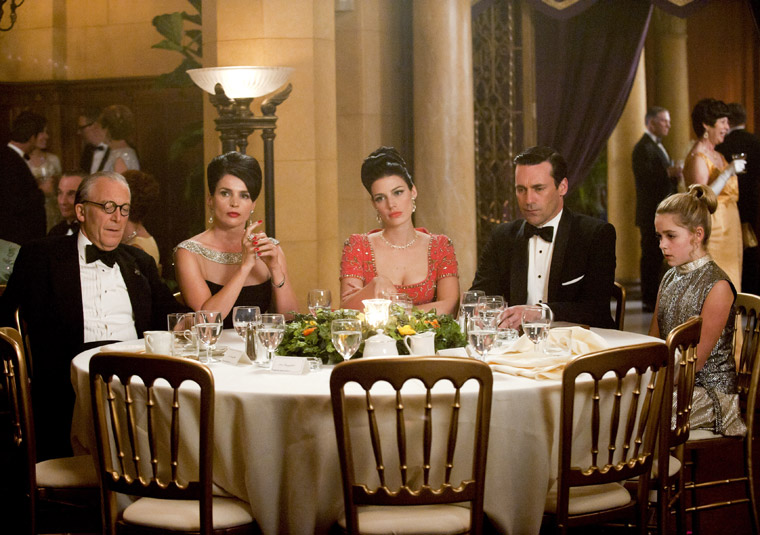
Derrick Rose is out for the season and a weekend that started badly might have ended sadly with another super dark episode of Mad Men. Instead, we got a few comedic rays of sunshine to break through the gloom – Pete tricking Megan’s pretentious father, Peggy’s mother’s surprise that Abe’s favorite dish is ham etc. Those of us looking to enliven our courses with the odd example here or there had to wait till the end.
Don is busy trying to drum up new business at his award dinner. He got the award for an anti-cancer ad he took out in the newspaper after losing the Lucky Strike cigarette account. But a colleague’s father rains on Don’s parade. He says that no-one will give Don any new business after he stabbed Lucky Strike in the back. Don signaled to the wrong audience in the last period of the Lucky Strike game. He tried to co-opt consumers by pretending to be concerned about their welfare. But consumers will not give his firm new accounts, firms selling crap to them will. And with them Don lost his reputation – will he also throw them under the bus if things turn sour? Life is an infinite horizon game with many bilateral interactions. Lose your reputation in one and, if your behavior is publicly observable, lose your reputation in all.
Textbook stuff on exit, entry and shutdown decisions:
Gas rigs have been disappearing particularly fast since late October, the last time prices were above $4.
Essentially, gas is so cheap that it’s no longer profitable to drill.
“Producers typically need $5 [per 1,000 cubic feet] to break even,” says David Greely, an energy analyst atGoldman Sachs (GS). The industry hasn’t seen prices consistently over $5 since September 2010, back when there were nearly 1,000 rigs operating in the U.S. The number of gas rigs peaked near 1,600 in mid-2008, when prices peaked at $10. (The boom was effectively confirmed in June 2009, when a Colorado School of Mines report showed that U.S. natural gas reserves were 35 percent higher than previously estimated.)
Other analysts say $5 is too high and that the average gas producer can still make money with the price between $3 and $4, depending on the well because different types of wells have different cost structures. Newer, high-production wells can turn a profit even with prices below $2, while older wells that are just trickling out gas need much higher prices to make money. That’s probably why there’s been stronger demand for horizontal rigs that specialize in fracking. Even those numbers have started to diminish in the last couple weeks.
Hat Tip: Jonathan Schultz, Kellogg MBA student
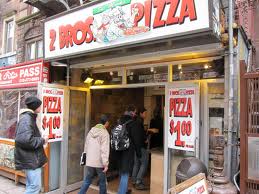

It’s best to start at $1.50 a slice.
That is what pizza was selling for about a year ago at a family business that is a combination vegetarian Indian restaurant, candy store and pizza parlor on Avenue of the Americas (also known as Sixth Avenue), between 37th and 38th Streets. It is called Bombay Fast Food/6 Ave. Pizza.
Then a Joey Pepperoni’s Pizza opened near the corner of 39th and Avenue of the Americas, offering pizza for $1, a price that has in recent years been favored by a number of New York pizza establishments.
So Bombay/6 Ave. Pizza shrank its price to $1 too.
All was good until last October, when a third player entered the drama.
A 2 Bros. Pizza, part of an enlarging New York chain of 11 shops that sell slices for a dollar, opened virtually next door to Bombay/6 Ave. Pizza. The only separation is a stairwell that leads up to a barbershop and hair salon.
Price stability at a buck all around persisted until eight days ago, when both 2 Bros. and Bombay/6 Ave. Pizza began selling pizza for the eye-catching price of 75 cents a slice, tax included — three slender quarters.
There is a sign that some parties hope things get better:
For his part, Eli Halali made it clear that 75 cents was a temporary price point. He said he could not make money at that level and eventually would return to $1. He said that if Bombay/6 Ave. Pizza went back to $1, he would as well.
But emotions may overcome reason:
If it didn’t, he said, it better watch out.
His father, Joshua Halali, who acts as a consultant to 2 Bros., said, “I suggested to my children to go to 50 cents.”
Oren Halali said, “We might go to free pizza soon.”
Eli said: “We have enough power to wait them out. They’re not going to make a fool of us.”
The brothers said they are also contemplating adding fried chicken to the Avenue of the Americas store to intensify the pressure on Bombay/6 Ave. Pizza.
Meanwhile, Mr. Patel remains intransigent. “We’re never going back to $1,” he said. “We’re going lower.”
“We may go to 50 cents,” Mr. Kumar said. Of his next-door rival, he said: “I want to hit him. I want to beat him.”
Differentiation may protect them. Yelp reviewers love the Indian items at Bombay Fast Food. The Halalis should introduce some Middle Eastern items. And perhaps Bombay Fast Food should just get out of the pizza business. This will allow pizza prices to go up. Then, pizza sales will stop cannibalizing profits from the Indian food operation.


The nationally recognized Piven Theatre Workshop would play a leading role in the revitalization of the Noyes Cultural Arts Center, occupying renovated space and a state-of-the-art theater in the building under a plan that received backing Monday from a city committee…
With past efforts to change things at the city owned building “not going as smoothly, as easily as we wanted,” the new plan seems to heading the city in the right direction, said Alderman Judy Fiske, in whose 1st Ward the building is located….
Piven Theatre officials are proposing to occupy the southern one-third of the building and would extensively renovate the area with new classrooms, rehearsal space, offices and a new theater, he said……
The building, which leases space at below-market rates to artists, faces substantial repairs, including a new roof and heating and air conditioning system.
City officials have looked at a new model for operating the center, a former school building, including asking tenants to take a greater role in the building’s upkeep.
Because of the ambiguity, Piven officials told [officials] last fall they were likely moving out of the building, and possibly out of Evanston…
Clear property rights are necessary to resolve the hold up problem.
But a battle to establish property rights can generate a war of attrition and hence the hold up problem. For the Church of thew Holy Sepulchre inthe Old City in Jerusalem:
The primary custodians are the Eastern Orthodox, Armenian Apostolic, and Roman Catholic Churches, with the Greek Orthodox Church having the lion’s share. In the 19th century, the Coptic Orthodox, the Ethiopian Orthodox and the Syriac Orthodox acquired lesser responsibilities…
Under the status quo, no part of what is designated as common territory may be so much as rearranged without consent from all communities. This often leads to the neglect of badly needed repairs when the communities cannot come to an agreement among themselves about the final shape of a project….A less grave sign of this state of affairs is located on a window ledge over the church’s entrance. Someone placed a wooden ladder there sometime before 1852, when the status quo defined both the doors and the window ledges as common ground. The ladder remains there to this day, in almost exactly the same position it can be seen to occupy in century-old photographs and engravings.
If one church fixes something, they then claim property rights over the thing they fix. Hence, all repair is vetoed
Dr Richard Weitz, Senior Fellow and Director of the Center for Political-Military Analysis at Hudson Institute said: “From our perspective, China should have done more in terms of security. From their perspective, they didn’t need to; they could free-ride, we were going to do it anyway. They didn’t see any point because all they would do is incur a lot of sacrifice and antagonise the Taliban and the global terrorist movement, and they’d rather let us incur that.”
Why aren’t Western countries going in there themselves?
Peter Galbraith, former deputy head of the UN mission in Afghanistan, said: “Western companies are exceptionally timid when it comes to operating in places where there is even the remotest hint that it might be a little risky, and the Chinese are not and are willing to go to these places. And the Chinese have business practices that Western countries … let’s just say that Chinese generosity towards local officials exceeds that of what Western companies are capable.”
I guess some might argue trade is good for Afghanistan and hence for us if trade leads to a stable prosperous economy. But as I have made it to Chapter 4 of Acemoglu and Robinson’s Why Nations Fail, I worry that Afghanistan will adopt “extractive political institutions” and all this trading will lead nowhere except a Swiss bank account.

People who read e-books on tablets like the iPad are realizing that while a book in print or on a black-and-white Kindle is straightforward and immersive, a tablet offers a menu of distractions that can fragment the reading experience, or stop it in its tracks.
E-mail lurks tantalizingly within reach. Looking up a tricky word or unknown fact in the book is easily accomplished through a quick Google search. And if a book starts to drag, giving up on it to stream a movie over Netflix or scroll through your Twitter feed is only a few taps away…
“The tablet is like a temptress,” said James McQuivey, the Forrester Research analyst…. “It’s constantly saying, ‘You could be on YouTube now.’ Or it’s sending constant alerts that pop up, saying you just got an e-mail. Reading itself is trying to compete.”
My (quite old) Kindle loses battery power rapidly if you attempt to use its wireless capabilities and its browser lacks the capability to access webmail or surf the web comfortably. So, you have only one option – use it to read. Fewer options are better is you lack self control. Far sighted readers who easily fall prey to Twemptation should stick with the Kindle over the iPad.

In an under-caffeinated state yesterday morning, I picked up the NYT Travel section to see where I might escape once my teaching is over in a few weeks. Nogales, Mexico, seemed easy to get to – you just go to Nogales, Arizona, and walk across the border. Good for tacos and cheap dental work.
A few hours and several coffees later, I settled down to read Why Nations Fail, Daron Acemoglu and Jim Robinson’s new book. It summarizes their many years of research (some with Simon Johnson) on political and economic institutions and their impact on economic growth. The book has no equations, graphs or tables and is aimed at a popular audience. The book begins by comparing the colonial history of Mexico and the U.S.
Mexico was settled by Spanish conquistadores who extracted as much gold and silver as possible and used the population as slave labor. The British tried to take the same approach when they arrived in Virginia. But there was no gold or silver and the population density was low. They were forced to set up political institutions that fostered economic activity. Settlers eventually got to keep a large slice of any surplus they generated and got the right to vote on taxation (this led to trouble for the British in the long run!). All very interesting and yet it seemed familiar. Eventually it dawned on me that a key Acemoglu and Robinson motivating example, used to show the importance of institutions, is Nogales Arizona vs Mexico. The geography is the same and yet the political institutions are quite different. And so are the economic outcomes. So, geography is not the major determinant of economic outcomes (roughly the theory of Jared Diamond) and political institutions are at the core of economic development.
Serendipity, synchronicity, call it what you will, but the time seems ripe for this book. Acemoglu and Robinson have a blog to accompany their book. I suppose they will interpret comtemporary events through the lens of their theory. I look forward to reading it on a regular basis.
The Cubs are finally ready to end their losing streak.
After years of being out-hustled by secondary ticket brokers, which flip high-demand seats for huge profit, the North Siders are stealing a page from their South Side rival’s playbook and implementing “dynamic pricing” in their 5,000 bleacher seats this season.
Until recently, all 30 Major League Baseball teams set prices well before the start of the season, leaving their hands tied on game days, when StubHub Inc. sellers might be hawking the same tickets for twice as much. Now, if demand spikes, the Cubs can hike prices much like airlines do as departure time nears.
“Teams are looking at (dynamic pricing) to capture some of that secondary market that they’re not capturing,” says Colin Faulkner, the Cubs’ vice president of ticket sales and service, who implemented the new system when he worked for the NHL’s Dallas Stars before moving to Wrigley Field in 2010. Mr. Faulkner says the dynamic pricing will supplement a tiered system in the bleachers, where initial costs range from $17 to $78 apiece.
(Hat Tip: Kathryn Landis, Kellogg MBA)

We blogged many times about the Next restaurant’s innovative ticket scheme. Potential restaurant goers had to sign up to try to acquire seats at a fixed price for a set meal. Good for the restaurant in terms of knowing what inventory to hold, predictable revenue etc. The scheme turned out to be extremely successful with resale prices of the tickets running into thousands. Why not just auction off the seats – that is what very economist would say? It turns out that Nick Kekonas and Grant Achatz do not want to make too much money and want everyone to be able to afford to come. In response to my blog post Nick commented:
Since we have universally high demand right now, the question is why don’t we flatten the pricing towards the top of what the market will pay? There are a few reasons for this, mostly having to do with customer service and the hospitality industry. Simply, we never want to invert the value proposition so that customers are paying a premium that is disproportionate to the amount of food / quality of service they receive. Right now we have it as a great bargain for those who can buy tickets. Ideally, we keep it a great value and stay full.
I replied
If you want to give it to charity, to start a foundation to teach disadvantaged kids how to cook or whatever is close to your heart, that surely dominates just giving up the money to random lucky people who sign up and sell tickets for profit on Craigslist. And given you have software already, I bet it would be pretty easy to program a simple auction.
My advice was pretty obvious and I’m sure they though of it already. Anyway:
Next created a special page to run a Dutch auction for an El Bulli menu two-top every night, all proceeds to go to the University of Chicago Cancer Center where Grant Achatz was treated….
Not surprisingly, there are a lot of people who couldn’t stand to wait for Next El Bulli tickets to come down in price— as of this writing 46 of the 72 tables, many of them for the $5000 maximum price (compared to about $800 for a regular pair of Next El Bulli tickets; most of that will be tax deductible as a donation) have sold for a total of $215,000. Odds are the entire block will sell out later today, bringing in around $350,000 for the hospital in little over a day. Next’s food fascinates, but it’s hard not to think that Next’s radically innovative business models will prove equally important and influential for the restaurant industry and its extensive charitable involvement over the years to come.

Diehard Downton Abbey fans didn’t watch the SuperBowl, preferring the trials and tribulations of Matthew and Mary to the seesawing fortunes of Tom and Eli. Series 2 has already been shown in the U.K., as well as a Xmas special. For those who could not work out how to set up their computer to mirror British I.P.addresses and watch it on streaming video, the wait has been long. How can they get their Downton Abbey fix? They could get the British DVD version and have it shipped. But will it work on their DVD player? But do not worry, the producers are going to give the fans a relaxing spliff – series 2 is coming out on DVD is the US on Feb 7. Cunning on two levels.
First, there is plenty of time to have it shipped and get it in time for Valentine’s Day for your loved one. (Reminder to self – get the dvd asap)
Second, and more dastardly, the rabid fans can get to watch all the episodes yet to be shown on PBS (and maybe even the Xmas special?). The timing is perfect. Release it any later and people will have seen the end and fewer people will buy it. Release it any earlier and PBS will not pay as much for the TV rights. Someone’s thinking back in England – probably a working class guy who would have been a footman in Downton Abbey days but now runs ITV.
Gingrich, Santorum (and I guess also Ron Paul) keep splitting the conservative vote in the Republican primaries. Romney gets through because of the split.
Gingrich and Santorum are playing a dynamic version of Chicken (a war of attrition) with budget constraints. With complete information, a war of attrition has the player with the lower budget dropping out immediately in equilibrium. He knows that eventually there will be a penultimate stage where the player with the bigger budget will definitely fight because he knows he will be the only player left standing the next and final period and hence will win the prize with certainty. The player with the dwindling budget might as well drop out and save his money at the penultimate stage. But then we can backward induct to the pen-penultimate stage etc. and the player with the smaller budget drops out immediately.
This solution relies on a lot of rationality and complete information. Both of these are suspect in the Republican primaries. On the one hand Gingrich seems to be in the better financial position. He has a billionaire bankrolling him, Santorum does not. But on he other hand, the billionaire might not want to waste money on a lost cause. And it appears Santorum does have more money in the bank than Gingrich because he does have some support. And both men display the mixture of nutty self-belief and guile that is characteristic of politicians. Plenty of reason for the race to go on for along time.
Perhaps too long for Obama supporters. I think they should prefer Gingrich as the Republican candidate in the general election not Romney. In Florida, Romney showed that he has strong support among moderates. Moderates are the key to victory in the general election. A Democratic billionaire has to pitch in, help out the casino billionaire and bankroll the Gingrich SuperPac. They can do this by setting up an anonymous company with a PO box, keep their identity hidden and sign over a check. A big enough donation should trigger a Santorum exit as in analysis above. Then, it’s Romney vs Gingrich the rest of the way (with fringe support for Paul).
B School Profs looking for “war stories” read McKinsey Quarterly more religiously than the Quarterly Journal of Economics. The stories are just stories because there is no effort at identification and data come from surveys rather than payoff based decision making. This does not make for research in the academic sense. Here is a claim in a recent article (free registration required):
Most executives, the survey found, believe that their companies are too stingy, especially for investments expensed immediately through the income statement and not capitalized over the longer term. Indeed, about two-thirds of the respondents said that their companies underinvest in product development, and more than half that they underinvest in sales and marketing and in financing start-ups for new products or new markets
Why aren’t companies investing? Decision making biases says the survey:
Executives who believe that their companies are underinvesting are also much more likely to have observed a number of common decision biases in those companies’ investment decision making. These executives also display a remarkable degree of loss aversion—they weight potential losses significantly more than equivalent gains.
I wish there was a crisp anecdote (e.g. “When I moved to General Mills, I did not introduce Choco-Honey-Nutto-Organic Cheerios – even though it did great is focus groups – because in my last job I got burned when I okayed perfumed Pampers and it stank in the marketplace.”)

From a NYT Q&A about a trip to Bangladesh:
WASSIM RAGAB: How do you overcome the corruption in Bangladesh and still run successful projects?
MELINDA: It’s unfortunate and true that Bangladesh is perceived to be one of the world’s most corrupt countries. The Bangladeshis I have met have told me that they feel this in small ways on a fairly regular basis. Because the problem is systemic, it’s hard for them to go against the tide. One doctor I met with yesterday told me that nobody pays attention to traffic lights since you can buy your way out of a ticket for a small fee and because if you don’t run the red light, “everyone else will and you’ll never get to your destination.” Obviously, these unnecessary surcharges on everyday life and other forms of corruption are a major impediment to faster economic growth and it’s something the government and others must address.
Because everyone else is running a red light, a best response is to run it yourself. For some people, a best response to everyone not running the red light is to not run it yourself. This is a coördination game logic. Actions are strategic complements: I am more willing to run the red light if you are running it.
Corruption can be thought of in two ways. First, it is a sunspot that makes the running lights equilibrium focal. Second, there are heterogeneous costs (or benefits) to running a red light. Suppose there is no corruption. Then, there is a threshold equilibrium where people run the red light if and only if their cost is below the threshold. Corruption lowers the costs of running the right and shifts the threshold up: More people run red lights. By strategic complements this creates a spiral where yet more people run red lights etc.
You are managing a small team. You are meant to make sure they work hard. Monitoring is costly and you would like to shirk your responsibilities. But your monitoring is observable to the worker bees. They incur no costs to observe your effort. If you shirk your duties, there will be payback from the workers. There is always the possibility that they turn you in to your supervisor. This could be a deliberate act. More likely, it is inadvertent because “loose lips” that sink ships. So, you are left with no choice but to monitor. And since you are monitoring, the workers are left with no option but to work. Everyone is worse off. If only the workers could keep their mouths shut and the manager could shirk.
Yoram Bauman is also an environmental economist. With this hat on, in the NYT, he says:
Learning about the shortcomings as well as the successes of free markets is at the heart of any good economics education, and students — especially those who are not destined to major in the field — deserve to hear both sides of the story.
Which reminds me of my plan to put in more stuff about common property resources, public goods and externalities into my MBA course next quarter…
Richard Russo bemoans Amazon’s takeover of retail:
Amazon was encouraging customers to go into brick-and-mortar bookstores on Saturday, and use its price-check app (which allows shoppers in physical stores to see, by scanning a bar code, if they can get a better price online) to earn a 5 percent credit on Amazon purchases (up to $5 per item, and up to three items).
Amazon seems to be using decentralized market intelligence to undercut the competition. Good for consumers but bad for bricks-and-mortar retailers, as Richard Russo explains. But the logic can equally go the other way. Firms can use market intelligence to maintain high prices. If Firm A can immediately observes Firm B’s price cut (and vice versa), it can match the price cut immediately. This can eliminate the incentive to cut prices and hence allow firms to maintain high prices. A local example:
Over a four-year period beginning in the summer of 1996, the two dominant supermarket chains in the Chicago area charged virtually identical prices for milk, attorneys in a class-action lawsuit accusing Jewel and Dominick’s of price-fixing charged Friday in opening arguments.
So closely aligned were the chains’ pricing structures for the staple that whenever one changed milk prices the other would match it within days, the attorneys alleged….
For example, he said the chains lacked competitive behavior, indicated by a July 1996 memorandum by Dominick’s officials outlining an arrangement with Jewel in which Dominick’s employees would be permitted inside Jewel stores to check prices.
Can Dominick’s and Jewel now use iPhone apps to implement a collusive scheme without hiring employees to visit each other’s stores? There is a large mass of anonymous consumers. The firms offer discounts via apps. It would be in consumers’ interests to collude with each other, reject discounts and refuse to use the apps. But with a large mass of anonymous consumers, collusion is impossible to enforce. The firms can trigger a free-rider problem or prisoner’s dilemma amongst consumers so everyone uses the apps to get discounts. The market intelligence so gathered can be used by the firms to collude. As a consumer, this is the Orwellian nightmare I fear, the reverse of Richard Russo’s.
(Hat Tip: Mort Kamien told me about the milk case years ago. Perhaps he testified against the supermarket chains?)



Next Iron Chef is much better than Iron Chef. The latter almost always has Bobby Flay matching his Southwestern style cuisine against some hapless contestant who usually loses. Next Iron Chef has more uncertainty, some new faces and some better chefs. Last night’s episode had fun twists and turns coming out of the mechanism design and a tragic-comic outcome.
First, the chefs had to “bid” for ingredients in a Dutch auction with time allowed for cooking as the “currency”. There were five chefs and five ingredients. The lowest bid won for each of the first four ingredients. The chef who “won” the last ingredient was by the rules of the mechanism left with a cooking time of the lowest bid on the first four ingredients minus 5 minutes. The ingredients were revealed one by one. That was the first twist. The second was that the Chef Anne Burrell had “won” the previous episode and had an advantage coming into this one (more on this below).
Equilibrium analysis for the first twist is not available but instinct suggests very aggressive bidding towards the end since you begin bidding on the fourth ingredient knowing the maximum time you will have with the fifth. This will trigger aggressive bidding all the way through. This was true for all ingredients except sardines which Anne Burrell won for a bid of 50 minutes. Chef Alex Guarnaschelli got the last ingredient, lamb chops, with 25 minutes to cook. Since, Chef Anne had about 20 minutes more than the other chefs, she made three sardine dishes. It is always an error to make multiple dishes in this competition. The judges seem to use a lexicographic criterion. They compare your worst dish with the those of the other chefs. If your worst dish is tied with others’ dishes, then your best dish comes into play and you win. So, doing multiple dishes typically backfires because you cannot spend enough time perfecting each of your dishes so you invariably end up with the worst dish and your best dish gets ignored. The First Irony is that having more time made Chef Anne think she had to do more dishes (she did three) and one of them was Yuk.
Now the second twist: Chef Anne’s advantage was that she got to taste the other four dishes and decide which was of them was the worst. The theme of the episode was “Risk” and she decided, in my opinion voting honestly according to her preferences, that Chef Jeffrey Zakarian had the least risky dish. The two worst chefs from the first part of the competition face off in the second part. And the loser gets eliminated. Chef Anne got to chose one of the two potential losers. What if Chef Anne had voted strategically? The first instinct is to put the best chef in the knockout round but this is wrong. This chef will face one of the worst chefs in all likelihood, beat them and come back the next episode. It is is better to chose the chef you would like to face in case your dish ends up at the bottom. That chef is Chef Alex in my opinion. But Chef Anne chose Zakarian who is a star. And he defeated her in the knockout round. This is Second Irony.
Who would the judges have chosen if they had leeway? It seems Chef Alex would have been in the knockout round and probably Chef Anne would have dealt with her. This is Third Irony. This episode was Shakespearean, as Chef Alex pointed out.

Pfizer’s Lipitor, which my doctor will prescribe for me one of these days, is going off patent and facing generic competition. This leads typically to intense price competition and collapsing sales for the brand name. But Pfizer is trying to stave that off by offering deals such as a $4 co-pay rather than the $10 co-pay required with most generics. The mystery is why they are doing all this.
All the special discounts have the same impact as a price cut and the deals actually involve a price cut anyway. So, what’s in it for Pfizer?
The only rationale I can think of is that there is something weird going on at the insurance company level. That is, consumers are getting deep discounts and want to stick to their favored brand name product. So that consumers can consume what they want, the insurance companies will be forced to pay for the drug at the back end. But this does not hold water either because the insurance companies can simply stipulate that only generics be prescribed. hence, they have to be offered a deal to tick with Lipitor.
So, still the Pfizer strategy does not make sense because it replicates the Bertrand competition solution with funkier pricing schemes but no real advantage….
Q: Why did ATT attempt to merge with T-Mobile when there were huge anti-trust issues?
But the advisers that AT&T’s board were listening to most intently were the lawyers who would be on the front lines of the battle: Arnold & Porter and Crowell & Moring, which worked the antitrust strategy in Washington. (Sullivan & Cromwell worked on the deal mechanics.)
Those firms all charge by the hour, so the cynic — or skeptic — might suggest they had every incentive to push the deal ahead.
According to people involved in the decision-making process, the lawyers put the chances of success at 60 to 70 percent.
For AT&T’s board, that was a chance worth taking. The question they now must ask themselves: would they use those lawyers again?
A firm selling complementary products may cut the price of one to encourage sales of the other. This effect can be so strong that one of the products is sold as a loss leader:
A recent analysis from IHS iSuppli determined that Amazon’s $79 Kindle e-reader, which is the online retailer’s cheapest Kindle thus far, costs $84.25 to make…..Even if Amazon pays more to build the $79 Kindle than it sells it for, the company has several other ways to bring in money from the device. This Kindle model includes ads that show up as screensavers and at the bottom of the device’s home screen. And Amazon sees all the devices in the Kindle family — and the free Kindle apps it offers for mobile devices and computers — as a way to spur more sales of its digital e-books, music, games and apps.
I leave it to Paul Krugman to advice Greece. I’ll stick to Greeks. In a couple of weeks from now, while everyone is at the rally complaining about the austerity plan, the government will shut down all banks. They will get out of the euro. On Monday, Greek ATMs will issue euronotes with a picture of Plato photoshopped onto them. They will be called drachmas. Plato’s picture will cause the value of the note to fall to a fraction of the value of the euro. So, in the next couple of weeks, following the simplest prescription of Hirschman’s Exit, Voice and Loyalty, Greeks should move all their bank accounts abroad. Of course, the country that gave us Plato, Aristotle, Pythagoras and, my personal favorite, Thucydides, does not need my shallow advice. Via the Daily Mail:
Fat-cat Greeks have secretly shifted more than €228billion euros out of their country’s crisis-hit banks and into accounts in Switzerland, according to a report.
The big money is fleeing the country as rich Greeks fear the possible re-introduction of their old currency, the drachma, would instantly halve the value of their euros if they are left in Greek banks.
Netflix has increases prices. What should Redbox, the kiosk DVD rental firm do? Thye could cut or maintain prices and gain share. Or they could raise prices, lose some sales and gain margin. Redbox has decided to raise prices:
The new rental rate will be $1.20 per day, instead of the current $1 daily rate. Redbox prices will remained unchanged for Blu-ray discs at $1.50 per day and video games at $2 per day.
Why don’t companies do this more often? One explanation:
[I]t spooked investors, especially because Redbox appears to be picking up customers still stewing over the higher prices at Netflix. Coinstar’s shares plunged 10 percent in Thursday’s extended trading.
To outsiders, sales are more observable than profits/unit, because variable costs are kept private by firms but sales figures are publicized. The market can see lower sales but has a harder time calculating the profit implications – lower sales could mean higher profits. Or stock market analysts are crazy short termists.
All Cambridge (U.K.) undergrads have (had?) to struggle through a chapter by chapter reading of Keynes’ General Theory of Employment, Interest and Money. Some come out of this confirmed Keynesians and even Marxists and then go on to work in the City of London. This rich irony comes at the cost of some confusion for hordes of the intellectual elite as the book is extremely hard to read. It turns out that Keynes offered a lucid synopsis of his theory in the QJE in a reply to his critics. My only quibble is that I wish he had used the odd equation here or there – he speaks in equations but does not dare spell them out presumably for fear of losing his reader. But here is a spectacular passage on uncertainty vs risk:
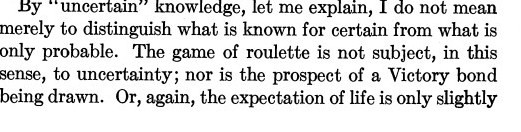

Why does it matter? Because it affects demand for money and hence the interest rate:
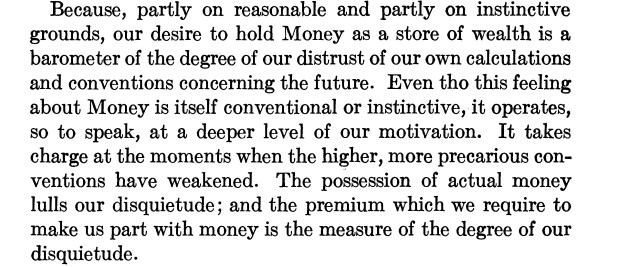
The whole article is full of amazing insights. i’s are not dotted or t’s crossed. Many papers remain to be written.
(Hat Tip: Nabil Al-Najjar)
Kevin Murphy is a John Bates Clark Medal winner, he has a MacArthur “Genius” Award and is a superstar in the economics profession. But the green-eyed monster has finally stirred because I found out he is consulting for the basketball players in the current labor negotiations.
Teams pay a luxury tax if they go over a salary cap specified by the league. The revenue generated by the tax is transferred to the other teams. If the luxury tax is too high, teams will not go over the salary cap and the labor market for payers will be moribund. But if it is low, the rich teams will go over the salary cap and the poorer teams will get the revenue this generates and will themselves compete to hire players. The labor market for players will be active. There is some threshold luxury tax below which the market is active and above which it is inactive. The players want a tax that is below the threshold. Who might be able to work out this threshold? Kevin Murphy:
[An ESPN reporter] asked a union official how they know where that player-friendly effect stops, and where the de facto hard cap kicks in.
His answer was that their economist Kevin Murphy had the task of predicting how owners would spend under the last CBA, back when it was new. Looking back, they realize his work was, the official says, “pretty much perfect.”
Who is the consultant to the teams I wonder?
(HT: MR)
Why would a narrow elite ever extend the vote to the masses? Perhaps the hand of the elite is forced by the threat of revolution. To convince the masses that the elite is committed to giving them surplus, the elite extend the franchise. This is argument of Acemoglu and Robinson.
Lizzeri and Persico have a quite different argument which has particular resonance for Britain’s Age of Reform in the nineteenth century. Suppose only a fraction of the population can vote. Two parties, the Whigs and the Tories compete for their vote. The parties can either offer a public good or a transfer with revenue generated via taxation. When the enfranchised group is a small elite, there is an incentive to tax the entire population and then target transfers to swing voters in the elite. That way a party can give them as much as they would get with pubic good provision and get into power. The mass of the elite that is not targeted gets no transfer.
When the franchise is extended pork barrel politics is not as powerful as the taxable endowment is not large enough to offer the now larger majority enough to compensate them for zero pubic good production. Each political party can at least get a 50% chance of getting elected by offering public goods. Hence, an extension of the franchise leads to less pork barrel politics and more public good production. Some members of the elite are indifferent to this change and others – those who were not receiving transfers when the franchise was small – strictly prefer it. Hence, extension of the franchise Pareto-dominates a small franchise. The franchise can be extended even when there is no threat of revolution by the disenfranchised masses.
The Pareto-domination property does not obtain in general (when voters are ideological and pubic good production is not zero-one) but the majority of the elite prefers extension of the franchise. In nineteenth century Britain, members of the elite clamoured for the extension of the franchise. There was less pork barrel transfer and more public good production after the franchise was extended.
Students anywhere can watch my old friend Ben Polak teach his famous Yale class. They can’t get a Yale grade for the class but that possibility is coming ever closer: A professor at Stanford is teaching a robotics class and everyone can sign up, do the assignments, take the exams and get a certificate of “accomplishment. Prospective employers do not know whether your friend took the exam for you. This means the certificate has little value. But surely it is only a matter of time before some verification mechanism is set up and this problem is dealt with.
The implications of this change are multifold but I just want to focus on one: the impact on the research university. Universities produce research as well as teaching and this other dimension is often forgotten in all the discussion of virtual teaching. Here is one possible sequence of events:
1. Virtual teaching cannibalizes face-to-face teaching. Tuition goes down and courses become quite cheap.
2. This destroys tuition-based universities which turn into vast teaching factories. A few universities try an “elite” approach with tiny classes taught by excellent teachers.
3. Endowment based universities continue to survive. Researchers become concentrated in these universities. They compete for government funding and do mainly PhD teaching.
4. A “top heavy” university structure emerges with a handful of research universities and a number of vast teaching universities.
This analysis assumes there is weak complementarity between research and teaching. If there is strong complementarity, the teachers have to be researchers to keep courses up to date, exciting etc. This will make step 2 above more difficult and leave a structure like today’s but with universities having virtual counterparts and huge scale.
I am attending an antitrust conference hosted by the Searle Center at Northwestern University. In my attempt to Americanize, I am drawn to any paper involving sport. And if British sport is thrown in for comparison, resistance is impossible.
Haddock, Jacobi and Sag offer an analysis of American NFL football stadiums versus English soccer stadiums. Their thesis is simple: the NFL controls entry of new teams in the league and teams can move from one city to another. So, if the New Jersey government does not cough up $1 billion for the New Meadowlands, teams can threaten to move and the NFL can refuse to allocate another team to the state. For example:
When the Houston Oilers threatened to move to Jacksonville, Florida in 1987 Harris County, Texas, responded with $67 million in improvements to the funded by property tax increases, doubling the county’s hotel tax, and underwriting bonds to be paid over the next 30 years. Within six years the Oilers began lobbying for a new stadium with club seating. Rather than opposing the Oilers rent seeking, NFL Commissioner Paul Tagliabue warned Houston that “If the Oilers’ situation doesn’t work down there, I don’t see any circumstances in which we’re going to guarantee a team, especially when one team’s already found it unsatisfactory.” The message was clear, if Houston lost the Oilers because it refused to accede to the team’s demands, it was unlikely to receive a prompt replacement. At the end of the 1996 season the Oilers left Houston for Nashville where city officials had promised to contribute $144 million toward a new stadium.
In England, entry is easy. If a team attempts to hold up a city, it can create its own new team. This reduces the bargaining power of the team.
Jerry Hausman, the discussant, found much to disagree with. Hausman claimed many British teams were simply no-hopers. Very few teams are actually competitive. Arsenal is not one of them and hence no-one would fund a stadium for them. In the NFL, many teams are competitive. Hence, they can extract rents from the local community. He thought politics was an the center of problem: Why did Massachusetts fund a new high school in Newton rather than soend money in poorer areas? He displayed a surprising amount of knowledge about English soccer and claimed to have worked for the Chicago Bulls (I didn’t catch what he did for them). He speaks fast so I may have missed some details.
David Pogue has also been thinking/fuming about the Netflix price change which effectively increases prices from $10 to $16 for streaming plus one-DVD-at-a-time. He ends with:
[W]hat makes me unhappiest is how calculated all of this feels. In July, a spokesman told me that Netflix had already taken the subscriber defection into account in its financial forecasts.
And sure enough. When I tweeted that Netflix had lost one million of its 25 million customers, @npe9 nailed it when he wrote:“It damages their brand and images, but 24 million customers paying $16 is still better than 25 million @ $10. Increases revenue by >50%.”
This issue is perplexing many of us who teach in business schools – are we going to have to change our classes as one of the firms in many of our key examples goes bankrupt?
We are not sure we have a good answer to our question so we will satisfy ourselves with a brain dump.
First, it may very well be true that, as CEO Reed Hastings is saying, Netflix does not want to end up like Borders or AOL in the garbage can of history when the next new technology comes along. After all, Blockbuster has never really recovered from missteps when Netflix DVDs arrived on the scene.
Therefore, Netflix wants to be ahead of the curve when DVD technology dies and everyone watches streaming movies. Here is one way to do this: keep the total price of 1 DVD at a time +streaming at $10 but price streaming alone at $6 and 1 DVD alone at $8. What they did instead, to maintain margins we assume, is raise prices by 60% so I DVD at a time + streaming is now $16. Of course this going to cause some serious fall in demand and also create a media frenzy.
There is a broader point: we gave one example of how Netflix might shuffle prices to create switching but we do not have the internal data on revenue and costs so the optimal pricing might be different. But whatever it is, the optimal pricing requires the DVD and streaming prices to be coordinated. If you split these two services into different (competing?) companies, you might create a price war and not only undermines your whole strategy but destroys your profits….
Even if completely separating the two businesses is the only way Netflix feels it can incentivize its streaming business to move ahead properly, there is absolutely no reason the company should expect consumers to care about its internal strategy issues – the strange angle taken by Hastings’ blog postings and emails to customers. It seems to us that it is the large price hike, far more than any other aspect, which has upset customers.
As a final comment, even if Netflix gets everything right operationally in its streaming business, it is hard to see how they plan to maintain margins and demand given that their suppliers (the content producers and owners) have a great deal of bargaining power and have every incentive to treat Netflix as only one outlet among many competing ones for their product. Other companies in the content delivery business, such as cable & satellite operators, face similar issues, but have the advantage of higher barriers to entry in terms of local franchise rights and physical infrastructure that gives them greater scope to raise prices……Our guess is that we will have more posts as more information arrives.
Sandeep Baliga and Peter Klibanoff
Suppose a firm can enter one of several markets. Other things equal, the fewer competitors there are, the greater is the incentive to enter as profits are decreasing in the number of competitors. So, smart managers should enter markets with fewer competitors. The deregulation of local telecommunications services in 1996 led to entry by competitive local exchange carriers (CLECs). These varied in the experience and education of senior managers and hence allow a descriptive and analytic analysis of entry decisions. Goldfarb and Xiao perform this analysis and find
Our descriptive analysis, which  characterizes the entry decisions of facilities based CLECs in 234 midsize US markets with populations between 100,000 and 1,000,000 as of
the 2000 Census, reveals that experienced CEOs, CEOs with an economics or business
education, and CEOs who attended the most selective undergraduate institutions tended to enter
markets with fewer competitors.

They also estimate a behavioral model of entry to try to identify strategic sophistication as defined by the Cognitive Hierarchy model of Camerer, Crawford etc.  They find that the firms with strategically sophisticated managers are more likely to survive and be profitable.  There are many things that one might ague with - e.g. Doesn't better (economics/business) education help you to motivate workers better, cut costs etc?  Why is strategic sophistication identified only with competition avoidance?  Many questions come to mind but this is still an interesting paper.
 Cheap Talk