
You are currently browsing jeff’s articles.
This guy wrote a column about The Hunger Games and gave away many details of the plot, some of them big-time spoilers. Then he wrote a column about how he was actually doing his readers a favor because spoilers actually increase the enjoyment of the book. For example
The suggestion is that there is a trade-off in the pleasures available to first-time readers or viewers on the one hand, and “repeaters” (as they are called in the scholarly literature) on the other. First-time readers or viewers, because they don’t know what’s going to happen, have access to the pleasures of suspense — going down the wrong path, guessing at the identity of the killer, wondering about the fate of the hero. Repeaters who do know what is going to happen cannot experience those pleasures, but they can recognize significances they missed the first time around, see ironies that emerge only in hindsight and savor the skill with which a plot is constructed. If suspense is taken away by certainty, certainty offers other compensations, and those compensations, rather than being undermined by a spoiler, require one.
and
The positive case for spoilers is even stronger if you are persuaded by those who argue, in the face of common sense, that suspense survives certainty. This is called “the paradox of suspense” and it is explained by A. R. Duckworth: “1. Suspense requires uncertainty. 2. Knowledge of the outcome of a narrative, scene or situation precludes any uncertainty. 3. [Yet] we feel suspense in response to fictions we know the outcomes of” (“The Paradox of Suspense II—The Problem,” The Journal of Film, Art and Aesthetics, Jan. 14, 2012).
and some other related arguments. Even if you accept these arguments, they amount to saying that there is a qualitative difference between the spoiled reading and the fresh reading and you want to have both. But this does not vindicate the spoilage. The problem with the spoiler is that it deprives you of the fresh reading. Spared the spoiler, or suitably alerted, you could have had both.
Now maybe you have time for only one reading. And so the counterargument could be that if the spoiled reading is in fact better than the fresh one then the spoiler saves you the effort of self-spoiling (settle down Beavis!) and gets you straight to the good, i.e. spoiled, stuff.
But notice what this says about the author of the novel. The author invented this whole story. She created the entire spoil-fodder. Indeed the spoiler only exists because the author chose not to “spoil” it himself by informing the reader right away what’s going to happen later. Either that is because this makes for a better story, or because the author is incompetent. In other words, putting a naked spoiler into your column and claiming that it makes the story better is tantamount to saying that the author is a hack. Not
If “The Hunger Games” is so shallow that it can be spoiled by a plot revelation, the alert doesn’t save much. If “The Hunger Games” is a serious accomplishment, no plot revelation can spoil it.
Deerstalker dash: Alex Frankel.
This is a screenshot from an espn.com webstreaming replay of the French Open match between Maria Sharapova and Klara Zakapalova. As you can see Sharapova won the first set and now they are locked in a tight second set. But hmmm… something tells me that Zakapalova will be able to push it to three sets…
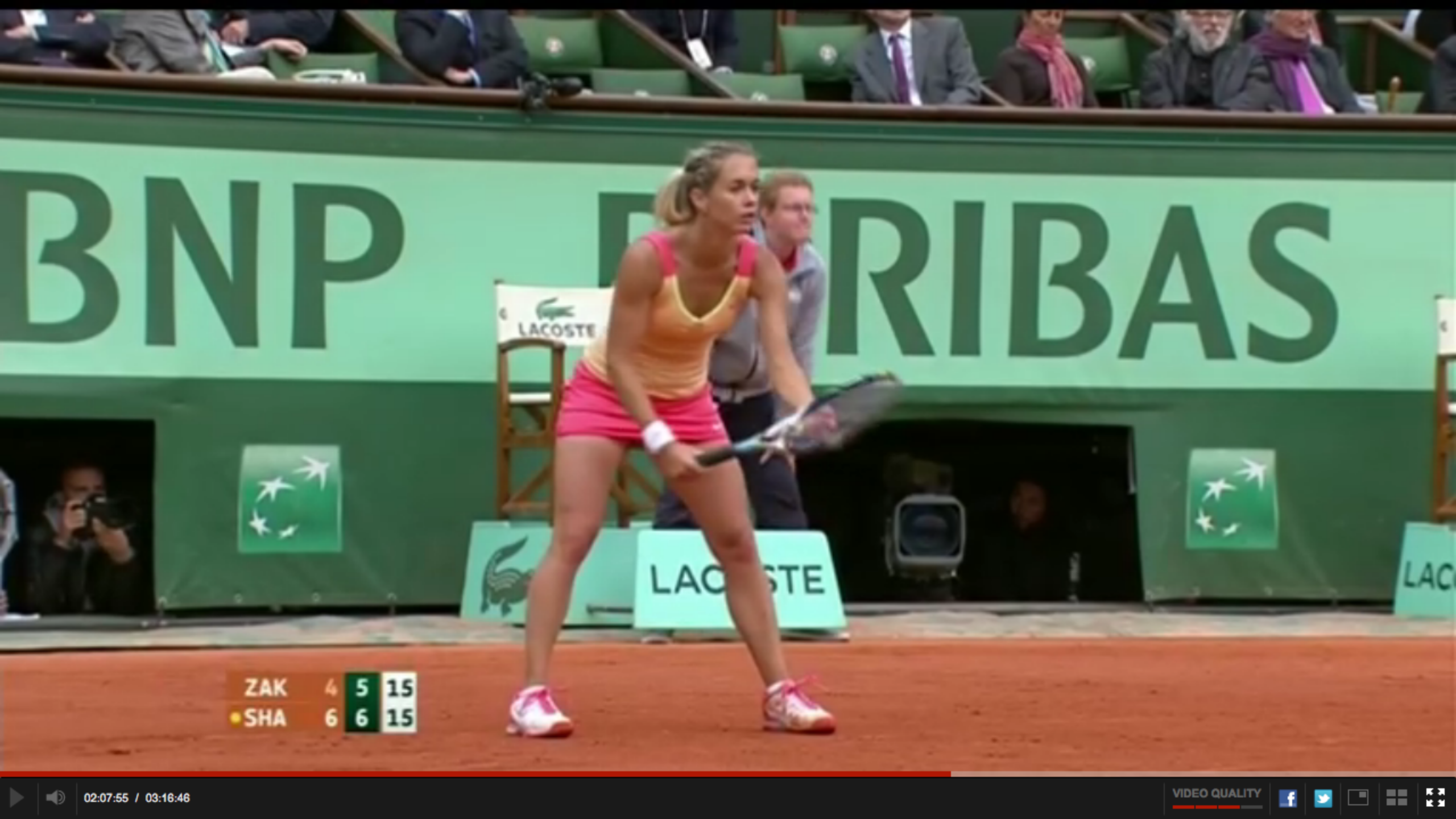
Courtesy of Emir Kamenica.
Ariel Rubinstein brings his game theory debunking manifesto to The Browser.
In general, I would say there were too many claims made by game theoreticians about its relevance. Every book of game theory starts with “Game theory is very relevant to everything that you can imagine, and probably many things that you can’t imagine.” In my opinion that’s just a marketing device.
Let’s show its usefulness by using game theory to analyze Ariel Rubinstein. We model him with the following game. Ariel is the first mover. He privately observes whether game theory is useful. Then he has the first decision to make. He can either announce publicly that game theory is not useful or stay silent. If he stays silent the game is over. If he announces then everybody else moves next. We can either try to prove him wrong by citing examples where game theory is useful or we can stay silent. Then the game ends.
Let’s solve the game by backward induction. If Ariel has announced that game theory is not useful, each of us has a strong incentive to find examples to prove him wrong so we do (assuming game theory is in fact useful which we will find out by looking for examples.) Knowing this, and having privately observed that game theory is useful and being the humble yet social-welfare maximizing (not to mention supremely strategic) person Ariel is, Ariel announces that game theory is not useful so as to give the rest of us the incentive and the glory of proving him wrong.
And so it is done.
Dawkins couldn’t be more dull when he is playing the heretic. When he is excoriating heretics, on the other hand, he is sharp as a tack:
Misunderstanding Number One, which is also perpetrated by Wilson, is the fallacy that “Kin selection is a special, complex kind of natural selection, to be invoked only when the allegedly more parsimonious ‘standard Darwinian theory’ proves inadequate.” I hope I have made it clear that kin selection is logically entailed by standard Darwinian theory, even if the B and C terms work out in such a way that collateral kin are not cared for in practice. Natural selection without kin selection would be like Euclid without Pythagoras. Wilson is, in effect, striding around with a ruler, measuring triangles to see whether Pythagoras got it right. Kin selection was always logically implied by the neo-Darwinian synthesis. It just needed somebody to point it out—Hamilton did it.
Edward Wilson has made important discoveries of his own. His place in history is assured, and so is Hamilton’s. Please do read Wilson’s earlier books, including the monumental The Ants, written jointly with Bert Hölldobler (yet another world expert who will have no truck with group selection). As for the book under review, the theoretical errors I have explained are important, pervasive, and integral to its thesis in a way that renders it impossible to recommend. To borrow from Dorothy Parker, this is not a book to be tossed lightly aside. It should be thrown with great force. And sincere regret.
To discover in the course of research some engaging detail we know can be put into a story where it will do some good can hardly be classed as a felonious act– it is simply what we do. The worst you can call itis a form of primate behavior. Writers are naturally drawn, chimpanzee-like, to the color and the music of this English idiom we are blessed to have inherited. When given the choice we will usually try to use the more vivid and tuneful among its words. I cannot of course speak for Mr. McEwan’s method of proceeding, but should be very surprised indeed if something of the sort, even for brief moments, had not occurred during his research for Atonement. Gentian violet! Come on. Who among us could have resisted that one?
From Letters of Note, again.
Do memories depreciate slowly, bit by bit, or do they remain constant for some time and then wiped out completely? For short term visual memory its the latter:
Which is exactly what happened: Zhang & Luck found that participants were either very precise, or they completely guessed; that is, they either remembered the square’s color with great accuracy, or forgot it completely. It was almost as if their memories behaved like files on a computer: Your Microsoft Word documents don’t lose letters over time, and your digital photos don’t yellow; rather, they continue to exist until you move them into the trash—where they are wiped out all at once.
But for long term memories its the former. Check out this Scientific American article that surveys some recent research on the shelf life of memories.

Here’s a model of self-confidence. People meet you and they decide if they admire/respect/lust after you. You can tell if they do. When they do you learn that you are more admirable/respectable/attractive than you previously knew you were. Knowing this increases your expectation that the next person will react the same way. That means that when you meet the next person you are less nervous about how they will judge you. This is self-confidence.
Your self-confidence makes a visible impression on that next person. And it’s no accident that your self-confidence makes them admire/respect/lust after you more than they would if you were less self-confident. Because your self-confidence reveals that the last person felt the same way. When trying to figure out whether you are someone worthy of admiration respect or lust, it is valuable information to know how other people decided because people have similar tastes on those dimensions.
And of course it works in the opposite direction too. People who are judged negatively lose self-confidence and their unease is visible to others and makes a poor impression.
For this system to work well it must escape herding and prevent manipulation. Herding would be a problem if confident people ignore that others admire them only because they are confident and they allow these episodes to further fuel their confidence. I believe that the self-confidence mechanism is more sophisticated than this. Celebrities complain about being unable to have real relationships with regular people because regular people are unable to treat celebrities like regular people. A corollary of this is that a celebrity does not gain any more confidence from being mobbed by fans. A top-seeded tennis player doesn’t gain any further boost in confidence from a win over a low-ranked opponent who wilts on the court out of awe and intimidation.
Herding may be harder to avoid on the downside. If people who lack confidence are shunned they may never get the opportunity to prove themselves and escape the confidence trap.
And notwithstanding self-help books that teach you tricks to artificially boost your self-confidence, I don’t think manipulation is a problem either. Confidence is an entry, nothing more. When you are confident people are more willing to get to know you better. But once they do they will learn whether your self-confidence is justified. If it isn’t you may be worse off than if you never had the entry in the first place.
Drawing: Life is a Zen Roller Coaster from http://www.f1me.net
Someone asks you a question and you have an intuitive understanding of precisely what is being asked. If you are not a game theorist you stop there and answer.
If you are a game theorist you start to analyze the question and discover that, as with all language there is some ambiguity. There’s more than one way to answer the question, the answer could be very detailed or just straightforward, the question might actually be rhetorical, there may be some implicit message to you in the question.
You begin to analyze how else she might have posed the same question. The fact that she chose this particular wording over another gives you clues about what precisely she is getting at. By a process of elimination this leads you to refine your interpretation of the question.
But if you are just a mediocre game theorist its pretty likely your analysis is totally wrong and you are worse off than if you hadn’t ever thought to analyze it. Indeed there is a good reason that your intuitive interpretation was the right one. Because the language evolved that way. And the evolution was probably so complex that there is no way a mediocre game theorist could have traced through the path of evolution to deduce that interpretation.
This is like how drugs can be found from compounds that have evolved in the plant and animal kingdom despite the fact that science has no way of knowing how to synthesize those.
And of course pretty much all of us are mediocre game theorists at best.
- This gets really good at 3:32.
- The iRistocrats.
- The machines that get women off at the gym.
- Consider the equilibrium. Hint: the equilibrium path begins with cars stenciled with “Make Money Fast: Ask Me How!!” and ends with goatse.
- Sisyphean slinky.
- QR code that you can only see when you pour a pint of Guinness.
- Beautiful all-paper stop motion animation.
A rundown of various tricks restaurants use when arranging items on a menu. Including The Anchor, Siberia, Boxes and Bracketing. A sampling:
4. In The Vicinity
The restaurant’s high-profit dishes tend to cluster near the anchor. Here, it’s more seafood at prices that seem comparatively modest.5. Columns Are Killers
According to Brandon O’Dell, one of the consultants Poundstone quotes in Priceless,it’s a big mistake to list prices in a straight column. “Customers will go down and choose from the cheapest items,” he says. At least the Balthazar menu doesn’t use leader dots to connect the dish to the price; that draws the diner’s gaze right to the numbers. Consultant Gregg Rapp tells clients to “omit dollar signs, decimal points, and cents … It’s not that customers can’t check prices, but most will follow whatever subtle cues are provided.”
Montera move: TYWKIWDBI
It was described in a novel L’ecume des Jours by Boris Vian:
For each note there’s a corresponding drink – either a wine, spirit, liqueur or fruit juice. The loud pedal puts in egg flip and the soft pedal adds ice. For soda you play a cadenza in F sharp. The quantities depend on how long a note is held – you get the sixteenth of a measure for a hemidemisemiquaver; a whole measure for a black note; and four measures for a semibreve. When you play a slow tune, then tone comes into control to prevent the amounts growing too large and the drink getting too big for a cocktail – but the alcoholic content remains unchanged. And, depending on the length of the tune, you can, if you like, vary the measures used, reducing them, say, to a hundredth in order to get a drink taking advantage of all the harmonics, by means of an adjustment on the side.
And here it is, realized:
(Porkpie pirouet: Adriana Lleras-Muney)
NPR’s marquee show This American Life recently polished its journalistic credentials by using an entire episode to cajole Mike Daisey into a point by point retraction of his made-up FoxConn muckraking. Now the show’s host, Ira Glass is facing some soul searching as NPR tries to decide whether favorite son David Sedaris should be subjected to the same scrutiny.
Alicia Shepard, NPR’s former ombudsman and a visiting journalism professor at the University of Nevada at Las Vegas, had a similar view. “David Sedaris has never been presented as a journalist,” she said. “He’s a storyteller. I do think there are different expectations. It’s acknowledged that he’s making things up.”
In fact, listeners would be unlikely to know this by the way NPR and “This American Life” present Sedaris on the air. NPR introduced its last rebroadcast of Sedaris reading “SantaLand” in December by calling it “a ‘Morning Edition’ holiday tradition.” It has used similar language in each of its rebroadcasts.
“This American Life” rebroadcast an old Sedaris monologue on May 5 — a nearly 15-minute piece about his family’s pets — without any hint that parts of it might have been untrue.
In an interview, Glass said no one at his program was concerned about Sedaris before the Daisey episode. “We just assumed the audience was sophisticated enough to tell that this guy is making jokes and that there was a different level of journalistic scrutiny that we and they should apply,” he said.
But the Daisey debacle has brought about a reassessment. Glass said three responses are under discussion: fact-checking each of Sedaris’s stories to ensure their accuracy, labeling them to alert the audience that the stories contain “exaggerations” or doing nothing.
At the moment, Glass said, he thinks the best course is to check Sedaris’s facts to the extent that stories involving memories and long-ago conversations can be checked. The New Yorker magazine subjects Sedaris’s work to its rigorous fact-checking regime before it publishes his stories.
I have a theory that your siblings determine how tidy you are in your adult life, but I am not exactly sure how it all works out.
My theory is based on public goods and free-riding. If as a kid you shared a room then you and your sibling didn’t internalize the full marginal social value of your efforts at tidying up and as a consequence your room was probably a mess. At least messier than it would have been if you had the room to yourself.
This would suggest that if you want to know whether your girlfriend is going to be a tidy roommate when you shack up one easy clue is whether she has a sister. If not then she probably had a room to herself and she is probably accustomed to tidiness.
But here is where I start to think it can go the other way. A kid who shares a room needs to adapt to the free-rider problem. It pays off if she can develop a tit-for-tat strategy with her sibling to maintain incentives for mutual tidiness. This kind of behavioral response is most credible when it stems from an innate preference for cleanliness. Bottom line, it can be optimal for a room-sharing sibling to become more fussy about a clean room.
As I said I am not sure how it all balances out. But I have a few data points. I have two brothers and we were all slobs as kids but now I am very tidy. My wife has no sisters and if I put enough negatives in this sentence then when she reads this it will be hard for her to figure out how untidy I am herein denying she never fails not to be.
Her brothers also cannot be accused of coming dangerously close to godliness either but I don’t think they shared a room much as kids. One of them now lives in an enviably tidy home but I credit that to his wife who I believe grew up with two sisters.
My son has his own room and at age 5 he is already the cleanest person in our house. He is also the best dressed so there may be something more going on there. My two daughters have been known to occasionally tunnel through the pile of laundry on their (shared) floor just to remind themselves of the color of their carpet.
I have a cousin whom I once predicted would eventually check herself into a padded cell mainly because those things are impeccably tidy. She always had her own room as a kid. Sandeep is an interesting case because as far as I know he has no brothers and while his home sparkles (at least whenever they are having guests) his office is appalling.
College sports. The NBA and the NFL, two of the most sought-after professional sports in the United States outsource the scouting and training of young talent to college athletics programs. And because the vast majority of professionals are recruited out of college the competition for professional placement continues four years longer than it would if there were no college sports.
The very best athletes play basketball and football in college, but only a tiny percentage of them will make it as professionals. If professionals were recruited out of high school then those that don’t make it would find out four years earlier than they do now. Many of them would look to other sports where they still have chances. Better athletes would go into soccer at earlier ages.
As long as college athletics programs serve as the unofficial farm teams for professional basketball and football, many top athletes won’t have enough incentive to try soccer as a career until it is already too late for them.
Embedded in a retrospective of James Q. Wilson. Its worth reading the whole thing, here is just one excerpt.
Call me unforgiving, but I can still remember sitting at Jim and Roberta Wilson’s dinner table in Malibu, California in January 1993 listening to Murray explain, much to my consternation and with Jim’s silent acquiescence, that social inequality is inevitable because “dull” parents are simply less effective at child-rearing than “bright” ones. (I rejected then, and still do, Murray and Herrnstein’s claim that profound social disparities are due mainly to variation in innate individual traits that cannot be remedied via social policy.) Neither can Glenn Loury in 2012 ignore what he failed to see in 1983: that Wilson and Herrnstein’s Crime and Human Nature—a book that sets out to lay bare the underlying bio-genetic, somatic, and psychological determinants of individuals’ criminal behavior—is an enterprise of dubious scientific value. The behavioral theories of social control that Wilson spawned—see, for instance, his 1983 Atlantic Monthly piece, “Raising Kids” (not unlike training pets, as it happens)—and the pop–social psychology salesmanship of his and George Kelling’s so-called “theory” about broken windows is a long way from rocket science, or even good social science. This work looks more like narrative in the service of rationalizing and justifying hierarchy, subordination, coercion, and control. In short, it smacks of highbrow, reactionary journalism.

My 9 year-old daughter’s soccer games are often high-scoring affairs. Double-digit goal totals are not uncommon. So when her team went ahead 2-0 on Saturday someone on the sideline remarked that 2-0 is not the comfortable lead that you usually think it is in soccer.
But that got me thinking. Its more subtle than that. Suppose that the game is 2 minutes old and the score is 2-0. If these were professional teams you would say that 2-0 is a good lead but there are still 88 minutes to play and there is a decent chance that a 2-0 lead can be overcome.
But if these are 9 year old girls and you know only that the score is 2-0 after 2 minutes your most compelling inference is that there must be a huge difference in the quality of these two teams and the team that is leading 2-0 is very likely to be ahead 20-0 by the time the game is over.
The point is that competition at higher levels is different in two ways. First there is less scoring overall which tends to make a 2-0 lead more secure. But second there is also lower variance in team quality. So a 2-0 lead tells you less about the matchup than it does at lower levels.
Ok so a 2-0 lead is a more secure lead for 9 year olds when 95% of the game remains to be played (they play for 40 minutes). But when 5% of the game remains to be played a 2-0 lead is almost insurmountable at the professional level but can easily be upset in a game among 10 year olds.
So where is the flipping point? How much of the game must elapse so that a 2-0 lead leads to exactly the same conditional probability that the 9 year olds hold on to the lead and win as the professionals?
Next question. Let F be the fraction of the game remaining where the 2-0 lead flipping point occurs. Now suppose we have a 3-0 lead with F remaining. Who has the advantage now?
And of course we want to define F(k) to be the flipping point of a k-nil lead and we want to take the infinity-nil limit to find the flipping point F(infinity). Does it converge to zero or one, or does it stay in the interior?
- LP trick shots.
- Faces of people getting blown.
- “The American, whom later we were to learn to know and love as the Gin Bottle King, because of a great feat of arms performed at an early hour of the morning with a container of Mr. Gordon’s celebrated product as his sole weapon in one of the four most dangerous situations I have ever seen, said: “The show’s going to begin.”
- Opening a beer bottle with a chainsaw.
Oh, dear me, how unspeakably funny and owlishly idiotic and grotesque was that “plagiarism” farce! As if there was much of anything in any human utterance, oral or written, except plagiarism! The kernel, the soul—let us go further and say the substance, the bulk, the actual and valuable material of all human utterances—is plagiarism. For substantially all ideas are second-hand, consciously and unconsciously drawn from a million outside sources, and daily use by the garnerer with a pride and satisfaction born of the superstition that he originated them; whereas there is not a rag of originality about them anywhere except the little discoloration they get from his mental and moral calibre and his temperament, and which is revealed in characteristics of phrasing.
From the wonderful Letters of Note.
From Tyler Cowen:
Any Martian visiting the economics blogosphere, …, could tell you that most of micro is a more or less manageable topic, whereas macro induces economists to start thinking of each other as idiots and fools.
Kidney exchanges have saved many lives since economists Al Roth, Tayfun Sonmez, Utku Unver, and Atila Abdulkadiroglu first proposed them and then convinced doctors and hospitals to embrace them.
In paired kidney exchanges the transaction involves multiple pairs of patients. Each pair consists of a kidney patient who will receive a kidney, and a donor, typically a family member, who will give one. Each pair is incompatible: because of a blood-type or tissue-type mismatch the patient would reject the donor’s kidney. The exchange works by creating a cycle of patients and donors who are compatible. For example, patient A’s wife donates her kidney to patient B whose husband donates his kidney back to patient A. Even longer cycles are possible.
As a rule all of the transplantation operations in any paired exchange are carried out simultaneously and in the same hospital. This acts as a guarantee to each donor that they will give their kidney if and only if their loved one also receives one. If some donor along the cycle becomes ill or gets cold feet, the entire cycle is halted before it begins. Such a guarantee surely makes patients more willing to participate in the exchange but it also limits the size of the cycle since there is a limit to the number of surgeries that any one hospital can support.
Then there are the chain exchanges. Here, without any paired patient to receive a kidney in return, a good samaritan comes forth and offers to donate his kidney to any compatible stranger. This good samaritan is going to save somebody’s life. And through the power of exchange, possibly many more than just one life. Because instead of just an arbitrary compatible recipient, the kidney can be given to a patient paired with a donor whose kidney is compatible with another patient paired with a donor whose kidney is compatible with… That is, the good samaritan can activate a long chain of transplants that otherwise could not be completed by paired exchange because the chain of compatibility did not cycle back to its beginning.
The kidney exchange economists noticed a subtle difference between paired and chain exchanges. And based on their observation they convinced doctors to relax the rule on simultaneous surgeries in the case of chain exchanges. The ever-increasing record length chains of kidney transplants are only possible because of this.
Why were doctors willing to do sequential surgeries for chained exchanges while they insisted on simultaneity for paired exchanges? It’s not because they have any less concern that the chain would be broken before all patients receive their promised kidneys. It’s not because extending the size of a cycle is any less of a blessing than extending the length of a chain. The difference that the economists noticed can be boiled down to an esoteric concept known to mechanism designers as individual rationality.
When a paired exchange cycle is broken because one surgery along the line is not carried out, one patient is necessarily made worse off than he would have been if the exchange had never happened. Because that patient’s loved one has given her kidney and not only has the patient not received any kidney in return, but his donor no longer has a kidney to give. The patient has lost bargaining power in the kidney exchange market going forward. The anticipation of this possibility would make patients and donors reluctant to participate in an exchange in the first instance.
By contrast, when the sequence of transplants in a chain is halted, every patient-donor pair who gave their kidney to the next patient downstream in the chain already received one from the previous upstream donor. Yes the patients at the end of the chain do not receive their promised kidneys but they are no worse off than if the chain had never been planned in the first place. Without any threat to individual rationality there is no reason not to extend the chain of surgeries as long as imaginable capitalizing on the original good samaritan’s altruism as much as compatibility allows.
Tayfun Sonmez is here at Northwestern giving a mini-course on market design, here are his lecture slides including a lecture on kidney exchange.
The politics of not funding Political Science:
By a vote of 218-208, the House Wednesday night backed an amendment that would bar the NSF from spending any of its 2013 funds on its political science program, which allocated about $11 million in peer-reviewed grants this year. Explaining the amendment on the House floor Wednesday evening, Flake said that given his colleagues’ reluctance to slash the agency’s overall budget — the House defeated his earlier amendment by a vote of 291 to 121 — Congress should ensure, “at the least, that the NSF does not waste taxpayer dollars on a meritless program.”
In hunting for programs that the government should not spend its precious dollars on, Flake said, “I can think of few finer examples to cut than the National Science Foundation’s Political Science Program.”
Here’s a list of apparently less fine examples that will live on:
I remember the first time I saw a session at a conference under the heading of Neuroeconomics. I thought it was some kind of joke. Well it certainly wasn’t a joke, it has turned out to be a big deal, bringing a new kind of data to economics. Genetic data is the next new kind of data and Genoeconomics is the newest non-joke.
Koellinger didn’t see it that way. Four year later, he is part of a group of young economists saying it’s time for their field to jump into the gene pool with both feet. In a series of papers, including one forthcoming in the Annual Review of Economics and another in the Proceedings of the National Academy of Sciences, Koellinger, along with a team headed by Cornell economist Daniel Benjamin, David Laibson and Edward Glaeser from Harvard, Union College psychologist Christopher Chabris, Cesarini, and others, is heralding the arrival of a new discipline—“genoeconomics.” They say economists are missing something important by ignoring the genetics underlying things like risk-taking, patience, and generosity. If we could grasp how our genes influenced such economic traits, they argue, the knowledge could be transformative.
I saw David Cesarini last week present an introduction to Genoeconomics. From what I can tell Genoeconomics has made one major contribution already: demonstrating that so far there is no reliable statistical correlation between genes and economic behavior. The picture I got was some kind of Gresham’s law for p-values. Because there are so many genes, there is vast scope for data mining and so journals are insisting on significance levels of 1 – 10^{-some god awful exponent}.
Check this out. Five numbers appear on a screen in different locations. They remain visible for 210 milliseconds and then they are obscured. The subject must then touch the locations in increasing order of the numbers that appeared there. That’s pretty much impossible. Here’s a human subject who is highly trained and does an impressive job but still fails miserably.
Now check out how nonchalantly this chimpanzee does it.
I didn’t even know they could count. Note that the 5 numbers are random integers between 1 and 9. So the chimp is processing a binary relation in short-term memory, not to mention reading at a super-human rate. There are more videos here. I saw these at Colin Camerer’s talk last week at Arthur Robson‘s conference on the Biological Basis of Preferences.
How much do your eyes betray you?
Have two subjects play matching pennies. They will face each other but separated by a one-way mirror. Only one subject will be able to see the other’s face. He can only see the face, not anything below the chin.
Each subject selects his action by touching a screen. Touch the screen to the West to play Heads, touch the screen on the East to play Tails. (East-West rather than left-right so that my Tails screen is on the same side as your Tails screen. This makes it easier to keep track.)
You have to touch a lighted region of the screen in order to have your move registered and the lighted region is moving around the screen. This is going to require you to look at the screen you want to touch. But you can look in one direction and then the other and touch only the screen you want. Your hands are not visible to the other subject.
How much more money is earned by the player who can see the other’s eyes?
(Conversation with Adriana Lleras-Muney)
Microsoft Research will open a lab in New York City.
The research community is highly connected, so we’re well aware of and have long admired the incredible work being done by the researchers we are welcoming to Microsoft Research, including thought leaders such as Duncan Watts, David Pennock, and John Langford. But as we in Microsoft Research connected with them to begin a meaningful dialogue about their plans and aspirations, we began to fully appreciate not only their individual talents and expertise, but also their uncanny ability to work together with unrivaled energy and passion. The conversations left me and other Microsoft Research researchers inspired to expand our East Coast presence. I’m thrilled to share that David Pennock will take the reins as MSR-NYC’s assistant managing director, overseeing the day-to-day operations at the NYC facility.
I’m excited as well for the collaboration opportunities between the research interests of this phenomenally talented team in NYC and the work being done by my team in the New England lab around social media, empirical economics, and machine learning. The approaches of the two labs to social science and economics research are distinct but highly complementary, and, indeed, we expect that the whole will be much greater than the sum of its parts.
I spent a week last fall at MSR Cambridge and it was one of the most pleasant and productive weeks I have had in a long time. If they can recreate the same environment in Manhattan it would be an incredibly attractive place for visitors and full-time scholars. Here’s more.

Over the weekend I attended a conference at the University of Chicago on The Biological Basis of Preferences and Behavior, and Balazs Szentes stole the show with a new theory of the peacock’s tail. In Balazs’ theory a world without large and colorful peacock plumage is simply not stable.
A large tail is an evolutionary disadvantage: it serves no useful purpose and it slows down the male and makes him conspicuous to predators. So why do genes for large tails appear and take over the population of male peacocks? Balazs’ answer is based on matching frictions in the peacock mating market. Suppose female peacocks choose which type of male peacock to mate with: small or large tails. Once the females sort themselves across these two separate markets, the peacocks are matched and they mate.
The female peacocks are differentiated by health, and within a peacock couple health partially compensates for the disadvantageous tail. In the model this means that healthy females who mate with big-tailed peacocks will produce almost as many surviving offspring as they would if they mated with peacocks without the disadvantage of the tail.
This substitution between the characteristics of female and male peacocks creates a selection effect in the mating market. Consider what happens when a small-tailed peacock population is invaded by a mutation which gives some male peacocks large tails. Since female peacocks make up half the population of peacocks there is now an imbalance in the market for small-tailed peacocks. In particular the males are in excess demand and some females will have trouble finding a mate.
On the other hand the big-tailed male peacocks are there for the taking and its going to be the healthy female peacocks who will have the greatest incentive to switch to the market for big tail. The small cost they pay in terms of reduced quantity of offspring will be offset by their increased chance of mating. The big tails have successfully invaded.
Once they have taken over the population (Balasz shows that under his conditions there is no equilibrium with two kinds of male peacocks) he same selection effect prevents small tails from invading. When a small-tail mutation appears all the females will want to mate with them. The market for small tail gets flooded with eager females up to the point where some of them are going to have a hard time finding a mate. Given this, each female must decide whether to take a gamble and try to mate with the small-tail male or have a sure chance of mating with a large tail.
The unhealthy females are going to be the ones who are most willing to take the risk because they are the least compatible with the large-tail males. This means that the small-tail mutants can only mate with unhealthy females and (under the conditions Balazs identifies) this more than offsets their advantage, they produce fewer offspring than the large-tails and they are driven out of the population.
The human eye color blue reflects a simple, predictable, and reliable genetic mechanism of inheritance. Blue-eyed individuals represent a unique condition, as in their case there is always direct concordance between the genotype and phenotype. On the other hand, heterozygous brown-eyed individuals carry an allele that is not concor- dant with the observed eye color. Hence, eye color can provide a highly visible and salient cue to the child’s heredity. If men choose women with characteristics that promote the assurance of paternity, then blue-eyed men should prefer and feel more attracted towards women with blue eyes.
This calls for an experiment.
The eye color in the photographs of each model was manipulated so that a same face would be shown with either the natural eye color (e.g., blue) or with the other color (e.g., brown). Both blue-eyed and brown-eyed female participants showed no difference in their attractiveness ratings for male models of either eye color. Similarly, brown-eyed men showed no preference for either blue-eyed or brown-eyed female models. However, blue-eyed men rated as more attractive the blue-eyed women than the brown-eyed ones. We interpret the latter preference in terms of specific mate selective choice of blue-eyed men, reflecting strategies for reducing paternity uncertainty.
The first ever MD to specialize in the treatment of hangovers.
Earlier this month, he unveiled his new treatment clinic, a 45-foot-long tour bus emblazoned with soothing blue and white graphics and his business’s name, “Hangover Heaven.” Inside the bus, it looks like a cross between an ambulance and a conference room at Embassy Suites. IV drips hang from the ceiling, patients are swathed in blankets, but there are also spacious leather sofas with built-in beverage-holders and flat-screen TVs. EMTs administer relief to patients in the form of branded medical cocktails. The $90 Redemption package contains one bag of saline solution, vitamins, and an anti-nausea medication. The $150 Salvation package includes a double shot of saline solution, the vitamins, the anti-nausea medication and an anti-inflammatory as well.
They don’t take insurance. For some reason I am blanking on whom to thank for the link but I have a feeling it’s Courtney Conklin Knapp.
 Cheap Talk