You are currently browsing jeff’s articles.
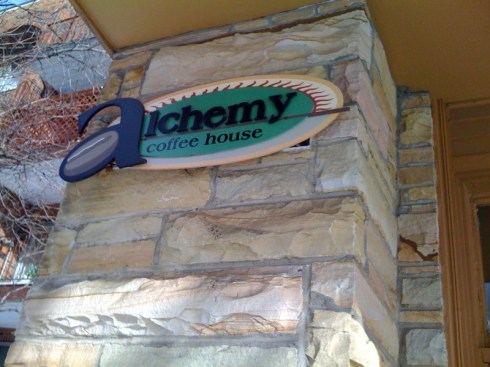
Alchemy coffee in Wilmette is in a strange location for a coffee shop. Its in a standalone little shack in an area which does not attract a lot of foot traffic and is not along many natural commuting routes. Its the kind of place you would drive by and never know there’s a coffee shop there except that you never even drive by there.
The place is owned and run by exactly one guy and he sells exactly two things, the main thing being coffee. His tiny shop has only one table and a small bar. There isnt much room for any more than that because most of the space is taken up by this gleaming machine which sits right in the middle of the shop.
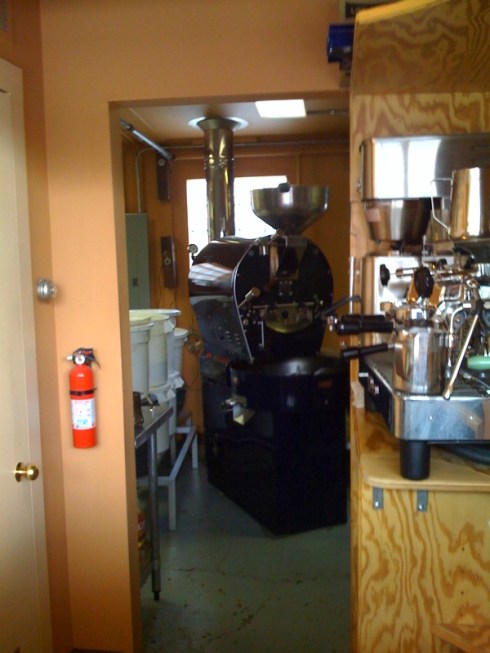
Its a coffee roaster. All of his coffee is roasted right there in that machine and you can usually buy coffee that has been roasted less than 24 hours ago. If you love coffee, you know that coffee loses aroma and flavor very quickly after roasting and so this kind of freshness is a big deal. He puts a few pounds in bags on the counter but if you tell him what you want it for (espresso, drip coffee, french press) and a little about your tastes, he will disappear behind the machine for moment and come back with a blend put together on the spot.
Business is not brisk. I’ve been in there about three times and I have seen him sell a few lattes, but not much more than that. But each time I have gone there for beans I told him in abstract terms what I wanted and he came pretty close to assembling the perfect blend. The other thing he sells: scones. And he is about as obsessed with his scones as he is with his coffee.
The guy is old school: cash only and here’s the sound system.
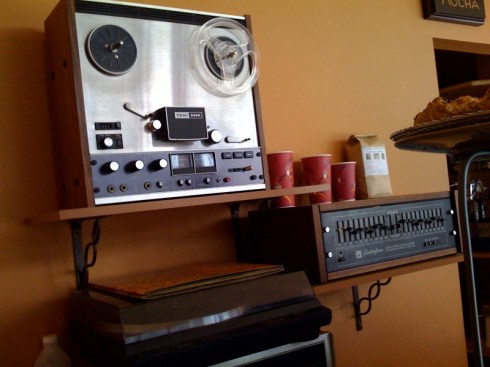
Keepin it reel in Wilmette.
Back home:
The vintage is supposed to be good but not great. It comes on the heels of the super-strong 2005 and the dramatic run-up of prices that was sustained through the solid 2006 and 2007 vintages. Now it appears that the market for 2008 futures will not clear at these prices and the adjustment is not happening. But there are no “menu costs” here. One possible explanation is given here.
David Sokolin, a fine wine dealer in Bridgehampton, New York, notes another potential pitfall. “If the producers cut prices sufficiently for the 2008 en primeur to move their product, they could undermine the prices of the 2007 vintage,” he said. That would hurt merchants and investors holding the back vintage, because their stocks of those wines would lose value. All of the first-growth, or highest ranked, producers — Château Lafite Rothschild, Château Margaux, Château Latour, Château Haut-Brion and Château Mouton-Rothschild — declined interview requests, citing the press of business before the start of the tastings.
Sounds like 2008 Premier Cru is a toxic asset.
A debate is going on between Lawrence Lessig and Congressman John Conyers about a bill that Conyers is sponsoring. The bill would repeal an existing rule for NIH funding that requires funded research to be published in Open Acess journals. In addition it would generally prevent federal agencies from imposing these restrictions in the future. A good place to start is here and here are Lessig and Conyers. (hat tip: sandeep.)
There is some debate about the legal issues but to me those issues appear to be a red herring clouding the main dispute. There is probably one point of agreement: for-profit journals will be hurt. The disagreement is whether or not this is a good thing.
Requiring open-access publication obviously fulfills the aim of getting the maximum social benefit from dissemination of publicly-funded research. The marginal cost of distribution is zero, so the efficient price is zero. But the bill’s proponents argue that a dissemination is only one of the services provided by journals. Far more important is the evaluation and editing of submitted articles by the peer-review process. They worry that a zero price means that open-access journals have insufficient incentive to invest in this process. The result is that it becomes harder for outsiders to distinguish good, credible research from bad, sloppy research.
I have two points to add to this. First, as an editor of an Open Access journal and a member of editorial boards for many commercial journals I can testify that the publisher’s revenues are not being used effectively (or in most cases, at all) in providing incentives for editors and reviewers to do a good job. To the extent that the peer-review system works, it works because reviewers have external incentives like reputation, prestige, and plain old scientific integrity. And these incentives work at least as well in the Open Access world. (In fact, they seem to work even better since reviewers feel better about their work when it is serving the public interest and not the profits of publishers.)
Second, even if you disagree with the above it remains an empirical question which market structure would best provide material incentives for peer-review. Open Access publishing prevents the use of distortionary prices for raising the funds to pay reviewers. The alternative is a model in which authors pay for peer-review with submission fees. Of course this is also distortionary because the social benefit of having a manuscript carefully evaluated may outweigh the author’s willingness to pay.
But let’s remember: we are debating a policy about public funding of research. Basic research is publicly funded precisely because the social benefit of the research outweighs the researcher’s private incentive. Given this, the funding agency maximizes the value of its subsidy by funding not only the research itself but its dissemination. This is achieved by requiring Open Access publishing and earmarking some of the funds to pay for peer-review.
(Not an April Fool’s gag.)
Sandeep and I will make a brief appearance in Mark Bazer’s comedy show The Interview Show at the Hideout in Chicago on Friday April 3 at 6:30. I just glanced at the sketch and it appears that because this is a comedy show I will be wearing a tie, whereas in my day job as an economist I usually opt for shorts, T-shirt, and flipflops. I may have to borrow one from Sandeep who teaches in the Business School.
Because we hate them both, it is instinctual to hate the idea of a merger. And indeed it is being looked at by the Justice Department. There is a clear economic benefit of this merger: eliminating double-marginalization. A monopoly causes an inefficiency because it sets price over marginal cost, resulting in too little output. Live Nation is a monopoly but it sells its product through an intermediary, Ticketmaster, which is itself a monopoly. That means that the “price” charged to Ticketmaster becomes Ticketmaster’s marginal cost, and Ticketmaster will fix an additional Monopoly markup over that. This second source of inefficiency would be eliminated if Ticketmaster and Live Nation were to merge.
(This is somewhat over-simplified because they most likely use a more complicated contract than a price, but unless they use a very clever kind of contract, there will still be elements of double-marginalization. And this very clever contract effectively creates a merger anyway.)
So when you read this post from Trent Reznor you should downplay his worries that the merger will result in an increase in ticket prices. The auctions he imagines are already happening. Nevertheless his other points are very interesting and worth a read.
And I would not worry that this vertical merger will shut out competition for ticket distribution. First of all, Ticketmaster was doing fine at that already, and second, the only reason we cared about the Ticketmaster monopoly was the double marginalization.
The only argument I can see against the merger is that it throws up an barrier to competition with Live Nation for concert promotion. You could certainly draw some graphs and show that this is a concern theoretically, but I don’t believe that the merger would be held up for this.
Genetic evolution is a clumsy way to adapt to a changing environment. Our genes were presumably shaped by very different conditions than we face now. Why wouldn’t natural selection favor organisms who can adapt to current conditions and pass on these adaptations to their children? Wouldn’t we be more fit if Lamarck was right and if so, why was he so wrong?
Turns out he wasn’t so wrong after all.
This was the first evidence, now confirmed multiple times, that an experience of the mother (what she eats) can reach into the DNA in her eggs and alter the genes her pups inherit. “There can be a molecular memory of the parent’s experience, in this case diet,” says Emma Whitelaw of Queensland Institute of Medical Research, who did the first of these mouse studies. “It fits with Lamarck because it’s the inheritance of a trait the parent acquired. There is even some evidence that the diet of a pregnant mouse can affect not only her offspring’s coat color, but that of later generations.”
That is from an article in Newsweek on epigenetics. Here is more. And here is a blog about epigenetics.
This raises the theoretical question: if you were to design the system of inheritance, where would it be optimal to draw the line between those characteristics that should be hard-wired in genes and those that can adapt at higher frequencies? And wouldn’t that depend on the environment? So would the line be hard-wired or epigenetic? And which side of the line is that trait on?
Ever notice how when you are in a crowded resataurant, say, and there is a general rumble of conversation and you are enjoying your lunch and not paying attention to any of it and then suddenly a word or phrase jumps out? It is usually a phrase that you have some special familiarity with like maybe the name of somebody you know or a subject you have some connection to. As soon as you hear it, it grabs your attention and yanks you out of your daydream.
It is as if in the background your brain all along has been monitoring everything going on around you and filtering all of the noise until it notices something relevant it wakes up and tunes in. That’s very interesting because it means that there is so much information that you are processing without ever being conscious of it. That’s a lot of untapped processing power going on in everyone’s head at all times. (This is saying more than the usual observation that our senses take in a lot of information that we do not process. Because in order for your brain to do this, it has to actually interpret the words that it is taking in and connect it to stored memories. So this is real thinking and learning that is happening without us paying attention.)
But here’s the really interesting thing. Your brain is taking you ever-so-slightly back in time. When this happens (pay close attention the next time it happens to you) you do not have the sense that ‘oh while i was busy studying my salad someobody just said “Garrison Keillor” .’ Instead you hear the phrase in real time. It is as if your brain knew in advance that something interesting was about to be said and woke you up just in time to hear it. But of course that is an illusion.
A recurrent topic on Al Roth’s excellent blog Market Design. The latest news is that legislation has passed in Singapore which may open the door to monetary compensation for organ donors. (I say “may” because the reports are somewhat murky. See the article for details.)
Whether or not the new laws truly legitimize organ sales, markets have a way of organizing themselves around and in-between the cracks of legislation. I wonder if the following transaction would be considered taboo. I need a kidney, you have a spare. By law, I cannot pay you for the kidney and you would not give it to me without compensation. So instead I buy five minutes of primetime network TV air, say in the middle of American Idol, to broadcast my documentary about you telling the world what a heroic human being you are, how you saved my life and where to send you donations.
I could imagine that the amount of donations exceed the cost of airtime.
Update: Al Roth has a new post clarifying the Singapore legislation.
What’s your favorite crisis euphemism?
In trying to rebrand dodgy financial instruments, treasury secretaries like Paulson and Timothy Geithner are continuing a recent tradition. So much of the finance sector’s innovation in the past 30 years, it turns out, wasn’t developing new stuff, but rather developing new ways of talking about pre-existing stuff. In the 1980s, labeling risky debt offerings as junk bonds was an intentionally ironic feint (pros knew that the instruments possessed real value). But as junk bonds went mainstream in the 1990s, they evolved into “high-yield debt”—their liability became an asset. Frank Partnoy, a reformed derivatives trader who teaches law at the University of San Diego, recalls that at Morgan Stanley in the 1990s, “we were constantly coming up with new acronyms” to describe similar financial instruments. The goal: to present products, some of which had been discredited, in a more favorable light.
I like “distressed assets.” Clearly the poor damsels need to be rescued from those nasty banks. Or is the image rather one of “gently used” furniture?
The article is “Bubblespeak” and it’s at Slate.com. (nod to Language Log.)
You are the household’s representative agent. You watch two programs: the Daily Show (broadcast in standard definition 4×3) and Good Eats (on the Food Network-HD, widescreen.) Exercise: find a utility function for which the following is the optimal shape of your television. (via kottke)

Hint: I think you will have a hard time coming up with one. Below the fold.
(I have taken to titling my posts in the style of an Alinea dish.)
I was reading one recent morning to my 2 year old boy a story from Frog and Toad. In this story, Toad is grumpy about Winter but Frog talks him into coming for a sleigh ride. Once the sleigh gets going really fast, Toad begins to forget all of his complaints and enjoy the ride. Unbeknownst to Toad, Frog is knocked off the back of the sleigh as the sleigh starts to hurtle faster and faster down the hill. Despite the sleigh being without a driver and completely out of control, Toad begins to feel more and more secure and at peace with the Winter.
Of course, something is going to happen to bring it all crashing down on Toad. In fact, what happens is not that the sled crashes into a tree, at least not yet. What happens is a crow flies by and upon hearing Toad describe what a wonderful ride he and Frog are having, points out to Toad that Frog is not behind him anymore. Its only after learning that there is nobody at the wheel does Toad panic and cause the sleigh to crash.
This is a recurrent theme in children’s literature. I think the quintessential expression of it is from the cartoons, especially the roadrunner/coyote cartoons. Here is the image. Coyote is chasing roadrunner through some rugged canyonland along a steep ridge and the chase brings Coyote to a cliff. He is so focussed on finally nabbing the roadrunner that he does not notice that he has run off the cliff. He keeps running. In mid-air. But then at some point he looks down and notices that there is no ground beneath his feet and at that moment that he falls to back to Earth. (At which point he turns to the next page in his ACME catalog and the chase is on again…)
If you run off a cliff you should make sure you are running fast and that the opposing cliff is not too far. It also helps to be like the roadunner: looking down is not in his nature and he always makes it to the other side.
I think of Obama’s first 100 days as running off a cliff. We have a pretty good running start. So far we are not looking down. I hope we get to the other side before somebody does. And please, pay no attention to the crows.
And the same for food critics/wine tasters. Also, wine tasters generally drink in moderation whereas chefs and food critics have been known to carry a little extra weight.
In both cases, the choice of profession has revealed a taste for the respective delicacy. Winemakers love the taste of wine, chefs love the taste of food. And, as demonstrated by wine tasters, you can taste without consuming, and you can partake without consuming to excess. The wine tasters manage to achieve this but the chefs do not.
Evolution has given us taste as an incentive to acquire necessary nutrients. Pleasant taste is our reward for consuming. Presumably, sometimes we might prefer to consume less (maybe more) than what Mother Nature would prefer, so she gives us the sense of taste so that we internalize her preference. But we try to find ways to manipulate her incentive scheme and get this taste without consuming a lot, or even at all, viz. the wine taster.
Mother Nature is perfectly content to allow us to taste but not consume wine if we see fit. But when it comes to food, she insists that she knows better than us and she will not let us get away with just a nibble. As with the taste of wine, the taste of food draws us in, and we expect to have just a taste. But once the food is in front of us, the trap is set and she deploys her most powerful weapon: temptation that cannot be overcome.
An evolutionary explanation of time-inconsistency and a preference for commitment, a’la Samuelson and Swinkels.
Its a tempting hypothesis. And its entertaining to look at the wives of your relatives/close friends and theorize which attribute of their mothers they replicate (likewise for husbands/fathers.) But this seems like a difficult hypothesis to carefully test. Here is one attempt. Assemble a dataset of bi-racial families. We want the race of the father and mother, the sex of the child, and the race of the child’s spouse. To control for the racial proportions in the population, we compare the probability that a bi-racial male with a white mother marries a white wife to the probabiltity that a bi-racial male with a black mother marries a white wife. The hypothesis is that the first is larger than the second.
Now, marriage is a two-sided matching market. This means that we cannot jump to conclusions about the husband’s tastes on the basis of the characteristics of the wife. It could be that this husband would prefer a black wife (other attributes equal) but the best match he could find was with a white wife.
For example, an alternative story which would explain the above statistic is that black spouses are generally preferred but having a white father makes you a more attractive match and so bi-racial children with white fathers are more likely to match with their preferred race. (Any theory would have to explain why there was a difference in the ultimate match between those with white fathers and those with black fathers.) But the data would enable us to potentially rule this out. If this alternative story were true then bi-racial daughters with white fathers would also be more likely to marry black husbands than those with black fathers. That is, girls marrying their mothers rather than their fathers, the opposite of what the original hypothesis would predict.
So if the data showed that boys marry their mothers and girls marry their fathers, we could rule out this particular alternative story. Of course there will always be some identification problem somewhere, and here the following story would be observationally equivalent: having a white father makes you a more attractive mate, women like white men, men like black women. (Allowing men and women to have different racial preferences adds the extra degree of freedom to explain the [hypothetical] data.)
I have disturbing condition that needs a bill of rights and a support group, at the very least it needs medical terminology. You know those “motion activated” faucets and towel dispensers that are now ubiquitous in public facilities? They don’t work for me. Well, at least 30% of the time they act as if I do not exist. I wave my hands in front of the fixture and nothing happens. I show it my palms, my wrists, my fingernails. I clap, jump up and down, step out of and then jump back into its line of sight and nothing happens.
Sometimes showing the right body part does the trick, other times a shoe or my phone has to be pressed into service. It gets really embarrassing when I am standing there dripping and I have to ask a total stranger to repeatedly trigger the air-drying device on my behalf. This is not an option at the hand-washing stage when all of the faucets are activated by infrared sensor.
The engineers who designed these devices must be aware from pre-market testing that there is a small segment of the population that is deficient in motion-activating-aura. You would think that they would equip the devices with some fallback analog instrumentation, but no, we the unreflective, the hypo-present, the less-than-solid, we are subjected to the tyranny of digital sanitation and the mockery of little infrared panels that stare back at us like HAL9000 saying “I wouldn’t do that if I were you Dave” as we sneak back into the stall to dry our hands with toilet paper.
The worst part of being a member of the infra-undead is that its a condition that seems to ebb and flow. And that is a disaster when you are sitting on a toilet that is flushed by motion-activation. If you think about it for a moment you will understand what I mean.
This post from Mark Thoma is useful in spelling out some of the accounting behind the Geithner plan and its old incarnation due to Paulson and co. But we cannot asssess the policy unless we come to grips with the Treasury’s motives for intervening in the first place. When we do the picture changes a lot and it becomes clear that this amounts to a blanket insurance policy for the banks.
Suppose that a bank has a stockpile of toxic assets, and suppose that this bank is solvent only if those assets value at least $X. When TALF comes to negotiate the purchase of these assets, we know that the bank will not accept anything less than $X for them. Accepting less than $X turns a concern which is potentially solvent (under rosy assumptions about a recovery in the market for the assets) into one which is certainly insolvent. The balance sheet woud now be transparent and the bank will be shut down.
So TALF either results in no sale, or a sale above $X. A sale at $X or higher ensures that the bank is solvent and therefore amounts to guarantee of the bank’s liabilities.
I am not expert enough to know whether guaranteeing the bank’s liabilities is a good idea (I suspect it is not the best), but I can say this. If free insurance is what the Treasury wants out of TALF, then TALF is a bad way to do it. A simpler and far better way is to simply declare that the bank’s liabilities are backed by the government. It amounts to the same thing if TALF were to work properly. But there are many ways TALF could go wrong.
For example, there is no assurance that under TALF the bank will actually use the $X cash from the sale to stay in business. No doubt Geithner will make sure that an AIG-style transfer to executives and shareholders will not happen but there are too many other possibilities to guard against in law. By contrast, a real insurance guarantee means that the money does not change hands until the creditors come calling and then it goes directly to the creditors without the bank ever touching it.
A second problem with TALF is that the government typically does not know the exact value of $X. To be sure that it actually covers $X, it would have to accept the high probability that it overpays. With a real insurance policy there is no need to guess at X because it will be revealed when the bank defaults.
BTW, I made a related, but somewhat different point about TALF’s predecessor here (pretty technical.)
Banks who bought CDS protection from AIG could, and did, hedge against failure of AIG by buying CDS protection against AIG default. So where’s the problem?
The problem facing the banks had AIG failed has less to do with their $ exposure to AIG and more with their position exposure to AIG. For example, let’s say I buy $100mm of protection from AIG and then I buy protection on AIG to hedge against the case of AIG’s bankruptcy. Let’s say AIG does in fact go bust. In the ideal scenario the collateral plus the AIG hedges offset exactly my CDS MTM exposure against AIG, then the banks don’t actually lose money. However, the problem is that they are now long risk $100mm of protection (because their $100mm short risk position against AIG is now gone). What happens then is the market realizes that a dozen banks have massive long risk positions in much of the same trades that they will all now try to hedge at the same time. Spreads blow up and the banks lose.
There is much more in this interesting article.
I remember once thinking what an amazing stroke of luck it was that on the Earth there happen to be so many wonderful gifts for people to enjoy. For example, it seemed close to definitive proof of a benevolent God that tangerines were just hanging there from trees for us to pick and eat. Somebody had to understand us very well and care about us a lot to give us this delicacy for free.
Of course this is a fallacy. It was not the fruit that was designed for our taste buds but the other way around.
We need to be incentivized to consume whatever we need to survive. And there is no need to bring any Designer into the story because this can be taken care of by natural selection.
These points are nicely recounted in this TED lecture by Dan Dennett. However, he stops short of considering the plot twist in which we develop conscious thought and learn how to manipulate nature’s incentive scheme. It starts with nutra-sweet, vasectomies and pornography. That’s when the real game begins.
Most of us are “irrationally” afraid of snakes…but few of us are afraid of mushrooms. Since both can be potentially fatal and both can be good eating, this is puzzling.


 Most of us are “irrationally” afraid of snakes…but few of us are afraid of mushrooms. Since both can be potentially fatal and both can be good eating, this is puzzling.
That’s from “Information, Evolution and Utility,” a paper by Jeroen Swinkels and Larry Samuelson about why natural selection shaped our preferences the way it did. In their story, Nature accepts that there are things that we can learn that she hasn’t had time to program into us (like which mushrooms are safe to eat.) So instead of giving us a complete set of instructions for how to behave in every situation, she gave us beliefs and the instinct to experiment and learn. Then she lets us choose.
But there are somethings she knows better than us . For example that snakes will likely kill us. So, forseeing that these beliefs she has given us can, and often do, go astray, she builds in backup measures to stop us from acting on them in contexts where she is confident that she knows best. Hence irrational fears.
I think there is wide open arbitrage opportunity in behavioral economics to import ideas from principal-agent theory to explain why Nature (the principal) has given us (the agent) certain preferences (incentives.)
In my inbox this morning:
REF/PAYMENTS CODE:06654
This is to inform you that we have verified your payment,Nigerian 419 scam practiotioners where Arested,your name has been shortlisted and approved for this payment as one of the 419 scam victims,get back to me immedately
Yours faithfully,
Dr.John Odey
– MINISTRY OF INFORMATION
I have been enjoying reading the blog of Seth Godin. In a recent post he wrote the following.
It’s quite possible that the era of the professional reviewer is over. No longer can a single individual (except maybe Oprah) make a movie, a restaurant or a book into a hit or a dud.
Not only can an influential blogger sell thousands of books, she can spread an idea that reaches others, influencing not just the reader, but the people who read that person’s blog or tweets. And so it spreads.
The post goes in another direction after that, but I started thinking about this conventional view that the web reduces concentration in the market for professional opinions. No doubt blogs, discussion boards, web 2.0 make it easier for people with opinions to express them and people looking for opinions to find those that suit their taste.
But does this necessarily decrease concentration? If everybody had similar tastes in movies, say, the effect of lowering barriers to entry would be to allow the market to coordinate on the one guy in the world who can best judge movies according to that standard and articulate his opinion. Of course people have different tastes and the conventional view is based on the idea that the web allows segmentation according to taste. But what if talent in evaluating movies means the ability to judge how people with different tastes would react to different movies? A review would be a contingent recommendation like “if you like this kind of movie, this is for you. if you like that kind of movie, then stay away from this one but you might like that one instead.”
In fact, a third effect of the web is to make it easy for experts to find out what different tastes there are out there and how they react to movies. This tends to increase centralization because it creates a natural monopoly in cataloging tastes and matching tastes to recommendations. Indeed, Netflix’s marketing strategy is based on this idea and I am lead to hold out Netflix as a counterexample to the conventional view.
Scrabble point revaluation in the works?
“Za,” “qi” and “zzz” were added recently to the game’s official word list for its original English-language edition. Because Z’s and Q’s each have the game’s highest point value of 10, those monosyllabic words can rack up big scores for relatively little effort. So now that those high-scoring letters are more versatile, some Scrabble aficionados would like to see the rules changed — which would be the only change since Alfred Butts popularized the game in 1948.
Let’s kill two birds with one stone. Eliminate the role of chance in scrabble by having players buy their letters rather than draw them at random. Whenever a player needs to replenish his tiles, a tile is turned over and put up for auction. Players bid for the tile with points. A player who already has seven tiles who wins the auction selects one of his tiles to replace and puts that tile up for auction. This continues until all players have seven tiles.
This removes chance from the game and also eliminates the need to revalue the tiles because that will be taken care of endogenously by competitive bidding.
Update: Free Exchange at http://www.economist.com makes fun of me.
This post suggests that data on suicide seasonality debunks the myth of “winter blues.” Most studies show that suicide rates peak in the Spring suggesting that Spring is a more depressing season than Winter. But to make this inference we need a model of the optimal timing of suicide.
Suppose that your emotional well-being is a stochastic process which is mixed with a seasonal trend. If Winter makes everyone unhappy, then this transient shock confounds the movements in the underlying stochastic process. You are not able to uncover the realization of your emotional random walk until after Winter is over and the seasonal component has washed away.
So you are really depressed in the winter but you are willing to wait it out to find out how you feel in the Spring. If Spring arrives and you are still depressed, you know you are riding a permanent shock. Thus, the spike in suicides in the Spring actually proves that Winter is indeed the most depressing season.
NPR had a story this morning about the rise of loan sharking in Italy as a fallout from the credit crisis. The question to ask is why is the credit crunch affecting banks but not loan sharks? Credit is credit so why does the credit crisis make lending cheaper for loan sharks than for banks? Put differently, if loan sharks have an advantage over banks why didn’t they have the same advantage before the crisis?
A simple story is based on a fundamental problem with the way credit markets operate. The market for credit is like any other market with supply and demand and a price. The price is the interest rate. The problem with the credit market is that the price often cannot serve its usual market-clearing purpose. When the supply of credit goes down, the interest rate should rise to clear the market. Clearing the market means reducing demand to bring it back in line with the low supply. The problem is that high interest rates reduce demand by disproportinately driving away borrowers who are good credit risks and leaving a pool of borrowers who are now more risky on average. This makes lending even more costly, reducing supply, driving the price up again…
The effect is that there may be no way to clear the market by raising interest rates. Instead credit must be rationed. This is part of the story of the credit crisis. By itself it doesn’t explain the rise of loan sharks yet because loan sharks face the same problem.
One way to improve rationing is to increase collateral requirements. But borrowers who are already excessively leveraged (the other part of the credit crisis story) will not have additional collateral to compete for the rationed loans. Here is where the loan shark comes in. Loan sharks use a form of collateral that banks do not have access to: kneecaps. Highly leveraged borrowers who are rationed out of the credit market cannot post collateral to service their debt so they turn to loan sharks.
Tyler Cowen asks why do people lose originality as they gain influence? There are two observationally equivalent ways to explain it.
- Since nobody really knows anything more than anybody else, opinion-rendering boils down to a game where everybody makes a random guess. The outcome of this game is that one person says something unconventional that turns out to be right. (by pure luck.) He gets noticed for that. Influence is the reward for being noticed. (We don’t have to assume that the public is unaware that he is just as ignorant as everyone else. The public is just trying to coordinate on whom to listen to. Winning the random-guessing game makes him a focal point.) Having influence is nice and in order not to jeopardize that he goes on saying the same thing as before which turned out to be right and is now conventional wisdom.
- Since nobody really knows anything more than anybody else, opinion-rendering boils down to a game where everybody makes a random guess. And people go on making random guesses over and over. People whose guesses are right get noticed and get influence, the more unconventional the guess the more you get noticed. Its very rare that something really unconventional is correct, so the people who repeatedly make unconventional guesses eventually lose influence. It follows that those that survive this game for a long time are those whose random guesses were unconventional once and conventional the remainder of the time. We forget about all of the others.
Tyler asked for case studies. But given the nature of the question what he really wants is a theory that generates a forecast that we can test against future data. So as you guessed from the title, my case study is Noriel Roubini. In 10 years he will either continue to be a regular talking head who no longer says anything unconventional (theory 1) or he will continue to make unconventional guesses and will have lost influence and be forgotten (theory 2).
The relevant part seems to be:
Wiley-Blackwell will support our authors by posting the accepted version of articles by NIH grant-holders to PubMed Central upon acceptance by the journal. The accepted version is the version that incorporates all amendments made during peer review, but prior to the publisher’s copy-editing and typesetting. This accepted version will be made publicly available 12 months after publication. The NIH mandate applies to all articles based on research that has been wholly or partially funded by the NIH and that are accepted for publication on or after April 7, 2008.
So it seems that NIH-funded articles will appear in an Open-Access outlet, but 12 months after publication. I don’t know all of the details of the NIH rules, but this does seem a step in the right direction.
From CNN:
They’ve sung his praises on social networking pages, calling him a “hero,” “the greatest man of our time,” “a legend.” They’ve said he deserves to be knighted and should be decorated with medals. They’ve cried out for his amnesty and have even proposed serving time for him.
The article is about the man who threw his pair of shoes at the former President of the United States. He was sentenced this week to three years in prison. The quote raises the question of whether we should allow a third party to serve jail time on behalf of (and instead of) the convicted criminal.
In the economic theory of criminal justice, a punishment is designed to make potential “criminals” internalize the costs imposed on society by their crime. The principle is that we can never know in advance whether any act should be allowed. There are always circumstances in which the private benefit exceeds the social cost and so we design the punishment so that the act will be committed if and only if that is the case.
For example, driving too fast raises the chance of an accident and the driver internalizes only half of the consequences of an accident. So traffic fines are set in order to cover the gap. (The fine equals the cost of the damage times the increased probability of an accident due to speed. This explains why the fine is small and why it is increasing in speed.) We understand that sometimes it is socially optimal to allow the driver to speed. For example, his wife may be about to give birth all over his nice upholstry. So we allow him to speed for a price. If the price is set correctly, he will choose to do so only when it is socially optimal.
As it turns out there are occasions in history when it is socially optimal to throw a shoe at the leader of the free world. A pair of shoes in fact. Since this is not always the case, there is a punishment for it which ensures that it will be done only when it is socially optimal. But here’s the problem. Let’s suppose that those who benefit from seeing a shoe nearly leave its heel print on the cheek of the departing Decider are prevented from ever getting within range. Then it is socially optimal to enforce a contract which appoints a representative who will be in range to do the throwing and to have a third party enjoy the video and then pay the penalty.
In fact, when the benefit of seeing said video is shared by millions around the world, but the benefit to each is not enough to outweigh the cost of the penalty, then it is optimal to allow each of us to volunteer to serve a small jail sentence in return for watching the shoe fly.
All part of bringing Western democracy and justice to the Middle East.
Al Roth, Utku Unver and Tayfun Sonmez are economists who study matching markets: mechanisms for linking buyers and sellers. They have for the last few years been involved in a remarkable project which utilizes the ideas from matching markets to improve the way kidney donors are matched with patients who need kidney transplants. Traditionally there have been only a few ways in which these transplants were made possible:
- a patient’s family member with matching tissue characteristics donates a kidney.
- a patient receives a kidney from an altruistic donor with matching tissue characteristics.
- two patients who have family members willing to donate but whose tissue characteristics match only the other patient have four simultaneous operations to transplant the kidneys from patient A’s family member to patient B and from patient B’s family member to patient A.
1. is unlikely because there are a surprisingly high number of characteristics that have to match. 2. happens but there is a very long queue of kidney patients waiting for donors and many patients die before reaching the top of the queue and finding a matching donor. (On top of that, waiting around on artifiicial kidney dialysis = suffering.) The possibility of 3 improves the chances of a succesful transplant for many.
What these authors did was to point out the tremendous increase in the potential number of successful transplants that would arise if longer chains of transplantation were allowed and suggested mechanisms for matching patients along long chains where a donor gives to a patient who has a family member whose tissue matches with another patient who has a family member whose tissue matches… eventually returning to a family member of the original donor. Even better, if the original donor is an altruist, one fewer constraint has to be satisfied.
Well, today it was announced that the longest donor chain in history was just succesfully carried out: 10 patients long. Here is a link to the announcement on Al Roth’s blog.
The NY Times reports on some preliminary results from one of Roland Fryer’s field experiments in which students are rewarded with cash for high AP test scores.
Results from the first year of the A.P. program in New York showed that test scores were flat but that more students were taking the tests, said Edward Rodriguez, the program’s executive director.
Fabio Rojas at Orgtheory.net, interprets this as saying that the incentive didn’t work.
The question is simple: does paying kids improve performance? As I mentioned yesterday, the preliminary evidence is that children are more likely to participate in the test, but they are not more likely to get better grades.
I think he has jumped to his conclusion. If more students take the test, then we are drawing in the marginal students whose baseline test scores would be lower than average and would bring therefore bring the average down. Since the average did not go down that means that performance by infra-marginal students (and probably even the marginal students) improved.
The blog Lone Gunman is one year old, and here is my selection of his best pointers from the past year.
- Lies told to a three-year-old. (Mine: roads are paved to flatten out a spherical Earth.)
- Planned Parenthood.
- Days with my Father.
 Cheap Talk