
You are currently browsing jeff’s articles.

- Most family home videos are boring. You film your kid doing something, like tying his shoes for the first time. It seems really exciting the first time, but years later you’ve seen your kid do that every day for years. The video is boring but it’s entertaining to notice things in the background like “hey remember when our yard looked like that before the landscaping?” So the best home videos are of things that are boring now because you currently do them all the time. Someday you will no longer be doing them and the video will bring back memories.
- “Jack of all trades, master of none.” The causality actually goes in the opposite direction than the phrase is usually intended to mean. (Take it from me.)
- Can someone explain to me why I want a ceiling fan to cool my room? The hot air is near the ceiling. I would rather it stay there. Storn, are you reading this?
- Like any other measurement, the “hawkeye” electronic line judge in tennis has confidence intervals. When the human judge calls it in, and the hawkeye’s point estimate is one millimeter out, why does the hawkeye trump?
- For any album there is a finite number N of listenings before it grows on you. All album reviews should begin by stating the smaller of the following two numbers: N or the number of times the reviewer listened to the album (before giving up.)
- Nature gives men a powerful urge for sex with a lexicographic preference for quantity of mates over quality. But when it comes to our sons having sex the preference completely reverses. But both are means to the same end: passing on genes. Puzzle.
If Twitter bans the sale of usernames then they take away any incentive to squat. But is the commitment credible?
While Twitter tries to work out how to make money, a Spaniard has sold his username on the site for a six-figure sum.
In 2007 Israel Meléndez set up a Twitter account under his first name. This year he was approached by the state of Israel, which wanted to buy @Israel from him for a quantity of dollars that, he told Spain’s Público newspaper, included “five zeroes”.
The sale went through despite Twitter’s stated policy of preventing username squatting and Meléndez, who runs adult websites for a living, said Twitter itself had advised the Israeli government on how this could be done.
“All the business of getting in contact with Twitter was done by them [Israel],” Meléndez said. “I never saw any emails [between them] and Twitter never contacted me, but if the @Israel account is open and working I imagine it means that Twitter had no problem with the transaction.”
Cell phone use increases the risk of traffic accidents right? But how do we prove that? By showing that a large fraction of accidents involve people talking on cell phones? Not enough. A huge fraction of accidents involve people wearing shoes too.
I thought about this for a while and short of a careful randomized experiment it seems hard to get a handle on this using field data. I poked around a bit and I didn’t find much that looked very convincing. To give you an example of the standards of research on this topic, one study I found actually contains the following line:
Results Driver’s use of a mobile phone up to 10 minutes before a crash was associated with a fourfold increased likelihood of crashing (odds ratio 4.1, 95% confidence interval 2.2 to 7.7, P < 0.001).
(Think about that for a second.)
Here’s something we could try. Compare the time trend of accident rates for the overall population of drivers with the same trend restricted to deaf drivers. We would want a time period that begins before the widespread use of mobile phones and continues until today. Presumably the deaf do not talk on cell phones. So if cell phone use contributed to an increase in traffic risk we would see that in the general population but not among the deaf.
On the other hand, the deaf can use text messaging. Since there was a period of time when cell phones were in widespread use but text messaging was not, then this gives us an additional test. If text messaging causes accidents, then this is a bump we should see in both samples.
Anyone know if the data are available? I am serious.
Each brain-damaged person got a wad of play money, and instructions to gamble on 20 rounds of coin tossing (heads-you-win/tails-you-lose, with some added twists). Other people who had no such brain lesions got the same money and the same gambling instructions.
The brain-damaged gamblers pretty consistently ended up with more money than their healthier-brained competitors. The researchers speculate that when “normal” gamblers encounter a run of unhappy coin-toss results, they get discouraged and become cautious – perhaps too cautious. Not so the people with brain-lesion-induced emotional disfunction. Encountering a run of bad luck, they plough on, undaunted. And then enjoy a relatively handsome payoff. At least sometimes.
This article from Not Exactly Rocket Science discusses an experiment studying “competition” between the left and right sides of the brain. Subjects in the experiment had to pick up an object placed at different points on a table and what was observed was which hand they used depending on where the object was. The article makes this observation in passing.
they always used the nearest hand to pick up targets at the far edges of the table, but they used either hand for those near the middle. Their reaction times were slower when they had to choose which hand to use, and particularly if the target was near the centre of the table.
This much is expected, but it supports the idea that the brain is choosing between possible movements associated with each hand. At the centre of the table, when the choice is least clear, it takes longer to come down on one hand or the other.
I stopped there. Because while this sounds intuitive, there is another intuition that points squarely in the opposite direction. When the object is in the center of the table, that’s when it matters least which hand you use, so there is no reason to spend extra time thinking about it. Right? So…when you have competing intuitions you need a model.
You have to take an action, say “left” or “right” and your payoff depends on the state of the world, some number between -1 and 1. You prefer “right” when the state is positive and “left” when the state is negative and the farther away from zero is the state, the stronger is that preference. When the state is exactly zero you are indifferent.
You don’t know the state with perfect precision. Instead, you initially receive a noisy signal about the state and you have to decide whether to take action right away (and which action) or wait and get a more accurate signal. It’s costly to wait. For what values of the initial signal do you wait? Note that in this model, both of the competing intuitions are present. If your initial signal is close to zero, it is likely that the true state is close to zero so your loss from choosing the wrong action is small. Thus the gain from waiting for better information is small. On the other hand, if your initial signal is far from zero, then the new information is unlikely to affect which action you take so again the gain from waiting is small.
But now we can compute the relative gain. And the in-passing intuition quoted above is the winner.
Consider two possible values of the initial signal, both positive but one close to zero and one close to +1. In either case if you don’t wait you will take action “right.” Now consider the gain from waiting. Take any state x and let’s consider the scenario where waiting would lead you to believe that the state is x. If x is positive then you would still choose “right” and waiting would not gain anything. So fix any negative x and ask what would the gain be if waiting led you to believe that the state is x. The key observation is that for any fixed x, this gain would be the same regardless of which of the initial signals you had.
So the comparison then just boils down to comparing how likely it is to switch to x from the two different initial signals. And this comparison depends on how far to the left x is. Signals very close to -1 are much easier to reach from an initial signal close to zero than from an initial signal close to 1. And these are the signals where the gain is large. On the other hand, for x’s just to the left of zero (where the gain is small), the relative likelihood of reaching x from the two initial signals is closer to 50-50.
Formally, unless the distribution generating these signals is very strange, the distribution of payoff gains after an initial signal close to zero first-order stochastically dominates the distribution of payoff gains when you start close to 1. So you are always more inclined to wait when your initial signal is close to zero.
- Submitted with no implied approval and simply as an exquisite example of a rhetorical takedown by someone apparently deeply scarred by whoknowswhat. (This doesn’t mean that all other sordid links lacking this disclaimer are submitted with implied approval. Thank you for the cake, now I will eat it too.)
- Mobius comic strip
- Reading Playboy to the blind.
- Soap operas and unknown soldiers.
- Pine-nut mouth. Clues from Denmark.
- “We shared a cab, you hit me in the face.”
And why you should too.
There is a painful non-convexity in academic research. Only really good ideas are worth pursuing but it takes a lot of investment to find out whether any given idea is going to be really good. Usually you spend a lot of time doing some preliminary thinking just to prove to yourself that this idea is not good enough to turn into a full-fledged paper. Knowing that most ideas are unlikely to pan out there is an incentive not to experiment on new projects.
Blogging bridges that gap in a way I didn’t expect when I started. Blogging means that half-baked ideas have scrap value: if they are not publishable you can at least write about them on the blog. This means that you are more likely to recoup some of those costs of experimentation and you undertake more projects ex ante.
So, readers, don’t thank me for blogging (not that I thought you had any good reason too.) I thank you for wading through the scraps.
The never-enigmatic Presh Talwalker analyzes the strategic bobbling occasionally effected by the heads of Indians.
I have personally witnessed this maneuver in two contexts which fall outside of the categories Presh identifies in his post.
- Indian students asking me a question and getting an answer. The ensuing head-bobble has always suggested to me something like “of course. obvious. so obvious in fact that the thundering stroke of clarity is making my head roll around.” I have also noticed that on these occasions the bobble is contagious. The Indian student sitting next to the questioner bobbles sympathetically.
- Indian classical music. The tabla player, say, will bobble just after a rapid-fire phrase. There might even be a sound emitted. It’s something like “Chella.” The whole display says something like “Behold, the rhythm is so frenetic that it is rebounding back through my arms and neck and dissapating through the top of my head. Chella.”
Obama has an interesting strategic decision to make about how to engage the Tea Party. If there is one power that the President has, even when he has lost momentum policy-wise, it is to control attention. How should he use this power in relation to the Tea Party?
Right now the Tea Party has few leaders, and none with any real power. Obama can essentially anoint a leader by picking him/her out of the crowd and engaging directly. For example, by personally responding in a press conference to some attack and addressing the Tea Partier by name. As the Tea Party tries to internally organize, a well-targeted salvo could throw a wrench in the works. On the other hand, it could backfire and provide them with a much-needed lightning rod.
He could frame the upcoming election as “sane, albeit perhaps incompetent Democrats” versus “nutty Tea Partiers.” By doing so he would raise the stakes for the Tea Party higher than they might want to make them. In its infancy, the Tea Party may not be ready for an up-or-out test.
Obama could be wisely waiting until after this election to make any move like this. It may even be that he and the Tea Party have a mutual interest in keeping their profile low for now. Because making this election out to be a test of the Tea Party’s fitness can only really have consequences in the event they fail to make a good showing. In that case, the Tea Party disappears and Obama loses a potentially valuable third-party threat in 2012.
Instead, if they tacitly agree to view the Tea Party as too young to be a big contender this November, they both keep their hopes alive in the event of defeat. Which of course means that the mainstream Republicans should have exactly the opposite incentive.
Now I am trying to figure out how this fits in with the story.
For the sake of argument let’s take on the plain utilitarian case for waterboarding: in return for the suffering inflicted upon a single terror suspect we may get information that can save many more people from far greater suffering. At first glance, authorizing waterboarding simply scales up the terms of that tradeoff. The suspect suffers more and therefore he will be inclined to give more information and sooner.
But these higher stakes are not appropriate for every suspect. After all, the utilitarian cost of torture comes in large part from the possibility that this suspect may in fact have no useful information to give, he may even be innocent. When presented with a suspect whose value as an informant is uncertain, these costs are too high to use the waterboard. Something milder is preferred instead like sleep deprivation.
So the utilitarian case for authorizing waterboarding rests on the presumption that it will be held in reserve for those high-value suspects where the trade-off is favorable.
But if we look a little closer we see it’s not that simple. Torture relies on promises and not just threats. A suspect is willing to give information only if he believes that it will end or at least limit the suffering. When we authorize waterboarding, we undermine that promise because our sleep-deprived terror suspect knows that as soon as he confesses, thereby proving that he is in fact an informed terrorist, he changes the utilitarian tradeoff. Now he is exactly the kind of suspect that waterboarding is intendend for. He’s not going to confess because he knows that would make his suffering increase, not decrease.
This is an instance of what is known in the theory of dynamic mechanism design as the ratchet effect.
Taken to its logical conclusion this strategic twist means that the waterboard, once authorized, can’t ever just sit on the shelf waiting to be used on the big fish. It has to be used on every suspect. Because the only way to convince a suspect that resisting will lead to more suffering than the waterboarding he is sure to get once he concedes is to waterboard him from the very beginning.
The formal analysis is in Sandeep’s and my paper, here.
Two guys named David Pendelbury and Eugene Garfield use citation counts (combined with some other magic) to predict Nobel laureates. They claim success: they have“correctly predicted at least one Nobel Laureate each year with the exception of the years 1993 and 1996.” Granted, since they are picking 5 or so people in four fields (Chemistry, Economics, Physics, Medicine) that doesn’t seem like such a big deal.
But for the record, here are the predictions for Economics.
- Alberto Alesina for theoretical and empirical studies on the relationship between politics and macroeconomics, and specifically for research on politico-economic cycle.
- Nobu Kiyotaki for formulation of the Kiyotaki-Moore model, which describes how small shocks to an economy may lead to a cycle of lower output resulting from a decline in collateral values that creates a restrictive credit environment.
- John Moore for formulation of the Kiyotaki-Moore model, which describes how small shocks to an economy may lead to a cycle of lower output resulting from a decline in collateral values that creates a restrictive credit environment.
- Kevin Murphy for pioneering empirical research in social economics, including wage inequality and labor demand, unemployment, addiction, and the economic return of investment in medical research, among other topics
David K. Levine has written a white paper for the NSF proposing that they invest in large-scale simulated economies as virtual laboratories:
An alternative method of validating theories is through the use of entirely artificial economies. To give an example, imagine a virtual world – something like Second Life, say – populated by virtual robots designed to mimic human behavior. A good theory ought to be able to predict outcomes in such a virtual world. Moreover, such an environment would offer enormous advantages: complete control – for example, over risk aversion and social preferences; independence from well-meant but irrelevant human subjects “protections”; and great speed in creating economies and validating theories. If we were to look at the physical sciences, we would see the large computer models used in testing nuclear weapons as a possible analogy. In the economic setting the great advantage of such artificial economies is the ability to deal with heterogeneity, with small frictions, and with expectations that are backward looking rather than determined in equilibrium. These are difficult or impractical to combine in existing calibrations or Monte Carlo simulations.

A guy sometimes says stuff that, for reasons completely mysterious to him, hurts a girl’s feelings. It comes out that she’s hurt and he desperately tries to explain. He didn’t mean it. He didn’t think she would interpret it that way. He was just talking. She’s taking it too personally.
He forgets to call, he misses important dates, he get stalled by unexpected commitments. She listens to all of his excuses.
He’s trying to convince her that he had the right intentions. You see, he thinks that relationships are all about moral hazard. He wants her to know that he’s trying hard, but mistakes get made.
And he can never figure out why this isn’t enough for her. But the reason is simple. For her, relationships are all about adverse selection. It’s not his actions per se, it’s what they reveal about his type. She’s perfectly willing to forgive his missteps, she believes him that he’s trying hard and that he didn’t know he was being a louse, but that’s precisely the problem. If he weren’t such a lemon he would know the right way to say things, she’d always be in his thoughts, and she’d always be his highest priority.

This morning I was on my own for breakfast so I looked around and saw heirloom tomatoes from the garden, a jar of artichoke hearts with a few left after last night’s chickpea salad, and chive oil which I made last week as a lobster marinade and have put to good use in various applications since.
So I made an omelette. (I am a devotee of the Alton Brown omelette method.) And then I ate it.
The season finale of Bachelor Pad featured a surprise twist. The share of the prize money would be decided by a “keep” or “share” Prisoners’ Dilemma-style game. $250,000 was at stake and the last standing couple, Dave and Natalie, could split the money if they both chose Share. If one of them chose “Keep” then he/she would take all the money for him/her-self. If they both chose “Keep” the $250,000 would be shared among all the contestants who were previously eliminated from the show.
What makes this game different from the Golden Balls game is that the decision to Share doubles as a signal to be a faithful partner in their post-show everlasting love.
The clip below is a bit long, but the highlight comes in the middle when the loser bachelor(ettes) give their game theoretic analyses while Dave and Natalie go into separate rooms to prove theorems.
Thanks to Charles Murry for the pointer.

What would you believe in the face of the unbelievable? For example, how would you react if you discover suddenly that you can fly. Before today flying was impossible, but now you can do it. Something you were convinced of is wrong and you have to decide whether it’s that you can’t fly or that you are not prone to hallucinations.
In fact you already know how you would react, because it happens in your dreams. Have you ever dreamed you could fly? If so, did you infer that you must be dreaming? Some do, and then wake up. (Poor them.) Others just go on flying.
Are you irrational to believe you can fly?
Maybe you aren’t fooled by flying dreams or maybe you’ve never dreamed of flying. But crazy things happen in everybody’s dreams. What is the craziest thing that happened in your dreams that you nevertheless accepted as the way the world must work since after all it’s happening right before your eyes?
Tomatoes are about the only attribute these two have in common, so the choice comes down to personal preference. Heinz is spicier, with distinct Worcestershire notes. Market Pantry has mostly tomato flavor, which comes through precisely because it’s not as spicy. The flavor differences are apparent straight from the bottle or with fries.
With that conclusion, summarized briskly in workmanlike prose by journalists you’ve never heard of, Gladwell’s Grand Unifying Theory of Ketchup–which he was allowed to present in painstaking detail (and 5,000 words) in the nation’s most prestigious magazine–simply turns to air.
The background is in the Globe article.
Jean Tirole has written the best theoretical analysis I have seen of the role of government intervention to revitalize frozen asset markets. The key idea in this paper is that investors need to finance their next project and are unable to do this by selling their “legacy” assets because adverse selection has frozen the market.
A government buyback of these toxic assets attracts the bottom tail. The government of course is losing money on all of the assets it buys. But the payoff is that it rejuvinates the market: private financiers will now step in and buy the assets of those who refused the government offer. It’s a surprising result but ex post its pretty easy to understand.
If the government is offering a price 


All that was required was that the government price
The paper then goes on to study the optimal intervention when the market is not restricted to simple buybacks. The optimal scheme is a mix of buybacks and partial transfers of legacy assets that keep “skin in the game” to reduce the downstream adverse selection problem. The government is trying to minimize the cost of the intervention by spurring as much activity as possible from the private finance market.
This paper is worth studying.
This optical illusion appears on a street in West Vancouver. It is an experiment to see whether the image of a girl crossing the street will get drivers to slow down.

The pushback has been from groups who worry that drivers might react by braking or swerving and cause an accident. But that’s the short-run problem. Isn’t the bigger worry what happens in the long run when drivers no longer react when they see a child crossing the street?
- Stark County, Ohio.
- I lost the game.
- Auto-tune your voicemails.
- Classically conditioning your roomie.
- Sartre’s facebook Wall.
- First ever commercial for a marijuana dispensary. (The real humor here is that you are first forced to watch an ad for “Spiriva” which is medicine for who-knows-what. This is targeted advertising.)
The demographic changes that have swept the county reflect what is happening across the state and much of the nation. It has happened slowly but surely over the course of a generation, becoming increasingly apparent not only in a drive through the 34 cities that fill this sprawling 789-square-mile county south of Los Angeles, but also, most recently, in the results of a presidential election. In 2008,Barack Obama drew 48 percent of the vote here against Senator John McCain of Arizona. (By comparison, in 1980,Jimmy Carter received just 23 percent against Ronald Reagan, the conservative hero whose election as California governor in 1966 and 1970 was boosted in no small part by the affection for him here.)
The article focuses on changes in ethnic composition but my sense is that a lot has to do with generational differences as well. During its rapid growth the people who lived there were the people who chose to move there, plus their kids. Their kids didn’t make that choice and so they are more of a random sample. Plus they naturally rebelled against the conservative culture that their parents created.
I thank Matt DeBeer for the pointer.

- They are presumably sitting on a mountain of internal research on the science of herding people efficiently. My favorite example was how they seat people for Captain EO. One entire side of the theater opens up and people are naturally guided in lines that form parallel to the rows and eventually feed into them. The whole process takes about 1 minute to seat about 500 people. The host asks those in the front of the lines to go 2/3 of the way down. They know that a request to go all the way to the edge would be ignored so they offer a compromise which is mostly honored.
- There is now a system called “fastpass” which allows you to reserve a time 1-2 hours later when you are able to bypass nearly all of the line. The efficiency doesn’t come from allowing people to take more rides. The easy way to see that is to note that each ride runs a fixed number of times in a day and if every ride has a line all day then the total number of rides taken is that fixed number. Rather the efficiency comes from allowing patrons to spend less time in line (and more time in the gift shops.)
- The cars in Autopia must have been grandfathered by the California legislature because they still burn fossil fuels and would not pass California emissions standards.
- They are the residual claimant for just about anything that goes wrong for their patrons. Not surprisingly we have never been to a restaurant anywhere near as knowledgeable and accommodating for my son’s food allergies.
- The debate about whether commercial developers provide the socially optimal level of public parking could be informed by comparing the number of restrooms per square foot on Main Street in Disneyland, to say Broadway.
- Some rides have lines that fork and you have to commit to one branch without full knowledge of the relative wait times. Pick the side with the most shade. Not just because shade is good, but also because people cluster in the shady sopts reducing the total density and making the wait time shorter per fixed line length.
- I got RSI from the Buzz Lightyear “ride.”
The commenting dynamic is very different on small blogs than it is on popular blogs. On small blogs, people typically comment when they have something to contribute or ask that is relevant to the post. These are frequently of high quality (relatively speaking; recall Sturgeon’s Law: 90 percent of everything is crap). On more popular blogs, this positive commenting dynamic is confounded by the presence of eyeballs. Every post is read by many thousands of people. For the self-involved who could never attract such a large audience on their own, this is an irresistible forum for expounding pet hypotheses, axe-grinding, and generally shouting at or expressing meaningless agreement with the celebrity post-authors.
which sounds plausible but it assumes a sorting condition that is debatable. Presumably everyone, the high-quality and low-quality commenters alike, want a bigger audience. The question is one of relative elasticities: does a percentage increase in audience lead to a larger percentage increase in low-quality comments relative to high-quality? I am not sure.
There is a perception cloud because most of us think that our own comments are the highest-quality ones and so the overall pool of comments appears distorted downward in quality. But there is one force for Gresham’s law that may swamp any having to do with commenters’ motives. There are simply more ways to be wrong, off-topic, and crazy than there are to be right, on-topic, and smart. So even if the sample scales proportionally with audience size, the space of good quality comments will be exhausted quickly leaving the long tail for the riffraff.
Bottom line: the way to maximize the proportion of good-quality comments is for the bloggers themselves to use up all the crazy ideas at the start. I like to think Sandeep and I are getting better and better at this.
For 15 years, the British bookmaker William Hill allowed bettors to wager on their own weight loss, often taking out full-page newspaper ads to publicize the bet. This was a clear opportunity for those looking to lose weight to make a commitment, with real teeth. Here is a paper by Nicholas Burger and John Lynham which analyzes the data.
Descriptive statistics are presented in Table 2, which shows that 80% of bettors lose their bets. Odds for the bets range from 5:1 to 50:1 and potential payoffs average $2332.9 The average daily weight loss that a bettor must achieve to win their bet is 0.39 lbs. In terms of reducing caloric intake to lose weight, this is equivalent to reducing daily consumption by two Starbucks hot chocolates. The first insight we draw from this market is that although bettors are aware of their need for commitment mechanisms, those in our sample are not particularly skilled at selecting the right mechanisms.10 Bettors go to great lengths to construct elaborate constraints on their behaviour, which are usually unsuccessful.
Women do much worse than men. Bets in which the winnings were committed to charity outperformed the average. Bets with a longer duration (Lose 2x pounds in 2T days rather than x pounds in T days) have longer odds, suggesting that the market understands time inconsistency.
Beanie barrage: barker.
Recruit homeless people to run as candidates in an opposing party. Steve May, Republican party operative in Arizona is recruiting three way-way-outside-the-beltway candidates to run for the Green party in a local election, expecting that Green candidates will siphon votes from Democratic candidates.
“Did I recruit candidates? Yes,” said Mr. May, who is himself a candidate for the State Legislature, on the Republican ticket. “Are they fake candidates? No way.”
To make his point, Mr. May went by Starbucks, the gathering spot of the Mill Rats, as the frequenters of Mill Avenue are known.
“Are you fake, Benjamin?” he yelled out to Mr. Pearcy, who cried out “No,” with an expletive attached.
“Are you fake, Thomas?” Mr. May shouted in the direction of Thomas Meadows, 27, a tarot card reader with less than a dollar to his name who is running for state treasurer. He similarly disagreed.
“Are you fake, Grandpa?” he said to Anthony Goshorn, 53, a candidate for the State Senate whose bushy white beard and paternal manner have earned him that nickname on the streets. “I’m real,” he replied.

Whether it is desirable to have your kid fall asleep in the car goes through cycles as they age. It’s lovely to have your infant fall asleep in the snap-out car carriers. Just move inside and the nap continues undisturbed. By the time they are toddlers and you are trying to keep a schedule, the car nap only messes things up. Eventually though, getting them to fall asleep in the car is a free lunch: sleep they wouldn’t otherwise get, a moment of peace you wouldn’t otherwise get. Best of all at the end of a long day if you can carry them into bed you skip out on the usual nighttime madness.
Our kids are all at that age and so its a regular family joke in the car ride home that the first to fall asleep gets a prize. It sometimes even works. But I learned something on our vacation last month we went on a couple of longer then usual car trips. Someone will fall asleep first, and once that happens the contest is over. The other two have no incentives. Also, in the first-to-fall game, each child has an incentive to keep the others awake. Not good for the parents. (And this second problem persists even if you try to remedy the first by adding runner-up prizes.)
So the new game in town is last-to-sleep gets a prize. You would think that this keeps them up too long but it actually has some nice properties. Optimal play in this game has each child pretending to sleep, thereby tricking the others into thinking they can fall asleep and be the last. So there’s lots of quiet even before they fall asleep. And there’s no better way to get a tired kid to fall asleep than to have him sit still, as if sleeping, in a quiet car.
Is the United States the world’s dominant exporter of culture? If this were true of any area you would think that area would be pop music. But it appears not to be the case.
In this paper we provide stylized facts about the global music consumption and trade since 1960, using a unique data on popular music charts from 22 countries, corresponding to over 98% of the global music market. We find that trade volumes are higher between countries that are geographically closer and between those that share a language. Contrary to growing fears about large- country dominance, trade shares are roughly proportional to country GDP shares; and relative to GDP, the US music share is substantially below the shares of other smaller countries. We find a substantial bias toward domestic music which has, perhaps surprisingly, increased sharply in the past decade. We find no evidence that new communications channels – such as the growth of country-specific MTV channels and Internet penetration – reduce the consumption of domestic music. National policies aimed at preventing the death of local culture, such as radio airplay quotas, may explain part of the increasing consumption of local music.
Here is the paper by Ferreira and Waldfogel. And before you click on this link, guess which country is the largest exporter as a fraction of GDP.

If you receive email from ‘me’ and every instance of the word “me” is single-quoted, as in ‘me,’ don’t bother looking for any hidden message.
Rather it is a strange bug in my iPhone text-substitution mechanism which replaces every instance of me with ‘me.’ I could probably figure out how to fix this, but I might not. Sometimes feel like I am encased in single quotes so it seems appropriate.
We planned to have a quick bite at the cafe before spending the afternoon at the California Academy of Sciences, an aquarium/science museum in Golden Gate Park. But when we walked in we knew right away that we would be spending at least as much time in the cafe as in the museum.
Freshly prepared fast food from many cuisines. It’s San Francisco on a plastic tray. We had tofu and cauliflower curry with brown rice, an hierloom tomato salad, barbecued ribs, carnitas tacos, Pho, steamed pork buns, and blackberry agua fresca. This fed 7 of us and cost about 70 bucks. With more time we could have doubled that.
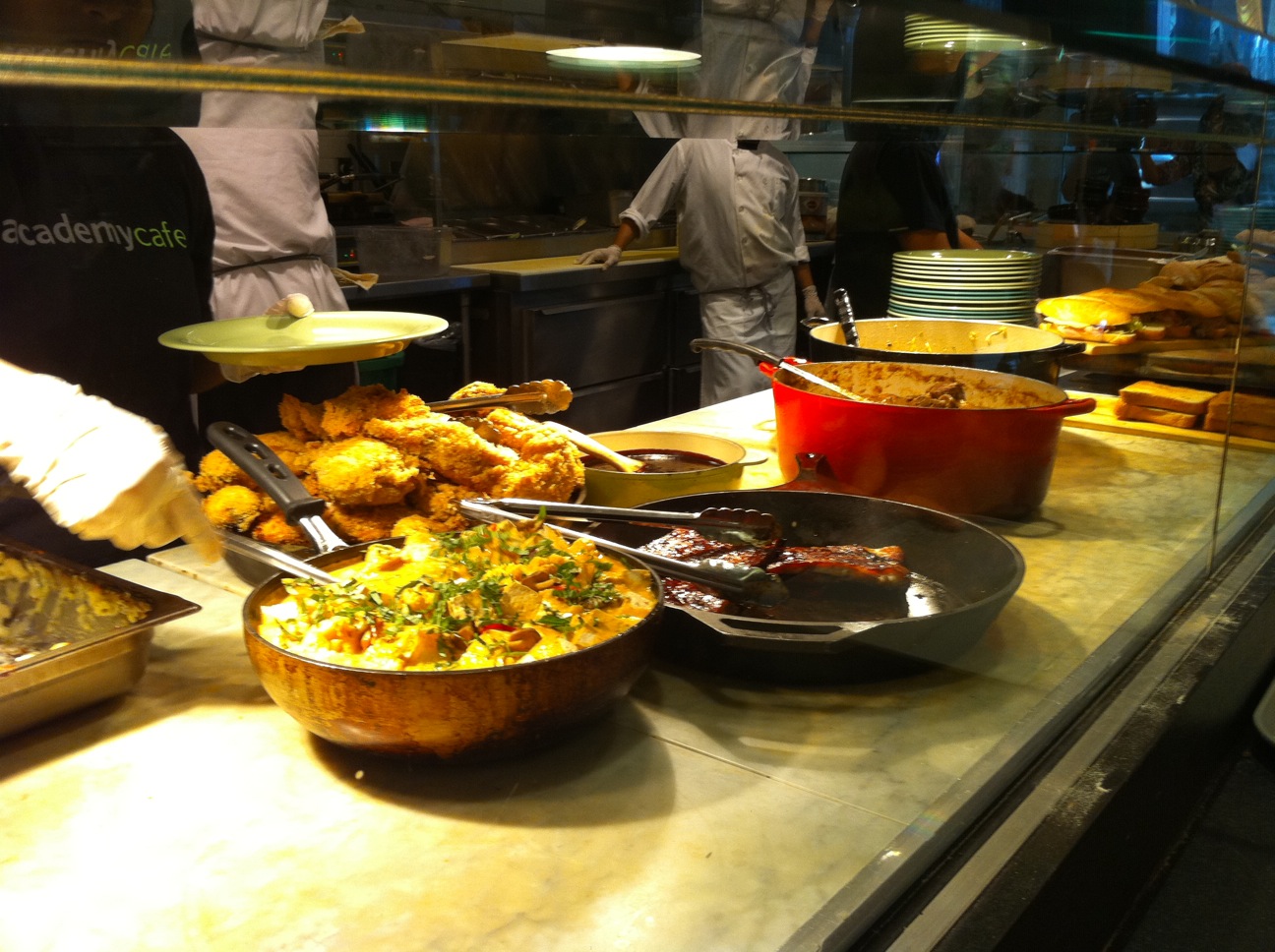
The stalls are organized by cooking style rather than cuisine. “Steamed,” “Slow-Cooked,” etc. Many of the stalls have cooks stationed behind who will prepare the food on the spot. Here’s the guy making the tomato salad:
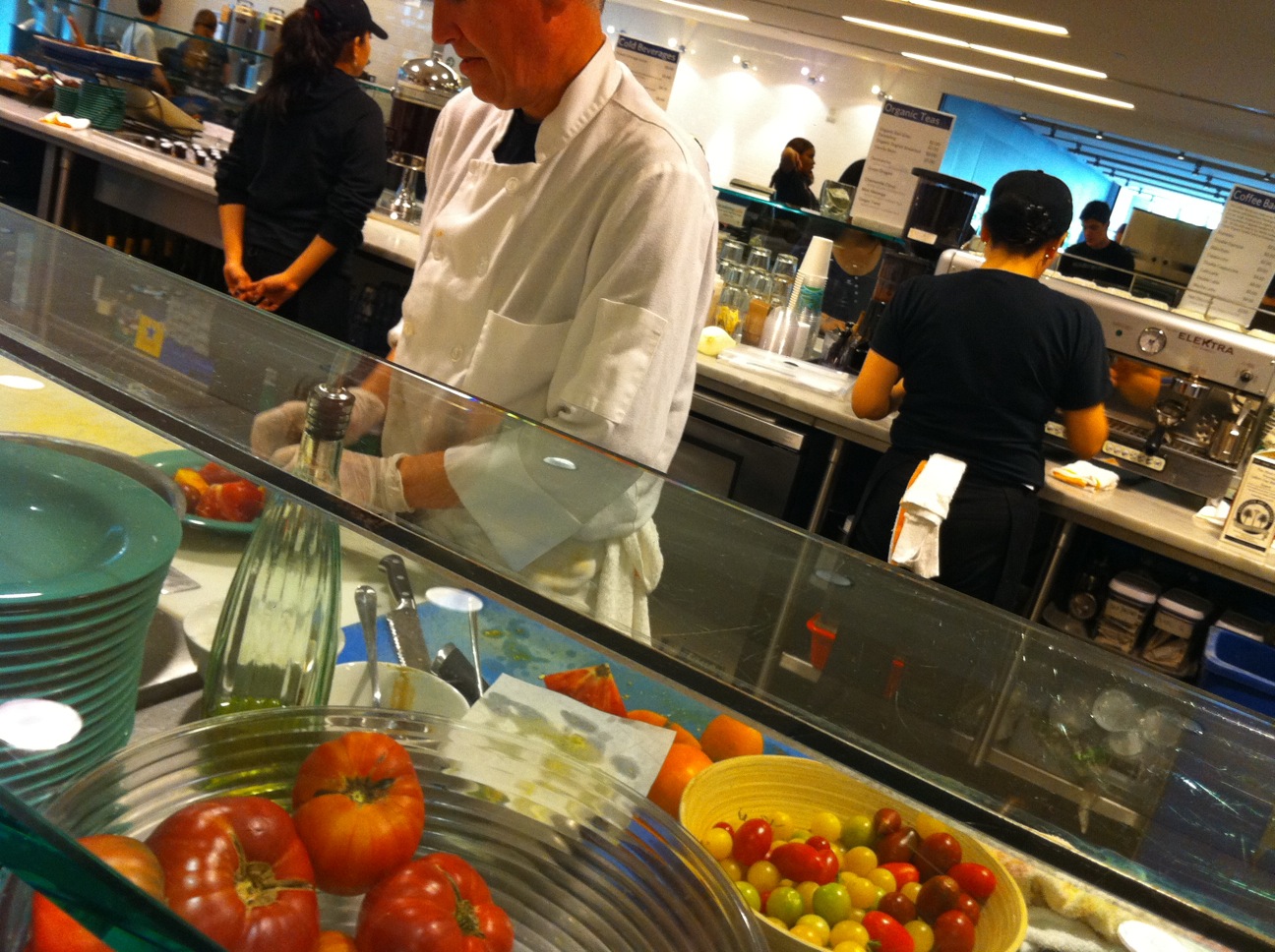
Be careful to skip the first cafe you see from the entrance to the building. It’s inviting because it has terrace seating but your resistance is rewarded. There is a sit-down restaurant downstairs which will be our dinner destination the next time we come (without kids.)

The museum? Brilliant. It has a rain forest. The aquarium dominates Chicago’s Shedd despite being only 1/8 of the size. We spent 3 hours there and didn’t even make it to the planetarium. Next time.

 Cheap Talk