You are currently browsing jeff’s articles.
- Neologism of the moment: gate rape.
- When did you decide to be straight?
- Transcription errors in the Yale Anthology of Rap.
- Parkour for lazies.
- Nativity on Google StreetView.
- This just in: special bonus sordid link, courtesy of kottke.org. Painful flashback inducement machine.
Today Qatar was the surprise winner in the bid to host the FIFA World Cup in 2022, beating Japan, The United States, Australia, and Korea. It’s an interesting procedure by which the host is decided consisting of multiple rounds of elimination voting. 22 judges cast ballots in a first round. If no bidder wins a majority of votes then the country with the fewest votes is eliminated and a second round of voting commences. Voting continues in this way for as many rounds as it takes to produce a majority winner. (It’s not clear to me what happens if there is a tie in the final round.)
Every voting system has its own weaknesses, but this one is especially problematic giving strong incentives for strategic voting. Think about how you would vote in an early round when it is unlikely that a majority will be secured. Then, if it matters at all, your vote determines who will be eliminated, not who will win. If you are confident that your preferred site will survive the first round, then you should not vote truthfully. Instead you should to keep bids alive that will easier to beat in later rounds.
Can we look at the voting data and identify strategic voting? As a simple test we could look at revealed preference violations. For example, if Japan survives round one and a voter switches his vote from Japan to another bidder in round two, then we know that he is voting against his preference in either round one or two.
But that bundles together two distinct types of strategic voting, one more benign than the other. For if Japan garners only a few votes in the first round but survives, then a true Japan supporter might strategically abandon Japan as a viable candidate and start voting, honestly, for her second choice. Indeed, that is what seems to have happened after round one. Here are the data.
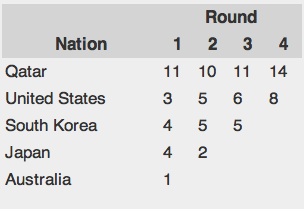
We have only vote totals so we can spot strategic voting only if the switches result in a net loss of votes for a surviving candidate. This happened to Japan but probably for the reasons given above.
The more suspicious switch is the loss of one vote for the round one leader Qatar. One possibility is that a Qatar supporter , seeing Qatar’s survival to round three secured, cast a strategic vote in round two to choose among the other survivors. But the more likely scenario in my opinion is a strategic vote for Qatar in round one by a voter who, upon learning from the round 1 votes that Qatar was in fact a contender, switched back to voting honestly.
Groovy Action At A Distance
Isaac Washington was so cool
That when he left his stateroom
He would set the door in motion
With the precise velocity
That in the time it would take
For the deceleration
To bring the locking mechanism
To a halt
An infinitessimal measure short
Of fully shut
He has walked
No, drifted,
Just far enough across the deck
At which distance
The radiant force of his
Cool
Was just enough to induce
The final click.

And sell them in January to take advantage of the January effect: the predictable increase in stock prices from December to January. Many explanations have been, the most prominent being a tax-motivated sell-off in December by investors trying to realize a capital loss before the end of the year. But here is a paper that demonstrates a large and significant january effect in simple laboratory auctions. Two identical auctions were conducted, one in December and one in January and the bidding was significantly higher in January.
In the first experimental test of the January effect, we find an economically large and statistically significant effect in two very different auction environments. Further, the experiments spanned three different calendar years, with one pair of auctions conducted in December 2003 and January 2004 and another pair of auctions conducted in December 2004 and January 2005. Even after controlling for a wide variety of auxiliary effects, we find the same result. The January effect is present in laboratory auctions, and the most plausible explanation is a psychological effect that makes people willing to pay higher prices in January than in December.
Sombrero swipe: Barking Up The Wrong Tree.
Why do we get more conservative (little ‘c’) as we get older? Trying out new things pays off less when there’s less time left to benefit from the upside. That’s a simple story based on declining patience.
But there’s another reason which could kick in at middle age when there is still plenty of life left to live. Think of life as a sequence of gambles presented to you. They come with labels: gamble A, gamble B, …, etc. Every time you get the chance to try gamble A its a draw from the same distribution and you get more information about gamble A.
Suppose your memory is limited. What you can remember is some list of gambles that you currently believe are worth taking. When you have the opportunity to take a gamble that is on the list, you take it. When you are presented with a gamble that is not on the list you have a decision to make. You could try it, and if it looks good you can put it on your list but then you have to drop something else from your list. Or you can pass.
As time goes on, even though you don’t remember everything you once tried and then removed from your list, you know that there must have been a lot of those. And so when you are presented with an option that is truly new, you have no way of knowing that and your best guess is that you have actually tried it before and discarded it. So you pass.
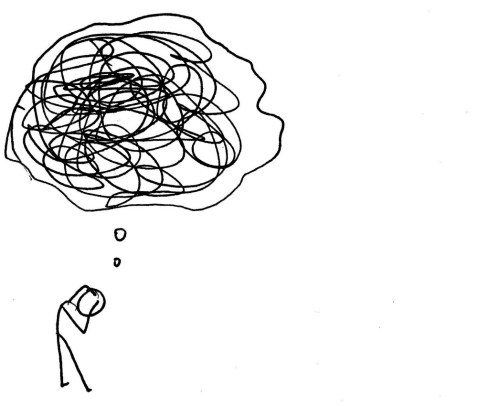
(drawing: Stuck In Your Head from f1me.)
What makes an actor a big box office draw? Is it fame alone or is talent required? Usually that question is confounded: it’s hard to rule out that an actor became famous because he is talented.
The actors playing Harry, Ron, and Hermione in Harry Potter and The Deathly Hallows are most certainly famous, but almost certainly not because they are talented. They were cast in that movie nearly 10 years ago when their average age was 11. No doubt talent played a role in that selection but acting talent at the age of 11 is no predictor of talent at age 20. The fact that they are in Deathly Hallows is statistically independent of how talented they are.
That is, from the point of view of today it is as if they were randomly selected to be famous film stars out of the vast pool of actors who have been training just as hard as they from ages 11 to 20. So they are our natural experiment. If they go on to be successful film stars after the Harry Potter franchise comes to an end then this is statistical evidence that fame itself makes a Hollywood star.
Here’s Daniel Radcliffe on fame.
Responding to the flap about the Pope’s new stance on condom use by male protsitutes, Rev. Joseph Fessio, editor in chief of Ignatius Press which published the book in which the Pope is quoted provides this clarification:
But let me give you a pretty simple example. Let’s suppose we’ve got a bunch of muggers who like to use steel pipes when they mug people. But some muggers say, gosh, you know, we don’t need to hurt them that badly to rob them. Let’s put foam pads on our pipes. Then we’ll just stun them for a while, rob them and go away. So if the pope then said, well, yes, I think that using padded pipes is actually a little step in a moral direction there, that doesn’t mean he’s justifying using padded pipes to mug people. He’s just saying, well, they did something terrible, but while they were doing that, they had a little flicker of conscience there that led them in the right direction. That may grow further, so they stop mugging people completely.
Side topic: is the Catholic Church revealing that sin is a problem of moral hazard or adverse selection?
If your parents are not intellectuals then they don’t spend as much time trying to get you interested in ideas when you are a kid. So you are first exposed to them as an adult when you can appreciate the feeling of discovering ideas on your own. You are probably in college so you associate discovery with independence and counterculture.
If your parents are intellectuals they bore you to death as a kid with their lame ideas. By the time you are an adult and you can potentially appreciate them you are deprived of the chance to discover them for yourself. And anyway it all just reminds you of your parents.
Verifying this is our Thanksgiving Social Science project while surrounded by grandparents and their children and grandchildren. (Of course you can probably substitute “discovery of ideas” with just about anything and the logic is undisturbed. But on top of “Gardening is for losers because my loser Dad was always talking about his lame garden” there’s something extra having to do with the complementarity between the act of discovering the ideas and the ideas themselves.)
But it certainly awaits a behavioral treatment. Why do auctioneers talk like they are calling a thoroughbred race?
They talk like that to hypnotize the bidders. Auctioneers don’t just talk fast—they chant in a rhythmic monotone so as to lull onlookers into a conditioned pattern of call and response, as if they were playing a game of “Simon says.” The speed is also intended to give the buyers a sense of urgency: Bid now or lose out. And it doesn’t hurt the bottom line, either. Auctioneers typically take home from 10 to 20 percent of the sale price. Selling more items in less time means they make more money.
You may have noticed the line drawings I have been putting at the top of some posts recently. These are the work of Stephanie Yee and I found them on her blog f1me. I started noticing them in my Google Woody Buzz and something about them just clicked with me. When I started seeing connections with my blogging topics I had to ask her if I could use them on Cheap Talk and she graciously agreed. I think they are a great addition to the blog so let’s all cheer for Stephanie Yee’s playful artwork.
(Chickles: my word, don’t blame her. It rhymes with tickles, they are way more than doodles, and because she is not a dood.)
Every year my employer schedules two weeks for Open Enrollment in the benefits plan. This is the time period where you can freely change health plans, life insurance, etc. In the weeks before Open Enrollment we receive numerous emails reminding us that it is coming up. During the Open Enrollment period we receive numerous emails reminding us of the deadline. The day of the deadline we receive a final email saying that today is the deadline.
Then, every year after the deadline passes the deadline is extended an additional week, and the many people who procrastinated and missed the first deadline are given a reprieve. This happens so consistently that many people know it is coming and understand that the “real” deadline is the second one. So many that it is reasonable to assume that a sizeable number of these people procrastinate up to the second deadline and miss that one too. But there is never a third deadline.
You notice this kind of thing happening a lot. Artificial deadlines that you can be forgiven for missing but only once. It’s a puzzle because whatever causes the first deadline to be extended should eventually cause the second deadline to be extended once everyone figures out that the second deadline is the real one. For example if the reason for the first deadline extension is that year after year many people miss the first deadline and flood the Benefits office with requests, then you would expect that this will eventually happen with the second deadline.
The deadline-setters must feel on firmer ground denying a second request by saying “We warned you about the first deadline, then we were so nice and gave you an extension and you still missed that one.” But if a huge number of people missed the second deadline, no doubt they could still mount enough pressure for a second extension. Indeed the original speech of “We sent you emails every day warning you about the deadline and you still missed it” didn’t stem that tide.
Is it just that every nth deadline is a new coordination game among all the employees and the equilibrium number of deadline extensions is simply the first one in which the “no extension request” equilibrium is selected? I think there is more structure than that because you rarely see more than just one, and you almost never see zero.
I think there is scope for some original theory here and it could be very interesting. What’s your theory?
We focused our analysis on twelve distinct types of touch that occurred when two or more players were in the midst of celebrating a positive play that helped their team (e.g., making a shot). These celebratory touches included fist bumps, high fives, chest bumps, leaping shoulder bumps, chest punches, head slaps, head grabs, low fives, high tens, full hugs, half hugs, and team huddles. On average, a player touched other teammates (M = 1.80, SD = 2.05) for a little less than two seconds during the game, or about one tenth of a second for every minute played.
That is the highlight from the paper “Tactile Communication, Cooperation, and Performance” which documents the connection between touching and success in the NBA. Controlling (I can’t vouch for how well) for variables like salary, preseason expectations, and early season success, the conclusion is: the more hugs in the first half of the season the more success in the second half.
It has been argued that earmarks can’t have any effect on the level of goverment spending because earmarks only specify how already-budgeted spending will be allocated. Earmarks don’t represent additional funding, they simply dictate how an agency spends its funds.
But this assumes that the ability to earmark spending doesn’t change the incentives to spend in the first place. Here are two arguments why they must.
- Earmarks raise spending. Suppose you are deciding on your grocery budget but your wife is going to do the shopping. Whatever you budget, she is going to spend it to maximize her own utility function which is not the same as yours. Your marginal return for every dollar spent is smaller than if you were doing the spending. Your grocery budget is determined by the condition that the marginal return on groceries is equal to the marginal return on Ahmad Jamal concerts at the Regatta Bar in Cambridge (last week: awesome.) This happens at a lower level of spending when your wife has discretion than when you do. If you could “earmark” the grocery spending you would get exactly what you would buy if it were you doing the shopping. So the earmarks raise spending.
- Earmarks Reduce Spending. Legislation is not decided by a single agent who is maximizing a single utility function. Legislators have to be bribed to get their support. Suppose that a crucial supporter wants a road built in his state. With an earmark this can be achieved directly. Without an earmark, you have to appropriate general infrastructure spending and hope that he gets treated well by the agency. For the same reason as above, the marginal value to your colleague of a dollar allocated to general infrastructure is lower than if the spending were earmarked. So you have to increase the budget in order to achieve the bribe he requires.
Professor Richard Quinn informs his Business Strategy class at the University of Central Florida that “forensic analysis” of the data gives him a good sense of who cheated on the midterm exam. (The link has video of the scolding.) Such a good sense that he can provide the administration with a list that he is “95% certain includes everyone who cheated on the exam.” (Quick: can you come up with such a list, even without seeing the data?) Unfortunately he can’t be as sure of the converse: that everyone on that list was a cheater.
So he is offering a deal to his students. They can individually confess to cheating, attend a 4 hour ethics course and receive amnesty, or they can take the risk that they will not be caught. What would you do?
- Professor Quinn’s speech reveals that the only evidence for cheating is an anonymous tip plus a suspicious grade distribution. Based only on this the only signal that you cheated was that your score was high. But it’s not credible to punish people just for having a high score.
- If Professor Quinn expects his gambit to work and for cheaters to turn themselves in, then he should believe that everyone who doesn’t turn himself in is innocent. So you should not turn yourself in.
- The biggest fear is that someone who you collaborated with turns himself in and he is induced to rat you out. Then as long as you are not sure who knows you were in on the scam you should turn yourself in.
- It’s surprising that this possibility was never mentioned in Professor Quinn’s rant because without it, his threat loses much of its force.
- The fact that he didn’t raise this possibility reveals that he is not so interested in rounding up every last cheater but simply to get a large enough number to confess. That way he can say that a lesson was learned. This suggests that you should confess only if you think that your confession will just push the total number of confessions over that threshold. Unlikely (unless everyone is thinking like you.)
Now you can add coffee stains to your LaTeX documents without wasting coffee:

Your readers will appreciate you saving them the effort. From the package documentation:
This package provides an essential feature to LATEX that has been missing for too long. It adds a coffee stain to your documents. A lot of time can be saved by printing stains directly on the page rather than adding it manually. You can choose from four different stain types:
1. 270◦ circle stain with two tiny splashes
2. 60◦ circle stain
3. two splashes with light colours
4. and a colourful twin splash.
Dunce Cap Doff: Jordi Soler.

Suppose you find out that someone named Rory L. Newbie predicted the financial crisis. Should you conclude that he has some unique expertise in predicting financial crises? Seems obvious right: someone who has no expertise would need tremendous luck to make a correct prediction, so Rory must be an expert.
But you know that millions of people are making predictions all the time, and even if not a single one of them has any expertise, the numbers guarantee that at least one of them is going to get it right, just by sheer luck. So for sure someone like Rory is going to get it right, that doesn’t make it any more likely that he is a true expert.
But this sounds unfair to Rory. Rory made his prediction all on his own and he got it right. All those other people had nothing to do with it. If Rory were the only person on the planet then when he gets it right he is an expert. It seems that just because there are lots of other people on the planet making predictions, Rory is no longer an expert. How could it be that his being an expert is dependent on how many other people there are in the world?
The way to resolve this is to remember that we only came to know about Rory because he made a correct prediction. If Rory hadn’t made a correct prediction but instead Rube did, then we would have been talking about Rube instead of Rory. No matter who it was that made the correct prediction, and for sure there’s somebody out there who did, we would be talking about that person. The name Rory is a trick because in this scenario it is really naming “the person who made a correct prediction.”
But when there’s only Rory, the name refers to that fixed individual. He was very unlikely to make a correct prediction by dumb luck and so we are correct to conclude his prediction was born of expertise.
Fine, but I leave you with one more paradox for you to resolve on your own. Suppose Rory told his prediction to his wife in advance. For Rory’s wife Rory is a fixed person. While there are still many other predictors on the planet, none of them are Rory. They are irrelevant for Rory’s wife deciding whether Rory is an expert. Now Rory’s prediction comes true. Impossible by dumb luck alone so Rory’s wife concludes that he is an expert. But, following our logic from above, nobody else does.
Normally a difference of opinion between two people is logically consistent provided they were led to their opinions by different information. But Rory’s wife and the rest of the world have exactly the same information. This particular guy Rory made a prediction and got it right. There is nothing that Rory’s wife knows that the rest of the world doesn’t know. And Rory’s wife is just as aware as the rest of the world that there is a world full of people making predictions. For Rory’s wife that doesn’t matter. Why should it for the rest of the world?
As I was walking toward my locker at the gym I checked my pocket for the little card with the locker combination written on it. It wasn’t there. In a panic I tried to recall the combination. It was just 30 minutes ago that I had that combination in my head. But I couldn’t remember it. So I searched all of my pockets and finally felt the card in my back pocket. Panic over, I left the card in my pocket and kept walking, my mind quickly wandering to some random topic.
When I reached the locker, without thinking I opened it from memory without looking at the card.
I often have that sense that trying too hard makes it hard to remember something. There is even a physical feeling that comes with it. It’s like the brain seizes up and gets locked into a certain part of memory storage with no way of retracing steps back to neutral and starting the search over. After enough experience with this I sometimes notice the potential for panic before starting to search intensively for a memory that feels like its going to be hard to find. You have to pretend like you don’t really have something to remember. And most of all you have to make sure not to think of the thing that you are trying to remember because you know that if you do, the search will start by itself and get stuck. If you can do a little Zen breathing for a minute and let that feeling pass over, then you can safely start to think about it and recover the memory with ease.
At least that’s how I imagine it would work.

Throw a party. And use a system like evite.com to handle the invitations. There is a typical pattern to the responses over time. You will have an initial flurry of yeses and regrets followed by a long period of silence punctuated by sporadic responses which continues to the days before the party. Then there is a final flurry and that is when you learn if your friends are real friends.
Because people come to your party for one of two reasons. Either they like you or they just feel obligated for reasons like you are an important co-worker or they don’t want to hurt your feelings, etc. Think of how these two types of people will handle your invitation.
An invitation is an option that can be exercised at any time before the date of the party. The people who did not respond immediately are waiting to decide whether to exercise the option. If she’s a true friend then this is because she has a potential conflict that would prevent her attending. She is waiting and hoping to avoid that conflict. When she is sure there is no conflict she will say yes.
The other people are hoping for an excuse not to come. Once they get a better offer, manage to schedule a conflicting business trip, or otherwise commit themselves, they will send their regrets.
In both cases, when the party is imminent, the option value of waiting is gone. Those who want to come but haven’t gotten out of their conflict give up and send their regrets. Those who hoped to get out of it but failed to come up with a believable excuse give up and accept.
So, a simple measure of how much your friends like you is the proportion of acceptances that arrive in the final days. Lots of acceptances means you better set aside a few extra drinks for yourself.
I want to make a prediction. But I want to do it like this:
- Keep the prediction secret, indeed even keeping secret what the prediction is about.
- Have the prediction revealed at some pre-specified future date.
- Have it certified that the prediction was recorded on a certain date and not changed after that.
Is there a web service that facilitates predictions like this? It would be a useful service. There are probably lots of reasons someone would want to keep their predictions secret prior to the resolution: you don’t want your prediction to be self-fulfilling (or self-defeating), you don’t want others to know what you are predicting about (maybe it arises out of some proprietary research), or you want to trade anonymously on your prediction.
If anyone has any ideas, please let me know in the comments below.
Addendum: Mallesh correctly points out in the comments that the system would have to publicize that you made a prediction. This I want to do.
A dozen Cook County judges deemed unqualified by legal organizations won reelection on Nov. 2, a result that left their opponents searching for better ways to educate city voters and strengthen Chicago’s judiciary.Two judges rated “not recommended” in a Judicial Performance Commission pilot project only barely topped the 60 percent of votes necessary to keep their jobs. Their support was stronger in the city than in the Chicago suburbs.

Because communication requires both a talker and a listener and it takes time and energy for the listener to process information. So it may be cheap to talk but it is costly to listen.
But then the cost of listening implies that there is an opportunity cost to everything you say. Because you can only say so much and still be listened to. They won’t drink from a firehose.
When you want to be listened to you have an incentive to ration what you say, and therefore the mere fact that you chose to say something conveys information about how valuable it was to you to have it heard. There is no babbling because babbling isn’t worth it.
I also believe that this is a key friction determining the architecture of social networks. Who talks and who listens to whom? The efficient structure economizes on the cost of listening. It is efficient to have a small number of people who specialize in listening to many sources then selectively “curating” and rebroadcasting specialized content. End-listeners are spared the cost of filtering. The economic question is whether the private and social incentives are aligned for someone who must ration his output in order to attract listeners.

Last Tuesday, everyone’s favorite mad-scientist-laboratory of Democracy, the San Francisco City Council enacted a law banning the Happy Meal. Officially what is banned is the bundling of toys with fast food. The theory seems to be that toys are a cheap substitute for quality food and that a prohibition on bundling will force McDonald’s to compete instead on the quality of its food.
But it’s not easy to lay out a coherent theory of the Happy Meal. You could try a bargaining story. Kids like toys, parents want healthy food but are willing to compromise if the kids put up enough of a fuss. McDonald’s offers that compromise in the form of cheap toys and crappy food, raking in their deadweight loss (!).
You could try a story based on 2nd degree price discrimination. There are parents who care more about healthy food (Chicken Nuggets??) and parents who care less. A standard form of price discrimination has a higher end item for the first group and a low-end item for the second. The low-end item fetches a low price because it is purposefully inferior. But if toys are a perfect substitute for healthy food in the eyes of the health-indifferent parents, then a Happy Meal raises their willingness to pay without attracting the health-conscious (and toy-indifferent) parents.
You could even spin a story that suggests that the SF City Council’s plan may backfire. That’s what Josh Gans came up with in his post at the Harvard Business Review Blog.
For a parent, this market state of affairs spells opportunity. With McDonald’s offering a toy instead of additional bad stuff, the parent can ‘sell’ this option to their children and get them to eat less bad stuff than they would at another chain. The toy is a boon if the parents are more concerned about the bad stuff than having another junky toy in the house … They allow a parent to increase the value of healthier products in the eyes of children and negotiate a better price (perhaps in the form of better food at home) for allowing their children to have them. Happy Meals do have carrots after all.
But all of these stories have the same flaw: McDonald’s can still achieve exactly the same outcome by unbundling the Happy Meal, selling toys a’la carte alongside the Now-Only-Somewhat-Bemused Meals they used to share a cardboard box with. Just as before families will settle their bargains by re-assembling the bundle, health sub-conscious families will buy the low-end burger and pair it with toys, and parents who have to bribe their kids will buy McDonald’s exclusive movie-tie-in toys to get them to eat their carrots.
(Yes I am aware of the Adams-Yellen result that bundling can raise profits, but this has nothing to do with toys and healthy food specifically. Indeed McAfee, McMillan and Whinston show that generically the Adams-Yellen logic implies that some form of bunding is optimal. So this cannot be the relevant story for McDonalds which is otherwise a’la carte.)
So I don’t think that economic theory by itself has a lot to say about the consequences of the Exiled Meal. The one thing we can say is that McDonald’s doesn’t want to be forced to unbundle. Putting constraints like that on a monopolist can sometimes improve consumer welfare and sometimes reduce it. It all depends on whether you think McDonald’s increases its share of the surplus by lowering the total or raising it. The SF City Council, like most of us one way or the other, probably had formed an opinion on that question already.
You manage a colony of slave-maker ants. It’s a small colony (not a knock on you, all slave-maker ant colonies are small) so you have only a handful of scouts to send out on an enslavement mission. Do you target a similarly weak colony (better odds) or the biggest and strongest around (better slaves)? According to this account of a study published in Animal Behavior, you risk it and go for the big prize.
It’s fun to theorize why:
Now, like most animal fables, this one can be spun in any number of ways. (Ants are particularly suitable for, or susceptible to, this.) Are the populous, well-defended colonies doing anything wrong? Do these attacks work because whoever’s running the big, powerful colony doesn’t mind losing a few small members? Is the answer more defenses, or subtler ones? Do you change how you live because of a small band of violent actors? Should the hostages fight back when they’re older? (They sometimes do.)
Homburg Howdyado: The Browser.

Last Friday I earned $17.20 for a day’s work as a standby juror. Standby jurors wait in a big room until they are put in a panel of 14 and sent into a courtroom for selection. In civil trials, 6 jurors will be selected and seated from the 14. I was rejected from two panels and then sent home.
The jury selection process is a little obscure, but I found this. Here’s the model I glean from it. The panel is numbered 1-14. Lawyers for Plaintiff and Defendant each have 3 “peremptory” challenges which enables them to strike a juror from the panel. The Plaintiff moves first and makes any peremptory challenges. This creates a provisional jury consisting of the 6 highest jurors on the list that have not been eliminated yet. The Defendant can either accept this jury or use a challenge to strike one or more from it sending a new proposed jury, again consisting of the 6 highest jurors not yet struck, back to the Plaintiff. This continues until someone accepts or all challenges are exhausted.
The game can be solved by backward induction. I think something like the following is an optimal strategy. First, when given a proposal of 6 jurors, rank them from least favorable to most. To decide whether to strike the least favorable, ask whether her replacement will be stricken by the opposition (and any further replacements) and if so whether the final replacement will be better or worse than the least favorable now. Of course you could always just strike the 3 least favorable in one go, but you are better off moving sequentially in hopes that the other guy makes a mistake and does it for you.
It gets more complicated when you take into account the challenges for “cause.” These are challenges that require justification on the grounds that the juror is biased. The possibility of challenges for cause explains why the panel has 14 rather than just 12. And challenges for cause are evidently used a lot because on my second panel all but 3 jurors were excused.
In practice the jury selection is at least as much signaling as screening. As if we were playing jury-Jeopardy, the lawyers sent messages phrased in the form of a question. The defendant asked us “Does everybody understand that anyone can file a lawsuit if they pay a fee?” The Plaintiff said “Does everyone understand that an insurance company has all the same rights as an individual?” This is a kind of pre-opening statement.
I wonder whether it was the Plaintiff or Defendant that challenged me. What they knew about me is that I am a Professor of Economics, the father of three kids, and that I drove a car over a mailbox when I was 16. (Both of the cases were insurance claims arising out of an auto accident so they wanted to know.)
When I entered the first courtroom the Judge informed us that this case involved an insurance company. I sized up the lawyers for the two sides. I immediately pegged the Plaintiff as a sleazy ambulance chaser and the Defendant as a slick insurance company henchman whose life’s calling is to deprive the injured their just deserts (and instead send them to the Mojave for ice cream sundaes.) The next thing we were told was that this was in fact a case in which the insurance company was suing a client. So much for reading people by their faces.
The judges struck me as smarter than the attorneys. (This based on talking with them, not just the looks on their faces 🙂 )
30% of my fellow standby jurors were unemployed. 60% were divorced or separated.
I have standby jury duty today. Might make for some good blogging.
- The New York Times torture euphemism generator. My contribution: Logs show binding IC, no IR.
- How WSJ stipple drawings are made. (I came this close to having one but I was edited out of a story on latte art.)
- Nature scores a point versus Nurture.
- Price discrimination based on the browser you use.
- How Chatroulette is making money?

- Are people with blue eyes more successful? Many studies of the effects of physical attractiveness have endogeneity problems. But given the randomness of eye color (conditional on parents with recessive genes), siblings make a great control. Someone must have looked at this.
- Procrastination is a best-response to perfectionism. A perfectionist spends too much time on a task, so she should optimally procrastinate so that the deadline disciplines her to work quickly and settle for imperfection.
- When secretly hiding Halloween candy from your kids you face a non-convexity: either hide just a little bit at a time, or go all the way and hide it all. Leaving too little is the worst of both worlds: the stash itself reminds them that they have Halloween candy, then the noticeably small remainder cues them that you are hiding the rest.
- In sports like golf, bowling, and chess players are rated in order to match players of similar skill or handicap the weaker players. Then there are kludgy rules to prevent “sandbagging:” playing poorly in one tournament in order to get an advantage in the next tournament. These systems could surely be improved by formally analyzing the strategy-proof mechanism design problem.
You may have heard that the Michelin guide has been bestowing many stars on Japanese restaurants. So many that Europeans are suspecting ulterior motives.
The generous distribution of stars has prompted a snarky backlash among some Western critics and celebrity chefs, whose collective egos can be larger than acroquembouche. Some have said Michelin is showering stars upon Japan in an attempt to gain favor in a brand-conscious, France-loving country where it wants to sell not only culinary guides, but automobile tires.
Well, the Japanese aren’t so keen either.
Many Japanese chefs, especially in the Kansai region, say they never courted this attention. Even a single Michelin star can be seen as a curse by the Japanese: Their restaurants are for their customers. Why cook for a room full of strangers? Even worse: crass foreigners.
“It is, of course, a great honor to be included in the Michelin guide. But we asked them not to include us,” says Minoru Harada, an affable young Osaka chef. His Sakanadokoro Koetsu, a fish restaurant with a counter and 10 seats, just earned a single star, its first. Loyal customers have sustained the restaurant over the years, he says, adding: “If many new customers come, it is difficult.”
And with the upcoming realease of Michelin’s guide to Tokyo, Japan may soon be the most spangled restaurant nation in the world.
I saw David Myatt present this paper in Oxford this Fall. It made quite a splash with some surprising results about voter turnout rates consistent with “rational choice” theory. Voting theories based on the assumption that voters calculate the costs and benefits have always been thought to imply very low turnout in order to generate sufficiently high probabilities of close elections.
Consider a region with a population of 100,000 where 75% of the inhabitants are eligible to vote. Suppose that a 95% confidence interval for the popularity of the leading candidate stretches from 56% to 61%. If each voter is willing to participate in exchange for a 1-in-2,500 chance of influencing the outcome of the election, then turnout will exceed 50%. Greater turnout for the underdog offsets her disadvantage.
Your vote makes a difference only when it is pivotal. Now don’t worry, I am not bringing this up to sort through the tired old arguments about whether you should go to the polls today. You should! That settled, let’s talk about what it implies for how you should vote once you get there.
Because if your vote only makes a difference when it breaks a tie (or makes a tie), then when it comes time to decide how to vote, you might as well assume your vote will be pivotal. And ask yourself how would you vote if your vote was going to make or break a tie.
Be careful. This is not the same as the question “How would you vote if you were the dictator?” Indeed quite often your vote should not be the vote you would cast if yours was the only vote. That’s because when your vote is pivotal you learn something that a dictator doesn’t. You learn that all of the other voters were (almost) perfectly split and and that implies something very specific about the other voters and what they must know about the candidates (or propositions) on the ballot.
Quite often that information is crucial for determining how you want to vote. Let me give you a simple example. Judges are almost always re-elected. Pretty much the only time a judge is voted off the bench is if that judge is completely incompetent. Now you haven’t bothered to read anything about the judges on your ballot. You know nothing about them individually but you know that most judges are doing just fine and should be re-elected.
If you were the dictator (an uninformed dictator!) you would vote yes for every judge. But things turn completely upside-down in an election when you factor in the information you learn from your vote being pivotal. Since all competent judges are easily re-elected, the only way it could have happened that all the other voters are split is that this judge is not competent! Knowing that, and knowing that your vote will decide whether an incompetent judge is re-elected, you should vote no. Against every judge.
Now, the smart readers of this blog have already thought one step ahead and noticed that this logic is self-defeating. Because if everyone figured this out, then everyone is voting against every judge and then every judge is voted down, not just the incompetent ones. Here’s where the theory takes one of two paths, use your judgement.
First you might not believe that the electorate in general is as sophisticated as you are. The vast majority of voters don’t understand the logic of pivotalness and they are naively voting the way they would if they were dictators. In that case, the argument I have laid out works as written and you should vote against every judge.
On the other hand you might believe that a signifcant fraction of voters do understand the strategic subtleties of voting. Then we have an equilibrium to find. For starters we take as given that the judge himself and all of his friends will vote for him. So he has a head start. Now there’s a small group of do-gooders who have read up on this judge and know whether he is competent. They vote as if they are dictators, with good reason now because they are informed. They vote yes if he is competent and no if he is not.
The rest of us know nothing. Until, that is, we take into account what we can infer from being pivotal. And if it were just the informed and the judge’s friends who were voting then what we can infer is that enough of the informed are voting no to counteract the judge’s head start. That is, the judge is incompetent.
In equilibrium none of us uninformed voters vote yes. Because if any of us are voting yes, then effectively the judge has an even bigger head start and that makes it even worse news that the no votes caught up with the head start. But not all of us vote no. Some of us do, but most of us abstain. Enough of us that it remains a valid inference that a pivotal vote means that enough of the informed voted no to make it optimal for us to vote no.
This is the logic of The Swing Voter’s Curse.
 Cheap Talk