
You are currently browsing jeff’s articles.

You go around saying X. There are some people who agree with X and others who disagree. Those who agree with X don’t blink an eye when you say X. Those who disagree with X tell you X is wrong.
At some point you have to rethink whether you agree with X. You have a bunch of definitive signals against X but the signals in favor of X are hard to count. You have to count the number of times people didn’t say anything about X. You are naturally biased against X.
Eventually you change your mind and go around saying not-X. Repeat.
Here’s a broad class of games that captures a typical form of competition. You and a rival simultaneously choose how much effort to spend and depending on your choices, you earn a score, a continuous variable. The score is increasing in your effort and decreasing in your rival’s effort. Your payoff is increasing in your score and decreasing in your effort. Your rival’s payoff is decreasing in your score and his effort.
In football, this could model an individual play where the score is the number of yards gained. A model like this gives qualitatively different predictions when the payoff is a smooth function of the score versus when there are jumps in the payoff function. For example, suppose that it is 3rd down and 5 yards to go. Then the payoff increases gradually in the number of yards you gain but then jumps up discretely if you can gain at least 5 yards giving you a first down. Your rival’s payoff exhibits a jump down at that point.
If it is 3rd down and 20 then that payoff jump requires a much higher score. This is the easy case to analyze because the jump is too remote to play a significant role in strategy. The solution will be characterized by a local optimality condition. Your effort is chosen to equate the marginal cost of effort to the marginal increase in score, given your rival’s effort. Your rival solves an analogous problem. This yields an equilibrium score strictly less than 20. (A richer, and more realistic model would have randomness in the score.) In this equilibrium it is possible for you to increase your score, even possibly to 20, but the cost of doing so in terms of increased effort is too large to be profitable.
Suppose that in the above equilibrium you gain 4 yards. Then when it is 3rd down and 5 this equilibrium will unravel. The reason is that although the local optimality condition still holds, you now have a profitable global deviation, namely putting in enough effort to gain 5 yards. That deviation was possible before but unprofitable because 5 yards wasn’t worth much more than 4. Now it is.
Of course it will not be an equilibrium for you to gain 5 yards because then your opponent can increase effort and reduce the score below 5 again. If so, then you are wasting the extra effort and you will reduce it back to the old value. But then so will he, etc. Now equilibrium requires mixing.
Finally, suppose it is 3rd down and inches. Then we are back to a case where we don’t need mixing. Because no matter how much effort your opponent uses you cannot be deterred from putting in enough effort to gain those inches.
The pattern of predictions is thus: randomness in your strategy is non-monotonic in the number of yards needed for a first down. With a few yards to go strategy is predictable, with a moderate number of yards to go there is maximal randomness, and then with many yards to go, strategy is predictable again. Variance in the number of yards gained in these cases will exhibit a similar non-monotonicity.
This could be tested using football data, with run vs. pass mix being a proxy for randomness in strategy.
While we are on the subject, here is my Super Bowl tweet.
The MILLTs at Spousonomics are calling on spouses to look for Pareto improvements in our marital transactions. Paula offers this list for her husband on Valentine’s day.
1. Help with garbage night.
2. Join you in the 30-day meditation challenge.
3. Not remind you when you have to make up a work shift at the food coop.
4. Use my Petzl head lamp when I’m reading in bed and you’re already asleep.
5. Work on my tone of voice when I’m frustrated.
6. Pick my battles.
7. Entertain notion that my way isn’t the only way.
8. Try again to make braised pork shoulder.
9. Give Sonny & the Sunsets another chance.
10. Let things go.
I’m as keen on free lunches as the next guy (I’m looking at you Asher), but at the risk of throwing cold water on Paula’s Valentine’s Day overtures, let me bring a little dose of tradeoffs to this home economics lesson. First of all, Paula is shortchanging her generosity on many of these because very few of them are literal Pareto improvements. Garbage night? Who isn’t better off keeping their hands clean, not to mention taking a pass on the sub-freezing walk to the curb. And I am not sure what exactly a Petzl head lamp is but I’d be worried about waking up to the fragrance of molten hair after dozing off with one of those on.
No those are genuine sacrifices. Indeed Pareto improvements are pretty hard to come by even if you are otherwise a selfish pig. Especially if you are a selfish pig. Because as long as you are already doing everything that would make you better off, the only room left for Pareto improvements is spanned by the knife’s edge of indifference.
There is a second category represented on the list: proposals that take a long-run view. These are a bit more subtle. Give Sonny and the Sunsets another chance. This qualifies as a Pareto improvement even though the implicit suggestion is that Sonny and the Sunsets didn’t cast a warm glow the first time. If the clouds part for Paula the second time around then she and her husband are both better off. But again Paula’s pure self interest already takes care of this one so long as she’s thinking ahead. Anyway, if even Sonny and the Sunsets can grow on us after a few listenings then anything can. Why not just spend 30 days meditating? Oh wait…
And let’s not forget that a Pareto improvement has to make the other party better off, at least weakly. Given what we can all infer from the pledge itself, “Try again to make braised pork shoulder” seems to fail on that count.
Then there’s the issue of narrow framing. Pareto efficiency for the household may entail violence against the rest of the world. Not reminding him about food co-op is nice but what about the poor slobs waiting for their food at the co-op? Heck why not replace this one with “Encourage you to pilfer more food from the co-op?”
The last set of proposals all relate to improving conflict resolution. Most appear superficially to be obvious Pareto improvements. Work on my tone of voice when I am frustrated. Paula is probably truly indifferent to how her own voice sounds when she’s frustrated, but I would bet that her husband has a clear preference. So this does seem to require a little more than pure self-interest to implement. “Let things go” is another.
But it’s for exactly this kind of household constitutional amendment that the logic of Pareto efficiency can be turned on its head. The concept of renegotiation in repeated games holds a key lesson. Marriage is a partnership that requires individual sacrifice in order to reach the efficient frontier. The temptation to cheat on the relationship must be deterred with the threat of moving below from the frontier as a reprisal. Once there it is tempting to re-negotiate back to the frontier. But as soon as we get used to doing that, the incentive keeping us at the frontier in the first place goes away.
Best not to “Let Go” so quickly, Paula. Sorry Mr. Paula. Try to have a Happy Valentine’s day anyway.
I am talking about world records of course. Tyler Cowen linked to this Boston Globe piece about the declining rate at which world records are broken in athletic events, especially Track and Field. (Usain Bolt is the exception.)
How quickly should we expect the rate of new world records to decline? Suppose that long jumps are independent draws from a Normal distribution. Very quickly the world record will be in the tail. At that point breaking the record becomes very improbable. But should the rate decline quickly from there? Two forces are at work.
First, every new record pushes us further into the tail and reduces the probability, and hence freqeuncy, of new records. But, because of the thin tail property of the Normal distribution, new records will with very high probability be tiny advances. So the new record will be harder to beat but not by very much.
So the rate will decline and asymptotically it will be zero, but how fast will it converge to zero? Will there be a constant K such that we will have to wait no more than nK years for the nth record to be broken or will it be faster than that?
I am sure there is an easy answer to this question for the Normal distribution and probably a more general result, but my intuition isn’t taking me very far. Probably this is a standard homework problem in probability or statistics.
The Boston Globe piece is about humans ceasing to progress physically. The theory could shed light on this conclusion. If the answer above is that the arrival rate increases exponentially, I wonder what rate the mean of the distribution can grow and still give rise to the slowdown. If the mean grows logarithmically?

We have been blogging for two years now. When we turned 1 I started writing a sequence of posts on Why I Blog. Here’s a few of them. As a final why-thought I would like to say that while blogging often feels like shirking, in fact the number one reason that keeps me going when I start to worry I am running out of ideas is that this blog has proved to be a huge boon to my research.
Sandeep and I started writing Torture on this blog. Simply put, that paper would not exist if Cheap Talk did not exist. This post I wrote recently about overbooking set me thinking for a day or two and now, with ideas from Daniel Garrett and Toomas Hinnosaar, the three of us are writing a paper on it. These are the concrete products but there are many more benefits that are harder to measure but easily as important.
First, if you look at the tag vapor mill, you will find a trail of ideas that I have written down, each of which has the potential to be a real research project. A number of them I intend to work on when I have the time. Second, its a true cliche that writing about “the real world” makes you a better theorist. Sometimes you learn that crucial assumptions are too restrictive to explain a story. Sometimes you find a new appreciation of just how far they go. And not even the most prolific “applied theorists” get the opportunity to write as frequently and about the kind of wide-interest topics as a blogger gets.
Done with the why, onto the how. Blogging is a big commitment and you learn only very slowly how to do it efficiently. Given the amount of time I spend staring at a blank text editor I still have a lot to learn myself. But I’ll write a few things I picked up. For starters let me tell you how Sandeep and I started this blog because I think we did something smart that I would recommend to anybody who was thinking about jumping in.
We blogged to ourselves for about a month. It was a a real dress rehearsal: we used the WordPress blog that we are using now, we wrote posts about once a day, but nobody read them because nobody knew the blog existed. This was mainly to see what it would be like to try to write on a daily basis. If it looked like we wouldn’t be able to keep it going we would just call it off and nobody would know we were failures.
But when we finally decided that it was a go, it had a second benefit. Before going public, we archived all of the posts we had written already and scheduled them to be published a day at a time over the next several weeks. Here’s why this is such a great idea. Blogging requires momentum. Unless you are a highly unusual person, it is impossible to conjure up something to write about on a daily basis. Instead, what you do is collect ideas, allow them to percolate around in your head for awhile and then write them down when they are ripe. It takes months before there’s enough in the pipeline to keep you actively writing. Having a headstart gives you the lead time you need to reach that cruising speed.
(Drawing: Riding The Wave from www.f1me.net)

When your doctor points to the chart and asks you to rate your pain from 0 to 5, does your answer mean anything? In a way, yes: the more pain you are in the higher number you will report. So if last week you were 2 and this week you are 3 then she knows you are in more pain this week than last.
But she also wants to know your absolute level of pain and for that purpose the usefulness of the numerical scale is far less clear. Its unlikely that your 3 is equal in terms of painfulness to the next guy’s 3. And words wouldn’t seem to do much better. Language is just too high-level and abstract to communicate the intensity of experience.
But communication is possible. If you have driven a nail through your finger and you want to convey to someone how much pain you are in that is quite simple. All you need is a hammer and a second nail. The “speaker” can recreate the precise sensation within the listener.
Actual mutilation can be avoided if the listener has a memory of such an experience and somehow the speaker can tap into that memory. But not like this: “You remember how painful that was?” “Oh yes, that was a 4.” Instead, like this: “You remember what that felt like?” “OUCH!”
Memories of pain are more than descriptions of events. Recalling them relives the experience. And when someone who cares about you needs to know how much help you need, actually feeling how you feel is more informative than hearing a description of how you feel.
So words are at best unnecessary for that kind of communication, at worst they get in the way. All we need is some signal and some understanding of how that signal should map to a physical reaction in the “listener.” If sending that signal is a hard-wired response it’s less manipulable than speech.
Which is not to say that manipulation of empathy is altogether undesirable. Most of what entertains us exists precisely because our empathy-receptors are so easily manipulated.
After winning her Australian Open semi-final match against Caroline Wozniacki, Li Na was interviewed on the court. She got some laughs when she complained that she was not feeling her best because her husband’s snoring had been keeping her up the night before. Then she was asked about her motivation.
Interviewer: What got you through that third set despite not sleeping well last night?
Li Na: Prize money.
The government in Egypt is cutting off communications networks, including mobile phones and the Internet.
The decision to get out and protest is a strategic one. It’s privately costly and it pays off only if there is a critical mass of others who make the same commitment. It can be very costly if that critical mass doesn’t materialize.
Communications networks affect coordination. Before committing yourself you can talk to others, check Facebook and Twitter, and try to gauge the momentum of the protest. These media aggregate private information about the rewards to a protest but its important to remember that this cuts two ways.
If it looks underwhelming you stay home, go to work, etc. And therefore so does everybody who gets similar information as you. All of you benefit from avoiding protesting when the protest is likely to be unsuccessful. What’s more, in these cases even the regime benefits from enabling private communication, because the protest loses steam.
Now consider the strategic situation when you lines of communication are cut and you are acting in ignorance of the will of others. The first observation is that in these cases when the protest would have fizzled, without advance knowledge of this many people will go out and protest. Many are worse off, including the regime.
The second observation is that even in those cases when protest coordination would have been amplified by private communication, shutting down communication may nevertheless have the same effect, perhaps even a stronger one. There are two reasons for this. First, the regime’s decision to shut down communications networks is an informed one. They wouldn’t bother taking such a costly and face-losing move if they didn’t think that a protest was a real threat. The inference therefore, when you are in your home and you can’t call your friends and the internet is shut down is that the protest has a real chance of being effective. The signal you get from this act by the regime substitutes for the positive signal you would have gotten had they not acted.
The other reason is that this signal is public. Everyone knows that everyone knows … that the internet has shut down. Instead of relying on the noisy private signal that you get from talking to your friends, now you know that everybody is seeing exactly the same thing and are emboldened in exactly the same way.
It’s as if the regime has done the information aggregation for you and packaged it into a nice fat public signal. This removes a lot of the coordination uncertainty and strengthens your resolve to protest.
Addendum: Tyler has some related observations.
If you read this piece you might come to believe, as I have, that by spending your days and nights observing the patterns of life in a White Castle you could become enlightened, an artist, a social critic. And fat too.
7:12 p.m. 8/13/10. How White Castle Explains Aesthetics.
The interior of White Castle #100034 feels a little cramped. It is not a welcoming dining space. The kitchen and staff areas are encased in bulletproof glass. You sit on benches made of lacquered plywood and consume your onion rings ($1.72) on melamine tables the color of muggy summer skies. It is meat-locker cold. The bathrooms are also cordoned off by bulletproof glass and you have to gesture (through more glass) at someone in the kitchen to buzz you in. Out of the 11 occasions I ate at WC, only once was I asked “to stay or to go?” and given a meal tray; every other time my food came in a paper or plastic sack.
The word crave is everywhere—customers are called Cravers, the menu subdivisions are Sandwich Cravings, Drink Cravings, etc.—and cravings are immediate, short-lived. You satisfy them and then they’re gone.
I personally have never been to a White Castle. And now I think I must go.
(Toque tweak: The Browser.)

At this stage of the Chicago Mayoral election we have the following candidates: Rahm Emmanuel and a bunch of people who for entered a race they had almost no chance of winning and so presumably were motivated by something other than being the Mayor of Chicago. It is past the stage when new candidates can enter the race. Perhaps you dread having Rahm Emmanuel as Mayor, but at this point wouldn’t removing him be even worse? Just sayin’.

Tennis commentators will typically say about a tall player like John Isner or Marin Cilic that their height is a disadvantage because it makes them slow around the court. Tall players don’t move as well and they are not as speedy.
On the other hand, every year in my daughter’s soccer league the fastest and most skilled player is also among the tallest. And most NBA players of Isner’s height have no trouble keeping up with the rest of the league. Indeed many are faster and more agile than Isner. LeBron James is 6’8″.
It is not true that being tall makes you slow. Agility scales just fine with height and it’s a reasonable assumption that agility and height are independently distributed in the population. Nevertheless it is true in practice that all of the tallest tennis players on the tour are slower around the court.
But all of these facts are easily reconcilable. In the tennis production function, speed and height are substitutes. If you are tall you have an advantage in serving and this can compensate for lower than average speed if you are unlucky enough to have gotten a bad draw on that dimension. So if we rank players in terms of some overall measure of effectiveness and plot the (height, speed) combinations that produce a fixed level of effectiveness, those indifference curves slope downward.
When you are selecting the best players from a large population, the top players will be clustered around the indifference curve corresponding to “ridiculously good.” And so when you plot the (height, speed) bundles they represent, you will have something resembling a downward sloping curve. The taller ones will be slower than the average ridiculously good tennis player.
On the other hand, when you are drawing from the pool of Greater Winnetka Second Graders with the only screening being “do their parent cherish the hour per week of peace and quiet at home while some other parent chases them around?” you will plot an amorphous cloud. The best player will be the one farthest to the northeast, i.e. tallest and fastest.
Finally, when the sport in question is one in which you are utterly ineffective unless you are within 6 inches of the statistical upper bound in height, then a) within that range height differences matter much less in terms of effectiveness so that height is less a substitute for speed at the margin and b) the height distribution is so compressed that tradeoffs (which surely are there) are less stark. Mugsy Bogues notwithstanding.

From an article in the Boston Globe:
He’s a sought-after source for journalists, a guest on talk shows, and has even acquired a nickname, Dr. Doom. With the effects of the Great Recession still being keenly felt, Roubini is everywhere.
But here’s another thing about him: For a prophet, he’s wrong an awful lot of the time. In October 2008, he predicted that hundreds of hedge funds were on the verge of failure and that the government would have to close the markets for a week or two in the coming days to cope with the shock. That didn’t happen. In January 2009, he predicted that oil prices would stay below $40 for all of 2009, arguing that car companies should rev up production of gas-guzzling SUVs. By the end of the year, oil was a hair under $80, Hummer was on its way out, and automakers were tripping over themselves to develop electric cars. In March 2009, he predicted the S&P 500 would fall below 600 that year. It closed at over 1,115, up 23.5 percent year over year, the biggest single year gain since 2003.
He’s not such an outlier:
To find the answer, Denrell and Fang took predictions from July 2002 to July 2005, and calculated which economists had the best record of correctly predicting “extreme” outcomes, defined for the study as either 20 percent higher or 20 percent lower than the average prediction. They compared those to figures on the economists’ overall accuracy. What they found was striking. Economists who had a better record at calling extreme events had a worse record in general. “The analyst with the largest number as well as the highest proportion of accurate and extreme forecasts,” they wrote, “had, by far, the worst forecasting record.”
But it’s not a bad gig:

(Pictures are worth some number of words you know.)
If markets are efficient then price movements happen because of news that changes the value of assets. Often however stock prices seem to fluctuate even in the absence of any new information. On Black Monday in 1987, US stocks dropped by more than 20% without any obvious reason in terms of information about fundamentals. Are asset price movements simply random, or worse, a result of manipulation?
The question is impossible to answer using data from today’s markets. How can you independently identify what is news? And even when there is verifiably no news how can you rule out the possibility that prices moved precisely because of the absence of some expected good or bad news?
Peter Koudijs has found a wonderful historical episode in which it is possible to identify precisely the days in which news arrives and to measure the effect of news on stock prices. During the 18th century there were a few English companies whose stock was traded both in London and in exchanges in Amsterdam. When the prices of these stocks changed in London, information about the price movements reached Amsterdam via mail boats that crossed the North Sea. When weather prevented these boats from crossing, news was delayed. These weather events enable him to show that a large component of price volatility is directly attributable to the arrival of news. This dramatic picture pretty much summarizes it:
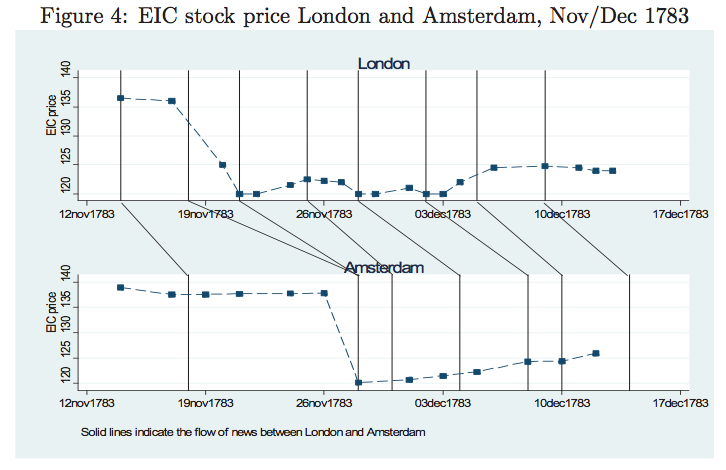
On the 19th of November, shares of the British East India Company (EIC) began to drop in response to a speech given by British Prime Minister Fox who spoke of “the deplorable state” of its fiances. Bad weather delayed the arrival of boats from England to Amsterdam until around the 27th of November. In the intervening period, there was little change in the price of EIC shares on the Amsterdam exchange. But as soon as the boats arrive, the stock price dropped to the level seen on the London exchange a week earlier.
Here is a paper by Hugo Mialon which examines titles of economics papers and how they correlate with publication success and citations.
This paper examines the impact of titles and other characteristics of published economics articles on the ultimate success of these articles, as measured by their cumulative citations over the six year period following their publication. Interestingly, poetic titles are pivotal to the productivity of published empirical papers, but detri- mental to that of theoretical papers. Another finding of general interest is that the reputation of authors and their institutions counts much more toward the success of empirical papers than toward that of theoretical papers.
Also, here is Hugo’s paper on Torture, whose title wisely eschews poetry.
It appears to be intended for using illustrative experiments in an undergraduate-level course in game theory.
This site is based on the perception of game theory as the study of a set ofconsiderations used by individuals in strategic situations. Models are not seen as depictions of how individuals actually play game-like situations and are not meant to be used as the basis for a recommendation on how to play real “games”. My goal as a teacher is to deliver a loud and clear message that game theoretic models are not meant to supply predictions of strategic behavior in real life.
Chinese motorists stuck in traffic can now hire someone to sit in jams for them, with entrepreneurs finding a business opportunity in the growing gridlock across the car-crazy country.
As wider car ownership leaves roads more congested in the country of 1.3 billion, motorists can now escape by calling a substitute driver to take their cars to their destinations, China Daily reported Saturday.
As drivers are whisked away on the back of motorcycles, a car service employee sits in traffic for them, the state-run newspaper said.
The service is for “those with urgent dates or business meetings to go to, and those who have flights to catch and can’t afford to wait in a traffic jam for too long,” Huang Xizhong, whose company offers the service in the central city of Wuhan, was quoted as saying.
Before there was PPACA (“ObamaCare”) there was already government-provided health insurance. It’s called bankruptcy. Neale Mahoney studies the extent to which it crowds out demand for conventional health insurance.
Hospitals are required to provide emergency care and typically provide other health-care services without upfront payment. Patients who experience large unexpected health care costs have the option of avoiding some of these costs by declaring bankruptcy. Thus bankruptcy is essentially a form of high-deductible insurance where the deductible is the value of assets seizable by creditors. For many of the poorest households, “bankruptcy insurance” is an attractive substitute for health insurance.
Because states differ in the level of exempted assets, the effective deductible of bankruptcy insurance varies across states. This variation enables Mahoney to measure the extent to which changes in bankruptcy asset exemption affect households’ incentives to purchase conventional health insurance. Ideally you would like to compare two identical households, one in Deleware (friendly to creditors) and one in Rhode Island (friendly to debtors) and see how the difference in seizable assets affects their health insurance coverage. Things are never so simple so he uses some statistical finesses to deal with a variety of confounds.
The results allow him to address a number of natural questions. If every state were to adopt Delaware’s (restrictive) bankruptcy regulations, 16.3% of uninsured households would purchase insurance. For a program involving government subsidies to achieve the same increase, 44% of health insurance premiums would have to be subsidized.
From a welfare point of view, bankruptcy insurance is inefficient because the uninsured do not internalize some of the costs they impose from using bankruptcy insurance. On the other hand, because they are uninsured their providers directly bear more of the costs of care, mitigating the moral hazard inefficiency of standard insurance. With this tradeoff in mind we can ask what penalty should be imposed on those who choose not acquire private health insurance. Mahoney finds that the PPACA penalty is two large by almost a factor of two.
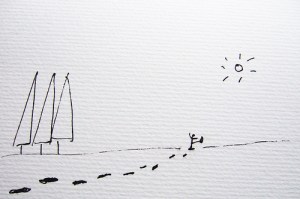
Do you know the name of the first bank in the United States? The First Bank of The United States of course. How about the second bank? The Second Bank of the United States. And after that it seems like every time a bank opens in a new place for the first time that bank calls itself First Bank of The New Place. (Try your favorite place. Here’s mine.)
Why? Because only the first can be The First. If people trust banks more the longer they have been around, then in equilibrium the first bank will call itself the First Bank and everyone will know who was first.
Titles of papers have something in common with names of banks. A paper titled Law and Finance is guaranteed to be the seminal paper in the field because if it were not then that title would have already been taken. You can go ahead and cite it without actually reading it. By contrast, you can safely ignore a paper with a title like Valuation and Dynamic Replication of Contingent Claims in a General Market Enviornmnet Based on the Beliefs-Preferences Guage Symmetry even if you don’t know what any of those words mean. The title is essentially telling you “Don’t read me. Instead go and read a paper whose title is simply Valuation of Contingent Claims. If you have any questions after reading that, you might look into dynamic replication and then beliefs, preferences, and if after all that you still haven’t found what you’re looking for, check here for the lowdown on guage symmetry.”
Two pieces of advice follow from these observations. First, find the simplest title not yet taken for your papers. One word titles are the best. Second, before you get started on a paper, think about the title. If you can’t come up with a short title for it then its probably not worth writing.
The absolute worst thing you can do with your title is to insert a colon into it. (quiet down beavis!) As in, Torture: A Model of Dynamic Commitment Problems. Or Kludged: Asymptotically Inefficient Evolution. In the first case you have just ruined a seminal-signaling one-word title by adding spurious specificity. In the second, you just took an intriguing one-world title and turned it into a yawner.
The second worst kind of title is the question mark title. “Is the Folk Theorem Robust?” This says to the reader: “You picked this up because you want to know if the folk theorem is robust. Well, if I knew the answer to that I would have told you right away in the title. But look, all I could do is repeat the question, so you can safely assume that you won’t find the answer in this paper.”
(Drawing: Back in the Snow from www.f1me.net)
- I am sure the interviews are probing.
- “the Fett-ster would look down the swoop of my abdomen & see all the way to Florida.”
- “I coped with youth hostels, handwashing underwear and persuading my bowels to open in strange lavatories.”
- Remarkably frank testimonial of a Chinese Mother.
- Soon seminars will be like this.
- Vintage Vonnegut.
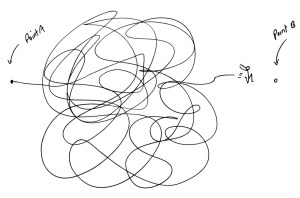
I was sitting in a seminar and the guy was talking about unraveling in the labor market. Someone asked a question whether it could happen in reverse. The speaker said “Do you mean raveling up? Yes it is possible that there is raveling up.”
And I thought “Wait a minute, you don’t need the ‘up’ in ‘raveling up’ because surely the opposite of unraveling is just ‘raveling.’ ” But then I realized that I have never heard that word used. Unraveling, all the time. Raveling, never. So I went for the dictionary. Three dictionaries in a row gave me a definition of raveling something like this.
Ravel. verb. To disentangle. Unravel.
What? To ravel means to unravel?? But then what does unravel mean?
Unravel. verb. To untangle.
So two very strange things now. First, unravel has an independent definition (in terms of other words) but ravel, the un-prefixed word, is defined in terms of the prefixed unravel. Second, ravel is defined to mean unravel!
My colleague Rakesh Vohra thought the good old Oxford English Dictionary would save us from being swallowed up into the lexicographic Weezer-vortex, but alas (login with username trynewoed, password trynewoed. works until Feb 5), not even the Queen can help:
1. To entangle or disentangle
(!) The word means A and also the opposite of A. Doesn’t it now follow that disentangle means the same as entangle? And isn’t there a theorem that once you allow a contradiction into a formal system you can make anything into a contradiction. So if we flip through enough pages of the OED eventually we can prove that True means False?
2. To become unwound, to fray; to unravel.
3. To disentangle, make plain or clear.
Yeah right.
(drawing: Road of Life from www.f1me.net)
Did you know that in the states of Oregon and Louisiana a defendant is convicted if 10 out of 12 jurors vote guilty? In Federal trials and in all other states unanimity is required. A recent case was appealed to the Supreme Court challenging Oregon’s non-unanimous juries on 14th Ammendment grounds. On Monday the Court declined to hear the case. (Here is Eugene Volokh, who brought the petition.)
This opinion piece in the Washington Examiner argues that the unanimity requirement is essential for preserving “liberties.” I assume that what the author means is protection against convicting the innocent. Because on its face it would seem that such a mistake is less likely when unanimous agreement of all 12 jurors is required.
Of course we should care not just about the error of convicting the innocent, but also acquitting the guilty. But even if your concept of liberty puts maximum weight on the protection of the innocent, it is naive to suppose that this is achieved by unanimous juries.
Suppose you are on a jury in Oregon and the foreman has joined with 8 others who have decided to convict. Looking for the 10th vote, he turns to you. Compare your incentives to convict in this situation to the analogous situation where, in Illinois, 11 others are looking your way. With only 9 others prepared to convict there is not only less peer pressure on you, but other things equal the evidence is less persuasive. It has only convinced 9 others.
All jurors see the same evidence but each views it from his or her own perspective. When a jury votes the jurors are signaling to one another how they interpret the evidence. The more other jurors voting to convict, the stronger is your inference that the evidence shows the defendant is guilty. When you are the pivotal 10th juror you know only that 9 others have concluded that the defendant is guilty.
The lower threshold for conviction in fact makes you less likely to vote to convict.
This strategic effect of course has to be weighed against the mechanical effect of lowering the threshold and the net effect could go either way. However, there is one unambiguous sense in which unanimous jury standards are in fact the worst possible.
In a famous paper, Feddersen and Pesendorfer showed that jury voting is informationally efficient in the following sense: given enough jurors with enough independent information the strategic effect outlined above is dampened. And the defendant is convicted if and only if he is guilty.
Now in a sense this is purely of theoretical interest. Juries of 12 are not “arbitrarily large” and even if they perfectly pool their information they will make mistakes. But the point of this result is that it says that jury voting in principle works. Feddersen and Pesendorfer showed that this is true regardless of the threshold fraction of votes required for conviction, but with one single exception. Under unanimity rule the strategic effect is not dampened. Indeed with more and more jurors, knowing that you are the last holdout is stronger and stronger evidence that you should convict. Thus there is always a probability of convicting the innocent even with very large juries.
From Presh Talwalker:
In poker tournaments, everyone gets a fair shot at holding the dealer position as seats are assigned randomly.
In home games, an attempt is also made to assign the dealer spot randomly. There are many methods to choosing the dealer. One of the common methods is dealing to the first ace. It works like this: the host deals a card to each player, face up, and continues to deal until someone receives an ace. This player gets to start the game as dealer.
The question is: does dealing to the first ace give everyone an equal chance to be dealer? Is this a fair system?
Answer: it’s not. Presh goes through the full analysis, but here’s a simple way to see why. Suppose you have 5 players at the table and you are dealing from a deck of 5 cards with 2 aces in it. Every time you deal there will be two people with aces. But the person who gets to be dealer is the one who is closest to the host’s left. If the deal went in the other direction, someone closer to the host’s right would be dealer.
It can’t be fixed by tossing a coin to decide which direction to deal because that would disadvantage players sitting directly across from the dealer. You need to randomly choose the first person to deal to. But if you have a trustworthy device for doing that, you don’t need to bother with the aces.
(Regular readers of this blog will know that I consider that a good thing.)
It is rare that I even understand a seminar in econometric theory let alone come away being able to explain it in words but this one was exceptionally clear.
A perennial applied topic is to try to measure the returns to education. If someone attends an extra year of school how does that affect, say, their lifetime earnings? Absent a controlled experiment, the question is plagued with identification problems. You can’t just measure the earnings of someone with N years of education and compare that with the earnings of someone with N-1 years because those people will be different along other, unobservable, dimensions. For example, if intrinsically smarter students go to school longer and earn more, then that difference will be at least partially attributable to intrinsic smartness, independent of the extra year of school.
Even a controlled experiment has confounding factors. Say you divide the population randomly into two groups and lower the cost of schooling for one group. Then you see the difference in education levels and lifetime earnings among these groups. These data are hard to interpret because different people in the treated group will respond differently to the cost reduction, probably again depending on their unobserved characteristics. Those who chose to get an extra year of education are not a random sample from the treated group.
Torgovitzky shows that under a natural assumption you can nevertheless identify the returns to additional schooling for students of all possible innate ability levels, even if those are unobservable. The assumption is that the ranking of students by educational attainment is unaffected by the treatment. That is, if students of ability level A get more education than students of ability level B when education is costly, they would also get more education than B when education is less costly. (Of course their absolute level of education will be affected.)
The logic is surprisingly simple. Under this assumption, when you look at students in the Qth percentile of education attainment in the treated and control groups, you know they have the same distribution of unobserved ability. So whatever their difference in earnings is fully explained by their difference in education attainment. (Remember that the Qth percentile measures the relative position in the distributions. The Qth percentile of the treated groups education distribution is a higher raw number of years of schooling.)
Not only that, but after some magic (see figure 1 in the paper), the entire function mapping (quantiles of) ability level and education to earnings can be identified from data.

Thanks to everyone who suggested restaurants. I went to three:
- Rootdown Denver. The clear favorite. Loud, trendy, waitstaff heavily tattooed. Small plates for under $10 each. I had beet gnocchi, carrot and thai red curry soup, some other stuff. All great. I was lucky to find a seat at the bar otherwise I would have waited a long time. So definitely you need reservations. The best part of my dinner was that I finally found a bar that serves a mythical cocktail: The Aviation. I have been looking for this for a decade. It was fantastic. Thanks for the pointer Dan!
- Osteria Marco. Fine but typical Italian. I had pizza. I’ve had worse. They served by the glass a blend of Dolcetto, Barbera, and Nebbiolo from Langhe. That was something new for me, and I liked it.
- Tastes Wine Bar. A little depressing because I was the only person there. But the food was somewhat adventurous and good. The wine was fine, but not the kind of varied selection I would have expected from a place that calls itself a wine bar. The menu listed a sauvignon blanc from the Loire and when I ordered it to start with, I was told that they were out and tonight they were substituting a Sauv Blanc from Colorado!! I did taste it. Once.
Its a shame I didnt make it to the Fluid coffee bar that Jacob Grier suggested. I was going to stop there on Sunday before going to the airport but Denver got hit with a snow storm and so I got on standby and headed to the airport early to make sure I got out of there before the flights were cancelled.


I am making a prediction. For reasons discussed in this previous post, its important that I announce the prediction but keep it a secret until the uncertainty is resolved. Following the suggestion of a commenter, I wrote my prediction in a text file and ran it through the SHA1 secure hash algorithm (using the web tool here.) Here is the hash:
a35fc654c7a68404bcb94b3b6a1d162223ff69e5
Briefly, this is a digital signature that is (for practical purposes) uniquely associated with the text. But the algorithm is “one-way:” unless you have a powerful computer you will not be able to invert the mapping and discover my prediction from the hash.
When the uncertainty is resolved (it will happen in the not-too-distant future) I will post the prediction here. You can then take it and generate the SHA1 hash and verify that it is the one above. That will prove that the prediction I show you is in fact the one that I have made today.
While we are waiting to find out, you can try to predict what my prediction is. (No, my prediction is not about what you will predict I predicted.)
Update on Jan 10 (one day later:) Having forgotten one important detail, I have updated the prediction and the new hash is:
f502acfb48395d6ab223ca30803f98b9bd6fd6ce
When I reveal the prediction, sometime before the Summer Solstice, I will reveal both text files and you will see the (innocuous) reason for the update.
As suggested in the comments, since I am able to modify the text of this blogpost, I should post the hash somewhere that it cannot be modified. Since Twitter puts a timestamp on every tweet and tweets cannot be edited ex post, I tweeted the two hashes. Here and here.
Illinois governor Pat Quinn is considering whether to sign into law a tax bill that includes a new tax on online retailers, the so-called Amazon Tax. Until now, online transactions are not taxed in states where the retailer has no physical presence (with a few exceptions.) The new measure would end this in Illinois, treating Amazon as an Illinois retailer so long as one of its online affiliates is based in the state. (Every state has thousands of online affiliates.)
Amazon is responding by playing chicken. From Presh Talwalker:
So Amazon is fighting back at Illinois with a threat. Amazon has emailed its commissioned affiliates the following message:
We regret to inform you that the Illinois state legislature has passed anunconstitutional tax collection scheme that, if signed by Governor Quinn, would leave Amazon.com little choice but to end its relationships with Illinois-based Associates. [emphasis mine]
The following logic seems to explain the motive. If Amazon ends its affiliate relationships in Illinois, then it would have no physical presence in the state, and hence it would get around the bill.
The email levies harsh criticism at Illinois and is meant to garner sympathy. In reality, the move is calculated and strategic.
Amazon is threatening all affiliates on purpose – even though it doesn’t have to. Here is an interesting tidbit the Chicago Tribune reported:
The bill applies only to affiliates that have at least $10,000 a year in revenue. But if large retailers, such as Amazon, cut off all affiliates in Illinois, it would end commission streams to small Web sites, such as bloggers, who might sell Amazon goods at their sites. Amazon could not be reached for comment.
Amazon is playing a classic retaliatory strategy. If Illinois wants to pass this law, then it will do everything to hurt the state and even otherwise innocent and small-time bloggers, who might decide its time to complain to Gov. Pat Quinn.
There’s more in Presh’s article here. (Amazon seems to understand reputation building because it carried through with its threat in Colorado when that state passed a similar measure.)
My view is that the threat is credible even ignoring reputation-building. The lost revenue from sales tax would dwarf the losses from cutting off affiliates.
25 of them. Ranging from “Creepy Animal Experiments” to “It Could Destroy The World” (i.e. LHC). The usual suspects are there, but this one is new to me (from “Mind Control”)
MK-ULTRA
MK-ULTRA was a code name for a series of CIA mind-control research experiments, heavily steeped in chemical interrogations and LSD dosing. In operation Midnight Climax, they hired prostitutes to dose clients with LSD to see its effects on unwilling participants.
Here’s wikipedia on MKULTRA, and on Operation Midnight Climax.
(Barretina bluster: Arthur Robson who quips “Economics has the power to bore rather than to scare, at least.”)
 Cheap Talk